Loading summary
Transcript28 lines
- [00:01]
A
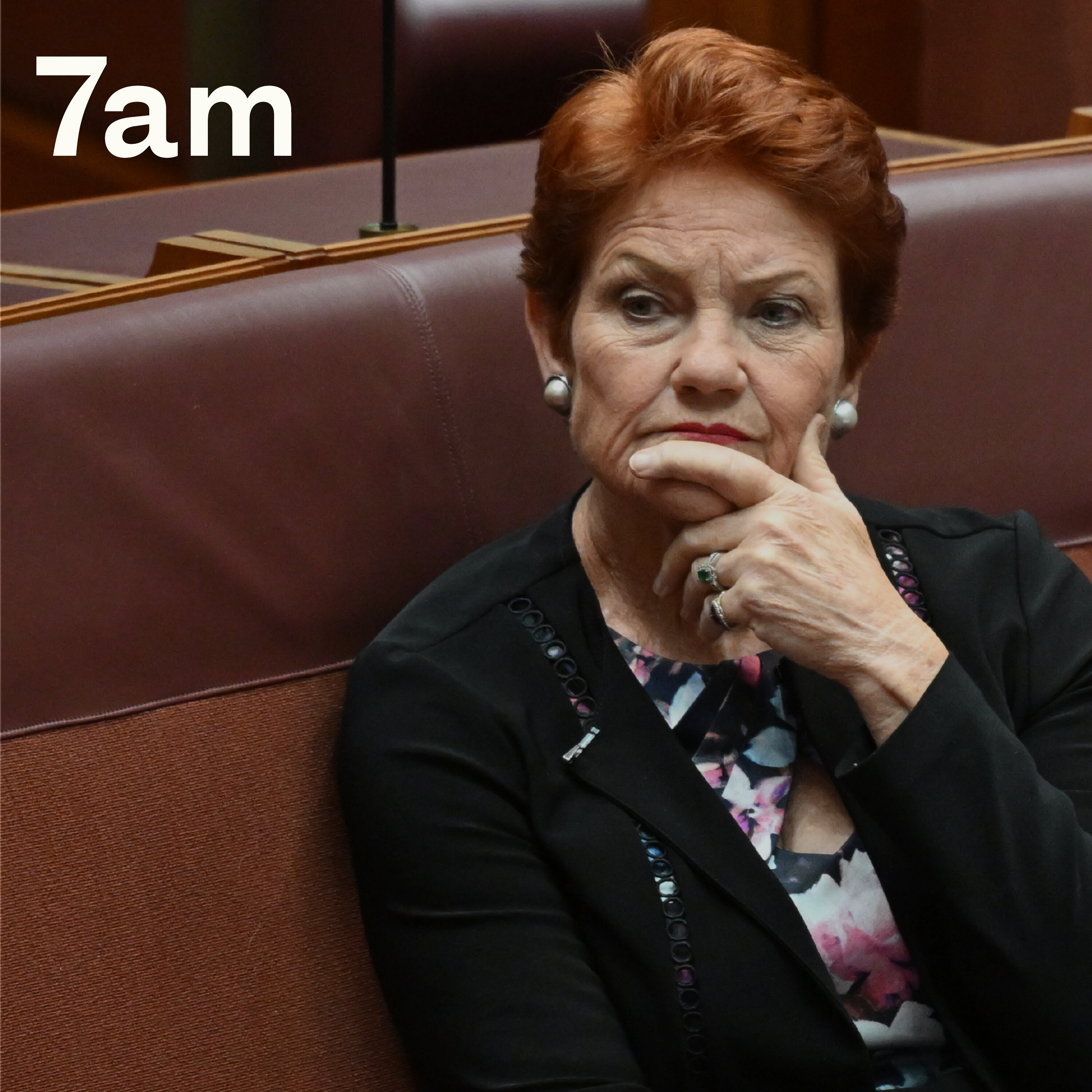
I'm Ruby Jones and you're listening to 7am. For decades, Pauline Hanson has been on the fringe of politics. Sometimes mocked, often ignored, occasionally courted. Even from that position, she's been influential. Her presence can be felt in our immigration policies dating back to Howard. But her power and her popularity have never been greater than they are today. A recent poll had one nation as the most popular party in the country, surpassing labor in primary support. So just how possible is an Australia governed by one nation today? Host of the the Making of One Nation podcast, Ashlyn McGee on the party's popularity and what it will try to do with it. It's Wednesday, June. Ashlyn, you've been a journalist for a long time, including time in the press gallery in Canberra, which means that you've watched Pauline Hanson's career as she's been in and out of Parliament, national television jail. But right now, she is the most popular she's ever been. So what's your sense of why that is?
- [01:22]
B
It's so interesting, I have to say. Ruby and I never thought that we would be in this position and we would be having this conversation. So if we look at the position we're in right now, 31% of Australians, so that's like one in three Australians reckon they would vote for one nation. If an election was held today, only 28% would vote for labor, the government, and 20% would vote for the coalition. That is absolutely mind blowing. So if we think about how we've ended up in this position, I think there's a couple of things that have led us here. So the first thing, and I think this one really can't be dismissed, is that the coalition is in complete disarray. Now, the second part of it is you've got house prices through the roof, like absolutely through the roof, inflation through the roof. You've got interest rates that keep rising, you've got wages that aren't keeping pace. And people are looking for someone to blame for that. They're looking for a boogeyman. And in doing so, they find an outsider, they find the foreigner, and they say, well, you're the one to blame. And one nation is sitting there encouraging that. And then I think the third factor in all of this is how people find one nation, right? Like, one nation is in the media constantly. We're talking about it, everyone's talking about one nation, but they're also online constantly. The algorithms favor polarization. They favor what one nation's sprouting. So you can't go online without seeing one nation. So I think if you look at the coalitions in disarray, the world we live in is in a fair amount of chaos. And then you've got a party that's been waiting in the wings for essentially 30 years now practising how to do this far right populist politics. And it's no wonder people are turning to One Nation.
- [03:11]
A
And so, as you mentioned, One Nation is in the media constantly. And there's no doubt that Pauline Hanson has benefited from spots on Dancing with the Stars and morning tv.
- [03:22]
B
Well, she is famous for her fish and chips, but did you know that Pauline Hanson has a bit of a sweet tooth? And she's showing us how to make
- [03:28]
A
a strawberry pump today.
- [03:30]
C
Just very quick. You've got the kids home from school holidays now, so it's very quick.
- [03:34]
A
But she also avoids scrutiny. She recently banned the ABC from One Nation events. So in terms of her staying power in the mainstream, how much of that do you think has been helped by media coverage of her stunts and the kind of spectacle that has surrounded her?
- [03:52]
B
You know, this was one of the biggest reflections for me doing this podcast, right, Because I was based in the press gallery in Canberra for a while, and I have to admit that when I was there, you'd kind of see this stuff happen with One Nation, you know, the media, actually. And I say this, you know, I'm to blame. We're to blame for really what's happening now with One Nation. I think we've given the party disproportionate coverage of their stunts, of their antics, of their outrageous statements. You do a story on Pauline Hanson doing something outrageous and it sells a paper, it gets a click. So you see news outlets covering what she does. But I think increasingly what we're seeing is actually the power has shifted. And I don't know that One Nation needs the traditional media as much, but when I say they don't need us, it's because they're so good at talking to voters directly. So they've got this Please Explain series, which you've got hundreds of thousands of views on those episodes.
- [04:54]
D
Wouldn't you consult with first nations peoples before putting this park bench here? Oh, I didn't think that. Tear it down and apologize. Oh, okay. I'm sorry, I'm sorry. Yeah, that's right. Ah, there's so much racism around here.
- [05:06]
B
And essentially what that show is doing is taking One Nation's worldview to an entirely new group of people. And it's washing over the misogyny, the racism, you know, the really objectionable Politics of that with humour and going, well, if you don't laugh, you're just a bit too woke.
- [05:25]
D
That's right. Take a good look at this. Get him out of here. Nuh, you can't call me a he. I'm a woman. That's hate speech. That's the law. Yeah, read it, Penny. Not only can I force my way into women only gyms and brunches and bathrooms, but you also have to be nice to me.
- [05:42]
B
But the party itself has actually been hugely innovative in how it uses technology. So for example, they were one of the first, or in fact the first in Australia to have a website. It's pretty funny when you look at it, actually. It's like a blast from the past. They were one of the first on Facebook, they were one of the first on Instagram, they've got some of the biggest followings on YouTube and TikTok. They know how to talk to people directly and they don't need us anymore.
- [06:09]
A
And to what extent do you think that her popularity intersects with her gender? Because I think there is this case that can be made that other far right leaders, people like Giorgia Meloni in Italy, have been able to make their politics more palatable because of how they're seen as a woman and all of the stereotypes around that. So do you think that that's a factor here, that Pauline Hanson's politics are softened for the public by her gender?
- [06:34]
B
It's a really interesting question how her gender influences her politics. I think it's actually helped and hindered her as well. I think in the first way, if we think about it, she was underestimated in those early days and dismissed and ridiculed and not taken very seriously. I don't think we would have treated a male politician like that, quite frankly. I think she would have been taken far more seriously and perhaps as a more genuine threat, given the kind of rhetoric she was, she was using. But because she was ridiculed and dismissed and belittled, people flocked to her as sort of the anti hero. So that was actually the start of her popularity. The more she was ridiculed, the more people moved towards her. And I think that her gender was a big part of that. Now the second part of it is that she hasn't had to climb a traditional male hierarchy within a party. So if you think about the woeful lack of female leaders in Australian politics, it's because a lot of the establishment parties are full of blokes and women can't get to the top. Now, Pauline Hanson co founded her party, she just didn't have to navigate that. That mess, Right? And if you look at overseas examples like Georgia Maloney, she founded her party and even Marine Le Pen, like her father, founded the party so that these far right women haven't had to navigate those structures that lock women out of politics. But you think about how much women can get done and they are organised, they're fierce, they are hands on, they're out there talking to people, they're recruiting people, they're standing for elections, they're running branches, they are so involved and they're bringing other women to the party. So I think Pauline Hanson, her gender means she attracts other women to the party to do similar to what she's doing. And, you know, I think you can't understate that it is a big part of who she is. And you could also probably say, I mean, she probably runs screaming, but I think she's a bit of a feminist.
- [08:38]
A
Coming up, what would it take for Pauline Hanson to actually become prime minister? Hanson's politics, the anti immigration, the anti Muslim rhetoric. She's been consistently saying these things for decades now, long before Trump, I believe
- [08:58]
C
we are in danger of being swamped by Asians between 1984 and 95.
- [09:05]
A
So to what extent do you think Australia is kind of seen as a ground zero for this kind of politics? Because we often hear about how here in Australia we might be following the far right movement overseas. But do you think that they're watching us taking cues from politicians like Pauline Hanson?
- [09:24]
B
I think Australia and One Nation has absolutely been a trailblazer on the far right. And I think some of the academics I spoke to for the podcast were pretty insistent that Australia had been, in a way, a model for some of the far right parties overseas. If you look at the issues that propels One Nation and Pauline Hanson into parliament in 1996, they were very Australian issues and they weren't the kind of issues that were being talked about anywhere else in the world. It wasn't until the 2000s, really, that we saw populist radical right parties really kicking off around the world. You know, Silvio Berlusconi in Italy, Jean Marie Le Pen in France. You know, that was the 2000s. So Pauline Hanson and One Nation were here and doing it first. And really they set up that whole idea of that underpins a far right party, that you need an enemy, that there's an us and a them. And it's really interesting to see how that has developed, filtered through into international politics and then also Filtered back into Australian politics.
- [10:30]
C
They hate Westerners. And that's what it's all about. You know, you say, oh, well, there's good Muslims out there. Well, I'm sorry, how can you, you know, tell me there are good Muslims?
- [10:40]
A
If Gia had so to come back to the polls, Pauline Hanson currently is the most popular politician in the country. One Nation, the most popular party. She says that she has the ability to become Prime Minister.
- [10:54]
C
Do I want to be Prime Minister? Well, I tell you what, I won't knock the job, Andrew, because I believe that I have the ability to do it. I'm not going to underestimate myself or say, no, I can't do it.
- [11:07]
A
So talk me through that. What would actually have to happen for that to be a reality?
- [11:12]
B
I mean, it's a long way to the lodge, Ruby. It would be pretty exceptional. So if we talk about Pauline Hanson as Prime Minister for a moment, I mean, we don't directly elect the Prime Minister in Australia, so she would have to be the leader of a party that wins the majority of seats or forms a coalition in the lower house. So let's just talk about where we are now and then where we need to get to. So in terms of where we are now, one nation has two seats in the House of Representatives, and they've got six seats all up. They're leaders in the Senate. So two seats in the House of Reps, four seats in the Senate. You've got a House of representatives that has 150 seats. So to get from two seats in the House of Reps to 76 is a massive jump. So they either need 76 seats in the House of Reps or they're going to need to cobble together some kind of coalition. And when you think about who they might form a coalition with, I mean, it's certainly not going to be the Greens, is it? So, you know, Qatar's Australia Party, the Nationals, the Libs, maybe. So to get 76 seats or even, you know, a decent WAC and form a coalition, I think it's going to be a really tough ask.
- [12:25]
A
And the next election's not till 2028, so at least 18 months away from this being really tested. What do you think the biggest risk for One Nation is as it grows? Because we've got more money coming in from people like Gina Rinehart, more candidates being scouted, some of whom, you know, have seem to have questionable backgrounds. So what is your sense of whether One Nation, as it kind of tries to make this tilt, will hold together as a Coherent political force.
- [12:55]
B
Yeah. So this is something I've been thinking about a lot. Like what happens over the next, you know, 18 months, two years. The one nation that we see today is way more professional, way more organised than it ever has been. And a large part of that is due to James Ashby, who is Pauline Hanson's chief of staff, her right hand man. He's smart, strategic, stays out of the way. He is a big part of why that party holds together. But one nation traditionally is chaos. Like absolute chaos. They're being wracked over the years by defections, by scandals, by punch ups, like physical punch ups. Blood being smeared on the door of someone's office like crazy, crazy stuff. Right? So that's the first risk is that more chaos, more defections. They get people in, but they leave the party. People don't vote with them, all the rest of it. The second is that the bigger you become as a party, the more establishment you become, the less you're an outsider. And that's really what one nation sells itself on. We're the outsider, we're the anti establishment, anti elite. But if you're taking money from Gina Rinehart and those huge mining entities associated with her, how can you be anti elite? How can you be anti establishment? And at some point, the party's going to have to reckon with that and their voters are going to go, hang on a sec, like, is this our interests or their interests that you're representing? And then the third threat is actually one that I think is most interesting to me. And it's not a threat that exists now, but it is a threat that could exist. And that is one nation has been really good at rallying the troops and bringing people with them because they create this sense of what it is to be Australian. You're one of us. It's them over there that's our enemy. Come with us. But what if a party on the left or a leader on the left did that? What if a leader on the left really spoke about what it means to be Australian and bring people with them on that something that people were proud of, that they wanted to belong to, that they felt a part of, that really got some momentum and moved people along? I think that people just want to belong. And that is actually perhaps the biggest risk, is that the left gets organized, they get very strategic and they create something that is more positive, that people want to be part of. And we'll see people moving away from one nation.
- [15:25]
A
Well, Ashlyn, thank you so much for your time.
- [15:28]
B
My pleasure.
- [15:37]
A
Also in the news Australia's minimum wage will rise by 6% and workers on the minimum award will score a 4.75% pay rise from July 1. The decision handed down by the Fair Work Commission will see minimum wage jump from 24.95 to 26.44 an hour. Around 3 million Australians will benefit from the two pay increases. And Labor MP Ed Husick has called on his government to rethink the Aukus pact, saying Australia won't get the deal we were promised by the us. It comes after news that former environment minister and midnight oil frontman Peter Garrett will lead an independent inquiry into the Aukus deal. A group of labor veterans and public figures launched the inquiry over concerns proper scrutiny has never been applied to the $368 billion pact with the UK and US I'm Ruby Jones, this is 7am thanks for listening.