Loading summary
Transcript22 lines
- [00:01]
A
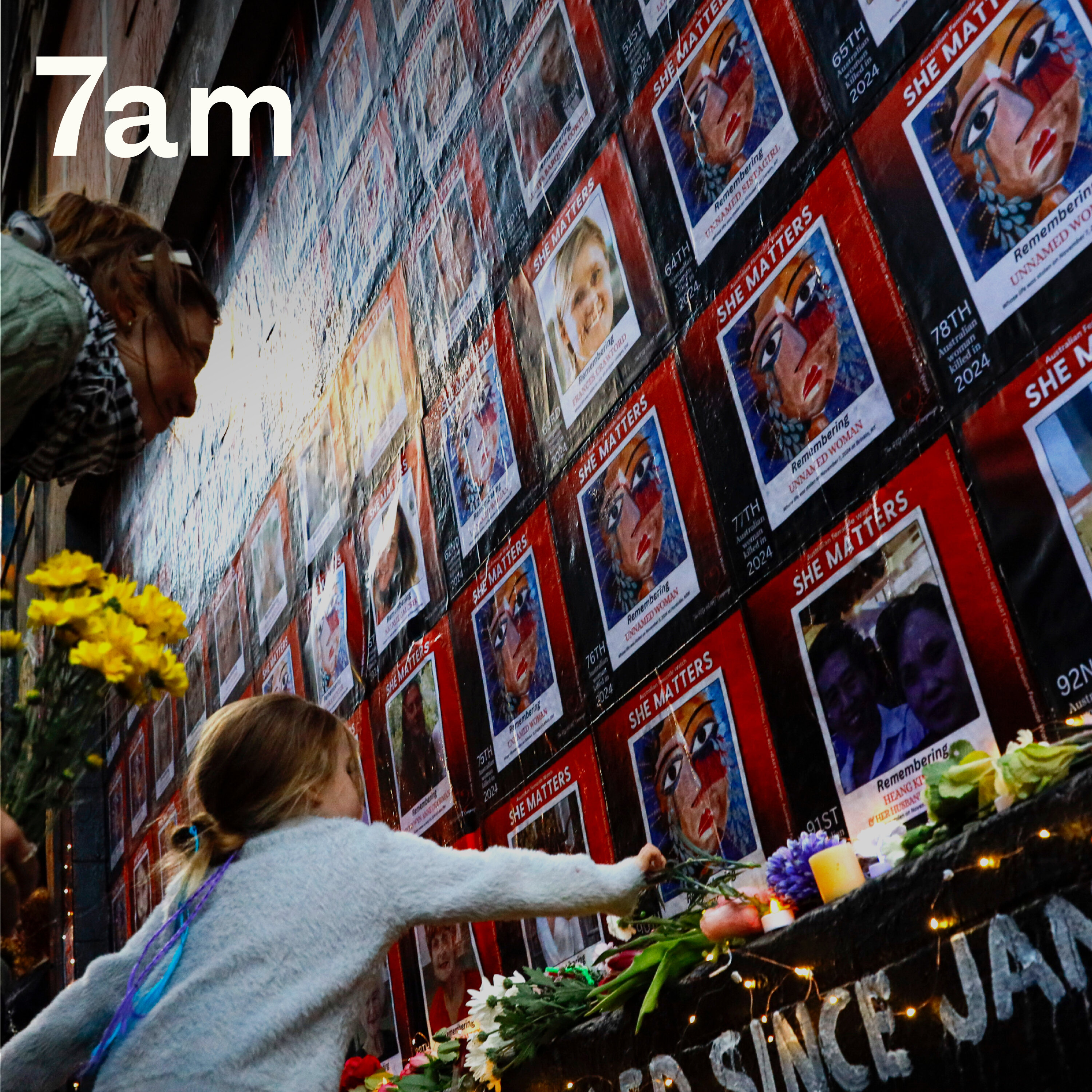
Who says renting can't feel like home? Make your rental feel like yours. It all starts with one scroll. Download TikTok to discover easy home decor ideas. I'm Ruby Jones and you're listening to 7am. 29 women have been killed in Australia so far this year, most allegedly by their intimate partner. Their names sometimes hit the headlines, but often not. And even then, the outrage seldom lasts. We've known for a long time that Australia has a problem with violence against women. Little seems to work to change the statistics. For some advocates, a royal commission is the only chance at making a difference. A petition calling for that now sits at more than 110,000 signatures. Today, writer and advocate Jess Hill on whether it will ever happen and what it could achieve if it did. Foreign. June 4th. So, Jess, a royal commission into femicide. To begin with, tell me what you think that could achieve. What is the most hopeful scenario if something like this were to happen?
- [01:27]
B
So royal commissions are called when you have sustained institutional failure to respond to a really serious social crisis. And that petition is really highlighting things around police and the courts particularly. Obviously, that would just be the tip of the iceberg. It would summon decision makers and officials to give evidence. It would galvanise public attention, it would create a momentum that can be hard to sustain in this area. Often the only time we have kind of a bubble of media interest in domestic and family violence is when there's either like a trial happening with a sort of big media personality, or there's a cluster of homicides, or there's just some sort of strange angle that's come out of nowhere, like a petition for a royal commission. And particularly if the Prime Minister makes a glib response to it, I know that there is a call for a royal commission into the deaths of women. There's 90,000 signatures so far. What does your government feel about that? Will we see this?
- [02:33]
C
Look, there's calls for royal commission about everything.
- [02:35]
B
Well, I think the rights of women
- [02:37]
A
are pretty paramount, wouldn't it be?
- [02:38]
C
Yeah, there are, but you've got to work out, what does a royal commission do besides fund lawyers? What we need here.
- [02:44]
A
And I think that response for a lot of people led to anger and probably more drive to advocate for a royal commission. So a commission, it would aim to force some sort of institutional response to violence against women. Tell me which institutions you think are failing women the most at the moment.
- [03:03]
B
So if we look at particularly this call for a royal commission, which is specifically into femicide, the institution that comes to the top of the list is police. They are totally inconsistent in terms of their response. There is a toxic masculinist culture across the police force, where you see some exceptions in some local area commands and amongst some police, but that is the overarching culture. You have really persistent levels of racism and low levels of understanding of the crime that they are spending the vast majority of their time policing. Police spend, on average about 40 to 60% of their time. In some areas, that percentage is much higher. We have a domestic violence call out every minute in Australia that's gone up from every two minutes 10 years ago. So one example that really comes to mind out of the research that I'm currently doing on the family law system, which of course crosses over with police and child protection, is a woman who went into a police station and she spoke to several officers at the same police station. The first three officers that she spoke to basically just looked at her blankly. The fourth officer, when she told him what had happened, this was. And he was a junior officer, he went white in the face, got her to give a statement and they ended up pressing several charges. If you had, across the health system surgeons that, like, may or may not really know how to do the operation that you're being wheeled into the operating room to have, and you're not quite sure whether you might bleed out on the table or whether you'll come out and you'll be all better. Just a bit of a potluck when you go into that operating room. How would society run? So police are a big one. The family law system, despite a lot of efforts to improve it over the last few years, is still horrendously failing. Victim survivors and their children. We have children being ordered into the custody and care of parents who they've openly disclosed have harmed them. And, I mean, you could talk for an hour about the number of systems that are failing. One, I would like to point out that perhaps people don't think about so much is the health system, because there are professionals to whom victim, survivors and perpetrators are most likely to disclose. Doctors and counsellors and psychologists. And there is no obligation for anyone across the health system to have any understanding of domestic, family and sexual violence, despite the incredible prevalence of it and despite the fact that they are often in the position of being a first responder to that. If we were to activate that health system, I think that we would see massive changes. We've already had so many recommendations from coroners, say that if there'd been a better response from that GP at that time, this woman could still Be alive.
- [06:19]
A
So we've got these systems, police, the courts, perhaps the health system as well, where women are being failed when they seek help. You have been working for a long time to try and improve these systems for women. You've contributed to various inquiries, task forces over the years. I wonder what you think the main barrier is to being able to effectively change systems like this.
- [06:46]
B
So we often direct our anger and frustration towards the federal government, not undeservedly, they do hold the purse strings in a number of areas and they, they do set the tone and set the direction to a certain extent in terms of the response. But if we were going to change policing, say for example, if we wanted to bring in, I don't know, like actually independent civilian led accountability mechanisms and oversight, there is nothing the Prime Minister can do to influence that. This is firmly in the jurisdiction of state and territories. And I guess the problem that we have is that there are very few Premiers who have the guts to take on police. Most states and territories tend to have a very cosy relationship between the Premiers, the police ministers and police commissioners. And it's a protection racket. This is like the really hard edge of power that we're coming up against when we're trying to get to the nub of why these murders continue and why women and children continue being terrorized by men, seemingly with impunity. But then we also have the, the other issue which is just getting various ministers from different portfolios to see domestic family and sexual violence as a core priority for them. We would need to see, for example, the Attorney General's department in every state and territory see this as their core business, which it should be because it literally is the number one law and order issue in the country. So this should be a priority. It should be definitely a priority for Attorney Generals, it should be a priority for the Health Minister, it should be a priority for the Education Minister. You know, these are portfolios who see domestic family and sexual violence as something extra that they do on the side. They don't see it as core business. If we could change that, then I think we might make some progress.
- [08:56]
A
Still to come, do Royal Commissions still have the same power that they used to
- [09:02]
B
foreign?
- [09:05]
C
What's up everybody? It's Bretzky and America is turning 250 and I can't think of a better way to celebrate that than playing on an American owned social casino. Spinquest.com with all of your favorite games, live crafts, bubble craps, live blackjack, there's no better place to play for Free and win real cash prizes. Spin Queen Quest.com Spin Quest is a free to play social casino void where prohibited. Visit spinquest.com for more details.
- [09:37]
A
Jess We've been talking about the ways various institutions are failing women and the ongoing violence that's perpetrated against them and how change in those institutions would need to come from leadership in states and territories. A Royal commission, though, that would have to be called by the federal government, which does not want to do that. So why do you think there is this resistance federally to taking that on?
- [10:02]
B
Well, first of all, primarily the domestic violence sector does not support it. And the reason is, if you think about it from the sector's point of view, they are operating sometimes at 200 to 300% capacity at the moment because they are underfunded. Then you ask them to be part of a royal commission which requires them to write submissions, requires them to gather evidence, requires them to make this a priority, this process a priority. This process could go on for years. In fact, a process of this kind. We saw the Royal Commission into violence against people with disability went on for about four years. What would happen at the same time with the federal Royal Commission is heightened awareness. Heightened awareness means more people reaching out for help, means services having to respond to more requests. So for a lot of people in the sector, it just feels like, what are we actually going to get out of this? And that's actually a bit of a lottery. You know, it could be the thing that just tips public awareness of systems failure over to such an extent that the pressure on premiers to act and bring in civilian led accountability for police and bring in, you know, much greater consistency and accountability across their court system to totally revolutionize the way that we do child protection in the country. To link the, you know, issue of child removal and child protection with youth justice. I mean, there's a whole. There's so many potentialities that could be the thing. And I think, you know, we saw that with the Royal Commission into institutional responses to child sexual abuse. Like, did that fix institutional child sexual abuse? No. Did they enact all of the recommendations? No. But there's a before and after Australia when it comes to that Royal Commission. Before that Royal Commission, we had really very little clue as a public about just the sheer level of institutional collusion with child sexual abusers and pedophiles through every institution, from the Scouts to the Catholic Church. That knowledge is now well established. But not only that, we actually see in the child maltreatment study that the prevalence of institutional child sexual abuse dramatically drops within a generation after that Royal Commission. So they can have seismic effects, but it's just very hard to know when you set out.
- [12:38]
A
Yeah, I mean, I think that's a really good question to ask, because that particular Royal Commission into institutional responses to child sexual abuse, I think that's sort of the high watermark in Australia in terms of a Royal Commission that did have real impact. It was more than a decade ago, though. And do you get the sense that Royal Commissions have lost some of their power in that decade?
- [13:01]
B
I would say that the Royal commissions themselves haven't lost power. It's more that the governments that would have made the changes they recommended have lost courage. A Royal Commission is still one of the most powerful mechanisms we have to establish knowledge and seek accountability and also to really give people with lived experience of whatever that Royal commission is investigating the chance to be heard. And that's extremely powerful and it can be healing in itself. So there's a cathartic truth telling that happens with Royal commissions and I'd hate to see a situation where we start seeing this very powerful mechanism as something that is pointless. Yes, we know that governments sometimes use them as delay tactics. Yes, we know that sometimes they unearth all sorts of horrors and all sorts of, you know, possible solutions and then lead to nothing. But there is no other process that can subpoena the level of information that might be required to look across an entire system and see what's going wrong, that can summon people who would otherwise refuse to attend any other type of inquiry that might be held and make them stand there and get examined by lawyers and get asked all of those hard questions that they won't have to answer almost anywhere else. So this is a really important process. But, yes, I think, you know, there's been a lot of disappointment. There's been disappointment after the banking Royal Commission. There's disappointment after the Royal Commission into violence against people with disability. You know, that was $600 million, four years unearthed, total horrors that nobody had any idea about outside of the disability community. And yet the take up of those recommendations across federal government, state and territories was like, minimal, you know, and so I just. Yeah, I don't think it's the Royal Commissions that are the problem. I think it's the government's.
- [15:11]
A
A Royal Commission is only as good as the government that calls it.
- [15:14]
B
Yes, exactly.
- [15:16]
A
Well, Jess, thank you so much for your time.
- [15:18]
B
Yeah, my pleasure. Thanks.
- [15:37]
A
Also in the news, underworld figure Mick Gatto and his wife have been arrested and questioned as part of the ongoing investigation into corruption and organised crime in the construction industry. It's after a report tabled at Queensland's inquiry into the CFMEU detailed what was referred to as the Gatto extortion model, which involved demanding payment from contractors to avoid industrial trouble. Geoffrey Watson, who authored the report, accused Gatto of running a terror campaign worth millions of dollars a year. And Australia's economy has grown by 0.3% in the March quarter, down from 0.9% at the end of last year. The rapid slowdown came after two interest rate hikes from the Reserve bank. But despite the decline, economists won't rule out further interest rate hikes. I'm Ribby Jones, this is 7:00am thanks for listening.