Loading summary
Transcript40 lines
- [00:02]
A
It's almost unimaginable as a number, right, let alone as an amount of money. I mean this is a one with 12 zeros, right? It's 1 million millions.
- [00:12]
B
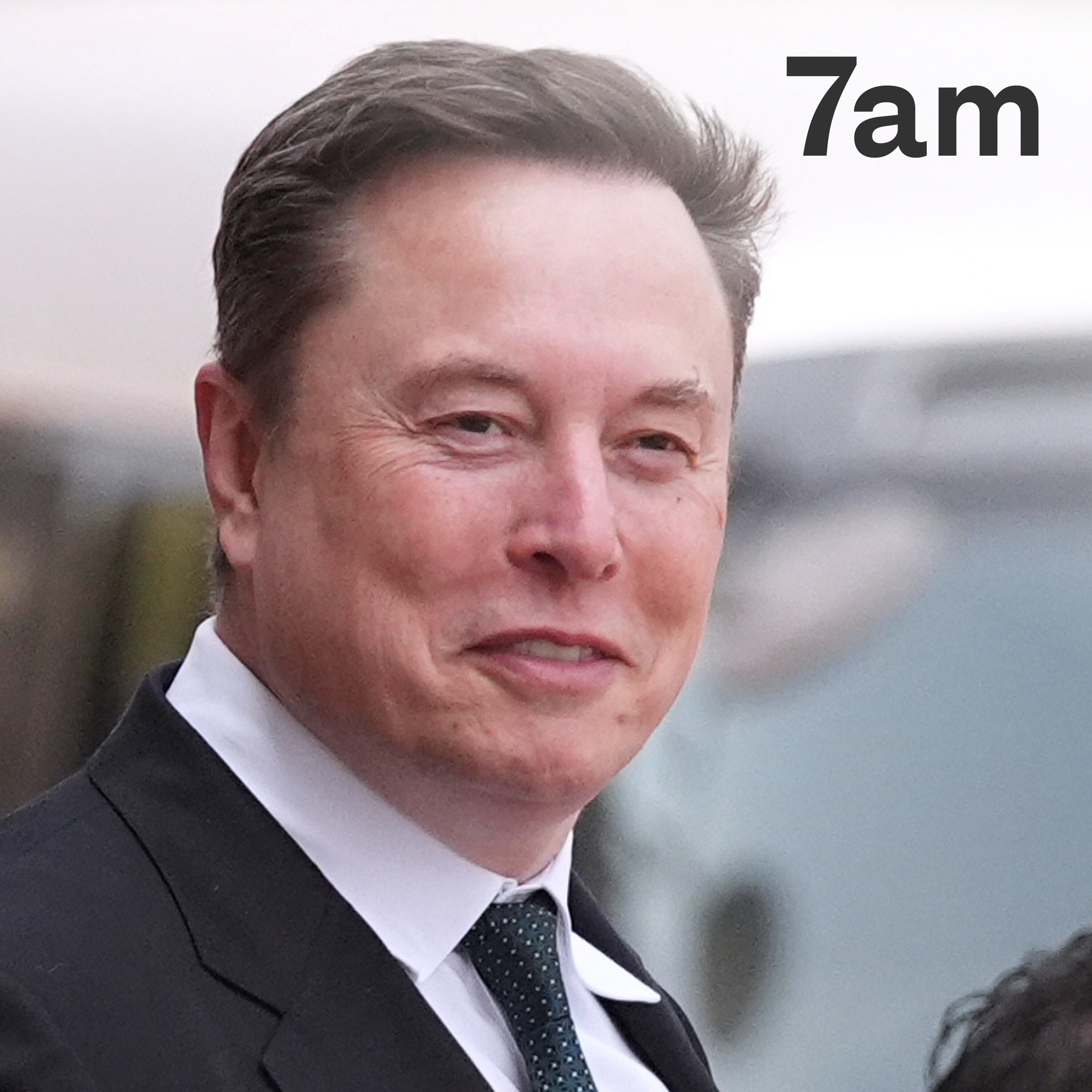
Over the weekend, Elon Musk became the world's first trillionaire. As SpaceX jumps at the open well above $2 trillion in terms of market
- [00:22]
A
capitalization, he's got this 1.1 trillion. A couple of years ago he only had only only had 200 billion. So it's not just that, it's a that his personal wealth has massively increased fivefold, making him by far, far the wealthiest person in the world.
- [00:41]
B
His company SpaceX began trading on the NASDAQ today, already raising a whopping $75 billion for its initial public offering. That is the largest IPO in history.
- [00:52]
A
I mean, it's a whole new category of wealth that we've entered into with this milestone, I guess you could call it.
- [00:59]
B
But while some are celebrating Musk's milestone, for others it's jarring. To much money in the hands of someone who uses their power for political purposes. And at a time when so many are living with so little.
- [01:11]
A
This is the same total wealth as around the bottom one third of the entire globe's population. A trillion dollars is more than the entire annual GDP of Belgium or of Sweden or of Ireland.
- [01:29]
B
I'm Ruby Jones and you're listening to 7am today, author of St the Four Myths of the Good Billionaire, Carl Rhodes on what the world's first trillionaire means for the distribution of power and wealth. It's Wednesday, June 17th. Thanks so much for coming on the show, Carl.
- [01:56]
A
It's a pleasure to be here, Ruby.
- [01:57]
B
A few days ago, Elon Musk became the world's first trillionaire. So tell me how, walk me through what happened with SpaceX.
- [02:06]
A
SpaceX is a company that was just listed on the NASDAQ on 12 June and it was record breaking. When the company listed it went up to a market value of somewhere up to $2 trillion.
- [02:22]
B
Good morning everybody. Today we make history again. I want everyone to know that we did open this morning in a rather exciting way. We launched Falcon 9, launched Starlink satellites to orbit.
- [02:34]
A
So this is a company that incorporates Starlink, which is a global satellite, Internet, space travel, rockets, investment in future infrastructure around space, which affects defense and communication. And there's big speculation and big hype really about the long term value of this company. So Musk founded this company back in 2002 and he owns I think about 38% of it. So as this thing listed 38% of it is his. And so he was already the richest person in the world and his wealth just surged now due to this public listing.
- [03:14]
C
Yeah, it is certainly hard to believe that little company that started in a warehouse in El Segundo is now going public with the largest IPO that ever. And let me tell you, if people had told me this was going to happen, I was like, man, you must be smoking some really good crack.
- [03:37]
A
He didn't earn this money like you and me doing a job and getting paid a paycheck for it. It was as a result of the speculation over the company that he founded.
- [03:48]
B
Yeah, it's tied to the public. Listening to the valuation of SpaceX, he doesn't have a trillion dollars in cash that he could go and spend tomorrow. Does that distinction matter?
- [03:57]
A
Well, I mean, yeah, some people will kind of say this, right, that it's not real cash, but that would be like saying that your superannuation isn't real because that's also tied up in shares. I mean, it doesn't make much difference to him, right, whether he has 200 billion or trillion. His lifestyle doesn't change like it would. Like if my personal wealth increased fivefold, a lot of things would change in my life. It doesn't matter to him in a material sense. It's really. This money is more a question of how much power he is able to hold, both through his companies, Tesla and SpaceX, which have significant. And while he only owns 38% of the shares, the way that shares work out, he actually has 80% of the voting power. So he can really kind of call the shots on what is very important, global infrastructure. So that gives him political power. He can also access money when he wants to do things. He was able to buy Twitter and then change it to X. By raising money, Tesla CEO Elon Musk
- [05:04]
B
will buy Twitter for $54.20 a share, or $44 billion in a deal that will take the popular microblogging service private.
- [05:12]
A
He was able to put a whole lot of money in to support the election of Donald Trump. You remember, might remember seeing him prancing around the stage with those giant checks.
- [05:21]
C
Let me first hand out to $1 million checks in appreciation.
- [05:25]
A
You know, trying to get people to vote for Trump.
- [05:27]
C
You know, the reason for the checks is that it's really just to get, get attention. It's like we need to get attention.
- [05:33]
A
So he does have access to cash when he wants it, but the money also gives him significant power. So to kind of dismiss it as Just being paper money and not real. I think that's. Yeah, that underestimates what's going on.
- [05:49]
B
I mean, a lot of the story around Musk is that he got here because of this genius. You know, he took risks, he built companies, he disrupted industries, he's changed the world. But how much of the wealth that he has built has come off the back of things like subsidies and government contracts and privatization of industry?
- [06:09]
A
Yeah, I mean, there's a lot of people who do want to say this is just about him and that he's, you know, it goes back to what some people call the, the great man theory. It's usually about men and it's a wrapped up in masculinity as well. Right. The idea that one person is a genius single handedly can change things through risk taking and vision and kind of like you said, personal brilliance. And it's true, Musk did build these kind of companies, but there's much more to it than that. There was a lot of public funding for his company. SpaceX started out with massive NASA contracts and those long term contracts provide stable revenue to allow for growth. Now the company's deeply embedded in the US defense industry. So you have that. But also, you know, there might have been some engine scientists and workers who are involved in this too. It's not just all one person. So the idea that it's one person, it's a strong kind of cultural myth that we might want to buy into. But in reality there's a lot more to it than that. I mean, granted he is quite a unique individual. Whether that means he's, you know, worth a trillion dollars or not is quite another question of whether that risk taking means that he somehow meritoriously should have this extraordinary wealth that would hard to defend.
- [07:33]
B
Still to come, the trillionaire effect on power and democracy. Carl, what changes in terms of the way the world functions when wealth like this becomes this concentrated, when individuals become this rich?
- [07:58]
A
Well, with concentrated wealth comes concentrated power, the ability to influence things in many ways, both through the operation of the companies that you own and control. He's been supporting a number of cases. I mentioned Donald Trump, but he's been an outspoken supporter of the far right activist Tony Robinson in the uk. Elon, we are incredibly grateful for your time. We know what a busy man you are. Why is it important for you to be here today speaking at this United Kingdom event?
- [08:30]
C
Well, I, I am of primarily British heritage, British ancestry. I, I want Britain to be greater than it ever has been. I, I want Britain to, to remain
- [08:41]
A
Britain he was supporting of the populist party in Germany, Alternative auf Deutschland.
- [08:49]
C
It's proud, it's okay. It's good to be proud of German culture, German values, and not to lose that in some sort of multiculturalism that dilutes everything.
- [09:04]
A
He's been implicated. I mean, this is controversial. Even in the race riots that we've seen just in the last few weeks in Ireland, Police arrested a 30 year old refugee from Sudan and charged him with attempted murder. Tech mogul Elon Musk has been very active on X in the days since retweeting posts calling for mass deportations and suggesting that the United Kingdom is under attack from migrants. So there's a significant direct implication that his kind of profile and money can have politically and he has exercised that. And you see this with billionaires around the world. If you look at a local level here in Australia, you would have seen in the news a little while ago Gina Rinehart donating this private jet to Pauline Hanson and One Nation. So you see that kind of political influence coming here and it's often connected to political populism, ironically, often born out of a sense of disenfranchisement from growing economic inequality seems to come hand in hand with billionaire support in many cases. So there's a whole kind of new terrain we're entering into politically around the world, of which Elon Musk is not the only example. He's just the most extreme example.
- [10:23]
B
Yeah, he's the first trillionaire. But the class of billionaires is also growing. Do you think that democracies still have the power to restrain this kind of wealth?
- [10:33]
A
Well, they don't seem to be exercising the power at the moment. Whether they have the power, I mean, that's a difficult question. It seems at the moment not. But at the same time, you see movements around the world kind of trying to focus on limiting extreme wealth on a smaller scale. The tax debates we've seen here over the federal budget, which fairly modest kind of set of changes trying to curb aspects of growing wealth inequality. And I think part of the problem is that when it comes to economic inequality, there would have been a time where we thought of poverty and destitution and people really suffering from hardship. And that's still a problem. Poverty in Australia is on the increase, but what we see now is that inequality has increasingly become a middle class problem, especially for younger people. Where we see people who are well educated, maybe with university degrees, trade qualifications, good jobs, career prospects, but struggling, living paycheck to paycheck and feeling kind of pushed out of the housing market. So inequality is affecting more and more people in a society like Australia, and that creates a different kind of political environment. And we've started to see that in the last 12 months around debates over intergenerational inequality. We've seen it in the debates over the federal budget. I'm not yet prepared to give up hope that democracy is dead and we're living in the hands of, you know, all powerful oligarchs. I'm hopeful that that is not yet the case, although we could get there if we don't do something about it.
- [12:07]
B
Yeah, I mean, you mentioned the federal budget and the enormous pushback we've seen against what the federal government's trying to do there. So what does that pushback say to you about how ingrained these systems are?
- [12:20]
A
Oh, I mean, it says that they're very ingrained in many ways. And the problem's not just economic. I mean, the problem is cultural. You know, we've had so many years of being told that, you know, if the economies grow, wealth will trickle down and that individual effort will be rewarded. And, you know, people kind of want to continue to believe in these things, even though the system increasingly works against that, that wealth isn't trickling down, prosperity isn't being shared, and increasingly, you know, hard work doesn't lead to individual advancement. So these kind of myths that we've been told to believe for so many years are kind of crumbling. And that's a kind of transition period, I think, that people are going through at the moment of wanting to hang on to these things. And also, of course, you know, there are vested interests that want us to believe that the status quo is the best of all possible worlds, when in fact, for so many people, it's not. So, you know, the backlash over what, again seemed to me to be a fairly modest sense of set of reforms around equality in this country have met with this terrible backlash. But it's a question of the political will to make those changes. And, well, we'll see how that plays out here in this country. But the fact that this debate has happened itself is important because even as recently as 12 months ago, the idea of capital gains tax reform would have just been seen as a political death wish. So the fact that that has actually changed now, to me, is actually a sign of progress.
- [13:57]
B
Do you think we're going to see more trillionaires?
- [13:59]
A
Estimates say that we'll have up to five in the next 10 years. So I think we will see more trillionaires. We'll also see more billionaires. Their numbers are kind of growing and growing and growing. So I don't think that trend is heading for a change at the moment yet. There's more to come.
- [14:19]
B
Carl, thank you so much for your time.
- [14:21]
A
Absolutely, my pleasure. It'll be great to talk to you.
- [14:35]
B
Also in the news, the RBA has left interest rates on hold at 4.35%. It comes as a relief to mortgage holders who have been hit with three interest rate hikes in a row this year. Some economists say there is a chance of another interest rate rise later this year, with rate cut relief not expected until 2027. And the AFP is now investigating allegations that Australian activists on board the Gaza bound Global Samud flotilla were sexually assaulted by Israeli defence personnel. An Israeli embassy spokesperson has categorically rejected the claim, which are also part of a submission to the International Criminal Court alleging war crimes. Juliette Lamont, who was among the women who met with Penny Wong, spoke with 7am last month. You can catch up on that episode wherever you get your podcasts. I'm Ruby Jones, this is 7:00am thanks for listening.