Loading summary
Transcript33 lines
- [00:01]
A
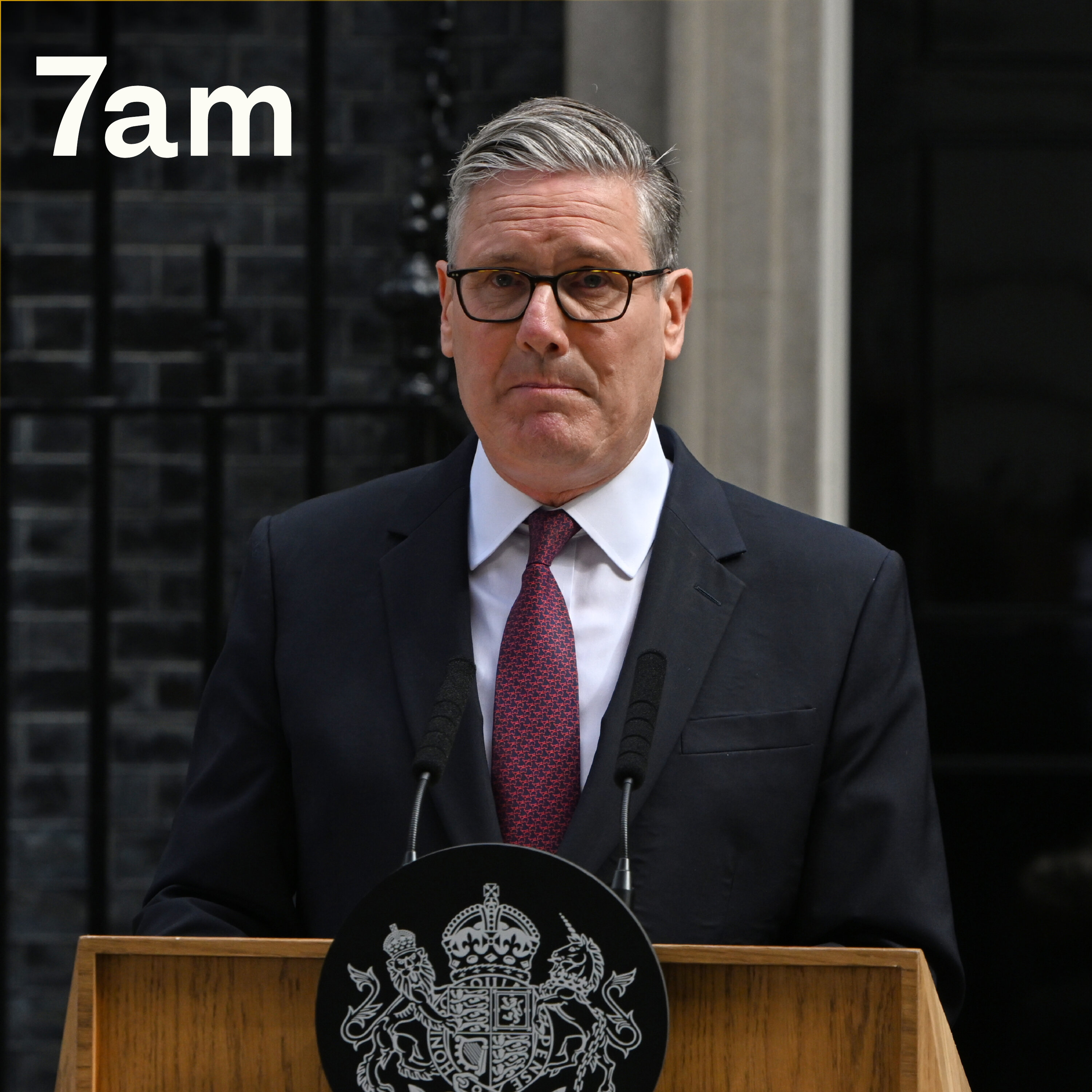
I'm Ruby Jones and you're listening to 7am. The Prime Minister of the uk, Keir Starmer, has announced his resignation, meaning Britain is preparing for its seventh leader in just 10 years. Starmer, who won in a landslide victory for the Labor Party only two years ago, has been haemorrhaging support from the public and the party for months. The man likely to replace him, Andy Burnham. Today, journalist and host of the News Agent, Emily Maitlis on who Burnham is and how he's poised to take power. It's Tuesday, June 23rd. Emily Maitless, welcome back to 7am thank you for joining us.
- [00:50]
B
Thanks, Ruby. It's good to be with you.
- [00:52]
A
Huge day. Let's begin with Keir Starmer's address to the public. It was brief. He was momentarily emotional. Tell us about what he said about why he's resigned.
- [01:04]
B
Look, British politics is a brutal contact sport and you heard, in his words that were excruciating and they were heartbreaking. A man who is being pushed out of a job that he absolutely loves and thought he was doing well because his party don't want him there anymore.
- [01:23]
C
The question my party is asking now is whether I am best placed to lead us into the next general election. I have heard the answer of my parliamentary party to that question and I accept that answer with good grace.
- [01:44]
B
And what you heard from Keir Starmer in those brief few minutes was essentially an itinerary of things that he thought he'd done pretty well.
- [01:54]
C
An economy that is stronger, growing faster than our peers, wages rising faster than inflation in every single month since we came to power, investment secured, infrastructure being built, an end to austerity with the fastest fall in NHS waiting lists for 17 years, the biggest improvement.
- [02:19]
B
And then an acceptance of the reason he was going, which was not, in his words, in his mind, because he hadn't achieved enough. It was simply that the party had made it clear that he was going. And it ended on this. Incredibly. I found it quite moving, quite heartbreaking, actually, breaking of his own voice when he was talking about his wife Victoria and his kids.
- [02:43]
C
I shall spend more time on the most important job being the best husband I can. To my fantastic wife, Vic, who has been a rock by my side through good times and bad and being the best dad I can. To my beautiful children, who are my pride and my joy. Thank you very much.
- [03:08]
B
Look, I think there will be a lot of people who feel he was a very decent man who did everything right up to the point where he came into government and then couldn't really do anything right after that. And there will also be people who think that it tells you something about our system, that we are now heading for our seventh prime minister in 10 years. That 10 years absolutely coincides with the Brexit period, which, you know, we're marking the anniversary tomorrow night, which will be 10 years. Exactly. And I guess there are questions around whether we have become ungovernable or whether democracies are ungovernable, or whether we've just had a series of people who have not really had much luck in getting through an agenda that they thought they wanted to pursue.
- [03:57]
A
Well, let's talk a bit more about what went wrong for Keir Starmer if we go back. I mean, there's been speculation for months about his future. We had a conversation here at 7am about a month ago where we were trying to work out whether he was about to be forced out. What was the tipping point in the end, though?
- [04:14]
B
Well, I mean, it was a very simple thing. It was a set of local elections in May, which, you know, we're always told that local elections are about local issues. They're about your bin collections, they're about potholes, they're about who governs your neighborhood. But actually, this time round, they felt like a referendum on the government itself, because the Reform Party, the sort of, you know, Nigel Farage UK MAGA party, did incredibly well, and both the Conservatives and Labour did incredibly badly. And at that point, I think there were many in the Labour Party who saw entire councils of Labour, Labour councillors wiped out and said, we've got to do something. This isn't working. When we're on the doorstep, people tell us specifically, it's about Keir Starmer. He had an unpopularity which I think to many of us was absolutely mystifying. We saw him as a man who might not have been a great orator, might not have been great at delivery, might not really have been a great people person. He certainly didn't connect with the electorate in a very forceful way. But the vitriol that people were sort of reporting on the doorstep was of another. And I think after those May elections, it became clear that something had to change. And the something that made it change was Andy Burnham.
- [05:34]
D
People are fed up with the way politics is. They're fed up with a Labour Party that sometimes has looked like a pale imitation of the Tories. They want something different. And I am offering change in this leadership election.
- [05:47]
B
Now, Andy Burnham was in the Brown government. He was in the Gordon Brown government. He's had Cabinet posts before. And then during the Corbyn years, he sort of took himself off to Manchester and said, right, I'm going to do something out of Westminster, away from it all. And he became a very successful Greater Manchester mayor. And he has been, I would say, the pretender to the throne now for pretty much a year. We saw his first attempt at the Labour Party Conference last year. He came very close to what looked like a sort of attempted assassination then, but he backed off because he got a couple of his lines wrong. He spooked the markets, felt this wasn't time, and he bided his time. Then he tried to get in to stand as an MP in the Gorton and Denton by election. And Keir Starmer made a very political move. He said, you're not doing it. The Mayor of Greater Manchester, Andy Burnham,
- [06:40]
A
has been blocked from trying to return to Westminster as an MP.
- [06:44]
B
In the last hour, Labours. And this time round, there was a seat that came free because Josh Simons, who, as it turned out was a pretty popular MP in Makerfield, had decided that he would essentially throw himself under the proverbial bus to let Andy Burnham stand in his seat. So he resigned. Andy Burnham stood in that seat. And that was the by election we had on Thursday night. And the results there were off the charts. The Labour and Cooperative Party, 24,927.
- [07:17]
D
We must now take this path and put this country back on the right path and bring people back together and get things working properly again.
- [07:31]
B
I think that they were convincing enough in terms of taking on the Reform Party, in terms of really showing what it takes to beat reform, to beat Nigel Farage, to sort of push the. The hard right populace back. That many around him and around Westminster started saying, he's the guy, he's got what it takes. It might only be one seat, it might only be one by election, it might only be one community that has voted for him. It's 0.03% of the population. But right now he feels like he's got the mojo, you know, the vibe. And that is a pretty dangerous way, frankly, for a country to go about electing a Prime minister. But I think there was so much desperation within the Labour Party, they could see this sort of tsunami of Farage coming towards them and they thought, right, we've got one chance. We've actually got one chance to try and save our jobs, save our party, save our government and maybe get a second term in government. And so they took was so audacious what Andy Burnham did. Starmer was standing outside his own Front door. He was making his goodbye speech at 9:30. Andy Burnham was on the train down from Manchester at 10:54 and you know, gets this sort of huge crowd welcoming him into the Commons, ostensibly just to get, you know, signed in as a new mp. But he could be Prime Minister within the month, within the next three weeks.
- [09:02]
A
Still to come, the man likely to become Britain's next Prime Minister.
- [09:20]
D
I swear by almighty God that I will be faithful and bear true allegiance to His Majesty King Charles, his heirs and successors, according to law, so help me God.
- [09:33]
A
Emily. Andy Burnham. He's barely an mp, yet it seems like Britain has already selected him as the next Prime Minister. It's extraordinary really. You've mentioned a little bit about his political history. Can you tell me more about his politics and also about who he is as a person?
- [09:50]
B
Well, I think for a lot of people, they're still trying to find out. And when I say a lot of people, I mean the newest members of the parliamentary party, because lots of the 2024 intake don't really know Andy Burnham. You know, he was hailed the King of the north. You know, slightly sort of Game of Thrones, sort of mythical status has become attached to him ever since he stood up to Boris Johnson in the COVID years and he said, I don't like the way you're treating us.
- [10:17]
D
It is wrong to place some of the poorest parts of England in a punishing lockdown without proper support for the people and businesses affected. The government is.
- [10:28]
B
And so he was sort of hailed as this, the figure that dared to take on Westminster. And frankly, he is a great campaigner. He got justice for the victims of the Hillsborough Stadium football disaster. And that was a real turning point for a lot of people. The main story this evening, 74 football supporters are reported to have been crushed to death at the FA Cup Final at Hillsborough in Sheffield this afternoon. What should have been one of football's annual showpieces, the FA cup semi final, was only six minutes old when the problems began. It's understood an outside gate at the Leppings Lane end of the ground had broken, enabling non ticket holders to flood in.
- [11:10]
D
What kind of country leaves people who did no more than wave off their loved ones to a football match, still sitting in a courtroom 27 years later, begging for the reputations of their sons, daughters, brothers, sisters and fathers? The answer is one that needs now to do some deep soul searching that
- [11:33]
B
really earned him a lot of respect both in Manchester and with the people of Liverpool. And since then he has transformed or helped transform or inherited a transformation of, you know, one of our big cities. Manchester is one of the few places in the UK and in England that is growing and there is a brand new skyline of skyscrapers. And he has this sort of phrase which is business friendly socialism. In other words, it's not all about capitalism and it's not all about handouts. It's about making the city grow, but in a way that cares for people along the way. And I guess there is something in that phrase that is attractive enough to huge sways of the Labour Party that they think we're going to give it a go. But he probably leans left in the Labour Party and yet he will have to come in and deal with big questions on defense. Keir Starmer's defense secretary just resigned because we weren't spending enough on defense. We don't know what Andy Burnham thinks about defense. We don't know his position on Ukraine. We don't really know what his relationship will be like with Europe or with Donald Trump in America. You know, there are quite a lot of unknowns at the moment and fundamentally there is a lot to deal with in the uk. If I put this into three numbers for you, Ruby. We have a national debt of £3 trillion, we have welfare spending of £353 billion and we have a tax take of 38%. So whoever comes in now, they are dealing with something absolutely huge to grapple with. Right? How do you bring down the debt, how do you cut welfare spending? And how do you make people feel that their taxes aren't going on the wrong thing or telling them they have to pay even more?
- [13:23]
A
And obviously so much of this was about the party trying to answer this question of who can beat Nigel Farage's far right Reform Party. So how do you think someone like Andy Burnham is placed to do that? How is that battle going to play out?
- [13:37]
B
Well, if the result in Makerfield is anything to go by, then he seems to have an answer. I mean, there's something about Burnham which is he cannot be classified as an out of touch elite. I mean, forget for a moment that he has a Cambridge education, you know, two, one from Cambridge in English. But in terms of how he presents himself, he's always in the kind of the black T shirt, the black jacket, the jeans, it's this very Mancunian look. And if you go around Manchester, people know him and they call him Andy. And one of the strangest things I heard over the weekend which just stuck in my head was from the pollster that I was working with from more in common, who said, surprising. When you go around Manchester, how many people say that they've got drunk with Andy Burnham. And they don't mean kind of rolling around in the aisles, but they mean he's a guy who's sort of normal. You know, he will go out drinking, he will play football with people. That's. That's his brand of doing politics. You know, he'll sit in the pub with people or he'll have a game. He's a genuine football fan. And I don't think it's sort of made up. And so one of the words that I'm sure you guys are sort of hearing the whole time is this idea that politics has to be authentic, you know, has to be authentic. It has to somehow go to the heart of who you are. Now, I would argue that Keir Starmel was very authentic, but his authenticity was not something that particularly chimed with people. He didn't sort of ever have that connection with an electorate in a way that made him feel kind of normal and easy and, you know, relaxed in people's company. And I think Burnham certainly has achieved that on his home territory. So can he translate that into something that hurts Reform? Now, Keir Starmer on Friday was quite interesting about this because he said, oh, you know what? I think reform has peaked anyway. In other words, it's nothing to do with Andy Burnham, it's nothing to do with Makerfield. I think they're on their way down and we don't know if that's true yet. You know, I think Reform are probably coming off their sort of dizzy heights of last year. They're not on 30% share of the vote in the polls. They're more around sort of 24, 25%. And there's also this party on the right of Reform called Restore, which is led by Rupert Lowe, which is kind of full on re migration. I mean, you know, that is the party that makes Reform look like they're the moderates. So the right is also tearing itself apart in Britain at the moment. And all that is weirdly having a pretty positive effect on the party in power right now, which is saying, okay, we'll leave you guys to your arguments. You go to sort yourselves out. We'll just carry on, you know, governing in power.
- [16:29]
A
Well, he's certainly set expectations very high. Interesting times for everyone, I'm sure. Emily Maitlis, thank you so much for talking with me.
- [16:37]
B
Thanks for having me. Thanks, uvi. Bye.
- [16:50]
A
Tomorrow on 7am, what the hell has happened to the Greens? We chat with former Greens MP Max Chandler Mather on why his party has gone missing in action in the national conversation at a time when the anti establishment sentiment from voters should play right into the Greens hands.
- [17:06]
E
Well, obviously, we could always do better. I mean, I think it's a broader question about how we think about change. And I've been very clear for a long time that change is not going to come through negotiations with the Labor Party or sort of tinkering around the edges in a broken political system. There's a lot of work to do to demonstrate that as a political movement, we are in opposition to the political establishment.
- [17:30]
A
That'll be in your feed first thing tomorrow. I'm Ruby Jones. Thanks so much for listening to this special bonus episode of 7aM.