Loading summary
Transcript37 lines
- [00:05]
A
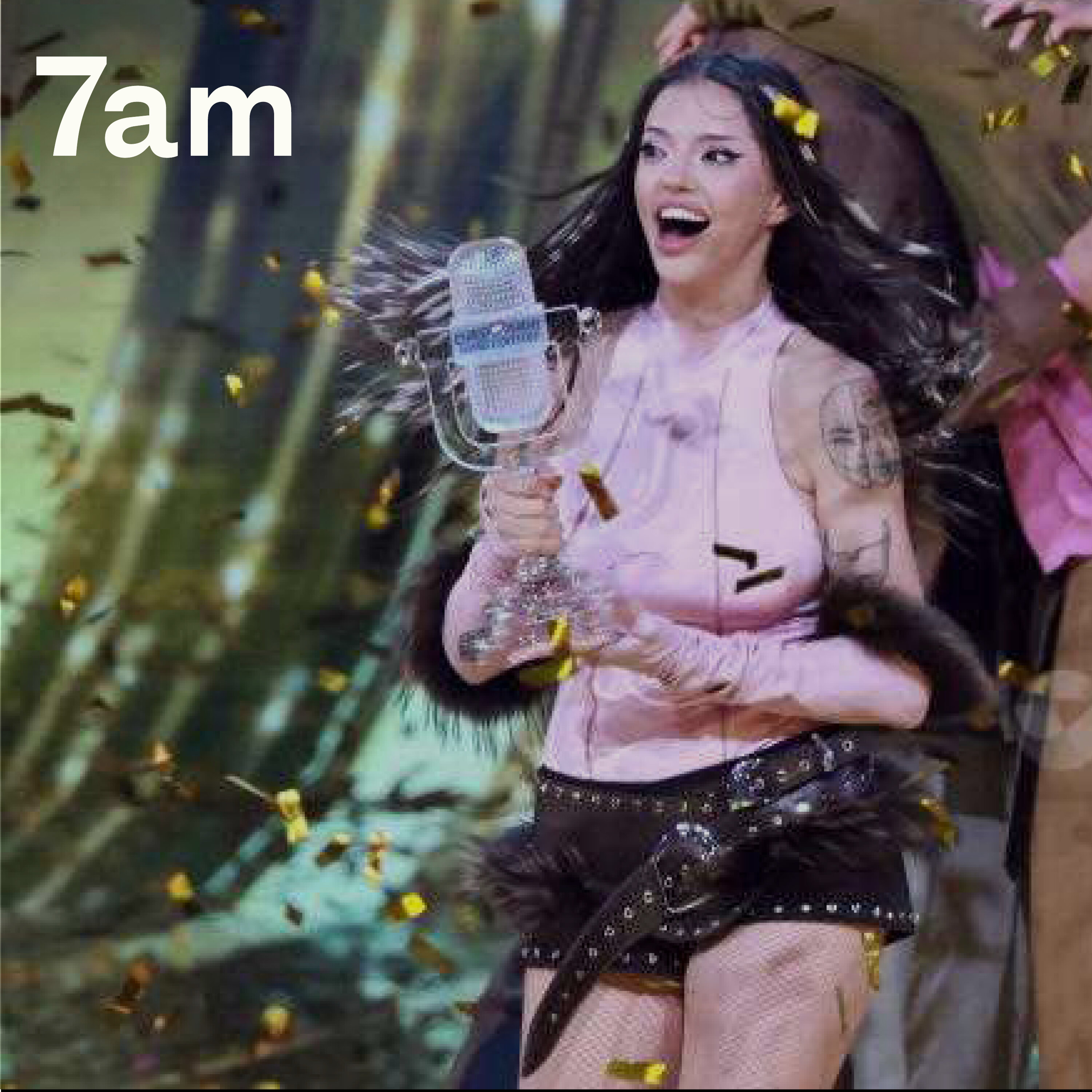
Over the weekend, Eurovision got a feel good ending. Bulgaria won the contest for the very first time with their infectious song Bangaranga. And Australia came close too, with Delta Gujran placing fourth. But this year's controversy over Israel didn't go away. Israeli singer Noam Betem finished second after a huge public vote, despite protests outside the contest, boy from five countries and warnings over Israeli broadcaster Kan running a campaign telling people to vote 10 times. Eurovision insists it's a non political contest, but over the past three years, Israel's place in it has exposed how political the stage can be and how useful it can be for a government trying to shape how the world sees it. I'm Daniel James and you're listening to 7am today, author of Eurovision the History of Modern Europe through the World's Greatest Song Contest, Chris west on the boycott the vote and how Israel turned the world's biggest song contest into a soft power campaign. It's Monday, may 18th. Chris, this year Eurovision has faced what has been described as its worst crisis in history. There have been protests and boycotts over Israel's inclusion. Can you tell us a little bit more about what's happened?
- [01:39]
B
Well, the worst year was probably 2024. There were a lot of protests. We boycott Russia because of the terrible war in Ukraine. And I think the same situation we should do as Israel of what they the artists protested much more.
- [01:59]
C
You've chosen Ogham writing in your face and on your leg as a part of your stage costume and the words are ceasefire and freedom for Palestine. Why was it important for you to include those hidden messages in your stage costume? It was very important for me because I am pro justice and pro peace. Unfortunately, I had to change those messages today to crown the witch only in order from the ebu.
- [02:27]
B
The atmosphere at the contest became very unpleasant. Israel's inclusion's been contentious, prompting booze during the dress rehearsal. That was the worst year. This year things have gone relatively smoothly. There was some booing during the Israeli entrance song, but otherwise there's been much less aggravation than 2024. 2024 was the really bad year when the wheels really fell off.
- [03:00]
A
Can you tell us a little bit more about the boycott? Because some of the major countries that have traditionally been involved in Eurovision have pulled out this year. What reasons have they given?
- [03:10]
B
Absolutely. The five countries have pulled out and that's Spain, the Netherlands, Ireland, Slovenia and Iceland. The reason they give is because they don't think Israel should be in the competition and they're not prepared to share the stage with somebody representing Israel or decided not to send an act to the contest or to not broadcast it at all. Slovenia's national broadcaster will be showing a series of Palestinian documentaries and dramas instead, while Ireland's RTE has opted to show an episode of Father Ted instead. Instead, I think it must be understood that this is not some kind of horrible, evil, anti Semitic thing. They are complaining against the specific policies of the current Israeli government. So there's no nobody saying Israel shouldn't be in Eurovision. As a sort of general point, it's specifically about the current policies of the current government in Tel Aviv. And that's terribly, terribly important. People don't get huddled at the wrong end of the stick.
- [04:12]
A
Adding to Eurovision's woes is a New York Times investigation which has unveiled a soft power campaign to manipulate the Eurovision results. What's Israel accused of doing there?
- [04:26]
B
Well, I think, first of all, I've got to say that the New York Times piece is a very good piece of journalism by two very bright young journalists. But a lot of what it says, people knew already. So the idea that they've blown the whistle on some terrible thing that they've just discovered is it's not true at all. People have known from the very start that Israel has been, in the last two or three years, has been manipulating the contest. They've been instrumentalizing it and using it as a vehicle for political soft power.
- [04:59]
C
My colleague and I at the New York Times, we were able to show that Israeli efforts, Israeli government intervention in Eurovision started years earlier.
- [05:10]
B
And how they do that is that they put adverts on various social media saying, vote for our song, Vote 20 Times.
- [05:19]
C
Now, given that people can vote up to 20 times in the past and 10 times this year, that means that it would take relatively few people to swing the vote.
- [05:30]
B
And they've also, they've used people who support them, told them to go and spread the word.
- [05:35]
D
Israel has been issued a formal warning over Eurovision advertising from the EBU. Here's what the EBU said. On Friday, May 8, it was brought to our attention that videos with an on screen instruction to vote 10 times for Israel had been published and released by the artists representing Khan. Within 20 minutes, we had contacted the Khan delegation to ask them to immediately stop any distribution of the videos and remove them from platforms where they had been published. The voting instructions of the Eurovision Song Contests, that cover promotion are predominantly directed at disposal, discouraging large scale funded third party campaigns. And we are satisfied that Eurovision itself
- [06:04]
B
did some research into this. And if you vote, if you get a small Number of people voting 20 times. That skews the results massively on the public votes. And so you saw this, it was blatantly obvious. In the last two years, in 2024 and 2025, the Israeli song was rated by the judges as okay. It was a middle ranking song. It was a nice song. It's well done. You know, there's nothing wrong with it, but it wasn't outstanding. But if you look at the public vote, it got maximum votes in many, many countries, and maximum by a long, long way, 290.
- [06:57]
A
That means we have a new leader on the scoreboard.
- [07:01]
B
So this was clearly a totally skewed result, and that was due to all this advertising and everybody knew the advertising was there. So this is not radical news stuff. This was well known and this was funded partially by the Israeli government. And they've admitted that they haven't turned around and said, it's nothing to do with us, Governor. They said, yeah, we've, yeah, of course we've done it.
- [07:23]
A
Obviously, every country promotes its own entrant, but do governments normally get involved in Eurovision? Chris? And where do you think the line is between promotion and manipulation?
- [07:33]
B
Well, I think that's a very good question. I mean, if you look at other, other broadcasters will sometimes put up little ads saying, vote for our candidate. Record companies, if somebody's signed to a record company, will do it. The artist may do it themselves. But nobody has ever said vote 20 times, or even you can vote 20 times. They just say, vote for me, I'm nice. Over the last two years, this has been taken to a totally new level. It's a total order of magnitude different. Total order of magnitude different.
- [08:07]
A
Some people might think that a song competition is an unlikely place for a government PR campaign. But how powerful is your revision and how much reach and influence does it have? Chris?
- [08:19]
B
Well, I think it has quite a lot of influence. I think the Israeli government is keen to be seen as a sort of European state. It's part of Israel's campaign to say, look, we're a modern civilized country, so that is important. But also there's another refinement on that, which is that if they do well in the public vote, they can turn around and say, look, people love us in Europe, they think we're wonderful, and that's a very important thing. So I think to be seen as participating in things like Eurovision is, yeah, it's soft power. It's important.
- [09:00]
A
Coming up, why Eurovision has always been political.
- [09:10]
C
Chris?
- [09:10]
A
I think most people associate Eurovision with weird and wonderful characters, costumes and performances. But, you know, when you say that politics has always been a part of Eurovision's DNA, what's the origin of that?
- [09:25]
B
Well, it was founded in 1956 and the founder of Eurovision was a guy called Marcel Besancon, and he was a very, very keen supporter of European integration. Jean Monet, who is the father of the European Union, was one of his closest friends. This was closely tied in with the political aim of bringing Europe closer together. So we wouldn't do what we did in 1914 and 1939 is basically fall on each other's neck. Never again was a driving force behind the creation of the Eurovision Song Contest, because Eurovision has been political in other ways apart from sort of national geopolitics. It's been, I think, an important player in the whole rise of gay rights. For example, if you go back to 1961, there's a marvelous French song, do listen to it, called Nous Les Amoureux, and that's clearly about a gay love affair. If you look at the lyrics, it's, you know, these imbeciles, these horrible people, they're condemning us, but we have love. At the time, people didn't perhaps notice that so much outside the gay community, and they became a kind of safe space for gay people. Certainly by the late 90s, Eurovision was really sort of coming out. If you look at Paul Oscar's performance in 1997, it's got a very sort of gay vibe to it. And then, of course, in 1998, Downer International, who's a transgender singer, won. She was from Israel, actually. See, this is very interesting. So the whole thing is stories always much more complex than it looks. And C1, it was very important moments.
- [11:34]
A
What have been some of the biggest political moments or controversies in Eurovision's history?
- [11:40]
B
Well, the biggest political controversies have been quite recent because, in fact, in the old days, some of the contestants were pretty shocking if you look at them by modern standards. I mean, France was involved in a horrendous colonial war in Algeria and nobody said anything about it, really, in the context of Eurovision. In the 1960s, Spain and Portugal participated and they both were dictatorships and people did make a bit of a fuss about it. And somebody ran onto the stage of the banner saying, boycott Franco and Salazar, one of the contests. But there was no sort of general sense that this was wrong to showcase these countries. But Even back in 2014, when Russia invaded Crimea, there wasn't that much call for them to be thrown out of Eurovision. There were protests at Eurovision, but that was also linked with Russia's extremely unpleasant attitudes towards gay rights and things like that. So there's always been a little political undercurrent, but it's come to the fore more recently, I think.
- [12:41]
A
What about the impact on this year's competition itself? Because, as you mentioned, five fairly sizable countries with a lot of influence have boycotted this year's Eurovision. Is that impacting the integrity of this year's competition itself?
- [12:55]
B
I know, so that it is. We miss them. Spain is a big five contributor. There are five. Five countries contribute the most to the contest's coffers. Netherlands has always been a very keen Eurovision competitor. The contest is very popular in the Netherlands. You know, it's a big deal there. They've done very well over the years, so they're an important player. They're not there, which is a shame. Iceland, Slovenia, Ireland have won it seven times, but everybody's part of the Eurovision family and it's a shame they're not here. But on the other hand, the contest is going ahead, so the five countries pulling out hasn't broken it.
- [13:38]
A
Chris, you don't just write about Eurovision, you're also a fan. You've seen just about every Eurovision that there's been.
- [13:43]
B
I have, yeah.
- [13:44]
A
Are you worried that these boycotts and the controversies surrounding Eurovision this year will have lasting impacts? And what would it take for Eurovision to sort of recover from this? Is there a concern that more boycotts might be in. In. In the pipeworks for future events?
- [14:03]
B
Yeah, there might be. I. I don't know. One can. I think, as a general principle, Eurovision is a big, big thing and it's had some sort of controversies in the past. Not as much as this, but I think it'll survive. It's a wonderful thing. Loads of people love it, if it's sensible. It needs to think a little bit about this whole question of having some kind of rule, for if a country's administration is acting in a way that doesn't fit with the Eurovision brand and its values, then they need to have some way of saying, sorry, guys, you've passed a mark. You can't participate. Because Eurovision does have a very clear brand, which is about. There was a wonderful parody done a few years ago by the Swedish host called Love, Love Peace, Peace. And I do recommend you watch it because it's very funny and it's very clever. And it does sum up this kind of slightly sort of hippie ish feel of Eurovision, and that is part of its brand and that kind of needs protection a bit more than it's being protected. At the moment, but there needs to be a rule in place. Otherwise these arguments will be going on and on and on.
- [15:20]
A
Well, it's, it's a, it's an event that brings a lot of joy to a lot of people. So hopefully something can be worked out. Chris?
- [15:26]
B
Absolutely.
- [15:27]
A
Thank you so much for your time.
- [15:28]
B
My pleasure. It's been nice talking with you.
- [15:40]
A
Also in the news, opposition leader Angus Taylor has rejected Labor's claims that his promise to index tax brackets to inflation will cost $250 billion over 10 years. He says the cost will be 22.45 billion over four years. The measures announced during Taylor's budget reply speech would begin for the first two tax brackets from 2028 and the higher tax brackets from 2031. And New South Wales police are warning of a new scam that's seen four victims lose $800,000 in the last month. Victims were contacted via phone or messaging apps by scammers posing as Chinese police or government officials. They were falsely told that they were suspected of a crime and told to transfer money or cryptocurrency if they didn't want to be arrested. I'm Daniel James. Thanks once again for listening to 7am we'll be back tomorrow.