Loading summary
Transcript55 lines
- [00:02]
David (Farmer with Parkinson's)
I was born and bred on this property. I'm 68 years old, I run sheep and I was diagnosed with Parkinson's disease roughly three years ago.
- [00:14]
Daniel James (Host)
Parkinson's is the fastest growing neurological disorder in the world. By the time patients come to Professor Wesley Thevatharsen, a specialist in Parkinson's, many are already dealing with symptoms that have changed their lives.
- [00:27]
Professor Wesley Thevatharsen (Neurologist)
I've got the classical movement problems, slowness, stiffness, tremor, gait problems, falls, sometimes cognitive issues as well.
- [00:39]
Daniel James (Host)
But in some Australian farming communities the question isn't just what Parkinson's does, it's why so many seem to be getting it.
- [00:47]
Local Farmer with Parkinson's
There's four guys around here and we've all got it. We all got it about the same time. I mean what was it? Sunspots on the sun.
- [00:55]
Narrator/Reporter
There is a lot of Parkinson's in this family. David's father and his uncle both had it. His brother in law has it. It's really very, very prevalent in this community.
- [01:08]
Daniel James (Host)
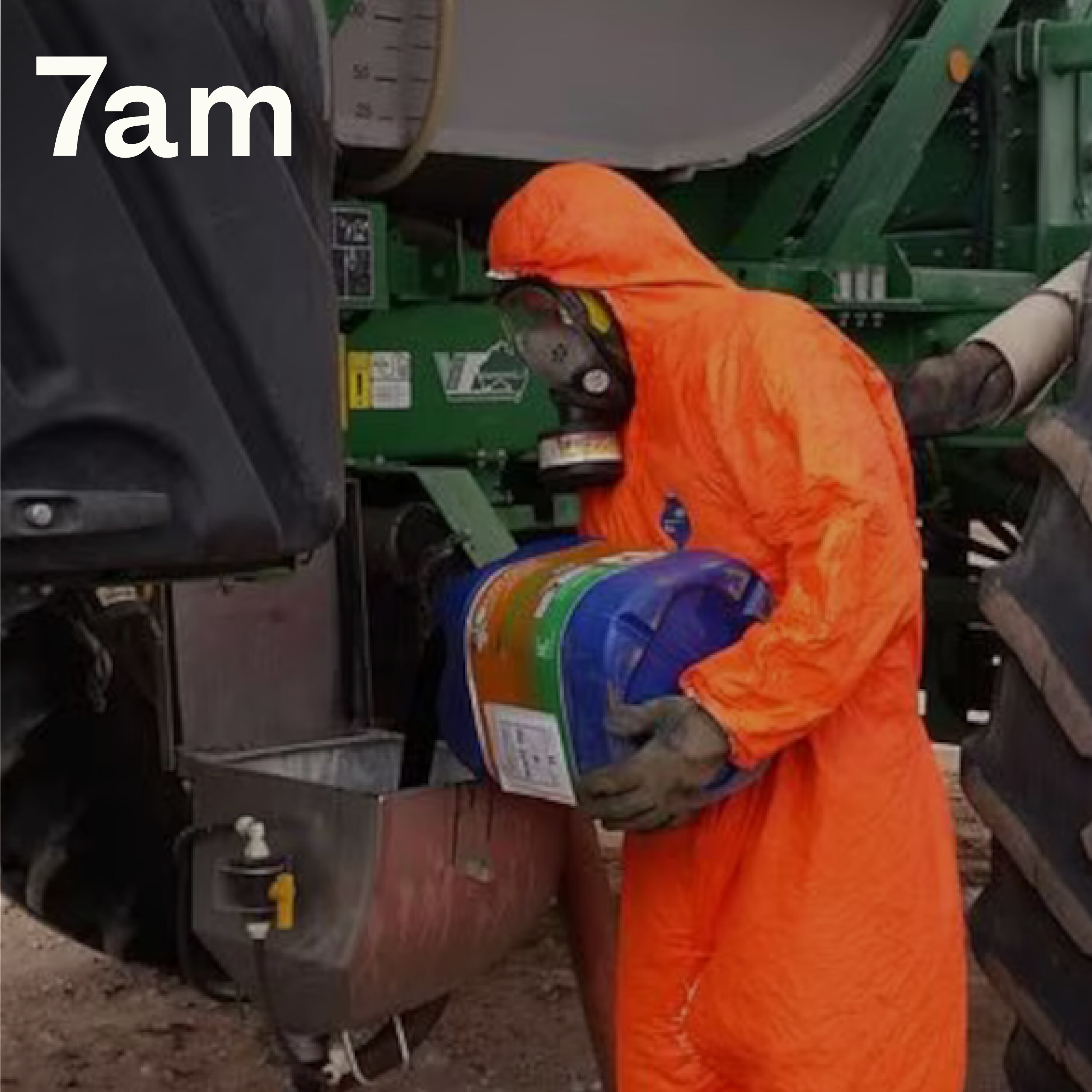
For years now, some farmers have been drawing a link to paraquat, a powerful weed killer.
- [01:15]
Dr. Phil Botham (Syngenta Principal Science Advisor)
As a teenager I waved a flag for an aeroplane to spray paddocks with paraquat and I can recall people blowing out nozzles with their mouth, wearing gloves.
- [01:27]
Local Farmer with Parkinson's
Was, was for pansies.
- [01:29]
David (Farmer with Parkinson's)
You blowing the chemical up on your face all the time you were out spraying, you'd be saturated and you stay in those clothes all day.
- [01:38]
Local Farmer with Parkinson's
The chemical companies have got a bit to answer for.
- [01:42]
Daniel James (Host)
And while it's already banned in over 60 countries including the UK and China, it's still used widely on Australian farms. This month the chemical regulator is expected to make a final decision on on whether it can keep being used here after a review that's been going since 1997. Professor Thiberthaarson is one of about 50 neurologists who made submissions to that review calling for it to be banned. But he says the regulator has ignored them. As well as some of the strongest evidence linking paraquat to Parkinson's, these reflect
- [02:16]
Professor Wesley Thevatharsen (Neurologist)
the peak Scientific minds who know about Parkinson's disease wrote to the regulator close to two years ago and as far as I know there's been no engagement at all. I haven't heard anything. I've spoken to others, they've heard nothing.
- [02:37]
Daniel James (Host)
I'm Daniel James and you're listening to 7am today, Professor Wesley Thevatharsen on the farmers who fear paraquat made them sick and whether Australia's chemical regulator is listening. Its Friday, June 19th. Wesley, you said farmers are overrepresented amongst the patients you see. Tell me about that what are you seeing from them?
- [03:07]
Professor Wesley Thevatharsen (Neurologist)
Well, yes, I see a lot of farmers as patients and this literature goes back to when I was a medical student. We've long known that a childhood upbringing is an increased risk. It's increasingly understood that the role of pesticides in that risk is being understood better. And even in Victoria, we have quite good evidence that there tends to be strong clustering of the diagnosis in farming communities.
- [03:35]
Interviewer/Reporter
And you believe that one pesticide in particular, paraquat, could be to blame. Where does that concern come from?
- [03:42]
Professor Wesley Thevatharsen (Neurologist)
Yeah, well, certainly the evidence is by far the greatest for paraquat causing Parkinson's disease amongst all the pesticides, even as
- [03:51]
Narrator/Reporter
there's widespread agreement about its toxicity. For years, some of the world's leading scientists have also published studies saying that pesticides like paraquat can also lead to an elevated risk of developing Parkinson's.
- [04:05]
Professor Wesley Thevatharsen (Neurologist)
And look, multiple research groups from around the world, looking at different data sets, who are independent of one another have found, using what we call epidemiological studies, that Parkinson's is a, the risk is increased by exposure to paraquan.
- [04:21]
Narrator/Reporter
There's clear cut epidemiology showing the exact use of pesticides in terms of how many pounds per acre, which specific areas got treated with what pesticides and what the incidence of Parkinson's disease is that correlates with that.
- [04:38]
Professor Wesley Thevatharsen (Neurologist)
That is also coupled with viable biological mechanisms because we know, for example, that paraquat can alter the shape of a protein called alpha synuclein. And what happens is that alphous nucleon, once it's changed in shape, it actually can spread throughout the brain from entry in the nose and from entry in the gut.
- [05:02]
Narrator/Reporter
Loss of smell and shoulder pain are among the early symptoms. Tremors, slowing of movement, difficulty sleeping and stiffness can come later. Then in more advanced stages. Loss of cognitive ability.
- [05:15]
Professor Wesley Thevatharsen (Neurologist)
Paraquat ulcer looks a lot, chemically looks a lot like an agent called mptp. It's an agent that we know can destroy dopamine cells in the brain. And that's a core feature of Parkinson's disease. So look, there's lots of different angles to approach this question and they're all leading to the same understanding that paraquat is associated with a greatly increased risk of Parkinson's disease.
- [05:42]
Interviewer/Reporter
So you've noticed the risks, you've had a look into the science behind it. And so you've gone to speak to the community themselves at forums in rural areas. What are farmers and families telling you at those meetings?
- [05:55]
Professor Wesley Thevatharsen (Neurologist)
Well, I guess the people who are attending those meetings by Their nature are selected to be those who are perhaps open minded and they're genuinely concerned. They just want to hear what the facts are. They want to understand whether they're at risk, whether their previous exposures have put them at risk. And more, even just as important or more important, is whether their families are at risk who are living in these rural communities. And there's many patients with Parkinson's disease who are farmers who come to those meetings as well. And they're not looking for someone to blame. They just want to understand how they got the condition and whether, you know, a registered legal product in Australia may have contributed to their risk. So they're just looking for factual answers. I think they don't. They don't realize until I present to them what's been going on. When I present them that information, I often get gasps in the audience. My concern, though, is that lots of people aren't feeling this way because it's been somehow politicized. I mean, there's another group of farmers, maybe the one is sort of the loudest in the farming lobbying groups, who have a different perspective. Their perspective is, you know, this is doctors against farmers. You know, you're trying to take away a product which is extremely helpful for us to increase our crop yields. And I say to them, this is not about doctors against farmers. This is doctors against diseases that occurs in farmers and their families. So we're on the same side.
- [07:25]
Interviewer/Reporter
There's been a fair bit of pushback from the Australian Farmers Federation, which says paraquat is essential, particularly because of its suitability to Australian conditions. What would removing this product do to their livelihoods? Wesley?
- [07:38]
Professor Wesley Thevatharsen (Neurologist)
Well, here I want to say that I'm a scientist, I'm not a farmer. I don't have any good understanding of the importance of paraquat to their crop yields. But this doesn't mean that we should bury our head in the sands and say that there's nothing wrong with this agent and let's carry on. And we need to, at a minimum, be honest and truthful about the risks associated with it. I mean, I follow up by saying that paraquat is banned in 70 countries. The EU, it's banned in Switzerland, it's banned in China, and yet Australia still allows it. So, I mean, other jurisdictions have managed to farm effectively without paraquat. Interestingly, Switzerland has banned paraquat despite the fact that Syngenta, the company which makes it, is actually headquartered there, and China has banned paraquat despite the fact that Syngenta manufactures paraquat in China. So I mean, Australia is really amongst a very shrinking group of countries that are still permitting use of that agent.
- [08:48]
Daniel James (Host)
Coming up, the vested interests benefiting from a never ending paraquat review.
- [09:03]
Interviewer
How long have you been reviewing Paraquat 4?
- [09:07]
Regulator Representative
So the paraquat started being reviewed in 1997, I think, and
- [09:16]
Interviewer
so it's been on. The review has been ongoing since 1997,
- [09:20]
Regulator Representative
constantly evolving and constantly changing. So there's been milestones along the way.
- [09:25]
Interviewer/Reporter
Wesley, the chemical regulator here, the APVMA, they've been looking into this since 1997 and there still isn't a final decision on whether to ban this herbicide. Why has that been going on for so long?
- [09:41]
Professor Wesley Thevatharsen (Neurologist)
27 years is a long time.
- [09:43]
Regulator Representative
It is.
- [09:44]
Professor Wesley Thevatharsen (Neurologist)
I don't think I had a mobile phone or an email address.
- [09:47]
Interviewer/Reporter
27 years ago I may have had my first Motorola.
- [09:51]
Professor Wesley Thevatharsen (Neurologist)
You must have been a technological trailblazer. I don't know if I had one. But over that time period the evidence has grown. So despite the fact it's been on ice, the growing scientific consensus around the world that paraqut causes Parkinson's disease has increased.
- [10:10]
Interviewer
Is that not concerning that we can have a 30 year review of a herbicide that in the meantime is being banned left, right and centre, including by a whole range of countries in West Africa that I assume don't have the resources that APVMA would have available to you.
- [10:33]
Regulator Representative
The scientists that we have working on this, looking at the data that they have available to them, are the very best that exists around the globe. So I'm going to be comforted by the quality of the science we've got working on the assessments.
- [10:48]
Professor Wesley Thevatharsen (Neurologist)
The fact that I don't want to comment on why the APVMA have taken so long. I'm not an expert in their processes and I don't speak for them, I just find that it's atypical. And I guess one of the questions I would ask is who benefits from a 27 year delay in a scientific review? It's not people who are exposed to paraquat who could have been prevented from developing Parkinson's disease over that timeframe.
- [11:18]
Interviewer/Reporter
I mean, if you were to have a think about who does benefit from this delay, Wesley, who would you surmise does?
- [11:26]
Professor Wesley Thevatharsen (Neurologist)
Who benefits from the delay in regulating, say, smoking? Who benefits from the delay in regulating anything? It's presumably the people that make the products. You know, listeners can draw their own conclusions on that one.
- [11:42]
Interviewer/Reporter
And as a part of that, there's been a lot of industry resistance and push back to regulation.
- [11:47]
Professor Wesley Thevatharsen (Neurologist)
Has there not There has been. And Syngenta, which is one of the major producers of paracord around the world, has been pushing back now for decades, claiming that there is no link between Parkinson's disease and paraquat.
- [12:03]
Dr. Phil Botham (Syngenta Principal Science Advisor)
I'm Dr. Phil Botham, I'm principal science advisor for Syngenta Product Safety. I used to be the global head of product safety for the company. I absolutely agree that paraquat is safe for farmers and growers to use. There is no causative link at all between paraquat exposure and Parkinson's disease.
- [12:27]
Professor Wesley Thevatharsen (Neurologist)
I mean, you'd expect them to say that, right? Companies are not entities with morals, they're entities that are designed to make a profit. And that's completely understandable. But then we shouldn't take our lead from them. We should see through their desire to make a profit and we should ask our regulator to protect us.
- [12:50]
Interviewer/Reporter
As late as 2024, the regulator's position was basically that the evidence still isn't strong enough to prove paraquart is causing Parkinson's and people who use it at work.
- [12:59]
Daniel James (Host)
Are you saying that assessment is wrong?
- [13:01]
Professor Wesley Thevatharsen (Neurologist)
Yes, straight up and down. I have read these outputs they've created. And I must say, I mean, as a scientist reading what's purported to be a scientific output from an Australian regulator, I've found it deeply troubling. Their 2024 paper was very similar to the 2016 paper. The major landmark studies from around the world. They use epidemiology to draw a link between paraquot and Parkinson's disease. They ignored almost all of them. So these are not even cited in these so called scientific reports that the APVMA have produced. They didn't even acknowledge them, let alone deal with them. I mean, these are epidemiological studies which look at how populations of people who are exposed to paraquat in their daily lives, whether they're applicators or in rural communities. It compares their risk of Parkinson's disease to controls where that exposure did not occur. And time and time again, these studies have reproduced the same finding, that paraquart is associated with a roughly threefold increased risk of Parkinson's disease. And importantly, the greater the exposure, the greater the risk. And these are multiple groups from around the world. And when you piece it all together in one of the highest forms of science called a meta analysis, well, there's been two of those and they also corroborated the increased risk of Parkinson's disease. And look, this is the same way that we showed that smoking causes lung cancer. And these studies, the ones I've just been talking about are not in the APVMA technical reports, or one of them was. But they also weighted that against a Syngenta study that looked at paraquart exposure in the factory workers who used to make the agent decades ago. So it's just, I do not understand. I mean, these reports wouldn't pass the first test in a science degree.
- [15:17]
Interviewer/Reporter
Do you have any faith that the regulator will ban paraquat at some point?
- [15:21]
Professor Wesley Thevatharsen (Neurologist)
Honestly not without political pressure. I mean, this has been now, what, 27 years of inaction? I'm glad that, you know, the media is now looking at this. That's the sort of pressure we need. This is why, you know, I'm talking to you now, I guess. I think public pressure, parliamentary action, the medical community is pretty united on this, not only in Australia, but around the world. You know, there's growing consensus around this. And I think that may, you know, pressure the regulator because looking at their previous technical reporter, I don't really hold much hope in them looking at the science in a way which would be reasonable. But I am happy to be surprised. I would love to be surprised.
- [16:09]
Interviewer/Reporter
Professor Wesley, thank you so much for your time.
- [16:12]
Professor Wesley Thevatharsen (Neurologist)
Thank you for having me. It is much appreciated.
- [16:15]
Daniel James (Host)
We've reached out to the regulator for comment. The APVMA says it acknowledges the reporting on concerns about a possible association between paraquote exposure and Parkinson's disease, but says it cannot preempt the findings of its final regulatory decision which remains due in mid-2026. It says agricultural chemicals are assessed through an ongoing monitoring, scientific review and statutory safety criteria, and that approved products must be used according to strict label instructions. Also in the news, the US and Iran say an interim agreement to stop military action and reopen the Strait of Hormuz is now in effect. The deal includes a 60 day window for a final agreement, Iranian commitments not to develop or acquire a nuclear weapon, and US moves to ease sanctions, release frozen Iranian assets and support a reported reconstruction fund. However, despite Israel's inclusion in the agreement, Israeli forces have continued military operations in southern Lebanon. Iran has warned further attacks or continued occupation would breach the deal. And Western Australia's largest prison is again under scrutiny with a new inspection report finding conditions at the Cassowarina prison have deteriorated amid ongoing overcrowding and staff shortages. Inspectors found the prison is regularly operating above capacity with some inmates sleeping on the floor. The report says long running problems identified in previous inspections including overcrowding and aging infrastructure, have intensified, limiting access to healthcare, family contact and rehabilitation programs. Around 2/3 of prisoners at Cassowarina are being held on remand despite the prison being designed primarily for sentence inmates. I'm Daniel James. You've been listening to 7aM we'll be back tomorrow.