Loading summary
Transcript34 lines
- [00:01]
Daniel James
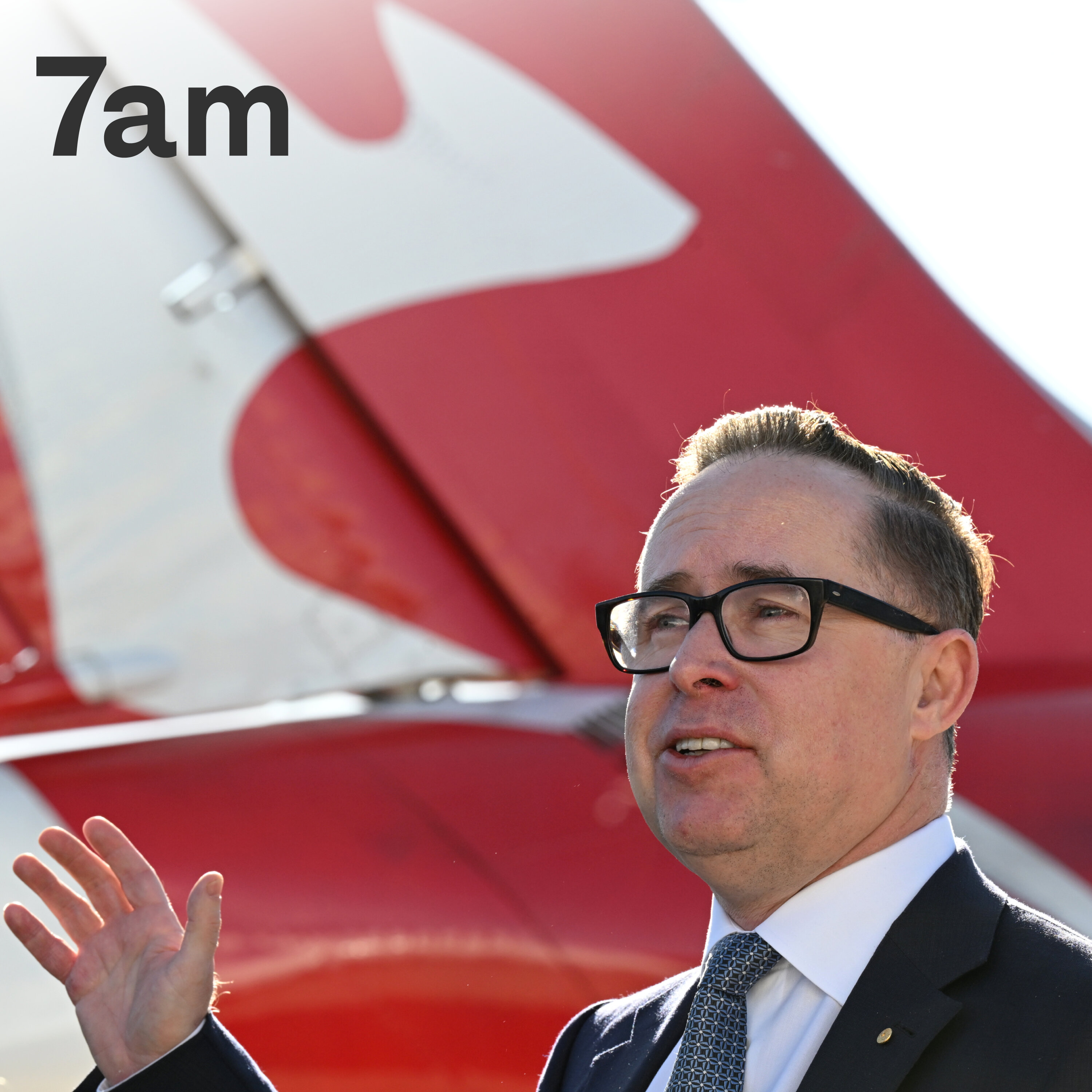
I'm Daniel James and you're listening to 7am. This week. 7:00am spoke with former Qantas Chief Executive Alan Joyce as he returned to public life with a memoir defending many of the decisions he made during his final years at the airline. Joyce said the company was fighting for survival during the pandemic and that while mistakes were made, the difficult decisions taken under his leadership were necessary to keep Qantas from going under. Today we revisit our conversation with journalist and author Joe Aston, recorded after Qantas was handed a record $90 million penalty for illegally outsourcing 1800 workers. It asks what those decisions cost, if they were really necessary, and whether the airline has actually changed since Joyce's departure. It's Sunday, August 2nd. This episode was originally published in August20.
- [01:06]
Ruby
So, Jo, thank you for joining me on 7:00am My pleasure. On Monday, Qantas was ordered to pay a $90 million fine for illegally sacking 1800 workers back during the pandemic. And in delivering his judgment, Justice Michael Lee called Qantas the wrong kind of sorry. So tell me what you made of his comments and of the decision more broadly.
- [01:29]
Joe Aston
Well, I mean, I've been watching this case for a long time. It's been a marathon. The first try, the actual original LIAB trial was in 2021, in the middle of lockdowns.
- [01:39]
Daniel James
Federal court will decide whether Qantas acted illegally when it sacked hundreds of Melbourne
- [01:44]
Joe Aston
ground crew and gave their jobs to a cheaper contractor. You know, then Qantas had lost that case and then appealed straight to the full court.
- [01:52]
Ruby
The Federal Court found the decision to outsource about 2,000 ground workers was in breach of the Fair Works Act TW.
- [02:00]
Joe Aston
And then they lost that case in 2022. And then they appealed straight to the High Court and they lost that case in 2023. The court has dismissed unanimously Qantas appeal.
- [02:11]
Unidentified Expert or Commentator
It now stands their actions against these Qantas families as the largest sacking in Australian corporate history.
- [02:21]
Joe Aston
It was sent back to the Federal Court to decide on the compensation that they should pay to those workers. And that was decided in 2024, that they should pay $120 million. Qantas has been forced to pay more than $120 million in compensation to workers whose jobs were illegally outsourced during about 18. And only now in 2025, have they been hit with their penalties.
- [02:42]
Ruby
Qantas has just been fined $90 million for illegally sacking 1800 ground staff five years ago.
- [02:51]
Joe Aston
It's just been sort of this incremental debacle. Unfolding, which Qantas, until the very last minute was fighting. Even when they lost in the High Court, the then chairman of Qantas, Richard Goyder, was dismissing the ruling of the court and saying, well, look, we had sound commercial reasons for. Justice Lee was quite brilliant in pointing out how completely silly that argument is. Of course they had sound commercial reasons. I mean, what kind of an outsourcing would it have been if they didn't have sound commercial reasons? It was just a bizarre reasoning that they were offering. You know, we engaged in illegal behaviour because it made us money. Now, that doesn't make it okay. So it wasn't just the illegal outsourcing, it was the way they conducted themselves, even when they were found to have done the wrong thing by a court afterwards. And Justice Lee also, this is one of the big reasons why he didn't believe that they were really sorry. Only last year, in 2024, Qantas was in arguing in the compensation hearings that the workers should get zero dollars of compensation. That was actually the argument being put to the court by Qantas that the workers should not get any compensation at all. That's obviously not an argument that suggests a company that is feeling contrite about its wrongdoing.
- [04:06]
Ruby
Ok, so we had the company, at least initially, arguing that there should be no compensation for workers. They have now been ordered to pay a $90 million fine. So let's talk about that for a moment. How does that amount compare with what Qantas wanted versus what the union wanted?
- [04:23]
Joe Aston
Well, yeah, I mean, the fine itself is staggering. By far the biggest fine ever imposed on a company for a breach of general protections under the Act. The last high ever was $10 million against the Commonwealth bank for an underpayment issue that went over a decade. The fine is generally paid to the party that is bringing the case, and usually that party is the Fair Work Ombudsman, who prosecutes breaches of the act by employers. But of course, in this case, the ombudsman was fast asleep and the union decided to take the action itself. And that's what's really unusual about this, that such a huge amount of money is being paid to the union. Right.
- [05:06]
Ruby
And so does that money then go from the union to the workers? Have they said how it'll be divvied up?
- [05:11]
Joe Aston
So the penalty's 90, 50 of that goes to the union and then the other 40 will go to the workers on top of the 120 million that they were already getting in compensation. But, you know, if you look at how many workers were illegally sacked. There's 1,800. It actually, you know, this is not sort of life changing money for people who've lost their livelihoods. The $40 million split 1800 ways, that's only $22,000 per person. So for someone who's lost a long term good paying, blue collar job, that's not going to get them over the line.
- [05:47]
Ruby
And Jo, it's been a year now since Qantas announced that it was slashing Alan Joyce's payout by almost 10 million. And that was partly because of his handling of this. And at the time, Qantas acknowledged the harm that had been done to their reputation, particularly with their customers, and they commissioned a to tell them how to fix it. So what did that review end up saying and has the company implemented any changes?
- [06:14]
Joe Aston
Well, yeah, well, the review was damning and the review found that Qantas had a terrible culture and it had a board that was too weak to challenge the CEO, Alan Joyce, and this case, the illegal sackings was one part of it. But, you know, you remember there was also the ghost flights, the issue of COVID credits and the way customers were really poorly treated by those. There was a huge amount of price gouging. There's a massive suite of issues that were affecting Qantas reputation. Now, what has actually changed a lot of that is sort of at the surface level, I think it's fair to say that Qantas under Vanessa Hudson is a company more focused on its customers and on its staff than it had been previously. But, you know, does it still charge the highest possible fares that it can on routes where there's not very much competition? Absolutely. Does it still still invest insufficiently in new aircraft to improve the experience and reliability for its customers? Absolutely. You know, and also, by the way, to reduce the, the impact on the environment. So Qantas has changed its bedside manner? I think that's fair to say. And that's not nothing, that's an important thing. But if you look deeply, Qantas is still a very aggressive company.
- [07:33]
Ruby
Right. So the underlying strategy might not have changed, even though Joyce is out of the picture. So what ongoing benefits does Joyce get as a result of the time that he spent there?
- [07:42]
Joe Aston
Well, I mean, you know, he made $130 million as CEO of Qantas. That's pretty good coin if you can get it. And he's got a golden ticket. It's like the one they give you in Charlie and the Chocolate Factory, except instead of unlimited chocolate, it's Unlimited first class flights for life.
- [08:02]
Ruby
After the break, what Qantas says it's learned and what its profits really show. Jo. Qantas for the past year has been run by Vanessa Hudson. So tell me a bit more about her and how she's approached her role so far.
- [08:20]
Joe Aston
Yeah, well, Vanessa Hudson's even more of a Qantas lifer than Alan Joyce in that she started at the company. I think it was almost her second job in the audit department, which is a very exciting place, as you can imagine, in 1994. In her twenties and has worked right across the company. When I worked at Qantas in the late 2000s, she was running customer product and service in flight product and service when the airline received its first a 380s. And then she's gone and run the American division of Qantas. She came back and was chief Customer Officer briefly and then became the Chief financial. So she's really worked right across the company and she became CEO in 2023. Her pitch to the board of Qantas for the job was, I'm not going to change anything. I'm going to be just like Alan Joyce. Now, as Alan Joyce became absolutely toxic in the dying months of his reign, she had to very quickly change that plan and try to distinguish herself from Joyce and be someone different.
- [09:23]
Ruby
We want to get back to the national carrier that Australians can be proud of, that's known for going above and beyond. We understand we need to earn your trust back, not with what we say, but what we do and how we behave.
- [09:37]
Joe Aston
And she has to keep the shareholders happy, she has to make up with customers and she has to make staff feel like it's worth going out there and putting themselves on the line every day. For those customers, she's sort of done pretty well. For the shareholders, they're very happy. The share price has more than doubled since she's been in charge. And in terms of making up with the customers, the right noises are made. But, you know, they'll never admit this, but every senior executive at Qantas knows that they only have to be so nice to their customers. But really, they'll all keep coming back for more punishment because the customers just don't have other options.
- [10:15]
Ruby
And it's not just the chief executive who has changed. Last year, John Mullen became chair. So what impact has he had so far?
- [10:25]
Joe Aston
Well, look, I think John Mullen's someone who has a really good sense of, you know, what the average person on the street thinks and feels. You know, he's somebody who's really quite in touch. And that's a good thing for Qantas, because that's how this happened in the first place. Alan Joyce was living in his own world and his board was subservient to him. So even though they might have had doubts about how angry Australia was at Qantas, they weren't prepared to challenge Alan Joyce to do anything about it. Put it this way, there's no way in the world that Vanessa Hudson is going to be telling John Mullen what to do. And there's no way in the world that John Mullen's going to be too afraid to pull Vanessa Hudson into line. And that's the way companies are supposed to be run.
- [11:08]
Ruby
Ok. And so have we heard from John Mullen since this ruling came down on Monday?
- [11:14]
Joe Aston
No, we haven't, and it's probably not for him to comment at this stage. But, you know, look, there's no doubt that John Mullen has got Vanessa and her team really focused on cultural change. But I just find it really disappointing that given the opportunity and everyone was pointing this out to them at the time in 2024, that they continued to argue that the workers should get zero compensation, because that's a really hard thing for them to defend. And it just opens them up to the absolutely legitimate criticism that they're all talk that the cultural change is about a surface appearance and not actually about root and branch. You know, should we do the right thing even when it's expensive? Should we do the right thing even when it's. When it's painful? I think that's really regrettable. And this is the thing about company culture. Everyone thinks that company culture is something that everyone is part of. And in some ways that's true. But the real truth of it is that company culture is really set by very few people at the top. And it is the values of the boss that emanates through the organization. And Alan Joyce had some executives around him whose judgment was very poor when it came to ethical decision making. And the court has ultimately found that.
- [12:29]
Ruby
Jo, there is this line in Justice Lee's ruling where he says that Qantas is pleading virtue only when cornered and feigning contrition while harbouring no genuine regret. And I think that really goes to everything that he kind of said when handing down this decision. So how does that square with the culture that you have observed at Qantas over your many, many years of reporting on the company?
- [12:54]
Joe Aston
Well, it's confirmatory of what I was just saying about, you know, being very sorry, saying that you're very sorry. But then saying to the court, well, please, we don't really want to pay these people any money for what we did to them. It's very hard to argue that that is actual deep and profound cultural change and not just a sort of airbrushing of the ugly things from view. Bear in mind, Qantas has a lot of reasons not to be sorry for doing this. Look at the numbers, right? So they've spent almost a quarter of a billion dollars on this case. $120 million in compensation, $90 million fine, at least 20 or $25 million in legal fees. And even then, they're still ahead financially because although they've been publicly shamed and humiliated and the chairman had to resign and the CEO had to resign, and all these sort of. All these executives had to resign and all of calamity befell them, what actually happened is by sacking these people illegally, they saved $125 million every year on wages and they avoided $80 million of equipment costs that they were gonna have to invest in. So it's been five years now, so that's almost $700 million they've already saved by doing what they did versus the 200 and something million dollars that they've had to pay for the infringement. So, like, yeah, they have to look like they. But I bet there's plenty of people in the company who just very quietly say, that was a ripper decision. We've made more money for our shareholders. And so, you know, we all have to send the right signals. But we do it again 10 times out of 10. That's something the government needs to think really deeply about. Because there's something wrong with a country where breaking the law is cheaper than complying with the law, where breaking the law is so financially rewarding, that to me, signals a problem with the law.
- [14:53]
Ruby
Well, Joe, thank you so much for your time today.
- [14:56]
Joe Aston
My pleasure. Thanks, Ruby.
- [14:59]
Daniel James
You can listen back to our interview with Alan Joyce, titled Alan Joyce on Qantas Reputational Collapse and His Legacy. You'll find it in your podcast feed. Published Monday, July 27, 7am will be back tomorrow with an interview with journalist and filmmaker Abby Martin. Over five years, she's been investigating the hidden environmental footprint of the largest military in the world for a new documentary, Earth's Greatest Enemy. Traveling from international war games and military conferences to communities living with the toxic legacy of the US military's global presence.
- [15:43]
Unidentified Expert or Commentator
I mean, the US military has air forces that are five times bigger than the next five biggest air powers combined. The amount of waste and emissions that are just being used just to fly around in pointless patrols, just to maintain mission readiness. I mean, just to wrap your mind around that, comparing to the average Australian driver, it would be comparable to like 20 years driving straight to one flight mission of a glowing Pegasus.
- [16:09]
Daniel James
It'll be in your feed tomorrow. I'm Daniel James. Thanks for listening to 7am.