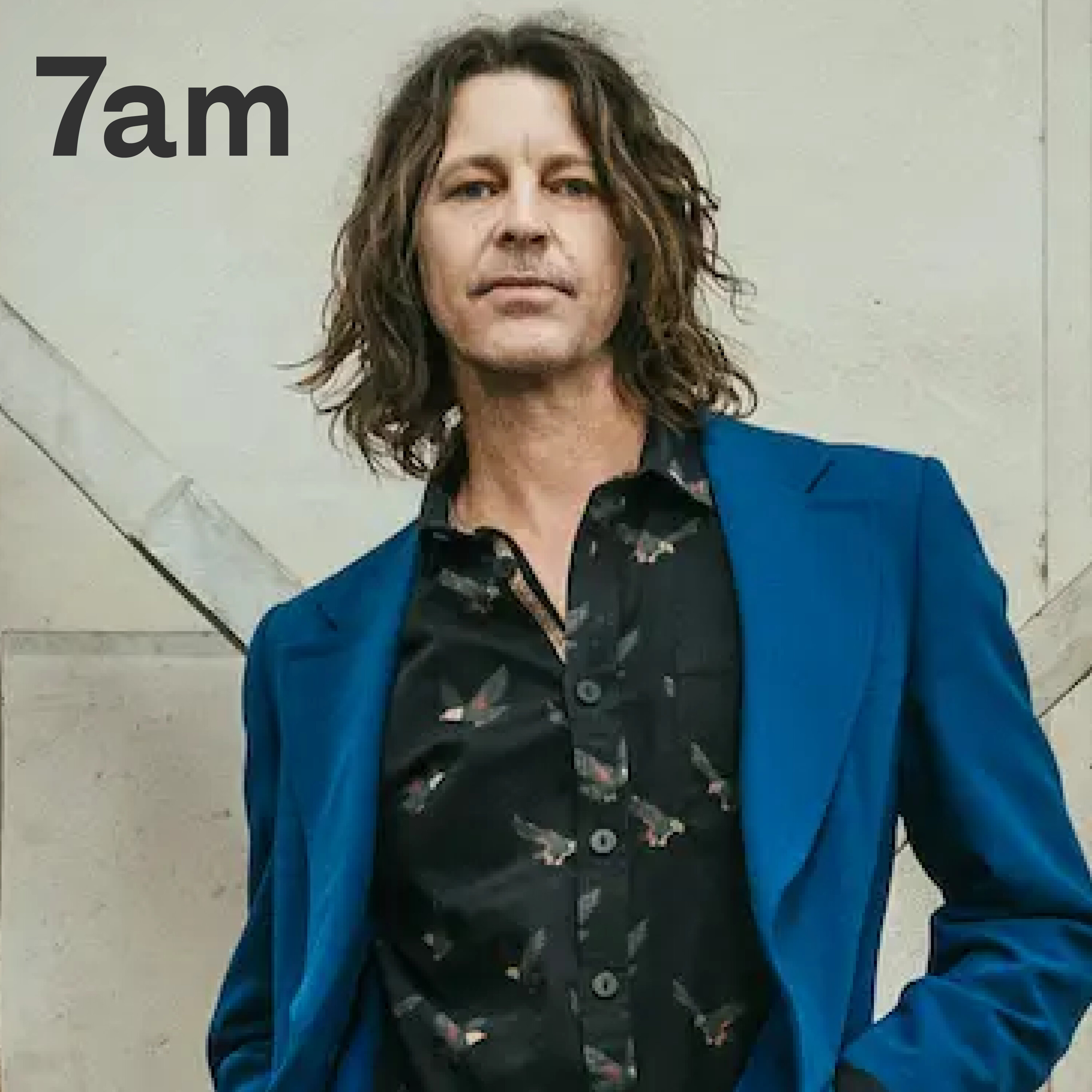
Loading summary
Transcript35 lines
- [00:04]
A
For generations of Australians, Powder Finger songs are tied to first loves, long drives, share houses, breakups and summers that still feel close enough to touch. They were written by people, played by a band, and carried by listeners into their own lives. Now that music has been found inside the machinery of artificial intelligence, harvested into vast data sets without permission and without payment. At the same time, the federal government is fending off whistleblower claims of a dirty deal with tech giants that would see AI access to Australian art in exchange for billions of dollars of investment. I'm Daniel James and you're listening to 7:00am today, Burnet Fanning. And what happens when machines are trained on our songs? And who gets to tell Australian stories, us or a
- [01:03]
B
foreign?
- [01:05]
A
July 6, Bernard Fanning, welcome to 7am For a whole generation of Australians, Powder Finger was the soundtrack of their youth. What did it feel like to hear that? That soundtrack, the band's entire original catalogue, had been used to train artificial intelligence without your consent?
- [01:28]
B
Well, it feels like you've been robbed, I guess. It's a violation. I mean, I'm not surprised. I wasn't surprised, to be honest. I mean, there's. There's not many lengths that these tech companies won't go to to further their own agenda. So, yeah, violated. I guess it's.
- [01:51]
A
It's very easy just to think of a catalog as a catalog, but can you give us some sort of idea of the years and the effort that went into creating that catalog to have it so quickly hoovered up by AI?
- [02:04]
B
Yeah, so I had a look at that Atlantic site the other day, which lists what's been used, and I think there was a. It was around 150 or 155 powder finger songs and then 55 of mine, my own solo songs. So that's over. I don't know, seven or eight albums from Powder Finger, which were kind of released between 1994 and 2009, I think. Plus I've made four or five albums myself, maybe more. Six. So that's, you know, 30 years of work, really. I mean, I haven't only written 200 songs in 30 years. I've probably written a thousand songs, but that's the ones that have been released and that were available to be scraped.
- [02:53]
A
You're part of a group of Australian artists who are speaking out after a whistleblower claimed that the federal government is considering doing a deal to let AI companies train on Australian copyright material like your music, in exchange for these tech giants investing billions of dollars into data centres and hundreds of millions of dollars into a fund for artists, David Pocock has labelled it as the ultimate dirty deal.
- [03:16]
B
When I raised this in the Senate, the Minister accused me of being reckless. He went on a personal attack, but didn't actually refute the claim, wouldn't rule it out. And I'm really concerned.
- [03:28]
A
What do you think about it?
- [03:30]
B
Yeah, I agree with him. There's the thing that I don't understand about it, is that it's even possible we as artists have entered into these agreements with labels or publishers or whatnot under those terms, and for that to then be just undermined by changing. Changing legislation, it seems absurd to me. I don't. I can't understand why it's even under consideration, especially given the. The current federal government has made a big deal about what great supporters of the arts they are. You know, our Prime Minister's a DJ and our arts minister is a, you know, frequent attender of gigs of Australian bands and whatnot. So I'm a little confused by it, to be honest, and I don't really understand how it's even a consideration. But the fact that it is means that it's kind of incumbent on us to speak out about it and make people aware of it.
- [04:28]
A
It would be a huge turnaround from the government, which just last year ruled out an exemption for data mining like this after it copped criticism from the arts community. I don't think at the moment, you know, AI understands what a lounge room in Shepparton, Victoria, smells like. It's like the innate human quality of the art and the authenticity that, you know, we strive to create, that our audience strives for and expects from us as artists. And, you know, quite simply, all we're trying to do is future proof that to make sure we have. How disappointed were you to hear that the question marks around this issue are still there when you thought, like the rest of us thought, that this issue was resolved?
- [05:21]
B
Well, I'm very disappointed. I mean, I think everybody understands that governments have, you know, responsibility to try to do the best by their constituents. That is the theory. Right. It appears that there's a lot more weight given to corporate interests in the modern political age. There's obviously the economic considerations of jobs and whatnot that, you know, the data centres would provide, however temporarily. I understand that, but if it comes at the cost of undermining Australian culture and a cultural identity, which is essentially what this will do, I mean, a machine can't write flame trees, you know, it just can't because it hasn't lived in a small town and experienced that anguish and Those difficulties that take really deep thinking to process and put into a song or a piece of art. And, you know, this isn't just songwriters, it's authors, it's visual artists, it's any journalist, you guys, academics. It's. It's a. I was trying to kind of think of an analogy, and this is very clumsy, but the best I could come up with was your neighbour, who you don't know, comes over, gets your mower out of your shed, takes it back to his place, mows his lawn and then puts it in his shed and it's his. Then. And then he rents that mower to all the other neighbours and he makes money off your mower. It's a. It's a ridiculous, absurd situation and like I said, it's very clumsy, but it kind of. That. That is essentially what's happening.
- [07:15]
A
We should note that the government says these claims are inaccurate. But does that ease your fears at all? Or would you like more assurances from the government? I mean, I guess the government could just come out and say, no, we're not going to do that.
- [07:26]
B
Yeah, they could just rule it out. That would end any speculation. We wouldn't even be having this conversation if they did it. And people are rightly up in arms about the fact that this is even being contemplated. So I think most Australians would acknowledge how much the arts are struggling.
- [07:47]
A
Yeah.
- [07:47]
B
In the modern economy. And Australian music, live music in particular, is. Is really struggling under that. So live music is actually the way now that musicians are able to derive an income, because the streaming platforms have just completely stripped away the idea of being paid for your recordings.
- [08:09]
A
Does it feel in some ways, Bernard, that, you know, given what's happened to musicians and revenue for recording artists over the years, particularly through the streaming platforms, that if this was to go through in some way, that this could actually be the final blow for a lot of artists when it comes to a recording career in particular?
- [08:28]
B
Well, I think so. For a recording career, I don't think anything will stop people writing songs. Nothing will stop me. It's a compulsion. It's something that is kind of a requirement in your life for your physical and mental health, you know, So I don't think people will stop doing it. It's just their ability to do it will be completely compromised. And, I mean, the biggest question is, what do we want our country to be? What sort of soul and identity do we want? And I don't want to sort of lean into jingoistic rubbish, but there is something that Australian music has brought to especially Contemporary music in the last 60 years, that is really unique. It's really unique and that should be preserved. And this idea that our music can be traded as an economic token or our ideas are somehow able to be our property is able to be traded away is ludicrous.
- [09:43]
A
Coming up, the responsibility we all have to protect Australia's Ark community. BERNARD Depressingly, a recent poll found 90% of listeners couldn't tell AI generated songs from human made ones. We're increasingly seeing AI songs make it to the top of the music charts. And a Sydney band affair yesterday hid out on Instagram after finding out that the act that played before them at a recent gig. Yeah, was actually AI generated.
- [10:14]
B
I saw that.
- [10:15]
A
I played a gig at Bootleggers in Newtown, Sydney, Sydney, and the artist that played before us was AI generated.
- [10:21]
B
Our band was playing as part of
- [10:22]
A
one of Bootleggers mixed bag events, the lineups of which are put together. Is the genie out of the bottle on this?
- [10:27]
B
I guess. I mean that kind of goes to a wider question about the regulation of AI doesn't it? And the idea that it's, it's Wild west at the moment, there is no regulation. I heard someone, an expert, talking about it recently saying that the toys that his three year old plays with are way more heavily regulated than AI And I think we're all cognizant of the danger that it poses. I mean, this is not to blanket rule out that AI is useful. It's going to be incredibly useful in a lot of ways and help us to solve a lot of problems, but it's not going to help us to process our experiences and our feelings and make them into a piece of art that are there for other people to enjoy and to take, take some value from.
- [11:19]
A
If you were starting out either as a solo artist or starting out again with Powder Finger, how much more difficult would it be now to start the career or to sustain the career that you've had in music?
- [11:31]
B
It would be unbelievably difficult. I mean, I don't think we can create the impression that it's ever been easy. You know, we were fortunate to come up in the 90s when the cost of living wasn't anywhere near as high as it is now. But we spent seven years before we were paid by Powder Finger just working, mowing lawns, using the neighbour's mower and doing traffic surveys. Whatever it was we could do in between touring to, to actually survive. And I know that young artists are doing that now. Most of them need to work full time to Be able to just pay rent and eat. It's becoming increasingly difficult. And I mean, part of that is, is that music and art in general, film too, they've been devalued so much in the last 25 years, so that now, you know, you have a subscription model where you pay 11 bucks a month for the entire history of recorded music. You know, you are probably around the same generation as me, Dan, and we used to pay $30 for one album, mind you. You know, maybe $2 of that went to the artist split six ways or whatever it was. Right.
- [12:49]
A
But. But it used to be. It used to be an event, too. Burn it. When you know that's a new powder finger CD or album was coming out, you'd go down to the local music store and you line up and you get it, and it would be an event. And so it's kind of been devalued in that. Just so much more easy to consume with so little effort.
- [13:06]
B
That's right. And this is. Obviously, we're talking about this as an Australian example, but this is also a gateway for that to happen to all the music that's ever been made, you know, and most of us that are interested in music treasure that. And I don't think many people would think that it's fair that. That it was just able to be used without permission and without payment, you know, and. And on top of that, it's just. It's fucking bad manners. And that's seriously lacking in society these days.
- [13:46]
A
Yeah, absolutely. 100%. Well, on that, I mean, we've talked about the government's responsibility and all of this. What about music fans? What responsibility do we have as listeners when it comes to AI?
- [14:00]
B
Well, I mean, are there many people out there going and searching for AI content? And I call it content on purpose because that's what it is. It's not music. It's content. It's just a series of ones and zeros that are aggregated. Right. I mean, we tend to think of musicians as. As people that you see at Splendor in the Grass or whatever. You know, you see them on stage and whatnot. But there's thousands more that are composers that write music for advertising or television or whatever, as well, that are obviously probably at even more danger than people that are writing music for kind of general public consumption as a, you know, as a band or whatever. So there's so many layers to this that the public has a responsibility, I suppose, to refrain from using it. But also that also goes to advertising agencies, film soundtrack directors, and whatnot, to not use it because it's actually undermining the entire industry.
- [15:08]
A
Yeah. There are several different points in which people can choose not to use it and I guess that goes to listeners as well. Finally, Bernard, how do you see the future of music and art more broadly if we don't create solid boundaries and regulations around AI? What's your greatest fear?
- [15:25]
B
Well, I think it's probably the extension of the idea that already exists that it's not a real job. You know, the idea that working on a piece of art or a film or whatever it is, or a song or a book is something that you should do as a hobby. And the devaluing of, of art has already been happening at pace for quarter of a century. And this will accelerate it massively. Absolutely massively. I mean there's lots of kind of phrases like late stage capitalism and whatnot. This is about money. This is about companies that are already incredibly powerful, have massive amounts of capital capital behind them looking to save money for themselves at the expense of other people who are trying to create something. And it's a pretty clear representation of where we're at as a society worldwide that money is the new God and it's taking center stage over everything because our leadership is failing on so many levels.
- [16:43]
A
Yep. The stakes are very high. Bernard, thank you so much for coming and speaking to us on 7am no worries.
- [16:48]
B
Thanks Dan. Nice to talk to you.
- [17:01]
A
Also in the news, the family of a Thai teenager allegedly murdered by an Australian man says they want the legal process to take its course. In Thailand, people facing criminal charges are allowed to pay victims or their families compensation as a show of remorse and to reduce their jail time. But the father of 17 year old Tanjanuk Dhol Hamar says they don't want the accused money. If found guilty, 45 year old Simon Carmen could face life in jail or even the death penalty. And the Australian Space Agency is examining suspected space debris which washed ashore north of Townsville over the weekend. An exclusion zone remains around the four mystery objects found on Forest Beach. Experts say that the shape of the objects suggest they may have come from a large satellite or rocket. I'm Daniel James. Thanks for listening to 7am we'll be back tomorrow.