Loading summary
Transcript14 lines
- [00:02]
A
I'm Ruby Jones and you're listening to 7am. Since the ceasefire was announced late last year, Gaza has dropped out of the headlines. But the horror of living there hasn't stopped. Israel has killed at least 857people in Gaza and wounded almost 2,500 in near daily attacks since last October. And Palestinians are still in a daily struggle for survival. Independent journalist, author of the Palestine Palestine Laboratory and filmmaker Anthony Lowenstein recently traveled to the Middle east and has been speaking to people in Gaza. Today he tells us about what he saw on the west bank and the future for Palestine. It's Wednesday, july 8th. So Anthony, you've recently traveled to the Middle east, including to the west bank, which I want to ask you about. But to begin with, obviously it's incredibly difficult to get in or out of Gaza at the moment. But I know that you spoke to people there and have been speaking to people regularly. So could you start by telling me a bit about what they say to you about what life is like in Gaza right now?
- [01:18]
B
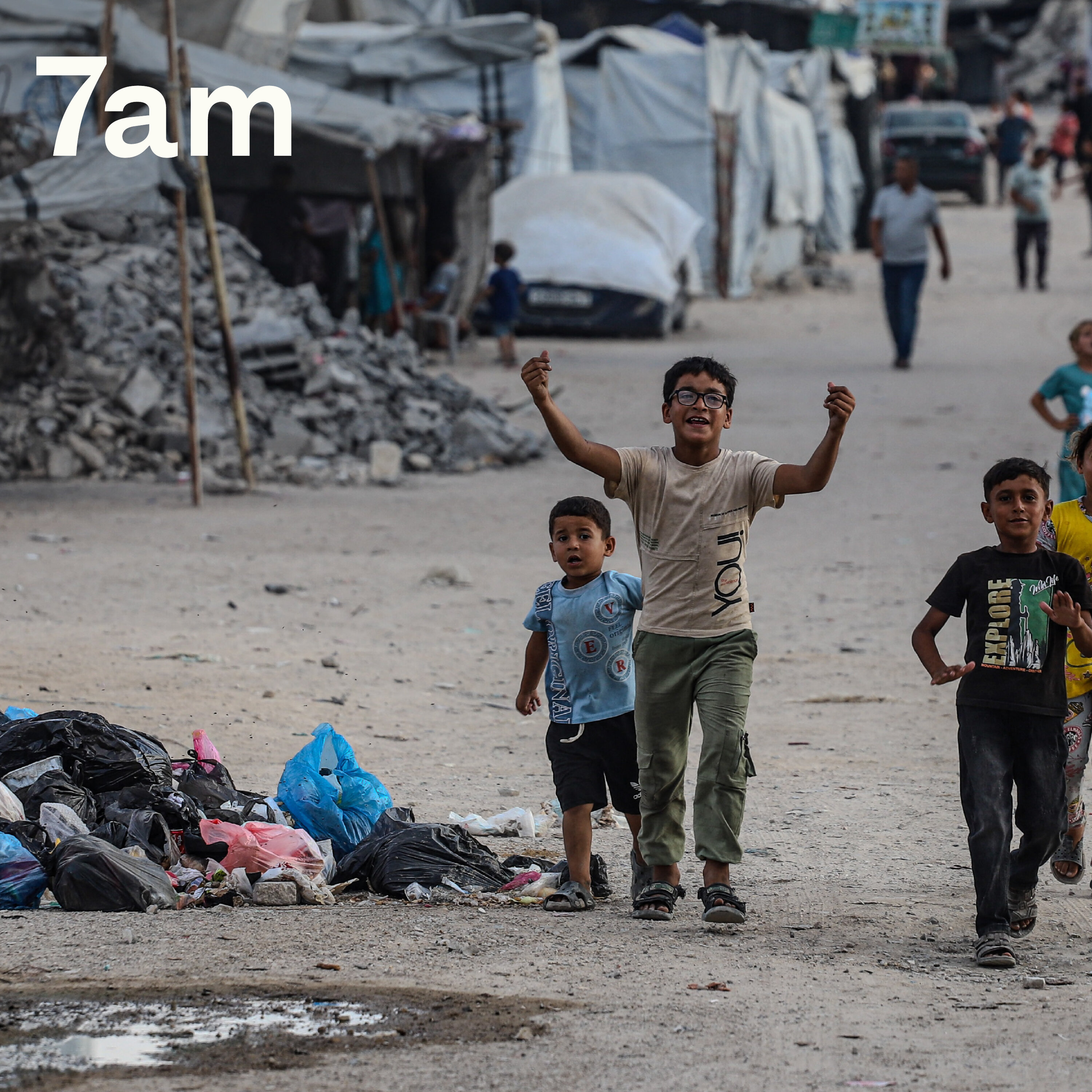
Yeah, it's worth just reminding people that the situation in Gaza obviously is being. Or the war, the genocide has been going for nearly three years and basically no international journalists have been allowed in, apart from a handful who will take official Israeli military tours. Some have done that. It's obviously a propaganda tour, but if you want to be an independent journalist, no one's getting it. Literally nobody. I have got a number of contacts in Gaza who are Palestinian, who are living there, including a doctor who I've had contact with for a while. One of the things, the real challenges he says to me is people have no home. There's no sense that things are going to change, that there's no rebuilding, there's no pathway, there's no sense of a future. There's Israeli government ministers literally saying every day our goal is still to remove all Palestinians from Gaza. Not talking about killing them all, but finding countries that will take them. So when I speak to this doctor, he said to me recently he organized this day for kids. I saw photographs, these kids were maybe 8, 9, 10. And to try to give them some color, some fun, some enjoyment, they were playing games, pretty basic stuff that any kid would enjoy. But because these children have been through such hell for the last three odd years, he said the kids really enjoyed it. It was almost to take their mind off the horrors when they leave this place. And he showed me the photos, there was balloons up and streamers and just trying to give a bit of, you know, basic stuff that any kid in the world really enjoys, or adult for that matter. And. But then they go back to their grim reality where this finally he showed me also photos of there's no decent sanitation. And this is across the whole of Gaza. So diseases from this lack of sanitation is rampant. There's lots of stories of when people are sleeping in their tents. Don't forget it's the middle of summer there, so of course it's incredibly hot. There are lots of rats running around all of Gaza biting, particularly when adults too, but particularly kids getting lots of diseases. It's completely, it's still apocalyptic. I mean, that's the best way to describe it. It's both what he has said to me, this Gazan doctor, and what I'm hearing and one other story, just briefly would be worth telling is that a friend of mine, Palestinian, who has family still in Gaza, she's left, she was telling me that recently because there's no sanitation, people have to find their own way to go to the toilet, basically. And this family member was digging a latrine pit away to dispose of human waste. And while he was digging that, he fell in and he couldn't get out. And she was telling me about just the fear of this, that this person thought they were going to die, they could not get out, someone else goes to help them, they also fall in. Now you can just sort of, when I tell that story, you can almost just picture the sense of think about 35, 40 degrees, the smells must be just unimaginable. They eventually got out, they survived. But that level of desperation and really just the most basic daily tasks are Herculean. And it's hard not to feel both devastated and infuriated that this doesn't get much coverage anymore.
- [04:39]
A
Hmm. Yeah, it doesn't. And a lot of that is to do, obviously with the war in Iran taking up headlines and the fact that there has been a quote, unquote ceasefire in place since last October. But bombs haven't stopped falling, attacks haven't stopped happening in Gaza. Tell me about the scale of what we still are seeing happen since last October.
- [05:00]
B
The number of Palestinians who have been killed since October, the vast majority of whom are civilians, is at least a thousand. That's what a so called ceasefire means. So when a lot of Palestinians hear the term ceasefire, whether it's in Gaza or Lebanon or elsewhere, they're rightly skeptical because they just look at it and go, well, this is what's been happening to us. I've seen footage, some other people may have as well, of tents on fire, people literally Being burnt. Israel bombing tents where civilians are sleeping are living. There are some Palestinians in Gaza who do live in homes, but when I use that word, I use it advisedly. They're often crumbling. But what people are telling me there is the lack of access to food. Food is incredibly expensive. And I think one thing also people need to understand, when the so called ceasefire was signed, there was a sense that Israel was going to control roughly 50 or so percent and Hamas basically the other 50%, give or take. Well, here we are in July 2026 and Israel now controls about 70% of Gaza. Now the other 30% are roughly controlled by Hamas. But it's worth saying that what Israel is doing to try to get more than 70% is fund and army Palestinian militia groups to fight Hamas for them. In other words, to try to cause a civil war or civil unrest. Now, there's been some reporting about this. I've heard this from my own sources as well. This is kind of the divide and conquer mentality. So when Israel has now controlled 70%, there's no rebuilding, there's no rebuilding materials getting in, there's no pathway. The so called Board of Peace that Donald Trump and others have been backing is kind of in quasi limbo. They have meetings in Cairo, but doesn't really go anywhere. There was a story in the Guardian just this week talking about how the Board of Peace wants to give themselves legal immunity in case they do something that someone doesn't like. I mean, it's kind of a. It's all a sham. And what. Meanwhile the Palestinians themselves are living in this state of limbo is too mild a word, Ruby. In a state of they're alive, but they're basically the living dead.
- [07:26]
A
Yeah, because we're supposedly in phase two of a ceasefire in Gaza now, where the aim is supposed to be demilitarization and reconstruction. But you're saying none of that is happening on the ground?
- [07:39]
B
None of it's happening on the ground. There's no rebuilding. I mean, the vision, so to speak, that's been put forward by Donald Trump and Jared Kushner, his son in law, who has no official role in a weird way, but yet is apparently the one who's leading. This is, as people may remember from a number of months ago, kind of skyscrapers and beautiful beach resorts. I mean, just delusional nonsense. No, Palestinians in Gaza A, want that and B, they're living in tents that are being bombed. So when you have the Australian government talk about, oh, we're very glad that there's a ceasefire, you just Want to say what planet I live on. They know what's going on, they know. They don't want to, I guess, kick the hornet's nest, so to speak, namely to be too critical of Israel. But they know there's no ceasefire. There's a ceasefire in name and there's no rebuilding. And as I said, the Israeli government, literally every week, including this week, again, a senior Israeli government minister saying her ultimate goal is to kick all the Palestinians out. Today, the IDF holds nearly 70% of the Gaza Strip. We must complete the conquest of the remaining 30%, defeat Hamas and above all, we need to establish a belt of Jewish settlements within the territory of the Strip. That's his words, not mine. So it is, yeah, as grim as you could imagine, Ruby.
- [09:01]
A
Still to come, the future for the West Bank. Let's talk a bit about the west bank, because you actually did go there. You spoke to people, you traveled around, you went to some fairly remote parts of the West Bank. Can you tell me a bit about what you saw?
- [09:19]
B
One of the things that people need to understand is that when you're in Israel itself, it can seem like everything is normal. When I use the term normal, obviously this is a time where there was still Iran and the US and Israel at war. So when I say normal, I use that term very advisedly. But if you're in Tel Aviv or even Jerusalem, you don't see houses being bombed, you don't see settlers running wild. You drive for an hour or so. I was in Tel Aviv, I went to the west bank. And as soon as you cross into the west bank, you start seeing a few things. One, which was not there before October 7, kilometre upon kilometre upon kilometre, every few meters of Israeli flags, literally the entire way around the west bank, which obviously is a statement to say this is ours. I was there on a day where it was 35, 40 degrees, searing hot. It sort of feels like biblical times. There is barren ground. I mean, I spent time with the family there who lived in literally caves. They literally live in a cave. They were petrified, not of us, but they were petrified of their day to day life. Settlers come there regularly to assault them, to abuse them, to kill their sheep. There's lots of footage, people may have seen some of it of settlers burning Palestinian olive groves, burning their farms, killing their animals, assisting the dispossession of Palestinians. I mean, this is what the occupation means. A centuries old olive grove in ruins, flames licking at the stones of a 5th century church. And then the Israeli army comes to assist the settlers and the goal is clear, is to kick them off the land. And what we've seen, and I saw this time and time again, I heard this from people, is that eventually people have a breaking point. You're not going to spend if you have a family, not going to live in a place where you feel literally threatened every day. So what happens? These Palestinians leave. So the village that we went to, and I say village, we drove for an hour on this really rocky, difficult road, got to this area, there were Palestinians who started talking to us about what they'd experience with settlers. The settlers were coming literally every day, attacking them. Often, because these areas are so remote, people can't get access to water. So Palestinians have to pay water trucks to come and deliver the water. But often the settlers block that water, so therefore they don't get water. It's the middle of summer. I mean, it is grim. And people might say, well, why do they live there? Why don't they go somewhere, which is easier? I mean, the response to that is, well, this is their homes. I mean, some of these people have been there for literally generations. They have rights to this land. And yet all the people that we met, the Palestinians, were basically saying. They didn't quite say it like this, but it was implied. We don't know how long we're going to be able to survive here. So what I saw was, on the one hand, not overly surprising as someone who's been reporting on this for 20 years, but also what shocked me in a way was it has gone so far worse than what it has been in the past, particularly since October 7, because the world was focused on Gaza. Whereas in the west bank, the plan is clear as it is in Gaza. Ruby. The Israeli government plan is to remove all Palestinians from the West Bank. That remains the goal. There's 3 million of them. To make life so impossible and unlivable that Israel, again, is trying to find places where they will be forcibly moved. This is the goal. It's not simply, oh, we should stop some settler violence, that the Australian government says. This is not the issue. Of course, settler violence is terrible, but the broader picture is to make life impossible for Palestinians in the West Bank.
- [13:03]
A
But that doesn't have broad U.S. support. I mean, Trump has publicly opposed annexation of the west bank many times. The partnership between Trump and Netanyahu is less stable than it has been for the past few years. At this moment in time, do you think that the US is likely to try and intervene at all in terms of what's happening on the West Bank?
- [13:23]
B
If only if only. Ruby. I mean, this is the same argument that was made when Biden was president where we kept on reading stories and certain outlets that Biden is very upset with Netanyahu around what's happening in Gaza. And yet the weapons and the support kept flowing. I see a lot of the supposed issues between Trump and Netanyahu and J.D. vance as kind of theater. They may well be pissed off with him, they may well think that he's a bit of a rogue, but ultimately they're not stopping anything. Like what are they, what are they stopping? The weapons are still going, the support is still going, the diplomatic backing is still going. And I don't really think that there is any concern for the lives of Palestinians. I mean, do we think Donald Trump cares about Palestinians or J.D. vance for that matter? I think that the U.S. could play a hugely important role in stopping what's going on. And of course issued annexation is. It's happening anyway. Ruby. Maybe not officially annexation is happening. It might not be officially declared, but this is what is going on. So on the one hand, there has never been more support for Palestinian rights in the West. Poll after poll after poll shows that support for Israel is in the toilet. And yet on the ground lives of Palestinians has become impossible. And I fear in years to come that there will be very few Palestinians left there. I mean, that is the trajectory and it's petrifying.
- [14:53]
A
Anthony, thank you so much for speaking with me.
- [14:56]
B
Thank you, Ruby.
- [15:07]
A
Also in the news, Anthony Albanese says Australia wasn't given enough notice after China's missile test in the Pacific yesterday. The Prime Minister says there should have been 48 hours warning before the test was launched. He spoke at a press conference alongside his Solomon Islands counterpart, Matthew Wale, who condemned the exercise, saying it's not something a friend does. And the NRL has announced the most expensive rights deal for an Australian code in sporting history. Nine and Foxtel unveiled a $5.3 billion agreement to continue airing rugby league until 2034. The Foxtel boss dodged questions about whether the extra money being paid would see subscription costs hiked. For sports fans, I'm Ruby Jones.
- [15:50]
B
This is 7:00am thanks for listening, Sam.