Loading summary
Transcript33 lines
- [00:02]
A
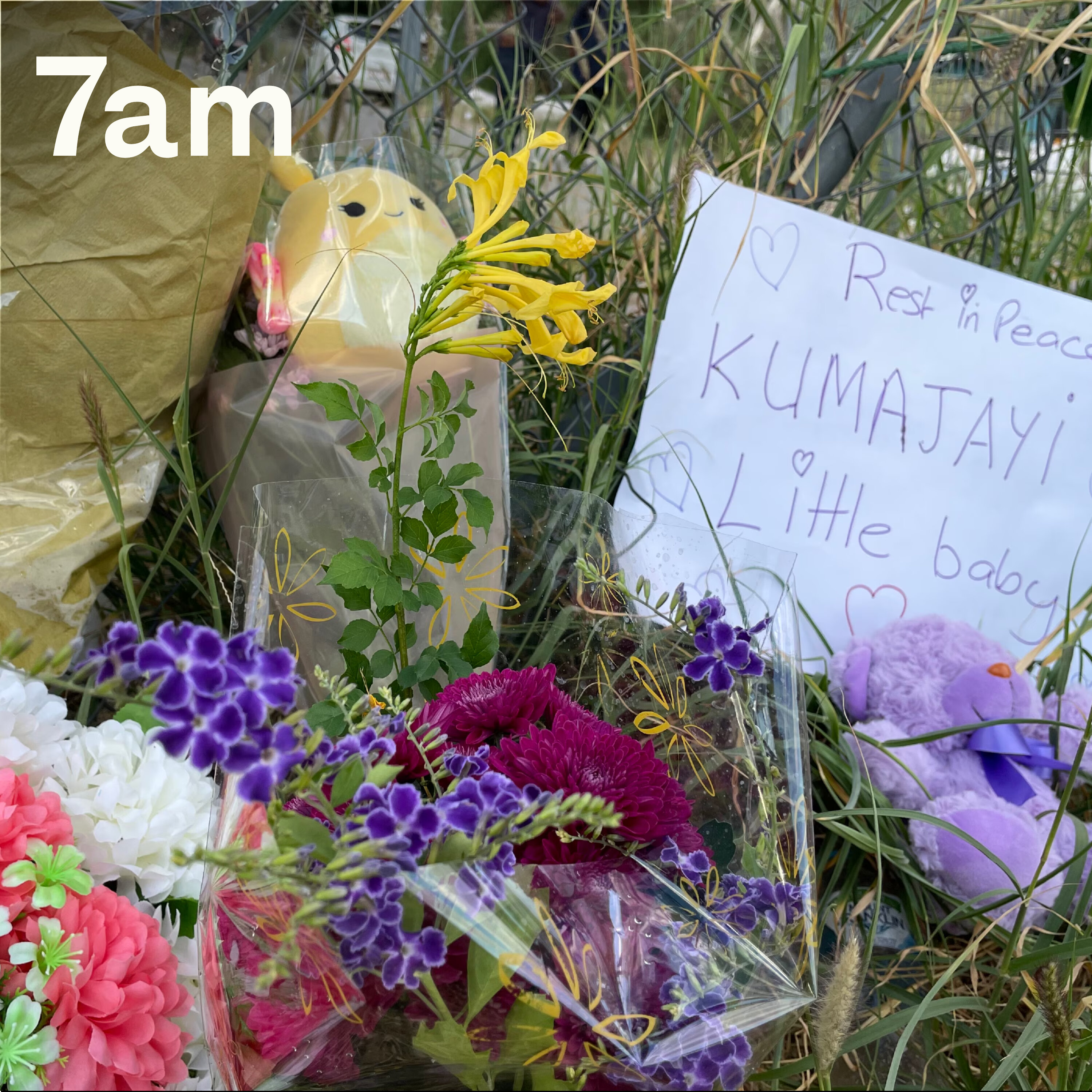
My name's Robyn Jabunanga Granite and I'm the grandfather of our little baby, Kumanye Little. Who is the queen? Who's our little queen? And we ask that everyone, Yapa and Karia are together in respecting this time of sorry business and mourning.
- [00:25]
B
On April 25, little baby was reported missing from her bed at the Old Timers Town camp just south of Alice Springs. Five days later, after a community unifying effort, her body was found. She was five years old. Soon after community members found the man accused of killing her, they called police. And now a 47 year old man has been charged with murder and other charges we can't mention for legal reasons. For the past week, as her family and community have mourned, Alice Springs in Batway has once again been placed under the intensity of the national gaze. Its grief, anger and calls for justice broadcast across the country.
- [01:10]
A
We must now let the justice system do its work. I also ask all our politicians, leaders to be respectful of this sorry time. We too need to work together on this, on many issues facing our people and communities here in Central Australia. But our little babies passing must not become a politician issue or an argument.
- [01:44]
B
I'm Daniel James and you're listening to 7am today, the chief executive of Stake, the national peak body advocating for Aboriginal and Torres Strait Islander children and young people, Catherine Little on Kumenjayi. Little baby, the grief in Mbatwe and the questions that need to be asked without turning her death into another political fight. It's Tuesday, May 5th. Catherine, you've been up in Alice Springs during this horrendous event. Now that things have settled down, the alleged perpetrator has now been charged. How is the community doing more broadly up there?
- [02:29]
C
I think the way our community is doing is the way the rest of the nation is doing. If you're feeling sad still, we're still feeling sad. Every now and then people are angry. You still get a bit angry because this, what has happened is absolutely horrific. It is absolutely horrific. Might be responding at any point in time, might depend on where you're sitting or what you can see. I know that many of the volunteers are still feeling very traumatised, as is anyone who lives on a town camp. And part of that concern for a lot of people has been, you know, how do you respond to moments in time like this? When the alleged perpetrator was found, you know, he was found by community. It was community that rang the police and said, we have found him. And there was that moment, and the violence in that moment is not Acceptable violence can never be acceptable. But it was a flashpoint at the Alice Springs hospital. Situation critical. Get more Amanda. It will be tonight. A kind of chaos our nation rarely ever knows. Tensions red hot in Australia's red centre.
- [03:37]
A
They smashing the cars up now.
- [03:39]
C
For Alice Springs police, it was a choice of run or hide.
- [03:46]
A
So last night, the Northern Territory police apprehended Jefferson Lewis. During that apprehension, our police were assaulted. Ambulance officers were assaulted.
- [03:56]
B
We conveyed Mr. Lewis to the Alice
- [03:58]
A
Springs hospital, and shortly after, a large
- [04:00]
B
crowd gathered and tried to gain access to that hospital and access to Mr. Lewis.
- [04:05]
A
Police responded and we called out all the resources we had available to quell that violent disturbance.
- [04:11]
C
And that flashpoint, even that, while completely unacceptable, was a moment in time in a community that is a microcosm that was incredibly heightened. And there was so much misinformation on it, like things like saying it was payback, when in actual fact it was not payback. And Mr. Granites has been very clear on that and very clear in that he didn't want people to behave like that. And people now have to settle down and be calm. And I think that's probably the voice we need to listen to most on this. That is what Aboriginal leadership is about. The person with the authority to speak has told us it's time to mourn. And I know. I heard him when he was speaking to a group of us last week talking about Kumunjay. Little baby. But little baby is how he describes this little one. And he says, you know, I love my little granddaughter. I love that little baby. And there's nothing more I can do right now than say thank you to everybody who's cared for her, everybody who stepped out there, everybody who wanted to help. And now all I can do is cry. And I think that's what he's reminding us to do. It's okay to cry.
- [05:25]
A
We still are feeling very, very sorrows. And we've got people coming in still coming up to us and shaking us and hugging us and crying.
- [05:37]
C
We.
- [05:37]
A
We like that for the people because it makes us think that we are all together in one.
- [05:44]
B
What did you notice about the way the police and community work together? Is there a chance that through this horrible, horrible circumstance that there could be an opportunity for a better relationship between police and the Aboriginal community up there?
- [06:00]
C
Look, I think we've heard that very strongly that the incredible unity that was shown and those of us that have lived in Alice Springs all our lives know this. We know that that is the story of Alice Springs, you know, that is Our home. And we have lived there forever. You know, people like my family, traditional owners, we've lived there for generations upon generations, and it has always been famous for coming together. And I think a lot of what the locals are saying is, wouldn't this be nice if this is what we return to the personality that we have always been famous for. A personality that is overridden by flashpoints in time and stories that are not told by us. Even the story of Kumanjayi little Baby. How many of the stories that listeners might be listening to were actually told by the spokesman himself, Mystic Granite?
- [06:54]
B
One of the things that we've been thinking about nationally is that you only hear about Alice Springs in Bathway. When something terrible happens, is that frustrating? And does that make people in the town and in around the town camps more sensitive to the national gaze when something like this happens?
- [07:13]
C
Yeah.
- [07:13]
B
What do you want people to know about the town beyond the headlines?
- [07:17]
C
Alice Springs is an amazing place. And, you know, I don't think I'm biased. I am a traditional owner, and traditional owners have fought very hard for the reputation of our town to be one that reflects what is actually there. You know, even as you land and you have to go through those incredible ranges, you know, our ancestors, the great caterpillars who once defended us, decapitated in war, and those stories written into the landscape all around Alice Springs. So I think even if you are not familiar with how to read those stories, you certainly can feel it. But we can't shy away from the fact that we've got some really challenging social issues. We really do. Where you have high levels of poverty and people that are disenfranchised, you are going to have some really challenging social issues. But it is part of the fabric. And when those things and the flashpoints in time are told by others, then what happens is people don't want to come, they don't want to visit. For example, the riots in Alice Springs, is that actually what happened? Was it a riot? Or were there a lot of people that were gathered and they were angry and they were agitated and they reacted at a moment of extraordinary emotion? And I'm pretty certain listeners have all felt some of that extraordinary emotion. Again being very clear, I'm not making any excuses for that, but it was a flashpoint in this whole conversation. And how much of the story has been on that moment in time, as opposed to thinking about what we should be thinking about, and that is a little girl has lost her life in the most horrific circumstances. And right now, her family is calling for peace and calm and to grieve.
- [09:16]
B
Still to come, questions around why and how the alleged killer was released from jail. Catherine, the family has asked politicians not to turn Kimadjaya little baby's death into a political issue. How do we respect that while not trampling on people's griefs, while still asking serious questions about how this happened and what has to change?
- [09:39]
C
Look, there are some really tough questions that have to be asked. There's absolutely no doubt about it. And what they're saying is put the attention where it needs to be. And the biggest question is how did someone get released from a camp 500 kilometres away and end up in a town camp in Alice Springs? Someone that's been released from custody end up in a town camp with no money, not given any financial support, no transition of living conditions as you reintegrate into society. What we know about things like prisons is the more contact you have with them, the more likely you are to be caught up in a cycle. The more times you have contact with it, the more violent your crimes are. But while we're concentrating on these, you know, tough on crime laws, what we're doing is putting people into those conditions that the fact is, worsen the type of offending that we're going to see. So they're some of the questions that are going to have to be asked as to how this happened. Because what happened to this little baby girl was not a failing of her parents. She was loved. What happened to her was not a failing of our community. The alleged perpetrator was released from prison with no eyes on them and nowhere to go.
- [11:04]
B
After a case like this, governments often reach for tougher policing, more surveillance, more restrictions, and then in some instances, more child removals. What would be the wrong lesson to take from common jail? Little baby's death.
- [11:18]
C
Yeah, and I think that is one of the concerns that we're hearing from the family, but from Aboriginal people more generally. Stop blaming us. Again, this. How do you even describe it? You know, I think people are just so tired of banging their heads against the wall. The conditions on town camps have been known for a very, very long time. It wasn't the conditions of camp that were responsible for what happened in this moment in time. And often when we start talking about those types of things, we start turning our blame on the people who were victims themselves. And that is something that we saw with the little children. A sacred report. It is something that we've seen in all of the inquiries. And I want to be clear, there have been so Many inquiries into aboriginal people and Aboriginal children. But for town camps, there is nothing there is not already known. We know that people in town camps live well below the poverty line. We know that overcrowding in indigenous communities has been a massive problem for a very long time. What's new is the number of offenders being released from jail and turning up on town camps. What is new is the sheer size and tune of people going into our justice system. Because tough on crime to be effective doesn't mean we're going to punish issue after something horrific has happened. Tough on crime means, you know what, we're going to divert our attention now into investing in the structures and services that we need that genuinely keep you and your family safe. And they are system structures.
- [13:00]
B
Katherine Kalindrye Little Baby's disappearance received national attention, but that is unusual when it comes to the disappearance of aboriginal children and women in this country. Historically, so many other missing aboriginal and Torres Strait Islander kids don't get that type of attention. Do you think that this horrific case could be a turning point in terms of the national gaze on these issues?
- [13:22]
C
I would hope so. I really, really would hope so. And I think we've seen two things recently that are slightly different now. I want to be really clear. The mainstream media didn't pick up this story until community came out, right? So Baby Girl was missing for nearly 48 hours before it was picked up by mainstream. And it was picked up because of the sheer number of people in the local community that heard about it and came out en masse and said, we're going to donate, we're going to volunteer, we're going to talk about it, we're going to look for baby Girl. We need to bring her back to the arms of her mother. There were hundreds of people that gave up their time to walk through grass. Up to your on me. I'm pointing to my eyes if you can't see me in quite hot conditions, you know, and we've had big rain, which means there's snakes everywhere. And people were out there, they put on their jeans and they put on their boots and they said, what matters is finding kumje little baby. And you can do that in a microcosm. You know, Alice Springs is a microcosm. We're only 22,000 people. So when hundreds of people in a community that small come out en masse, it absolutely changes everything. Everybody's talking about on Facebook. It's at scale. Even though we're a smaller community the other time, we've seen it in recent moments. Has been the alleged bombing attack in Borlu. And again, that was something completely ignored by mainstream media, pretty much ignored by mainstream media and everybody else, until the community picked it up more broadly. And Australians said, did something horrific just happen?
- [14:57]
B
Just to be clear, Katherine, this is the alleged and attempted terrorist attack on the Australia Day Slash Invasion Day rally in Perth.
- [15:04]
C
Yeah, correct. Yes, correct. That is what I'm talking about. And again, completely ignored. And if it hadn't been for the National Indigenous Times, it wouldn't have been anywhere, really. So it was a conversation more broadly from Australians that said something really horrific has just happened. Why are we not paying attention to it? So I would hope that it's a turning point. I really would. And I think what we saw with Australia mourning more generally is there is a genuine concern and a genuine love for our children. And I think what Australians saw was, despite this horrific story that is often told about Aboriginal children, Aboriginal people fight very hard for their children. Aboriginal people love their children and are fierce about their children and will do anything to find them. And maybe for the first time ever, because the amount of tension that this story has received, maybe for the first time ever, that is front and centre on the consciousness of all Australians, Aboriginal people love their children.
- [16:09]
B
Catherine, thank you so much for your time.
- [16:12]
C
Thank you.
- [16:16]
B
And if this story has raised any concerns for you or someone you know, please contact 13 Yarn on 139276 or Lifeline on 1311 14. Also in the news, research company Roy Morgan has urged the Reserve bank not to raise interest rates when it meets today, saying it would be an historic mistake. It argues that key economic indicators show our economy is already in a weakened state, warning a rate rise would likely plunge Australia into a recession we don't have to have if we aren't already in one. But experts say there's nearly an 80% chance the RBA will deliver its third straight interest rate hike. And the Royal Commission into anti Semitism hearings will continue today. After kicking off in Sydney yesterday, the daughter of one of the Bondi victims told the commission there's been a massive shift in anti Semitism after the October 7 attacks and that in the wake of the Bondi massacre, she's received hundreds of comments saying she should have been killed too. I'm Daniel James. You've been listening to 7am we'll be back tomorrow.