Loading summary
Transcript23 lines
- [00:01]
A
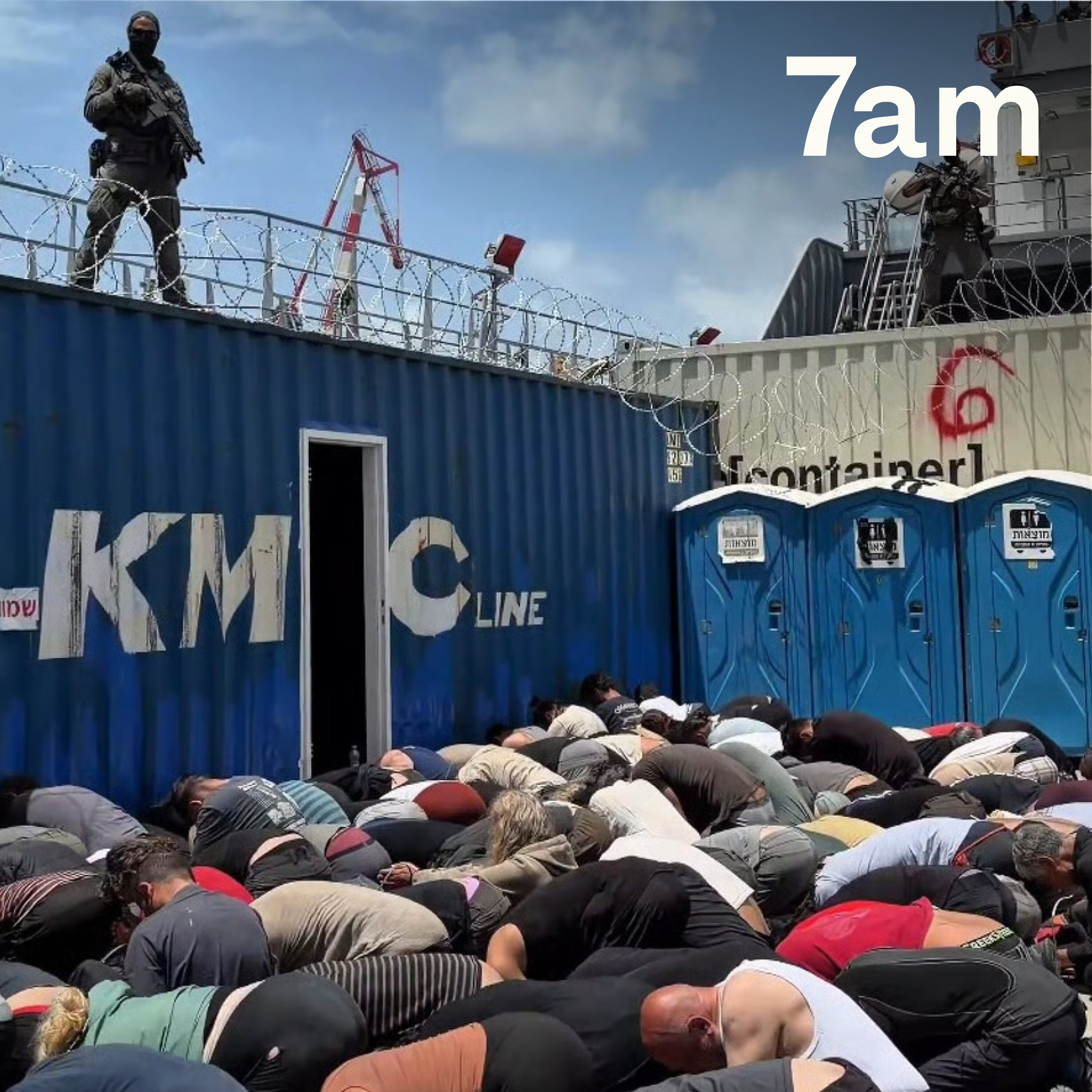
Who says renting can't feel like home? Make your rental feel like yours. It all starts with one scroll. Download TikTok to discover easy home decor ideas. This is part two of a two part episode. If you haven't already, go back and listen to our conversation with flotilla participant Juliette Lamont. I'm Ruby Jones and you're listening to 7am. Lawyers for the Australians detained after Israel intercepted the Global Samut flotilla are now building a record of what happened. They're reviewing footage, collecting medical evidence and taking witness statements alleging beatings, humiliation, denial of food and water and detention in harsh conditions. The legal team says the evidence points to serious abuse of Australian citizens and amounts to crimes. So now the Australians are home, the question is what happens next? Whether Australia will do more than condemn and whether Israel will face any consequences. Today, human rights lawyer Bernadette Zaden, who represents the 11 Australians on the Global Samud Flotilla, on what accountability looks like. It's Tuesday, may 26th. So, Bernadette, you've been talking to people who were on the Global Smood Flotilla. You've been taking witness statements about what happened to them. So to begin with, can you just tell me about what they're saying about the stories that you're hearing?
- [01:41]
B
Yes. Hi, good morning from Istanbul. I am on the ground and I have come here to get witness statements and also to get evidence that will then be put together so that we could consider next steps for the Australians. What the legal team's hearing is evidence of some really horrific crimes that have been committed against our citizens. And these range from, you know, broken bones to bruising, to the face bruising, to the body, and they are really severe. I yesterday took photographs of a woman who was. You could see the whole hand of the officer who you could see it imprinted on her skin. I don't think I saw anyone without a bruised eye. So what I'm hearing is there are citizens and citizens of the world who have been subjected to some really horrific torture, like what I would consider to be crimes. And so I was up quite early this morning because some of our citizens, as you know, have returned home. And I have been alerted to the fact that on their return, Border Force had taken away their phones, all their devices, took their passwords and for 20 minutes took these away. So I've made inquiries with the Australian government, with dfad. I've asked what was the purpose of taking their devices and I'll wait to see what they say and for them to give me clarification because on the one hand, I am here to document what we are alleging to be crimes committed against our citizens by the Israeli military. But on the other, I am being advised that the Australian government appears to be treating our citizens as suspects.
- [03:37]
A
And so what do you anticipate you will do with these briefs that you're compiling and this evidence, what's the purpose of gathering it all?
- [03:44]
B
Well, of course, it's to gather them so we could give our citizens legal advice, so we could tell them what their legal options are. And look, I do want to say that we have written to the Attorney General's office and I have foreshadowed that this evidence will be provided to her office in the hope that they will investigate and look into what we are alleging to be crimes that are committed by the Israeli military. And from there, we will see where we go.
- [04:17]
A
Ok. And recently, Israel's ambassador told the ABC here in Australia that no one on the flotilla was harmed.
- [04:23]
B
In fact, the whole flotilla was dealt with great sensitivity. No one was hurt. The interception was done very smoothly.
- [04:31]
A
So, based on what you've heard, what's your response to that?
- [04:34]
B
Look, I want to say that that's shocking, that's surprising, but it's not. It is a pattern that we see that Israeli government officials do shield the Israeli military's crimes. And what I would say to him is that is incredibly misleading and he should not waste his time on trying to gaslight us. We have the evidence, we have the photographs, we have medical reports, we have people in hospital. So what I would say to him is, you know, get real, mate, just get real. And this is not going to assist his government in trying to, you know, gloss over what they've done. And, you know, I do want to also say that we are really looking into the detail of what happened and who committed these crimes. So what I would say to him is this is, you know, the same argument over and over again. Israeli military has done nothing. But we know, even Australian lawyer Chris Sidoti has come out and said that, you know, the Israeli military is one of the most criminal armed forces in the world and we see that the crimes are committed against our own citizens. So it's just absolute nonsense and misleading. And don't tell us what we see before our eyes.
- [06:00]
A
The people who were on the flotilla, they were attempting to deliver food and medicine to people in Gaza. And that action, that's protected under humanitarian law. So do you mind just explaining to me how that works and what your argument is around the kind of the legal status of the people who were on the flotilla and how they were then treated.
- [06:18]
B
International law permits humanitarians to deliver aid. And that is the fundamental principle of the Global Smooth flotilla, is that they intend on delivering aid in compliance with the law. And this is life saving aid, which the people of Gaza have been denied for years and years. So under international law, you cannot staff people, you cannot place a siege on an entire population. You must allow aid to get in. Governments are obliged to actually make sure that aid does get in. But where governments fail to do so, then these civilians have decided, well, we're going to take matters into our own hands. We are going to comply with the law and we are going to attempt to break the siege and deliver aid. Now, under international law, you and what we know from the United nations, there's a report after report that says Israel must lift its siege on Gaza. It must let aid flow in. We have seen trucks in the Sinai Desert that's waiting to be let in and Israel refuses to let it in. We also see illegal settlers who have destroyed aid on those trucks. So you have civilians who have made the decision whether we agree with it or not. They have made the decision to arm themselves with aid and comply with international law and then sail to Gaza. So look, international law is clear. We will also argue that maritime law has been violated by the Israeli military by intercepting the citizens of the world in international waters, then taking them on a prison ship in international waters. And you know, there's other allegations as well, which is, you know, jamming their radio communications, which is a serious breach of maritime law.
- [08:29]
A
Coming up, how Bernadette is hoping to use the law to hold Israel to account. Can you talk me through what the legal avenues are that are open to you now? Once you have collected all this evidence, what is possible? What are you considering?
- [08:54]
B
Considering all legal avenues. We will consider any domestic law, which is very restrictive, but we will consider what laws. I mean, if you look at the Commonwealth criminal code, we do have laws that could hold Israeli military to account, but unfortunately it is up to the Attorney General to take action. But we will assist the Attorney General. We will be providing all the evidence she will need to hopefully open an investigation. We also looking with our global legal colleagues international law and how the evidence would fit into some of the violations we say have occurred. There is an option to file a complaint at the un, especially when it comes to torture, arbitrary detention. We could put in complaints to the icc. We will explore every avenue, but at this stage, we're really just focused on making sure that we collect the evidence and we tag it and we preserve it so that we could use it for the future. That's our priority at the moment. And our second priority is to get the participants well enough to come out of hospital and to send them back home and then we could give them legal advice and take it from there.
- [10:18]
A
And what kind of response are you getting from the Australian government and from DFAD at the moment?
- [10:24]
B
They just don't seem concerned, to be honest. They offered our citizens assistance from a consular perspective, different to last year. This time around, there was no medical assessment conducted. I believe that the Australians decided that they'll get themselves home because they didn't want to be sent a massive bill that would be issued after their arrival. Look, I'm getting more administrative. We're getting more of an administrative response. We're not getting a political or any legal support. And as I said, that citizens have reported that their devices have been confiscated for 20 minutes, presumably downloaded. So that's not the kind of welcome home you would expect from your government. You would expect that your government would be concerned? We expect that your government would uphold international law. We would expect, especially what we saw with the Bengaveer conduct, we would expect that the government, at least the Prime Minister, would be making a public statement. We really have received very little, very little of comfort and very little support. Mind you, they have not broken any laws. And if the Australian government wants to point out what laws these humanitarians have broken, then I'm available, I'm open to have a discussion with them. But at this stage, they can't tell me what laws they've broken. But they are being treated as suspects.
- [12:08]
A
And so when it comes to international accountability, the path there can be slow and uncertain. The obvious precedent is the Mavi Marmara raid in 2010, under cover of darkness, Israeli special forces descending upon the Mavi Marmara as it made its way through international waters heading towards Gaza. But it was not meant to be. As the Israeli raid turned deadly, with soldiers opening fire with live ammunition on those aboard. There were UN reports, there was an ICC process, there were criminal proceedings in Turkey, eventually some compensation, but there was no clear criminal accountability. So how do you think about your chances of this going somewhere?
- [12:53]
B
Look, international law is problematic. I do agree with you, in terms of trying to hold a state to account. It is slow in the past, it hasn't necessarily served justice, but it doesn't mean that it's not an avenue that we could explore. And the difference between the example you gave and today is that we now have Israeli Government personnel who are wanted war criminals by the International Criminal Court. So that's the difference. There has been progress, and we have had the International Criminal Court issue arrest warrants. So that's an important point. But the other important point is that we also have an ICJ ruling. There's a plausible genocide, but the UN has come out and said there is a genocide. So in light of those two developments, I think that we have a very strong position and probably stronger than ever before. But I take your point. International law is slow, but when there has been a violation of the law, then we need to hold those who violated the law to account. And that's exactly what we will try and do.
- [14:10]
A
So do you think that this moment is a turning point, or does the release of activists make it easier for governments and international bodies to now just move on?
- [14:19]
B
Yes, this is kind of the pattern in the past where you see that the especially mainstream media would just move on. But we can't move on. We're just starting. The mission has not necessarily ended from a perspective of we are still working with the participants, we are still collecting evidence, we are still collecting testimonies, and then comes the next step. So it may be quiet in a news cycle with mainstream media, but it's definitely still going. There's a legal team on the ground in Istanbul. There's a medical team who's also assisting. So it's going to be ongoing for a while now.
- [15:04]
A
And does it seem to you like the world is watching what's happening closely, that there is enough attention on this?
- [15:10]
B
Absolutely, absolutely. And I'm actually really blown away with the support that I have seen here in Turkey. The mission has support from the people and we were moved from one hotel to another and we had people cheering. So, yes, I do believe the world is watching and so are lawyers. Lawyers are watching and lawyers are acting. Colleagues of mine have reached out and said, bernadette, if you need any assistance, I'm here to support. Let me know how I can support. So, yes, I do think there is greater attention from maybe not so much mainstream media, but there's definitely a lot of media attention. And there's also also a lot of attention from lawyers because we are seeing an escalation from the Israeli military.
- [16:00]
A
Well, Bernadette, thank you so much for speaking with me today.
- [16:03]
B
Thank you.
- [16:21]
A
Also in the news, details of a police standoff with Desi Freeman have been detailed in an inquest into the deaths of Freeman and the two police officers he shot dead in 2025. Lawyers say Freeman taunted the officers as they lay dead, saying die in hell. Later, he fled, messaging his wife to say get a mile away and keep going and that he'd see her in heaven. Freeman remained on the run for seven months before he was shot dead in a three hour standoff with police in northeastern Victoria earlier this year. And Australian swimmer James Magnussen has come Last in the 100 metre freestyle event at the Enhanced Games in Las Vegas, the face of the so called Steroid Olympics. Magnussen had the benefit of performance enhancing drugs and a super suit, but it wasn't enough. Greece's Christian Kokolomiev, who also used banned substances, won the event while clean swimmer Hunter Armstrong beat out his doped up competitors in the 50 meters backstroke. I'm Ruby Jones, this is 7am thanks for listening.