Loading summary
Transcript36 lines
- [00:01]
A
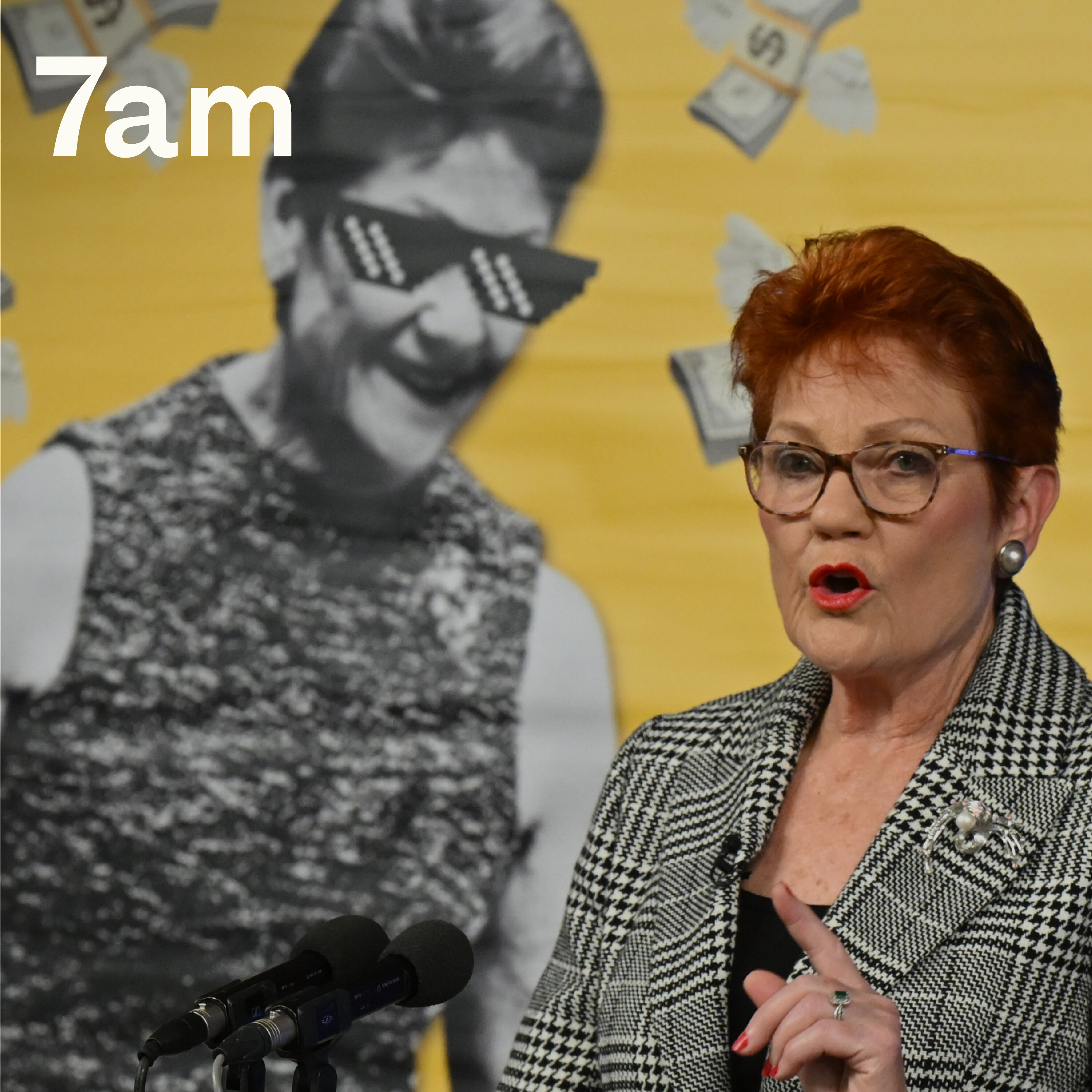
I'm Daniel James, and you're listening to 7:00am this week, Pauline Hanson took to the National Press Club stage with the greatest hits collection of the grievances that have fuelled her political career. Immigration, multiculturalism, trans rights, indigenous Australians, the political elite, the changing face of the country were all in her sights. The backlash against her speech from the government, sections of the community and the commentariat was immediate. But that may no longer be enough. For years, Hanson survived controversies that would have ended most political careers. And as one nation's support grows, one thing is becoming more evident. We are now entering a political era where outrage carries no penalty, where the shock of what politicians say matters less than the anger they channel. Today columnist and former advisor to Kevin Rudd and Julia Gillard, Sean Cowie on Hanson's resurgence, the opportunities it creates for politicians of every persuasion, and what becomes possible when voters decide the old political order is broken. It's Saturday, june 20th.
- [01:20]
B
You might remember Elon Musk was given a big chainsaw to try and cut government tape and bureaucracies over in America. We need more than a one of these things. We actually need a beautiful, big fat. Where is it? It's coming.
- [01:42]
A
Sean, good to speak to you again. Should we start with the small orange bulldozer in the room? Now, I'm going to try and refrain from swearing here, so I'm going to ask this question. What the hell is going on with Pauline's latest gift from Gina Rinehart?
- [01:58]
C
Well, we all remember Scott Morrison describing himself as a bulldozer in. In the dying stages of the 2022 campaign. Now, that was an attempt by Morrison to reframe the sense that he was a bit of a. Bit of a bully, a little bit of a stubborn guy into a real positive. He was a bulldozer. He got things done. He pushed through barriers. I mean, that was the message that Gina Rinehart, you know, Pauline Hanson's best friend these days, was trying to send about Pauline Hanson, that she is somebody who will get things done, who will push through barriers.
- [02:33]
B
We need an orange bulldozer. Let's hear the noise. Grr.
- [02:43]
C
She's the orange bulldozer. And, you know, I think. I think we also probably have to acknowledge there was a bit of mining subtext there, wasn't there?
- [02:50]
A
I think so, yes.
- [02:51]
C
Orange bulldozers are not absent from mining sites. So a little bit of subliminal advertising perhaps as well.
- [02:58]
B
Okay, I don't hear that noise. Let's hear a bit more.
- [03:04]
A
You wrote at the start of this week that Pauline Hansen's press club speech could end up being consequential or it could end up being irrelevant. We're days away now from. From that in the distant past. Which one is it?
- [03:19]
C
I mean, I think probably irrelevant in the wider scheme of things. I don't think it shifted anything in any particular direction. And the reason I wrote that beforehand is because press club speeches, traditional set pieces of the political landscape. And so there was a sense that this was Pauline Hanson's her acceptance into the institutional settings of Canberra. And, you know, I think we should rightly be concerned about that. But also, it is a tough question to ask now, exactly what should the relationship of institutions like the press club be towards a figure of like Pauline Hanson? Obviously a very concerning far right figure who is also currently leading a number of polls taken of the Australian people. So the reason I said it could be significant is because those are generally significant occasions. But the reason I said it could end up being irrelevant is because I just don't know what would really affect Pauline Hanson's rise right now. And to a great extent, that's because Chip here is fairly untethered by any typical political concerns.
- [04:30]
A
Yeah. Do you think that the real worry here, Sean, is that we're at this nihilistic moment which Donald Trump reached quite early in his political career, where he can say and do anything and not lose a scary support from his base, retain the interest of the mainstream media. I mean, Pauline Hansen's on record for saying that there are no good Muslims. She said at the press club that she wants to get rid of sbs, that workers are lazy, that the ABC should be a subscription service, that we should be monocultural. Do you think we're at a point now that she can say and do anything and it's not going to affect her support?
- [05:06]
C
I think that is true at this particular moment. So I think there are a few things to take from that appearance. The first is that we should make no mistake, she is a very far right politician. There was anti trans stuff.
- [05:21]
B
Dr. Deke Krester, the head of the Human Rights Commission, wants more power, basically to control the debate about what is a woman. And this stuff is going on in schools. This transgender ideology is infecting all of society.
- [05:40]
C
There was anti Muslim stuff.
- [05:42]
B
Western civilisation and its values are under siege. The people to whom I speak are fed up with hate preachers in some Sydney mosques. If they hate this country, they should be told to leave.
- [05:58]
C
There was anti immigration stuff.
- [06:01]
B
Under the failed policy of multiculturalism, all cultures are allowed equivalents to ours. Surely opposing that is not racist. It's common sense.
- [06:13]
C
There was talk of her words.
- [06:15]
B
The Aboriginal department, even Aboriginal corporations are treated totally different to any other Australian corporation under adsic. The inequality, the differences have to change.
- [06:25]
C
She talks about global warming as a hoax. She is a far right figure. The second thing I think that is important to note is while there are a number of people out there making fun of her use of language, of what could, you know, fairly be described at times as her mangling of the language, I think that they miss the point. Not just that that won't really register with her supporters, but actually that she turned in what I think in conventional terms, it pains me to say this was a strong performance in the sense that she does have a certain level of political charisma. She, you know, looks the journalist in the eye, she takes them on, she makes her points, she doesn't back down. And I don't say that in an admiring way. I say it as a warning. People should be frightened. There isn't an obvious thing, an obvious weakness that is going to suddenly TE Pauline Hanson down off the Australian stage. And then you get to this third issue, which is the one you raise, which is the topics that she deals with. And it is true to say that some of them uttered by a politician from a major party, could be incredibly unpopular. You know, she talks about abortion. You know, that is fairly taboo at this point for most mainstream politicians. One of the really interesting things, one of the things that surprised me was a difference between her and Donald Trump. Donald Trump can say anything and do anything, and pretty much he does say anything and do anything and gets away with it to a fairly large extent, in part because he's willing to be confusing.
- [08:04]
A
It's a cool part of his strategy
- [08:06]
C
and part of his personality. I think Pauline Hanson has been in politics for far longer than Donald Trump was in politics when he became president. When she's asked about policies, she doesn't freelance in the way that Donald Trump does. She says, you know, give us time. There's a lot of time until the election. These are more conventional answers. So I think she is behaving in some ways like a more conventional politician, and that might just anchor her to conventional politics in a way that doesn't quite work for her in the longer term and makes her more vulnerable on some of those very extreme positions. Positions
- [08:48]
A
coming up, how the changing political landscape may present opportunities on both the left and right. Sean, you've written that instead of asking what made possible One nation's rise, we need to Start asking what one nation's rise makes possible. What does it make possible?
- [09:14]
C
Well, I think it fundamentally makes clear to Australians that something else is possible. Now there'll be many Australians who watch the rise of one nation and don't like what the rise of one nation in particular seems to be saying about the country and potentially about the country's direction in the future. That is not the full picture. The fuller picture is that once a party, any party, demonstrates that it can leap ahead of the major parties in this country, and that is what one nation has done in a series of polls. Now it makes clear to everybody that the hegemony of the major parties is not set in stone, that there are other political models that this country could follow. Now, it's not necessarily that those models are good or bad. It is simply that they are possible. And suddenly they. That shakes everything up. That means that other people will become interested in creating political parties. It means that you have discussions like the discussions we've heard about recently in the Teals about forming new parties. It means that you also suddenly have space for new policies. It doesn't have to mean policies like the policies one nation is putting forward, but it does suddenly complicate the political landscape and make possible the idea that things that we thought were off the table could in fact be on the table. And to give you one example, I think a really significant fact about Pauline Hanson's speech at the press club that has been under reported, or at least reported in fairly subdued terms, is how much time she spent and how emotional she became in talking about homelessness, in talking about poverty.
- [10:58]
B
35% of parents said their children had gone to school hungry. How can we hold our heads up? How can we, as members of Parliament who were supposed to represent the people of this nation, allow that to happen?
- [11:14]
C
This part of her speech was the type of thing that you would have expected from a left wing leader, from somebody in the Greens, or from a Labor prime minister. But I think for centre left parties, talking about poverty quite that dramatically and quite that openly has become almost gauche. Something they don't want to come too close to for fear of offending all of those Australians who are worried about
- [11:38]
A
people on welfare for the working poor. Right, Right.
- [11:42]
C
There's this sense of there being a kind of right wing backbone to Australian political beliefs. And you don't want to offend that too much by coming across as too much of a bleeding heart. And Pauline Hanson just stepped right into that. Now her solutions are obviously not going to be green solutions or labor solutions. But I think suddenly, with the rise of a party that is not one of the two major parties, it makes everyone think again about the types of topics that can be discussed, about the types of policies that can be put forward, about the types of political groupings that can be created. And I think that just opens up the political landscape. And many of those ways can be terrible and many of them could be good. And we don't know right now in which direction that will head.
- [12:34]
A
So in a way, one nation is actually making things that were previously taboo possible and that can actually impact both sides of the spectrum.
- [12:45]
C
That's exactly right. I think both labor and Liberal and the other parties and independents in Parliament are going to have to rethink the way that they approach politics. And you are seeing that certainly in the coalition, you are also seeing that in the shifts within Labor. I think these are all to some extent responses to the rise of one nation and responses to the existential threat to the major parties posed, if not by one nation, to the parties that might come after it. Because I think we have to remember, you know, there's this kind of. There's this argument that people often make that Pauline Hanson will ultimately fall down, that she is a fairly inarticulate spokesperson for One Nation, that she contradicts herself. You know, all absolutely reasonable points, points that should be made. But it is entirely possible that some other party, some other far right party, some other far right figure seeks to and succeeds in capitalising on the type of movement that Pauline Hanson has begun to create. And what we know from the past 12 months, in which One Nation's vote has jumped from 6% to, you know, one in four, almost one in three Australians supporting the party, is that politics right now is very volatile. Voters are very volatile in terms of who they will give their support to. So we can talk about Pauline and we should talk about Pauline Hanson, but there is absolutely potential for somebody else to simply come along and fill the space that Hanson is currently filling.
- [14:24]
A
And finally, Sean, in the brief time we have left amidst all that volatility, we saw labor announce CGT exemptions for small businesses after the budget backlash. Will that be enough to quiet the government's critics, do you think?
- [14:38]
C
I mean, yes and no. It's never enough to quiet critics. You know, most of these critics, they don't want anything to happen. They don't want any change. They will never be satisfied. And that's why governments always need to be wary of responding too strongly or too quickly to criticism. Because a lot of critics will just keep coming for them. But I think in the broad, this will do enough to quiet some of the louder voices, or at least to narrow the number of voices complaining about this. There are going to be negotiations in the Senate, but I would be surprised if labor didn't get some version of its changes through now.
- [15:17]
A
Well, Sean, if there was a critique of your jumper, it would be 5 stars. Thank you once again for coming on
- [15:24]
C
7am thanks as always.
- [15:36]
A
7:00am is a Daily show from Solstice Media. It's made by Ariel Richards, Atticus Bastow, Chris Dengate, Crystal Keller, Ruby Jones, Travis Evans, Zoltan Fetcho and me, Daniel James. Our theme music is by Ned Beckley and Josh Hogan of Envelope Audio. Thanks for listening to 7aM this week. Have a safe and happy weekend.