Loading summary
Transcript40 lines
- [00:01]
A
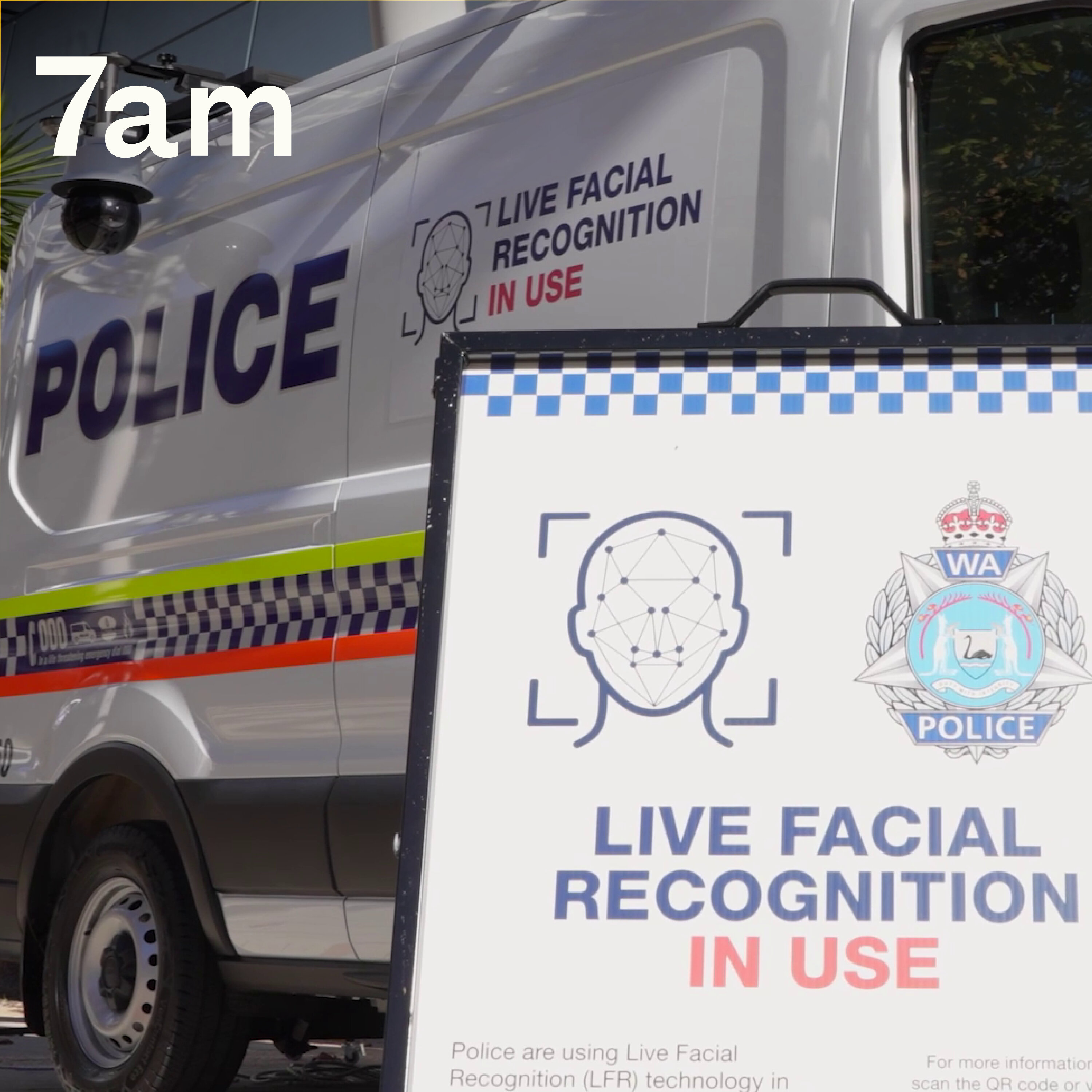
I'm Daniel James and you're listening to 7am. In Western Australia, police have just started trialling a technology that can identify people as they walk past. A marked police van will scan faces outside major events, cross checking them against a watch list of people wanted by authorities. Police say it's targeted and that innocent people have nothing to fear. But once this kind of surveillance is switched on, the question becomes how far it spreads and who decides when it stops. Today, University of New South Wales cybersecurity expert Professor Richard Buckland on the scope creep of live facial recognition and the danger of normalising police powers before the public understands them. It's Tuesday, june 23rd. Our custom built live facial recognition van,
- [01:05]
B
which is going to be used to
- [01:06]
A
assist police operations, van has a number of features inside it, including a computer system which processes images from high quality cameras, which then compares those images against a database. Richard Wa police have announced a trial of live facial recognition technology. What can you tell us about the technology and how will this trial work?
- [01:27]
B
So this is a very limited trial. They've announced it's just in one van which will be marked, saying, according to the images we've seen, that there's facial recognition running. And how it works is they are looking for particular people in this case, so they've got presumably a database somewhere of faces of people that fit a certain category and they're trying to see if any of those people walk past the van.
- [01:52]
C
The important thing for us in our police force, working with our community is transparency and public safety. That's why the van has police written on the side. It has very clear signage about what
- [02:04]
B
it's doing and the categories they've mentioned are people who are wanted for domestic violence, known sex offenders. So pretty reprehensible people, and the sort of people you'd really want the police to be able to catch. And it would seem reasonable that they'd be out in public looking for these people.
- [02:20]
C
This is not about mass surveillance, this is about specifying those in our community who are wanted by police because there is an arrest warrant out for them who are on sex offender lists, who should not be in the vicinity, particularly of young children. But it's also about helping missing people.
- [02:38]
B
As we understand it, they're obviously a bit coy about the details, but the images are scanned in real time. If there's a match, then the recording is left showing those faces and the police are alerted in real time, presumably in the van, and then the other faces that don't match anyone on this list are pixelated.
- [02:58]
C
This is actually a way that we can increase the freedoms and the privacy of our community.
- [03:02]
A
The police Commissioner says this is actually a less intrusive option than what police currently rely on, which is CCTV footage from private citizens.
- [03:11]
C
Look, I've always been concerned about the spread of CCTV around our community, particularly the ownership of the cameras, where the information's stored, how long they're storing it. We don't even know half these cameras and who's using them.
- [03:25]
A
What do you make of that argument?
- [03:27]
B
Yeah, I mean it's the argument that we always hear with privacy related things. I'm sure the police will continue using the methods that they currently have. So there's in no sense is adding this into the mix less intrusive. It's actually widening the range of surveillance powers they have. The argument's not going to the heart of things for a number of reasons. It is certainly the case that the police will use this to catch people that everyone agrees should be caught. The problem isn't with the software doing its job. The problem is what are the consequences to everyone else? What's the consequence to a society of having cameras everywhere? And if this goes continues on this trajectory, then this software now could be used once the trial's run and everyone's happy with the trial which achieved its knuckle end, it could then be used to monitor everyone, everywhere in a way we've never had before. Once you've got technology able to do something, then everyone sits around thinking of reasons and ways you can use it to do other things. And this is scope creep. And we see this over and over again with privacy. So the example I'm really familiar with is in New South Wales we had a trial of cameras to detect people using mobile phones. Because a lot of road safety data, as I'm sure everyone knows, shows that mobile phone usage by the driver was involved in a frightening number of accidents that caused harm to lots of other people, innocent people, when the driver was using it. So they put these cameras in locations and they're very high resolution that can detect if someone's using a mobile phone. It was a success, it identified lots of people using the phone as on the basis of that successful identification, those cameras have been rolled out and they're increasingly appearing around New South Wales. But the scope creep happened when someone said, we've got this footage, what else can we use it for? We can easily see if someone's wearing a seat belt using this. So now those cameras are used for seat belt, not wearing a seatbelt. Sure it's still a good thing to do, I guess, but the difference is, with a mobile phone, the argument in the trial was, you can kill innocent people. Other people suffer from you breaking this law. If you're not wearing a seatbelt, you're probably the only one that's going to suffer from not wearing the seatbelt. It won't go back to the public and it won't be tested again. Now they've got that capability, it can be used for other things. And this is, I guess, what's scary and why it's always good to check back after a short period of time and what the thing's being used for and by someone independent. Is this in line with our own intents and values?
- [05:55]
A
Right now they're using for this trial a very clearly marked police van. But police haven't ruled out using this in a more covert form in future, including at protests. How does that change the equation compared to what was originally being trialled?
- [06:10]
B
You're spot on. If it's used at protests, for example, imagine, you know, we're back in the old days where it was illegal to be homosexual, a criminal offence. Then if there was a protest for gay rights. Having a camera there, identifying people in real time, you know, obviously means that a database can be built to people. Now you could argue, well, we could have the camera and not record it in real time. You know, we could have the camera and analyze this later, but that's a much bigger job. Once you've got a, you know, you probably know yourself, if you get a book and read it, it's easy, but if you put it in that pile of books and that pile just gets bigger and bigger and bigger, it's much harder to search. So giving people real time capability to update databases means you could identify people who are violating the law, even when perhaps it's not a law we're totally happy with. And it's a chilling effect, really, on your ability to protest. Like we saw in China and Hong Kong.
- [07:01]
A
Coming up, how facial recognition technology is being used elsewhere in Australia and the world. Richard, what can you tell us about how this technology is being used by police in other parts of the world?
- [07:18]
B
Yeah, so in the States, they do a lot of facial recognition stuff and it's being used to identify people that the police are interested in and because they've had a long history of doing that. But I do think the big problem in the States is the chilling effect, that you would now be frightened to protest against things you might think are egregious and then there's this other question, which is once your movements are tracked and known and that data is stored somewhere, who has access to this? So in the States, there are examples where the police, individuals, insiders inside the police, use it for tracking their spouse, use it for finding spouses who've escaped them for family violence reasons.
- [07:58]
A
Orange County DA's office says this former Costa Mesa police officer not only use
- [08:02]
C
these flock cameras to track his mistress,
- [08:04]
A
her new boyfriends, as well as his current wife, but also use confidential law enforcement systems to be able to run
- [08:10]
C
people a number of times that had nothing to do with his work.
- [08:12]
B
One police officer used it to track down and date someone he thought was interesting and work out where they lived and where they went and all sorts of things like that.
- [08:19]
A
A former Milwaukee police officer pleading guilty today to a misdemeanor. It comes after court records show Josue
- [08:25]
B
Ayala searched the locations of his girlfriend and her boyfriend more than 170 times using Milwaukee Police Department's license plate reading technology. So even if the government and the police as an organization say they're going to look after the data and it's been used for good purposes, of course he individuals have access to the data, and then the extension of that is if they break into this database, so do criminals.
- [08:50]
A
Richard, Now a Florida man is suing police after AI facial recognition technology led to his wrongful arrest. How likely are situations like that to arise with this technology?
- [09:01]
B
Technology always makes mistakes. The only way of stopping at making mistakes is spending more money and, and often to reduce mistakes by a lot, costs a huge amount more. So usually we solve mistakes by shifting them from one type of mistake to the other. So there's type one and type two mistakes that this software can make. One is where it wrongfully identifies an innocent person as being a bad person, and the other mistake is where a bad person doesn't get properly identified. And really there's a knob almost on the software that you can choose where you set it. If you set it too far, if you're too determined to catch all the criminals and not let anyone through, then it will wrongfully identify a range of people.
- [09:40]
A
And with this technology. Richard, what about racial bias? Because there's been an issue with technology like this in the past, not really taking into account the diversity within communities. What can you say to that?
- [09:53]
B
Yeah, most of the data sets that things are being trained on are white middle class, white males and, you know, high profile people and disadvantaged groups, minority groups in America, people with perhaps disabilities. You know, you can just imagine they haven't trained it on everyone in the world. If your training data isn't good enough, it's making a guess based on what it's seen. So yeah, absolutely. There's all these sort of biases in the software. Even facial recognition with human makes mistakes. It's not a very good way of identifying people.
- [10:22]
A
Another one of the police commissioner's arguments was that this technology is already being used out in the community. How widespread is this both inside and outside of policing?
- [10:31]
B
Yeah, I mean it is, it is. Can I just say that's not a big deal. Brilliant argument, my children. Try that one.
- [10:36]
A
Everyone's doing it is the argument.
- [10:38]
B
Yeah, everyone's doing it. So I can, I mean this is I guess just taking a quick diversion. This is really the problem with the cameras. You put your finger on it in a nutshell that we're slowly drifting by a series of incremental steps. And at every point we can make an argument that if you don't look at it too carefully, you think, oh yeah, that's reasonable. But as we make step by step by step, people's privacy and ability to live a life not being surveilled is diminished. And arguments then are, well, you've already lost it, so we can just keep doing it. So this incremental drift is actually quite scary. Visual capture is very widespread. There's cameras everywhere. If we take it step by step, including lots of private cameras pointing onto the street, it's very hard to walk around in Sydney if you drive down the road to the Blue Mountains. There used to be one surveillance camera at the beginning. There's now one every 200 meters. I don't know how they got the budget to do that. So then there's facial recognition applied to recordings and that is not so widely done by people that's more forensic to people, but real time facial recognition that has commercial advantages and people do use that. And Bunnings and Kmart is a famous case that happened recently where they were using it to identify people that would be abusive to their staff or people that committed various sorts of fraud, either checkout fraud, not scanning things, or people who made multiple fraudulent returns and claimed money back on items they hadn't bought in the store. Some of our most popular retailers are being accused of invading customers privacy by installing facial recognition cameras in their stores. Kmart, Bunnings and the good guys have been blasted by this was met with a lot of public shock that they were recording people and identifying people without telling them. Kmart has been found to have breached Privacy laws. In its use of facial recognition technology
- [12:27]
A
installed across the country, Bunnings has been given the green light to use facial recognition technology across its stores. The hardware giant maintains it will only use the technology to prevent shoplifting and protect staff. It won an appeal in the Administrative Review Tribunal following an earlier ruling that it breached customer privacy.
- [12:46]
B
So, yeah, it is being used and I would expect, unless there is a stop to it, if we just keep saying, yeah, that sounds reasonable, we could eventually live in an Orwellian world. Wherever you go, you're recognized and noticed. Your movements are known. And that's an obvious problem for some people. Witness protection plans, people who are trying to hide from abusive partners, people trying to whistleblow. We've seen some whistleblowing happening recently. The KPMG case, they're now saying they wouldn't whistleblow again, that the fact of surveillance is actually enough to stop people wanting to speak out. So, yeah, so the world we're moving into, if this is allowed, would be a very different world and it'd be good for us to stop and think, is this what we want?
- [13:26]
A
To that effect, Richard, this is a trial, but history shows us that when police are given powers that those powers are usually extended. So what checks and balances are currently in place to show that there isn't overreach with this technology?
- [13:41]
B
My understanding, and I could be wrong, is very little. We've got some words saying, this is what we're going to use it for now. And credit to the police Commissioner for saying this. Most commissioners of police in most states do this stuff under the radar as much as they can. It's really good that he spoke about what they're doing and he has spoken about their intentions, but he's refused to rule out other other intentions. I mean, the things you'd like to see, an independent review after a short period of time constraints on what the surveillance could involve. The sorts of things we saw in Covid when the government tried to bring out the contact tracing app and there was a lot of alarm that the government would get everyone's location data in real time. The government then put a whole lot of quite good restrictions on how it could be used with the sunset clause. And it would be good to see this sort of thing, but it's very hard to get anyone to put constraints on the police, really. Both sides of politics almost outdo themselves for giving the police extra powers. I would hope that there will be a review, an independent review. I would hope there'll be restrictions on who can see the data. I would hope there'd be requirements about the data being stored in a way that insiders inside the police can't access it and that accessing get reviewed. I would hope that the data be encrypted in a reasonable way so if hackers break in they can't access the data. I would hope recordings would be destroyed and no one ever likes destroying data, so they won't unless forced to destroy it, they'll keep it. And then the last thing is the pixelation. They there should be legislative restrictions, not just down to the current way it's done, saying this pixelation has to happen either on the camera or on device, but certainly before any recording is made. So there is no way someone can ever get hold of the unpixelated version. It's not good enough to say, oh we promise we never will, or we have checks and balances in place to show it never will. There should be an independent audit to make sure you can't get anyone else's id.
- [15:35]
A
Well, thank you very much, Richard. We should note that the police say that they won't store the data of Australians who aren't on their wanted list. But in the meantime, what could possibly go wrong? Richard, thank you so much for your time.
- [15:46]
B
Thanks, Daniel.
- [16:00]
A
Also in the news, Inghams has announced a complete lockdown in Western Australia after a second case of H5N1 bird flu was confirmed. So far the cases have been contained to wild birds, but experts fear the outbreak may be larger than we know, with more than 50 calls to a hotline reporting sick and dead birds. Before the cases, Australia had been the only continent free of the virus, which has killed millions of birds and thousands of mammals. Nzali Steggle is reportedly set to launch a new party as soon as this week. After months of secret talks about its heel party, the independent MP is apparently ready to pull the trigger. It may initially be a party of one, but Allegra Spender, Sophie Skomps and Nicolette Buller are all reportedly open to joining. I'm Daniel James. Thanks for listening to 7am we'll be back tomorrow.
- [16:57]
B
Sam.