Loading summary
Transcript33 lines
- [00:02]
Ruby Jones
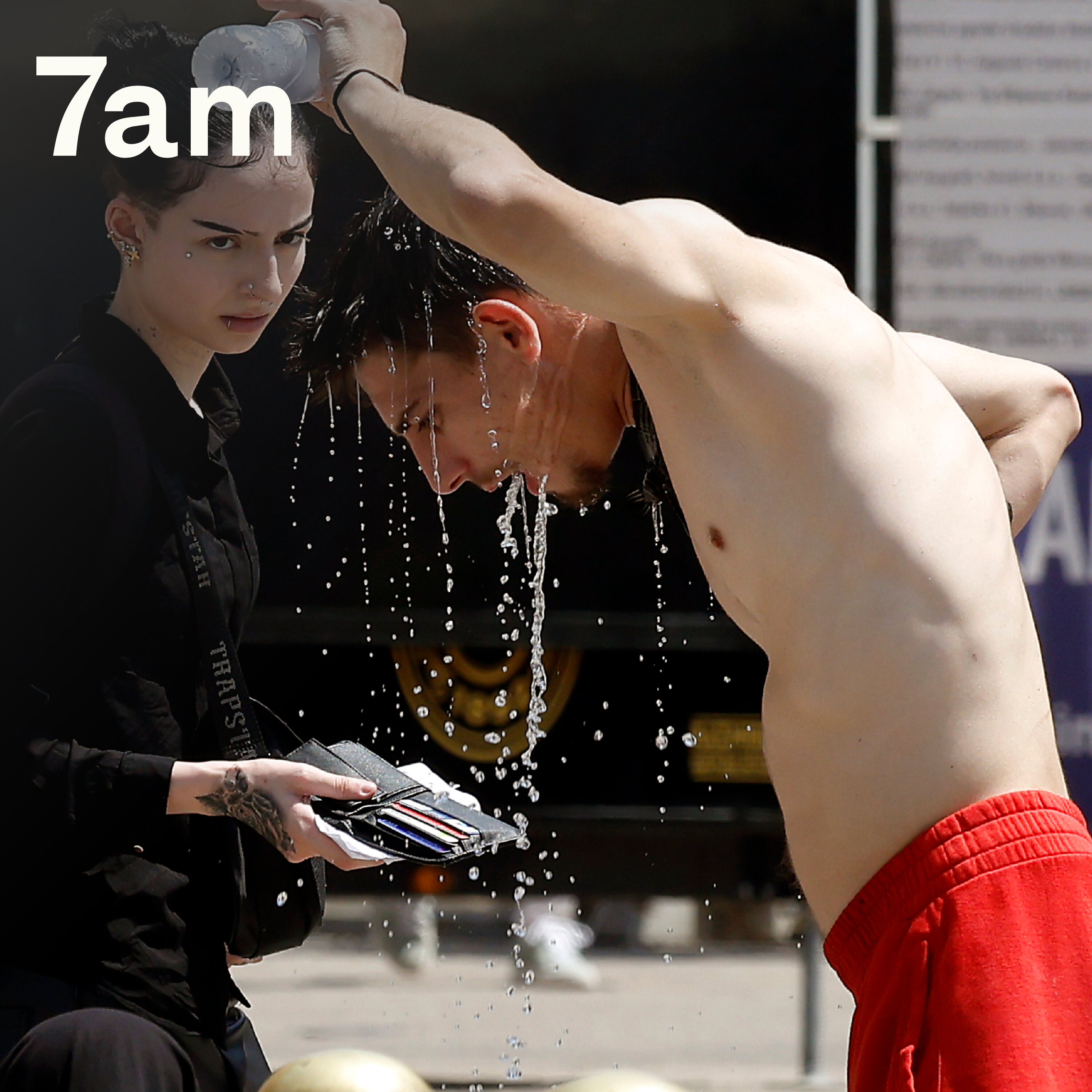
The temperatures were so high that roads melted and tram tracks buckled.
- [00:07]
Field Reporter
Temperatures have topped 40 degrees Celsius in Germany, France, Poland and the Czech Republic.
- [00:13]
Ruby Jones
Some locals resorting to sleeping in parks and even caves to escape the heat.
- [00:18]
Sarah Wilson
Scientists have said the heat wave, which
- [00:20]
Ruby Jones
began on June 20, was the worst recorded in Europe.
- [00:24]
News Reporter
In France, the authorities are reporting that over nine days, at least 1,000 people have died, in instance related to the heat.
- [00:35]
Ruby Jones
And at the epicentre of the European heat wave was Paris, which recorded its hottest day in history. It's where Australian author and climate activist Sarah Wilson has called home for the past few years.
- [00:47]
Sarah Wilson
Well, Ruby, as you know, I write about the way that complex systems interact in a city, in a civilisation, globally, and this is what is playing out.
- [01:01]
Ruby Jones
I'm Ruby Jones and you're listening to 7:00am today. Sarah Wilson speaks with us from Paris on the heat wave that's ravaged Europe and what it tells us about how humanity will need to adapt to the extreme conditions to come. It's Thursday, July 2nd. Sarah Wilson, welcome back to 7:00am Great to have you on the show again.
- [01:29]
Sarah Wilson
It's great to be back again, Ruby. Thank you.
- [01:31]
Ruby Jones
How are you? Yeah. Tell me about how the last couple of weeks have been.
- [01:36]
Sarah Wilson
They've actually been pretty existential. The heat wave here has been levels I've never experienced before. I grew up in droughts and heat waves in Australia and this felt dangerous. There were several times when I was actually scared to fall asleep in my apartment because I, you know, I'd been waking up every couple of hours and, you know, putting cold bricks on my body, wetting my towel, wetting my sheets. And I was concerned that if I didn't do that, you know, I would be in some kind of bad shape in the morning and found myself Googling what do heat waves do to the brain at, you know, three in the morning. It's been a very surreal experience but at the same time it's, it's been very heartening because the Parisians, humans have had to rally together and be in this together. It's this incredible. It was similar to Covid, actually. Somebody said that the other day. It feels like a peak Covid moment where there's this kind of bad stuff happening, but humans are actually been the best.
- [02:37]
Ruby Jones
And so you've got this, you know, small apartment in Paris that's heating up. Tell me a bit about the temperatures that it's getting to and I suppose a bit more about the city itself and how people there are set up to, or not set up to kind of cope with that kind of heat.
- [02:53]
Sarah Wilson
Well, Paris is in a unique position in the sense that the center of the city is UNESCO listed, it's heritage listed. And so the facades of the buildings, but including the roofs, cannot be altered. Anyone who's been to Paris would know that the roof line is a defining feature of the city. These tin roofs, they're made of zinc, they're black, and they attract the heat. Now I live on the top floor with no elevator. That's on the seventh floor. And these rooms were originally the maids rooms in the Haussmann era. They're cheap, they're romantic. You get to see the entire cityscape. They're quiet because you're up so high. But what it means is right under the roof line, with no insulation out
- [03:36]
Field Reporter
here in the sun. The thermometer's giving me a reading of 34 degrees. That's approaching about 100 degrees Fahrenheit. But let's see what happens when we put it on some zinc and see
- [03:48]
Sarah Wilson
whether that reading changes temperatures. In my apartment. I have a thermometer in there. Got to sort of 43, 44 degrees. At night, it only dropped as low
- [03:59]
Field Reporter
as 38, 43, 44, 45. Now I've left this up here for a couple of minutes, and we're up to 48 degrees Celsius. Let's see what that is in Fahrenheit.
- [04:11]
Sarah Wilson
So I've been in the worst predicament, but it's been the case for Everybody here. After 10, 11 days of a heat wave, most people's apartments are heating to very, very dangerous levels. The hospitals are inundated, and we heard yesterday that the morgues are also inundated.
- [04:28]
News Reporter
Funeral homes in the French capital, Paris, are now reporting that they are under pressure, rapidly running out of space and being overwhelmed with the need to safely store the bodies of those who have died.
- [04:42]
Sarah Wilson
It's placed a huge toll on the system.
- [04:46]
Ruby Jones
And so where have people been going? What have they been doing? As the heat's been building, it really
- [04:53]
Sarah Wilson
has been 10 days of survival. So people, it's very hard to work. The schools have shut down. Parents are to either stay home with their kids or bring their kids to the office. And in fact, the government came out and announced that that needed to be encouraged after several children died because they weren't getting enough water and the school had shut down and they were unsupervised. So, you know, there's this sort of chaos. People are trying to find air conditioning wherever they can. So the other unique thing about France and In Paris, only 20% of French people have air conditioning, compared with roughly 75% of Australians. It's 90% of American. So very few people have air conditioning. The hotels and cafes and restaurants, they're the same. So only 25% of hotels have air conditioning. So we've all been Googling places to go and sit. So hotel lobbies have been really wonderful with letting people come and work with their laptops all day. I'm walking into right now, check this out. So everybody in here is crowding into this room to stay cold. And that's because France, the mayor also opened up the canals. It was illegal to swim in the canals. They've been cleaning them up. They're much cleaner than they were a number of years ago, but weren't at a level where I think the government was, was happy to have people in there, but they opened them up and just, it was a losing battle. Police were chasing teenagers all over the city. They gave up and they said, we're going to open it up. And the canals are packed. You go there one in the morning, there's just thousands of kids just jumping off the bridges and cooling off. But you know, trains have shut down, the rail tracks have been buckling, roads are buckling, there are huge delays at the airport. I know this weekend There are over 1,000 flights that are either cancelled or delayed leaving Paris alone. And that's because of the ripple on effect of the storm that followed the heat wave. But also the heat wave itself, it's been pretty desperate. On the flip side, the French have been handling it particularly well. There's been this kind of just patience that, you know, is really quite palpable, a tolerance and everyone's just going slower. But you know, Ruby, you know, I rely on using one of the bike share schemes. My phone can't work outside. I get outside and my phone shuts down because it overheats. So I can't use the bike system. You can't use the rail system because a number of trains have got stuck in tunnels underneath the city and passengers have been left in 50 degree heat for over an hour. In several cases they've had to climb out and, and walk through the tunnels, the underground tunnels, to get out and into fresh air. So, you know, it's not even a matter of you can escape. And that's the other matter that you can't escape to elsewhere in Europe or France because it's just as hot and the transport options are obviously very, very compromised.
- [08:11]
Ruby Jones
Still to come, what this heatwave tells us about extreme conditions in the future. Sarah, One of the frightening things about a heat wave like this is that there is nowhere to go. It's hard to escape the heat and also to escape Paris. So tell me more about what it's been like being on the front line and seeing how things start to fall apart when an event like this hits.
- [08:40]
Sarah Wilson
Well, Ruby, as you know, I write about the way that complex systems interact in a city, in a civilization, globally, and this is what is playing out. This is what I refer to as complex systems collapse, where, you know, a stressor, in this case, a heat wave really, really pushes on a system and all the surrounding systems. So it's feeling really real now. It's the summer period. Families are entering into the holiday period. National parks have had to shut down slabs of their parks and also ban swimming because the problems with so many people with sunscreen and so on, polluting rivers in the lakes. So that's a huge implication. There's a number of high schools that students are having to sit their final exams and it's too hot, so they're moving them down into the car park basement and setting up the exams there. But this can't go on forever. The implications just keep rippling on. And I don't think until you're in it. And this is the sense that I've really got. You know, I've been writing about this stuff for many years now.
- [09:44]
Ruby Jones
I've.
- [09:45]
Sarah Wilson
I'm now in it. And it's not until you are in it that the dominoing effect becomes really apparent, you know, in Australia, because I know that it's been talked about quite a lot there. There's a monster or Godzilla, El Nino that we're now entering into. And, and it's suggested that we're going to be in this for a couple of years. So it looks like this is going to be the recurring pattern over the next couple of years globally and the infrastructure is just not in place. I mean, there's traffic lights melting in Belgium and Germany and this is going to take quite some time for all this infrastructure to be rebuilt. And how can you do that when there's another heat wave coming and people can't work because it's too hot to work?
- [10:24]
Ruby Jones
And is there a conversation happening about how to build more resilience into the system to withstand events like this?
- [10:31]
Sarah Wilson
There is. I think that's one thing that I will hand to the French is they're capable of having these kinds of nuanced discussions. I think it was only three summers ago the Number one best selling book was by a climate scientist who was writing about complex systems collapse. He's an energy futurist and climate scientist. And it was the book that everyone was reading on the beach that summer. So there are conversations being had about how to manage it, not just through a quick fix solution like putting in place air conditioning, which is what the far right, Marine Le Pen's party is coming out with. That's their response to this. But I would say that the bulk of the French are having really nuanced discussions about this because there is a sense that, and I've overheard this conversation with young people in the cab on the radio. People are saying if they get air conditioning it'll make their inside spaces a lot cooler, but it's going to make the outdoor spaces hotter. And it does in fact raise temperatures by about 1 to 2 degrees, which is significant in a situation like this. So this is the debate that's happening. Do we selfishly look after our own sort of, you know, 40 square metre apartment, or do we think broader? And it's really heartening actually that those kinds of discussions are being had. They're also being made in the context of if we get a quick fix solution like air conditioning, other more long term solutions are not going to be considered. Now the mayor of Paris has done an incredible job of sort of future proofing the city. They got rid of a thing third of all roads about four years ago and that has cut pollution, but it's opened up those areas, including car parks, to green zones. So they rewilding the city, they're not just planting trees, they're allowing weeds and flowers and all kinds of things to, to just grow in the place of these roads and car parks. The other thing which I think is incredibly interesting and I've, I really haven't seen much information on it. In 1990 the mayor and the French government created this network of pipes underground all across Paris and they produced a cooling system where they used the water from the Seine and pumped it into all the major galleries, the Louvre, government buildings, libraries, schools and hospitals. And so it's this natural cooling system that runs through all of these buildings. And they're looking at now tripling that. So that's been announced this week, they're tripling that network around the city. So yes, they are thinking of solutions that go beyond the simple air conditioning model.
- [13:07]
Ruby Jones
Okay, so like some quite creative and good ideas there. But I suppose if this moment is a bit of a taste of what's to come, a bit of a preview if you like, of what it's like when people are forced into survival mode under extreme conditions. What are you taking away from it on a, on a personal level?
- [13:27]
Sarah Wilson
Well, this is what the future's gonna look like. And if it's not a heat wave, it's going to be another extreme react to the heat waves. So a storm, you know, and flooding. As many of your listeners would know, climate change isn't just about heating, it's also about just unpredictable weather. That's essentially what we're looking at. I personally am very much feeling the precarity of the situation and I think a lot of people are. I should also mention this time last year, the European Commission advised all of the European leaders to get their citizens to prepare what they call survival kits in the case of a heat wave. But also a third world war. The run up, the idea that this is going to happen, you know, sort of down the track, that era is over. So I think there's going to be all kinds of implications and I think this debate is not going to die out. But we were warned. Admittedly the timeline has been brought forward, but that is because we have been continuing business as usual. Not a single nation on the planet has stuck to its Paris agreement. We are not halving emissions by 2030. We will not be reaching net zero by 2050. You know, it only takes three years of temperatures of 1.5 degrees Celsius above pre industrial temperatures. It takes three years in a row before one of the major food bowls goes down. And if you combine this with the Strait of Hormuz and the blockages there, the fertiliser not getting through to Northern Europe, there's going to be huge food scarcity issues again ripple on effects that need to be discussed. This issue cannot be discussed as a climate issue in isolation any longer.
- [15:10]
Ruby Jones
Sarah Wilson, thank you so much for your time.
- [15:13]
Sarah Wilson
Thanks, Ruby.
- [15:24]
Ruby Jones
Also in the news, economists are predicting that house prices will continue to fall in coming months after Australia saw its biggest month steadily decline in home values in three years. Sydney and Melbourne saw the biggest drops down around 1%. Adelaide was flat, while Brisbane and Perth are still rising but at a much slower pace. The decline in the national market is being put down to a combination of interest rate rises, the Middle east conflict and the federal government's tax changes. And the New South Wales Independent Commission Against Corruption has announced an inquiry into Liberal corruption allegations. It will hold hearings into claims against senior New South Wales Liberal Party figures, including two brothers of former Premier Dominic Perrotet. It's claimed DODGY Donations were taken by liberal figures in exchange for favours to fugitive property developers. Jean Nassif, among others. I'm Ruby Jones. Thanks so much for listening.