Loading summary
Transcript39 lines
- [00:02]
Professor Michelle Grossman
I'm on a Qatar Airways flight, about
- [00:04]
Ruby Jones
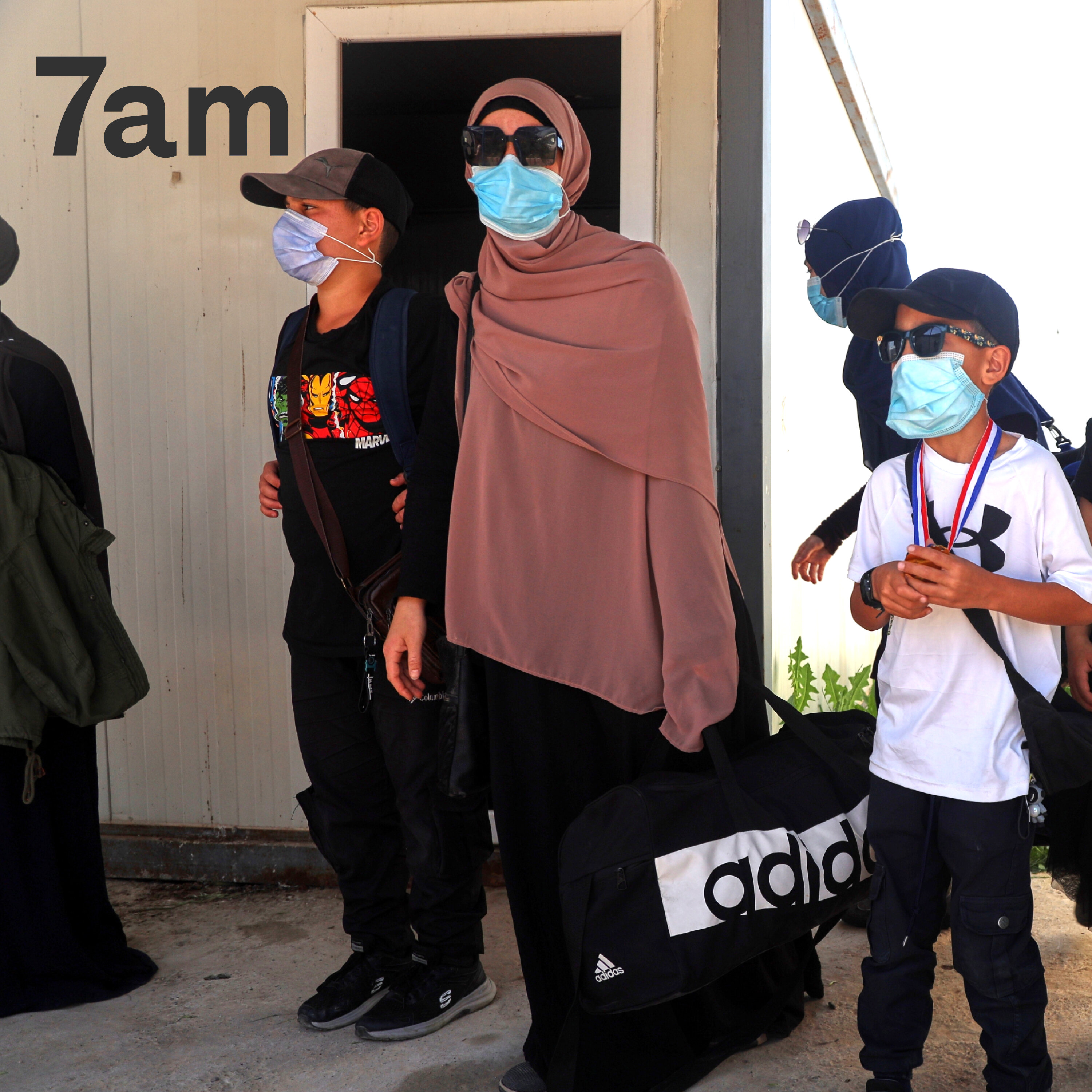
to head to Melbourne with a group of Australian women and children who have been linked to the Islamic State group. These are women who left the country to marry ISIS fighters and their sympathisers. They were put into the Al Raj detention facility in northeast Syria after the fall of the caliphate and to arrive tonight. But their freedom is likely to be short lived. Federal police have confirmed some of the women will be arrested as soon as they arrive on home soil. Late yesterday, four women and nine children arrived in Australia from Syria. The women, who originally left the country to be part of the Islamic State caliphate, have spent the years since its collapse in Syrian refugee camps. Many of their children, who are Australian citizens too, have never been here before. Well, I want to taste the ice cream set and buy, and buy some toys. We all want to go back to our countries and stay with our family. Aren't the first to come back. Since 2019, women and children like them have been returning. What they're returning to has become more and more hostile, with politicians maintaining they aren't welcome.
- [01:17]
Professor Michelle Grossman
We have been very clear from the beginning these people should not return to Australia. From the start is that the government
- [01:24]
Government Official
should be doing everything it can to prevent them coming back to the country. And they haven't.
- [01:27]
Ruby Jones
I don't want them here. I don't trust them, I don't like them. They're not compatible with a cultural way of life. They will never, ever, ever get involved. I'm Ruby Jones and you're listening to 7:00am today. Professor Michelle Grossman, expert on violent extremism from Deakin University. On our responsibility to these citizens and the danger of politicising their position. It's Friday, May8, So, Michelle, there's 13 women and children who left a detention camp in Syria a couple of weeks ago. They've now arrived back in Australia to begin with. Can you just tell me what we know about these women and how it was that they ended up in Syria in the first place?
- [02:21]
Professor Michelle Grossman
We know that a fairly large number of people, men and women and children, departed for Syria to join the Islamic State caliphate. 2014, 2015, 2016, those were really the sort of peak years.
- [02:37]
Government Official
The last thing we want is people who have been radicalized and brutalized by an evil death cult roaming our streets. We do not want anyone who is a menace to our community, who has broken our laws just roaming our streets.
- [02:52]
Professor Michelle Grossman
We talk about women who are joined Islamic State as if they're all a single cohort, but actually they're not. So some Women went because they were absolutely ideologically aligned with what Islamic State stood for and what it was trying to do, particularly in terms of establishing the kind of caliphate that they wanted. Some women went because they needed to keep their families together. They might not have made the choice themselves, but if their husbands or partners made the choice, they went along. In some cases, I think they did not want to lose their children. The children would have been taken by the husband. So you have a variety of different reasons. Having said that, the chief reason was because people did want to align themselves with Islamic State. And now, of course, because of the passage of time, you know, we're talking 10 to 12 years later than the peak period of travel. There are now children who were born either in Islamic State controlled territories or indeed born in the camps.
- [03:51]
Ruby Jones
And can we talk a bit more about what these women and children would have been exposed to over all of those years in Syria and then in detention? Because the Al Raj refugee camp in northeastern Syria, where many of these people were, that has a reputation for being a really desperate place to be.
- [04:09]
Professor Michelle Grossman
Yeah. So I think in terms of what they've been exposed to, certainly Islamic State represented not just a kind of military operation, if you like, to try to take control of territory in Syria and Iraq, but it represented a political and religious and cultural project. That's how I would describe Islamic State. And so people who were there, and particularly children, would have experienced a lot of indoctrination, a lot of training, a lot of socializing into the beliefs and the values and the behaviors and the norms of what Islamic State stood for. And then, of course, what did Islamic State stand for? It stood for a caliphate. It stood for a very rigid interpretation of Sharia law, and it stood for the annihilation of people and cultures and groups who did not believe in what they believed in or who stood in their way. So the children would have been exposed to that. At an ideological level, violence was very much normalized, the routine use of violence. So this is in Islamic State territory. The caliphate falls, and then both men and women and children are then, you know, dispersed to a variety of camps. The exposure to violence would have continued in those camps. There were a range of conflicts between different groups or factions. There was the kind of violence that you do find in refugee camps where people are desperate and where there are efforts to, you know, control and police behaviors. That's what life would have been like.
- [05:57]
Ruby Jones
Okay, so with all of that in mind, then, the normalization of violence, the indoctrination, the training that you mentioned, what do we know about the security risk that these 13 people pose to Australia.
- [06:11]
Professor Michelle Grossman
So I think in terms of security risks, nobody who is not a member of a law enforcement or an intelligence agency really has the knowledge to comment on what kind of security risk they pose. And for me, that's a very important point. There's a lot of rhetoric out there, but, you know, it's important to remember that we're talking on a case by case basis. So I don't think that we can do much more and I don't think we should do much more than rely on the assessment of the intelligence agencies. In particular, ASIO has come out publicly and clearly to say that they are comfortable. They have provided an assessment of risk. They are comfortable.
- [06:53]
Government Official
Of course, it's up to them what they do when they get here. And if they start to exhibit signs that concern us, we and the police through the joint counterterrorism teams will take action. But I'm not concerned immediately by their return, but they will get our attention.
- [07:06]
Professor Michelle Grossman
As you'd expect, there's been one exclusion order against one woman in that camp, one Australian woman who has been prevented from returning, and that was based on a security risk assessment.
- [07:19]
Government Official
The legal threshold that we have is with respect to temporary exclusion orders. I have received advice in one instance so far of that threshold having been met and when I received that advice, I acted immediately and that exclusion order remains in place.
- [07:36]
Professor Michelle Grossman
But the fact that the rest of them have been enabled to return without those exclusion orders being placed against their return tells you something about how the level of risk has been assessed.
- [07:49]
Ruby Jones
Coming up, do we have the right approach when it comes to counterterrorism, trauma and children?
- [07:58]
Commercial Announcer
Save on family essentials at Safeway and Albertsons this week at Safeway and Albertsons, fresh cut cantaloupe, watermelon, pineapple or Melon Medley Bowls, 24 ounces are $5 each and Wild Caught Lobster Tails are $4.99 each. Limit eight member price. Plus selected sizes and varieties of Doritos, Lays, Cheetos, sun chips and Kettle cook chips are $1.99 each, limit four member price. Hurry in. These deals won't last. Visit safewayoralbertsons.com for more deals and ways to save.
- [08:31]
Ruby Jones
Michelle We've been talking about the women and children returning to Australia from Syria after spending years there being linked to Islamic State fighters. As you said, we know that they're going to be closely monitored by police, by security agencies. But can we talk a little more about what we know is in place to meet them in Terms not only of assessing threat, but of potential de radicalization.
- [08:57]
Professor Michelle Grossman
So look, I think there are a number of elements that go into dealing with people returning from this kind of conflict zone. Regardless of what you think of the politics of it all, every single one of the people coming back will have experienced some form of trauma. So there will need to be a trauma informed framework and trauma based counseling and support especially provided for the children. That is a little bit different to the kind of counter extremism work that might go on. But there are programs to help them reorient themselves to a more pro social way of thinking, of feeling and of living. A lot of that also depends on the communities that they reintegrate into. And I know that quite extensive work has happened with the local communities where people will be resettled. And that is a crucial factor because with all the counter extremism programs and psychological and trauma based counseling in the world, if people are trying to reintegrate into a community setting where they feel they're unwanted, where they're going to be completely rejected and ostracized, what hope are you giving them for their prospects of being able to rehabilitate and adapt? When you leave people feeling hopeless, I'll never be accepted, I'll never be wanted, I will never be accepted. In terms of change, then you leave people feeling that they've got nothing to lose. And if they feel that they've got nothing to lose, that is a dangerous position for them to be in, in my view.
- [10:28]
Ruby Jones
And one way of judging how well any of this is likely to go is to look at what's happened to families who've been arriving back in Australia since 2019. So what do we know about how that has gone?
- [10:40]
Professor Michelle Grossman
Well, not much. And I actually take that as a very good sign. The reintegration process depends heavily on avoiding stigmatization, particularly again for children, allowing them to reorient readapt to life in Australia without feeling that everybody is, you know, giving them the side eye in terms of the potential threat or risk that they might pose. And actually, you know, one way to get people to pose a risk or a threat is to continue giving them, you know, that kind of side eye. So there is a lot of silence around the families who have already come back and are being reintegrated. I take that as a positive sign. I think if there were issues or problems, we would have heard. I think things would have leaked out to the media. The fact that we've heard nothing is a good sign.
- [11:29]
Ruby Jones
And you said that avoiding stigmatization is going to be very important here. But to what extent do you think that since Bondi the public view has changed on this?
- [11:40]
Professor Michelle Grossman
Look, I think the fact that the attackers in Bandai, you know, align themselves explicitly with Islamic State has reignited public consciousness about the kind of threat that ideologies like Islamic State pose. And this has fed right into what is at the moment quite a potent, even, I would call even virulent anti immigration discourse happening in some quarters, both of the political class and also the general public. So you can see an intersection there. But I don't know that people have hardened to the degree that I would say there's the kind of moral panic that we perhaps saw in earlier years.
- [12:20]
Ruby Jones
The federal government has been very actively hands off and at pains to let everyone know that they have not helped these people in any form to return.
- [12:30]
Government Official
There is a reason why the government has drawn a very hard line saying we will do nothing to assist. I have nothing but contempt for these people. I said the other day, hold on,
- [12:40]
Commercial Announcer
Prime Minister, some of these are children, Australian children, 23 children. You have contempt for them?
- [12:46]
Government Official
I have. I have contempt for their parents who have put these children in that situation.
- [12:51]
Ruby Jones
But the reason they are coming back is because they are Australian citizens. So what are our government's obligations here, not only to these 13 people, but to the rest of the women and the children who remain right now in Syria?
- [13:06]
Professor Michelle Grossman
I mean, in a very basic sense, the Australian government has already fulfilled one of its obligations, which is to provide them with passports. I think then what you're finding is that the focus shifts slightly because government also has a responsibility to community safety and community well being. So what government does to help them reintegrate, in my view, is actually government taking responsibility for hold of community, safety and well being, not just for those women and children. I think that when we talk about the women and children, we also have to disaggregate a little bit. Yes, the women made varying levels of degrees of choice to go. I mean, in the end they did go and they did make that choice. The children didn't choose. The children didn't have the agency to choose. The children did not say, I want to be in this position. So I think that we have to really pay out on the difference in terms of the support that we offer for children who through no fault of their own and through no choice of their own, ended up in the circumstances that they did.
- [14:17]
Ruby Jones
I want to be on Istanbul as Got Talent and get the golden buzzer. The golden buzzer?
- [14:24]
Government Official
Yeah.
- [14:24]
Professor Michelle Grossman
For dancing or for singing for both.
- [14:27]
Government Official
For both, yeah.
- [14:30]
Ruby Jones
And we've spoken a lot about what it will mean for these women and these children to come back to Australia and what life will be like for them. But as you have watched that debate play out here over their return, has it made you reflect at all on what it means to be Australian right now, how we're responding to this?
- [14:49]
Professor Michelle Grossman
Look, I think it does raise quite a fundamental question. Were we going to really turn children away and say through no fault of your own and no choice of your own, you ended up here and you are Australian citizens, but we don't want a bar of you? What kind of Australia would that make us to turn our backs on children who had no power and no choice as Australian citizens? It's not the kind of Australia I would want. And I don't think that is the kind of Australia that most decent Australians would want. And again, I draw a distinction between the women themselves and the choices that they made. And the children, I think the children are in a fundamentally different position. And the idea that Australia would ever turn its back on Australian children who, like it or not, are in need and are traumatized, that would be a very sad moment for me if that door had been permanently closed.
- [15:46]
Ruby Jones
Well, Michelle, thank you so much for your time today.
- [15:48]
Professor Michelle Grossman
Thank you very much.
- [15:59]
Ruby Jones
Also in the news today, energy companies will be forced to set aside gas for Australian use from July next year under a new east coast gas reserve. The government says the policy will address looming shortages and bring down gas bills by shielding Australians from international price shocks. The announcement comes after the Albanese government ruled out imposing a windfall tax on the gas industry in next week's budget. And Argentinian officials are scrambling to find the source of a deadly hantavirus outbreak on board a cruise ship. There are reports a number of passengers have returned to their home countries, including Australia. One later testing positive in Switzerland. Three passengers have died, one is in intensive care and three others have been evacuated from the ship ship after contracting the rodent borne disease. I'm Ruby Jones, this is 7:00am thanks for listening.