Loading summary
Transcript31 lines
- [00:01]
Daniel James
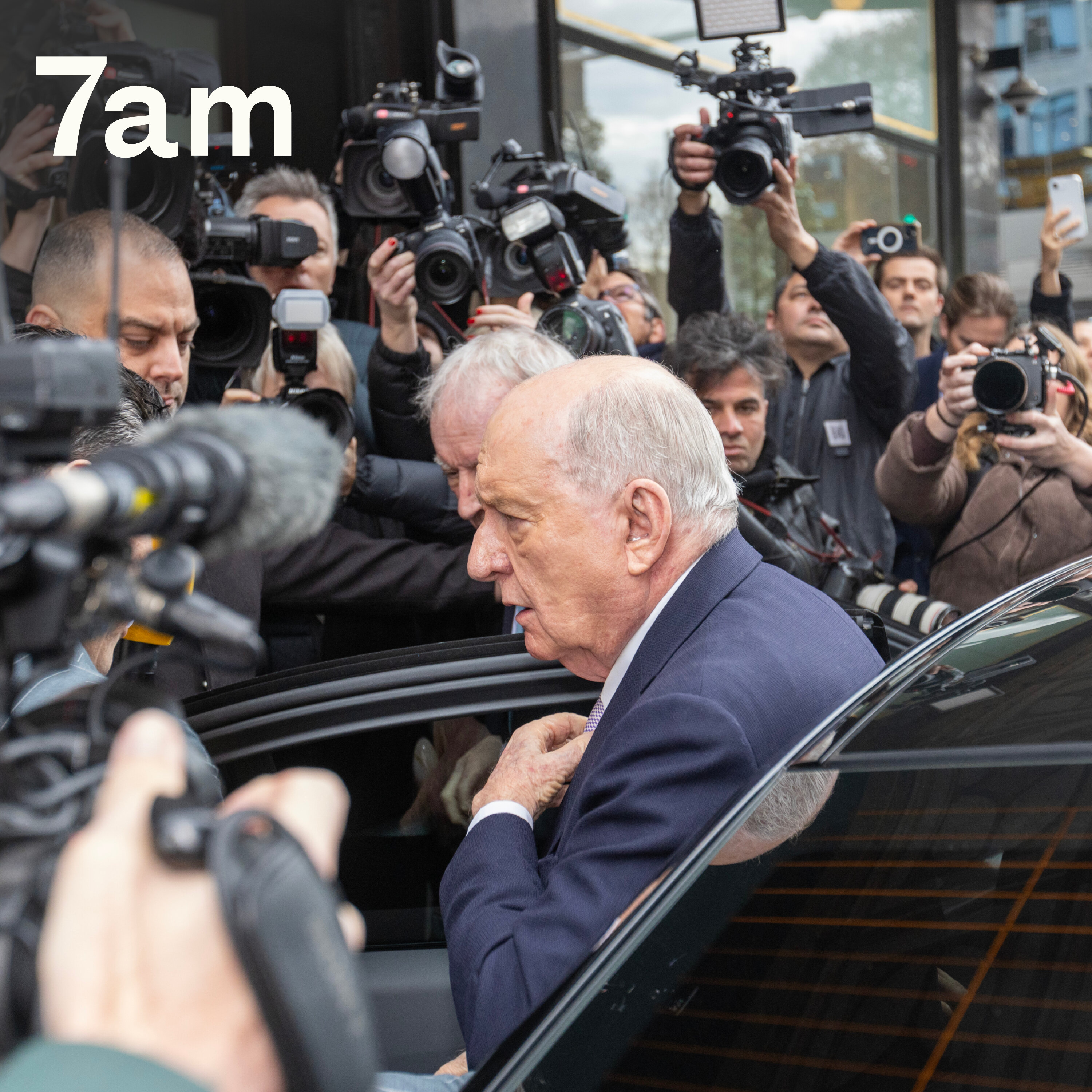
I'm Daniel James and you're listening to 7am. This week, Alan Jones went on trial in Sydney. More than 20 months after his arrest, the once powerful broadcaster is now facing 22 charges of indecent assault and sexual touching involving six complainants. He has pleaded not guilty to all charges and denies any wrongdoing. When we recorded this episode, Jones had just been charged with 24 offences involving eight complainants. Since then, the case has narrowed with a number of charges withdrawn or replaced
- [00:38]
Interviewer
before the trial began.
- [00:40]
Daniel James
Today we revisit our conversation with investigative reporter and author of Jonestown, the Power and the Myth of Alan Jones, Chris Masters, on the fall of one of Australia's most powerful men and what it tells us about the nature of power itself in this country. It's Sunday, August 9th. This episode was first published in November 2024.
- [01:10]
Interviewer
Chris, thanks for speaking with me. Alan Jones has been arrested. Can you tell me why?
- [01:17]
Chris Masters
I understand that he's been arrested on various charges of indecent assault. I certainly have some knowledge of an inquiry that's been going on for some time. You know, the police came and interviewed me some time back and of course there were witnesses from the book that I wrote, Jonestown, that was published back in 2006. And because I'm still in contact with them, I've heard that they've also been giving statements to the police and in fact, one of them said to me last week they thought that an arrest was imminent.
- [01:50]
Narrator/Reporter
Police will allege these offences took place between 2001 and 2019 involving eight victims. The youngest of those victims was 17 year old when the time, at the time when we alleged the offence took place.
- [02:10]
Chris Masters
Of course we're talking about allegations, nothing has yet been proved.
- [02:16]
Narrator/Reporter
Those offences include 11 charges of aggravated decent assault where the victim was under the authority of the offender, nine charges related to assault with active indecency, two charges of common assault, two charges of sexual touching.
- [02:37]
Chris Masters
But you know, there's been speculation about Joan's abuse of power and predatory behavior that go back well before I wrote that book 20 years ago.
- [02:49]
Interviewer
Chris, you've reported extensively on things like the military, on war crimes, most recently Ben Robert Smith. But you also developed a long running interest in Alan Jones too. What first drew you to him as a subject?
- [03:02]
Chris Masters
Yeah, my interest began in the early 2000s. I'd been reporting a lot on police corruption and I was quite surprised when I came to recognise that Jones had some power in law enforcement when he engaged in kind of a long running combat with the reformers. Police Commissioner Peter Ryan he was brought in from the UK because there were lots of concerns about institutional corruption in the New South Wales police force. And Jones seemed to have a lot of allies that were anti Peter Ryan and anti the reform process. And I wondered about that and I worried about that. And I went and saw Alan Jones and we had a bit of a discussion. He didn't want to do an interview with me, but it was all very polite. But essentially I came to the view that if my job was confronting abuse of power and I was seeing it in my own industry, then at Four Corners in those days, you take a deep breath and the story you least want to do is the one you probably should do. I wouldn't have thought that when I began that in about 2002, I'd still be talking about it over 20 years later.
- [04:16]
Interviewer
So you ended up taking a deep dive into Alan Jones's life. What can you tell us about his upbringing and how he became such a significant public figure in Australian life?
- [04:27]
Chris Masters
He came from fairly humble circumstances. He. He was the son of a Southeast Queensland farmer, had a very small, impoverished block, really. His mother was a special person. She insisted that the children go to private schools, which must have been a stretch for them. And so Alan had this kind of cross cultural background where on the one hand he aligned himself with the working poor, but on the other hand he also sort of seemed comfortable with the elites, which had something to do with that Toowoomba Grammar School upbringing. I think he always was thought of as something of a boy genius, had youthful looks and he became tertiary educated. You know, he, he got a teacher's qualification, he taught at Ironside Primary. He then went on to teach at Brisbane Grammar. And that's where a lot of the problems began. Jones seemed to be unduly interested in the young men. You heard stories about allegations of grooming, of Jones spending undue time with students, of Jones after athletics, massaging students, you know, having them shower, et cetera, in front of him, that sort of thing. He wouldn't get away with it today, you know, you couldn't have a master in the car with a student until 2 o' clock in the morning, which is something that happened with Alan quite a bit. In many respects, he was invaluable to the school because he was prepared to coach all of the sporting teams and do the choir and drama and work late at night while other teachers with families were going home, so became invaluable. And I think that became a bit of a trick over the years, wherever he worked, be it in Politics in broadcasting or as an educator. He made himself kind of invaluable and in a way, untouchable.
- [06:30]
Interviewer
In the process of writing that book, you witnessed Jones's influences firsthand as the ABC decided not to publish the book at the last minute. What were your recollections from that time?
- [06:40]
Chris Masters
Yeah, that was a really shocking experience for me. I'm still a bit shaken by it, actually, because very proud of the abc. And I always thought the ABC was the place to go that would do the stories that others wouldn't do. I'd been through the Queensland police corruption experience, you know, where I sued for something like 13 years, and I thought that the ABC was absolutely fearless. It didn't turn out to be the case. My sense was that they decided that they were going to kill it by saying that it was just unpublishable, that the lawyers said that, you know, I couldn't back it up. But that wasn't the case. I kept providing the lawyers with the evidence that proved that what I'd written was defensible. In the end, they just gave up and said, sorry, we're not going to go ahead with this. And as it turned out, I went to a commercial publisher, Allen and Unwin, and they published the book. Certainly he had friends in high places. Yes, a lot of influence was brought to bear.
- [07:49]
Daniel James
Coming up after the break, how Alan Jones cultivated powerful friends and got what
- [07:55]
Interviewer
he wanted out of them. How did Alan Jones cultivate these powerful friends? What did that look like in practice, based on the research and reporting you did?
- [08:11]
Chris Masters
I think it was. It was more that people feared him than respected him. The politicians would go on his show, and if he didn't play ball, he beat them up. The people who kowtowed to Jones, and honestly, they told me this up close plenty of times, you know, I'm not doing it, Chris, because I respect him. I'm doing it because I fear him. He can go on air and belt me up every day till the cows come home, and that's pretty much what he would do.
- [08:41]
Alan Jones
She's a clown. Jacinda Ardern, a complete clown. I just wonder whether Scott Morrison's going to be fully briefed to shove a sock down the throat. I mean, she is a joke, this woman, and an absolute and utter lightweight. Go away, Julia. We don't want to see you. We don't want to hear you climb into a chaff bag.
- [08:58]
Chris Masters
A lot of broadcasters, journalists, you know, were supposed to stay in our lane, and most of them pretty much stick to the lane, but not Alan. Alan pretty much saw himself as a prime minister in front of the microphone. He would tell prime ministers and premiers what to do unhesitantly, all the time. And I suppose he got away with it because they let him. But every now and then, in a battle of wits, a lot of them could easily take him on. Malcolm Turnbull did it famously on one occasion.
- [09:33]
Alan Jones
If you could say after me this, as a senior member of the Abbott government, I want to say here I am totally supportive of. Of the Abbott hockey strategy for budget repair.
- [09:46]
Chris Masters
Alan, I am not going to take dictation from you. I am a cabinet minister. I support. But at the time, even though he might have bested Alan in front of the microphone, there was no upside in opposing him. You came off worse off at the end of the day because to Jones's audience, you know, you were the enemy. It made me think that in one respect, he retained his omnipotence because of that microphone. One of the chapters in my book, Jonestown, was called Dictators and Tigers. And I speculated way back then that Jones was riding a tiger. And as soon as he got off that tiger, it threatened to devour him. And, of course, that's pretty much the way it's panned out.
- [10:35]
Daniel James
One of the men who spoke about
- [10:36]
Interviewer
his experiences said he did so because he doesn't want Alan Jones to get away with it, that if people don't know about this, Jones is likely to get a state funeral. He'll get a prime minister at his funeral. What do you think Alan Jones's legacy will be?
- [10:52]
Chris Masters
I think there's a book in that. Yeah, I think it's a really sad story, actually. At the end of the day, I think he was a very, very lone man. I think it was awful for him to go back to that expensive apartment night after night and be essentially alone. I'm not sure that he had a lot of friends, but I think the worst thing about him is his formula for success, the shock jock formula for success, which was to be strident. Never sit on the fence, he'd say, because it only gives you splinters. The reverse index of certainty is how I explained it. Alan Jones would be absolutely certain about issues where very little research was involved. And of course, that was important. It was important, if you're on air, to be angry and forthright day in and day out. And that's an unfortunate formula for democracy and for our business. If we really believe in facts and if we believe it's about the pursuit of truth, then you don't follow the Jones formula, but sadly, I think a great many people have.
- [12:18]
Interviewer
Chris Masters, thank you so much for your time.
- [12:22]
Chris Masters
Thank you.
- [12:25]
Narrator/Reporter
Foreign.
- [12:36]
Daniel James
James thanks for listening. Tomorrow on 7am, as police probe the first ever far left attack to be investigated as terrorism in this country, we speak with Waleed Ali about why it's being viewed through that lens and where this attack fits in the broader context of growing acts of political violence and terrorism around the world.
- [12:54]
Waleed Ali
You don't wake up one morning and say, oh, let's blow something up. What usually happens is you begin with a disillusionment. You decide there's no conventional way to deal with that disillusionment, and then you start to engage with ideas that begin to morally disengage from what we might call mainstream morality and an aversion to violence, and then start to engage with the possibility of violence as a moral political action. And once you hit that point, then things can accelerate fairly quickly. The evidence seems to be that more and more people are reaching that point.
- [13:24]
Daniel James
That'll be in your feed tomorrow.