Loading summary
Transcript27 lines
- [00:02]
Daniel James
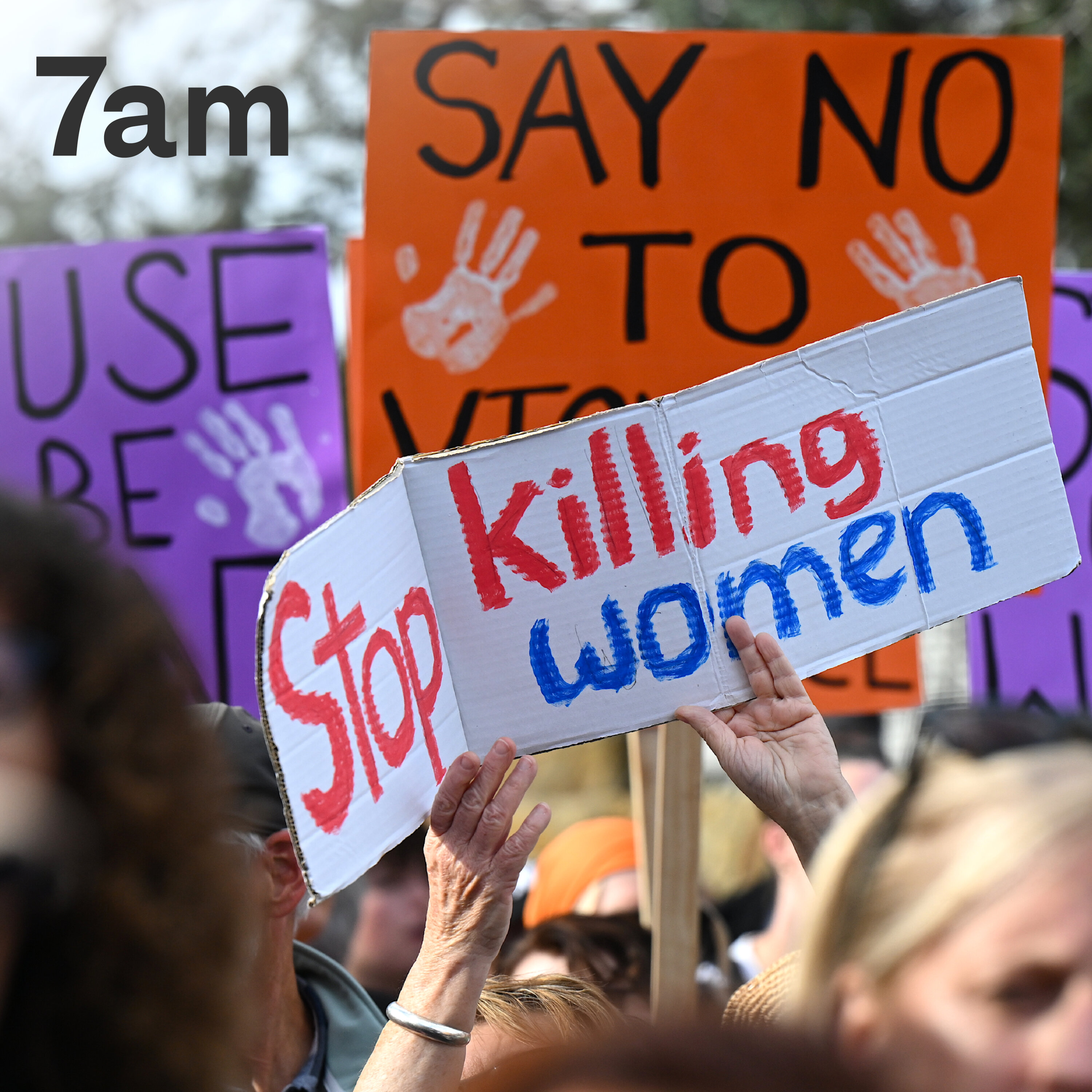
I'm Daniel James and you're listening to 7am earlier this month, in the space of just three days, four women and girls in Australia were allegedly killed by men and boys known to them. Among them are 13 year old Layla J. Jeffrey, whose body was found in Bush Lane in regional Victoria, a 16 year old boy she knew through friends has been charged with her murder. In the Northern Territory, a 17 year old girl was allegedly killed by a 34 year old man who she'd been in a domestic relationship with. In Toowoomba, 30 year old Yana Armstrong, the mother of a four month old baby, disappeared from her home. Her former partner has been charged with her murder. And in Melbourne, Lavanya Chapa was allegedly murdered by her husband while her two children were in the house. Two months ago, the Prime Minister resisted calls for a royal commission in the domestic violence.
- [00:53]
Ruby Jones
Will we say this royal commission?
- [00:55]
Daniel James
This calls for royal commission about everything. But women and girls continue to be killed, sometimes within hours of one another. Today we're bringing you an episode from 2024 where Ruby Jones speaks to Australia's Sex Discrimination Commissioner, Dr. Anna Cody, about why our domestic violence crisis is getting worse and why years of plans, campaigns and promises have failed to stop it. It's Sunday, July 19th. This episode was originally published in July 2024.
- [01:30]
Ruby Jones
Dr. Cody, thank you so much for taking the time to speak with me today.
- [01:35]
Dr. Anna Cody
Thank you, Ruby.
- [01:36]
Ruby Jones
So I believe that you were last on 7am when you'd just begun as Commissioner, so a year ago now. And it strikes me that it would be a tough time to be sex discrimination commissioner because it's a hard time to be a woman. In Australia at the moment, 52 women have been killed by men just in the first half of this year and there have been several terrible killings in recent weeks. Why do you think this is happening?
- [02:01]
Dr. Anna Cody
I agree it is a really hard time to be a woman in Australia right now. When I hear of another homicide, I feel shocked. I feel, I find it deeply upsetting to hear of another woman who has been killed in some of the most sadistic and horrific ways and now in a position of responsibility for trying to make some change in that. I feel that as a weight. I definitely feel that as I have a responsibility to try and make as much change as I can, really trying to understand what policies need to change and how I can influence that policy change. So it's both personal and then it's sort of like I've got this real responsibility to do something about this. How can I do this?
- [02:51]
Ruby Jones
And do you Feel like you understand what why men kill women.
- [02:56]
Dr. Anna Cody
I think I have glimpses of it. I think the fundamental cause is gender inequality and very rigid stereotypes, values, norms. But that doesn't mean all men kill or that all domestic and family violence ends in, in homicide. So the actual homicide part of it, the evidence is that there's three categories. Some who it's more sort of haphazard, it's alcohol related, drug related, and in some ways it's the same violence, but it just tips over into homicide. And then there's other where there's the coercive control where sort of typified by your typical white middle class professional man. And the third scenario is where someone's had a crisis in their life. So it's often older men, for example, they've had a mental health incident or had a particularly difficult sort of crisis in their life and then they sort of go downhill and then suddenly kill.
- [03:50]
Ruby Jones
Let's talk a bit more about what the government is trying to do. It was elected partly on this platform to address violence against women. And it has a plan. It's the National Plan to End Violence Against Women and Children. It was launched almost two years ago. Now with this target of reducing female intimate partner homicides by 25% each year. We're obviously not even close to being on track for an outcome like that. So tell me what you think of the national plan.
- [04:18]
Dr. Anna Cody
National Plan in itself has good objectives. It's how we implement it. We really need to see a decent investment of money policy change as well. While the ending violence payment that the government announced in its most recent budget is a one off and welcome response, it's not enough. We need to change some of the ways in which Social Security gets measured. So assuming that income is shared in a family or in a couple is a wrong assumption. That doesn't happen in violent relationships. Income is not shared. And we also know that the unemployment benefit is absolutely insufficient. So for any woman who's got children over 14, then she's stuck with the unemployment benefit. And that is not a living support system. So that needs to change. So some of the ongoing supports within the Social Security system need to change in order to support women leaving violent relationships. We've seen that one of the best ways of reducing domestic and family violence in first nations communities is to involve first nations women and first nations men and communities in designing the measures that are needed. So for example, we've seen in just reinvestment projects in Marangooka, in Bourke, a reduction in domestic and family violence. By 30% in that community. Those are the sorts of holistic responses that the National Plan is supportive of. It's recognising the handing over of some of that control and ensuring that first nations communities and first nations women are instrumental are at the centre of design.
- [06:02]
Ruby Jones
And Anna, something that we've heard a lot from the Prime Minister and others is that domestic violence is a cultural issue that we need to address attitudes towards women in society in order to address domestic violence. And we've had ad campaigns around that, around respect being the starting point. And those campaigns, I mean, they are heartwarming, they're certainly well intentioned. But should we be asking the question now, are they working?
- [06:29]
Dr. Anna Cody
We need to do more research on what actually works for behaviour change. What we want to see is behaviour change. We need to understand what is it that we actually need to do to stop that homicide. Absolutely. We need to also change attitudes and values. And some of the, the statistics coming out of the Personal safety survey in 2122 showed that there was a shift in some of those attitudes. But the most recent statistics are horrific. And we know that Australia, you know, the OECD countries were the eighth worst in terms of the G20 countries. So we have a serious problem with this.
- [07:08]
Ruby Jones
Do you think we need to make an, an ideological shift then, to change the way that we as a country think about and talk about domestic violence?
- [07:17]
Dr. Anna Cody
If we think about a similar threat, if we think of, you know, up to 40 women, depending on how we count, who have been killed this year, and we're only just halfway through how many women have been killed and the investment that we put into that, and there has been a substantial investment, but is that enough? But if we do draw an analogy with what sort of resources go into addressing terrorism, for example, and how many people have been killed by terrorism in Australia in the last five years, we have a huge investment in anti terrorism actions. Do we have an equivalent investment in anti domestic and family violence? So I think we do need to think about it differently in recognising how it is intrinsic. It's intrinsic to how we are in Australia. And that's a horrible thing to acknowledge. So how do we stop it? How do we stop it being a part of the identity of who we are as Australians?
- [08:30]
Ruby Jones
Anna, let's talk more about this idea that we should treat domestic violence with the same urgency as we treat domestic terrorism. That's a concept that Rosie Batty first raised when her son was killed by his father 11 years ago. Now, the idea of a family terrorism And I suppose when you think about terrorism, the idea or the fear there is that a terror attack could affect any person, so the innocent public is at risk. But there is this common perception that domestic violence isn't a public risk, that it's a personal one. And that sort of goes to the heart of the issue, doesn't it? People don't necessarily see domestic violence as something that could happen to them or to someone that they know until it does.
- [09:15]
Dr. Anna Cody
Yep, we know. We all know people, all of us in our families. We've all got family members who've experienced domestic and family violence. It is prevalent. We know it touches all of our lives, and yet we want to believe that it doesn't, that it is someone else somewhere else. And it's not. It is absolutely an intrinsic part across all classes, across all cultures. And maybe it is that fear of it impacting on us. And. And I think a lack of drawing connections between, even if it doesn't affect us personally, how it may affect our children, or the way in which our society functions and thinks about the role of women and the role of men and how limiting it is for men if they. You know, I think there's a continuum in terms of our very gendered ideas and stereotypes around what is masculinity and what femininity those are constraining for men and boys. So deeply constraining and leads to things like really bad mental health statistics for men. So we know that there's a complex way in which domestic and family violence, driven by some of those really gendered, rigid ideas, impacts on all of us. But maybe we're not the one being physically hurt or emotionally hurt, but we are impacted in our society, all of us, by the prevalence of domestic and family violence.
- [10:45]
Ruby Jones
And making this kind of ideological shift to thinking about domestic violence as akin to terrorism. That would seem to me to mean that we would then be asking that law enforcement would take a harder line on violence against women, so police would perhaps have more resources or more power. Given some of the significant failings that we've seen from police when it comes to domestic violence, do you think that it's a good idea for law enforcement to have more of a role in this space?
- [11:17]
Dr. Anna Cody
I think depending on how law enforcement were to use those powers, I think acting on breaches of apprentice violence orders is really significant. But I also think what we saw in Burke in the Maranguka Project was actually police working cooperatively with community, responding to what they identified. So it was very much a collaborative response rather than a punitive response. And so I think we have to reimagine rather than a law and order, rather police serving the community type of response. It must be really hard to be a police officer going to domestic violence incidents on such a frequent basis. I would think that would be a really difficult part of their work. But I think it is about training people to have an empathy and an understanding, being able to properly identify who the victim is, having an agenda, understanding of how domestic and family violence plays out, having the complexity of understanding around cultural and racial implications within domestic and family violence as well as lgbqti. So there's, there's a lot of training. So I don't, I wouldn't assume it was a more punitive law and order approach.
- [12:39]
Ruby Jones
So, Anna, do you have faith that the current government has the right priorities in their sights when it comes to gendered violence and that they're going to invest in the way that we need to see?
- [12:48]
Dr. Anna Cody
I think this government, and I know that the Minister for Women, Katy Gallagher, is deeply committed to change in this area, as is the Prime Minister, as is the Attorney General who has reviewed the family law system. We know that family law system has also functioned to keep women in violent relationships. So, yes, I am hopeful with some of the measures, but we need to see in the mifo and as a result of the rapid review that the government has announced, we need to see some really concrete and large scale investments in this area.
- [13:28]
Ruby Jones
Anna, thank you so much for your time.
- [13:30]
Dr. Anna Cody
Pleasure. Ruby.
- [13:34]
Ruby Jones
If you or someone you know is experiencing domestic violence, the 1-800-Respect hotline is available 24 hours a day. 1-800-737-732.
- [13:55]
Daniel James
Tomorrow on 7am, more than a dozen insiders speak out against their former colleague Carl Stefanovic. So what do they really say about Nine's ex poster boy and his podcast Pivot?
- [14:05]
Unnamed Insider
He was very good even back then at sucking up to the right people, the execs. There was one particular news and current affairs director who was visiting Brisbane and there was an after work drinks. You know, he said, I just heard this voice behind me, just really just talking himself up to the point of tedium. And after about five minutes of listening to his dissertation on why he was so wonderful and excellent, I sort of turned around to Lee Anderson, the news director, and said, who the hell's this bloke? And Lee said, oh, this is our new boy wonder. And that's when he said, well, he might be your boy wonder, but he's a 24 karat fuckwit.
- [14:45]
Daniel James
It'll be in your feed tomorrow. I'm Daniel James. Thanks for listening to 7am.