Loading summary
Transcript34 lines
- [00:02]
Daniel James
I'm Daniel James and you're listening to 7am. Anti abortion activists say it's the most successful pro life campaign in Australia. Last week, a bill to overturn abortion access after 25 weeks was voted through the upper house of South Australia's parliament. It didn't make it through the lower house, but women's advocates are still sounding the alarm amid a growing push against reproductive rights led in part by one nation. Pauline Hanson, once a supporter of a woman's right to choose, has changed her tune as her colleague Malcolm Roberts pushes for the party to adopt a blanket abortion ban. Today, writer and reproductive health advocate Hannah Bambrough speaks with Ruby Jones about the local and international forces looking to wire back abortion access in Australia. It's Monday, june 22nd.
- [01:09]
Anti-abortion Activist
If it was legal, if by some perverse form of logic it was legal to kill toddlers if they're of the wrong sex, we would have a demonstration that would go from here over the Harbour Bridge all the way to Manly, all the way out to Blacktown. Yet for some unknown reason, if they're in utero, it's ok.
- [01:32]
Ruby Jones
So, Hannah, I thought we could start by talking about one nation's Barnaby Joyce. So earlier this month he was at this rally in New South Wales where he praised an anti abortion bill that was up at the time. Could you tell me a bit about what he said and your thoughts watching that?
- [01:51]
Hannah Bambrough
I mean, it was really interesting to see Barnaby Joyce take the stage with people who are openly anti abortion. I think Barnaby's presence brought a lot of criticism and a lot of laughter in some ways because there was jokes on the Internet saying things like, man who completely ruined his life through unplanned pregnancy, wants everyone else to do the same.
- [02:16]
Anti-abortion Activist
And politically, does this make you popular? No, no. Probably lose half your votes every time you do it. But you know why you do it? Cause it's the right thing to do.
- [02:29]
Hannah Bambrough
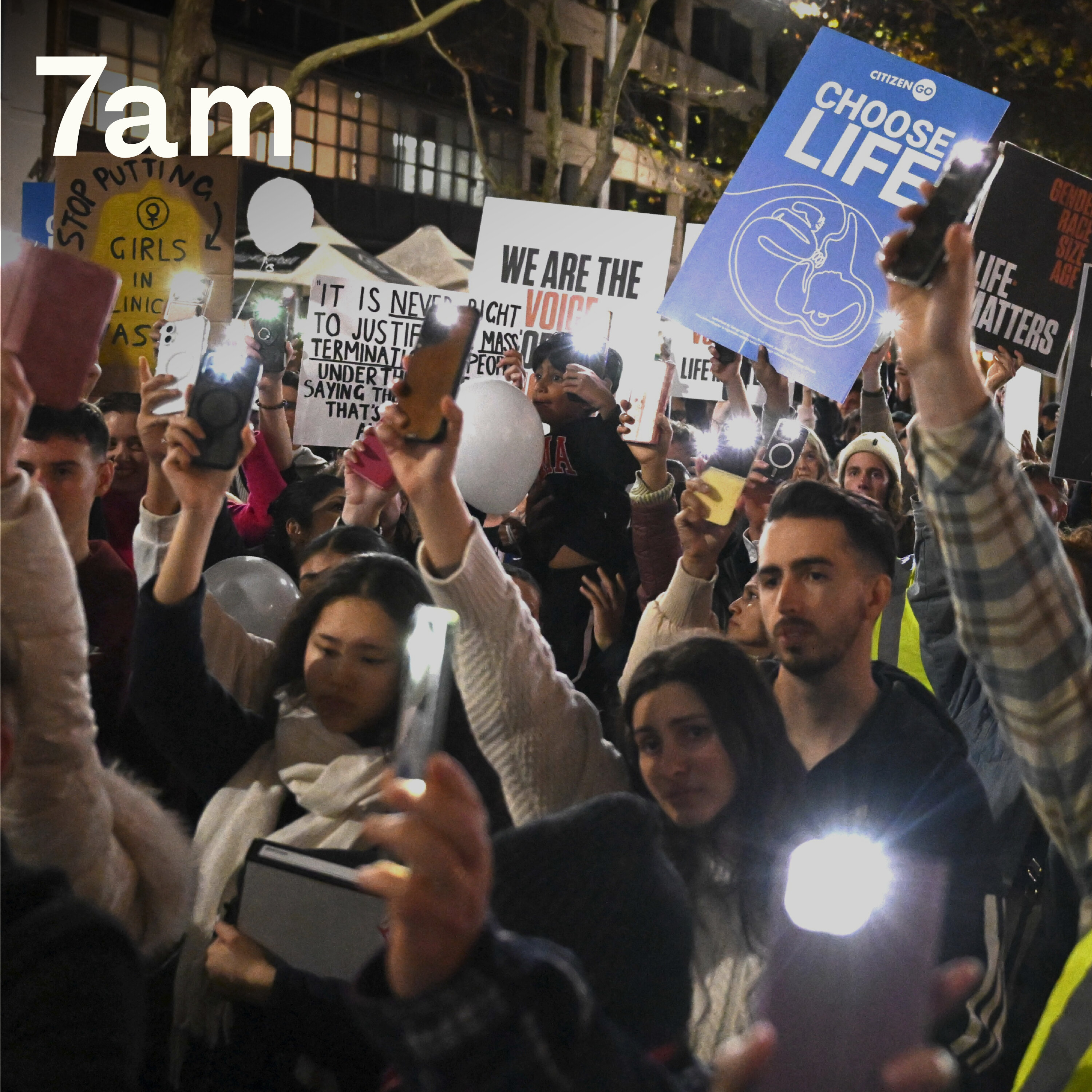
Something that I found really interesting, though was the other things that were on that stage behind Barnaby Joyce as well. There was two really big posters of completely full term pregnancies in the background that said Emma and Ruth above them. And this is the name of two fictitious children that anti abortionists in this country have been posting about online to try and tug at people's heartstrings around abortion care in later gestations.
- [02:59]
Pauline Hanson
We are here today particularly in honour of twins Emma and Ruth. Can we see them over here? Emma and Ruth.
- [03:07]
Hannah Bambrough
So originally those two names were used against a photo of two, what they were saying were fetuses of twins were actually images of sugar gliders. And the anti abortion movement in Australia said it doesn't matter if they're sugar gliders or if they're fetuses. And then a few weeks later we saw the same names in front of AI photos of full term pregnancies.
- [03:32]
Pauline Hanson
Okay, Disney, we are going to do this. We are going to save these babies. Every single baby. Every single baby. We are going to end abortion in this country. We're going to do it together.
- [03:47]
Ruby Jones
So this isn't the first or only rally of this type that we've seen. And New South Wales isn't the only place where there's been attempts to change legislation around abortion. Can you tell me a bit about what's been going on in South Australia?
- [04:01]
Hannah Bambrough
So last week we saw the MP Sarah Game, who is a former one nation candidate, take a bill to Parliament for the third time. And this legislation change was seeking to overturn access for abortions after 25 weeks, which some people refer to as later gestation termination.
- [04:24]
Ruby Jones
What vulnerable women in these circumstances need is genuine support and care, housing, safety, counselling and community, not a late term abortion that compounds their trauma and robs them of their child.
- [04:38]
Hannah Bambrough
Her bill, this time, the third time around, was passed in the upper House. Two of the supporters for the bill were the current Premier of South Australia and the opposition leader, which I can't imagine how women and pregnant people in South Australia are feeling at the moment, knowing that both the Premier and the opposition leader are against their rights for miscarriage care, for stillbirth care and for termination nations. Sarah Game took to the steps of Parliament last week after the bill passed the upper house and said that this is the most successful pro life campaign that we've seen in Australia.
- [05:16]
Ruby Jones
I'm here for at least another four years and I'll make it my mission to try and save these babies.
- [05:22]
Hannah Bambrough
At the moment, Australia is facing attacks on abortion rights in multiple states. So in Queensland there was a bill from Robbie Katter to try and stop nurses and midwives from able to prescribe medical termination of pregnancy. And then in New South Wales, as you said, we've seen this rally against what they said was about sex selective abortions, which are about 0.02% in the last data that was collected of terminations in New South Wales. So a real misrepresentation of why people seek out abortion care or miscarriage management. But these are really, I guess, kind of simple and emotive topics to be trying to focus on. I heard a leading GP talk about this as chipping away at the edges of abortion rights with the ultimate aim to try and reduce abortion rights overall or reduce access to abortion overall. So I think this is part of a global, well funded and strategic approach to try and limit particularly women's access to choice and what they're able to do with their bodies.
- [06:39]
Ruby Jones
And when you refer to this as a campaign that is organised, tell me more about what you mean by that.
- [06:46]
Hannah Bambrough
I think this is part of a bigger Americanisation of Australian politics and an attack on women's rights in Australia. So I think from that perspective there is funding that's streaming through influencers on social media to spread misinformation. There's so much conversation at the moment about the manosphere and how much misinformation is being put in front of young men. But I don't think many people are talking about so much anti contraception messaging that's coming through TikTok and Instagram that is usually funded by church groups and anti abortionists In America. There is money that is funding through to try and prop up social conservative ideologies and abortion rights unfortunately usually get wrapped up in that. So it might be a package of anti abortionism, anti trans rights, anti women's rights, anti ivf, anti gay marriage. There's these things that get put together as a package and promoted as promoting traditional family values. And it's really distressing to see that we haven't gotten more sophisticated in that conversation and that there isn't always the pushback that you would expect from some of the communities that this really impacts. The stereotypes around abortion seekers are usually that it's younger people, that it's people who are reckless with contraception. And if you look at the data, that's just not true. The majority of abortion seekers in Australia are people who already have kids, who are already struggling, people with wanted pregnancies, who need to access abortion care for miscarriage care. So it is really interesting when you look at some of the one nation messaging that's about supporting parents and supporting families and supporting what they call, quote unquote, traditional family values, when if you actually start to unpack it, attacking something like abortion rights and abortion access actually really hurts even the constituents that they say they're trying to defend and protect. So there's not much rationality or reason, but it's really part of a importation of far right ideology, in my opinion.
- [09:25]
Ruby Jones
Could you tell me a little bit more about the lobbying that's happening behind the scenes from groups like Citizen Go, who are actually there at that New South Wales rally.
- [09:35]
Hannah Bambrough
Yeah, it's really interesting. Looking more into it. Citizen Go is an international platform which was founded in Spain by a far right Catholic lobbyist. It's full of AI photos of anti trans education in schools. There's an image on there that's against voluntary assisted dying in the Northern Territory. They're using a digital platform to create very sort of specific imagery and very specific messaging to try and target people in Australia who might be frustrated about completely irrelevant policies that are going on at the moment, like the cost of living, for example.
- [10:27]
Daniel James
This isn't just about property, it's about trust. He looked Australians in the eye before the election, then did the opposite after it. That's not leadership, that's betrayal.
- [10:41]
Hannah Bambrough
They're taking international imported messages that we know are funded by church groups and other organizations and trying to twist them to say, this is something that you can be angry about, this is something that you can control. And overall, the social impact or the integration into the health system or the impact on something like birth rates just isn't there.
- [11:07]
Ruby Jones
Can we talk a little more about one nation's position on this? Because Barnaby Joyce obviously has waded into the debate, but prior to these kind of recent rallies, one nation was not associated with abortion rights in the public. So tell me a bit about the history here. Yeah.
- [11:22]
Hannah Bambrough
So in the 1990s, Pauline Hanson came out and overtly said that it's a women's right to choose what she does with her body and with a pregnancy. We can see a very clear flip from Pauline Hanson last week when she addressed the Press club and in recent rallies around Australia. And the reason for that is because it's an easy topic to politicise. At the Press Club last week, she used salacious terms such as aborting a pregnancy the day before birth. And we know that around Australia that is not an available option for anyone
- [11:57]
Ruby Jones
to abort a baby the day before
- [11:59]
Pauline Hanson
birth is abhorrent and disgusting, and that's what I oppose.
- [12:06]
Hannah Bambrough
So I think if we have a look at that, it's really about one nation jumping on the bandwagon of what other far right influencers are saying about this topic and trying to gain votes.
- [12:20]
Pauline Hanson
I'd rather educate women to use contraceptives
- [12:23]
Ruby Jones
than to go through an abortion. Too many abortions in this country anyway.
- [12:26]
Hannah Bambrough
It's never been about protecting fetuses, it's never been about protecting children. There's no evidence that one nation think that we should increase other parts of the system that would help people gain access to pregnancy. For Example like public IVF or gain access to adoption or to single parent payments that would help people keep pregnancies. It's really about controlling women's bodies and it's really about jumping on something that is easy to politicise and make salacious.
- [13:03]
Ruby Jones
And how likely do you think any of to succeed in terms of legislative change?
- [13:08]
Hannah Bambrough
I think in the way that people fear legislative change could happen in terms of say, directly approving any of these bills and limiting someone's access to, say, later term abortion on a state by state basis is unlikely to happen. But as that GP said to me, chipping away at the edges of abortion care can have some real world impacts for people. And there was a woman in Ireland, for example, a few years ago, a dentist who died because she was unable to successfully access abortion care when she had an infection related to her very much wanted pregnancy. So I think there's lots of examples like that around the world in maybe more conservative cultures. And we're seeing it happen a lot in America where they are limiting small parts of abortion care and making little changes and that has real world flow on effects for people. So I think it's likely that this is going to continue to be an issue and it's likely to be something that one nation and far right influencers keep trying to politicise because I think what they're really trying to do is be divisive. They are trying to say you're either with us or you're against us. And the more that they put something like healthcare in the middle of a divisive conversation, then the more that we're all at risk. So I think it's unlikely that any of these bills are immediately going to be accepted and that what they're asking for is going to happen. But I think that it might impact access to abortion and miscarriage care in other ways and when they slowly chip away at our rights, they hurt everyone.
- [15:00]
Ruby Jones
Well, Hannah, thank you so much for your time.
- [15:02]
Hannah Bambrough
No worries. Thank you, Ruby.
- [15:16]
Daniel James
Also in the news, relief at the petrol bowser will start to taper off after the Prime Minister announced plans to extend the fuel excise cut. But at a reduced rate from next month, the 32 cent discount will be reduced to 16 cents. The new discount will run until August 2, saving drivers $11 on a 65 litre tank. Global Oil markets are expected to take months to return to normal. Even if the Iran peace still holds and experts say Australia's first confirmed case of H5N1 bird flu is a genuine wildfire emergency. They're calling for $200 million in emergency funding to help contain the disease, which was found in a seabird near Esperance, Western Australia. The Marine Conservation Society says the outbreak poses a risk to the future of species like the Australian sea lion, which is already endangered and doesn't exist anywhere else on Earth. I'm Daniel James. Thank you for listening to 7am we'll be back tomorrow.