Loading summary
Transcript34 lines
- [00:00]
A
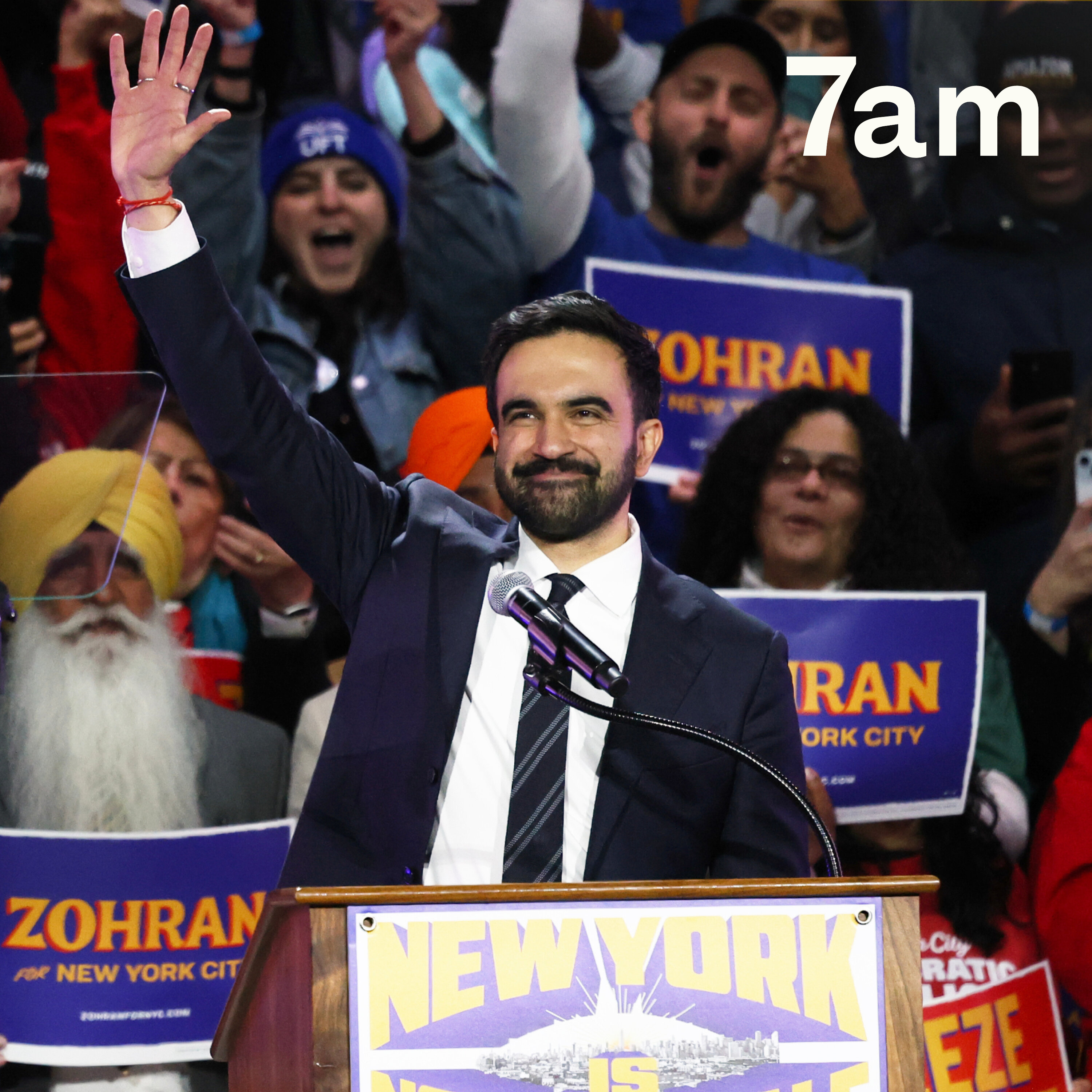
In America, New York City Mayor Zoran Mandani has turned anger over rent, grocery prices and childcare into a powerful movement of the left, one with real momentum.
- [00:11]
B
Today I am proud to announce a collection of essential staples that will be predictably 30% cheaper at all 5 of our city run grocery stores. We need to deliver universal childcare for each and every family across the city because after housing, childcare is the most expensive thing. For too long, bad landlords have been allowed to mistreat their tenants with impunity. That ends today.
- [00:38]
A
In Australia, that same anger is increasingly being captured by Pauline Hanson and the populist right while labor retreats towards the centre. So attention is turning to who in Australia could make a Mandani style case for economic change and to whether the Australian left has the organisation, discipline and ambition to build a movement around them. I'm Daniel James and you're listening to 7am today. Freelance writer, political commentator and host of Triple R's Spin Cycle, Rachel Withers on the political figure the left is searching for and whether the conditions exist to produce an Australian Mamdani. It's Saturday, august 1st. Rachel, good to see you. This week you asked the question, where is Australia's Zorin Mandani? So you looked at some of his signature policies and their equivalents here in Australia. Where did you find similar offerings?
- [01:44]
C
So, I mean, Mandani has so many policies, but I chose to focus on the core, like cost of living policies, which was the rent freezes, universal childcare, free buses, city run supermarkets and taxing the rich. Unsurprisingly, I found that the Greens and the Socialist parties were the most aligned, especially when it came to freezing rents, universal childcare and taxing the rich. You have former Greens MP Max Chalavaither, who made rent freezes like a huge part of his agenda and a huge part of the Greens agenda.
- [02:18]
B
I wouldn't call it socialism or communism. I'd call it what's being done around the world and worked. In fact, Victoria froze rents for six months during the pandemic. And what we're saying is that right now we're in a worse housing crisis than we were during the pandemic. And so we need an equally urgent national response to rents.
- [02:35]
C
And the Greens are still actually calling for them. They most recently called for one in response to the fuel crisis. We should be implementing rent caps and real rights for renters, longer leases, actual minimum standards, so that people aren't living in fear of their next rent increase. I think with universal childcare, Greens and socialists both Say it should be free, universally accessible. Anthony Albanese has said he wants childcare to be part of his legacy. So we gave labor some half points on the scorecard for that. But it won't actually be universal childcare if labor continues to subsidise costly private providers. Which is actually a point that I heard Amy Ramikis make really compellingly on this show at the end of last year. It's not universal if it's private, but subsidised.
- [03:28]
A
So is Australia actually lacking these Mamdani style policies or are we lacking a politician capable of turning these ideas into. Into a national platform? Someone with a compelling argument and with charisma?
- [03:42]
C
Yeah, I think that might be what we're missing. I think the ideas are there, but we don't have that. That compelling mumdani leadership figure. I think Australian politics has traditionally elevated parties, not people. You know, we've had a pretty strict two party system. It's a parliamentary system. The Prime Minister is the leader of the party. So parties decide who leads, not the public in the same way. But I do think there's, you know, a few people who sort of tried to occupy that space. Max Chandler Mather, as I mentioned, had a bit of a crack and I think he did speak really compellingly to renters. But he got a pretty tough run in Parliament being quite a minority voice there. And also the media was pretty tough on him as well. A few of the commenters on my piece pointed to David Pocock, but he is just one guy. He is just a senator. And unless he runs a David Pocock ticket across the country, it's hard to see how he can really build a national platform. Although I have had like a beautician I see ask me how she can vote for David Pocock. So I do think he's got the common touch.
- [04:46]
A
A lot of people ask how they could vote for David Pocock. I don't know what it is about him, but he does seem to have an appeal in some quarters.
- [04:54]
C
Yeah, look, I think it's hard to go past the fact that Mamdani and Pocock are both very good looking. I think that's part of it. That's part of it for Mamdani. You've got Purple Pingers. Jordan Van Der Lam, who is now running with the Vic Socialists. I think he does really well on TikTok. Hello, welcome back to Shitrentals with your host Purple Pingers. Today we're in Kangaroo Flat, which is in like the greater Bendigo area. It's $450 a week. And this was sent to me by Drew. I can't see that translating nationally, his sort of deadpan tone. Yeah. And I think within labor, the only person currently speaking boldly and authentically is Ed Husick, who spoke out quite a lot at the party conference last week. When we signed up for this membership
- [05:38]
A
card, we didn't sign up for the status quo.
- [05:40]
C
They can put me in the freezer,
- [05:41]
A
I don't give a.
- [05:42]
C
And I think it's interesting, demographically, he's the most similar to Mamdani as a Muslim man, but he would be the only person in Labour that's even trying to fill that mould.
- [05:54]
A
So there's some people around the country speaking to some of these policies, but how much of an appetite do you think there are for these more, I guess, socialist type policy amongst Australian voters? Because New York City is one thing, it's a progressive stronghold. Australia obviously has a much broader range of political leanings and right now there are a lot of people moving to the right. As one nation rises, do you think there's an appetite for a counter movement on the left?
- [06:18]
C
Yeah, look, I often refer back to this really great substack from my friend Alex Fine, who runs the focus groups for Redbridge and really, really spends a lot of time talking to voters twice a week. Back in March, she wrote a piece called Polarisation Is A Myth where she basically argued that Australians seem to broadly want the same things, whether they define themselves as left, right, centrist, don't care. You know, they want health care, education, they believe in fairness, kindness. She wrote in this piece that those with the greatest interest in keeping us divided need us to forget how much we agree the first progressive party to harness this properly will be unstoppable. And I've really thought a lot about that, and the fact that even though the Greens did quite terribly at the last election, the things they stand for, like taxing our resources and putting it into health care or adding dental to Medicare, these are things that Australians seem to kind of want. They currently don't. They think of the Greens as radical, and, you know, Alex has an argument for this as well, is that Australians do like to think of themselves as kind of centrist, not particularly radical people, but the policies they express a desire for are actually quite left wing, as you mentioned. You know, Pauline Hanson seems to be picking up a lot of the disenfranchised vote. A lot of people who are angry with the system are turning to one nation. You know, we're kind of eight years behind the US with what happened with Donald Trump there. Alex also had a substack in June where she wrote about raw power and the fact that people who feel robbed of agency right now really feel like Pauline Hanson is the one projecting that kind of anti establishment power. So in a way, maybe Pauline Hanson is the one coming closest to a Mamdani right now.
- [08:12]
A
Still to come, while labor is moving away from the Mamdani model, Rachel, the happenings of this week actually show that if anything, our major party is actually moving further away from the Mandani model. This week, Victorian labor replaced Jacinda Allen from the left with Ben Carroll from the party's right.
- [08:39]
C
The blandest man I've ever seen.
- [08:41]
A
Does this elevation signal that Victorian labor believes the answer to its political crisis is a move back towards the centre?
- [08:48]
C
Look, I think in this case, part of Vic Labor's thinking was anyone but Jacinta and Ben Carroll was there, but he is from labor right. A lot of the more conservative media outlets seem quite thrilled with his elevation. He essentially came out and said that he would immediately call the royal commission into union corruption on the big build, which is really what brought Jacinta Allen down. But he's also said that he will pause and review the suburban rail loop, which is, you know, a big infrastructure project that was very strongly pushed by Jacinta Allen and Daniel Andrews before her, both of the left. He said he will reopen closed police stations. He might pause the Daniel Andrews statue that we're getting here in Victoria. Essentially, he's, he's co opted a lot of the liberal platform ahead of the November state election here. So sort of like by moving to the center, kind of cutting off a lot of what Jess Wilson, the Liberal leader who was finally getting a bit of traction, is actually running on and federally.
- [09:49]
A
Anthony Albanese built his career in the labor left when it used to really have a proper left, I guess. But as prime minister, his instincts have increasingly become cautious. Tight part of discipline and reassuring business is his way of doing things. Why has he moved so far from the politics that formed him?
- [10:06]
C
This is a question that obsesses me. If somebody would like to give me a book deal so I can just spend all my time figuring out why Anthony Albanese has moved to the center. The 2016 and 2019 elections really spooked the party. Anthony Albanese has sort of argued that you can't make change too quickly. Like it's more important to be in there making progressive, as in slow change, than to do too much too quickly and get turfed out. I also think he just, I think he got more conservative as he aged. And at this stage, factions don't necessarily mean you're left or right. It's kind of just power bases in the Labor Party. And he has just such an expert control of all of those factions and how they work and where the power is that essentially I think he's just as a strategist, deciding what he thinks is best for the party. It's not so much ideological anymore.
- [11:00]
A
Yeah, we just had the ALP national conference and, you know, that's a place where, you know, a lot of disagreements and Argy bargies played out on the floor. This year was a much more sort of sanitised version of itself. Ed Husick said the party had become allergic to dissent. So what did the conference actually reveal about where power sits inside Albanese's Labor Party?
- [11:23]
C
Well, I mean, I think it sits where it's always sat with the factions. It's just that Anthony Albanese has them. He's put them into line for many conferences now. Dissent has been discouraged. I think there might be some pretty intense conversations going on within the factions, between the factions, but not on the conference floor. I actually went to the conference, not the one last week, but the one three years ago, and there was just no point being there unless you were in there with the factions going to the factional dinners. It's so stage managed at this point. So that's how things get decided in the Labor Party. I think it's really interesting that Ed Husick is actually of labor, right? He's the one pushing for more left wing policies, but he's a member of Labor, Right. I mean, he's kind of like out pushing his own agenda now, which is really what I think labor needs more of. More individuals who are not willing to just do what their faction says to do based on what Albanese says to do.
- [12:20]
A
What do you think it's actually doing to the party, the fact that it's so heavily managed now?
- [12:25]
C
I think it's. It's hurting it very much. I mean, there are policies that are really popular in the branches, you know, like things like the gas tax, things like acting against Israel and calling out Israel's genocide in Gaza. The labor branches, the rank and file, actually put forward a lot of motions on these issues, but none of it seems to filter up.
- [12:49]
A
Isn't that a recipe for disaster, sort of long term for any sort of party that starts to lose touch or not listen to its rank and file?
- [12:57]
C
Yeah, absolutely. And I think, I think you're seeing that with labor, with the fact that they have less and less rank and file, like the very few members they have left. It's not a particularly representative party at this stage. Obviously, it still wins like a third of the vote. But in terms of actual members who were able to influence the direction of the party, less and less people are bothering because they don't feel like they actually can have a say.
- [13:21]
A
I guess it's worth reminding, finally, Rachel, that from here in Australia, Mandani did seem to come out of nowhere. But he actually didn't come out of nowhere. He came out of a growing Democratic Socialist of America movement that's recruiting candidates and mobilising volunteers. DSA candidates have secured major party victories ahead of the midterm elections. It's a movement that has real momentum. So does Australia actually lack a Mandani or does it lack the organised movement to produce one?
- [13:50]
C
I think American politics work so differently to Australian politics. They don't have preferential voting. They're kind of locked into the two party system, which sucks for them. But it has meant that it's forced progressives to really channel all their energies into one place, which is trying to win Democratic primaries, because essentially it's going to be the Democrat or the Republican that gets up in most races. And so the DSA has been incredibly powerful at trying to steer the Democrats back to the left by putting up left wing candidates. We just don't seem to have that going on in Australia. It's hard to see how we would replicate that. I mean, if everybody of the left, the socialists, the Greens, all got involved in labor and wanted to force all of their branches to put up left wing candidates, potentially that would look like the same kind of organised movement, but at this point, the left is fractured. It's scattered across many different branches and so we don't have a unified left in the same way.
- [14:51]
A
Well, Rachel, thank you for coming on and not being scattered yourself. It's been a delight. Thanks again.
- [14:55]
C
Thanks, Daniel.
- [15:11]
A
7:00am is a Daily show from Solstice Media. It's made by Atticus Bastow, Chris Dengate, Crystal Keller, Renee Auckland, Ruby Jones, Travis Evans, Zoltan Fetcho Jr. And me, Daniel James. Our theme music is by Ned Beckley and Josh Hogan of Envelope Audio. And if you'd like to support 7am in bringing you the news independently, without fear or favour, please follow the show on your chosen podcast platform and on our social accounts on Instagram, Facebook, YouTube and LinkedIn.
- [15:46]
C
Sam.