← 99% Invisible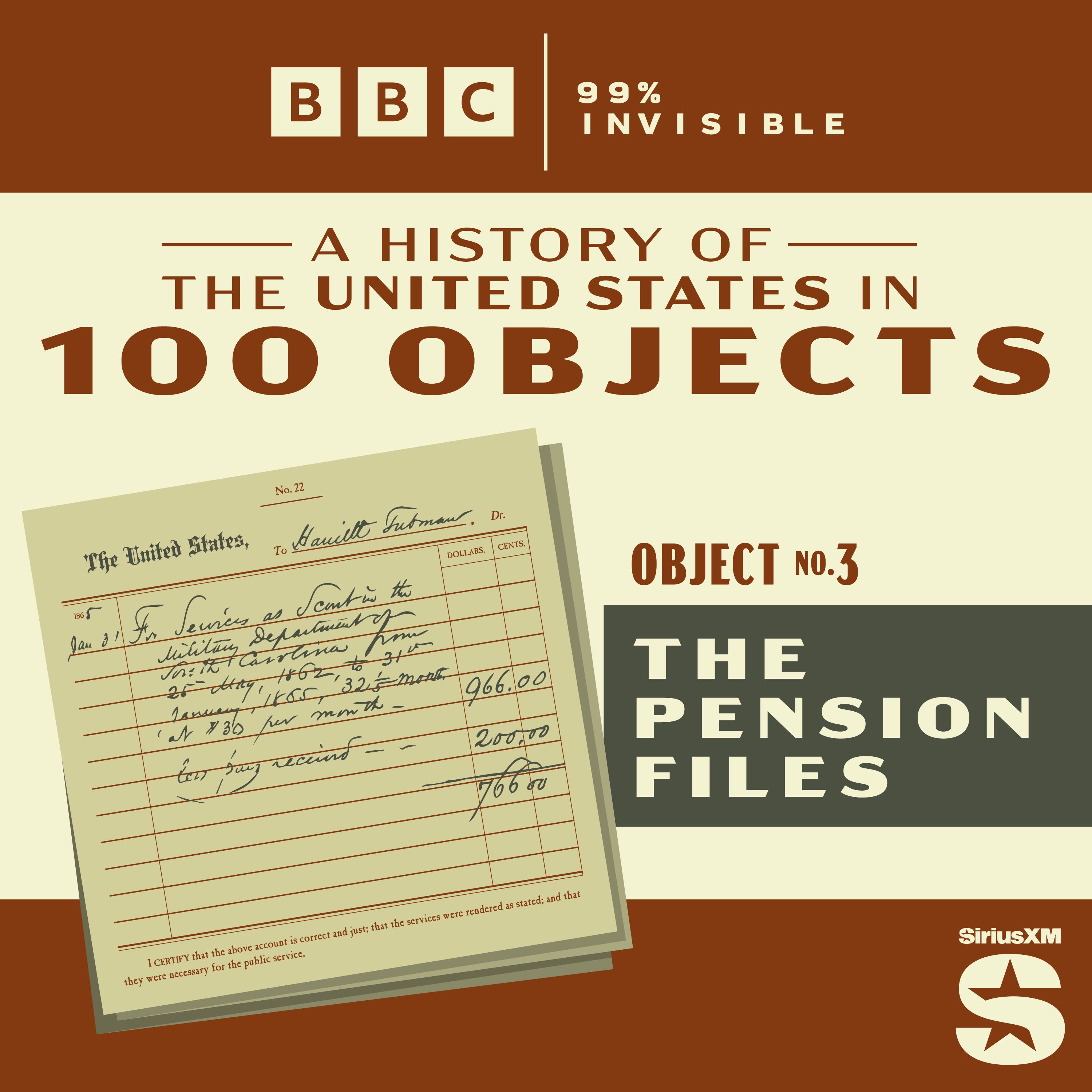
99% Invisible
100 Objects #3: The Pension Files
00:43:24
Unearthing a remarkable slave rebellion through dusty Civil War paperwork.
Loading summary
Transcript136 lines
- [00:00]
A
This episode is brought to you by PNC Bank. A lot of people think podcasts about architecture are boring. Yeah, okay, sometimes the details are boring, but that's what creates stable foundations and construction that lasts. And that's something that everyone wants. It's like banking with PNC Bank. It might seem boring to save, plan and make calculated decisions with your bank, but keeping your money boring is what helps you live a more happily fulfilled life. PNC bank brilliantly boring since 1865 brilliantly boring since 1865 is a registered mark of the PNC Financial Services Group, Inc. PNC Bank National Association Member, FDIC when you introduce extraordinary design into your life, something powerful happens. The world suddenly feels more alive, more vibrant, and you notice beauty where you didn't before. The same happens when you step into a Buick, feel the confidence of premium materials, revel in unexpected design details, and enjoy thoughtful technologies. Visit Buick.com to discover a luxury that can be yours right now. Buick Exceptional by design the year is 1863. It's June 2nd, and it's four o' clock in the morning. Light is beginning to creep into the sky, but the full moon still hangs heavy, its reflection bright in the winding Combahee River. And it's by this light that an old man, rail thin, leaves his cabin, joining his wife and the other enslaved men and women heading out to work the South Carolina rice fields.
- [01:34]
B
The slave cabins are about a mile from the rice fields.
- [01:38]
A
That's Pulitzer prize winning historian Dr. Etta Fields.
- [01:42]
B
Black they would have walked a mile through grass and moss infested with snakes and in the dark. And then they would be standing in the rice fields which were infested with alligators.
- [01:57]
A
The old man named Minus Hamilton ignores the snakes and the alligators and begins to hoe. This morning is like any other. Birds call from reeds, mosquitoes buzz. The horse carrying the overseer flicks its tail. But then everything changes.
- [02:16]
B
Minus Hamilton sees the US army gunboats
- [02:20]
A
coming up the river, US army gunboats coming up his river and docking at the edge of the plantation. And Minas cannot believe who he sees coming out of the vessel.
- [02:34]
B
Minus Hamilton sees young black men in uniform for the first time and he's completely awestruck by this. To see these armed black men who have come to liberate him. And he identifies them as the black soldiers. So presumptuous.
- [02:58]
A
Presumptuous. Minus repeats this word to himself, shaking his head.
- [03:03]
B
He talks about their stature, how they hold their heads up. This is an 88 year old man born in bondage, who who Likely thought he would die in bondage and someone who has spent his life in a subservient position. And now he sees these young armed black men who hold their heads up. And they march onto the plantation and begin to burn down Everything that the man who held him in bondage owned.
- [03:36]
A
His old life is going up in flames and a new one awaits him. So when the overseer yells at Minos to follow him into the woods away from the soldiers, for the old man, there is no choice.
- [03:48]
B
Minus Hamilton basically says, lord, I didn't care. Nothing at all. I was going to the boat.
- [03:59]
A
When Etta Fields Black came upon Minos story. She wasn't looking for it. She was researching an entirely different project. But it suddenly came to her what he was describing.
- [04:10]
B
I realized that he's actually talking about the Combie raid, the largest and most successful slave rebellion in US History.
- [04:19]
A
The Comb river raid was a Union military operation during the Civil War where three boats guided by none other than Harriet Tubman liberated more than 700 enslaved people in a single night, including Minus Hamilton. The story of the Comb raid is not new, but Etta had never read anything from the perspective of someone who had been freed in it.
- [04:42]
B
And I found the voice of Minus Hamilton. It was so striking. And it wasn't the complete account, but it was enough to really tantalize me. This was a formerly enslaved man who was telling the story of his own liberation. So that was enough. I was hooked. I wanted to know more and I dug.
- [05:07]
A
She dug around for more accounts like this, But Minus Story was kind of a one off. After the raid, a writer took a liking to him and wrote down his story. That was it. So she was kind of stuck. But through her digging, Etta came across a unique set of documents, mostly untapped by historians, that would unlock a whole world she didn't know was possible.
- [05:29]
B
You could say it was an accident. You could say it was serendipity. It was probably all of the above. But I stumbled upon the pension files.
- [05:39]
A
The pension files, meaning the records the government kept when people applied to receive a pension after serving in the Civil War. Dry bureaucratic documents, not exactly riveting material, but the ones Etta found contained something she wasn't expecting. Many of the men liberated in the Columbia raid would go on to serve in the Union army, like their presumptuous liberators. And in their pension applications, their names, histories and stories are recorded for the first time. From 99% invisible and BBC Studios. This is the history of the United States in 100 objects. Hi, I'm Roman Mars. Today, the US army pension files and how they unlocked a whole new story of the largest and most successful slave rebellion in US history. So let's get to Harriet Tubman. She's a key player in this story. Whether or not people know of the raid, they, they know about Harriet Tubman. But I think it's worth pausing here to take a moment to talk about just the incredible things she did as a young woman. Could you just tell us a little bit about her?
- [07:00]
B
Yeah. So Tubman is such an extraordinary, extraordinary figure. She liberated herself from bondage on the Maryland eastern shore in 1849. And from that point on, she made 13 trips back into the land of bondage. Back to the same county and occasionally the same plantation where she had been held in bondage. These are enormous acts of selflessness. I liken it to putting one's hand in the mouth of an alligator. When she liberated herself, she had been able to take her hand out from the alligator's mouth. Most of us would just go in the opposite direction and leave the alligator
- [07:53]
A
alone, it's fair to say.
- [07:55]
B
But Tubman, 13 more times. She puts it in. She takes it out. She puts it in, she takes it out. Thirteen more times. I mean, who does that? She rescues about 70 people personally. Rescues, brings out of slavery, 70 people.
- [08:17]
A
This is the Harriet Tubman that most of us know about. But our story begins where a lot of that history ends.
- [08:23]
B
So as the Civil War is nearing and after she makes her last rescue mission and is not able to rescue her sister and her sister's children, Tubman is being advised really to kind of cool it. Right. This war is getting ready to happen. We don't know what's going to go
- [08:43]
A
on at this point. Tubman is living in New York and is a well known part of abolitionist networks. And it is through these networks that she gets a new opportunity to help.
- [08:54]
B
And once the war gets started, the Governor of Massachusetts makes the arrangements for her to serve as a spy for the U.S. army.
- [09:05]
A
A spy recruited by the Army. So in May 1862, Harriet Tubman heads down to her first posting. A place called Beaufort, S.C. a town of old plantation houses, live oaks and eerie hanging moss. It sits on Port Royal island, one of a chain of so called sea islands along the coast. And it has just been captured by the Union.
- [09:28]
B
In November 1861, the US Navy captured Beaufort, Port Royal in the Sea Islands from the Confederacy. And the next day the US army occupied these territories. But before the US Navy's ships Arrived, the plantation owners, slave owners, fled, and they left behind about 8,000 enslaved people. And the US army decrees that it's not going to return the property in quotes of the Confederates. We're not enforcing the Fugitive Slave act anymore.
- [10:08]
A
Right.
- [10:09]
B
You have forfeited your property and we're going to keep them. Right. They become contrabands of war.
- [10:18]
A
And eventually the US army frees all the people who were enslaved on Port Royal and the Sea Islands, creating a kind of free city.
- [10:26]
B
So the US army begins to employ people who were able to work and house and feed and take care of people who, who couldn't. So it's in this context that hundreds of Northern abolitionists come down opening schools, clinics, shops, churches.
- [10:49]
A
And this is what's stunning to me is this is South Carolina. Like, this is a free community deep in Confederate territory. Like, the fact that this is happening in South Carolina is really stunning.
- [11:02]
B
Yeah, well, I like to say it's the belly of the beast. It's sort of an oasis. But I'm sure it felt very tenuous just because the proximity of the Confederacy. There's no buffer, there's no border, there's no barrier. It's right there.
- [11:24]
A
So Beaufort and the wider Port Royal island is becoming this experiment in what a post slavery society might look like. But that's not the only radical experiment going on in the quintessentially Southern town. Colonel Thomas Wentworth Higginson, a famous writer and abolitionist, the one who later interviewed Minus Hamilton, described it like five minutes walk beyond the live oaks will bring you to something so un Southern that the whole Southern coast at this moment trembles at the suggestion of such a thing. The camp of a regiment of freed slaves. For the first time in US History, the Union army is also building a company of black soldiers in Port Royal, arming and training the formerly enslaved. It's a radical idea. Higginson, who actually led the first black company, wrote, they had home and household and freedom to fight for, not just the abstraction of the Union.
- [12:24]
B
And Harriet Tubman comes down in this context. Technically she's a Northern volunteer, but. But she comes down to serve as a spy.
- [12:33]
A
Harriet Tubman's job would be to gather intelligence for the army from the Beaufort's growing population of people who had escaped slavery and made their way to the free oasis.
- [12:43]
B
This is what Harriet Tubman did. So we know that she was in downtown Beaufort working in the refugee camps. So as the freedom seekers came from the Confederate plantation, she was there to talk to them and find out what they knew. And they had a lot of information that the Union wanted and that could be beneficial to the Union.
- [13:08]
A
Before arriving in the refugee camps of Beaufort, many of the formerly enslaved had been made to work for the Confederate
- [13:14]
B
cause, Whether it was building fortifications, moving and hauling armaments, Serving Confederate troops and individuals, especially officers brought their slaves with them to camp. So they were in the camp cooking everything, washing everything, fixing everything, building everything. And Tubman was there to debrief them, as one of the CIA commanders says. And then she passed this intelligence back to the U.S. army commanders.
- [13:48]
A
Also, the Confederate army had planted explosives along the river in case of a Union attack, except they didn't actually do the labor. They had the people held in bondage do that. People who are now flooding into Beaufort and could tell Tubman exactly where the mines were planted. And these freedom seekers also taught Tubman about the terrain, where the river bends, where the sandbars are, because these plantations sit on a very different landscape than the one she grew up in.
- [14:16]
B
When Americans, if Americans think about slavery, we think about cotton. So the rice plantations are, and I should say the tidal rice plantations. They are located in the coastal wetlands.
- [14:30]
A
The marshland where the rice grows is home to deadly cottonmouth snakes and silent, slithering alligators. But it's also home to a much smaller but even more deadly animal.
- [14:41]
B
Mosquitoes breed in water, right? And so it creates this awful, deadly disease environment.
- [14:50]
A
The people working these plantations often lived with chronic malaria.
- [14:54]
B
What happens is that malaria shatters the immune system. And so having chronic malaria means that the immune system is then not able to fight off other things. Right? Something as simple as upper respiratory ailments killed otherwise healthy people. It means that women gave birth to babies who did not thrive. So children, infants are very vulnerable, elderly people and people with compromised immune systems very vulnerable. And so the death rates on these rice plantations are second only to sugar plantations in the Caribbean, Right? Where the life expectancy was seven years. Rice plantations are second to that.
- [15:53]
A
There's one time of year when the mosquitoes are particularly bad. So bad that the plantation calendar is organized around it.
- [16:01]
B
June is the sickly season. So this is when rice is growing in the rice fields in standing water. And that stagnant water's breeding malaria and is breeding mosquitoes, and the mosquitoes carry malaria. And so white plantation owners, slave owners, and overseers would leave the area. By the middle of May, almost all
- [16:27]
A
the white people in the area would leave the plantations and the deadly disease environment retreating to summer homes in Charleston, leaving just a few overseers and the enslaved to keep working the fields.
- [16:39]
B
Even The Confederate army had reassigned its troops. There were no troops stationed on the Combahee River.
- [16:47]
A
No army except two lonely soldiers monitoring the river. No plantation owners, no troops. It was a pretty dang perfect time to carry out a daring raid. Can you give me a sense of what is happening in the war at this time? Like, how is it going for the Union Army? What is the vibe like?
- [17:05]
B
Yeah, it's not going so well. They hadn't had a win, like a real win in a while and people were not happy. Morale was low because the Union was on the defense and couldn't seem to get back on the offense. And I think South Carolina in a lot of ways was a sore spot for the Union. This is where the first shots of the Civil War were fired.
- [17:34]
A
But a raid, now a raid might boost morale. It would be carried out by some of the new black troops that had been training in Beaufort. Their aim would be to liberate more enslaved people, some of whom would join them in the army, swell the Union ranks. Their other goal was simple, to burn everything in sight. So let's talk about the raid. Everyone at Beaufort has been working towards this raid for months, gathering information. They finally arrive to the night in question. Bring me to that night.
- [18:11]
B
So on June 1st at about 9pm so this is in the summertime. It's just getting pitch black, dark. This is the time when the boats leave the docks in downtown Beaufort and they are sailing under the light of the full moon. There are three boats, one gunboat and two transport steamers. And the transport steamers were brought along to bring the freedom seekers back.
- [18:47]
A
In the raid, Harriet Tubman told the Union army that she'd come on the raid if it was led by a man named Colonel James Montgomery. Montgomery is a well known white abolitionist, a man with a history of freeing slaves during his raids. He's a man Harriet Tubman trusts. So that night, Tubman is up on the front boat with Montgomery. With her are eight or nine men under her command. These are her very best informants. A group of black men who would act as spies, scouts and pilots during the raid. Then there are the soldiers. One battery of white soldiers and then 300 black soldiers from the 2nd South Carolina Volunteers. It's hard to imagine what these black soldiers were feeling as the gunboats pulled out from the harbor. Many of them had been enslaved on the very plantations they were returning to. Plantations where they still had family members held in bondage.
- [19:44]
B
They were going to war against slavery, right? They were going to war to free other people who were still enslaved
- [19:54]
A
together under the light of the full moon, they begin to make their stealthy way up the tidal waters of the Combahee River. But very quickly, something goes wrong.
- [20:05]
B
One of the transport steamers ran aground and it was about three hours until the next high tide, which could potentially have dislodged it. They couldn't sit there for three hours and be sitting ducks for whatever the Confederacy might have for them, so they had to abandon it and continue with two boats. And I suspect that that was really heartbreaking for Tubman. The second South Carolina volunteers, her scouts and pilots, all of these folks who were formerly enslaved, it must have really been heartbreaking for them to think that now they're only going to be able to bring half as many people down
- [20:49]
A
from the combi Today's episode is brought to you by Aquasana One easy way to live healthier is to hydrate smarter and smarter Hydration starts with Aquasana. With Aquasana water filters you get healthier odor free water that tastes amazing. Their advanced filtration removes harmful contaminants while preserving beneficial minerals, so better hydration comes with every sip. And it's not just drinking water. Aquasana protects your home and your health with a full range of whole house, under sink and shower filtration systems. Whether you're washing veggies, making coffee, or rinsing off after a workout, experience the difference in every drop. With Aquasana. I have an under sink model that I put in myself. It's easy. Super easy to install. In fact, as soon as you open the box, you know exactly what to do. It's that simple. The water tastes great and one psychological benefit. I swear to you I'm just drinking more water after I put one in. You put one in and you will remember to drink water and be healthier. Instead of grabbing some soda or something from the fridge, visit aquasana.com and use promo code invisible for up to 50% off select systems. That's a Q u a s a n a dot com promo code invisible Aquasana Healthy Living starts with Healthy water This podcast is brought to you by Squarespace. Squarespace is an all in one website platform that helps you stand out online whether you're just getting started or growing your business. It's got everything you need from securing your domain to building a professional site and showcasing your work all in one place. Bring your vision to life with AI powered design or curated templates, plus flexible editing tools that help you create something that truly reflects your style. No experience needed. Squarespace makes it easy to share your work, book clients and get paid with built in tools for scheduling, invoicing and email all in one place. I've had a Squarespace site RomanMarris.com for 12 years or so and the key for me isn't that it was easy to build, although it was, it's that it's easy to maintain. It never gives me any trouble at all. It's great. Head to squarespace.com invisible for a free trial and when you're ready to launch, use offer code Invisible to save 10% off your first purchase of a website or domain.
- [22:57]
C
Doing hard things doesn't always look dramatic. Sometimes it's an early workout, a long hike, or a full day outside where quitting feels easier than pushing through real life hard things. That's exactly what Noon Hydration is made for. It's real deal activated hydration built to help keep people moving through the moments that ask a little more from them. Noon Hydration tablets deliver clean ingredients and optimized electrolytes that hydrate better than water alone, especially when you're sweating, moving or pushing through a long day. Drop one into a bottle and it dissolves quickly, tastes great, and comes in a simple no mess tube you can take anywhere, and at less than $1 per serving, it's easy to make part of your routine. Noon is made for people who show up, value growth and find joy in the effort. It helps support clear focus, steady energy, and the mindset to take on whatever comes next. Shop noon hydration@noonlife.com that's n U-N-Com and fuel your next hard thing.
- [23:53]
A
So much activity is required to keep a business running smoothly behind the scenes, and connectivity is the key to it all. AT&T business is built for exactly that, helping small businesses stay connected with reliability they can count on. For small business owners, connectivity is not just a convenience, it's essential. It keeps operations moving, teams aligned and customers supported. It can be the difference between everything running seamlessly in the background or becoming the thing that brings work to a halt. AT&T business Internet is designed to be a reliable provider, helping reduce friction and keep things running smoothly so businesses can stay focused on what matters most. Powered by AT and T Business Built to Work Get AT and t business@business.att.com. The gunships are able to move up the river unseen until about 3am that's when the boat encounters the only two Confederate soldiers the army left behind in a lonely outpost on the river. The Confederates quickly realize that they are vastly outnumbered they fled.
- [25:02]
B
They fled. And there are some wonderful newspaper accounts that talk about them fleeing so quickly that they left their blankets warm.
- [25:13]
A
The Union soldiers on the raid knew that Confederate reinforcements would eventually arrive. So the clock was now ticking. And in the meantime, the two Union boats are right where they wanted to be. They've reached the rice plantations. They make a furtive stop at a first plantation and let some soldiers out, and then continue up the river and make another stop letting more soldiers out.
- [25:32]
B
The soldiers get on land, they went to the plantations and started burning things down, you know, burning down stables, barns. And the barns contained the previous year's rice harvest. They burned most of the, the houses, the manor houses where the plantation owner and his family lived. They go to the rice fields and they open the gates of the hydraulic irrigation system and let in all the salt water and they kill the rice crop that's growing in the fields.
- [26:10]
A
These rice plantations are considered the breadbasket of this part of the South. So as they destroy crops and burn food stores, they are dealing a massive blow to the Confederacy. But as all of this is happening, the other part of the operation begins.
- [26:24]
B
Not only do they disembark soldiers, but they also send out rowboats, and those rowboats bring the freedom seekers back to the the boat.
- [26:37]
A
The black soldiers, fresh out of slavery themselves, begin to call out to the enslaved people working on the plantations.
- [26:45]
B
They walked up and down waving flags, trying to attract the attention of the freedom seekers.
- [26:53]
A
And one of the people watching in utter amazement as this unfolds is 88 year old Rael Finn Minus Hamilton.
- [27:02]
B
He describes the enslaved people being in the rice fields hoeing rice when they first saw the Union gunboats coming up the river. And he talks about an overseer being in the rice fields with them on horseback. And so the overseer is seeing exactly what the enslaved people see. And he is shouting to them that the Yankees have come and, and are going to sell them to Cuba and they should follow him to the woods and hide. And Minus Hamilton basically says, everybody went the other way. I was going to the boat.
- [27:47]
A
Minus and his wife Hagar are both in the fields that day. Together they make their way to the gunboat carrying nothing with them.
- [27:54]
B
They really only had the clothing on their backs. He had a pair of pants and a shirt, and she only had just a single frock and a head tie. He laments that his two blankets, which are the only two things that he feels he can call his own, his two blankets are in the slave cabin and he has to leave them behind.
- [28:19]
A
But There is no time to waste. The freedom boat is here.
- [28:23]
B
So as you can imagine, Minus Hamilton and his wife are elderly, okay? He was likely one of the oldest people on these combi rice plantations. So as they're moving to the boat, people are coming up behind them and telling them to hurry. People are telling them that the Confederates are coming.
- [28:46]
A
To which Minus Hamilton's wife Hagar basically says, I'd like to see them try and stop us.
- [28:52]
B
She tells him to come on, right, come on, come plenty on. We're going to the boat. We're not worried about the Confederates here.
- [29:03]
A
The elderly couple are giddy. Minus looks back and sees the plantation where he was held in bondage. Burn Union Colonel Higginson, who later interviewed Minus, asked him how that moment felt
- [29:15]
B
and Minus Hamilton laughs and says, lord Master, I didn't care, nothing at all. I was going to the boat, you know, I. And he, he's like, I'm not looking back, I don't care. I'm leaving this all behind and I am going to freedom.
- [29:34]
A
But what Minus really remembered from that day were the black men in uniform. This is when he uses that very particular word, presumptuous, and repeats it three times.
- [29:44]
B
The black soldier's so presumptuous.
- [29:48]
A
What do you make of that word? Presumptuous? It's such an interesting and cool word to use in this moment. What does it strike you?
- [29:57]
B
It strikes me as he's looking at them and looking at the fact that these young armed men in uniform don't have to lower their eyes, they don't have to lower their heads. They're not cowing to white people, right? Instead they're here and they're like turning this whole world on fire, right? He likely saw them as destroying the institution of slavery. They're burning it down and in burning it down they are setting us free.
- [30:43]
A
In the meantime, Harriet Tubman is as ever on the front lines.
- [30:47]
B
We know that Tubman got out on a rowboat and went to a plantation and she went to the slave cabins. And I've said that there were enslaved people working in the rice fields. The able bodied people, including 88 year old minus Hamilton and his wife were working in the fields that early in the morning. So the people who were left in the cabins were extremely, even more elderly, but infirm, disabled children who were too young to work, women who had recently given birth or had very young nursing infants. Those are the people who would have been left in the slave cabins. Tubman went to the cabins to get these most vulnerable people and she Remembered this wonderful image of running with the freedom seekers, running with them back to the boats. So she's helping women carry their children, and she's helping carry these two pigs, which they named after Confederate officers and which were going to be given to the Union commanders, the Union generals back in Beaufort. And she talks about one woman who's running. She's got, you know, children in her arms and children holding on to her skirt. And one child on her shoulders, and she's got a rice pot on her head, and that pot is smoking.
- [32:27]
A
They just pulled it off the fire.
- [32:29]
B
Yeah, yeah. And the child is eating in flight. It's a wonderful image. And Tubman runs through some of these, like, thorn bushes near the edge of the rice field, and she tears her skirt. And so she laments the fact that she nearly tore her skirt off and writes a letter or has someone write a letter for her to the women of Boston, asking them to send her a pair of bloomers and telling them that she'll probably need them for another expedition. Yeah.
- [33:06]
A
Yeah. It's amazing. She learns she just wasn't dressed for the job.
- [33:10]
B
Exactly.
- [33:11]
A
She's going in there, rescue the babies. She needs pants on.
- [33:15]
B
She needs pants. Yes. Yes.
- [33:19]
A
Plantations are burning. Freedom seekers are being rowed to the boats. But this is, after all, a secret raid, and the raiders only have so much time on one plantation. The slave owners started to fight back.
- [33:31]
B
The overseer was able to get some of the Confederate soldiers to follow him back to the plantation, and they positioned themselves between the freedom seekers and the boat, which stopped many people from actually getting to freedom. And one enslaved girl ran for it, and she was shot and killed in cold blood.
- [33:54]
A
The raiders are out of time. And as freedom seekers realize this, some become desperate trying to get on the last departing rowboats.
- [34:02]
B
There were descriptions of them holding onto the sides of the rowboats and trying to stop the rowboats from. From leaving without them. And at one point, colonel Montgomery tells Harriet Tubman to sing to your people. Right. To calm them. Sing to them. And she does. And they become calm and kind of let go of the sides of the rowboat, and the boat takes off without them. So we can only imagine what happened to those people, that they were tortured. Some of them may have been killed for trying to escape. Some of them may have been sold for trying to escape. So 756 people get onto the boats, and the boats sail all night and arrive early in the morning Back in downtown Beaufort, back at the dock.
- [35:04]
A
Beaufort, the oasis of freedom, now home to 10,000 formerly enslaved people living free.
- [35:11]
B
And on that morning that the Combie freedom seekers arrived back in Beaufort, people came out, people came out to see them and line the streets. And many of these people had been free, you know, for a year, years since, since November 1861. They had jobs, they had houses, they had food and clothing and their kids were in school. They had left slavery behind. And yet here were 756 people who were straight out of the rice fields, right, in the same dirty gray field clothes as the newspapers describe them that they wore to their forced labor at 4 o' clock in the morning. And the newspaper accounts talk about just their bodies, right? Skin and bones, lots of injuries. People just looked sick and emaciated and broken down and nearly naked, right? They're in horrible shape, physical shape. But it also talks about how they're beaming with pride as they parade down the main street in Beaufort. They are beaming with pride because they are finally free and they are finally able to reunite their families. Families
- [36:54]
A
minus Hamilton is there walking down the main street with his feisty wife Hagar. So is their grownup daughter, Bea Mack. She made it onto the boat too, along with her husband Harry and their little daughter, also named Hagar. Tyra Brown Polite and Phoebe Fraser found one another among the freedom seekers. The friends had been separated, sold to different plantations along the Combi, but both made it onto the boat that day. There's an elderly couple named November and Sarah Small Osborne, childhood sweethearts who finally made it to freedom together. There's a seven year old girl named Martha Singleton and Andrew and Diana Harris, still grieving for their four small children who died back on the plantation. But they made it to Beaufort that day with their only surviving child, a little boy named Samuel. I mean, how do you feel when you think about that scene?
- [37:56]
B
It brings tears to my eyes.
- [37:58]
A
It does me too.
- [37:59]
B
It really does. It really, really does. Think about what the Combie freedom seekers lives were like in these ghastly death camps, labor death camps of these rice plantations. By the time they're parading down Beaufort, they finally made it. They're finally free.
- [38:33]
A
That day, everyone gathers at a church in downtown Beaufort, including the leaders of the raid, Colonel James Montgomery and Harriet Tubman.
- [38:41]
B
Colonel James Montgomery gives a speech to the freedom seekers and Harriet Tubman follows him. And we don't know what she said. There's no transcript and it's not on YouTube. But
- [38:57]
A
oh, if only your life would be so much easier.
- [39:03]
B
I can't even imagine. But you know, it's after her speech that 150 men aged 14 to 70. There was one 70 year old man who enlisted. The morning after they're liberated, they enlist in the second South Carolina Volunteers. It was a very immediate kind of thing that they came and liberated us. We are going to liberate others.
- [39:35]
A
And that brings us back to the pension files where we began this story. Our object that in many ways holds the stories of this raid.
- [39:43]
B
About 200,000 black men served during the Civil War. And after the war is over, those men, their widows, their dependent children, were entitled to military pensions just like veterans today. And that application process was long and laborious and it required a lot of paperwork.
- [40:08]
A
It didn't matter if you were a black soldier or a white soldier. You had to provide proof that you were who you said you were and that you had served.
- [40:15]
B
But the difference is that the black veterans and the widows were born enslaved. So they didn't have any paperwork. Right. They didn't have birth certificates, marriage certificates, death certificates. What the veterans had is they had people, people they grew up with and the men they joined the military with and the women they married. Right. And these people came out and testified for each other.
- [40:46]
A
Yeah.
- [40:47]
B
And it's through their testimony that they verify each other's identity, the sanctity of their marriages, the legitimacy of their children, who held them in bondage and where and how they were bought, mortgaged, given away, and passed down to within families. And then they talk about their lives together, courting. They go through the veterans and the widow's entire dating history because they have to show that they're actually legally married to this person. Right. And they're not married to those other people. You see the whole life of, of of people in the, the enslaved community in ways that we've never seen them before, because now they're telling their story.
- [41:45]
A
Once you know that these files exist and you see them and all the, all the oral history that they create, what do you realize you can do with these files when it comes to the raid?
- [41:56]
B
I realize that I can put the Combie enslaved community back together. I realize that I can identify the people who were liberated in the raid. Those people who testified about the raid become the main characters of the story.
- [42:16]
A
The pension files also helped Etta rebuild her own family tree, because Etta's family hails from a county not far from Beaufort. But she didn't have much to go on, just a little research her cousin had done.
- [42:28]
B
When I started looking for the Fields family, I went back to the notes my cousin gave me and I saw that he had Searched the through the census and identified our earliest known ancestor in the 1870 census as Hector Fields. But then he was stuck. Yeah, that's as far back as he could go.
- [42:54]
A
So the census said that Etta had a great, great, great grandfather named Hector, but that was kind of it. It's a dead end that people frequently hit when looking for ancestors who are enslaved. The 1870 census was. Was the first government document that listed formerly enslaved people by first and last name, which makes it really hard to trace anyone further back than that. In fact, people call it the 1870 brick wall, a brick wall that Etta herself was facing.
- [43:23]
B
So how do you find Hector Fields? I was working with the International African American Museum center for Family History. They identified Hector Fields as a veteran in Beaufort. So I took these little lists and I went down to the National Archives and I pulled these pension files, and Hector's file was a bust. There was no family information. It was like 30 pages long. I put it on the shelf, you know, and I looked at the other pension files. The beauty came when we discovered the pension file of Hector's brother, Jonas Fields.
- [44:01]
A
This pension file, the file from Hector's brother, was more than 250 pages long, and it contained precious details about the Fields family, details that Etta never would have learned otherwise.
- [44:13]
B
The name of his siblings, the names of their parents, how they got separated during the war. My aunt was given away as a wedding gift. The slaveholder gave her to his daughter when she got married. So the whole. It just opened up so many doors for our family history.
- [44:32]
A
Etta followed one document to another, one pension file to the next, until she learned something that no one in her family had known before. That Hector Fields, her great, great, great grandfather, was one of the soldiers on the Combi raid that he took part in, freeing 756 people from bondage. Her own ancestor was among those presumptuous black soldiers who set the world on fire. Of all the remarkable things that Etta was able to do with these pension files, there's one that stands apart, not because it's the most complex, but because it may be the most basic. She was able to restore people's real names. The names of the soldiers and the freedom soldiers who took part in the raid. Not the names of their slaveholders, but the names they gave themselves.
- [45:25]
B
Jack Aiken. Sunday Briscoe. Robert and Phoebe Frazier. Captain Brown. Edward and Peggy Brown. My goal was to tell the story of Diana Brown, the notable and the nameless. Right? The people we know and the people we don't know the people whose names we know and the people whose names we've never heard before. And they've their names have never been recorded before. Cuffy and Sophia Bowles, Samson Drayton, Thomas and Bella Drayton. And so how do we identify their names and tell their stories and then write their names in the annals of history? That's what I wanted to do. Carolina Flora and Stephanie. Grant Jackson and Jane Grant Jeffrey and Phoebe Gray.
- [46:33]
A
Dr. Edefield Fields Black. Thank you so much for talking with me. I really enjoyed it.
- [46:37]
B
Thank you. Thank you for inviting me.
- [46:52]
A
A History of the United States and 100 Objects is a production of 99% Invisible and BBC Studios. It's hosted and curated by me, Roman Mars. This episode was produced by Brenna Dahldorf. Our other producers are Priscilla Alabi and Ellie Lightfoot. Our associate producer is Isaac Fisher. This series was edited by Annie Brown and Courtney Harrell. Mixing by Charlie Brandon King, Fact checking by Amy Bracken. Our theme song is by Swan Real from 99% Invisible. Our executive producer is Cathy Tu from BBC Studios. Our executive producers are Annie Brown and Courtney Harrell. Our production coordinator is Shan Pillay and the production manager is Mabel Finnegan Wright. Artwork by Stephen Lawrence. 99% Invisible is part of the Sirius XM podcast family headquartered in beautiful uptown Oakland, California and BBC Studios is headquartered in beautiful white city West London. If you want to get in touch or have an object for us to consider, email us at 100objects99pi.org.
- [48:23]
D
In the US there's a break in every 26 seconds. But when intruders step near Simplisafe, home security steps up.
- [48:30]
B
Stop. This is Simplisafe. Police are on the way.
- [48:33]
D
Using AI alerts, US based live agents help deter break ins SimpliSafe. No long term contracts. Save 50% on your new system with professional monitoring at SimpliSafe.com sxm or with
- [48:44]
A
promo code sxm Outdoor deterrence requires a Simplisafe Active Guard Outdoor protection plan starting
- [48:48]
C
at $49.99 a month.
- [48:49]
A
Visit simplisafe.com licenses for alarm license information.
- [48:52]
B
Tennessee 2012 Breathe in.
- [48:55]
D
Feel the sense of calm that comes from having up to $300 in overdraft protection with Goto bank now.
- [49:01]
A
Did you say $300?
- [49:03]
D
Yes. Now back to our breathing.
- [49:05]
B
So if I overspend my balance, Goto bank has my back up to $300.
- [49:10]
D
Yes. Can we breathe out now? Less worries, more zen. With over $300 in overdraft protection, tap to open an account today. Eligible direct deposits and opt in required for overdraft protection fees. Terms and conditions apply.
- [49:24]
E
Sometimes life will get you stressed out. Lucky you can always count on Text Now. Free Talk, free text, free 5G and they'll never shut you off. Cause like I said, it's free. Text Now's got your back nationwide. No long term contract. But I'll be nervous about losing service. Text Now. Scratch your back. That's their sense of purpose. No matter what comes next, you've got Free Talk and Text with the Text now app. Wireless plans require the purchase of a sim card. Visit textnow.com for terms and conditions.