← 99% Invisible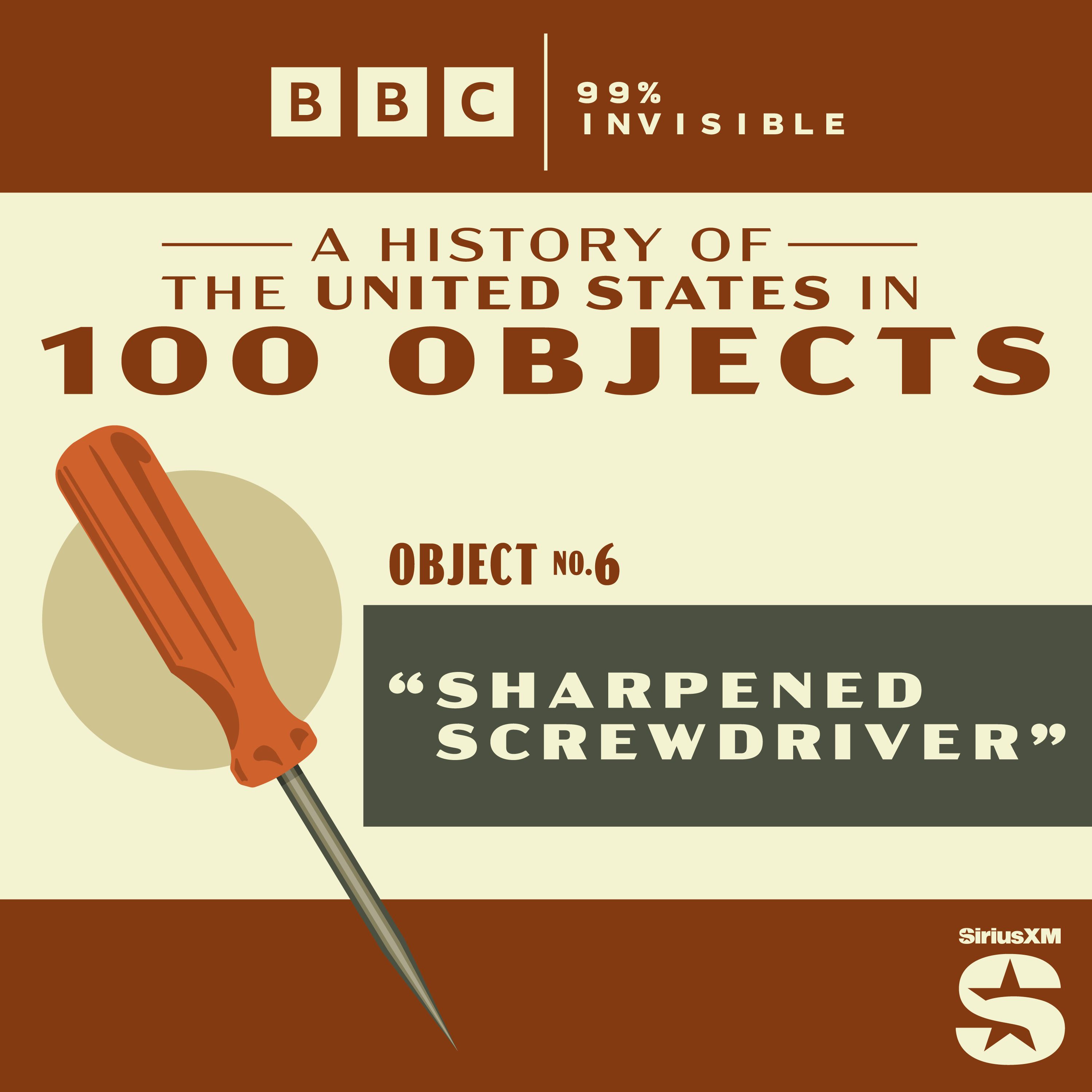
99% Invisible
100 Objects #6: "Sharpened Screwdriver"
00:40:28
How was a household tool reimagined as a deadly weapon…that never actually existed?
Loading summary
Transcript161 lines
- [00:02]
Mazda Advertiser
Mazda has been named Consumer Reports safest new car brand. It starts with our approach. Every Mazda comes standard with proactive safety features so you're more aware of what's around you, more focused on the road ahead and ready before problems ever start. Mazda more of what matters most to you. Go to mazdausa.com to learn more. Consumer Reports does not endorse or promote any product.
- [00:30]
Roman Mars
Ever invest in something that seemed incredible at first but didn't live up to the hype. Marketers know that feeling. They optimize for the numbers that look great, like impressions, but then they don't see revenue. LinkedIn has a word for that bull spend. Instead, you can get the highest roas of major ad networks with LinkedIn ads. Cut the bull spend, advertise on LinkedIn. Spend $250 and get a $250 credit. Go to LinkedIn.com invisible terms apply. It's 1984, Ronald Reagan is president. MTV is just three years old, and it's the era of the Death Wish movies. This is the story of a man
- [01:13]
Narrator/Interviewer
who decided to clean up the most
- [01:16]
Roman Mars
violent town in the world.
- [01:17]
Narrator/Interviewer
I said, turn around. Hand me the money.
- [01:22]
Roman Mars
If you've never seen the Death Wish movies, they follow the actor Charles Bronson as he goes on a shooting spree to, depending on the movie, avenge the murder of his wife or the murders of other ordinary New Yorkers who fall prey to the city's wildest, most violent criminals.
- [01:39]
Historian Heather Ann Thompson
The plot sort of doesn't matter in a weird way.
- [01:43]
Roman Mars
This is historian Heather Ann Thompson, author of the new book Fear and Fury.
- [01:49]
Historian Heather Ann Thompson
What matters is that the audience is relating to this feeling of always unsettled when you leave your apartment or your home, and that at any given moment some young black or brown thug will cause you harm.
- [02:07]
Roman Mars
The 80s were full of movies like this. Death Wish, the Exterminator, the Dirty Harry movies.
- [02:13]
Historian Heather Ann Thompson
This is kind of a glorified vigilante genre of media. Every man for himself. Make sure you're armed, Take out any would be assailant on your own. Make sure that you're protect your family
- [02:28]
Roman Mars
and that every man for himself message resonated with people. All the movies came out in what was actually a very difficult moment in cities like New York.
- [02:39]
Historian Heather Ann Thompson
This is four years into the Reagan revolution. Cities have been stripped of a lot of their social resources and trash is piling up on the city streets. Muggings are up, the drug trade is up. The city is feeling dangerous. There's many, mainly a sense that nobody is doing anything about any of this. There's a real lack of understanding of why our cities feeling so under siege.
- [03:11]
Roman Mars
Then, in 1984, something tragic happens in New York City. A white man named Bernie Goetz, fed up with the crime and violence of the city, boards the subway and shoots four black teenagers. None of them have weapons. But as the story spreads and becomes a headline in papers across the city, it starts transforming into a fantasy pulled right out of death Wish, complete with dangerous, armed criminals.
- [03:43]
Historian Heather Ann Thompson
You know, they're not always necessarily going to have the gun, right? But they're going to have something. They're going to slash you with jagged glass or they're going to whip out a tire iron. And in the Bernie Goetz case, there's sort of a new version of this, which is that young teenagers in the city are carrying screwdrivers.
- [04:07]
Roman Mars
Not just screwdrivers, sharpened screwdrivers, as in the normal tool transformed into a piercing deadly weapon, only it was completely made up. The teens were not carrying sharpened screwdrivers or any other kind of weapon. That was the invention of this one moment in 1984, a sneaky new weapon and a powerful symbol. From 99% Invisible and BBC Studios, this is a history of the United States in a Hundred Objects. I'm Roman Mars. Today how the mythical sharpened screwdriver at the heart of the Bernie Getz shooting surfaced a new era of misinformation and why it's still invoked as a justification for white vigilante violence today. Before the four teenagers in the Getz case became known as sharpened screwdriver wielding criminals, they were just four kids in the South Bronx.
- [05:20]
Elliot Williams
If New York was in bad shape, the South Bronx was in catastrophic shape.
- [05:25]
Roman Mars
This is Elliot Williams, legal analyst and author of a book on Getz called Five Bullets.
- [05:31]
Elliot Williams
The mid-1980s were quite a significant period of transition. Certainly just about everything withdrew as the city tightened its belt.
- [05:40]
Roman Mars
Firemen, police, sanitation workers, gone. Public schools were decimated. And stuck in the middle of that were four young men. Barry Allen, Darrell Cabey, Troy Candy, and James Ramseur.
- [05:52]
Elliot Williams
They were all between 18 and 19 years old and lived in a subsidized housing project called Claremont Village in the Bronx.
- [06:00]
Roman Mars
Like Bernie, the four teenagers were soon to become famous, but we still actually don't know much about their lives.
- [06:07]
Elliot Williams
I tried to speak to all of the surviving young men. Two of the four are surviving. I tried very hard to speak to them. I got as close as speaking to two of Darryl Cabey's sisters for the book. I did not want to be on the record or quoted in the book. And I Respected that.
- [06:23]
Roman Mars
Still, there are some small details we do know. We know they had siblings. We know James Ramseur was a talented breakdancer.
- [06:30]
Elliot Williams
We know that Barry Allen was a young father. We know Darrell Cabey ultimately is raised for most of his childhood by only his mother, because his father, who had been working as a taxi driver, had been crushed by his own cab in a carjacking. And his mother very much wanted more for him, wanted him to get from all of the pressures and troubles of the South Bronx to sort of find a better life.
- [06:58]
Roman Mars
But at this point in 1984, none of them had been able to get away.
- [07:05]
Historian Heather Ann Thompson
So these are four kids who are hanging around essentially day after day and have no money, no jobs, no prospects, but who still, of course, want to go on a date, want to play a video game, want to be a teenager. And so they decide on December 22, 1984, that they're going to go into the city and they're going to go to a video arcade. Because video arcades had machines that you could take a screwdriver, jimmy open the receptacle, and you could get some quarters out of it. And in 1984, if you got a bunch of quarters, that was the difference between you being able to get something to eat, between you being able to imagine maybe taking your girlfriend to the movies. That was the difference between having a life and not having a life.
- [08:04]
Elliot Williams
But I will note it was not that they were this sort of street gang who were out marauding or wilding or whatever else. This was a common act that teenagers did.
- [08:17]
Roman Mars
I mean, this was the golden age of arcade games. Pac Man, Donkey Kong. These games were everywhere.
- [08:24]
Elliot Williams
You're talking liquor stores, bodegas, bowling alleys. It was painfully easy for someone with a long screwdriver and a little ingenuity to just pop it open and run away with all of that money in it. And in many respects was cleaner or safer than mugging or robbing someone. It wasn't that police were likely to move heaven and earth to try to track down a kid with $80 of quarters in his pocket. And even if he got caught, you wouldn't go to jail for a long time.
- [08:53]
Roman Mars
So three days before Christmas 1984, when the city is bustling and people are scrambling to get last minute gifts, the four teenagers get on a train to go to an arcade downtown.
- [09:04]
Elliot Williams
They got on, they jumped the turnstile in the South Bronx, were goofing off. They were certainly doing pull ups on the bars, walking around, asking people for cigarettes or for matches or whatever else
- [09:18]
Roman Mars
Meanwhile, Birdie Goetz In Manhattan, about 30 minutes south of the Bronx on the train and is about to leave his apartment.
- [09:25]
Historian Heather Ann Thompson
He's had a frustrating morning, and he decides that he's going to get on a train and he's going to go down and potentially see some friends, maybe have a drink or two, but whatever, get out of the apartment. And so he leaves mid afternoon to walk very nearby to the 14th street station. He gets on the 2 train going downtown and onto this one car. There are these four teenagers. They were having a really good time. They are joking around, they're laughing. Back in the day, subways had these straps that hung down, and they were, you know, swinging on the straps and goofing around and talking to people. Hey, what's up? You got a light? And so Bernie Getz sits down and decides to sit right across from them, which, you know, is noteworthy to the teens. Cause of course, you know, nobody wants to sit next to teenagers.
- [10:26]
Roman Mars
The train wasn't full, so Bernie Getz didn't have to sit next to the teenagers, but he did.
- [10:32]
Historian Heather Ann Thompson
And one of them who is really closest to him, named Troy Canty, is sort of interested in this, and he says, hey. You know, he greets him, and Bernie gets kind of gruffly, you know, so, you know, hey responds back. And he's kind of encouraged, and he's encouraged in particular to ask this guy, does he have $5? And so that was not a particularly weird thing for Troy Canty to say. Hey, have you got five bucks? This is the 80s, and panhandling is the name of the game. You can't go anywhere in New York City in 1984 without somebody saying, hey, you got a dollar? You got five bucks?
- [11:10]
Roman Mars
But Bernie doesn't like that.
- [11:12]
Historian Heather Ann Thompson
Bernie stands up, he slowly turns, and in that moment, Tray Canty sort of thinks, wow, this guy's actually gonna give me five bucks.
- [11:22]
Roman Mars
Cool.
- [11:22]
Historian Heather Ann Thompson
And but what happens is Bernie Goetz stands up, reaches into the waistband of his slacks, and what he has there is a hidden holster.
- [11:33]
Roman Mars
What Troy didn't know was that Bernie Goetz routinely carried guns.
- [11:38]
Historian Heather Ann Thompson
And in New York, that was illegal to just carry a gun because you wanted to. So he'd actually purchased his guns illegally because he'd gone down to Florida and purchased them and brought them back, sir.
- [11:49]
Roman Mars
Bernie has one of those illegal guns on him, a.38 Smith Wesson. And now he pulls it out on the train.
- [11:56]
Historian Heather Ann Thompson
He swings around, assumes a combat position and shoots Troy Canty front on straight in the chest. And immediately right behind Troy is his Friend Barry Allen, who's not said a word to Bernie Getz. He, horrified, tries to get away, tries to run, and. And Bernie Getz shoots him in the back. And then their friend James Ramsor, who's even further down the train, who's also said nothing to Bernie Getz, he shoots him as he's trying to get away in the arm. It goes through his side and ultimately into his lungs.
- [12:33]
Roman Mars
Now, three of the four teens are on the floor of the train, bleeding. Troy Canty from a bullet to the chest, Barry Allen from a bullet to the back, James Ramseur from a bullet to his arm and side. Bernie also fires at the fourth teen, Daryl kby, and misses, shaking. KB Sits down in the rear of the car, head down, and grips the edge of a seat, hoping that Bernie will just move on.
- [12:59]
Historian Heather Ann Thompson
And when Bernie Goetz walks over to this fourth teenager, Darryl KB he looks down at him and he says, you look okay, here's another. And that's when he puts a gun straight in his, pulls the trigger, thus severing his spinal cord and rendering him paralyzed for the rest of his life.
- [13:25]
Roman Mars
While this is all happening, the conductor pulls the emergency brake, and the train comes to a halt.
- [13:31]
Elliot Williams
So the train is stopped on the tracks in the darkness somewhere between 14th street and Chambers street in lower Manhattan. Now, at that moment, Gatz appeared calm to passengers and appeared almost poised. But he ultimately, knowing that the train would be swarmed with police in a matter of moments, just fled, jumped off the train, ran through the subway platform with his gun, took a cab home, rented a car, and fled to New Hampshire.
- [14:04]
Roman Mars
The boys are hoisted out of the train and rushed to the hospital. All four were badly wounded, but Darryl Cabey is the worst off, in a coma with a bullet in his spinal cord. He and Barry Allen are hurried into the operating room.
- [14:19]
Historian Heather Ann Thompson
And meanwhile, back on the train, the police are trying to make sense of what in the world just happened. And so what are they left with? They're left with the clothing of the boys, who have been stripped so that they can be attended to medically. And the police discover that in the pockets of two of these young men in particular, it was Darryl KB And James Ramsor, that they have screwdrivers. And initially, when they pull these screwdrivers out and they note them, they catalog them, there'd been no reason to think they'd ever been taken out. They were secured in their jackets, and that was kind of the end of it.
- [14:57]
Roman Mars
The police log the screwdrivers, but they don't think of them as relevant yet. Meanwhile, the whole system begins to mobilize to figure out what the boys could have done to justify the shooting.
- [15:08]
Historian Heather Ann Thompson
They're casting about combing the records to figure out what in the world record must these teenagers have. Because surely they must be criminals. Surely they must be responsible for the fact that they themselves now have bullet holes in them. And they quickly realize that these teenagers have racked up a series of misdemeanor citations over the previous years.
- [15:39]
Roman Mars
They'd been caught jumping the turnstile to avoid paying the subway fare and trying to steal quarters from an arcade. All the citations were minor. If it weren't for the Goetz case, none of those charges would ever bring them to court.
- [15:52]
Historian Heather Ann Thompson
But within a very short period of time, two Bronx judges make the executive decision that they're going to suddenly issue a blizzard of warrants for these teenagers arrest.
- [16:06]
Roman Mars
Meanwhile, the police are looking for Bernie so they can question him too.
- [16:10]
Narrator/Interviewer
The search goes on today for the so called subway vigilante.
- [16:14]
Roman Mars
But already the public isn't even sure the police should be doing that.
- [16:19]
Narrator/Interviewer
Police reported receiving more than 500 calls praising the man who shot the teenagers.
- [16:25]
Historian Heather Ann Thompson
Bernie Getz is celebrated by ordinary people. They champion him. They decide that he's innocent even before they know his name. They, they are furious that the DA's office will even consider prosecuting him.
- [16:40]
Elliot Williams
Before Bernard Goetz was identified, the New York Post started calling him the, quote, death Wish Vigilante. That's the nickname they gave him. And they started running graphics about the Death Wish Vigilante after Charles Bronson, the protagonist of the movie Death Wish, so
- [16:58]
Historian Heather Ann Thompson
long before Bernie Goetz had pulled that trigger. They were already really being primed with this rhetoric to identify with Bernie Goetz. Bernie Goetz, he's just minding his own business. He's a hard working guy. He's a small business owner.
- [17:13]
Elliot Williams
Bernie was a regular guy, you know what I mean? He's a regular guy. There's no big thing about him, you
- [17:18]
Historian Heather Ann Thompson
know, and he gets on that train and four black thugs are going to try to harm him. And so that's all they need to know, right?
- [17:26]
Narrator/Interviewer
Gadz did the people of the city of New York a great favor.
- [17:30]
Elliot Williams
If it was me, I would have killed the guy.
- [17:32]
Roman Mars
I mean, if it was me and
- [17:33]
Mazda Advertiser
I had to defend myself, I would have done exactly the same thing.
- [17:36]
Elliot Williams
I think he did, right?
- [17:37]
Narrator/Interviewer
They tried to mug him. They're not kids. They're monsters.
- [17:43]
Roman Mars
But there's one detail in this story, one piece of misinformation that really started to stand out. And it had to do with those screwdrivers.
- [17:51]
Elliot Williams
Police say the teenagers had arrest records and three were carrying long screwdrivers.
- [17:55]
Historian Heather Ann Thompson
Police say the boys were armed with sharpened screwdrivers.
- [17:58]
Roman Mars
Now the media was reporting that even though the boys didn't have guns, they had weapons in the form of screwdrivers. And not just screwdrivers, sharpened ones.
- [18:08]
Historian Heather Ann Thompson
These were not sharpened screwdrivers. These were regular screwdrivers that they needed to jimmy open the coin receptacles at the local arcade.
- [18:20]
Elliot Williams
And it's not just the use of the sharpened screwdrivers, but the use of the term armed. The narrative that the four young men were armed with screwdrivers is itself a fiction. There was never any screwdriver shown to, brandished or made available to Bernard Goetz at any time. It is simply not true.
- [18:43]
Roman Mars
But that didn't matter. After the New York Daily News reported it, its tabloid competitor, the New York Post, doubled down.
- [18:53]
Elliot Williams
Every major paper ran with this notion that the screwdrivers were sharpened.
- [18:59]
Historian Heather Ann Thompson
Police say they did find several sharpened screwdrivers in the coat pockets of the victim.
- [19:03]
Narrator/Interviewer
According to police carriage sharpened heavy duty screwdrivers.
- [19:08]
Roman Mars
And each time another news story mentioned it, it became more and more real.
- [19:12]
Elliot Williams
Four black teenagers wielding sharpened screwdrivers pressed him for $5.
- [19:18]
Roman Mars
Eventually, even major mainstream publications like the New York Times and Time magazine ran with this detail.
- [19:24]
Elliot Williams
All you knew was a white guy that had shot for black teenagers who were armed with sharpened screwdrivers and that stuck. And it taps into a long running narrative in the United States over lifting up vigilantes and vigilante behavior.
- [19:43]
Roman Mars
Still, even as these news stories are circulating, there's a big piece of the puzzle missing. Bernie, who had been on the lam for nine days, still needed to be questioned and he was about to finally emerge and give his own version of events. This podcast is brought to you by Squarespace. Squarespace is an all in one website platform that helps you stand out online. Whether you're just getting started or growing your business. It's got everything you need from securing your domain and to building a professional site and showcasing your work. All in one place. Bring your vision to life with AI powered design or curated templates. Plus flexible editing tools that help you create something that truly reflects your style. No experience needed. Squarespace makes it easy to share your work, book clients and get paid with built in tools for scheduling, invoicing and email. All in one place. I've had a Squarespace site RomanMarris.com for for 12 years or so and the key for me isn't that it was easy to build, although it was is that it's easy to maintain. It never gives me any trouble at all. It's great. Head to squarespace.com invisible for a free trial and when you're ready to launch, use offer code Invisible to save 10% off your first purchase of a website or domain. Summer always changes how you get dressed. You want pieces that feel lighter and more breathable, things that are easy but still put together. That's where Quince comes in. They focus on high quality essentials that feel and look amazing. Think breathable linen and soft organic cotton. And Quint goes way beyond clothing. They have custom upholstered sofas, ceramic cookware, premium bedding and more for your home. It's the kind of brand you end up recommending to everyone for everything. I recently went to London to launch the Hundred Objects series and the temperature variation was wild there. Like it was like high in the 50s and then high in the 90s. The fact that I brought my ribbon cashmere zip up like changed everything. I wore it underneath my clothes in the beginning of the week and it still looked put together, still looked really good. And then when that temperatures got warm I could zip that thing, take it off and look good for the rest of the hot afternoon. Elevate your summer wardrobe. Go to quince.com invisible for free shipping on your order and 365 day returns. Now available in Canada too. That's Q U I n c-e.com invisible for free shipping and 365 day return.
- [22:10]
Nuun Hydration Advertiser
Quints.com invisible Doing hard things doesn't always look dramatic. Sometimes it's an early workout, a long hike, or a full day outside where quitting feels easier than pushing through real life hard things. That's exactly what Nuun Hydration is made for. It's real deal activated hydration built to help keep people moving through the moments that ask a little more from them. Nuun hydration tablets deliver clean ingredients and optimized electrolytes that hydrate better than water alone, especially when you're sweating, moving or pushing through a long day. Drop one into a bottle and it dissolves quickly, tastes great, and comes in a simple no mess tube you can take anywhere and at less than $1 per serving, it's easy to make part of your routine. Noon is made for people who show up, value growth and find joy in the effort. It helps support clear focus, steady energy and the mindset to take on whatever comes next. Shop noon hydration@noonlife.com that's n uunlife.com and fuel your next hard thing.
- [23:08]
Roman Mars
So much activity is required to keep a business running smoothly behind the scenes. And connectivity is the key to it all. AT&T business is built for exactly that. Helping small businesses stay connected with reliability they can count on. For small business owners, connectivity is not just a convenience, it's essential. It keeps operations moving, teams aligned, and customers supported. It can be the difference between everything running seamlessly in the background or becoming the thing that brings work to a halt. AT and T Business Internet is designed to be a reliable provider, helping reduce friction and keep things running smoothly so businesses can stay focused on what matters Most. Powered by AT&T Business Built to work. Get AT and t business@business.att.com. After nine days of traipsing around the snowy back roads of Vermont and New Hampshire, Bernie Goetz finally decides to turn himself in. He walks into the police station in Concord, New Hampshire and starts talking.
- [24:12]
Narrator/Interviewer
Mr. Getz, this is all on videotape? Sure.
- [24:15]
Historian Heather Ann Thompson
Nothing that's said in this room is off the videotape. It's for your protection and for ours. When he turns himself in, he voluntarily waives his right to a lawyer. And he proceeds to give a two hour videotaped confession. And in that, he pulls no punches.
- [24:35]
Narrator/Interviewer
I wanted to kill those guys. I wanted to name those guys. I wanted to make them sucker in every way I could. If I had more bullets, I would have shot them all again and again. My problem was I ran out of bullets and I was gonna, I was gonna gouge one of the guys eyes out with my keys.
- [24:49]
Historian Heather Ann Thompson
Afterwards, he makes clear that robbery had nothing to do with it.
- [24:55]
Narrator/Interviewer
Look, they don't have weapons.
- [24:58]
Historian Heather Ann Thompson
And he says this a few times, even when the da, you know, clearly mystified as to why he would have done. It's almost like people are throwing him a lifeline. Well, you know, is it because you were mugged, you know, you know, a few years earlier? He says, no, it had nothing to do with that. You know, were you being robbed? And he says no.
- [25:18]
Roman Mars
He even admits to going up to Darryl Cabey, who was cowering in his seat and saying a line that shocks me every time I hear it.
- [25:26]
Narrator/Interviewer
When I saw this one fellow, when I saw the gleam in his eye and the smile on his face, I went to him the second time and I looked at him and I said, you seem to be doing all right. Here's another.
- [25:45]
Roman Mars
Bernie was fed up with the city, with the boys, and he decided to take matters into his own hands. He had admitted to all of it. The question now was, would that matter? More than two years after the shooting, the case finally went to court. Bernie faced a 13 count indictment. And on paper, it looked like a slam dunk for prosecutors.
- [26:10]
Historian Heather Ann Thompson
On the one hand, you have a prosecutor who has everything on his side. He's got Bernie Goetz's confession, he's got very badly injured victims. You know, the facts are on his side. But Bernie Getz is already winning in the court of public opinion. And he has hired a very, very important lawyer by the name of Barry Slotnick, who was going to, in effect, bamboozle the jury.
- [26:38]
Elliot Williams
Barry Slotnick couldn't have been more out of central casting. When you think of the kind of glitzy, showbiz type attorney, Barry Slotnick was it. He had tailored Italian suits, he had jewelry, the tie tack. He had a alligator skin briefcase in each hand. He's chauffeured in a Cadillac. He smoked cigarettes. He had represented many high profile members, I believe, of the Colombo crime family. So he was a mob lawyer.
- [27:14]
Roman Mars
So on one side you have this shiny mob lawyer representing Bernie Goetz, and on the other there's the prosecutor tasked with proving the boys were the victims. And the jury is waiting to hear from both sides. You know, when you describe the contours of the case to anyone, they have a hard time coming up with what the defense is going to be. But could you boil it down for me? What was the sort of nature of the defense's case?
- [27:39]
Elliot Williams
The defense's case was multifold. I think the big part of it is, and Barry Slotnick says this in his opening statement, I am going to put these young men on trial. And frankly, I don't think he called them young men. It was thugs and hoodlums and savages and whatever else. He framed it as a gang, a street gang that sought to terrorize, if not Bernard Goetz, whoever was the next unlucky victim of their vicious path.
- [28:05]
Roman Mars
The judge banned explicit talk of race at the trial. But race was always front of mind.
- [28:11]
Elliot Williams
They never said black, they never said any. But they used language of savages, thugs, animals, monsters, hoodlums. The defense was not shy about doing everything they possibly could to stoke the racial biases of the jury.
- [28:27]
Roman Mars
And it wasn't just the language he used. One of the first things Slotnick and his team did was, was deliberately seek out photographs where the young men looked their most menacing.
- [28:36]
Elliot Williams
Giant, 24 by 36 or whatever, black and white posters of these four young men in which the young men just didn't look friendly.
- [28:47]
Roman Mars
Slotnick even put Those pictures on easels in front of the jury for no reason.
- [28:51]
Elliot Williams
Remember these are victims, these were not perpetrators or criminals. This isn't evidence. But every day when they walked in, these menacing looking photographs of these four young black men would be staring at the jury because they wanted the jury to see who these men were and draw their own conclusions from that.
- [29:11]
Roman Mars
Then about a month into the trial, Slotnick pulled out the big guns.
- [29:15]
Elliot Williams
One morning they went into court and taped out a model of the train car on the floor of the courtroom.
- [29:23]
Roman Mars
Slotnik was staging what was supposed to be a reenactment of the shooting. But very quickly it was clear that almost nothing about it resembled what actually happened.
- [29:32]
Elliot Williams
They brought in four of the meanest looking black guys they could find it and dressed them up in dirty jeans and white T shirts and had them represent the four young men.
- [29:45]
Roman Mars
So the representation of the boys was already inaccurate. But they also didn't try to replicate any of the other conditions on the train that day. The recreation didn't show any of the other passengers who had been there. And instead of trying to recreate where the boys were actually sitting or standing, the four actors were directed to stand in a semicircle around the stand in for Bernie Goetz.
- [30:08]
Elliot Williams
Think of all of the various factors that would have been at play. But all it was was a taped out model of the car with four mean looking black teenagers grabbing and tugging and shoving and pulling the model. Bernard Goetz.
- [30:22]
Roman Mars
The judge eventually stopped the demonstration, but
- [30:24]
Elliot Williams
the damage was done. The jury saw what the defense wanted them to see, which was four young black men beating up a white man. And that's it.
- [30:33]
Roman Mars
In essence, this is how most of the trial goes. The defense continued to use racialized language and stereotypes to amp up the jurors larger fears and anxieties about the city and to use all of this to prove that Bernie was acting in self defense, that he was reasonable to think that he was about to be robbed or mugged. They even explained away his confession.
- [30:56]
Elliot Williams
The defense made the decision a very risky one, but said that this was a frightened man and even though he's openly confessing he was unambiguous and I intended to murder these men and to make them suffer as possible. Those were his words, but because he was scared and out of his mind, that meant that we should discredit the words that come out of his mouth. It was very risky. But ultimately the strategy paid off.
- [31:26]
Roman Mars
In June 1987, the jury acquitted Bernie Goetz of the most serious charges against him. Not guilty of attempted murder not guilty of assaulting the four boys. The only thing he was held accountable for was the possession of illegal firearms. And in the end, he only served eight months. What is the sort of basic legal reason for the jury? Just explain to me why the jury, you know, voted not to convict him.
- [31:56]
Elliot Williams
The legal reason goes back to this question of reasonableness. The law in the state of New York says one can use deadly or lethal force if he reasonably believes he's about to be a victim of a robbery. And after doing that analysis, the jury felt that Getz was reasonably afraid. And they think that what they were simply doing was applying the law, saying in a rough environment, in a rough city, this individual was reasonable in his belief that a mugging might have been imminent.
- [32:35]
Roman Mars
The Getz case actually set a new legal precedent around that question. When is it reasonable for someone to act in self defense? Before the case, the New York state legislature hadn't clearly defined what reasonable meant.
- [32:49]
Elliot Williams
And the question was, is reasonableness subjective in the sense that if you genuinely feel scared in your heart, that's enough. I feel scared, therefore I can use deadly force or objective, I'm going to use deadly force. And that tracks with how we would assume other people in society would behave. That compares my behavior to everyone else's. And those are two different ways that courts around the country had grappled with how to use the term.
- [33:19]
Roman Mars
This question is so contentious, it actually goes up to the highest court in New York, which decides once and for all to clarify it. Technically, they say you have to consider both things. What the person was afraid of and what an average reasonable person would be afraid of. But as we, we see in the Bernie Goetz case, even considering that definition of reasonable, what the average person might do still ultimately comes down to a very subjective opinion. This measure of reasonableness seems to have just. I don't know, we seem to accept a lot of more of this.
- [33:55]
Elliot Williams
Yeah, we have no evidence to suggest that a robbery was imminent, but the mere fact that one might have sincerely thought that a mugging was coming would have allowed him to kill them under the law. Like if he'd succeeded and actually committed the act consummated the act of homicide that would have been protected under New York law, and which is just sort of. It's one of the realities of the American conception of self defense that we don't ever really stop to think about, which might lead to innocent people getting shot preemptively. And we as a society sort of make peace with that.
- [34:32]
Roman Mars
So if that's the legal reason why gets gone off. Do you have a take on what the real reason was? Like, what do people say?
- [34:40]
Elliot Williams
It's both my knowledge of the system and cynicism as a former prosecutor. And I would say honestly, the jury saw themselves in Bernard Goetz. Another jury could easily have convicted him of attempted murder, starting with the fact that he says on the record to police, knowingly and voluntarily, I intended to murder them in an attempted murder trial. That's a confession. And so this idea that he was scared and out of his mind means that we should discredit the words that come out of his mouth is. To me, that's just ludicrous. It's nonsense. But they saw themselves in him.
- [35:19]
Roman Mars
Ten of the 12 jury members were white. Half of the jury had actually been victims of crime, some of them on the subway. They were primed to see themselves in Getz and to see the boys as attackers. And if you believe the papers, attackers wielding sharpened screwdrivers.
- [35:38]
Elliot Williams
Every single serious source who have looked at this has found has debunked the sharpened screwdrivers theory. And again, that to me extends not just to whether they were sharpened, but the use of the term armed when referring to the teenagers. Because, number one, we know the purpose for which they had the screwdrivers, and number two, we know that they at no point attempted to even threaten to use them with respect to Bernard Goetz.
- [36:05]
Historian Heather Ann Thompson
And yet, at the end of the day, in a narrative very familiar to today that we all inhabit, the facts won't matter because people will want to somehow exonerate him anyway.
- [36:24]
Roman Mars
In the same way that the Goetz case acted as a kind of stress test for the legal definitions behind self defense, it was also a testing ground for something else. In the late 70s, Rupert Murdoch, then an ambitious conservative media mogul, came to the States with the dream of dominating the US Market, starting with buying the New York Post.
- [36:44]
Historian Heather Ann Thompson
And he quickly understands that the. One of the most important things that you need when you're going to dominate a media market is you need readers. And one of the easiest ways to get readers is to kind of keep hitting them with salacious stories that just baffle them and defy imagination. I'll give you just one example of that that just exemplifies this moment so well. A reporter from the New York Post was later interviewed about the reporting in the Post in these years. And this reporter gave an example of how there'd be an event and a Post reporter would be on the scene and sort of ask the police officer, like a crime and say, do you know, what happened, you know, who are your suspects, what's going on? And the police officers say, no, we're still investigating it. And the reporter would say, well, you know, have you ruled out this, have you ruled out that? And like, you know, have you ruled out a homosexual angle? And of course the police officer's like, look, we haven't ruled out anything. You know, we're still investigating. And then the headline would be homosexual angle not ruled out in this crime. Right? So, you know, the Bernie Goetz case was really ground zero for this in New York City and really the nation, because Rupert Murdoch's New York Post will become Fox News and Bernie Goetz will become that everyman, that resentful, rage filled everyman, that over time will be allowed to do whatever he wants, even legally, as long as he just says he felt threatened.
- [38:19]
Roman Mars
In the decades after, we have had more people enacting the death wish fantasy, taking their idea of justice into their own hands. In 2012, George Zimmerman, a neighborhood watch volunteer in Sanford, Florida, saw a black teenager in a dark hoodie walking down the street. Zimmerman said he thought the teen was casing the area looking for houses to rob. But rather than wait for police, Zimmerman got out of his car and gunned down 17 year old Trayvon Martin. Trayvon had no weapons, only a bag of Skittles in his pocket. In 2020, Kyle Rittenhouse showed up at a Black Lives Matter protest in Kenosha, Wisconsin with an AR15 style rifle. He said he went to protect local businesses to do what he thought law enforcement could not. Rittenhouse shot three people, killing two and wounding another.
- [39:13]
Historian Heather Ann Thompson
The modern day version of this kind of unleashing of rage and violence is perhaps not surprisingly, much more extreme. How can it be that Kyle Rittenhouse can literally show up at a protest, guns in hand and shoot three people, kill people, people, and have people celebrate him?
- [39:37]
Narrator/Interviewer
Powell Rittenhouse struck us as bright, decent, sincere, dutiful and hard working.
- [39:43]
Elliot Williams
Exactly the kind of person you'd want
- [39:44]
Narrator/Interviewer
many more of in your country.
- [39:47]
Roman Mars
Then in 2023, Daniel Penney, a former Marine, got on the same New York City subway as Jordan Neely, a 30 year old unarmed black man. Neely was in the middle of a mental health crisis and he began to shout and act erratically. Penny grabbed Neely from behind, brought him to the ground and placed him in a chokehold for several minutes.
- [40:09]
Historian Heather Ann Thompson
Daniel Penny, like Bernie Goetz, deemed him threatening and killed him.
- [40:14]
Roman Mars
And here, just like the other two cases, the same thing happened. They all claim self defense and they're all lionized.
- [40:22]
Narrator/Interviewer
Daniel Penney was a good Samaritan. Put his own life at risk.
- [40:26]
Elliot Williams
I think he deserves a medal. New York needs this
- [40:31]
Roman Mars
and this support. It doesn't stop with conservative media. It reaches beyond to billionaire businessmen, even the President of the United States.
- [40:41]
Elliot Williams
Just put on your imagination hat and imagine if Daniel Penney is a black man and Jordan Neely is a white man. Daniel Penny kills Jordan Neely in a chokehold. Close your eyes and imagine. Does Donald Trump invite him to sit in his private box at the Army Navy game weeks later after his acquittal? And I think the answer is no. Does Andreessen Horowitz, the most prestigious venture capital firm on the planet, give him a job offer days after his acquittal? And I think, again, the answer is no.
- [41:20]
Roman Mars
In the end, all three men are acquitted of all assault charges, just as Bernie Goetz had been. In fact, in the Penny case, when the jury asked for clarification on the question of what was reasonable, the judge specifically referred them back to the precedent set in the Goetz trial. And that's not the only way that Bernie keeps coming up in these vigilante cases.
- [41:41]
Historian Heather Ann Thompson
He is still very much lionized. He was asked what he thought about Kyle Rittenhouse's verdict. He was asked what he thought about Daniel Penney's verdict. He's still able to be the her of his story,
- [41:55]
Roman Mars
while Bernie Goetz is still invoked again and again. The four teenagers have sort of disappeared.
- [42:02]
Historian Heather Ann Thompson
Meanwhile, James Ramsor is dead. He killed himself. One of the anniversaries of this shooting.
- [42:10]
Roman Mars
Things weren't much better for his three friends. In 1996, KB's family did win a civil suit against Getz. They were awarded $43 million in damages, but they never received a penny. Goetz soon declared bankruptcy, and Kayby receded from the news. Barry Allen died, too. After years of struggling with drug addiction.
- [42:33]
Historian Heather Ann Thompson
Troy Canty is the only one of the four who managed to eke out some kind of an independent life afterwards. And he doesn't want to to talk to anybody, very understandably, because he doesn't trust that his story will actually be honored.
- [42:54]
Roman Mars
And what happened with the myth of the sharpened screwdriver?
- [42:58]
Historian Heather Ann Thompson
The myth of the sharpened screwdriver remains.
- [43:03]
Elliot Williams
Bernard Goetz. As recently as Kyle Rittenhouse was in an interview referring to the sharpened screwdriver.
- [43:11]
Historian Heather Ann Thompson
The sharpened screwdrivers are evoked to explain why Bernie Goetz had done what he did.
- [43:18]
Elliot Williams
It was just a narrative that took off from the first day. And now, 42 years later, it still is not really back in the bag.
- [43:35]
Narrator/Interviewer
Foreign.
- [43:43]
Roman Mars
Objects is a production of 99% Invisible and BBC Studios. It's hosted and curated by me, Roman Mars. This episode was produced by Ellie Lightfoot. Our other producers are Priscilla Alabi and Brenna Daldorf. Our Associate producer is Isaac Fisher. This series was edited by Andrew, Annie Brown and Courtney Harrell, mixing by Charlie Brandon King, fact checking by Amy Bracken. Our theme song is by Swan Real from 99% Invisible. Our executive producer is Kathy Tu from BBC Studios. Our executive producers are Annie Brown and Courtney Harrell. Our Production coordinator is Shan Pillay and the Production Manager is Mabel Finnegan Wright. Artwork by Stephen Lawrence. 99% Invisible is part of the Sirius XM podcast family headquartered in beautiful uptown Oakland, California and BBC Studios is headquartered in beautiful white City West London. If you want to get in touch or have an object for us to consider, email us at 100objects99pi.org.
- [44:55]
Narrator/Interviewer
Sam.
- [45:21]
Dan (Scared to Death Podcast Host)
Do you love hair raising allegedly true stories about the paranormal? Then you should summon the podcast Scared to Death. It's the popular horror series with more than 60 million downloads to its name and is co hosted by me Dan
- [45:34]
Historian Heather Ann Thompson
Cummins and me Lindsay, co host and also Dan's wife. Each week on Scared to Death we share bone chilling tales from old books and creepy corners of the web and even some submitted by our listeners. All designed to make you want to sleep with the lights on.
- [45:50]
Dan (Scared to Death Podcast Host)
Think you can handle the horror? Tune in to Scared to Death every Tuesday at the stroke of midnight to find out.
- [45:58]
Historian Heather Ann Thompson
The all new Tropical Butterfly Refresher is now at Starbucks. Dive into juicy guava and passion fruit flavors with mango pineapple popping pearls bursting in every sip. Ice cold, instantly refreshing and impossible to put down. Made for summer only at Starbucks.
- [46:17]
Text Now Advertiser
Sometimes life will get you stressed out. Lucky you can always count on Text Now. Free Talk, free text, free 5G and they'll never shut you off. Cause like I said, it's free. Text Now's got your back. Nationwide. No long term contracts but all they nervous about losing service. Text Now's got your back. That's their sense of purpose no matter what comes next. You've got Free Talk and text with the Text now app.
- [46:42]
Elliot Williams
Wireless plans require the purchase of a sim card.
- [46:45]
Text Now Advertiser
Visit textnow.com for terms and conditions.