← 99% Invisible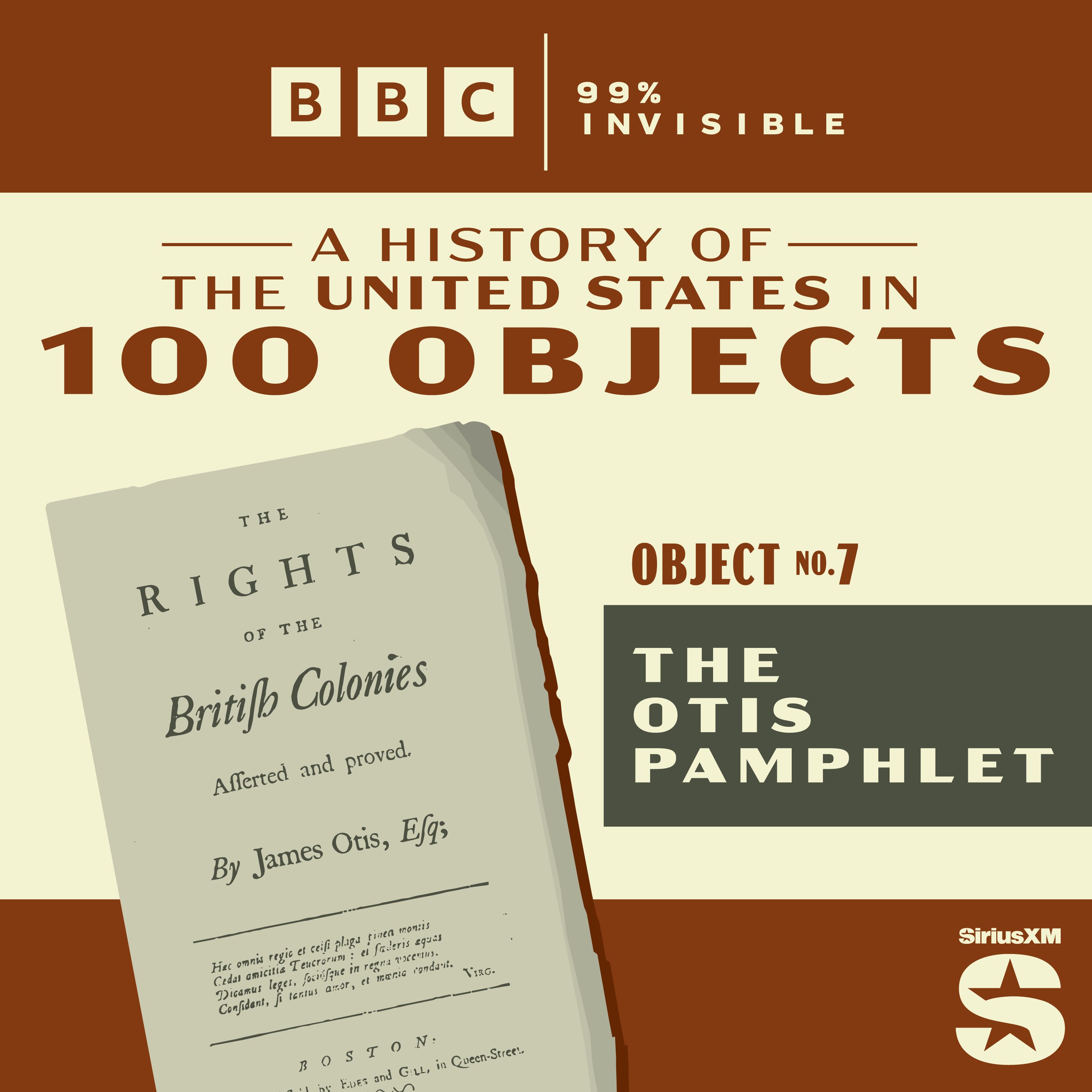
99% Invisible
100 Objects #7: The Otis Pamphlet
00:37:26
Journalist Jack Hitt returns to tell the wild, tragic story of America’s forgotten proto-founding father and his inflammatory 1764 pamphlet.
Loading summary
Transcript155 lines
- [00:00]
Roman Mars
Insurance isn't one size fits all. That's why drivers have trusted Progressive's name your price tool for years. Just tell Progressive what you want to pay and they'll show you coverage options that fit your budget. Visit progressive.com to find a car insurance rate that works for you. Progressive Casualty Insurance Company and affiliates Price and coverage match limited by state law. So much activity is required to keep a business running smoothly behind the scenes. And connectivity is the key to it all. AT&T business is built for exactly that. Helping small businesses stay connected with reliability they can count on. For small business owners, connectivity is not just a convenience, it's essential. It keeps operations moving, teams aligned and customers supported. It can be the difference between everything running seamlessly in the background or becoming the thing that brings work to a halt. AT&T business Internet is designed to be a reliable provider, helping reduce friction and keep things running smoothly so businesses can stay focused on what matters Most. Powered by AT&T Business Built to work. Get AT and t business@business.att.com It's 1984, and journalist Jack Hitt is walking up Broadway in Manhattan toward Columbia University. Jack is 27 at the time, recently out of grad school and obsessed with American history.
- [01:26]
Jack Hitt
I'm a Constitution nerd and my girlfriend and I have decided to write a book about marginalized figures in American history.
- [01:37]
Roman Mars
Romance right there. So on this particularly romantic day, Jack was on his way to do some research on the Revolutionary War in the stacks of Butler Library.
- [01:47]
Jack Hitt
Butler Library is one of these libraries. When you walk in the front door, it looks like it has about like four or five stories, but it's actually like 12 stories underground too, right? So I'm down like in the ninth floor. And you know that setting, right? It's just books, wall to wall books, and there's nobody down there. It's this wonderful feeling of come off the elevator or walk down the stairs. You're in this like just dark envelope of books and each aisle is only illuminated by this little 15 minute timer that you turn when you walk down it. And so I'm heading down towards the American Revolution section.
- [02:18]
Roman Mars
On his mind is one particular figure from the American Revolution, someone Jack thought history had almost entirely overlooked.
- [02:27]
Jack Hitt
We had come across this guy named James Otis who had written this sort of inflammatory pamphlet really early on in the early 1760s, a good 10 or 15 years before the Declaration of Independence. Some people say this is the document that sort of got the ball rolling.
- [02:46]
Roman Mars
Jack was fired up about this pamphlet. And if you're thinking this is kind of like a brochure that you get at a doctor's office with a diagram of the food pyramid. Think again. Pamphlets were how big ideas were spread at the time. They could be printed quickly and disseminated widely.
- [03:02]
Jack Hitt
And it was also the place where you might have a hot take. Right? So think of the famous pamphlets that we all learn later in American history. Thomas Paine's Common Sense or Letters from a Farmer in Pennsylvania by John Dickinson. They're the ones that, you know, that lasted and were famous. And that's why my girlfriend at the time and I wanted to write this book is Otis's pamphlet deserves to be that famous. Right. But what made the story kind of great for us is that things go sideways for Otis, actually horribly tragic. That's like Shakespeare, a man, you know, soaring into greatness, crashing into unbelievable humiliation and, and then madness. And you know, of course I romance the idea that, you know, these dangerous ideas that he was entertaining so early on, you know, had taken him over the edge.
- [03:50]
Roman Mars
So without the Internet to rely on, Jack is looking for a book that might tell him more about this tragic proto founding father and his inflammatory pamphlet.
- [04:00]
Jack Hitt
And I'm poking through the books, looking for which ones I should check out. And I look behind one of the books and I see that there's something back there. A thin volume, hand sewn binding. I'm like, what? Pull out some books, pull this thing out. And this is the pamphlet that James Otis wrote.
- [04:21]
Roman Mars
Wow.
- [04:21]
Jack Hitt
And this is an original copy. It's a 1764 edition of the pamphlet that made him famous. My first thought, of course is I should steal this. And I'm thinking that in the most virtuous way, of course.
- [04:43]
Roman Mars
Yeah.
- [04:44]
Jack Hitt
They don't, they don't know what they have. They don't appreciate it. It's rotting into dust back there behind these books. I know what it is. It's the Magna Carta of America. I know what I'm holding in my hand. Wouldn't it just sit back there and turn into dust over the next hundred years if I don't save it?
- [05:01]
Roman Mars
It's the only moral option is to take it.
- [05:04]
Jack Hitt
Right. And then the light timer cut off and I was plunged into darkness.
- [05:11]
Roman Mars
Matching the darkness of your soul.
- [05:12]
Jack Hitt
Exactly. So of course I crab walked out of there, took the elevator to the ground floor and up to the sixth floor into the bright light of the rare books division and handed it to the curator. And I told her, this jewel of the American Revolution has been rotting away in the stacks. And I hope that they will take it and preserve it. And that's where it is today.
- [05:37]
Roman Mars
Wow.
- [05:38]
Jack Hitt
But James Otis is still sort of in that hidden place in American history.
- [05:49]
Roman Mars
To tell the story of James Otis in his seminal pamphlet is to tell the story of a bolt from the blue. A spark that would electrify the American Revolution. Before the Declaration of Independence was even a twinkle in the founding fathers eyes, there was James Otis. And you could argue that the story of this pamphlet is the story of the founding document of the United states of America. From 99% Invisible and BBC Studios, this is a history of the United States in 100 objects. I'm Roman Mars and today Jack Hitt is back with the Otis pamphlet, America's Forgotten Magna Carta and the life of the tragic hero who wrote it. The story of this pamphlet begins around 15 years before the Revolutionary War in 1761 in the tiny hamlet of Boston, Massachusetts.
- [06:50]
Jack Hitt
You know, at the time, Boston is this tiny little port town, population 16,000.
- [06:57]
Guest/Listener
Wow.
- [06:58]
Jack Hitt
Yeah. So it's like a large university. You all practically know everybody on campus, Right. And certainly the people in power all knew each other.
- [07:09]
Roman Mars
The city is so small, you could walk from one side of it to the other in under an hour. During which time you might hear boats from Boston harbor creaking and knocking into the docks. You might encounter pigs loose in the street. And if you weren't like in a church, you were probably in a tavern.
- [07:25]
Jack Hitt
And just remember, we're talking about a time when no one is thinking of rebellion, no one's thinking of independence. These are British citizens in Boston, 1761, a full 15 years before the Declaration of Independence. And at the time, they're mostly merchants trying to make a living and make something of their new life in America.
- [07:48]
Roman Mars
But the living the merchants were making wasn't always strictly legal.
- [07:53]
Jack Hitt
There's a. There's a good bit of smuggling and everybody kind of knows it, you know, And a lot of it was about getting cheap French molasses out of the Caribbean and into the rum kegs.
- [08:04]
Roman Mars
One of the big trades in the New England colonies was making rum. But the cheapest molasses was from the French Caribbean. So to get around heavy tariffs, merchants smuggled it in. And London was tired of it. They wanted those tax dollars, or I suppose, those tax shillings.
- [08:21]
Jack Hitt
And so to catch these smugglers, London has issued these new kinds of search warrants called writs of assistance. And they're blanket warrants. I mean, you don't need any evidence. You can come aboard a ship day or night, you can go into a house or a warehouse, anytime during the day with the barest of suspicions. And the reason they're called writs of assistance is the other aspect of them is that they. Any agent who holds this piece of paper can kind of dragoon anyone into accompanying them on one of these searches. That's the assistance part. You command it. I mean, if they stop you, if one of these customs agents stops you and says, you have to help me. You have to help them. And so you have this, like, little mob practically coming into people's places and searching and looking for smuggled goods and everything.
- [09:11]
Roman Mars
And the kicker was that the customs agents also had a financial incentive. They got a cut of whatever they found. So you've got agents prowling around town more and more like thugs, and everyone is scared and on edge. And ostensibly, the owner or the holder of this writ of assistance is an agent of the British government in some way.
- [09:31]
Jack Hitt
Oh, yeah. These writs are executed, you know, by authority from London by the court in Massachusetts.
- [09:38]
Guest/Listener
Got it.
- [09:39]
Jack Hitt
So you really have this sort of, like, wonderful tempest in a teapot where you have, you know, the authorities are angry because duties are definitely being avoided. Right. Taxes are not being collected. Money is not going into the king's coffers. So you have that, and then you have the merchants. And they're also furious about, you know, the abuse of these blanket warrants. So, you know, everybody's, like, ready for a courtroom battle. And so the merchants bring a lawsuit and charge that, you know, these writs of assistance are illegal.
- [10:09]
Roman Mars
Okay, okay.
- [10:10]
Jack Hitt
So now. Now it's February 1761. We're in the town hall that's now called the. The old State House in Boston. And there were five British judges sitting in wigs and red robes at the front. And so you can imagine, the public is permitted to come. And so the place is packed.
- [10:31]
Roman Mars
First, the British government's lawyer gets up and makes the expected case in favor of the Ritz. Parliament authorized these search warrants, and Parliament's word is law.
- [10:41]
Jack Hitt
Standard, you know, defense of the Ritz.
- [10:44]
Roman Mars
Then it's the merchant's turn to try to convince the judges that the writs are illegal. And the first lawyer for the merchants
- [10:50]
Jack Hitt
gets up, a guy with a fabulous Dickensian name, Oxenbridge Thatcher.
- [10:55]
Roman Mars
Oxenbridge makes an equally predictable case on the opposite side.
- [11:00]
Jack Hitt
And he makes this very tidy argument about the writs, you know, citing precedent and so on.
- [11:06]
Roman Mars
Oxenbridge sits down. So far, the packed audience doesn't seem moved. But the merchants have a second lawyer, too, a hotshot Hot headed man who just joined their team.
- [11:18]
Jack Hitt
And this is James Otis. Now, I just gotta, I gotta try to describe James Otis to you. And he was sort of known as a really hotshot, kind of badass lawyer. He defended pirates in Nova Scotia. There were some young guys that went rioting on Guy Fawkes Day. He took their case. You know, and his, his friends had a nickname for him. He was called Furio.
- [11:40]
Roman Mars
Oh, wow. You have to earn that one. And just to complicate things for Furio a little more, he had a personal history with the Chief Justice, a man named the Thomas Hutchinson, who at the
- [11:52]
Jack Hitt
time had just been appointed by the governor. And the man he had passed over for this job that the governor had passed over and given to Hutchinson was James Otis's father.
- [12:03]
Roman Mars
Oh, I see. Yeah.
- [12:05]
Jack Hitt
So it's no secret these two don't
- [12:08]
Roman Mars
like each other, but they also fundamentally disagree. Otis quit his job to take this case. Until days before the trial, he was working for the government side, meaning he should have been arguing in favor of the Ritz.
- [12:21]
Jack Hitt
But he, he quit the job and dramatically offered to represent the merchants for free.
- [12:27]
Roman Mars
Wow.
- [12:28]
Jack Hitt
Now you can say, you know, he did this for principle or he did this because he still steamed about his old man. Yeah, yeah, yeah, whatever. It's pretty exciting stuff. So Otis takes to the floor and. And he speaks for five hours. Now, let me just say something about five hours. I think people forget that way before television and radio, before telegraph, before even magazines, oratory was a whole other kind of, you know, public entertainment. Really. I always love to remind people that, you know, we laud the Stephen Douglas Abraham Lincoln debates.
- [13:06]
Roman Mars
There were seven Lincoln Douglas debates. Each were three hours long, but people
- [13:10]
Jack Hitt
had all the time in the world and this was great. So when I say he carried on for five hours, I mean, that was just like, this is a good show. That's what that is.
- [13:17]
Roman Mars
Totally. They're binging a Netflix show, right?
- [13:20]
Jack Hitt
This is Sopranos season one, and you're
- [13:22]
Roman Mars
just hitting next episode. Next episode.
- [13:24]
Jack Hitt
Exactly. And we know that he's Furio. Right. He's a thunderous kind of fellow. So, you know, he warns the audience, he says, I'm gonna make this rather dangerous argument, and even suggests one that may end up destroying me. And as we know them, these are the words he said right at the beginning of his talk. He says, let the consequences be what they will. I am determined to proceed. The only principles of public conduct that are worthy of a gentleman or a man are to sacrifice his state, ease, health and applause and Even life itself, to the sacred call of his country.
- [13:58]
Roman Mars
Otis is preparing his audience. Whatever he's about to say about these writs of assistance, these search warrants, might be so crazy that it could threaten everything.
- [14:09]
Jack Hitt
And in fact, you know, he comes right in and lands it. He says, this writ, he says, appears to me the worst instrument of arbitrary power, the most destructive of English liberty and the fundamental principles of law that ever was found in an English law book, swinging.
- [14:29]
Roman Mars
What he's saying is that it's inherently wrong for thugs to break into your home without due process.
- [14:35]
Jack Hitt
He says, now one of the most essential branches of English liberty is the freedom of one's house. And then he brings out this sort of cherished old metaphor. He says a man's house is his castle, and whilst he is quiet, he is as well guarded as a prince in his castle. This writ, if it should be declared legal, would totally annihilate this privilege.
- [15:02]
Guest/Listener
Hmm.
- [15:02]
Jack Hitt
And then he goes right there, he says, no acts of Parliament can establish such a writ. No matter how Parliament might word this writ, it would be void. Well, gulp.
- [15:16]
Roman Mars
What is so radical about this is the fact that he's questioning the very validity of Parliament, that there might be some laws that are deeper, more fundamental than the laws of Parliament. Because what he's basically saying here is that the King's law is, doesn't stand up against natural law.
- [15:33]
Jack Hitt
That's right, he's saying Parliament's law. So understand, at this time, you know, no one has really brought into an American courtroom this idea of natural rights, these notions that haven't even been written down yet. These five appointed judges, they totally believe that Parliament was supreme, no exceptions. So remember in the previous century, you know, a king had lost his head and another his throne in this like centuries long struggle that culminated in this idea that the law of Parliament is supreme. And that's the word they always used, the law of Parliament is supreme. So here he is saying, like this right to privacy. And these British rights in general predate Parliament or any government. It's certainly older than any of Parliament's mealy laws.
- [16:23]
Roman Mars
And so how is this panel of judges who represent Parliament's mealy laws, how are they reacting to this?
- [16:29]
Jack Hitt
Well, the judges must have been floored, but you know, the merchants in the room, they were moved. They thought, hey, you know, we were just trying to wiggle out of some smuggling fees. But now we're practically the Knights of the Round Table in the court of King Arthur.
- [16:45]
Roman Mars
The truth is we don't know exactly what James Otis said In that room, there isn't a transcript of his speech. There was no minutes taker for the court. In fact, we only have one set of notes from it.
- [16:55]
Jack Hitt
There was really only one young guy who frantically scribbled down everything that he could get down on paper before it was all over. 25 year old, freshly minted lawyer, John Adams.
- [17:09]
Guest/Listener
Wow.
- [17:10]
Jack Hitt
Yes.
- [17:10]
Roman Mars
In the room, that John Adams. For people who don't know, I mean, I don't know that John Adams, founding father, second president, and kind of the scholar of the group, you know what I mean?
- [17:23]
Jack Hitt
He's not only the scholar and the intellectual, but you know, Adams, he kept his diaries, he's kind of the minutes taker of the entire revolution. I mean, we have his commentary on just about everything. And in fact, here he famously writes, a little later, Otis was a flame of fire. Every man of an immense crowded audience appeared to me to go away as I did, ready to take arms against writs of assistance.
- [17:48]
Roman Mars
To be clear, Adams isn't a merchant. He has no money at stake here. He's just a young lawyer who is swept up in the brilliance and prescience of James Otis before him.
- [17:58]
Jack Hitt
Later he swoons a little bit and he says, and this is this very famous line about this little moment, then and there, the child independence was born.
- [18:08]
Roman Mars
Even the chief judge Hutchinson would later marvel at the magnitude of this moment.
- [18:14]
Jack Hitt
Later, Hutchinson writes his own little memoir and remembers that, you know, basically all the troubles in the colony stem back to this time and remembers that Otis, before this speech, Otis swore to him that he would, quote, set the province in flames.
- [18:37]
Roman Mars
His five hour oration may have radicalized the crowd of merchants and onlookers, but it failed to win the case. He lost the case, but he kind of won in the battle of ideas, at least in the crowd.
- [18:50]
Jack Hitt
Absolutely, and won in terms of his reputation.
- [18:53]
Roman Mars
Otis becomes a politician, he's elected to the Massachusetts House, and meanwhile, over the next few years, he's taking this electrifying speech and refining his ideas, turning the argument into something he'll write down on paper in one of the most popular forms of political commentary of the day, the pamphlet.
- [19:11]
Jack Hitt
You know, this is three years after the speech when this pamphlet comes out. So he's taken this idea of like these natural rights, these British liberties, these inherent rights that predate government, and he's kind of pulling it all together.
- [19:24]
Roman Mars
And in 1764 he publishes a little pamphlet with a big title, the Rights of the British Colonies Asserted and Proved.
- [19:33]
Jack Hitt
Otis writes this pamphlet and it does kind of go viral in America. It goes through, like, three editions. It's published in London, so they're discussing it in Parliament.
- [19:43]
Roman Mars
Wow.
- [19:44]
Jack Hitt
So, yeah, this is a serious piece of paper. Right. And made all the more serious by some of the crazy ideas that are being thrown out from this pamphlet. He says, and I think he believes in his heart that he's trying to describe British government. He's describing what he thinks once existed in England, but in fact, he's kind of outlining what America is about to become.
- [20:07]
Roman Mars
Otis goes much further in this pamphlet than he went in his courtroom speech, and he starts to outline a version of a country that was so foreign at the time, it would put his life in jeopardy. Which is strange, because to us today, these crazy ideas sound so familiar, they are almost boring. For example, in the pamphlet, he lays out a structure for government instead of the supremacy of Parliament, he describes three branches working in tandem.
- [20:34]
Jack Hitt
Then he even uses the phrase checks and balances to describe how they work harmoniously. But, of course, understand me, Parliament does not see it that way.
- [20:46]
Roman Mars
He also takes issue with how the colonists are taxed even though they don't have a vote in elections.
- [20:51]
Jack Hitt
He says the very act of taxing exercised over those who are not represented appears to me depriving them of one of their most essential rights as free men. And, you know, this is going. This idea is what sort of boils down to the bumper sticker, taxation without representation is tyranny. Right. One of the central sort of mottos of the revolution that's in this pamphlet.
- [21:18]
Roman Mars
And he evokes this idea in this dramatic moment that our rights aren't given to us by government, but by God.
- [21:25]
Jack Hitt
He says Parliament cannot make 2 and 2 5. And he says, you know, the only person that can make Natural law like 2 and 2 is for is God.
- [21:36]
Roman Mars
Yeah.
- [21:36]
Jack Hitt
You know, and every founding person would kind of take this idea and make it their own. You know, Adams later talks about rights granted by our Maker. And of course, Jefferson famously says, you know, inalienable rights endowed by our Creator.
- [21:49]
Roman Mars
But he's also imagining a version of America that is far more of a utopia than most of the Founding fathers would consider conceive of.
- [21:57]
Jack Hitt
And he has this one passage. Check this out. He says at one point, the colonists are by the law of nature freeborn, as indeed all men are white or black.
- [22:08]
Roman Mars
Whoa.
- [22:09]
Jack Hitt
Yeah. James Otis, in this pamphlet, goes there, because this is the absolute logic of all of these ideas.
- [22:15]
Roman Mars
Absolutely, absolutely.
- [22:17]
Jack Hitt
And he says slavery threatens to reduce Europe and America to the ignorance and barbarity of the Dark Ages. Wow.
- [22:26]
Roman Mars
I love that he sees it.
- [22:27]
Jack Hitt
All right. It's all there and he just carries it forward because he's hot headed. You know, he's furio. Yeah, he's gonna, he's gonna take his argument to the end.
- [22:38]
Roman Mars
Otis wasn't trying to start a revolution with this pamphlet. Remember, it's lovingly, awkwardly called the Rights of British Colonies asserted and proved. He wants to reform Britain, not start a new country, but the logic he sets out, it's like a grenade. Once he asserted that natural law supersedes parliamentary law, that there are rights so fundamental that no government can take them away. The tab had been pulled and the grenade thrown. If you're ready to upgrade your home, Article makes it easy with stylish, high quality furniture at an unbeatable price. Whether your style is mid century, modern, coastal and industrial, Scandi or boho designs, Article has something for every home. Every Article piece is thoughtfully designed, well crafted and made to last. They offer expert customer support, free design assistance and a 30 day satisfaction guarantee so you can shop with confidence. I have so many pieces of Article furniture in my house, but still my all time favorite is the GIOM sideboard. It looks really really cool and it houses all of my CDs so if you have precious objects, get a GEOM sideboard to put things into. You'll be glad you did. Article is offering our listeners $50 off your first purchase of $100 or more. To claim, visit article.com99 and the discount will be automatically applied at checkout. That's article.com 99 for $50 off your first purchase of $100 or more. This podcast is brought to you by Squarespace. Squarespace is an all in one website platform that helps you stand out online whether you're just getting started or growing your business. It's got everything you need from securing your domain to building a professional site and showcasing your work. All in one place. Bring your vision to life with AI powered design or curated templates, plus flexible editing tools that help you create something that truly reflects your style. No experience needed. Squarespace makes it easy easy to share your work, book clients and get paid with built in tools for scheduling, invoicing and email. All in one place. I've had a Squarespace site RomanMarris.com for 12 years or so and the key for me isn't that it was easy to build, although it was, is that it's easy to maintain. It never gives me any trouble at all. It's great. Head to squarespace.com invisible for a free trial and when you're ready to launch, use offer code Invisible to save 10% off your first purchase purchase of a website or domain. One thing about summer is that everything just feels easy. It's the season for comfortable go anywhere pieces that make getting dressed simple. That's what makes Quint such a great fit for the season. They focus on well made essentials that you'll actually live in all summer long. Quince's 100% European linen pants and shirts are breathable, easy to throw on and the summer upgrade your rotation needs. And their tees are soft enough to live in all day and the lightweight cotton sweaters are exactly what you want when summer nights cool down. My essential Quint item is the Italian Suede tailored sneaker. I wear boots a lot of the time, but in summertime that just will not do. So the Italian suede sneaker complements any summertime attire that I have on make your summer wardrobe easier. Go to quints.com invisible for free shipping on your order and 365 day return. Now available in Canada too. That's Q U-I-N-E.com invisible for free shipping and 365 day returns. Quints.com invisible anyone who's run a business or a team knows that the people you hire determine everything. Whether or not you're going to achieve your goals and whether or not everyone's going to work well together. Indeed Sponsored Jobs helps you find candidates who move your business forward when workplace chaos hits and the right hire becomes urgent. This is a job for Indeed Sponsored Jobs. Your post gets a visibility boost so it's seen by candidates who match your criteria. Spend more time interviewing candidates who check all your boxes with Indeed Sponsored Jobs. Listeners of the show will get a $75 sponsored job credit@ Indeed.com podcast. Terms and conditions apply. Need to hire. This is a job for Indeed Sponsored Jobs. So once Otis's pamphlet is published, what happened? Like, how is Otis being perceived?
- [26:59]
Jack Hitt
Well, you know, at first, of course Otis is this great hero and this is a very powerful and strong pamphlet and here in the States they think it's all great. Now it does get published in London
- [27:10]
Guest/Listener
and
- [27:12]
Jack Hitt
like I said, this argument that Parliament is not supreme, that is not going to sit. I did find this. The eminent jurist of the day was a man named Lord Mansfield and he did offer this opinion quote, it is said the man is mad. The book is full of wildness.
- [27:29]
Roman Mars
Meanwhile in the colonies, counter pamphlets are written. Customs officers start badmouthing him. So Otis responds in follow up Pamphlets, hot takes flying back and forth. And the consequences are becoming more and more dramatic.
- [27:42]
Jack Hitt
People are asking some hard questions like, what do you mean Parliamentis and supreme. Isn't that treason to say that? Don't you get hung for that? These are the questions that are floating around.
- [27:56]
Roman Mars
Yeah. And so how does Otis take that?
- [27:58]
Jack Hitt
Increasingly, in these newspaper articles that he writes or in these other pamphlets that are sort of the follow ups, he starts backtracking. He doesn't want people to think that he's not a good Brit, that he's not a loyal British citizen swearing allegiance to the King and recognizing the supremacy of Parliament. He is, after all, a politician in Massachusetts, a British politician. He writes in one of his subsequent pamphlets things like, of course, Parliament is the supreme sovereign power. And then he says, you know, Parliament, quote remains the supreme judge from whose final determination there is no appeal.
- [28:32]
Roman Mars
Wow.
- [28:33]
Jack Hitt
So you're like, oh, wait, what, what, what happened, Otis? Yeah, what happened, James? What's going on? And you get a sense of Otis might be just even a little bit afraid.
- [28:43]
Roman Mars
Yeah, yeah.
- [28:44]
Jack Hitt
They're talking about treason.
- [28:46]
Roman Mars
Right.
- [28:47]
Jack Hitt
The last one is kind of hard to read because it's so full of this kind of language. Check this out. If there's anything offensive, he's referring to his previous pamphlets. He says, if there is anything offensive in either, I am heartily sorry. And then he refers to himself in the third person and says that the author of these previous pamphlets has given me authority in his name humbly to ask pardon for the least iota that may have displeased his superiors.
- [29:18]
Guest/Listener
Wow.
- [29:20]
Jack Hitt
Yeah.
- [29:23]
Roman Mars
What do you make of this? What is your read on him backtracking?
- [29:27]
Jack Hitt
Well, I mean, I think he was afraid, you know, the pushback was fervent. John Adams, once again, always with his diaries and notes, always observing the scene, writes that Otis was called a reprobate, an apostate and a traitor in every street in Boston. The indignation of all his political friends against him was universal. So now Otis is a pariah, the town goat.
- [29:52]
Roman Mars
Yeah. You can see why he would begin to acquiesce, why he would begin to capitulate. You know, we lament him backtracking here, but there's nothing to stop what he's already started in a way.
- [30:08]
Jack Hitt
Right, right. And I think Otis, in that pamphlet, he floats so many radical ideas. I mean, when he goes off about racial equality, he's speaking to an audience that almost 100% can't hear anything he's saying. He is, he's in a world of his own. Making. He's in an America that wouldn't exist for. Well, doesn't exist yet. Yeah, but certainly he sees it, right? And I think all of his boldness in the pamphlet, once it hits the, you know, the buzzsaw of all this criticism, talk of treason, you know, even the gallows, you know, makes him realize, well, man, maybe. Maybe I did go a little too far. But he does back up, he does retreat, and it's kind of horrible to read.
- [31:03]
Roman Mars
This is where things start to get Shakespearean. Otis knows he's not going to win the fight against Parliament, so he starts backing off his revolutionary rhetoric. But he's still mad. He's still furio after all. So he starts fighting any fight that he might be able to win. He starts publicly feuding in the papers with some of the customs agents who disagree with him. They're always fighting each other in the papers. In one article, he calls them, quote, superlative blockheads. So one day, Otis learns that one of these superlative blockheads, a customs agent named John Robinson, is coming to Boston. And Otis takes to the newspaper to speak again about the natural rights of man.
- [31:43]
Jack Hitt
In the Boston Gazette, he writes this line, I have a natural right if I can get no other satisfaction than to break his head. Now we're parodying himself.
- [31:56]
Roman Mars
Parody or not, Otis tries to make good on his threat.
- [31:59]
Jack Hitt
Otis prowls the bars one night looking for Robinson and finds him. And he challenges him to a duel then and there, and Robinson just grabs Otis by the nose and drags him around. Now, they both have walking sticks, so they just start beating the crap out of each other. But Robinson gets the upper hand and seriously bashes Otis's skull in with his stick. He is seriously injured. Brain injury. A few months afterwards, Adams visits him and sees the healed gash and has a, as always in his diary, writes, you could lay a finger in it.
- [32:43]
Roman Mars
Oh, wow.
- [32:44]
Jack Hitt
Yeah. So it's bad. And then it just gets worse.
- [32:52]
Roman Mars
The injury proves to be devastating. Otis starts falling apart right there in front of all the townspeople of Boston. Remember, this is like a college campus. And the hotshot hothead lawyer who took on the government with all the bravado in the world is now being described as a, quote, miserable vagabond rolling in the streets and gutters a drunkard, a madman shooting guns out of his windows. And then he does something poetically tragic.
- [33:21]
Jack Hitt
One night he is in a rage, and one of the merchants in town writes in his diary, Mr. Otis got into a mad freak tonight and broke a great many windows in the townhouse. Now remember, that's where he made his speech. And he goes there one night and smashes out all the windows.
- [33:41]
Roman Mars
Oh, where he made his first fiery speech.
- [33:44]
Jack Hitt
Right.
- [33:44]
Roman Mars
He just goes there at night and just smashes out the windows, just throws
- [33:48]
Jack Hitt
rocks through all the windows.
- [33:49]
Roman Mars
Oh my God.
- [33:50]
Jack Hitt
Yeah, yeah. But then in 1771, he's declared lunatic. L U n a T I C
- [33:58]
Roman Mars
K. Oh yeah, the pre Webster spelling of lunatic. That's right.
- [34:03]
Jack Hitt
Which is some sort of like category of mental state, you know, at the time.
- [34:08]
Roman Mars
Otis leaves Boston, leaves politics and law and all the arguments about parliament and the superlative blockheads, and he retires to a farm to convalesce and stops writing pamphlets and newspaper articles, stops outlining a version of a country only he can see. But pretty soon others start to see it too. Samuel Adams spreads Otis argument now filed into the sharpest slogan of the age. No taxation without representation. In 1768, John Hancock's ship, the Liberty gets seized while smuggling Madeira wine. Hancock comes out the other side a revolutionary, throwing in with the sons of Liberty, putting his fortune behind the cause. Some of them turn fast like that. Others, like Jefferson and Washington, come to it slowly, talking themselves into treason one year at a time. But here's the thing. They came to it together. They had committees and taverns and each other. When Hancock needed a lawyer to defend him, his friend John Adams took the case and won. It was a whole crowd of men radicalizing in the same direction at once, but not Otis. So the whole war happens. He is taking a rest at the farm as to not sort of aggravate his lunacy. And then we win, right?
- [35:33]
Jack Hitt
Yorktown, the British surrender, and it's 1783 and we're about to. We're. We're en route to signing the Treaty of Paris and become a country. So somewhere in that year, John Hancock decides to have a big party. You know, he is John Hancock and he invites everybody. It's a big party. And somebody, I think it's Hancock, comes up with the idea that, you know, we should invite James Otis because, you know, he was there at the beginning, right?
- [36:04]
Roman Mars
Yeah, yeah.
- [36:04]
Jack Hitt
This is right at the time when people realize, you know, books are going to be written about them now, statues are going to be carved. They won. We're starting a new country. And so they invite Otis out of respect, you know, and, and he comes.
- [36:19]
Roman Mars
There's not much written about this party, but you can imagine it in the Hancock Manor, the finest home in all of Massachusetts Bay. They must have been drinking Madeira Wine. John Hancock's famous smuggled good or the rum punch that was the preferred drink of the revolutionary elite. And the toasts, There must have been toasts. A war had been fought and won. The lives had been lost, and an unlikely colony had beaten the most powerful empire on earth. And all the while, James Otis is there. Old friends, familiar faces celebrating the victory of a battle he'd surrendered. He could probably imagine the statues and the plaques, the parades and the holidays to come. What was this like for Otis? Most of what we know comes from what a nephew of his recorded.
- [37:14]
Jack Hitt
And so the nephew escorts him not only out of the party, out of Boston and back to the farm. And we just have this one sort of bleak note that, you know, immediately after this dinner, his nephew tells us he just kind of breaks down. The way the nephew describes it is there was a visible oscillation of his intellectual. He was overwhelmed by the recollection of past days, impressed probably with greater force by the presence of Hancock and others of the convives, and by the scene altogether. You know, it's hard to imagine what Otis was thinking when he was at that party, but, you know, very few of us ever get to see the road not taken. You know, we take our road. You know, the significance of the Frost poem, of course, is that we all take the roads we take and then we make up lies about how we made the right decision. Yeah, yeah, yeah, right. That's what that poem's actually about. Because most of us never get to see the other path. Yeah, but Otis did. He goes to that dinner and there it is, the other path. They're all sitting around him. I can't imagine the, the. Just the gravity of that revelation. Certainly that alone would have made a man insane.
- [38:40]
Roman Mars
He was alone when he was a revolutionary and he was alone when he wasn't a revolutionary. He was a man always out of step. But it took him taking that first step. The revolution he missed required a singular voice to crack through the status quo and electrify the people who came after him.
- [39:01]
Jack Hitt
He's taken back to the country, back to the farm. And a few months later, it was just a lovely May spring afternoon. A nice shower started. He steps out onto the porch of the Osborne farm in Andover, and a single bolt of lightning came out of the sky and killed him.
- [39:25]
Roman Mars
Get out of here.
- [39:26]
Jack Hitt
Yeah, that's how he died.
- [39:28]
Roman Mars
Oh, my God. It's like mythical. It's not even Shakespearean. It is like Greek and Roman and Shakespearean and biblical, Biblical all in one.
- [39:44]
Jack Hitt
I think it's sort of fitting that he is taken out like a God, you know, I think that's the final sort of compliment for Otis. This is here. Here's how you go. Zeus will take you down.
- [39:56]
Roman Mars
Absolutely, yeah. What an amazing story jacket. So much fun. Thanks for letting us all know about the tragedy of James Otis. Really something else.
- [40:09]
Jack Hitt
It's the glory and the tragedy. I mean, there's so many great things that come from Otis and just God, wow. The price of that kind of enthusiasm, that kind of daring and that kind of ambition, that's James Otis.
- [40:27]
Roman Mars
Jack Hitt is an author and contributing editor of Harper's, the New York Times Magazine and this American Life, A History of the United States and 100 Objects is a production of 99% Invisible and BBC Studios. It's hosted and curated by me, Roman Mars. Our series producers are Priscilla Alabi, Brenna Dahldorf and Ellie Lightfoot. Our associate producer is Isaac Fisher. This series was edited by Annie Brown and Courtney Harrell, mixing by Charlie Brandon King, fact checking by Amy Bracken. Our theme song is by Swan Real from 99% Invisible. Our executive producer is Kathy Tu from BBC Studios. Our executive producers are Annie Brown and Courtney Harrell. Our production coordinator is Shan Pillay and the production manager is Mabel Finnegan Wright. Artwork by Stephan Lawrence. 99% Invisible is part of the SiriusXM podcast family, headquartered in beautiful uptown Oakland, California and BBC Studios is headquartered in beautiful white city, West London. If you want to get in touch or have an object for us to consider, email us at 100objects@99pi.org.
- [42:19]
Guest/Listener
For adults with Crohn's disease or ulcerative colitis symptoms, every choice matters. Tremphya offers self injection or intravenous infusion. From the start. Tremphya is administered as injections under the skin or infusions through a vein every four weeks, followed by injections under the skin and every four or eight weeks. If your doctor decides that you can self inject Tremphya, proper training is required. Tremphya is a prescription medicine used to treat adults with moderately to severely active Crohn's disease and adults with moderately to severely active ulcerative colitis. Serious allergic reactions, increased risk of infections or lower ability to fight them and liver problems may occur before treatment. Get checked for infections and tuberculosis. Tell your doctor if you have an infection, infection, flu like symptoms or need a vaccine. Explore what's possible. Ask your doctor about tremphya today. Call 1-800-526-7736 to learn more or visit tremphyaradio.com. you're more than just one thing. You're the boss. Hey Google, what time is my meeting with Tim today? The athlete that class wrecks me. The ringleader. And we're good and always their mom. Everyone in the all new Mazda CX5 more to move every side of you. Learn more@mazdausa.com Google is a trademark of Google LLC. Sequences shortened and simulated.
- [43:49]
Jack Hitt
Now at McDonald's get an $8 McChicken or a $9 McDouble FIFA World cup meal deal. They come with small fries, a soft drink, Four Piece McNuggets, and one of nine legendary cups at participating McDonald's for a limited time while supplies last. All rights reserved. 2026 McDonald's at FIFA World Cup 2026.