← 99% Invisible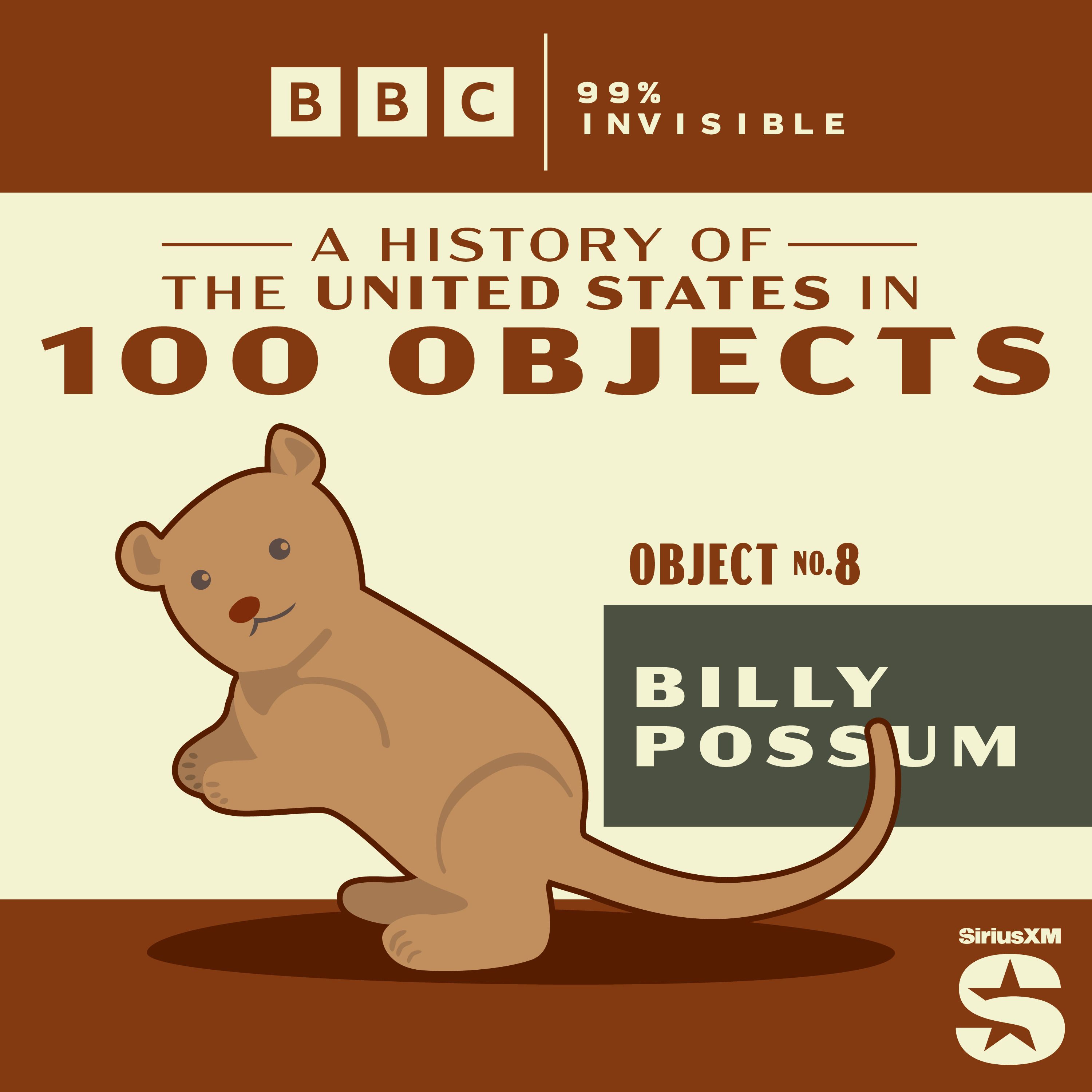
99% Invisible
100 Objects #8: Billy Possum
00:36:10
The teddy bear was a huge hit, and sparked an idea…maybe every president from then on should have their own viral stuffed animal.
Loading summary
Transcript108 lines
- [00:01]
Oregon Lottery Announcer
Oregon parks make an Oregon summer. But what makes an Oregon park well? Oregon Lottery gameplay helps no matter the game Megabucks, video lottery or keno funds from lottery games help support parks projects across the state, ensuring they stay safe, accessible, and open for all. In fact, Discover State Park Scratches are in stores now. It's the perfect way to put a little bit of Oregon's parks in your pocket. The Oregon Lottery Together we do good things. Must be 18 or older to play. Lottery games are based on chance and should be played for entertainment only.
- [00:31]
John Moellam
Your outdoor space is where you unwind and make memories, so make it count. Belgard pavers are designed to elevate your outdoors. Design forward and built to last. Learn more@belgard.com that's B E L G
- [00:44]
Roman Mars
A R D.com Our story begins one day in November of 1902. Just a few months prior, President Theodore Roosevelt had become the first president to make a public appearance in a car. And now he was off on a new adventure, this one taking him to a small town in Mississippi called Smedes.
- [01:05]
John Moellam
And he's gone down to Smedes to do a hunt, a bear hunt.
- [01:09]
Roman Mars
That's journalist John Moallam.
- [01:11]
John Moellam
And he's there for a few days without seeing a single bear, and then his hunting party happens to spot one, and it runs into a kind of a weedy thicket.
- [01:21]
Roman Mars
It's a good move. The hunters can't really get to the bear, but Roosevelt's guide says, hang on, you just stay right here and I'll flush it out and you can kill it.
- [01:31]
John Moellam
Roosevelt gets a little bored, though, and he goes back to have lunch.
- [01:36]
Roman Mars
So when the hunting guide finally flushes the bear out, Roosevelt is nowhere to be seen.
- [01:41]
John Moellam
So his guide jumps off his horse, whacks the bear on the top of the head with the end of his rifle, and then ties it to a tree and then starts calling the President back over so that he can do the honors.
- [01:52]
Roman Mars
When the President arrives and sees the bear, let's just say he was far from impressed.
- [01:58]
John Moellam
He takes a look at this thing and it just looks pitiable, dazed, kind of semi conscious, looks pretty mangy, malnourished and about half of its normal weight. And so he takes pity on it and he says, you know, it's against my code as a sportsman to shoot this pathetic thing. And he refuses this moment in which he refuses to shoot the bear. It's memorialized a few days later in a cartoon in a newspaper in Washington,
- [02:27]
Roman Mars
D.C. the cartoon is captioned drawing the line in Mississippi.
- [02:32]
John Moellam
And when you look at this cartoon, you see the President there with his arm out, kind of sparing the bear's life. And he's holding his rifle. And the bear is there just watching Roosevelt, wondering what's going to happen to it. He's got its fate in his hands. This bear looks really good, vulnerable and cute. Its eyes are huge. It's got a big round head. And it wouldn't necessarily be familiar to you at the time in 1902, but now we understand what this thing is right away. It's a teddy bear. After this cartoon runs, a toy manufacturer turns the bear from that cartoon into a stuffed animal and start selling Teddy's bear all over the United States. And it becomes a huge hit.
- [03:24]
Roman Mars
Teddy's bear for Theodore Roosevelt, an object that would become so ubiquitous, it would take on a life of its own outside of its namesake president. In fact, I bet you or your kid have one somewhere in your house right now. But before we get ahead of ourselves, the teddy bear is not our object for this episode. Now, our object comes out of what happens next. Because what is funny about this story is that the lesson that the toy manufacturers take from this is that maybe this model can be repeated. Maybe every president from here on out will have a viral stuffed animal named after them.
- [03:59]
John Moellam
Yeah. So they're thinking, well, Roosevelt's going to leave office in 1909. We need the next president's version of the teddy bear. Now, the next president was William Howard Taft. Not nearly as charismatic of a fellow as Teddy Roosevelt, but, you know, the profit motive is strong. We've got to find something to be a mascot for his presidency. And they land on something a little suspect in retrospect. It's not a bear. It's a possum. And they market it as the Billy Possum. There's a reason why you have not heard of the Billy Possum, and there's a reason why there's no Billy Possum next to your sleeping child in the in the other room.
- [04:45]
Roman Mars
From 99% Invisible and BBC Studios, this is a history of the United States in 100 objects. I'm Roman Mars. We in America, Land of the Bald Eagle, have always turned animals into symbols. They represent what we're afraid of, what we love, what we think deserves to survive. Those stories are some of the most powerful tools we have for protecting the natural world today. The story of the Billy Possum and how our fickle feelings about animals have shaped the history and perhaps the future of our relationship with the natural world. Before we meet the Billy Possum in full. Let's go back to the moment his infinitely more successful cousin, the teddy bear, was first introduced, when that cartoon showing Roosevelt refusing to shoot the cute little bear was published. It was not how people were used to seeing bears or how most people thought about them, because back in the early 1900s, we did not see bears as cute.
- [05:56]
John Moellam
You know, bears were monsters. Bears were a shorthand for everything that was dangerous and unruly about nature, about the Western frontier. This was part of a outlook in the United States that anything big and wild was basically a threat to us and a threat to our ability to take over the landscape. Yeah.
- [06:16]
Roman Mars
And we didn't just treat it as a threat like this was an active response to the federal government that we were going to eradicate bears so that people could live in the West.
- [06:22]
John Moellam
Yes, we were absolutely at war with bears. There was a department of the federal government called the Bureau for Biological Survey. One of its primary jobs was just shooting and trapping and killing animals. We had sorted nature into sort of the desirable and undesirable ones, and we were letting all the undesirable ones really have it. Coyotes, wolves, mountain lions. It's also a cultural outlook. You see this reflected in a lot of fiction of the time, especially fiction for kids. Ladies Home Journal magazine published a story in 1900 about a boy named Balzer who was described as, quote, the happiest boy in Indiana because he owned a rifle and enough ammunition to kill every creature within five miles. And in this story, Balzer, he kills a bear, but he gets bitten by the bear in the process. And so it all culminates in this kind of feel good ending when Balzer and his dad track down the bear's mate and then shoot her in revenge.
- [07:21]
Roman Mars
And how successful were we at this time period of taking out the bears?
- [07:26]
John Moellam
Very successful, if you want to call that success. Yeah. This is an era in which a lot of what we call, you know, megafauna of the United States is being driven, you know, either out of its territory or just extinct. The grizzly bear was a huge target of these efforts, and it was about to be extirpated from 95% of its original range in the continental U.S. the
- [07:52]
Roman Mars
eradication of the grizzly bear coincided with a big shift in America. For the first time in our history, a majority of Americans were living in cities for far from nature, far from the threat of bears. And so as more and more bears disappeared from the landscape, they started showing up differently in our imaginations and in the pages of children's Books.
- [08:13]
John Moellam
There was an extremely famous writer at the time named Ernest Thompson Seton who was leading a movement in fiction, especially stories that were read by a lot of American children, where he was writing stories with protagonists who were bears and other animals, exactly the same kind of species that the government was busy exterminating. One of his most famous books was called the Biography of a Grizzly, and it centers on a cub named Wab, who at the beginning of the book, has to watch his mother and his siblings be shot dead by a rancher. And the rest of the book is just this poor cub wandering through a wilderness where every threat to him is not a wild threat, but a man made threat. So he's dodging traps and other people with guns. Even the scent of man is said to be unsettling to him. So now these grizzlies that were once seen as ferocious competitors on the landscape, things to fear, they're now fearing us. And what Seton's getting at is something that you see across the culture. People are really starting to feel conflicted about all the killing going on. We hated the bear and we feared the bear, but we also suddenly sort of wanted to give the bear a hug.
- [09:30]
Roman Mars
So this is the ideological war that is going on as the teddy bear arrives at our shores. What happens after that? Political cartoon and the teddy bear takes off the way it does. What happens when the teddy bear hits the market?
- [09:45]
John Moellam
It kickstarts this whole craze of teddy bears where within a few years, this German company, Stief, is said to be exporting a million bears a year. Suddenly, it's to the extent that there are newspaper editorials worrying about children playing with bears instead of dolls. They're displacing human dolls. And what could this mean? You can buy clothing for your bear, you can buy winter coats for your bear, which is astonishing because this I. I sort of think of this as the moment that the evolutionary trajectory of teddy bears and regular bears splits. That your teddy bear warm unless it has a winter coat.
- [10:22]
Roman Mars
So this is the point in our story where people know that Theodore Roosevelt is not going to be president that much longer, and they need to figure out what to do next. Taft gets elected. He's sort of Teddy Roosevelt's handpicked successor, and they want a new cuddly plaything to sort of mark his presidency. So let's talk about the Billy Possum story. How did they come to deciding on opossum as the thing that would represent William Howard Taft?
- [10:52]
John Moellam
Right. So once again, we're in the South. We're in Atlanta. So Taft is going to be inaugurated. He's doing a tour of the south, and he's the guest of honor at a banquet in Atlanta for the Atlanta Chamber of Commerce. And they really. They're pulling out all the stops, and they serve him this very particular Southern delicacy, you know, really seen as an authentic piece of the South. And it's called Possum and Taters. What we have is an opossum, roasted whole, head on tail, still hanging off it like a meaty noodle. And it's on a platter surrounded by sweet potatoes. And in many cases, it would be served with a small sweet potato crammed into the opossum's mouth. And how many teeth does an opossum have, Roman? Do you remember? I have no idea. 50 teeth. So jammed in its 50 teeth, which is just a phenomenally disgusting number of teeth, is a small sweet potato. This thing is rolled out at the middle of the banquet. The one they put on taft's table weighs 18 pounds. He eats it. After he's done, the band starts playing, and a group of Taft supporters makes a big ceremony of giving him a surprise gift. And it's a small stuffed opossum toy, very realistic, with those kind of creepy beady eyes, the naked ears, the tail. They hand this thing over with great pomp. This is the icon of his presidency. This is it. This is the Billy Possum.
- [12:35]
Roman Mars
Billy Possum, as in William Howard Taft's possum? I mean, they had this whole manufacturing apparatus and marketing machine ready for this moment to make this work.
- [12:51]
John Moellam
Yeah, this is the launch. This is the activation. This is the Billy Possum activation. But all the groundwork has been laid. I read news reports about how within 24 hours, this company called the Georgia Billy Possum Company, which was already set up and ready to go within 24 hours of the banquet, they're already brokering deals to distribute the toys all over the country. The LA Times covering this wrote, the teddy bear has been relegated to a seat in the rear. And for four years, possibly eight, the children of the United States will play with Billy Possums. So I actually found an advertisement for a toy store in Brooklyn that had a promotion where kids could come in and see a actual opossum in a cage so that they would just get more familiar with this thing that was going to be their cuddly pal for the next four years, possibly eight. And the ad read, do not let it be said that any man, woman or child in Brooklyn has not seen the cute little animal whose name is mentioned more in all parts of the world today than any other. So yeah, very bullish on Billy Possums.
- [13:55]
Roman Mars
And not just the toys themselves, but there's all kinds of other merchandise associated. Right.
- [13:59]
John Moellam
Merchandising merchants. Yeah, there was like attendant Billy Possum merchandise to help make the craze go even wider. There was postcards, there was pitchers for cream. For coffee time. Taft supporters wore Billy Possum pins at his inauguration. And then as Taft is touring around the country, people are actually meeting him at railroad stations and appearances and handing over actual opossums like bouquets of flowers. There's a moment, a brief moment when it's, it's sort of an icon of the man.
- [14:34]
Roman Mars
And as you mentioned, this moment is brief. What happens to the lily possum?
- [14:39]
John Moellam
Almost nothing happens. Possum, to answer your question. You know, from what I could tell, it's really just only a matter of months before there's no mention of it anywhere. Everyone stops caring about it. Sales tank. And remember that this all started in January of 1909. So that means the Billy Possum didn't even make it to Christmas. It didn't even get to see a Christmas season, which is sort of a special tragedy for a toy.
- [15:11]
Roman Mars
So I mean, there might be some obvious answers to this, but I think there might be some non obvious answers as to why the teddy bears took off and the Billy Possums didn't. What are your thoughts on that?
- [15:20]
John Moellam
Yeah, well, the obvious answer is that, you know, opossums are really ugly. It's a really long stretch, I think, to make one seem snuggly and adorable or like something you want to take care of. I just don't think there's any getting around that fact. More interestingly though, I also think that the possum lacked a story that had any resonance with Americans, even just subconsciously. I mean, when you think about it, for all of humans evolutionary history, the bear was this icon, you know, it was fearsome, it was independent from us. And that's what made it so impressive. It was living a parallel life as a menace to us, as a competitor to us, in some ways our superior, more powerful than us. And now at the time of the teddy bear, we've beaten that creature back to such a degree that it is at our mercy, that its survival is going to be dependent on us. And I think that stirs up some really complicated emotions. You know, both worries about the future of nature, but also worries about our place in it. This new place where we really have a kind of brutal dominion over everything. I think that's really unsettling for a lot of people. There's this oscillation that happens between demonizing an animal and then eradicating it, and then suddenly empathizing with that animal as a kind of helpless underdog and rewriting its reputation in our minds as something innocent and sweet that needs our help.
- [16:49]
Roman Mars
This, you could say, is John's teddy bear versus Billy possum theory, that the reason we love the bear is because of this compelling, complex relationship we have with it. We feared the bear, we vilified the bear, we killed the bear, and then we felt so bad about killing the bear that now we wanted to save it, whereas the opossum really had none of that resonance.
- [17:11]
John Moellam
It was hard to feel anything for the opossum, good or bad. Yeah, it was lacking of any kind of emotional import. The story with Taft was someone served him a dead opossum and he ate it. And he really loved it too. You know, he had a few helpings and then he just kept going. And a doctor at his table actually passed him a note saying, maybe you should slow down. And the next day he was Taft was bragging to reporters about it. He said, well, I like possum. I ate very heartily of it last night and it did not disturb in the slightest my digestion or my sleep. Yeah, he just obliterated it.
- [17:51]
Roman Mars
This podcast is brought to you by Squarespace. Squarespace is an all in one website platform that helps you stand out online whether you're just getting started or growing your business. It's got everything you need from securing your domain to building a professional site and showcasing your work all in one place. Bring your vision to life with AI powered design or curated templates, plus flexible editing tools that help you create something that truly reflects your style. No experience needed. Squarespace makes it easy to share your work, book clients, and get paid with built in tools for scheduling, invoicing and email all in one place. I've had a Squarespace site, RomanMarris.com for 12 years or so, and the key for me isn't that it was easy to build, although it was, is that it's easy to maintain. It never gives me any trouble at all. It's great. Head to squarespace.com invisible for a free trial and when you're ready to launch, use Offer Code Invisible to save 10% off your first purchase of a website or domain.
- [18:50]
Oregon Lottery Announcer
Oregon Parks make an Oregon Summer. But what makes an Oregon Park? Well, Oregon Lottery, Gameplay Helps no matter the game. Megabucks, Video Lottery or Keno funds from lottery games help support parks projects across the state, ensuring they stay safe, accessible and open for all. In fact, Discover State Park Scratches are in stores now. It's the perfect way to put a little bit of Oregon's parks in your pocket. The Oregon Lottery Together we do good things. Must be 18 or older to play lottery games are based on chance and should be played for entertainment only.
- [19:20]
John Moellam
Awkward time to ask this, but. Hey, did you download the trail map?
- [19:24]
Roman Mars
Yeah.
- [19:25]
Oregon Lottery Announcer
No, I don't need to.
- [19:26]
John Moellam
I don't understand. You're trusting your signal out here.
- [19:28]
Oregon Lottery Announcer
I'm trusting T Mobile. They have the best network and if we end up in bumtots nowhere, well, we've got T satellite for backup.
- [19:35]
John Moellam
Whoa. I don't trust my carrier that much.
- [19:37]
Oregon Lottery Announcer
We'll just use your phone as a flashlight.
- [19:41]
T-Mobile Advertiser
With America's best network and T Satellite, we're keeping you connected in places you never thought possible. And if you switch today, you get free phones for zero down and only 25 bucks a month per line for four lines. Find out more@t mobile.com or visit your local store. Best Mobile Network Based on analysis by OOGLOB Speedtest Intelligence data 2h 2025 with 24 monthly bill credits and 4 eligible pour ins on essentials for well qualified customers with autopay plus taxes, fees and $35 connection charge per line. Credits and imbalance due if you pay off early or cancel. Contact Us Finance Agreement example $299.99 Moto Edge 5G required T Satellite available with compatible device in most outdoor areas in the US where you can see the sky included with experience beyond your $10 a month. However, news monthly cancel anytime visit t
- [20:20]
Pantene/Simplisafe Advertiser
mobile.com all of us strands are in real danger and whatever it is, it's closing in. It started with just a few lost hairs here and there, but now more and more of us are disappearing every day. But listen, we think we have a plan. A way to stop the shedding. Pantene Abundant and Strong Go now. It's not too late. Pantene Abundant and Strong It's a three step system that reduces hair loss by 85%. Only the strongest will survive the shedding.
- [20:53]
Roman Mars
So we laid out this pattern of oscillation between exterminating animals and then empathizing with them. That pattern repeats throughout the 20th century, and during that time, animals start to become useful symbols for fights about the environment. Take the bald eagle. It was nearly wiped out from overhunting and the use of the pesticide ddt. And then people clocked that it was going extinct and turned it into the face of a big campaign against ddt, a big, successful campaign. The same thing happened with the spotted owl and the logging industry. But all those environmental fights were nothing compared to the existential threat that the planet was facing in the early 2000s.
- [21:36]
John Moellam
You know, it's interesting. In 2005, I remember being in graduate school at Berkeley and watching with a class the aftermath of Katrina, Hurricane Katrina, and seeing New Orleans flooded and realizing for the first time that there was a sort of general understanding that, like, oh, you know, this is, this has to do with climate change.
- [21:56]
Roman Mars
As the evidence for climate change started to stack up, climate activists and attorneys were trying to get the government to do something about it.
- [22:05]
John Moellam
And so what happens in the early 2000s is you have a group of environmental attorneys who have been struggling for years to try to get the George W. Bush administration to act on climate change or even just to acknowledge the science of around greenhouse gases.
- [22:20]
Roman Mars
But so far, all of their attempts had largely failed. What could they do to make the issue urgent enough to get the public outraged and the government to act?
- [22:30]
John Moellam
They needed some kind of emotional trigger, something that was going to not just make climate change feel real and urgent in an intellectual way, but that would cut through the kind of busyness of people's lives and make them care.
- [22:45]
Roman Mars
An emotional trigger, something people could care about. Something like an animal.
- [22:52]
John Moellam
You had environmental attorneys who are just, you know, in the trenches suing the administration. And one of these groups, the center for Biological Diversity, hit upon this pretty ingenious idea, and that was to get a species listed as endangered under the U.S. endangered Species act specifically because of the threat of climate change to its survival.
- [23:14]
Roman Mars
Here's why. The plan is because by law, if a species is listed as endangered, then the government is legally bound to look at what is threatening its survival.
- [23:23]
John Moellam
They could put that science in front of the administration. They would essentially force its hand to do what it had not wanted to do in other contexts, which was to affirm the validity of climate change.
- [23:33]
Roman Mars
No more dodging or dismissing, but to make this work, the activists feel like they have to really find the perfect animal. So basically, they start a casting process.
- [23:42]
John Moellam
And a good candidate on that front is going to be two things. It's going to have a lot of solid science backing it up to say that, yes, this thing will go extinct because of climate change, and it's going to be something that ordinary people care about, because if there isn't the Public interest. No matter how good the science is, the administration did have ways of kind of shunting that animal off into a kind of bureaucratic abyss and not having to deal with it.
- [24:09]
Roman Mars
In fact, hundreds and hundreds of species were sitting in a backlog, waiting to be looked at by the government. Species that the public had never even heard of.
- [24:19]
John Moellam
The Neosho mucket mussel and the Slabside pearly mussel. The band rumped storm petrel, the spotless crake, the relic leopard frog. We've got a whole list of cave beetles, the Icebox cave beetle, Fowler's cave beetle, fire cave beetle, the Tatum cave beetle. And at the time in 2013, when I was looking into this, at least 24 different species had actually gone extinct while they were waiting around on the candidate list.
- [24:45]
Pantene/Simplisafe Advertiser
Wow.
- [24:46]
John Moellam
And essentially no one cared about them. These things could just sort of pass into oblivion unnoticed, even though they had been deemed worthy of protection. And that's what the center for Biological Diversity was trying to avoid. That's why they needed the public behind them, so that whatever they petitioned the government for was. Wouldn't just slip away silently.
- [25:08]
Roman Mars
So they needed a good candidate, but they also needed one whose survival was really linked to climate change. And this was harder than you might think, because, remember, this is the early 2000s, and we're just starting to get a grasp on climate change, and there are very few actual studies that have been done about its impact on specific species.
- [25:28]
John Moellam
So they went looking for species, and a lot of the candidates they came up with were way more Billy possum than teddy bear. The first animal that the center for Biological Diversity looked at was called the Glacier Bay wolf spider. Okay, so it's a spider. It's disgusting. Second of all, it turns out there was some uncertainty about whether it was even its own species. So that one gets tossed out. Next, they have this kind of small speckled seabird in Alaska called the Kitlets murrelet, which is, you know, I guess it could be sold as cute, but, you know, you were working an uphill battle there. You had to first introduce people to it. It's hard to say there was exactly one expert in the bird, as far as I could tell. So these two species, even if you could make a strong scientific case, they were missing that wow factor. It wasn't going to inspire the public interest and the public concern that was going to make this petition go forward.
- [26:25]
Roman Mars
So a spider wasn't going to do a murrelet wasn't going to do. No cave beetle is going to get the public upset. Where did they end up landing as their sort of animal that was going to help combat climate change?
- [26:39]
John Moellam
The polar bear.
- [26:40]
Roman Mars
It's right there in front of you the whole time.
- [26:42]
John Moellam
They got the polar bear. They got the. I mean, fortunately, in 2004, I believe it was luckily enough, you had a really definitive first paper by a researcher named Andrew Durocher linking climate change to the near future extinction of polar bears. Polar bears survive on sea ice for most of the year. That's where they live. And they hunt seals out on the sea ice. And as the sea ice broke up earlier and earlier in certain parts of the Arctic or subarctic or just disappeared entirely from other places, you know, the entire platform where they walk around making their living was just going to be gone.
- [27:17]
Roman Mars
I mean, like, if you're trying to decide if you are a billy possum or if you're a teddy bear, let's run the polar bear through the teddy bear test. Okay, so, like, what are the things that it checks that make it appropriate to be the type of thing that we would rally around and love and want to make dolls of and hold?
- [27:34]
John Moellam
Yeah, I think it's operating on two levels. You know, a surface level, cute round face. You know, you can imagine it as a plush toy. It's no Glacier Bay wolf spider. And then on a deeper level, you have identical forces that were operating with the teddy bear story, where you have a creature that was, you know, regarded as this really powerful, independent lord of the Arctic. And now it's being shown in a completely new light, as helpless, as dependent on us for help, as living in this world that is literally trickling out from underneath it because of things that we've done.
- [28:12]
Roman Mars
Yeah, we have killed the polar bear off and now we need to save the polar bear.
- [28:16]
John Moellam
Yeah. I mean, I would read accounts of polar bears from back in history, and you would see a few hundred years ago, Arctic explorers, and they'd be writing about this thing like it was a demon. You know, stories about it's like a polar bear. I don't know if this is true, but it says something, just that these stories would be recited. You know, a polar bear jumps into a guy's boat and tries to eat them all, even when he lights the bear on fire. And you've gone from that into something on the COVID of Time where it's this, you know, sad, thin polar bear walking on a strip of ice, surrounded by water with the headline Be worried, Be very worried.
- [28:54]
Roman Mars
The polar bear had the science and it had the potential to capture the public and if the climate activists won their petition, it would be a landmark case. The first species to be protected explicitly because of climate change. And right away, the public seemed to respond.
- [29:11]
John Moellam
The day after the center for Biological Diversity and other groups filed this petition to get the polar bear listed as endangered, it was immediately splashed, you know, on the MSNBC homepage on cnn. It really got a kind of coverage that you had not seen endangered species and climate change getting in a while. One TV broadcast called a Shining White symbol of the green Movement.
- [29:37]
Roman Mars
And one of my favorites from this time is the Vanity Fair cover.
- [29:41]
John Moellam
Yeah, so at this time, there was a famous polar bear cub at a German zoo named Newtown. He was adorable, flashy, charismatic creature. And he was paired with another flashy, charismatic creature, Leonardo DiCaprio, and photographed by Annie Leibowitz for Vanity Fair.
- [30:03]
Roman Mars
But the public didn't just care about Leonardo DiCaprio. They cared about the petition that was now on the Bush administration's desk.
- [30:10]
John Moellam
This set a record at the time for the most public comments ever sent to the government for endangered species petition. They got a half a million letters and postcards and messages. A lot of them were from kids. You had drawings of like a polar bear. I found one of a polar bear that. That's drowning, and then it's also being eaten simultaneously by a lobster and a shark. You had, you know, letters saying, this fourth grader in Oakland wrote, I really think it is not fair to the polar bears. Also, they could drown and die off. And what if they were you? I liked another one from a kid named Fritz who he's actually proposes a solution to climate change. He's like, all in on an ethanol based solution. He says, I feel bad about the polar bears. I like polar bears. Everyone can use corn juice for cars from Fritz.
- [30:59]
Roman Mars
Good point, Fritz.
- [31:00]
John Moellam
Yeah, Fritz is ahead of his time. You know, it's like I grew up in the 80s, like, to the extent that I thought about polar bears, I did not think about polar bears the way Fritz does or the way, you know, the Juan who wrote about the polar bears drowning. It's just a completely different creature.
- [31:14]
Roman Mars
At that point, the plan was working. And the hope was that if this many people cared about the polar bear, politicians would have to care, too.
- [31:23]
John Moellam
One of the attorneys for the center for Biological Diversity, he was talking about the cultural power of the polar bear and said something like, no politician wants to tell their constituency, yes, I voted to kill the polar bear.
- [31:36]
Roman Mars
And how did the politicians respond to all this public pressure?
- [31:41]
John Moellam
They were really actually able to wiggle out of It. So the Bush administration, they were able to find another kind of procedural loophole. Basically, they. They were able to list the polar bear as a threatened species rather than an endangered species, and then they could apply something called a 4D exception to it. And basically that was just a legalistic way of saying that these arms of the federal government that are responsible for endangered species just didn't have the power or the ability to regulate greenhouse gases. And so we can't really. We can't really welcome the polar bear in the ranks of creatures that we're going to save right now.
- [32:17]
Roman Mars
Meaning, sure, the polar bear's existence might be threatened by climate change, but the Endangered Species act can't force the government to do what it would take to save the polar bear, which would be regulating greenhouse gases.
- [32:29]
John Moellam
The Secretary of the Interior at the time, Dirk Kempthorn, that's who oversees the endangered species program, said in a press conference that he wasn't going to let a law about animals be, quote, abused to make global warming policies. So this set off like a slew of other lawsuits and, you know, arguing about even the difference between endangered and threatened and back and forth and back and forth for years between the center for Biological Diversity and the Bush administration and then the Obama administration, until essentially, you know, despite the public outcry, despite the public sympathy for the polar bear, the entire issue just kind of got lost in this rabbit warren of lawsuits and counter lawsuits and semantic rebutting.
- [33:10]
Roman Mars
It is striking to me that, you know, we have this really powerful symbol of climate change, like the perfect teddy bear candidate, you know, for getting Americans to care about their relationship with nature, to care about climate change in particular. And it still gets outmaneuvered. It fails. I mean, do you think that the polar bear wasn't up for the task here, or were we asking the polar bear to do too much?
- [33:37]
John Moellam
I think it's important to go back to the original intent of that endangered species petition. The original intent wasn't necessarily to birth a mascot for the climate change movement that would lead the federal government and some of the most entrenched and powerful corporate interests to suddenly change their way of doing business. The intent was simply to find a kind of legal backdoor with that first endangered species petition. You know, it wasn't part of the plan to have it on the COVID of Vanity Fair, right, with Leonardo DiCaprio, but it was like the bear was just so damn charismatic that everyone just kind of lost their minds about it.
- [34:15]
Roman Mars
Also, the teddy bear phenomenon, it really didn't ask people to do Too much like the people carried on with their sort of exploitation of the west and hunting. You know, maybe it wasn't done with quite such complete eradication agenda, but, like, the teddy bear didn't ask much of us.
- [34:31]
John Moellam
That cartoon of Roosevelt in 1902, it takes 71 years from that moment to get the Endangered Species act, which actually proposes a way to help that animal. So, you know, I'd like action on climate change to happen a lot faster, but I do think it's. We're letting a lot of powerful people off the hook if we start to wonder, you know, what was wrong with the polar bear. I mean, dealing with climate change, I mean, we. We see it much more clearly now than I think we did in the early 2000s. Right. There was this feeling back then that, you know, if we just got people to accept it and care, we would just solve this thing. And I think that that's proven to be pretty naive. It's not just an environmental issue. It's, you know, a housing issue, it's a migration issue, it's an economic issue, it's a social justice issue. It's hard to just undo that just because enough people want to. So I think it's naive to think that the polar bear could have, you know, solved climate change. And therefore I think it's naive to say that it was a failure, because it didn't.
- [35:40]
Roman Mars
One thing you can say for sure is that the polar bear got a lot of people to care about climate change who didn't before it successfully became a symbol for an entire movement. But the problem with making any animal a symbol is that you can lose control of it. Climate change deniers started focusing on the polar bear, too, using it to debunk the claims that it was in danger,
- [36:02]
John Moellam
because there was a sense that if you could prove that polar bears were going to be okay, you were also disproving climate change. I talked to one researcher who was researching snow geese, and he made an argument in a scientific paper that, you know, this one population of polar bears, if there was no ice for them to live on for longer and longer periods of time of the year, they could probably subsist by eating snow goose eggs. And, you know, this poor guy suddenly was embraced by climate deniers, which he wasn't. And other polar bear scientists were upset with him. Not as far as I could tell, because his science was bad, but because he was sort of giving ammunition to the other side. So the symbol, in some sense, you know, became the issue.
- [36:46]
Pantene/Simplisafe Advertiser
Yeah.
- [36:47]
John Moellam
And we kind of lost sight of what what it was all about. It's very dangerous. I think when we start to mistake symbols for the whole reality in a way, they're like these psychic pack animals, you know, we just, we just heap a lot of our feelings onto their backs and whatever we say about them, they just always have no.
- [37:22]
Roman Mars
Do you think there's any hope for the possum to be something that we love the way that they wanted us to love it back in the blay possum days?
- [37:32]
John Moellam
It's not too late, I guess, you know, maybe as we as, you know, more and more creatures disappear. There will be a time in the future when people will think nostalgically about all the opossums that raided their trash cans and, you know, think of them as just, well, they were just trying to get by and now we owe it to them.
- [37:55]
Roman Mars
And that's our show. Our expert of all things Billy Possum and the Polar bear was journalist John Moella. He's the author of many books, including Wild Ones, a sometimes dismaying, weirdly reassuring story about looking at people looking at animals in America. A History of the United States and 100 Objects is a production of 99% Invisible and BBC Studios. It's hosted and curated by me, Roman Mars. This episode was produced by Brenna Dahldorf. Our other producers are Priscilla Alabi and Ellie Lightfoot. Our associate producer is Isaac Fisher. This series was edited by Annie Brown and Courtney Harrell. Mixing by Charlie Brandon King. Fact checking by Amy Bracken. Our theme song is by Swan Real from 99% Invisible. Our executive producer is Kathy Tu from BBC Studios. Our executive producers are Annie Brown and Courtney Harrell. Our production coordinator is Shan Pillay and the production manager is Mabel Finnegan Wright. Artwork by Stephen Lawrence. 99% invisible is part of the Sirius XM podcast family headquartered in beautiful uptown Oakland, California. And BBC Studios is headquartered in beautiful white city West London. If you want to get in touch or have an object for us to consider, email us at 100objects@99pi.org.
- [39:57]
Oregon Lottery Announcer
Oregon parks make an Oregon summer. But what makes an Oregon park? Well, Oregon Lottery Gameplay helps no matter the game. Megabucks, Video lottery or Keno, funds from lottery games help support parks projects across the state, ensuring they stay safe, accessible and open for all. In fact, Discover State Park Scratches are in stores now. It's the perfect way to put a little bit of Oregon's parks in your pocket. The Oregon Lottery. Together we do good things. Must be 18 or older to play. Lottery games are based on chance and should be played for entertainment only
- [40:28]
Walmart Money Card Advertiser
Walmart shoppers meet the debit card design with you in mind. The Walmart Money Card offers up to $75 cash back on purchases at Walmart each year, early direct deposit, overdraft protection and so much more. When Walmart is your everyday store, you need a card to match. That's the Walmart Money Card. Open your account to Today the Walmart Money Card is issued by Green DOT bank member FDIC. Fees, terms and conditions apply. Visit WalmartMoneyCard.com to learn more.
- [40:56]
Pantene/Simplisafe Advertiser
In the US there's a break in every 26 seconds. But when intruders step near SimpliSafe, home security steps up.
- [41:03]
Roman Mars
Stop.
- [41:04]
Pantene/Simplisafe Advertiser
This is Simplisafe.
- [41:05]
John Moellam
Police are on the way.
- [41:07]
Pantene/Simplisafe Advertiser
Using AI alerts, US based live agents help deter break ins. SimpliSafe no long term contracts. Save 50% on your new safety system with professional monitoring at SimpliSafe.com sxm or with promo code sxm Outdoor deterrence requires
- [41:19]
T-Mobile Advertiser
a SimpliSafe Active Guard Outdoor Protection Plan starting at $49.99 a month. Visit SimpliSafe.com licenses for alarm license information. Tennessee2012.