← 99% Invisible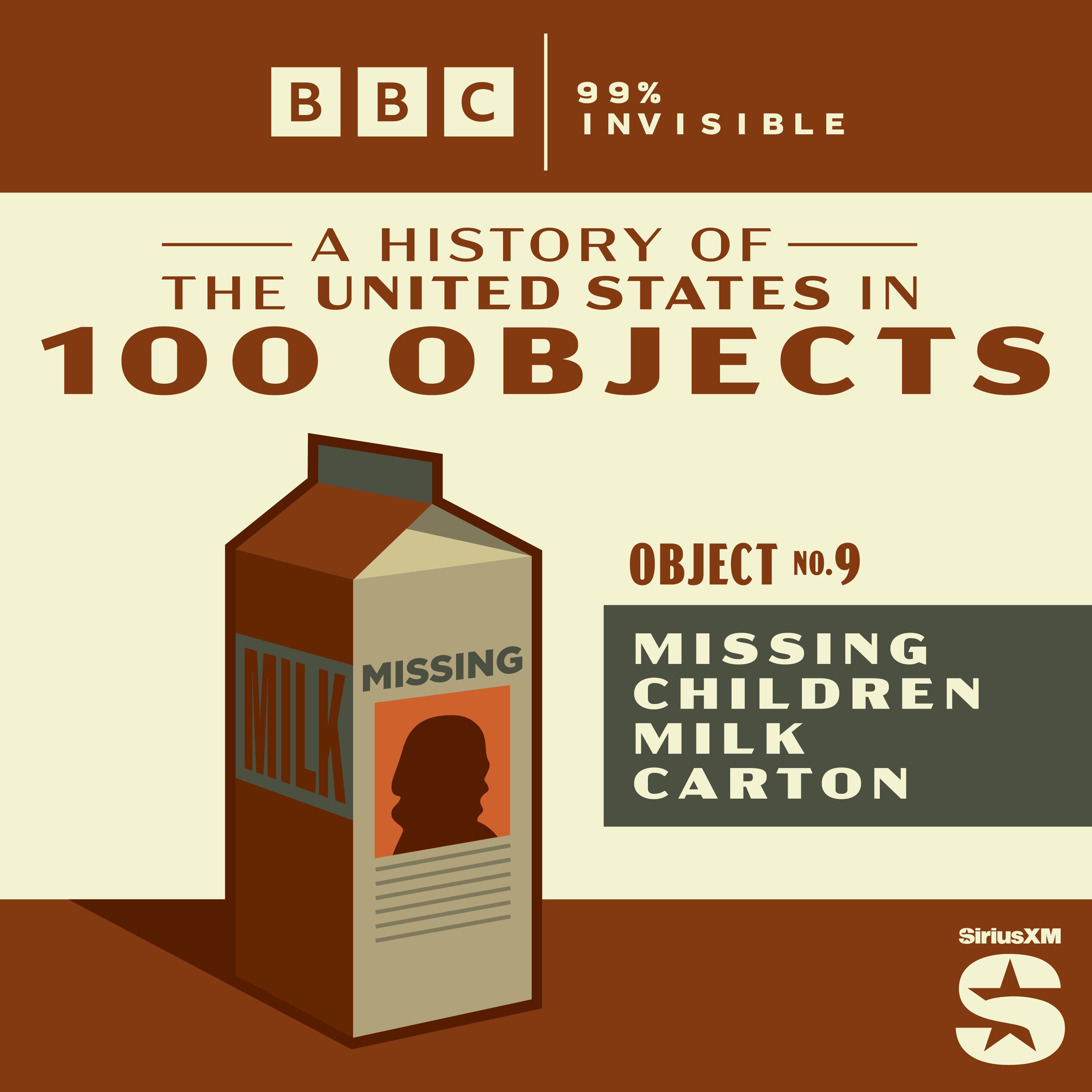
99% Invisible
100 Objects #9: Missing Children Milk Carton
00:33:53
In 1982, a twelve-year-old paperboy, Johnny Gosch, vanished from a quiet Iowa street and sparked an unlikely campaign: the faces of missing children printed on milk cartons by the billions.
Loading summary
Transcript178 lines
- [00:00]
Roman Mars
You simply can't run a successful business without good data. Data is at the heart of every organization, but managing it can create friction, risk, and manual work. Everpure transforms static data into a living system, making it intelligent, instantly accessible, secure, energy efficient, and ready to perform in the AI era. Plus, Everpeer's evergreen subscription automatically delivers the latest innovations and security upgrades. Whether your data is in the cloud, on prem, or at the edge, Everpeer makes data management so simple it feels like second n tame your data chaos with EverPure. Visit everpuredata.com to learn more. This episode is brought to you by PNC Bank Some design was made to be seen by all. Like for example, the Seven Wonders of the World. I mean, everyone should see those. While some were made to be less seen, like sewer systems. Like, when was the last time you thought about an aqueduct? Yet that doesn't mean they're any less impressive. You could say the same thing about PNC Bank's smart, calculated approach to banking. It won't make for flashy headlines or trends on social media, but it'll make the right money moves that'll help set you up for the successful financial future you're looking for. A design everyone can get behind. PNC bank brilliantly boring since 1865 brilliantly boring since 1865 is a registered mark of the PNC Financial Services Group, Inc. PNC bank national association member FDIC Our story begins in 1982. CNN is only a few years old, newspaper circulation is at an all time high, and every morning around a million children take to their paper routes to deliver the morning news. On September 5, 1982, one of those children was a boy named Johnny Gosch who slipped out of his house in West Des Moines, Iowa before the sun came up. While his mom and dad were still asleep in their bed,
- [01:51]
Noreen Gosch
we were awakened by the phone ringing.
- [01:54]
Roman Mars
That's Noreen Gosch, Johnny's mother.
- [01:57]
Noreen Gosch
It was the neighbors saying they did not receive their newspapers.
- [02:01]
Roman Mars
This wasn't like Johnny. He'd never missed a delivery.
- [02:04]
Noreen Gosch
His dad got up and said, I'll go help him finish the route. He's probably just running late. So he went up the street and that's where he saw Johnny's wagon sitting.
- [02:15]
Roman Mars
Johnny's red wagon was sitting at the corner. It was still full of newspapers.
- [02:21]
Noreen Gosch
So he rushed back and told me Johnny was gone and to call the police.
- [02:26]
Roman Mars
Johnny Gosch was 12 when he disappeared. He had blue eyes and dirty blonde hair with a small gap between his front teeth and his face would be on the very first milk carton to ever feature a missing child.
- [02:42]
Annie Brown
I have a distinct memory of being a kid and just staring at the milk carton with this blurry face on it.
- [02:49]
Roman Mars
That's reporter Annie Brown, which is weird
- [02:52]
Annie Brown
because I definitely wasn't alive to see one. The milk carton campaign only lasted a few years in the 80s, but it left an indelible mark on our culture. It introduced a kind of mythology around child safety that lingers to this day. And it changed what exactly Americans are afraid of when we fear for our children.
- [03:22]
Roman Mars
From 99% Invisible and BBC Studios, this is a history of the United States in 100 objects. I'm Roman Mars. Today, the missing children milk carton. The morning that Johnny disappeared, Noreen said it took 45 minutes for the police to arrive. So she called around to the other boys who delivered papers that morning. A few of them said they saw her son talking to a man in a blue car. But the police were skeptical.
- [04:02]
Noreen Gosch
The cop looked at me and said, well, has your son ever run away before? And I said, well, no, he's never run away ever. Nor did he run away today.
- [04:11]
Annie Brown
This was Iowa. This kind of thing wasn't supposed to happen to kids like Johnny in places like Iowa.
- [04:17]
Noreen Gosch
We'd never had a crime like this before.
- [04:21]
Roman Mars
This was before Amber alerts, before those text messages that you get when a kid goes missing. There wasn't even a category for missing children. Kids were put in the same group as missing adults, and an adult had to be gone for three days before they were considered missing.
- [04:37]
Annie Brown
So without the police's help, Johnny's parents tried everything they could to find him. They hired private investigators and coordinated search parties.
- [04:45]
Roman Mars
Meanwhile, as they searched, they also wrote Iowa state legislation that would differentiate missing children from missing adults.
- [04:54]
Noreen Gosch
I wrote the John Agash law at my kitchen table.
- [04:57]
Annie Brown
But after all of this, Noreen's son was still gone.
- [05:02]
Roman Mars
And then two years later, in 1984, another little boy disappeared while delivering newspapers. He lived in a neighborhood not far from Johnny's.
- [05:12]
Narrator/Reporter
Eugene Martin was last seen delivering newspapers
- [05:14]
Roman Mars
between 5:30 and 6 that morning. His paper bag with newspapers still inside was found just outside of Des Moines.
- [05:22]
Annie Brown
This second paperboy had a relative who worked at a local dairy, the Anderson and Erickson Dairy. That relative and the dairy's owner came up with an idea to help find these boys.
- [05:34]
Noreen Gosch
The Anderson Erickson Dairy contacted each family, and they wanted to do something helpful in the investigations.
- [05:42]
Annie Brown
And within a few short weeks, thousands of milk cartons were rolled out of trucks and into grocery stores. All Over Des Moines, as clerks stocked their shelves, the faces of Johnny Gosch and Eugene Martin smiled back.
- [05:58]
Roman Mars
The campaign started at one local dairy, but over the next few weeks it spread to other midwestern towns. And an Illinois dairy saw it and said, why don't we try that? And from there, it went national.
- [06:09]
Barbara Huggett
Nearly everybody drinks milk. Milk also turns over quickly so we could put a lot of different kids photos on and pull children's off that needed to come off.
- [06:20]
Annie Brown
That's Barbara Huggett. She was working as an artist at the National Child Safety Council in Michigan when the milk carton campaign took off.
- [06:27]
Barbara Huggett
Our founder, apparently he'd seen Johnny Gosh and Eugene Martin on the Anderson Erickson dairy milk cartons, but he felt that the program should be nationwide.
- [06:38]
Roman Mars
A nationwide milk carton campaign would alert families in California to look for a child that went missing in Iowa.
- [06:45]
Annie Brown
The national campaign brought together local groups looking for missing children, and together they came up with an initial list of 77 kids from all over the country.
- [06:54]
Barbara Huggett
We used cases that were believed to be what they termed in those days, dangerous stranger abductions.
- [07:02]
Roman Mars
In other words, kids that weren't taken by someone they knew.
- [07:06]
Annie Brown
Barb's team didn't have computers, so they cut and arranged all the layouts by hand.
- [07:12]
Barbara Huggett
We designed a layout that was just, you know, rather simple.
- [07:15]
Roman Mars
In black block letters. The word missing was printed across the top of each waxy paper panel. Photos of two children were laid side by side in black and white. Under the photos were their dates of birth, height, weight, and where they were last seen. They also printed the pictures on school milk cartons, but only one child could fit on those.
- [07:36]
Annie Brown
The National Child Safety Council reached out to dairies all over the country asking if they'd be part of the campaign. Within months, 700 independent dairies had signed on.
- [07:47]
Barbara Huggett
Boy, I wish I knew how many cartons had circulated. I imagine it's way into the billions when you have 700, 750 dairies printing day in and day out for years.
- [08:02]
Annie Brown
Some sources have estimated that as many as 5 billion milk cartons were printed with the faces of missing children.
- [08:10]
Roman Mars
5 billion milk cartons telling every American family this could happen to your kid.
- [08:16]
Noreen Gosch
It's every parent's worst nightmare. As I said, we had not had cases of this going on in our community. Johnny's was the first really big case to hit.
- [08:28]
Annie Brown
Johnny's may have been the first big case to hit and the first to spark the national milk carton campaign, but there had been previous kidnappings of other children in other places that hadn't sparked the same outrage.
- [08:42]
Paul Renfro
It's interesting. In Atlanta there were two young boys who also went missing at around the same time in July of 1979.
- [08:52]
Annie Brown
This is historian Paul Renfro.
- [08:54]
Paul Renfro
And this didn't really initiate the same sort of panic, the same sort of concern that you saw in Iowa with the disappearances of two paper boys.
- [09:05]
Annie Brown
It wasn't just two boys in Atlanta who disappeared. It was a whole slew of them. And it's striking to see just how differently the world responded. First, a 14 year old boy named Teddy Smith went missing. Four days later, 13 year old Alfred Evans disappears. A few months after that, another 14 year old vanishes on the way to the bank for his mom. Then a nine year old running an errand for a neighbor. The national media was largely quiet. There was no innovative campaign to find them. But it happened over and over again. In fact, over the course of two years, 29 kids and young people disappeared in Atlanta. One clear difference was that all of these children were black,
- [09:53]
Paul Renfro
all of these youths were African American. And the discourse around it. There was no real kind of cry from the public apart from the victims families.
- [10:04]
Annie Brown
And why didn't the Atlanta kidnappings lead to a similar campaign?
- [10:10]
Paul Renfro
I think it has to do with our understandings of childhood and childhood innocence. And I think those things are always racialized in very particular ways. And so the descriptors of innocence that were so readily attached to Johnny Gosh and Eugene Wade Martin in Iowa and other missing or slain white kids, those descriptors were not applied to the youngsters who were kidnapped and killed in Atlanta. Oftentimes they were described as streetwise, as street hustlers. And so in a way, some of the discourse surrounding their disappearances and deaths served to legitimate their disappearances and deaths.
- [10:49]
Annie Brown
Many of the children kidnapped in Atlanta were found dead in the weeks and months after they disappeared. But some remained missing. And yet none of them appeared in the National Child Safety Council's milk carton campaign.
- [11:02]
Roman Mars
And even for the kids who did end up on milk cartons, the campaign was largely unsuccessful. Of the 200 kids who were featured in the National Child Safety Council's campaign, only two were ever found alive.
- [11:15]
Annie Brown
Barbara still remembers the day they got the call that a boy named Bobby Smith Jr. Was found.
- [11:21]
Barbara Huggett
The day they called and said that he had been found, we got on the loudspeaker, on an intercom and let everyone know. And it was just a sense of elation. And you wanted to let everyone in the building that had mailed it, boxed it, shipped it you know, you just wanted to tell everyone who had touched it that it was worthwhile. You could hear the cheer throughout the whole building. Yay, we found a child. It was wonderful, you know.
- [11:49]
Annie Brown
But Bobby Smith wasn't found because of the milk carton.
- [11:52]
Roman Mars
Bobby was found by coincidence.
- [11:55]
Annie Brown
His kidnapper's car had been involved in an accident. And when the police came looking for the owner of the car, they found Bobby.
- [12:03]
Roman Mars
But most of the kids featured in the national campaign and in the smaller local ones were never found.
- [12:10]
Noreen Gosch
Unfortunately, the leads from the milk cartons did not reveal where Johnny's location was.
- [12:17]
Annie Brown
That's Noreen Gosch again. Her son Johnny was never found, but she and Barbara Huggett are both adamant that the campaign had a positive impact.
- [12:26]
Noreen Gosch
What it did was promote more awareness so that people were looking. If they saw a child that looked like they were in distress, maybe you questioned whether or not those were the parents.
- [12:39]
Annie Brown
Mostly, the milk cartons just got people thinking about kidnapping.
- [12:43]
Noreen Gosch
I have talked to quite a number of adults, and they could remember their mom putting the milk carton on the kitchen table and saying, now we're going to go over the rules again. And they would use the example of the boys on the milk carton and
- [12:57]
Barbara Huggett
then make the correlation between that child and their child's life.
- [13:03]
Roman Mars
In other words, the faces on the milk cartons scared the hell out of
- [13:07]
Annie Brown
everyone, which ultimately led to the campaign's downfall.
- [13:12]
Roman Mars
Almost as quickly as they began, the milk carton campaigns started to wind down. Dairies began to pull the missing kids pictures from their side panels.
- [13:22]
Barbara Huggett
One reason, of course, with the cartons is that the industry shifted to plastic.
- [13:27]
Annie Brown
But dairies also started to get tired of the depressing message.
- [13:31]
Noreen Gosch
They took it away because there were people that were complaining that they thought it might scare children at the breakfast table.
- [13:38]
Annie Brown
The famous pediatrician Dr. Benjamin Spock condemned the milk carton campaign. It was traumatizing. He said kids shouldn't have to face that over their lucky charms.
- [13:49]
Unidentified Expert/Commentator
They see these missing kids kind of staring at them. That milk carton almost demands them to have that conversation.
- [13:57]
Paul Renfro
What to do if you see a
- [13:58]
Unidentified Expert/Commentator
stranger or a stranger accosts you?
- [14:01]
Roman Mars
That's historian Paul Renfro again. Paul wrote a book about the milk carton kids and the larger panic gripping society at the time. Stranger Danger.
- [14:09]
Annie Brown
Paul studies the way child safety was talked about at this time in the news, on the radio by politicians.
- [14:16]
Unidentified Expert/Commentator
Folks are kicking around these numbers that are just astronomical. Folks are saying there are 1.8 million missing children in the United States. And missing becomes very Closely attached to abducted by strangers.
- [14:30]
Roman Mars
But that just wasn't true.
- [14:32]
Annie Brown
Every year, around 350,000 kids are reported missing to the authorities. That's around 1,000 every day. But the most recent report from the FBI found that the number of kids who are actually taken by strangers is only 0.1% of that.
- [14:51]
Unidentified Expert/Commentator
The major cases that kind of spur national anxiety about this sort of thing are presumed to be stranger kidnappings. But the overwhelming majority of kidnappings are perpetrated by parents or someone close to the child. This mirrors a kind of larger societal myth that those who are more likely to perpetrate sexual assaults are strangers or those who don't know the victim. And that's kind of a way to obscure or overlook the real source of that danger. It's not the stranger that we've constructed in our minds of this kind of evil individual who is lurking in the shadows, but, you know, it's someone whose face we know.
- [15:43]
Annie Brown
The National Child Safety Council's campaign was built on this misconception, and they were criticized for featuring only kids who had been abducted by strangers. But smaller grassroots campaigns cropped up across the country, ones that didn't have those rules.
- [16:00]
Roman Mars
It was one of these other milk carton campaigns that ended up featuring the face of a missing girl named Bonnie Bullock.
- [16:07]
Bonnie Bullock
I wasn't kidnapped by strangers. I was kidnapped by people that loved me.
- [16:11]
Annie Brown
And Bonnie was found after she saw her own face on the milk carton.
- [16:23]
Roman Mars
Claude is the AI for minds that don't stop at good enough. It's the collaborator that actually understands your entire workflow and thinks with you. Whether you're debugging code at midnight or strategizing your next business move, Claude extends your thinking to tackle the problems that matter. And Claude doesn't just give you answers. It helps you think through the problem and amplifies what you're already curious about. Create your personal command center by connecting Claude to your calendar, emails, and tools like GitHub, Jira, and Google Workspace. Save time by delegating tasks. Claude can run automated security reviews for your pull requests and fix vulnerabilities. So I wanted to buy this one room cabin that I had my eye on and had been on the market for years and years. And it also had, you know, some things that needed to be fixed. And it was in a weird market and I kind of didn't know where to start in terms of my negotiation. So I asked Claude, here's the list price, here's the location, here are the issues with the place. What should be my opening offer? And it broke down all the sort of logic of things and presented a range of what I should offer without insulting the seller and ended up that offer got accepted and I bought the place. For problems worth solving, get started with Claude at Claude AI. That's Claude AI if you're ready to upgrade your home, Article makes it easy with stylish, high quality furniture at an unbeatable price. Whether your style is mid century, modern, coastal, industrial, Scandi or boho designs, Article has something for every home. Every Article piece is thoughtfully designed, well crafted and made to last. They offer expert customer support, free design assistance and a 30 day satisfaction guarantee so you can shop with confidence. I have so many pieces of Article furniture in my house, but still my all time favorite is the GEOM sideboard. It looks really really cool and it houses all of my CDs. So if you have precious objects, get a GEOM sideboard to put things into. You'll be glad you did. Article is offering our listeners $50 off your first purchase of $100 or more. To claim, visit article.com 99 and the discount will be automatically applied at checkout. That's article.com 99 for $50 off your first purchase of 100 dollars or more. Say you've always wanted to have a backyard oasis. Here's the thing. If you get smart with your money, you can do things like that. With Empower, you can start making the most of your money so you can go out and live a little. Isn't that why we work so hard to have a little fun with our money Money? Like treating yourself to something special or spontaneously doing something extra for a loved one. So use Empower to get good at money so you can be a little bad. Join their 20 million customers today@empower.com not an empower client, paid or sponsored. Awkward time to ask this, but. Hey, did you download the trail map?
- [19:07]
Barbara Huggett
Yeah.
- [19:07]
Roman Mars
No, I don't need to. I don't understand. You're trusting your signal out here?
- [19:11]
Bonnie Bullock
I'm trusting T Mobile. They have the best network. And if we end up in bumtots nowhere, well, we've got T Satellite for backup.
- [19:18]
Roman Mars
Whoa, I don't trust my carrier that much.
- [19:20]
Annie Brown
We'll just use your phone as a flashlight.
- [19:24]
Roman Mars
With America's best network and T Satellite, we're keeping you connected in places you never thought possible. And if you switch today, you get free phones for zero down and only 25 bucks a month per line for four lines. Find out more@t mobile.com or visit your local store.
- [19:40]
Narrator/Reporter
Best mobile network based on analysis by ooklev speedtest intelligence data 2h 2025 with 24 monthly bill credits and 4 eligible port ins on essentials for well qualified customers with autopay plus taxes fees and $35 connection charge per line credits and imbalance due if you pay off earlier. Cancel Contact Us Finance Agreement example $299.99 Moto Edge 5G required T Satellite available with compatible device in most outdoor areas in the US where you can see the sky included with experience beyond or $10 a month. However news monthly cancel anytime visit t mobile.com
- [20:06]
Annie Brown
in 1995, a few years after the milk carton campaign had ended, CBS aired a brand new made for TV movie called the Face on the Milk Carton.
- [20:16]
Casual Speaker/Interviewer
Hi guys. Hey, what's up?
- [20:18]
Paul Renfro
Hey, what's up guys?
- [20:19]
Annie Brown
In it there's a classic scene. Janie Johnson, a typical teenager living a comfortable life with her loving parents, is in the cafeteria one day at school.
- [20:29]
Bonnie Bullock
Great bologna relish.
- [20:32]
Annie Brown
A friend spills some milk on her lap.
- [20:36]
Bonnie Bullock
You know, I have milk intolerance.
- [20:38]
Annie Brown
And starts to comment on the milk carton.
- [20:40]
Bonnie Bullock
How is anyone supposed to recognize a 3 year old kidnapped 13 years ago?
- [20:46]
Annie Brown
Only then does Janie glance down at the picture of the three year old girl and she recognizes her own face. This movie played over and over, over again throughout my childhood. And I think it was this story that actually introduced me to the milk carton kids and to the idea that it was possible that you could be kidnapped and not even know was fiction, of course. But something very similar had already happened to a very real little girl named Bonnie Bullock.
- [21:20]
Bonnie Bullock
I want to say I was gone from. I think I was a little after three and I was found when I was almost seven.
- [21:28]
Roman Mars
Bonnie had been kidnapped not by a stranger, but by her mother and her stepfather. And because of that, Bonnie's dad didn't know if her story would qualify to get on a milk carton.
- [21:39]
Bonnie Bullock
Someone introduced him to this campaign and he said, well, it's her mom that has her, you know. And they're like well do you know where she is? And he goes no. And he's like is she coming back? Have you talked to her? Have anything? He's like no, I know nothing. And he goes well then that's considered missing.
- [21:57]
Annie Brown
A local campaign decided to start printing Bonnie's picture. Meanwhile, three year old Bonnie has no idea she's been kidnapped. But her childhood was pretty strange.
- [22:07]
Bonnie Bullock
I don't know where we started on the run. I mean, I know we went to places like Pennsylvania, we went To San Antonio. We were gone for a while in a place called Saipan.
- [22:18]
Annie Brown
They spend a year in Saipan, this small island near Guam.
- [22:22]
Bonnie Bullock
Yeah, we lived in the woods, like in a shack.
- [22:25]
Roman Mars
Next was Hawaii, but they were still lying pretty low.
- [22:29]
Bonnie Bullock
We stayed inside all the time in Hawaii. I recall maybe one or two times being outside.
- [22:37]
Annie Brown
Finally, they end up in Colorado, and her mom and stepdad start to relax a bit. The next door neighbors had a bunch of kids, and Bonnie would play over there all the time.
- [22:47]
Bonnie Bullock
We would play Barbies, and I had my little, you know, Barbie case, and I would bring that over.
- [22:53]
Roman Mars
Aside from going to her neighbors, Bonnie was hardly ever allowed to leave the house. But on an unusual occasion, when Bonnie was 7 years old, her stepdad took her to the supermarket. They needed milk.
- [23:06]
Bonnie Bullock
I just remember, like, looking and seeing how many cartons of milk there were. Nowadays, it's like whatever brand it is would be facing you. Whereas at that time, it's seemed like all the pictures were facing you. He grabbed the milk. He's like, hey, do you know who that is? Hey, you're famous, you know? He's like, look, look, you're. You're here. And I was like, oh. And I saw myself. And I was like, ooh, is that me?
- [23:31]
Annie Brown
And he's like, hush, hush. Bonnie's stepdad bought the milk carton with her face on it. And when they finished it, he asked her a question.
- [23:43]
Bonnie Bullock
Do you want it? You want to keep it? And so I remember cutting it out and being like, whoa. And staring at the picture. And I think my hair was, like, in a little ponytail on the side, and I was wearing this little dress. He's like, now you gotta keep it in, you know, a safe place. And I must have tossed it in my Barbie case.
- [24:02]
Annie Brown
At this moment, Bonnie didn't know that anything was wrong.
- [24:06]
Bonnie Bullock
I know I didn't read then because I would have realized that I was missing. Because on the picture it actually said missing child. And then my name and the date.
- [24:16]
Roman Mars
At seven years old, she couldn't read. Bonnie doesn't remember ever going to a real school.
- [24:22]
Bonnie Bullock
He was so confident in himself that he could show me that because nothing's going to happen with it.
- [24:29]
Annie Brown
But one of the next times, Bonnie was at the neighbor's house, she left her Barbie case there with the picture she cut out of her own face on the milk carton.
- [24:39]
Bonnie Bullock
And I remember going back over there a couple days later, and I was like, oh, I left my Barbies. Can I get my Barbies? And the mom was there, and I Remember her being like, oh, Bonnie, we found this beautiful picture of you. And she was like, is this you? And I was like, yeah, yeah, it's me. I'm famous. And she was like, oh, is your name Bonnie Bullock? And I go, no, no, no, my name's Bonnie Smith. And she's like, oh. She's like, I don't have any pictures of you. She goes, do you care if I keep it? And I was like, oh, I don't know if you're allowed to keep it. And she goes, oh, I'll give it right back. Can I just keep it for a little bit on the refrigerator? And I was like, yeah. I was like, okay.
- [25:19]
Annie Brown
Not long after everything changed, I remember
- [25:23]
Bonnie Bullock
there a lot of police showing up. A lot of police showing up.
- [25:28]
Roman Mars
Police swarmed Bonnie's home. She was whisked away and returned to a her father. But the reunion wasn't easy at first.
- [25:35]
Bonnie Bullock
I remember being scared because I didn't
- [25:38]
Barbara Huggett
know my dad and all I wanted
- [25:40]
Bonnie Bullock
to do was be with her. It kind of sucked, you know.
- [25:45]
Annie Brown
After returning to her dad, Bonnie had a pretty normal life. She started school, went on to college, and eventually became a nurse. She's one of the milk carton campaign's few success stories.
- [25:59]
Bonnie Bullock
I believe that I am who I am because I was on a milk carton and I was found. And, you know, I had opportunities with my dad growing up that I might not have had with my mom. I was able to live a great life, and I'm grateful for it.
- [26:20]
Annie Brown
Her story, while the stuff of a literal made for TV movie, is actually much more representative than a lot of the missing child cases that made headlines.
- [26:30]
Paul Renfro
It just underscores the reality of the problem of kidnapping. Right.
- [26:35]
Annie Brown
This is historian Paul Renfro.
- [26:36]
Paul Renfro
Again, it is a problem that is primarily one of the family and of acquaintances. It really is not one that's focused on strangers, even though that is the phenomenon that is most feared and the one that drove this panic in the 80s and 90s.
- [26:57]
Annie Brown
Unfortunately, stranger danger didn't stop driving panic in the 80s and 90s, though. The fear itself has kind of mutated. New Tonight, a popular D.C. pizza joint is at the center of a social media firestorm accused of being a human trafficking hotspot, using children for satanic rituals and worse.
- [27:17]
Paul Renfro
It begins on Twitter.
- [27:18]
Annie Brown
Actually, just weeks before the 2016 election, a theory starts to take Twitter and Reddit by storm.
- [27:26]
News Reporter
Under the hashtag Pizzagate, the vandals are spreading an imaginary story that the popular Northwest D.C. pizza shop is the center of a child sex Slave ring.
- [27:38]
Paul Renfro
This notion that the Democratic Party and specifically folks in the orbit of Hillary Clinton were abducting and abusing children and they were doing all of this in a pizza parlor.
- [27:53]
Annie Brown
Now it's not just strangers taking your kids, it's political elites. Reddit sleuths believed that Clinton and her campaign manager, John Podesta were using underground tunnels to access the basement of a pizza place called Comet Ping Pong.
- [28:08]
News Reporter
The conspiracy theory may sound absurd, but. But it has won over lots of believers who keep turning up at the restaurant.
- [28:16]
Annie Brown
The story gets picked up by Alex Jones at Infowars and the Epoch Times. Protesters show up outside the pizza place, death threats start pouring in.
- [28:26]
News Reporter
The owner and staff at Comet Ping Pong have been getting plenty of those threats and now it is spreading to other nearby businesses.
- [28:35]
Annie Brown
And it really escalated a few weeks later.
- [28:39]
Paul Renfro
It spurred an individual to drive up from North Carolina to the Comet Ping Pong parlor and try to liberate the children who were ostensibly being enslaved and held hostage in the basement of the Comet Ping Pong. And of course he arrived armed. He was ready to die for this cause. He fired several rounds and thankfully didn't strike anybody. But soon learn that there is no basement to the Comet Ping Pong.
- [29:09]
Annie Brown
And of course there were no kids in the non existent basement.
- [29:14]
Paul Renfro
I think Pizzagate and the shooting incident really encapsulates, I think, a lot of the fears and anxieties that led to the development of the milk carton campaign, the child safety campaign around it, a lot of the legislation that grew out of that movement and these broader fears of human trafficking and sex trafficking, and the supposedly debaucherous acts of certain political elites in the United States.
- [29:44]
Annie Brown
But unfortunately, as we all know, political elites have indeed been committing debaucherous acts. I mean, this all gets complicated by the fact that as we start learning more about the Jeffrey Epstein scandal in it kind of confirms this sense of a cabal of these elites of a child sex abuse ring, right?
- [30:07]
Paul Renfro
I think so. In many ways, yes, it does confirm the existence of a cabal that is invested in abusing young people. But a lot of the discourse surrounding the Epstein files seeks to weaponize those files in the service of a political project and specifically a partisan project. And I think this is true on either side of the political aisle. So instead of focusing on victims or focusing on the eradication of abuse and exploitation, it's being used to score petty partisan points.
- [30:49]
Annie Brown
Here's the thing. The Epstein files document real abuse that deserves to be taken seriously. The perpetrators should be held accountable but that's not the only reason the story has consumed the American imagination in the way that it has. It's also that the files seem to confirm our stickiest conspiracy theories and our worst fears. But they paint a picture that is very different than what actually threatens most American children, which is something much more mundane.
- [31:19]
Paul Renfro
There's a tension, clearly, between the Epstein files and everything they seem to verify and the reality that children are far more likely to be exploited by people they know, by family members. The Epstein files and the discourse surrounding them, I think, will only sort of exacerbate the misunderstanding and exacerbate the confusion around these sorts of matters, and they will not contribute or will deter from the actual sort of naming of child sexual abuse and a deeper understanding of child sexual abuse.
- [32:05]
Roman Mars
Mr. Speaker. Domestic child trafficking is a serious problem. Sadly, in the United States in the
- [32:12]
Annie Brown
last few decades, one statistic about child sex trafficking has taken hold.
- [32:17]
Roman Mars
Around 300,000American youth are at risk of sexual commercial exploitation and trafficking each year.
- [32:24]
Annie Brown
It's in the neighborhood of 300,000 children domestically that are being trafficked every day that 300,000American children are at risk of being trafficked for sex. Studies suggest that over 290,000 youth, almost 300,000American children, are at risk.
- [32:40]
Noreen Gosch
There are estimates between 100,000 to 300.
- [32:44]
Annie Brown
The statistic is cited by lawmakers, more than 300 by celebrities, by nonprofits.
- [32:49]
Morgan & Morgan Representative
Furthermore, the FBI has estimated that over 300,000American children are at risk of sexual exploitation and trafficking annually.
- [32:57]
Annie Brown
And it stuck with the public. A survey done by a University of Miami political scientist found that over half of the country believes that the number of kids who are trafficked each year is 300,000 or more.
- [33:12]
Noreen Gosch
The more we talk about it, the more we can change it and stop it.
- [33:16]
Annie Brown
Thank you so much for your information and for educating me about this, too. I appreciate it. But this number is incredibly wrong. It comes from a study back in 2001, a study that wasn't calculating the number of victims of child sex trafficking, but how many kids might be at risk. And that meant kids in foster homes or public housing, kids who lived near borders or had access to a car. Child sex trafficking is a real problem, just not at this scale. The nature of these crimes is that they're underreported. But the statistics we do have tell a very different story. In 2021, FBI agents working on child sex trafficking cases identified just over 500 victims who are underage. Not 300,000, but 500. And some data suggests that for nearly half of all cases, the child is trafficked not by a stranger, but by someone close to them.
- [34:26]
Paul Renfro
In the United States, it most clearly is a serious, a grave problem, but it's one that we would rather distort through these larger, more fantastical narratives. I think it's far more comforting to say it's nefarious strangers rather than a larger kind of structural problem.
- [34:47]
Annie Brown
I guess my question is, like, why do you think that we gravitate towards these fantastical narratives of what is actually dangerous for children? Like, what feels good about that?
- [35:02]
Paul Renfro
Right. It's comforting to refuse to interrogate the actual relationships that do spawn this sort of abuse. And it's easier to localize that threat within forces that we already find dangerous or we already find suspicious. Yes, it is strangely comforting to say it's actually individuals who are holding children hostage in a pizza parlor, or individuals who were flying all over the world, snatching children and taking them to an island, then to really kind of question oneself and the sorts of commitments they have to the family, to these religious institutions or political and social institutions that they hold dear.
- [36:01]
Annie Brown
Nothing delivered this strange comfort in a more lasting way than the milk carton. For a few short years, 5 billion milk cartons sat in every kitchen in America telling the same story that the threat is out there.
- [36:19]
Roman Mars
After the milk carton campaign ended, pictures of missing children started showing up on all kinds of other things. Pizza boxes, plastic grocery bags, utility bills. Actually, the utility bill campaign went on for much longer than the milk cartons, but most of us haven't even heard of it. It just didn't stick. There was something different about seeing a face on the side of a milk carton.
- [36:43]
Unidentified Expert/Commentator
There is a sense of familial unity that I think milk helps to author this sense of maternal nurturance and also being this kind of item around which people gather around the breakfast table. So putting missing kids faces on that item was quite deliberate and perhaps the reason why that lives on.
- [37:15]
Roman Mars
A History of the United States in 100 Objects is a production of 99% Invisible and BBC Studios. It's hosted and curated by me, Roman Mars. Our series producers are Priscilla Alabi, Brenna Dahldorf and Ellie Lightfoot. Our associate producer is Isaac Fisher. This series was edited by Annie Brown and Courtney Harrell, mixing by Charlie Brandon King, Fact checking by Amy Bracken. Our theme song is by Swan Real from 99% Invisible. Our executive producer is Kathy Tu from BBC Studios. Our executive producers are Annie Brown and Courtney Harrell. Our production coordinator is Shann Pillay and the production manager is Mabel Finnegan Wright. Artwork by Stephen Lawrence. 99% Invisible is part of the Sirius XM podcast family, headquartered in beautiful uptown Oakland, California. And BBC Studios is headquartered in beautiful white city, West London. If you want to get in touch or have an object for us to consider, email us at 100objects99pi.org.
- [38:42]
Bonnie Bullock
Foreign.
- [38:53]
Casual Speaker/Interviewer
Confidence it's listening to your gut. It's moving forward, even when the path ahead is unclear. For nearly 160 years, Pacific Life has helped people keep their promises, building confidence for generations. Whether you're confident in your financial future or just beginning to envision it, we're here to help. Ask a financial professional how Pacific Life the Power of a Promise Pacific Life Insurance Company, Omaha, Nebraska. And in New York, Pacific Life and Annuity, Phoenix, Arizona.
- [39:21]
Morgan & Morgan Representative
You wouldn't take financial advice from a 72 hours in a single day alpha influencer, would you? Same goes if you're in a car accident or any accident. Who you choose matters. That's why Morgan and Morgan exists. They're the largest injury law firm in America, and they've built a reputation by actually winning cases, not just talking about it. Over a thousand lawyers across all 50 states and $30 billion recovered injured. Go to forthepeople.com podcast that's forthepeople.com podcast breathe in.
- [39:53]
Goto Bank Representative
Feel the sense of calm that comes from having up to $300 in overdraft protection with Goto Bank. Now.
- [39:59]
Roman Mars
Did you say $300?
- [40:01]
Goto Bank Representative
Yes. Now back to our breathing.
- [40:03]
Roman Mars
So if I overspend my balance, Goto bank has my back up to $300?
- [40:07]
Goto Bank Representative
Yes. Can we breathe out now? Less worries, more zen. With over $300 in overdraft protection. Tap to open an account today. Eligible direct deposits and opt in required for overdraft protection fees. Terms and conditions apply.