Loading summary
Transcript44 lines
- [00:04]
Narrator
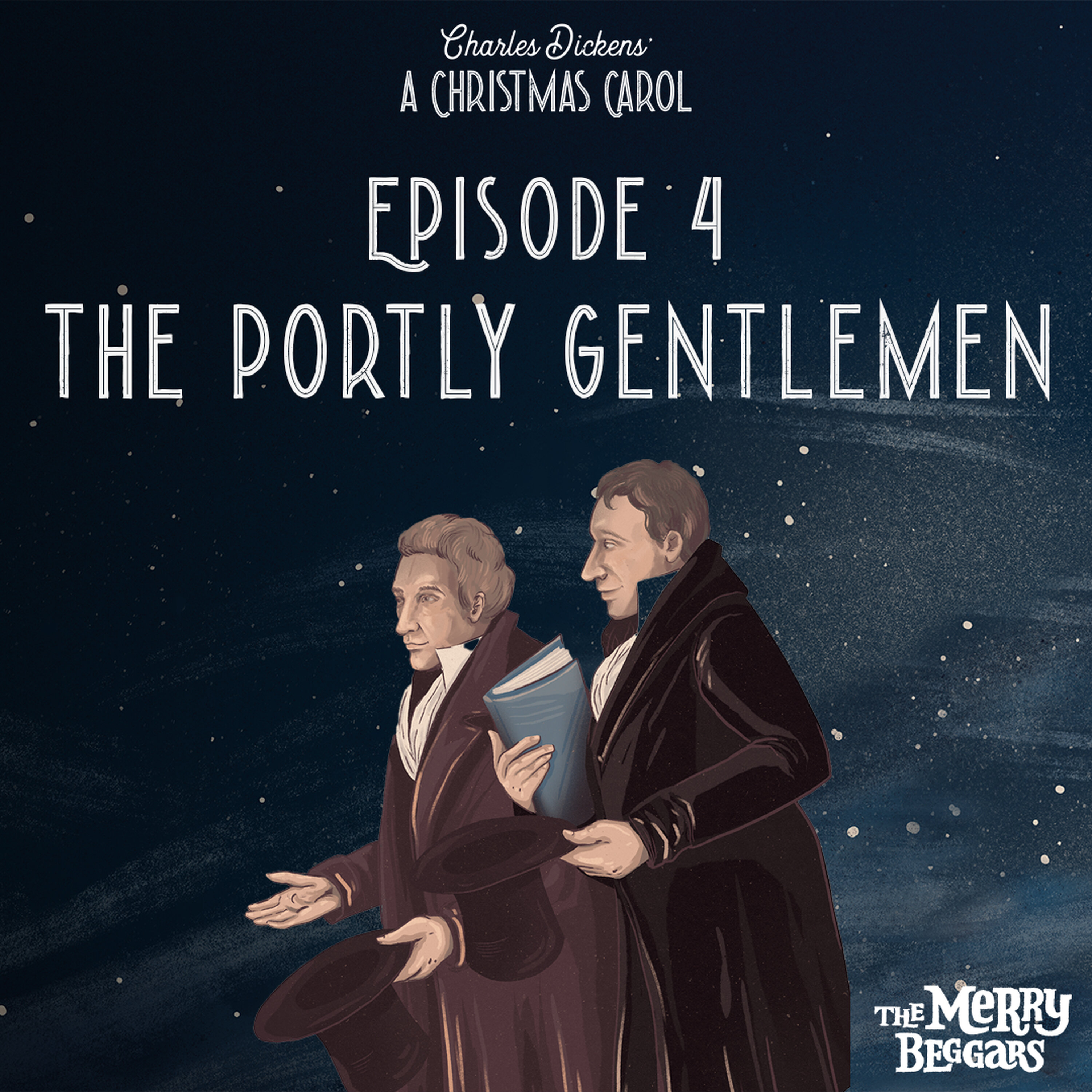
The Merry Beggars at relevant Radio present Episode 4 the Portly Gentleman to save.
- [00:18]
Charity Collector 1
Us all from Satan's power.
- [00:27]
Bob Cratchit
Scrooge's nephew left the room without an angry word. Despite his Uncle Scrooge's reception, he stopped at the outer door to bestow the greetings of the season on the clerk Bob Cratchit, who, cold as he was, was warmer than Scrooge, for he returned them cordially. Stay as warm as you can in here, Mr. Cratchit, for tomorrow is Christmas Day. We must make merry.
- [00:50]
Charity Collector 1
That we must, sir. God bless you, sir.
- [00:56]
Ebenezer Scrooge
There's another fellow with 15 shillings a week and a wife and family talking about a Merry Christmas. I'll go mad and retire to Bedlam.
- [01:08]
Bob Cratchit
As Bob Cratchit let Scrooge's nephew out, he let two other people in. They were portly gentlemen, pleasant to behold, and now stood with their hats off in Scrooge's office. They had books and papers in their hands and bowed to him.
- [01:23]
Charity Collector 2
Scrooge in Marley's, I believe.
- [01:25]
Charity Collector 1
Have we the pleasure of addressing Mr. Scrooge or Mr. Marley?
- [01:29]
Ebenezer Scrooge
Mr. Marley has been dead these seven years. He died seven years ago this very night.
- [01:35]
Charity Collector 1
Oh. Well, we have no doubt his liberality is well represented by his surviving partner.
- [01:44]
Charity Collector 2
Here is the organization we represent, Mr. Scrooge. Our credentials and a small brochure.
- [01:51]
Ebenezer Scrooge
Mmm.
- [01:53]
Bob Cratchit
Marley's liberality was certainly well represented by Scrooge, for they had been two kindred spirits at the ominous word liberality. Scrooge frowned and shook his head.
- [02:05]
Charity Collector 1
At this festive season of the year, Mr. Scrooge, it is more than usually desirable that we should make some slight provision for the poor and destitute who suffer greatly at the present time. Many thousands are in want of common necessaries. Hundreds of thousands are in want of common comforts.
- [02:24]
Charity Collector 2
Quite, quite.
- [02:27]
Ebenezer Scrooge
Are there no prisons?
- [02:29]
Charity Collector 1
Plenty of prisons, sir.
- [02:32]
Ebenezer Scrooge
And the union workhouses, are they still in operation?
- [02:36]
Charity Collector 1
They are still. We wish that we could say they were not.
- [02:40]
Ebenezer Scrooge
The treadmill and the poor law are in full vigor, then?
- [02:44]
Charity Collector 1
Both very busy, sir.
- [02:47]
Ebenezer Scrooge
Well, I was afraid from what you said at first that something had occurred to stop them in their useful course. I'm very glad to hear that is not the case.
- [02:56]
Charity Collector 1
Under the impression that they scarcely furnish Christian cheer of mind or body to the multitude. A few of us are endeavoring to raise a fund to buy the poor some meat and drink and means of warmth. We choose this time because it is a time of all others, when want is keenly felt and abundance rejoices what.
- [03:17]
Charity Collector 2
Shall we put you down for, sir?
- [03:19]
Ebenezer Scrooge
Hmm? Nothing.
- [03:24]
Charity Collector 2
You wish to remain anonymous?
- [03:26]
Ebenezer Scrooge
I wish to be left alone. Since you ask me what I wish, gentlemen, that is my answer. I don't make merry myself at Christmas, and I can't afford to make idle people. Mary, I help to support the establishments I have mentioned, and they cost enough. And those who are badly off must go there.
- [03:44]
Charity Collector 2
Many can't go there, sir, and many would rather die.
- [03:47]
Ebenezer Scrooge
If they would rather die, they had better do it and decrease the surplus population.
- [03:53]
Charity Collector 1
My word.
- [03:55]
Ebenezer Scrooge
Besides, excuse me. I don't know that they would rather.
- [03:58]
Charity Collector 1
Die, but you might know it.
- [04:00]
Ebenezer Scrooge
It's not my business. It's enough for a man to understand his own business and not to interfere with other people's. Mine occupies me constantly. Good afternoon, gentlemen.
- [04:12]
Charity Collector 2
Come, Thomas. There is no spirit here.
- [04:15]
Charity Collector 1
One moment, James. Mr. Scrooge.
- [04:17]
Charity Collector 2
Thomas, he's not listening.
- [04:19]
Charity Collector 1
Mr. Scrooge, we hope with most earnest feelings that you and yours have a merry Christmas. Abundant blessings on your Christmas, sir. Merry Christmas.
- [04:32]
Bob Cratchit
Saying clearly that it would be useless to pursue their point, the gentleman withdrew. Scrooge resumed his labors with an improved opinion of himself and in a more facetious temper than was usual with him. Meanwhile, the fog and darkness thickened, so the people ran about with flaring links, proffering their services to go before horses and carriages and conduct them on their way. The ancient tower of a church, whose gruff old bell was always peeping slyly down its Scrooge out of a Gothic window in the wall, became invisible and struck the hours and quarters in the clouds with tremulous vibrations. Afterwards, as if its teeth were chattering in its frozen head. Up there, the cold became intense. In the main street at the corner of the court, some laborers were repairing the gas pipes and had lighted a great fire in a brazier round which a party of ragged men and boys were gathered, warming their hands and winking their eyes before the blaze in rapture. The brightness of the shops, where holly sprigs and berries crackled in the lamp heat of the windows made pale faces ruddy as they passed, foggier yet and colder, piercing, searching, biting cold. If the good Saint Dunstan had but nipped the evil spirit's nose with a touch of such weather as that, instead of using his familiar weapons, then indeed he would have roared to lusty purpose. The owner of one scant young nose, gnawed and mumbled by the hungry cold as bones are gnawed by dogs, stooped down at Scrooge's keyhole to regale him with a Christmas carol.
- [06:07]
Young Singer
God bless. Bless you, Mary. Gentlemen, may nothing you dismay remember Christ our Saviour was born on Christmas Day.
- [06:24]
Ebenezer Scrooge
Not a moment of peace, not a moment of rightful labor. Enough.
- [06:33]
Charity Collector 1
Away.
- [06:34]
Ebenezer Scrooge
Be gone.
- [06:35]
Bob Cratchit
The young singer fled in terror, leaving the keyhole to the fog and even more congenial Frost.
- [06:44]
Narrator
Subscribe@adventwithscrooge.com for the next episode of A Christmas Carol and download a free companion guide with activities, questions and coloring pages. Subscribe for free at adventwithscrooge.com adventwithscrooge.com.