Podcast
A History of Marketing
Hosted by Andrew Mitrak · EN
A podcast about the stories and strategies behind the campaigns that shaped our world. Featuring conversations with top CMOs, marketing professors, authors, historians, and business leaders.
marketinghistory.org
marketinghistory.org
27episodes
Episodes
Newest firstAll episodes
Byron Sharp: “There’s only one science.”
1w ago00:48:11Tap to summarizeA History of Marketing / Episode 54Few people have challenged how I think about marketing more than Professor Byron Sharp. His book, How Brands Grow, might be the most influential marketing book of the contemporary era. It told a generation of marketers that much of what they’d been taught was wrong, and it had the data to back it up.Sharp is the director of the Ehrenberg-Bass Institute, the world’s largest center for marketing science research. You may remember my conversation with Professor Rachel Kennedy that covered the institute’s history and the two researchers it’s named for: Andrew Ehrenberg, who discovered law-like patterns in buying behavior, and Frank Bass, who believed marketing could be studied like any other part of the real world. This episode picks up that story, straight from the man who carried their work to a global audience. It’s a conversation that spares no sacred cows: Kotler’s STP, brand purpose, behavioral science, and personalized advertising all take hits.We cover:* How a young academic in Australia took on giants like Philip Kotler, and why marketing had the data to become a science long before it acted like one* The difference between looking scientific and being scientific* A round of overrated / underrated: Sharp’s hot takes on positioning, brand purpose, behavioral science, and personalized advertising* Whether AI opens new questions for marketing’s most famous empiricistListen to the podcast: Spotify / Apple PodcastsSpecial thanks to Xiaoying Feng, a Marketing Ph.D. Candidate at Syracuse, for reviewing and editing transcripts for accuracy and clarity. And to Nick Asbury, who you may remember from episode 53 of this podcast, for introducing me to Byron.Andrew Mitrak: Byron Sharp, you’ve been at the top of my list of people to interview since before I started this podcast. So I’m looking forward to a conversation with you about marketing history and “the arrival of science.”Byron Sharp: (Laughs) That’s not true because you interviewed Philip Kotler first.Andrew Mitrak: Yes, well, I’ve interviewed a lot of people. I feel like I’ve had a chance to do my homework prior to interviewing you. Of course, I read and re-read How Brands Grow and then, for the first time, I went through How Brands Grow: Part 2. So that was excellent. So I feel like I’ve done my homework prior to speaking with you, between that and the other interviews I’ve done.Byron Sharp: Excellent, excellent. At the end of your Philip Kotler podcast, he said, you know, “an inquiring mind” and “read a great deal of things,” and he was excited for the next revolution in marketing. He’d like to be part of it. I don’t know, when was that recorded? When did you record that with him?Andrew Mitrak: I recorded that in October of 2024.Byron Sharp: Okay, well, gosh, there has been a revolution. He’s obviously missed out on it.“Have you looked?”: The Shift to Marketing ScienceAndrew Mitrak: Let’s talk about that. So let’s talk back to sort of the Kotlerian era of marketing, and when you first encountered marketing, when did you realize that the prevailing marketing wisdom wasn’t sufficiently evidence-based?Byron Sharp: You know, when I did my master’s by research, I read a lot of the American literature and things, and it was researchy. You know, it’s researchy. But it’s not terribly—it’s not the sort of science that we learn when we’re at high school. There was sort of, I don’t know, it’s weird. It’s a weird thing in the—I mean, Andrew Ehrenberg wrote this amazing article, published it in Nature, right? The world’s most famous scientific journal, called “Even the Social Sciences Have Laws.” And in there, he said that there was this sort of belief that you could not have scientific laws that concern human beings or crazy things like advertising and stuff. And it’s a great line from Andrew. I don’t know if it was ever published, but when people said there can be no laws in marketing, he would say, “Have you looked?” You know, if you don’t look, you’re not going to find. Because that’s always been—I mean, science is actually quite a new thing, and it’s only a few hundred years old. And it was just people looking systematically, taking systematic measurements of things. It’s not actually rocket science.In the podcast with Philip Kotler, he talked about how—what was it?—in his time, finance was seen as science and marketing wasn’t. But even he is not talking about science; he’s talking about engineering. He’s talking about using numbers and spreadsheets and things like this, which is just not science. Science is repeating studies over and over and looking for repeatable patterns and then building—then when you find those, you can make predictions, and you can start to understand how the world’s working. And you can start to—you realize that some explanations work, fit with those laws, and some don’t. And you find weird things because the world is weird. There is only one science, right? People often say, “Can marketing be a science?” I’m like, “No, there’s only one science, it’s called science.” Science studies the real world. It can study marketing. It can study turtles. It can study whatever is in the real world.But it follows a method that is designed to establish laws that are so reliable that we don’t, you know, I always joke, no engineer asks, “So what’s Brazilian gravity like?” We know. And that repeatability—so a lot of academia was always about new things, new words, or just coming up with new titles. “Social marketing” we’ll call it, as if people in charities didn’t realize that beforehand. I don’t, yeah, or buzzwords and things.Applying Scientific Method to MarketingAndrew Mitrak: So was there ever a moment where you were in some marketing lecture or reading a marketing book and just realizing, “There is no science here”? Like, what was the spark or the initial moment where you felt like, “Oh, this is not sufficiently science-based and therefore I could actually be part of the movement to make it more science-based”?Byron Sharp: I don’t know. I think because I read philosophy of science, and I read writing by people like Frank Bass and Andrew Ehrenberg, and Andrew was actually doing it. And so I was very keen on replication, and I started a journal. I was advised, “Do a journal, it’ll be really widely cited.” It wasn’t. But I invited Andrew Ehrenberg onto the advisory board and then started working with him, and then sort of the rest is history, I suppose. But I came from the Phil Kotler school. I always liked how Phil Kotler was quite down to earth. He wasn’t like the Cannes crowd that I’ve just been with, you know. He was quite skeptical of the idea that advertising could manipulate people. There is a famous line about, you know, “People don’t have garages full of cars they don’t drive and fridges full of food they don’t eat” and things. They are quite experienced. And I liked that down-to-earth thing. So I sort of rebelled a little bit about the mystical part of marketing, the sort of magic advertising that subtly changed people’s psychology and things like that. I was quite skeptical about that. And at the same time, I thought, “Why aren’t people talking about memories? Why aren’t they talking about what we now call mental availability?” It seems that this is really underplayed. And that sort of got me doing research and discovering stuff.The Pareto Law That Wasn’t 80/20Andrew Mitrak: Do you have any hypotheses as to why it was that marketing was not more scientific, or stayed unscientific for so long? Or do you have any instincts, or have you looked at why—why wasn’t Phil Kotler more science-based, or why weren’t the folks of his era more science-based? Was there some bottleneck preventing them from being more scientific? Did they not have access to the research or the tools and processes to be more scientific, or do you feel like there was j...
Transcribe →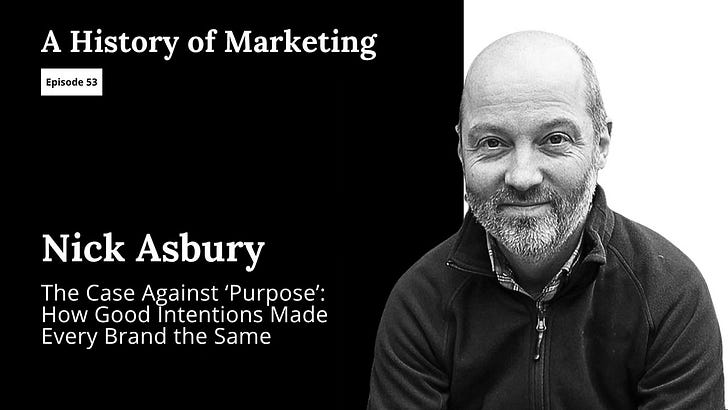
Nick Asbury: The Case Against “Purpose” - How Good Intentions Made Every Brand the Same
Jun 1101:14:27Tap to summarizeA History of Marketing / Episode 53Nick Asbury is a creative writer, one half of the design partnership Asbury & Asbury, and the marketing industry’s most persistent critic of brand purpose.He’s the author of The Road to Hell: How Purposeful Business Leads to Bad Marketing and a Worse World (And How Human Creativity Is the Way Out). It’s a title that tells you exactly where Nick stands.For 15 years, “Purpose” was an idea marketers weren’t supposed to question. It dominated creative briefs, advertising awards, and TED Talk stages. Brands from chocolate bars to social networks climbed what Nick calls “the ladder of abstraction” until they settled on something like: “we’re here to make the world a better place.”The Road to Hell is a rarity: most marketing books tell you how to do something right. Nick wrote one about why a whole movement got it wrong. He also argues there’s a way out: human creativity, lateral thinking, and humor.In this conversation, we cover:* How the 2008 financial crisis kicked off the capital-P Purpose era, and why the 2024 election may have ended it* Why even Dove’s Real Beauty, the most celebrated purpose campaign ever, doesn’t hold up to scrutiny* Why the most prominent purpose advocates are late-career marketing legends* Why AI can’t make the lateral leap behind slogans like “Just Do It,” and why that’s good news for human creativityListen to the podcast: Spotify / Apple PodcastsSpecial thanks to Xiaoying Feng, a Marketing Ph.D. Candidate at Syracuse, for reviewing and editing transcripts for accuracy and clarity. Why Write a Whole Book Against Purpose?Andrew Mitrak: Nick Asbury, we’re here to talk about your excellent book, The Road to Hell. I love this book, I read it cover-to-cover in one sitting, and I hope marketers everywhere read it. And it’s all about how purposeful business leads to bad marketing and a worse world, and how human creativity is the way out. And I wanted to ask you about this because most books about marketing focus on how to do marketing the right way versus why a certain approach is wrong. And so I’m wondering, why focus on why the purpose movement was a mistake? Why write a whole book about this?Nick Asbury: Yeah, that’s a really good question and first of all, yeah, thanks, thanks for reading it, thanks for having me on to talk about it. Yeah, I think, I think first of all, there is a, I hope, a kind of noble tradition of books that argue against something rather than for something. Like, I know Bob Hoffman has done some brilliant stuff against ad tech and advertising. You can even look at books like No Logo by Naomi Klein—books that are kind of polemics against prevailing wisdom. And I, I guess I would put this book in that category. I mean, it is arguing ultimately for something, in that the last of the five sections is arguing for creativity and humor and humanity. But yes, most of the book is an argument against purpose.And I guess it’s just been a kind of, you could almost say a kind of unfortunate fact of my career, I think, that I happen to be working at a time where I do think this huge idea of purpose has dominated the industry for, well, you know, 15, maybe even 20 years. I think you could say that period is, is waning now. But, yeah, I just found it was a very omnipresent idea that was affecting almost every kind of brief coming across my desk and was dominating industry awards, industry conversations. So, it felt like a—and I guess, one thing I’d add is it also felt like something you weren’t meant to question that much. There was a slightly taboo feeling about, you know, how could anyone be against this? And I guess when I sense that taboo, I do almost feel drawn to challenging it. Not for its own sake, but just because—The Risks of Challenging the “Purpose” OrthodoxyAndrew Mitrak: Yeah, it still somehow, to me, it feels a little bit riskier than something like No Logo, which was sort of like punching up. It’s sort of like taking aim at the brand bullies, or something that is anti-tech. Like there’s so much anti-tech, or is sort of more consensus to, like I feel like there’s more people to nod along. This one somehow feels almost a little bit riskier because how could you, how could you have an argument against purpose? Purpose sounds so nice. And did you worry at all that this might alienate potential clients or colleagues who had embraced the purpose-driven marketing?Nick Asbury: I guess, maybe on one level, I think I am, I’m maybe fortunate in that it’s fairly low risk for me because I’m basically a lone traveler in the industry. I’m a self-employed writer. So, it’s not like I work for a big employer who might be unhappy with it. I, ultimately, as a writer, only need enough work to keep one person busy. So, if a few clients don’t call me because of the purpose position that I have, then, you know, there will equally be clients who do call me because they like the arguments being made.But I didn’t really write it as a, as a kind of strategic business career move for myself, really. I just felt the urge to write it because I felt there were important things to say. I guess on that kind of punching up, punching down thing, which, you know, I, I would definitely think of it in my own mind as a kind of punching up exercise in that—and this kind of brings us on to the whole subject—but I see purpose actually as quite a big corporate, top-down kind of movement. I kind of consider myself, I guess, arguing for the smaller businesses and the consumer who kind of often gets slightly patronized by some of this stuff, I think. So, yeah, I would see it as kind of challenging an orthodoxy imposed by powerful people.The Origins of Capital-P PurposeAndrew Mitrak: Yeah, fair enough. And let’s, I think that is how it comes across, it’s just that at a high level, it seems like such a sacred thing. But as you’re saying, let’s get right into it because I think that, taking this sort of historical lens, you start with a moment as you’re seeing purpose and typing it out. And I’m wondering, when in your mind does this, does purpose become a movement? When does it become sort of the big behemoth omnipresent thing that you’ve experienced?Nick Asbury: Yeah, well, I think the simple answer is I see the kind of purpose with a capital P movement, I think, started after the financial crisis of around 2008. So, I think—and that’s not to say that none of these questions ever existed before that, I think you can see purpose as the latest manifestation of very old arguments about kind of stakeholder versus shareholder capitalism arguments that Milton Friedman was having back in the 1960s. You can basically take it as far back as business itself, really. People have always argued about the ethics of business and, you know, how they relate to the—can capitalism be ethical? You know, there’s all these big philosophical questions that have been debated for a long time.But I think the purpose movement in advertising, and in the kind of corporate boardroom, really did take off post-2008 when, I think, the story I would tell was there was kind of a reputational crisis for big business. A lot of people were turning against business, kind of blamed them for the excesses that led to the crash. And, you know, you had the Occupy Wall Street movement, kind of quite a large, widespread, anti-corporate kind of feeling in the world. And I think, I definitely sensed this at the time, even in some of the clients I was working for, was there was this sense that, oh, we need to tell a better story about business. Rather than people thinking of us as the enemy, we need to kind of tell a story about how we can actually be a powerful ally to important social causes.And I think that became a really persuasive, powerful thing that people wanted to believe in. There was this whole mantra of “do well by doing good,” which was kind of the slogan of the purpose movement, I guess. But this idea that you could, yeah, do good things in society, and that would, through a kind of virtuous circle, it would lead more consumers to buy from you because consumers, so the argument went, consumers are more concerned about ethical issues these days than they have been before. And therefore,...
Transcribe →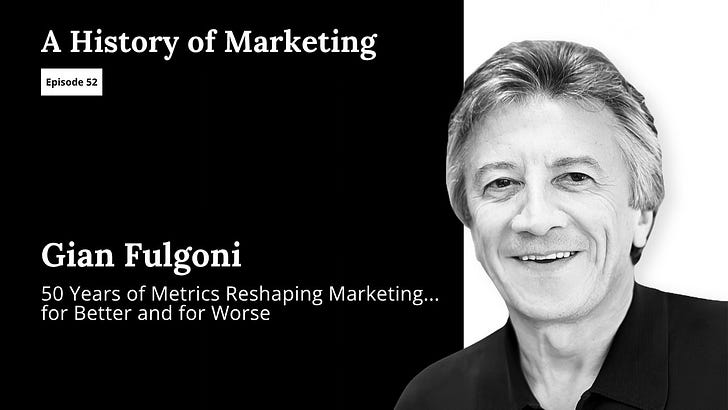
Gian Fulgoni: 50 Years of Metrics Reshaping Marketing... for Better and for Worse
May 1400:55:08Tap to summarizeA History of Marketing / Episode 52Gian Fulgoni has spent 50 years as a pioneer in market research and audience measurement. From his work on scanner data at IRI in the 1970s to co-founding Comscore in 1999, Gian helped invent how marketing gets measured, first in supermarkets and then on the internet.His career sits at the center of two transformations that reshaped the field. At IRI, he helped pioneer the use of supermarket scanner data and built one of the earliest controlled experiments in television advertising, a system that could send different ads to different households in real time, in 1979. Two decades later, he co-founded Comscore to bring that same measurement rigor to the chaos of the early internet, building the panels and tools that defined how digital audiences and e-commerce got counted.Gian has lived through every major shift in modern marketing measurement, and he’s candid about what went wrong along the way. He has watched the industry get seduced by metrics that are easy to capture but don’t actually measure whether advertising works.In this conversation, we cover:* Why digital marketing metrics like click-through rates and ROAS are misleading, and why the industry keeps using them anyway* How scanner data accidentally flipped CPG spending from advertising to promotion and handed power to retailers* Why data shows that creative is the biggest driver of advertising effectiveness, and why the industry keeps ignoring that lesson* What the dot-com era might tell us about today’s AI revolutionListen to the podcast: Spotify / Apple PodcastsSpecial thanks to Xiaoying Feng, a Marketing Ph.D. Candidate at Syracuse, for reviewing and editing transcripts for accuracy and clarity. And to Tod Johnson, whom you may remember from episode 51 of this podcast, for introducing me to Gian.Andrew Mitrak: Gian Fulgoni, welcome to A History of Marketing.Gian Fulgoni: Well thank you. Thanks for the invitation to be here today.Andrew Mitrak: I want to start right at the beginning. You studied marketing in London and then moved to Pittsburgh to work in marketing. How was the marketing scene different between the UK and the US?Gian Fulgoni: Well, you know, marketing was kind of viewed as having originated in the US, but that’s really not the issue that I was focused on. So my undergraduate degree is in physics. Right? And while I might have been good at it in high school, it was like going from the minor leagues to major league baseball when I got to university. I had no competitive advantage in physics. I was trying to figure out what to do next, and it was the beginning of marketing, actually, in the US and certainly in the UK. I did some research and realized that marketing might be a good place for me to be.I did, I think, anticipate correctly that data and computers and the like, analytics, would become more important in marketing as time went by, which kind of reinforced my decision to major in marketing. I got a master’s degree in it. Then I got offered out of the blue. I got a job while I was still at school that took me to Pittsburgh, and it was a company named Management Science Associates that was started by a professor out of Carnegie Mellon who wanted to do research on things he was interested in. He started a company that was focused on analyzing data, basically. Processing and analyzing data. And that’s where I ended up.Is Marketing a Uniquely American Discipline?Andrew Mitrak: I want to follow up on, you said that it seemed like marketing had originated as more of an American field. It’s something that on this podcast I’ve actually encountered. Like I’ve talked to Phil Kotler, who is often called the father of modern marketing, and he kind of says that marketing is uniquely American or comes from an American tradition. And I’ve talked to folks though from abroad who reject that or they push back on that, and it’s just sort of like a North American bias. So it’s interesting as somebody who was in the UK, you kind of perceived it that way. Can you speak to that?Gian Fulgoni: Yeah, I mean there’s no question in my mind. There’s no question in my mind. For example, where I got my master’s was the only university in the UK that had a master’s degree in marketing. That was in 1969. I mean, you could get a master’s degree in marketing in a bunch of universities at that point in time in the US. There were only two MBA programs in the UK at Manchester and London. You know, you had dozens of them. So, if you look at all of the people who pioneered marketing, they’re really from the United States. So I don’t think there’s any question that the US was ahead at that point in time and maybe to this day is still ahead.Andrew Mitrak: So did you go into marketing knowing you wanted to go to the US eventually?Gian Fulgoni: No. No, it was, I had done some research, talked to some other people who were going on to MBA programs when I was in my undergraduate final year. And that’s what I decided that marketing looked really interesting. As I said, I think I anticipated the data and analytics, computers, would become more important there. But I had no idea, no intention of coming to the US. It was when the job offer came along that I suddenly thought, man, this is the opportunity of a lifetime. I gotta do this.The Early Adoption of Computers and Data in MarketingAndrew Mitrak: You were really early to computers and data in marketing. Marketing as a field in the UK was early, and then attaching computers and data onto it. How did you make that connection initially?Gian Fulgoni: I think in large part it was because the company I worked for, Management Science Associates, their business was helping companies use whatever marketing data they had. And that would involve taking raw data, if you will, and processing it, analyzing it, whatever data it was. It could have been panels of consumers, back in those days it was diary panels. Or it could have been shipment data that companies had, or it could have been Nielsen audit data, or another database was SAMI warehouse withdrawal data, or whatever data they had. And so I was able to learn the basics of what was available as data, how to process it, analyze it, how to improve it, and I think started to get a feel for what was not available that maybe could be a home run if it became available.Riding the Technology Wave in Market ResearchAndrew Mitrak: It strikes me, this is a little bit of an odd question, but have you seen the show Mad Men?Gian Fulgoni: Yes. Yes.Andrew Mitrak: It strikes me the analogy I was thinking of like people like you who adopted computers early. In that show, there is a character, Harry Crane, who adopted TV, and he became the head of television and sort of rode the wave of TV. And people like you were very early on to computers and data and sort of rode that wave. I feel like marketers who can identify the right technology ride a wave, it can propel you in your career. Do you think of it that way at all, like part of it is timing and finding the right technology and positioning yourself as the expert in it?Gian Fulgoni: Absolutely. Oh, absolutely. I mean, I have often said I didn’t create any particular technology. I just took advantage of breakthroughs in technology that allowed for the creation of new applications and new products. But I think I did see early on that it just had to evolve, right? Computers, it was pretty clear, were getting faster, at that point bigger by the way, we hadn’t reached the trend when things were getting smaller. But you could see that the data that was becoming available, that was changing. The way that data was being analyzed, things that could be done with data that wasn’t available at the time. I mean, the emergence of scanner data was a great example, because that changed everything in how consumer packaged goods marketers operated. One truth at least that’s evident to me is that data, the availability of data, can change markets fundamentally. And I think there are numerous examples of th...
Transcribe →
Tod Johnson: The Evolution of Market Research - From Handwritten Diaries to Internet Ratings
Apr 2400:27:12Tap to summarizeA History of Marketing / Episode 51My guest Tod Johnson, a market research pioneer who was among the first people to measure the Internet. He’s an inductee to the Market Research Council Hall of Fame and former chairman of the Advertising Research Foundation. Tod is President and CEO of the Board of the Metropolitan Opera and is a member of the board of the Lincoln Center for the Performing Arts.Tod led The NPD Group for over 50 years, building it into one of the largest consumer research firms in the world. NPD became the company retailers like Mattel and Hasbro relied on to understand what was selling. In 1995, he founded Media Metrix, essentially the Nielsen ratings of the early internet.In this conversation, we dive into:* The era of pencil-and-paper diary panels, when consumer research meant tracking grocery purchases by hand and mailing the booklets back every month* Why Tod’s analysis showed that brand loyalty is mostly a myth, long before anyone in advertising wanted to admit it* How he accidentally discovered the internet was about to change everythingListen to the podcast: Spotify / Apple PodcastsSpecial thanks to Xiaoying Feng, a Marketing Ph.D. Candidate at Syracuse, for reviewing and editing transcripts for accuracy and clarity. And to Bill Moult, whom you may remember from episode 23 of this podcast, for introducing me to Tod.Why spend a career in market research?Andrew Mitrak: I watched a speech you gave while accepting a lifetime achievement award. And at the start of the speech, you quipped that you’re tempted to aim for a second lifetime achievement award and do it all over again. I take that as a sign that you spent your career really doing something you love, and your career was in market research. So, what do you love about market research?Tod Johnson: Well, I’ve always been a very quantitative-oriented person. I’ve loved numbers, I’ve loved facts supported by numbers, and I’ve always had an interest in psychology as well. In fact, I taught what today would be called cognitive psychology when I got out of graduate school for a while. Market research just puts those two pieces together very, very naturally. So it fit into what I really found exciting and wanted to do. I have to say, I never started out thinking market research was my career objective. I kind of fell into it by accident, but once I got into it, it was where I wanted to be.Innovation and Innovation Models in Early Market ResearchAndrew Mitrak: You were an academic doing quantitative analysis, and these were real-world business practitioners. Was this seen as new pioneering research that they could apply to their business? What was that dynamic like with them?Tod Johnson: Well, the dynamic was interesting and different in those days. These companies had their own staffs oriented to innovation and development, and they were always open to new ideas. Today, that’s not so easy to get into a company with a new idea because there’s just too many of them out there. But back then, it was kind of open arms, wanting to explore new ideas. We were solving real problems like new product introductions with trial and repeat models, which hadn’t really been focused on much before, market structure work, and consumer packaged goods (CPG) companies had a curiosity to want to learn that.The Era of National Purchase DiariesAndrew Mitrak: Can you set a scene of what market research looked like at the time? Was it ever influencing a certain product launch, or a certain product strategy, or messaging or positioning type?Tod Johnson: In those days, virtually every new product launch would go into a test market. We would set up a diary panel of consumers to record purchases in the appropriate category. We would do the trial and repeat analyses that would predict the long run success or failure of the particular product. That would be the most common application. On a national basis it would be more about consumer trends in those categories uh and how they were structured and what was changing.The other thing that was very good, I’m now jumping ahead to when I became involved in developing NPD, was in the mid70s, General Mills started to diversify from CPG into a lot of other categories like food service, toys, apparel, jewelry, and I was fortunate enough to be the person they looked to to set up how to track those industries similar to how CPG had been tracked.Andrew Mitrak: Amazing. They embraced the general in their name and kind of not so much the mills part of their name.Tod Johnson: Well, the general went away about 10, 15 years later.Andrew Mitrak: You mentioned National Purchase Diaries. What was the actual purchase diary? You mentioned like purchase diary panels and what does it look like? Walk me through the nuts and bolts of what a purchase diary panel would look like.Tod Johnson: Well, it would be a booklet which was about 20 pages and each page had a couple of categories on it like toilet paper, facial tissue, and paper towels might all be on a page, and they’d be structured in a way that if you bought one of those items, you answered some questions.The panelists would get a new booklet every month and mail the old booklet back in to us, which we would code up. Back then, it was pretty easy to get good representative samples because women typically weren’t working. They were interested in doing projects and interested in helping, and we made it clear how they were helping manufacturers make better products for them by providing this kind of information. That relationship with the consumer in market research just doesn’t exist anymore, but it was what a lot of the industry was based on in the ‘40s, ‘50s, ‘60s, and ‘70s.Measuring Product Success and Consumer LoyaltyAndrew Mitrak: The consumers were part of the panel who had these diaries. They would kind of punch in their purchases for the week?Tod Johnson: No, they’d fill them in by hand with pencil.Andrew Mitrak: Do you have any favorite examples of how this data was used? Especially in the early years of these manual diary entries.Tod Johnson: New product introductions, which were elaborate test markets for the most part back then, was perhaps the most common use. The other use was it was a way to track demographics. It was a way to track loyalty. I can remember in the ‘80s, I did a lot of publishing about how consumers weren’t very loyal because we’d see their purchase patterns. That was at a time when advertisers and advertising agencies believed in loyalty. You were always talking about their loyal buyers. It didn’t really exist, but that was the basic premise. I know I was swimming upstream for a while with those publications, but today, everybody accepts that as the truth and the fact, and that there’s enormous brand shifting and much less loyalty than once was thought to exist.The Growth and Diversification of NPDAndrew Mitrak: You joined when it was a $300,000 revenue company.Tod Johnson: $400,000. Give me the full credit.Andrew Mitrak: sorry, I also want to give you credit because it grew to a lot more than that. How did the small kind of regional fi...
Transcribe →
April Dunford: Positioning Is Not Branding, And It's Not Just Marketing's Job
Apr 200:55:23Tap to summarizeA History of Marketing / Episode 50Fifty episodes felt like a milestone worth marking. So I wanted a guest who was, well, obviously awesome.April Dunford is the authority on positioning for B2B tech companies and the author of the updated and expanded edition of Obviously Awesome. I’m a huge fan of April’s work and frequently reference her book, her blogs, and her frameworks in my daily work as a marketer. April’s premise is provocative: positioning cannot live in the marketing department alone. She argues that if the CEO, sales, and product leads aren’t in the room providing input, marketing is left guessing about what makes the product special and who it is actually for. Without their buy in, marketing will inevitably lose the “battle of opinions.”In this conversation, we discuss:* Building on Ries & Trout: The positioning pioneers defined the concept in their 1981 book, but they didn’t give a how-to manual. April does.* The death of the “positioning statement”: Why filling out a template is not a methodology.* Blind men and the elephant: How sales, product, and marketing departments each hold a different piece of the puzzle.* Skip the parts people don’t read: April discovered that CEOs don’t finish books, so she cut her manuscript in half.April is one of the most persuasive and grounded thinkers in the field. Here’s my conversation with April Dunford.Listen to the podcast: Spotify / Apple PodcastsSpecial Thanks to Xiaoying Feng, a Marketing Ph.D. Candidate at Syracuse, for reviewing and editing transcripts for accuracy and clarity.The Origin of April Dunford’s Positioning FrameworkAndrew Mitrak: I have a confession to make. Every time I join a new company, among the first things I do is I visit aprildunford.com and I enter my new email address and I download one of your positioning templates. You probably have several of my old corporate email addresses cluttering your mailing list. Sorry about that.April Dunford: I appreciate you jacking up my newsletter subscription numbers.Andrew Mitrak: And a big fan of your work and I want to say congrats on the updated and expanded edition of Obviously Awesome.April Dunford: Thanks. I’m super excited to get it out there.Andrew Mitrak: For this conversation, I wanted to start back before you became the go-to expert on positioning, and when you were coming up in your career, when did you first encounter the concept of positioning?April Dunford: That’s a good question. Pretty early, actually. My first real job in tech was at a little startup and I was brand new and junior, they assigned me to a product and the thinking was that product wasn’t doing very well and the plan was to shut it down. This is why I got assigned to it as the product marketer.We didn’t end up shutting it down. What we ended up doing was looking at gathering some feedback from people that were using the product, and then we got an idea to reposition it. We didn’t know it was called positioning, we thought we were doing, we’re just doing a Hail Mary thing to see if we can make this unsuccessful product successful doing something slightly different.We repositioned it, relaunched it, and it was super successful. Revenue started going up to the right, everybody’s happy, we’re making a lot of money on that product.And then we got acquired by a big company in California and the big parent company assigned us a couple of products that weren’t doing very well and then said, hey, do that thing you did with the other one. I didn’t have really any idea what we did with the other one. I was worried about getting fired, I thought, okay, I better figure this out.I did a deep dive into positioning. I figured out, A, this is what it’s called. B, I had a lot of conversations with smart marketers asking them about, how do you do positioning? If you were in this situation, what would you do? Do you have a strategy for that or a methodology for that?I also read a bunch of books. There’s the classic positioning book, Positioning: The Battle for Your Mind by these guys Ries and Trout, written in the early 80s, but even back then was considered the book on positioning. And then I took a couple of courses and some post-grad stuff at a couple of universities just learning about positioning.I dumped into this whole positioning thing pretty early in my career, and I was really interested in this idea, could we get a way to do positioning in a really repeatable manner so that we wouldn’t have this problem of, we launched the thing and it didn’t work and then now we’ve got to try and change it. Could I get to a point where there is a process for us to follow to, first of all, maybe do a better job guessing at what the positioning should be in the first place, and then secondly, if we do need to change it, is there a nice repeatable step-by-step thing we could follow to do that.Is Product Positioning Intuitive or Learned?Andrew Mitrak: You initially positioned or repositioned a product without even knowing what positioning was or knowing that it was called positioning that you were doing. And then you went to look at the literature. What’s your takeaway from that? Does that reveal to you that the fundamentals of positioning are somewhat intuitive or can be learned, or do you feel it was just dumb luck really? Or do you feel there were parts of it where this is just obviously the right thing to do for the product? How do you overall think about, can positioning sort of just be an intuitive thing, or is it best to look at the literature that’s out there?April Dunford: Sometimes it is really intuitive. I would say that’s true. I would say a lot of the time when I talk to founders, they’ll talk about how they built the product in the first place, and they’ll be, we saw this need, we had this idea, we could do this in a different way than the existing products that are out there.And we looked at it, we understood what the competition was, we built a thing that was demonstrably different, we understood what the value of that thing was because it was solving our own pain, we understood what kind of customers would want to buy that, and therefore what market we position in. It’s just, it is what it is, it’s super easy. And I think that happens a lot in the early stages of a company. Not for everybody, but I do think it happens a lot.However, what also happens a lot is if you fast forward two or three years, the market’s changed. Maybe your competitors caught up with you and the thing that made you really different isn’t different anymore. Or maybe the way people buy or what they want to do has totally changed. Or maybe your competitors did an acquisition and that changes the whole way everybody thinks about this market.Or maybe you and your product have changed, and you now do a whole bunch of other stuff that you didn’t originally do, and that enables you to get at a different kind of customer to deliver a different kind of value. Now how do you position it? That’s where people get messed up. Sometimes it can be quite intuitive at the beginning, but then a whole bunch of things change and it’s, okay, now the positioning needs to shift. How do we do that? Because we didn’t do anything the first time, it was just obvious. I think that happens a lot.The other thing that happens a lot is you have this thesis when you launch the product and you said, okay, we saw this problem and this is what it’s gonna be and these kind of people are gonna love us for these reasons and here’s the competitor. Then we launch it, and it turns out our thesis was incorrect.We get out there and we’re, man, we launched this thing and we thought banks were gonna love it, but it turns out we’re selling to insurance companies, we didn’t really build it for that, but they’re buying it like crazy. Now we’re in the insurance business, hello. And they love it, but there are some things they don’t love so much, and they’re comparing us to competitors we never really thought about. How do we position this thing because we thought it was gonna be something else.And this is not unusual, to be honest. We call that a pivot in lean startup language. It’s not unusual for a company to build something for one market and then get in the market and find out, whoops, the market’s a little bit different than we thought. People are looking at our product a little bit different than we thought. We’re getting pu...
Transcribe →
Peter Van Wijnaerde: Branding, Beauty, & Beheadings - Lessons in “Stopping Power” from Art History
Mar 2601:04:23Tap to summarizeA History of Marketing / Episode 49Have you ever stood in front of a 500-year-old painting of a father devouring his son and asked yourself, “Who paid for this?” Me neither. Until I met Peter Van Wijnaerde.Peter is a CMO based in Ghent, Belgium, and the writer behind a Substack that connects art history to modern marketing. Rory Sutherland recommended I speak with Peter (which is as high a compliment as you can get in this field) after seeing his presentation on medieval branding. Peter’s premise is provocative: art was the original marketing department. Patrons funded paintings, statues, and tapestries not for beauty’s sake, but because they needed to project power, build legitimacy, and sway public opinion. The separation of fine art and commerce is a relatively recent development.Peter brings a perspective that’s part art aficionado, hobbyist historian, and marketing strategist. He shows us that “stopping power” has been central to persuading the masses for a thousand years.Here is my conversation with Peter Van Wijnaerde.Listen to the podcast: Spotify / Apple PodcastsQuick Update: Thank you to the thousands of marketers from around the world who have played The CMO Game! It’s been amazing to see the response and I’ve had a few marketing professors reach out to request using it in their classes. Special Thanks to Xiaoying Feng, a Marketing Ph.D. Candidate at Syracuse, for reviewing and editing transcripts for accuracy and clarity. And thank you to Rory Sutherland for introducing me to Peter.The Intersection of Art History and MarketingAndrew Mitrak: You’ve written about so many topics connecting history, marketing, mythology, and art, and branding, and merging the past with the present in our work as marketers today. So how would you describe the content of your Substack and your perspective that you bring?Peter Van Wijnaerde: I like to stretch out the history of marketing a little bit to before the 1950s. And I love art and I love looking at art and I love using those art pieces that were made to compel people to have stopping power. I use those to explain how marketing is really one of the oldest professions there is and what we can learn today of marketing. So not that there’s no surprises anymore in the current time, but my blog is about widening the scope of the time frame of marketing.Andrew Mitrak: You mentioned one of the oldest professions. It is funny when Pompeii was uncovered – the ancient city that was covered by Mount Vesuvius. They discovered brothels but also they discovered artwork that would point people to the brothels. Right. So if prostitution is the oldest profession, there seems to be types of advertising to get people there. So they were very interconnected. So advertising does seem like an old profession.Peter Van Wijnaerde: Exactly.Andrew Mitrak: So what was your initial spark? How did you start connecting the past to the present?Peter Van Wijnaerde: I was always a very visual person, liked to engage with things that are visual. But I think the spark happened my first time in Vienna in the Belvedere. I started to appreciate medieval art. And normally medieval art is something we laugh about. You have the memes with the medieval cats and there is full Instagram feeds full of that. But actually we should not laugh with medieval art, because it’s very communicative. Because it’s very symbolic. It says there are two guys and a child and the child is just a little human and this is happening, right? And so it’s basically like a cartoon. I started to appreciate it, started to look at it and then started wondering, that must have been expensive and difficult to make. Why were people making this?Uncovering Medieval Marketing in the Bayeux TapestryPeter Van Wijnaerde: The moment that it clicked was when I was doing medieval travels through Europe. And I was in France and I was in Bayeux. Have you ever heard about the Bayeux Tapestry?Andrew Mitrak: I don’t know about the Bayeux Tapestry. I’m not too familiar with tapestries in general.Peter Van Wijnaerde: Well, it’s a 70-meter long tapestry that was embroidered in the year 1080, let’s say. They don’t know precise but it was embroidered there. And it’s a tapestry about the Battle of Hastings, about William the Conqueror kicking out the Anglo-Saxons out of England and putting in Nordic rule in England. And this guy, his brother, yes, this one.Andrew Mitrak: For listeners, most people listen to the audio, but I am going to, because this is a visual conversation, I’ll pull them up on the screen, because I find it useful to hear and see what you’re talking about. So I’m sharing my screen and showing the Bayeux Tapestry.Peter Van Wijnaerde: So what’s so interesting about the Bayeux Tapestry is that it’s a scroll of 70 meters, it’s about 40 centimeters high or something. And it tells the story about why William the Conqueror thought he had the right to conquer England and what the deal was and how they prepared for it and who they talked to and the whole story from beginning to end is on that tapestry. And it was made...Andrew Mitrak: So it’s a really wide tapestry. Cause it’s like frame by frame. Cause it’s... wow, okay. Yeah.Peter Van Wijnaerde: And you can roll it up too. And it was made by his brother, the Bishop Odo of Bayeux. And what’s so interesting about it, it was not a painting, it was not a statue, it was a tapestry. And there is actually really no other tapestry of that kind. But if you think about it, it was mobile, you could roll it up easily, you can transport it easily and put it out somewhere else also as easily. So it was actually a bit of a prop of a PR tour for William the Conqueror by his brother the Bishop of Bayeux. And then it clicked. And I thought, oh my god, they should give this Odo guy an Effie Award or something because he invented a completely new way of storytelling to convince the people that this king is their legitimate ruler. And you don’t do that by building a cathedral because a cathedral is only in one place. So I thought this is a 1,000-year-old marketing campaign in front of me. So this is when it started clicking even more.Andrew Mitrak: It’s, and you mentioned medieval art almost looks like a cartoon sometimes because it’s a little more two-dimensional, they didn’t quite have the same sense of perspective and lighting and depth that you convey that you’d later see in the Renaissance. But and then also medieval art sometimes you see it in memes today. Like you see it in internet memes and you see it kind of translates kind of because it’s cartoon-like. And in a way memes are such a huge part of internet culture and the way people communicate now. And this artwork, this tapestry kind of reminds you of a comic book almost, or a frame by frame and it sort of takes that type of visual storytelling and it seems like it communicates that to the masses who mostly would be illiterate but would still appreciate a story.Peter Van Wijnaerde: If you walk in front of it and you just go, it takes half an hour to see the whole thing. And there’s action scenes in there and little jokes in there. There’s a warrior showing his bare ass to another warrior, things like this. So it’s also made to entertain. And I think that’s beautiful actually. It’s not just, this is history, this is also, also very interesting fact: the guy who made it gave himself a very prominent role in the history as well. But he was the guy who commissioned it right? So he could embroider himself into histo...
Transcribe →
Scott McDonald: How the Golden Age of Magazines Shaped Brand Marketing
Mar 1901:03:38Tap to summarizeA History of Marketing / Episode 48This week, I’m joined by Scott McDonald, who spent three decades in the research trenches of America’s biggest magazine publishers before becoming president of the Advertising Research Foundation (ARF), an organization now celebrating its 90th year of trying to separate marketing science from marketing spin.Scott led consumer research departments during the Golden Age of Magazines. His insights helped launch Martha Stewart Living, tripled The New Yorker’s subscription price, and he saw the internet disrupt the business model he’d spent years optimizing.Along the way, he picked up insights that still resonate. Including: * The Strength of Weak Ties: How a core sociological concept explains networking and provides a framework for go-to-market efforts.* The Power of Print: Why Steve Jobs insisted that every new Mac launch campaign include an ad in Time Magazine.* Cultivating Authentic Brands: Behind-the-scenes stories of using qualitative focus groups when launching Martha Stewart Living.* Scientific Marketing via the ARF: Including the empirical rule that cutting your share of voice during a recession will reliably cost you market share.Listen to the podcast: Spotify / Apple PodcastsNow here is my conversation with Scott McDonald.Special Thanks:Thank you to Xiaoying Feng, a Marketing Ph.D. Candidate at Syracuse, for reviewing and editing transcripts for accuracy and clarity.And thank you to Bill Moult, whom you may remember from episode 23 of this podcast, for introducing me to Scott.Connecting Sociology with Marketing ResearchAndrew Mitrak: You got your PhD in sociology from Harvard University, and then you got into a career in media and advertising. Sociology is such a fascinating topic. I always enjoyed my sociology classes in college. At a broad level, how did sociology influence your career?Scott McDonald: Well, my interest in sociology went back to undergraduate days really, where I was mostly in the historical comparative wing of sociology and interested in social movements and things like that. And then when I graduated, I graduated from University of California, Berkeley and was totally broke by the time I got out of school. I needed a job. I went to the job board and found a job that involved program evaluation, just kind of project work, evaluating educational programs for the California Department of Education. And it ended up being quite fascinating because it was the first time I’d actually thought about how you would address structured applied problems using the skills of social science. So I cut my teeth on that, doing projects for the Department of Education, for Bay Area Rapid Transit, for all these sort of public entities. And that drove my desire to go to graduate school in sociology to learn the quant side, which I had not really studied as an undergraduate.So that’s really the main throughline to the work that I’ve had in advertising and media because I approached it very much through a background in studying statistical modeling, pattern recognition. I was particularly interested in graduate school in demography. And so demography sits at the border between sociology and economics. There are other borders in anthropology and psychology and other things like that. But I was mostly interested in the border between sociology and economics. And that carried through, I’d say, through my entire business side career. But also I had really fallen in love with doing applied work as opposed to sitting around theorizing at a university. So I was much more receptive to those job offers.And one came to me when I was just rehearsing for doing job talks, going around to campuses and presenting myself as a soon-to-be graduate of a PhD program. And quite randomly, a good example of the sociological theory of the strength of weak ties, that a job at Time (magazine) came up where they were looking for an academic social scientist to try to crack a problem that they found intractable. Because a guy at Sports Illustrated in the Time Inc. portfolio had gone to high school in Chicago with the wife of my thesis advisor. The weak tie led to the referral. I went to New York and hit it off and decided to move to New York and work for Time Magazine instead of joining the faculty at the University of Arizona as a starting tenure track professor.Andrew Mitrak: Can you define more so the strength of weak ties? Like what is that idea? I haven’t actually come across it.Scott McDonald: It was popularized as the six degrees of separation concept. That it isn’t so much who you know immediately, but it’s who people that you know know. That’s one degree of separation or two. So most jobs actually come to people through those kinds of referrals. Not exactly the person that I know, but someone else that I might be able to help them actually discover an interesting job. The exception usually in sociology is recent immigrants. Why do you have Haitian taxi drivers or Indian newsstand owners or something like that? Because their networks are small and they’re very specific to immigrant communities. But once you kind of move out of that, and of course universities themselves are super important as drivers of social networks, and they allow people to expand their networks a whole lot. There’s a whole field of economics now that has to do with the life chances that come to someone just as a function of whether they grow up in a well-networked place like say Austin or a poorly networked place like Waco. Geographically they’re not that distant, but they have very different social networks and different opportunity structures. So sociology, you know, again this is like demography, pattern recognition. When you think of the way that you would discover some of these theories and test them, they’re similar to analyzing the influence of say a magazine compared to a social media influencer. You can graph that stuff.Andrew Mitrak: It sounds like a concept that’s really applicable to marketing in a lot of ways. And we tend to as marketers think of it as just social networking or your second-degree LinkedIn connections or your alumni network, or how you might build an audience through reaching out to influencers and connectors. But it seems actually useful to look at concepts from sociology that have probably studied this in a more rigorous way and come up with things like the strength of weak ties to frame some of your go-to-market efforts.Scott McDonald: I’ve always thought of sociology as being very, very flexible partly because it overlaps with all these adjoining fields. And it’s always scrambling to try, it doesn’t have one unifying theory as economics does. It’s got a bunch of theories. So—Andrew Mitrak: Sounds kind of like marketing.Scott McDonald: It is, exactly. Exactly.The Golden Era of Magazine PublishingAndrew Mitrak: So you got to Time.Scott McDonald: My first big post-graduating job.Andrew Mitrak: And this was in the early 80s or so?Scott McDonald: Yeah, 1982.Andrew Mitrak: So what was the portfolio of Time magazines? Obviously everybody knows Time Magazine, and you mentioned Sports Illustrated...Scott McDonald: Yeah, so the big moneymakers were the weekly magazines. It was Time, Sports Illustrated, and People (magazine). And they all made boodles of money. It was sort of the heyday of the magazine publishing industry. There were also a bunch of monthly magazines as well. And of course, Time Inc. owned a bunch of other things. Book of the Month Club, a publishing imprint. I forget exactly which ones they had, but they had a lot of things. And importantly, HBO. And so there was already kind of a media empire. They owned some cable systems and stuff like that. And then a c...
Transcribe →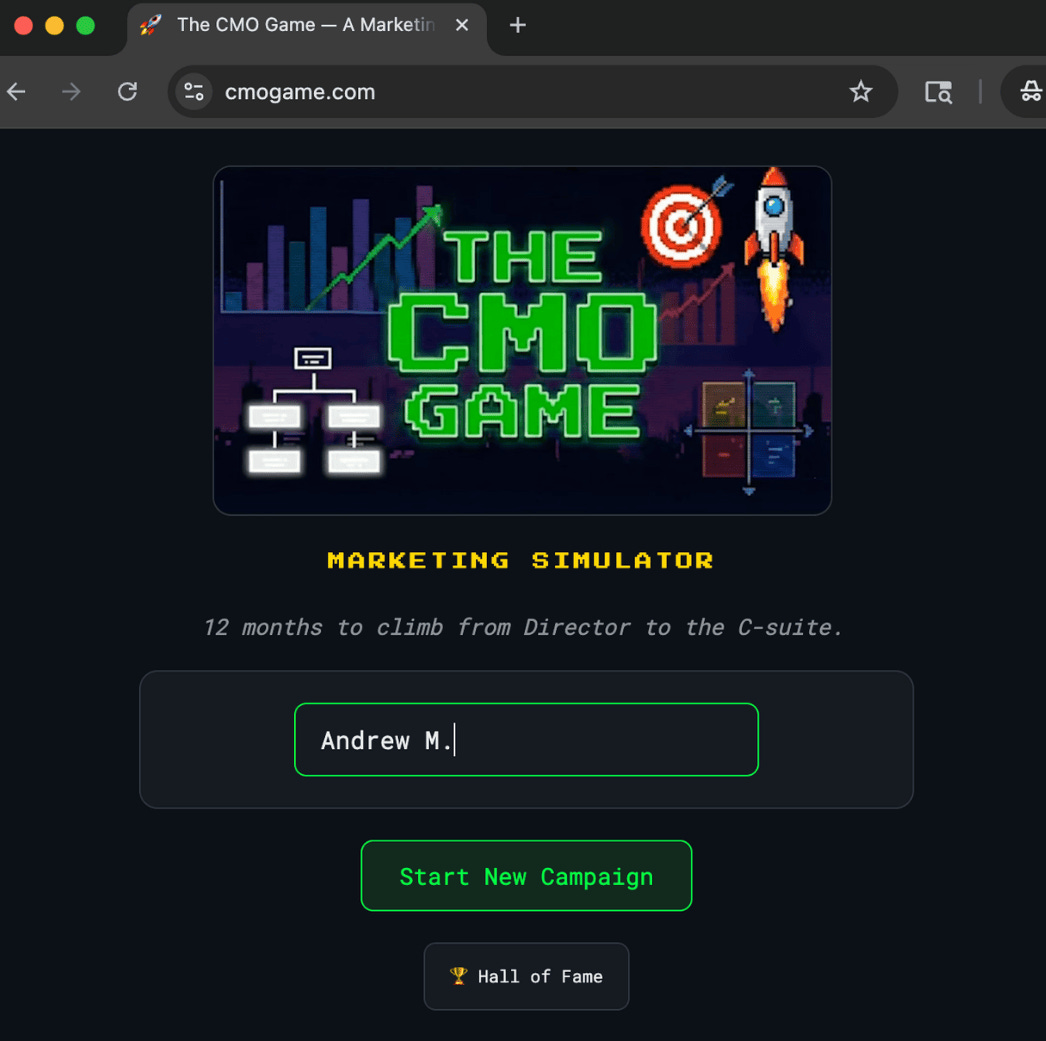
Introducing The CMO Game
Feb 1600:03:13Tap to summarizeI have an unusual update this week: I made a game! It’s called The CMO Game.You have 12 months and $5M to launch your product and climb from Director of Marketing to the C-Suite. But your CEO has aggressive goals and if you don’t meet them, it’s game over.It’s like The Oregon Trail, but for marketing (and with less dysentery).You can play it right now at cmogame.com.Why Make a Marketing Game?One thing I keep coming back to is how hard it is to teach marketing. Books, lectures, and podcasts are great resources, but I really learned marketing by doing. By making bets with incomplete information. By investing in long-term brand while hitting this quarter’s target. By navigating pressures from sales, finance, and the CEO.I designed The CMO Game with this in mind, creating an active simulation that complements other resources for marketing education.Like this podcast, it’s free and designed for marketers who want to get better.How The CMO Game WorksYou start by picking a product: soda, shoes, skincare, or software. Then you lock in positioning: premium, value, lifestyle, or disruptor. Each combination has unique marketing channels and tactics that work best.Next, you hire your team and make your pre-launch investments. And every single choice is a trade-off.Skip PR, and you’ll be caught flat-footed when a crisis hits later in the year. Over-index on data, and you’ll get great insights and better projections—but you’ll have way less money to actually run campaigns.Then comes the launch itself. You have to decide your strategy: Do you go for a massive, splashy launch to grab immediate market share? Or do you hold back, preserving your budget for a steady drumbeat of campaign spending over the next 11 months?Over the next 12 months, you face unexpected challenges, respond, and adjust your budget. Every decision has tradeoffs.The game models the tension between brand and performance marketing.Brand equity grows like compound interest, it’s invisible early but pays dividends late in the game. Performance marketing is efficient and immediate, but growth is linear and lacks long-term payoffs.Strategy, Luck, and the Messy Reality of BusinessNot everything is in your control. Some months you get lucky. Other times you face a crisis. How you respond matters as much as how you plan.Premium skincare, value sneakers, and enterprise software all require different approaches. The game rewards players who grasp this, and penalizes those who treat marketing as one-size-fits-all.And yes, the CEO can fire you. If revenue stalls, if brand equity craters, if you make too many bad calls in a row... you’ll end up #OpenToWork.What Marketers Are SayingI shared early builds of The CMO Game with marketers, professors, and friends who work in gaming.Elton X. Graham, CMO of Sur La Table, put it well:“Mitrak’s game sparks the right conversations by not giving you marketing answers, but better questions to ask... which is where real learning starts.”Brian Marr, a marketing executive and professor, plans to use it in his Advanced Marketing course, describing it as a “great way to break the ice in the first class.”This is what excites me most: that people might learn timeless marketing principles while having fun playing a game.Play It and Share ItThe CMO Game is 100% free. No login. No email capture. No in-app purchases. Just cmogame.com.A full playthrough takes 10-20 minutes, depending on how much time you spend considering your strategy.If you’re happy with your results, you can submit your score to the “Hall of Fame” leaderboard. If you think you can do better, play again with a different strategy.If you like The CMO Game, the best thing you can do is share it with someone: a colleague, a student, or a friend who’s curious about marketing. If you’re a professor, you are more than welcome to share the game with your class. I’d love to hear what you think, and I appreciate feedback on how to improve The CMO Game. Email me at hello [at] marketinghistory.org or find me on LinkedIn.Thanks!-Andrew This is a public episode. If you would like to discuss this with other subscribers or get access to bonus episodes, visit marketinghistory.org
Transcribe →
Tim Calkins: 60 Years Later and 20,000% Pricier... Why Super Bowl Ads Are Still Worth It
Feb 500:58:36Tap to summarizeA History of Marketing / Episode 47In 1967, a 30-second spot at the very first Super Bowl cost roughly $37,500. This Sunday, for Super Bowl 60, brands are paying upwards of $8 million. That is a price increase of over 20,000%.So… Is it still worth it?For Professor Tim Calkins, who’s spent 22 years studying this exact question, the answer is an emphatic, ‘Yes.’Since 2005, Calkins has led the Kellogg Super Bowl Ad Review, where MBA students evaluate every ad that airs during the big game. It’s easy to say which ads are funny. It takes more work to determine which ads will be effective.In this conversation, we dig into how Super Bowl advertising has evolved: why brands now release their spots weeks early, why the creative has gotten safer as the stakes have climbed higher, and what the tone of these ads reveals about the American economy and political climate.If you’re planning to watch the game this Sunday (or just the commercials), this conversation will deepen your appreciation for the work that goes into making every second worth $266,667.Listen to the podcast: Spotify / Apple PodcastsWe also talk about Tim’s years managing Kraft Mayo and Miracle Whip (two surprisingly different marketing challenges), and the most common mistakes that marketers make when delivering business presentations. As you’ll hear, Tim is an excellent speaker.Now here is my conversation with professor Tim Calkins.Special Thanks:Thank you to Xiaoying Feng, a Marketing Ph.D. Candidate at Syracuse, for reviewing and editing transcripts for accuracy and clarity.The Kellogg Super Bowl Ad ReviewAndrew Mitrak: Professor Tim Calkins, welcome to A History of Marketing.Tim Calkins: Well, thank you. It is great to be here.Andrew Mitrak: We will be publishing this right before the 2026 Super Bowl, which is Super Bowl 60. I had a lot of fun preparing and researching some of your work and also watching some old classic Super Bowl ads. The reason I wanted to have you on for this conversation is that you started publishing the Kellogg Super Bowl Ad Review in 2005, so over 20 years now. Can you introduce this project for listeners?Tim Calkins: This is our 22nd year doing this event. Back in 2005, we began the Super Bowl Ad Review, the Kellogg Super Bowl Ad Review as we call it. I teach at Kellogg, I teach marketing at Northwestern University’s Kellogg School of Management. Before I was at Kellogg though, I was at Kraft Foods, and I worked in marketing at Kraft Foods for a number of years. When I was at Kraft Foods, now Kraft Heinz, with my team I would sometimes do an exercise where we would look at Super Bowl ads and try to think about what we could learn from what had happened on the Super Bowl.When I came over to Kellogg, I thought there was a similar opportunity there to do something around the Super Bowl where we get the Kellogg students evaluating these Super Bowl spots. So the event has now been running for 22 years. The format is always the same. We pull together a panel of Kellogg MBA students. Nowadays it is about 70 or 75 students. As the Super Bowl unfolds, as it plays, the students evaluate all the ads that run.What makes our panel different from a lot of other panels that are out there is that we are very focused on efficacy. We are trying to think about: will these spots, will these Super Bowl ads, build the business and build the brand? Ultimately that is what Super Bowl advertising is all about. A lot of panels, and a lot of Super Bowl rating things—there are lots of these—they will look at likeability, humor, which one did you like the best, which one was funniest. Our panel, we don’t really do that. That’s not really the question. The question really is, using sort of an analytical framework and process, how do we think about which ones of these will be most effective?Every year we come up with our ratings. We give a handful of advertisers As, and then Bs, Cs. On occasion, we give out an F if somebody really misses the mark. It is a really fun event, but it also is a lot of work because what you realize being part of it is that there are so many ads that will run on the Super Bowl. There are probably 75 official Super Bowl spots, but then there are all these other things that show up. You have local spots, you have network promo spots for different shows. It is a lot of evaluation that the students do. It ends up being a very draining experience.Andrew Mitrak: Can you walk me back to the beginning? You mentioned Kraft, which later became Kraft Heinz, which I will follow up on because I want to ask you about that too. When you first started paying attention to Super Bowl ads there, this might be an obvious question, but what stood out to you about Super Bowl ads? Why did you want to pay special attention to Super Bowl ads?Tim Calkins: Super Bowl ads are really unique things in the world of marketing. What is amazing is they become more and more unique as time has gone by. Even if you go back 25 or 30 years ago—so we are now at Super Bowl 60, so you go back to Super Bowl 25 even—the advertising that was running was really different than normal advertising. What happens on the Super Bowl is a few things. Number one, it is expensive, so the investment is high. Number two, you have a huge audience, so there is a lot of people who are watching it. But also, the expectations are different for a Super Bowl spot.You can’t turn around and run an ad that you are running on Survivor. You can’t turn around and run that ad on the Super Bowl. For most advertisers, you are creating a special piece of creative just for that event. People expect to see amazing Super Bowl spots. That is the expectation and companies are under a lot of pressure to deliver.The Framework Behind Super Bowl AdvertisingTim Calkins: The reason it is really interesting to study is that you know that for each one of these advertisers, they are putting forward their best thinking, their best creative talents. This is the pinnacle of their work. So much scrutiny is on these things. Given that, it is fascinating to see what they decide to do. Sometimes they do brilliant things and other times they really miss. But to understand what is happening there and really think about it as a marketer is a really unique opportunity and you can learn a ton.Andrew Mitrak: You mentioned how Super Bowl ads are kind of this unique thing. They are a little different than other ads. When you think about this project of analyzing Super Bowl ads, how does it connect to your broader work in brand and marketing strategy? Do you see these as really closely related where a Super Bowl ad is just the epitome of a brand and a marketing strategy wrapped into 30 or 60 seconds? Or do you feel like this is just a little bit of a different, kind of like a fun side quest that’s related to a brand, but it is a slightly separate, unique, different thing than the rest of the brand itself? How do you frame this work?Tim Calkins: I think a Super Bowl spot is very much at the heart of everything that I teach. I teach marketing strategy, I teach biomedical marketing, I teach influencer marketing, branding. Across all of those classes where I really spend a lot of time is trying to think about the strategy. What are the choices that companies and brands are making? Are they going after new consumers, for example, or are they going after their current consumers? Are they trying to skew younger? Are they trying to go older? Is it about repositioning a brand, getting people to think differently about it? What are all the choices that companies are making?So when we look at Super Bowl spots, and I look at a Super Bowl spot, I am really interested in pulling apart the choices that the companies have made. Your first choice: the decision to run an ad on the Super Bowl. Well, that’s a big decision. How is it that the company reached that decision and decided that was a good use of 8, 10, 20, 30 million dollars? That begins there. Then the question is, okay, well what products are they talking about and who do they seem to be going after and what’s the message they are putting forward? All of those are sort of strategic choices that the company is making.Ult...
Transcribe →
David Reibstein: Linking Marketing Metrics to Financial Consequences
Jan 2900:58:50Tap to summarizeA History of Marketing / Episode 46David Reibstein has spent his career straddling disciplines that don’t always talk to each other: quantitative analysis and behavioral science, academic theory and management practice, marketing departments and finance teams. As a Professor of Marketing at the Wharton School of the UPenn and the co-author of Marketing Metrics, Reibstein is a world-renowned expert on how to measure what marketing actually contributes to a business.We discuss what David learned while under the mentorship of Frank Bass, a pioneer of bringing quantitative analysis to marketing and half the namesake of the Ehrenberg-Bass Institute. Then we trace David’s early analysis on brand switching through his current research on nation branding and cryptocurrency confidence.Along the way, we dig into why brand equity rarely shows up on balance sheets, why CMOs still struggle to justify Super Bowl ad spend, and what the Finance Minister of Saudi Arabia wanted to discuss over a private lunch.Listen to the podcast: Spotify / Apple PodcastsA few highlights from our discussion:* How Frank Bass transformed marketing from “think like a customer” intuition into a data-driven discipline* Why brand equity should account for both price premiums and volume gains* The surprising reach of nation branding research (and the heckler who said his data were wrong)* What crypto and meme coins reveal about confidence as currencySpecial Thanks:Thank you to Xiaoying Feng, a Marketing Ph.D. Candidate at Syracuse, for reviewing and editing transcripts for accuracy and clarity.And thank you to Bill Moult, whom you may remember from episode 23 of this podcast, for introducing me to Professor Reibstein.The Influence of Frank Bass on Marketing ScienceAndrew Mitrak: I thought I would start at the beginning of your career. One of the names that I saw you collaborated with and worked for was Frank Bass. I’ve interviewed a professor from the Ehrenberg-Bass Institute, and we’ve talked a lot about their work on the podcast. We haven’t actually talked about Frank Bass himself, so I thought I might just start there and ask you about Frank Bass and what you learned from working with him.David Reibstein: It’s a great place to start because that really is where my academic career began. He was known as basically one of the key people that was bringing quantitative aspects into the field of marketing. He was bringing meat into the whole category. He contacted me while I was in a master’s program. Frank started talking to me about, “You don’t need to finish that master’s program. Why don’t you come join the PhD program now?” I was three-quarters of the way through my master’s program, and I went and joined the PhD program, thinking if I go into academia, I don’t need that master’s. And I’ve never needed that master’s.Andrew Mitrak: So Bass was a pioneer in bringing this quantitative side of marketing to the field. Could you just describe the field before him? What was the status of quantitative analytics and taking more of a data-driven approach and measuring the impact of marketing at the time? Can you give us a picture of the before and after?David Reibstein: So if you think about what was marketing practice, it was “think like a customer.” There were a lot of consumer behavior aspects that were to it. Actually, when I was in my PhD program, I worked a lot with Jacob Jacoby, thinking about that. I had a minor in consumer behavior, but that was sort of where marketing had been. It’s now a major sector of the field of marketing.The Evolution of Data and EconometricsDavid Reibstein: But the quantitative side, if you think about the availability of data, it was 100% survey data with quarterly, at best, Nielsen data. We didn’t have a richness of data. Bass was looking at some time series data, how sales changed quarter to quarter. That’s sort of the field as it was at that time. He spent a lot of time, and some of the classes that we took with him—I say we, my fellow doctoral students—was thinking about econometrics as it applied to marketing. How sales changed over time with changes in marketing expenditures. That’s sort of where it is. If you think about where we are in 2026, the nature of data has exploded. You don’t need me in this session to talk about big data, but the abundance of data and moving away to a very large degree, but not entirely, from survey data has certainly been a prevalent part of how the field has evolved.Andrew Mitrak: Once you left your master’s where you were three-quarters of the way through and got started working on your PhD program under the guidance of Frank Bass, what did you learn from him? What did you collaborate with him on?David Reibstein: We spent a lot of time looking at brand switching behavior. It’s sort of related to brand loyalty issues versus just random behavior that happened to be there. He talked a lot about the stochastic man, that it’s all a stochastic process. There’s a probability of you buying certain brands, but what you bought last period doesn’t have an impact exactly on this period. There are different theories about how people switch, but a lot of what it is that I was working on with him at that time was looking at that switching behavior from consumers. That obviously would relate to frequently purchased goods (fast-moving consumer goods).Current models and thinking about customer lifetime value and how long you think they’re going to stay with you over what period of time—some of that early work really feeds into trying to think about customers and how long you’re going to have them as customers over time. We were trying to change the probability of choice. It moved from being deterministic, “Here’s what they’re going to choose,” to “Here’s the probability that they’re going to pick these particular items.” Predicting probability of choice, we’re much better at doing that than predicting specific choice.Andrew Mitrak: So this area became a thread throughout your career, tying marketing activity to measurable business impact. This is something that you worked on for decades afterwards, and it started back under your work under Frank Bass. Why did you see that this was the area to focus on for so long? Did you feel like there was a gap in this area where you could be the person to carve out your career here? What did you identify there?David Reibstein: I’m going to go back to your previous question and tie it to this question. A lot of what I learned from Dr. Bass, from Frank Bass, is really methodologies. Econometrics was a major part of that, but certainly how to deal with data, structural equations, and trying to think about all of that. But it turns out that rather than just be a methodologist, what I thought was important was to spend some time trying to think about actions that management takes and then relating that to particular outcomes using the appropriate methodologies.Bridging Methodology and ManagementDavid Reibstein: So when I left Purdue, I joined<a target="_blank" href="https://en.wikipedia.org/wiki/Harvard_Univer...
Transcribe →