← A Shot in the Arm Podcast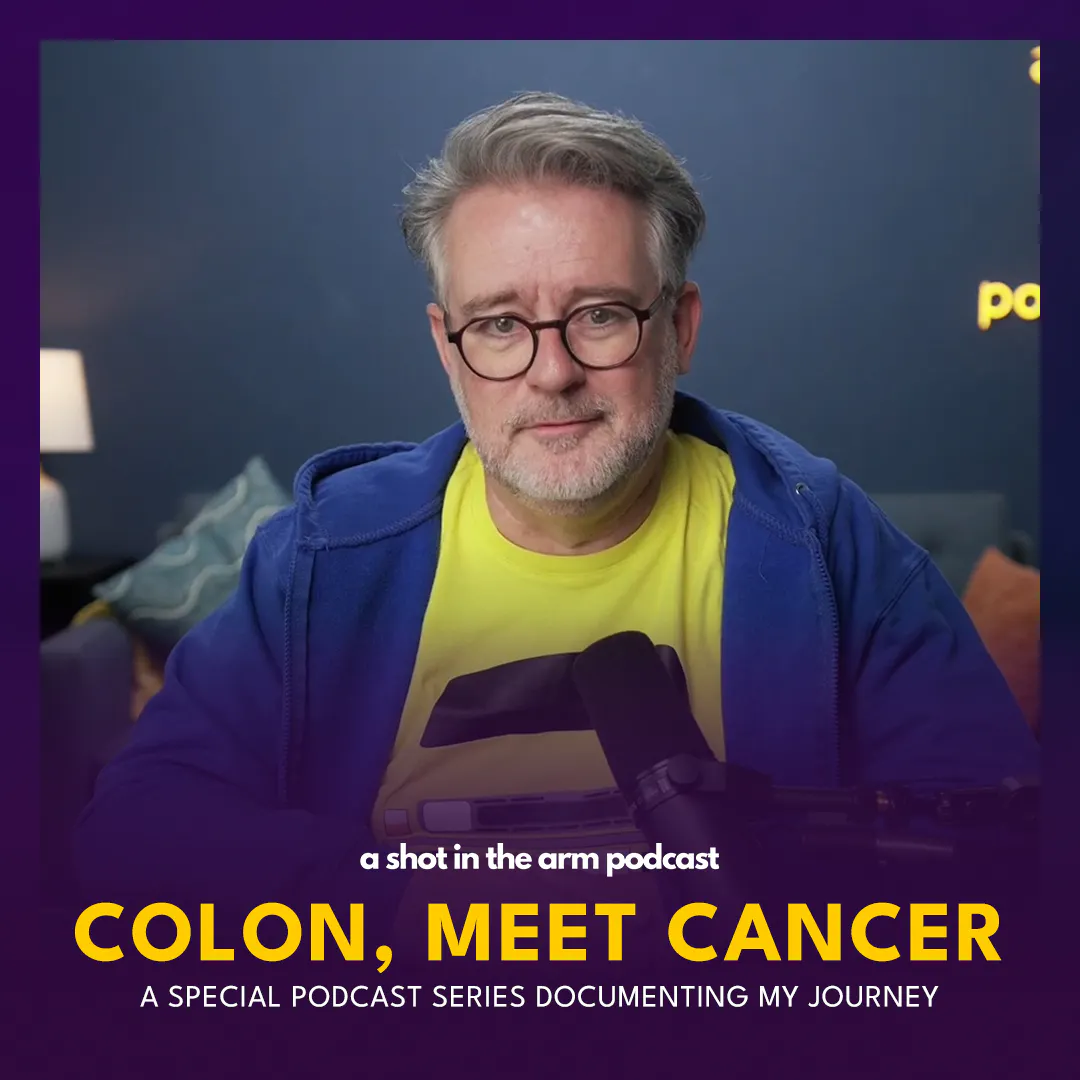
Loading summary
Transcript1 lines
- [00:09]
A
This episode is about faith, something that, as you embark on chemotherapy for a stage 4 colorectal cancer that has spread to the peritoneum, provokes a full bodied, complex palate of reactions. We recently had dinner with friends who are also wine connoisseurs. I can't drink while I'm on chemo, but my strategy, and it's one that works surprisingly well, is to sniff a dribble of wine and enjoy the plethora of smells that it releases. Hence, if you don't mind my rather florid description. Well, let's get back to the preface and I want to share a story about someone, a famous pop star who sang a song about faith and who died too early too unhappily, and who maybe didn't have enough faith in themselves. Although now I've written the preface, I'll leave you to judge who, in the tiniest of our interactions had the least faith in themselves. So yes, I actually met George Michael in 1995. I say met. What I really mean is that I was invited to join his table at lunch at a restaurant in Holland park in the west of London. But I got nervous, got paranoid that my lunch guests might think that I was gay. So I turned the opportunity down. Mr. Michael had been in deep conversation with his two tablemates, two utterly stunningly beautiful and intelligent looking young women who seemed to drip off every word he said. You could not take your eyes away from the three of them. I was also having lunch with two colleagues, coming to the end of an abstemious and far too healthy lunch. He was looking at his plate, not making eye contact with anyone. In fact, I wasn't even sure it was George Michael. I wore contact lenses back in them their days, and the right one tended to rise up with the eyelid, impacting my longer vision, so I might have just been squinting oddly and at nobody in particular. However, one of the beautiful young women got up from the table and glided over to us. She said directly to me, would you like to come over and say hello? My response shocked, shamed and embarrassed me then, and still surprises me a little today. I felt my face blush, turn the colour of beetroot, and I stammered that we had just finished a business meeting, had paid our bill, and we needed to return to our nearby office. My lunch guests were deep medicine lab rats, and one was a professor of virology at an important institute in the northwest of England. Now, as it turned out, although heterosexual herself, she held salons for the young gay men who clamoured to be a part of her laboratory. But I didn't know that then, and she didn't know, or didn't care to know who George Michael was. For context, even in 1995, I had no means completed my transition to accepting who I fully am, and the idea of my colleague seeing me with this superstar who oozed sexuality terrified the life out of me. What if they found out my career, my life, would be over. Thank you, thank you, thank you, I said, and I grabbed my wallet and smartly pegged it out of the restaurant, waiting for my colleagues to join me. I was relieved, thinking I had dodged a fatal bullet. Well, this vignette was supposed to be about the brilliant singer who could be viewed to have such a low self esteem that he could only be seen out in public with two beautiful women. And by the way, one would make sense, but two? A bit gaudy protesteth thee too much perchance. But then, what about my lunch guests? And in fact, now I have said the preface out loud, is it not about my own lack of faith in myself? I mean, what on earth did I think would happen that I would be ravaged and pillaged over a spilt plate of rigatoni? I would likely have a signed cocktail napkin and an amusing little tale with a soup somn of intrigue to share at dinner parties. But the real reason to tell this story from the vaults of my shamed memory is not to come clean about a moment in my life I'm embarrassed by still, but to show just what a slippery business faith is. But before we get into that, just a summary of where I am with the chemo. So we've done round four and I'm now officially halfway through the folfoxiri treatment regimen. Yay. I'm kicking cancer's butt. Too early to say anything about effectiveness, but I'm taking the right number of injections to promote white blood cell growth. The bone marrows are chugging along nicely, thank you. And my white blood cell count has improved enormously. Side effects predominantly depression, fatigue, nausea, malaise and chemo. Brain fog indeed. I do have the attention span of a gnat fly, but I'm too tired anyway to do anything about it, even if my mind was working on fully charged batteries. As it happens, I got through a board meeting this morning, so again, I'm feeling very proud of myself. Take that, cancer. A few mouth sores here and there, poor appetite, everything tastes like ash and I feel because I have a background nausea pretty much all the time. I've no desire to eat Anyway, hair loss continuing on my head and inside my nose. But strangely, my eyebrows are strong and hair continues to grow out of both ears. Taking prophylaxis for teeth pain and hiccups and diarrhoea and constipation. Fully regulated. And that's the real good news. So let's get back to faith. What is faith? Ask a thousand people and ye shall get a thousand powerfully compelling personal views. I've read that it is belief with strong conviction. It is a firm belief in something for which there may be no tangible proof. It's complete trust, confidence, reliance or devotion. I've read that faith is the opposite of doubt. Well, as you know, I trust Aldous Huxley on pretty much everything. What does he have to say about faith? Well, he says that it is a confidence that is empirically justified in our capacity to know who in fact we are. This implies, apparently, a more personal and experiential understanding rather than an adherence to rigid dogma. Although on this occasion, dear Aldous, I am none the wiser. For me, faith requires me to hold onto things as absolutely true, truer, in fact, than if solid evidence were to underpin them. And yet that faith almost demands that we don't have those critical pieces of evidence to support them in the first place. We take the leap of faith, and because we have made that leap, we must claim it to be evidence itself of. Of how overwhelming the faith is, rather than any evidence that supports it. And we have to do that. We have to embrace moments and ideas of faith, because without doing so, our lives become fundamentally flawed, less complete. The ways we make sense of the world around us become less bright, less compelling, and, crucially, less individual. Okay, I'm getting as clear as all this, aren't I? Let me try again. In other words, let's think of faith as a good thing. And it's also a very dangerous thing. Let's see how it plays out. In the context of my colorectal cancer journey treatment. I must have faith in not just a positive outcome, but the most positive of outcomes. That I'll be one of the 13% who make it to year five still alive. Although I must also have supreme faith in the idea that these estimates are only markers and my own personal outcome is going to be even better. Faith in my healers, which actually has been pretty easy given how professional, caring and organized they are. Faith in my own ability to get through it, which has been less easy. Faith in my future career and in the future of my personal life. And this is complex because I'M terrified that I'm going to have no future in the career, the vocation that I have in global health, and that I love. But I'm also amazed at how the love for my husband deepens every day and in ways I could not have predicted. I'm not going to get sloppy and sentimental here, so don't expect me to comment further on that last part. And finally, profound shifts in the faith which guides me in making sense of the world and which I'll come back to at the end of this episode. Faith that my reality will not unravel around me as bits of disconnected experience turn out to have no bearing on each other, or no shared order and faith that the resulting chaos will not collapse in on itself. Although actually that disintegration of faith has indeed been a reality for me that has provided the context of my life, particularly after encountering HIV aids. Make no guesses, make no assumptions that things will end up good or bad. Give up the sense that you can influence these things in any long term way. Regardless. Just do your best and try not to shame yourself when your best is simply not good enough and does not meet the moment. Which brings us to faith in the religious context. And that's not surprising, I guess, when you've got stage four cancer, do you have faith in God? I don't, and I don't see how that is possible given the devastation caused by hiv or arbitrarily to people, regardless of being good, bad, strong, weak, innocent or guilty, however you slice and dice it. And predictably, faith leaders with the politicians they fed off were certainly in the early days of aids, the ones who led the blame and shame game. And yet, even then I couldn't escape real faith leaders who were at the front line of care and support of terrified young men and families infected with this virus. My first job was for the Anglo Catholic priest Father Bill Kirkpatrick in London, a major influence and mentor of many community leaders in the AIDS response, including Tony Whitehead and Neil Whitehouse. So let's give religion another chance. I've done my reading and I read that the closest thing that the Bible comes to offering an exact definition is to be found in Hebrews 11:1 now faith is the assurance of things hoped for, the conviction of things not seen. James writes that faith by itself apart from works, is dead. James, chapter 2, verse 17 and yet Paul, in Ephesians chapter 2, verses 8 and 9, you can for by grace you have been saved through faith. And this is not your own doing. It is the gift of God not the result of works so that no one may boast. This verse explains that salvation is a free gift from God received through faith and not earned by any of our actions or merits, and hence we have centuries of bloodshed between Catholics and Protestants. I'm very much of the James camp. The idea of being saved by faith alone gives you an extremely wide latitude to embrace all sorts of horrendous actions which may be committed in the name of your faith or not. Because actions don't matter. There's a Softer well, I say softer Often used illustration to describe Christian faith Imagine you are at Niagara Falls and you're watching a tightrope walker push a wheelbarrow across the rope high above the falls. After watching him go back and forth several times, he asks for a volunteer to sit in the wheelbarrow as he pushes it across the falls for another time. At an intellectual level, you may believe that he could successfully push you across the rope and cross the falls, but you are not exercising biblical faith until you get in the wheelbarrow and entrust yourself to the tightrope walker. Now, I have to say I have always found that unhelpful in the extreme, and that would be a gross understatement. You put anything, let alone a human being, into his wheelbarrow and all bets are off. Honestly, a much less hair raising roadmap of faith can be found on the website of the English musician Cat Stevens, also known as Yusuf Islam. Now he's Muslim and he describes the articles of Islamic faith which are in any translation beautiful, but are made even more graceful by his poetry. And I'm going to quote them all now. 1. Belief in the Oneness of God There is one God, supreme and eternal, Creator and Provider, who is merciful and compassionate. God has neither father nor mother and no sons or daughters. God has never fathered anyone, nor was he fathered. God has no equals. He is God of all mankind, not a special tribe, race or group of people. He is the God of all races and colors, of believers and unbelievers alike. God is mighty and supreme, yet is also very near to pious, thoughtful believers, answering their prayers and helping them. God asks us to know him, to love him, and to follow his law for our own benefit and salvation. Number two Belief in the Angels of God. Angels are pure and spiritually obedient beings created by God to fulfil his commandments and worship him tirelessly. 3. Belief in the Revelations, Books of God. Muslims believe in the revelations sent by Almighty God to His prophets and messengers, including the Quran the Torah, the Gospels, the Scrolls of Abraham and the Psalms of David. Number four Belief in the Prophets of God all messengers and prophets of God such as Noah, Moses, Solomon, Jesus and Muhammad were mortal beings endowed with divine revelations and appointed by God to teach humankind how to submit to his will and to obey his laws. Belief in the Day of Judgment Muslims believe in an appointed day of judgment and in heaven and hell. 6. Belief in pre Measurement Muslims believe that Almighty God has knowledge of and control over everything that exists in all time and space. Belief in resurrection after death, after the world end. Muslims believe that all people who have died will be brought back to life or resurrected in order to face the judgment rendered to each of them by Almighty God. Now a long quote I know and there are things here I dispute once you brush away the beauty of Cat Stevens writing. But where for me the idea of an all powerful, all knowing and all loving God really falls apart is in the problem of evil. There have been recent memes on social media that portray the thoughts of comedian and author Stephen Fry, who says things like how can you create a world in which there is so much misery that is not our fault? And why should I respect a capricious, mean minded, stupid God who creates a world which is so full of injustice and pain? Now I relate to that, but more bluntly. The problem of evil is best captured for me by the Holocaust survivor and Romanian American Jewish writer Eli Wiesel, who said, if there is a God, he will have to beg my forgiveness. Wiesel himself acknowledged that he ultimately returned to prayer trying to fill the vacuum left by the horrors he experienced, but I don't believe that vacuum was ever truly filled. My journey across AIDS has given me much smaller moments. The time I was invited by the Confederation of Indian Industries HIV program to visit an utterly secret refuge for baby girls rescued from brothels where they had been used raped by clients in unprotected penetrative sex in the belief the faith that this would rid the clients of hiv. Besides being evidence of an appalling practice spreading from Africa to South Asia, it is the human willingness to embrace the most chilling of behaviors that is the deepest, most profound excoriation of faith in the ultimate goodness of all things. An all knowing, all loving, all powerful God makes no sense in this world. If we are to accept such a God, why did he create HIV or allow HIV to evolve? And for what purpose and why cause so much suffering? So that has been my relationship with and my rejection of faith for all of my adult life until now. I'VE been thinking for a while now that if you accept that everything in the universe started with the Big Bang, then everything around us and inside us is essentially profoundly the same. We're all related, if you like. We are all stardust. That doesn't have to be a religious reflection, but it could be, if that makes sense to you. And I've been okay with that. But during the last couple of months of chemotherapy, I've become aware of something else. A different kind of understanding that I'm not fully in control of my life. Yes, cancer is acting out inside me, but something more, something that my limited human senses can barely experience and can't make sense of. It's connecting me to the world around me in ways that are reassuring, good and kind. Am I making any sense here? But sceptic that I am, I question whether as I become more faith adjacent or faith curious or faith tolerant, whether this is the effect of being diagnosed with a life threatening illness. Am I moving from atheism to agnosticism in an attempt to have my cake and eat it? Is it a response to the fear of death and the nihilism of non existence? Or am I becoming aware of another aspect of living on this earth which I can vaguely sense but can't articulate properly? I hope it's the latter, because as I enter the second half of this cancer treatment, what I yearn for, what my spirit yearns for, is the negation of the excesses of my identity, the diminishment not only of my tumors but of my ego. I want to be more at peace with the world, however vile and rotten it now appears to be. It is irregardless of whether I die in 6 months, 6 years, or 16 years, or 26 years. I sense that it will make me a better inhabitant of this incredible planet that we are destroying. And I also sense that in doing so, I'll give up the desire to have an important impact and embrace the idea of having less of an impact. Yes, less of an impact, and by doing so, oddly, contribute more to the people I love and indeed the 8 billion people who live here on this blue planet. Well, that's also a question of legacy, what that is, and whether it matters at all, and which maybe we'll cover in a future podcast, maybe the next one, depending on how my body and soul responds to Cycle five of the chemo, which will likely have kicked off by the time this episode goes live. I hope this episode has made some sense of where my head and my heart are at. I'm going to place the transcript in my sub stack in case anyone is interested to do a slow read in the hope that they make a better sense of the craziness going on inside my fevered mind. Finally, my T shirt, it again has a Ukrainian theme and is produced by a local Ukrainian manufacturer raising money for the brave men and women on the front lines fighting for all our democracies. The company is called Saint Javelin and you can find out more information in the show notes. Thank you for sharing this journey with me.