← ADHD reWired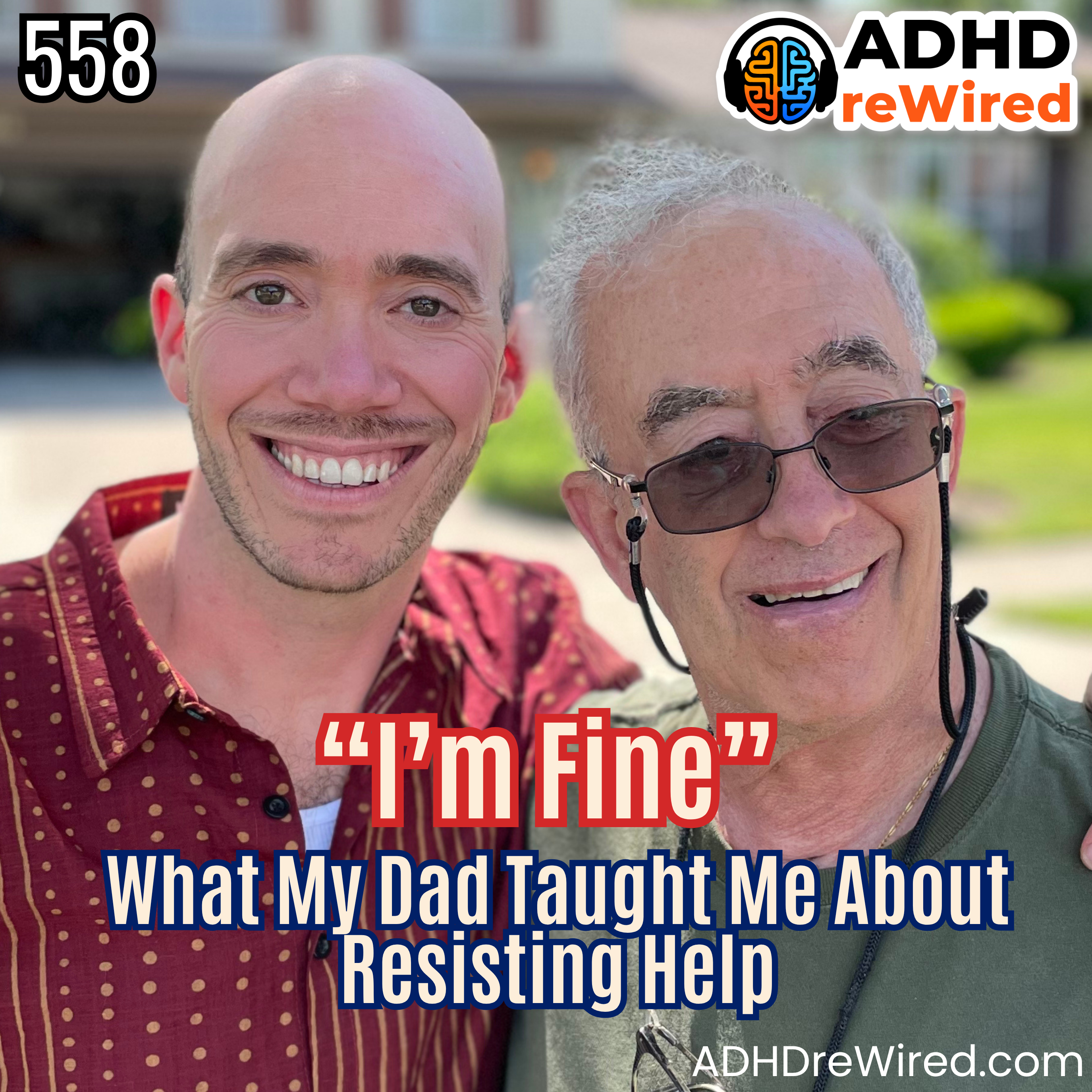
ADHD reWired
When "Fine" Keeps Us Stuck: A Reflection on My Dad, Masking, and Adapting ep 558
00:14:36
Loading summary
Transcript1 lines
- [00:00]
A
ADHD Rewired episode 558. Since 2014, this has been the podcast for ADHD adults who have really good intentions and a slightly wandering attention. I'm Eric Tivers. I'm a licensed clinical social worker by training and a coach by design. I'm your host. And I'm Audiehd. ADHD Rewired is more than just a podcast. You can learn about our coaching and accountability groups, our virtual coworking community, and more, all@adhd Rewired.com we have wired for connection and you are not alone. Learn more about our offerings, including our quarterly live Q and A's. Get additional resources for every episode, including links to any resources we mention on today's show. You can support us on Patreon, sign up for our email newsletter and more, all@adhd Rewired.com and if this is your first time listening, welcome. Don't forget to hit, subscribe or follow on your podcast app so you never miss an episode. We know that starting is the hardest part, so let's get started. Started. Hey, y', all, it's Eric. And today I actually want to share something personal with you. It's just me. And on I think it was last episode or the prior episode, I mentioned that my father passed away on August 14th. So it was about a month and a half ago. And, you know, it's. It is still tender. And while I've been grieving, I've also been reflecting a lot on his life and, you know, the stories that we told, that it's a eulogy and the lessons that we. That I want to carry forward. And those lessons land differently for me this year. Earlier in 2025, after years of knowing I had ADHD, I was also diagnosed autistic. And I really came into focus because of burnout. Burnout from running my business, trying to do it all, from masking more than I even realized. So as I thought about my dad, one theme kept coming up that speaks to both of our stories. The challenge and the importance of adapting. My dad loved people. He loved good food. The amount my dad was able to put away was amazing. He loved the Cubs. He was a huge Cubs fan. He just loved talking to people. He could literally strike up a conversation with anyone. Neighbors, nurses, total strangers. I remember so many times that I would be with him, maybe we were out of the store, someone would come up to him and go, hey, Bert, how you doing? He'd go, great. How you doing? Okay. Great. And then the person would walk away, and then I would look at my dad and say, you have no idea who that is, do you? And he would say, nope. Wonder where I got my ADHD from. But, like, he would talk to anyone. But even when his vision went from low to no vision, he still had this way of really, truly seeing people. My dad also loved baseball. He played it, he coached it. And he coached me in little league when I was a kid. And I was not a good athlete. But that never really mattered to him. He'd play catch with me, he'd help me with my swing, and most of all, he always made it fun. After work, he'd load up bats and gloves into our old red radial flyer wagon, and we would head down to the park. What I learned from that wasn't just about baseball mechanics. It was this from my dad. His love and pride for me were never contingent on performance. And of course, he was a lifelong cubs fan. And if you know anything about sort of the ethos of cubs fans, it only meant one. Optimism. No matter how many curveballs life threw at him, he always held onto hope. But for him, being a cubs fan was a way of life. It's about keep showing up, keep believing, and never stop hoping for better days. That was truly his life philosophy, even in his final days when he was starting hospice. In all seriousness, he was asking if we could postpone it to find out what happens with the cubs this year, because if they make it to the playoffs, he wants to hold off, but his body wasn't wanting to hold on anymore. Life threw a lot at my dad. Brain surgery 30 years ago when I was just 14. And then in the last year, dialysis because his liver was failing. Kidneys, whatever you need dialysis for. Kidneys, liver. It's one of those organs. Pneumonia. He'd fall, he had so many falls. Even fell out of a bus once. But my dad literally had more comebacks and bounced back more than anyone I ever knew. I used to joke that I thought he had more lives than a cat. And no matter how serious it was, if you asked him how he was doing, the answer was always the same. I'm fine. Sometimes he would say it with a straight face, sometimes with a smirk and that twinkle in his eye. But always, I'm fine. Even when he wasn't. You know, one of the impacts of my dad's brain aneurysm was it gave him really poor balance. And I'll never, ever forget coming home from college one time and finding him on the roof cleaning the gutters. Needless to say, I was horrified. But he Just grins and said, eric, I'm fine. That was my dad. Determined, stubborn, and fearless, but also struggling, because adapting to life as it changed wasn't easy for him. And here's where it really hit me. My dad's I'm fine wasn't that different from masking if you're ADHD or autistic or adhd. You know what I mean? Masking is when we downplay that struggle. We act like we got it all handled and tell the world, I'm fine. Sometimes it helps us get through, but often at a cost, because if all we ever say is, I'm fine, then we never ask for help. We never adapt. We never find new ways to go forward. My dad's determination kept him going, but it also, in so many ways, kept him stuck. And masking does the same to us. It looks strong on the outside, but it keeps us from receiving the support that can actually help us thrive. One of the clearest examples of this came from when I got my dad an adult trike for Father's Day. This was maybe 15 years ago. My dad would have never bought this for himself. In his mind, biking meant two wheels, not three. And a trike maybe would have felt like giving up, even though he could no longer drive and he couldn't ride a bike anymore. But once he had it, everything shifted. The bike opened up possibilities again for him. It gave him back independence, freedom, and joy. It let him keep moving forward when a regular bike was no longer possible. And that trike really kind of just reinforced something to me, and that's adapting often means accepting something new, because sometimes we resist. And there are things that maybe we wouldn't have wanted to choose for ourselves or we wanted to do it a certain way. But when we can accept, when we can let help in, it can give us back a part of our life that maybe we thought was lost or maybe out of reach. About five years ago, the same thing happened when my dad moved into Gidwitz, which is a senior living facility. But he resisted that, too. For him, moving felt like losing independence. Me and my sisters, we knew he would really like going there because he's very social, and he was really isolated, being at home. But within the first week, he realized that this was one of the best decisions that could have been made. What could have felt like loss gave him something new that he needed so badly. Connection, respect, and a community where he was truly seen. He lit up there. They even ended up calling him the mayor. His daily courtyard walks turned into events with these, like, nice little Old ladies who were cheering him on, bringing him water, that he even created these walker races as an event. And just like the Trike, the Gidwitz senior facility, it gave him something back that he would have never chosen for himself. Dignity, belonging, and joy. Looking back, both the Trike and Gidwitz followed the same pattern. Resistance first, then acceptance, and then life opening back up. He would have never chosen them for himself. But once he was able to adapt, he found freedom and connection waiting for him. And that's the pattern I keep sitting with. Sometimes the things we resist most fiercely are the very things that not only help us keep living, but really help us thrive and bring joy and meaning to life. When I was 14, my dad's brain injury changed him in undeniable ways. And in many ways. I've been grieving the loss of my dad, pre 14 years old, ever since then. Six years after my dad's brain injury, after myself nearly failing out of college, I was diagnosed with adhd. And then this year, I learned that I'm also autistic. That diagnosis, sparked by burnout, made me really look back at my life through a new lens. And at my dad's too. And here's what I Determination alone isn't enough. Pretending to be fine isn't enough. We have to adapt. We have to ask for help when we build structures and communities that work with our brains instead of against them. That's the lesson my dad struggled with, and that's the one I'm still learning. And that I think together, you as a listener and me, we're learning together. So here's the bigger takeaway. A month and a half after saying goodbye, we don't get to live life as we wish it were. We can only meet life as it is. And then we choose how to respond. My dad's I'm fine showed me how easy it is to cling to determination, all resisting change. But to Trike and Gidwitz, Those moments showed me how powerful it is when we fully and finally allow ourselves to adapt. So I'll leave you with this. Where in your life are you still saying I'm fine when you're not? And what might be possible if you stopped masking and started adapting? I had a college professor once that said, if you ever have a client say they're fine, you gotta dig. Because fine is an acronym for fucked up, insecure, neurotic and evasive. Think about that for a moment. You know, my dad might not have always been fine, but he really was a really, really fine man. And I'm grateful to have been his son. And so much of what I do at the podcast with our coaching groups, I mean, I have exercises in the coaching groups that were inspired by some of the lessons I learned from my dad, including things like looking at our legacy. I think this idea of we want to try to learn as if we will live forever, but let's live as if we could die tomorrow. Because we truly do never know. Because anytime we hear of bad things happening, my friend Tom Nardone, who you've heard on the podcast, years ago with the Tom Nardone show, many years ago when he was actually my dad's age, had a tumor and the day before he had his surgery, I remember him saying that whenever he heard of someone having something like this, he always thought that this just happens to other people. And I think that's so true. We always think that these kinds of things can never happen to us. So look, we have this one life. Did we ask to have ADHD or other neurodivergence? No. We really can make the best of it. And I'm telling you, being a part of an ADHD community is life changing. If you've never experienced that, if you've never really been at the growth minded people with adhd, I want that for you so badly because it is truly, truly life changing. So if you're ready to take off that mask, if you're ready to stop saying you're fine when maybe deep down inside you know you're not, or you just know deep down inside you could be doing better. Come join us for our fall coaching group. The ADHD Relired Coaching and Accountability Group helps us adapt together, helps us be honest with each other and with shame free support. We have our next registration event coming up next week on Thursday, October 9th at 2pm Central. That's noon Pacific 3 Eastern. And if there is still room we will have one more event on October 14th which is a Tuesday at 1pm Central which is 11 Pacific 2 Eastern. To learn more go to coaching Rewired. That's coaching Rewired.com Add your name to the interest list so you can get access to pre registration and if you're already on the interest list, start your pre registration. We have a 15 minute video for you to watch so you can get a better understanding about the group. A quiz for you to take to make sure you understand what the group is about and then on that page where we have the pre registration information there are five questions that we want you to answer in a video that's 45 seconds or less. And then we want you to send that to me. So I look forward to seeing your preregistration stuff and looking forward to meeting with some of you next week. It's time to stop doing life on hard mode, start doing life differently. I really hope you'll join us this fall. Learn more@coachingrewired.com and as always, thank you for listening.