← Adult ADHD ADD Tips and Support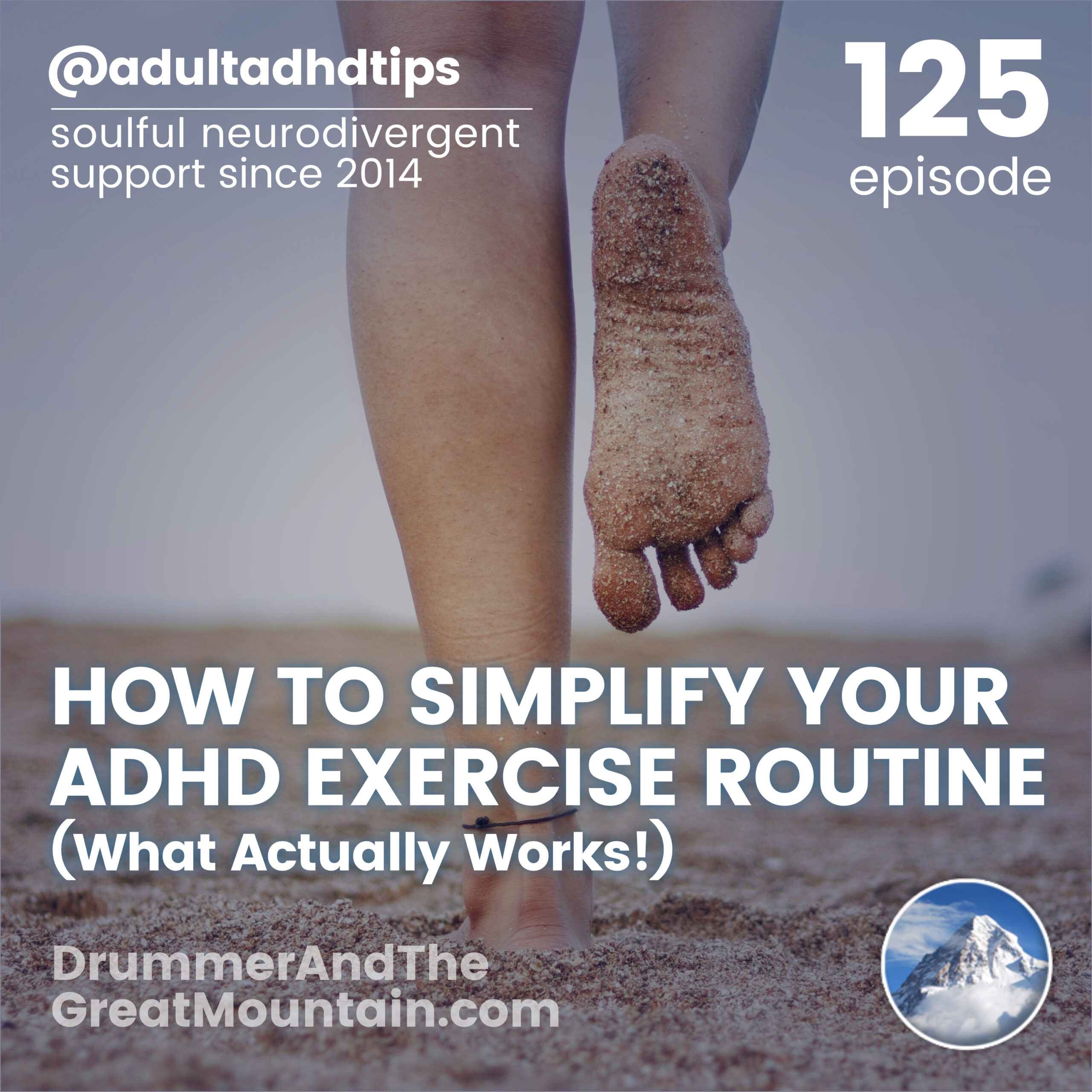
Adult ADHD ADD Tips and Support
How to Simplify Your ADHD Exercise Routine: What Actually Works!
00:16:38
Are you struggling to maintain an ADHD exercise routine that actually sticks? Join us as we explore how to simplify your fitness approach using neuroscience-backed strategies designed specifically for the ADHD brain. We’ve all been there.
Loading summary
Transcript2 lines
- [00:03]
A
Our annual ADHD health and wellness planning workshop happens next week, May 12 and May 19. So this workshop is designed to support you in optimizing your health routine. There are things that we know we should be doing, but we're not because it's difficult. Life is happening, things are going really fast and it's hard for us to slow down and take time to build our exercise routine, to dial in our nutrition plan, do what we need to do to get better sleep. So we build in our wind down routines at the end of the day. There are so many aspects of building a wellness routine that it can get very overwhelming. So I've designed this workshop over many years of observing my life coaching clients to give you exactly what you need to build that support system into your life. So as with all of our other online workshops, we have a community around the world that gets together, supports each other, connects in both via the live events and through a discussion group. In between the live sessions, we will have a topic that all of us will be focusing on each day so that we can incrementally support our wellness plan. All sessions will be recorded, so if you can't attend the live sessions, you can follow along via the discussion group and our emails that go out once a day. So I hope you can join us. If you'd like to learn more, go to drummerinthegreatmountain.com workshop. It's starting to fill up so I would encourage you if you're in interested to sign up as soon as you can. We'll probably close registration on Sunday the 10th, so I hope that's helpful and I hope you can join us. Welcome everyone. Thanks for tuning in. I'm your host, Michael Joseph Ferguson. I hope you're all doing well. In today's episode we'll cover how to simplify your exercise routine. So keeping with an exercise routine is notoriously difficult for us. I know this as a coach cause I work with so many of you. But a regular exercise routine, as I can attest to myself, can be life changing. But it's important to understand what actually works. How do we keep with the routine? What types of exercise work better than others in terms of increased mental clarity and focus and reduced anxiety? And how do we schedule our exercise routine in a way that we can stay consistent with it? So we're going to cover the neuroscience. I'm going to reference some specific studies including the type of exercise that can increase your memory by up to 16%. So I'm happy to report the new book is done. It will be released very shortly. We were hoping to do a release on Earth Day, but I needed to secure the rights to a couple photos and we just got those about a week ago. So it's a very visual book. It's going to be it's a lot of what you've all been asking for for many years, which is the Drummer and the Great Mountain is a large book. I know a number of you have reached out and said, I got the book. I haven't read it all the way through. This is the book for you. It's highly visual, it's in color, it's hardcover. I think you're going to really enjoy it. So if you want to be notified when we do the release party online and and when it becomes available, please join the email list, go to drummerinthegreatmountain.com and subscribe and we will keep posted. Okay, how to simplify your ADHD exercise routine. What actually works? So the challenge is it's very difficult for us to keep with our exercise routine. We often get into a streak for a couple days or maybe a week, then we fall off again and then we're often reluctant to start up again because we're concerned we'll just fail. And it's the same pattern that then gets more and more ingrained and that's what keeps us stuck. So the solution is to simplify your exercise routine. Most of you as a coach and working with a lot of you over complicate it and set too high a bar you want to optimize for what actually increases your focus, reduces your anxiety and overwhelm, and brings you the self esteem because you're doing it regularly. And and it doesn't have to be complicated, it doesn't have to be hard, it just has to be consistent. So first off, we need to know why we should exercise. Why is cardio exercise why is exercise in general helpful for us when we have ADHD tendencies, when we have challenges with focus, mood, procrastination, motivation? So we need to look at what does the neuroscience say? So I'm gonna go through each of these topics, I'm gonna give each point and then each one of these corresponds to a that I will leave in a link in the description of this episode. So the first topic is improved executive functioning, mood and attention. And what do the studies say? The studies say 10 to 15 minutes of moderate intensity cardio exercise that's brisk walking to light jogging is sufficient to trigger immediate improvements in executive functioning, mood attention. So if you've been listening to this podcast for a long time. You know, I've been stating this constantly, but let's keep going because there's other pieces here. So what about reduced cortisol and perceived stress? When we're stressed, we tend to procrastinate, we tend to get overwhelmed, we tend to get distracted by other things. That is sort of the mechanism at play. So what do we find in terms of reduced cortisol and perceived stress? Consistency is more critical than intensity. So low to moderate intensity aerobic exercise that could be jogging, brisk walking, swimming, cycling for as little as 15 minutes per day has shown to greatly reduce cortisol and perceived stress. There's another study that just discusses that piece, but let's keep going. So what time of day is best? The studies show morning. They call it the morning spike. Exercise in the morning provides the most significant cognitive protection in symptom or symptom relief for the remainder of the day. So morning exercise is typically better. Now I want to highlight that for many of you, if you can't do morning, I can tell you from personal experience that that is just one factor. You can exercise, especially in the afternoon when you're dipping, and it can still have a great improvement to your MO in focus, not only for that day, that potentially the day after, which is always what I'm aiming at. So to distill all those points down, we're looking at 10 to 15 minutes a day of moderate intensity cardio workout, ideally in the morning, but not necessarily. And that will have noticeable improvements in terms of executive functioning, mood and attention. Reduced stress and reduced cortisol. Okay, but let's go a little deeper. Is it better to exercise indoors or outdoors? And the resounding response from the studies is outdoors is better. So first off, reduction in rumination, walking in nature, or exercising in nature specifically decreases neuroactivity in the subgenal prefrontal cortex, a region associated with multiple morbid rumination and self focused negative talk. Urban exercise that includes indoor gym exercise does not show the same neural downregulation. Let's keep going though. So what about efficacy for clinical anxiety and depression? A 2026 meta analysis found that green exercise has significantly a larger effect on mental health outcomes than indoor exercises, effectively ranking it as a primary intervention for reducing clinical psychological distress. Now is it better to exercise with shoes on or barefoot? There are multiple studies that show that barefoot exercise is actually better, and there's quite a few of them. The first study shows that direct electrical contact with the earth significantly improves vagal tone. Research shows that grounding the body reduces skin potential and shifts the autonomic nervous system towards a parasympathetic state almost immediately. So if you are in a sympathetic nervous system response, you are in fight or flight. When you're in parasympathetic nervous system response, you are in rest and digest. So basically calming your nervous system down in terms of neuromodulation of brain waves. We spoke about. If you haven't listened to the episode in a while. About a year and a half ago, I did an episode on brain waves and adhd. Barefoot. Contact with natural surfaces alters the bioelectrical environment of the body, leading to immediate changes in your eeg. It typically increases alpha wave activity, which is associated with relaxed alertness, while decreasing high beta waves associated with high stress. So, once again, stress reduction. But here's the kicker. This is the one that I, that I did not know until I started doing research for this episode. Barefoot exercise is shown to improve memory. Running or walking barefoot on uneven natural terrain requires proprioceptive demands. And this tactile load forces the brain to recruit working memory resources, resulting in a 16% improvement in memory tasks compared to exercising in shoes. So if you want to go the optimal route, 10 to 15 minutes a day, exercise barefoot in nature, there's. There's a lot of studies that show that that is probably your best bet to maximize your daily exercise routine. And we gotta remember when we were kids, we knew this, right? We'd go out, we'd run all the time, we were always moving, we were barefoot. We'd sometimes get splinters on our feet. But that is, we naturally knew that that was the best way to go. And as we get to adults and we start to stiffen up and we gotta force ourselves to, you know, be an adult and act a certain way, we lose sight of this intuitive nature inside us that says this is the way we should be exercising. So, okay, so let's go through and start to integrate some of these tips. So tip one is keep it to 10 to 15 minutes a day. Aim for shorter exercise routines. I just hear from so many people saying, like, if I don't hit 30 or hit 40 minutes, it's not worth it. And that's what's keeping you from keeping from getting a routine going that you can keep with every day. You're making it too hard, reduce it down. The science shows unequivocally that you only need 10 to 15 minutes a day for the cognitive benefits of it. I'm not talking about losing weight, but if you're Exercising daily, you're most likely going to lose weight as a result as well. Make it a non negotiable. So in terms of whether you take ADHD or don't take ADHD meds from working with lots of different people, from my experience, I can say that either way it's going to help. Either way you're going to see most likely significant improvement in mental functioning. If you exercise every day. There's just I haven't seen anyone that came through. That said, I'm exercising every day, I'm getting no benefit from it. I've never had that happen. To get the streak started, get the pattern going. So you're doing it three days in a row. So just tell yourself I'm doing it. Don't have to think about doing this forever. I'm just going to do a three day challenge. I'm going to exercise 10 to 15 minutes a day for three days. As we stated, if you can do it in the morning, that's great. But what I would say is just tell yourself I need to exercise 10 to 15 minutes sometime during the day. So if you can do it in the morning, great, but if it's the afternoon, that's also a great time. If it's before dinner, that's fine too. As you get towards Evening time, around 6 or 7 o', clock, you can have some challenges with exercising over energizing yourself and then having a hard time sleeping. So you should probably have a cutoff of around 7:30pm depending on what time you go to sleep. If you can afford it, hire a trainer for one month that I've just watched. So many clients really benefit from just having another person support them in a training session once a day. If you're not doing it once a day, then maybe two or three sessions a week that are a little more high intensity. Pick exercise that you enjoy. Biking, running, swimming, sports, dance, rebounder, that's trampoline, stationary bike, sports. I mean like I mentioned, sports go through and find something that you enjoy doing so that you're more motivated to do it. Pick a spot that you'd like to go to. I ideally if you can exercise outside, that's going to be helpful. So find a nature location near you that you really like, that's going to help. And having a support group is really important. So that's why we're doing this workshop. But also just in general, either with your spouse, with someone you know, having an exercise buddy. Joining a running group can be really helpful. Joining a sports group can be really helpful. I know a lot of people are into pickleball as we get older. That's a sport that a lot of people take on and that's great if you can. If that gives you the community motivation to do it, then that's a really great way to kickstart your exercise routine. Okay, so there you have it. Those, that is how do you optimize your exercise routine? Those are some very key examples backed by neuroscience. I will leave those links in the description so you can take a look at those yourself. And if you would like to join us in our upcoming wellness workshop, we only do it once a year, so if you can join us, it's going to be fun. We always have a good time. And then also people tend to stay connected via the discussion group well after the workshop. So if you'd like to join us, go to drummerinthegreatmountain.com workshop and I hope that was helpful. So I hope you all have a wonderful rest of your week, wherever you are in the world. And until next time, be well.
- [15:18]
B
Thanks for joining us. If you'd like to learn more about the book the Drummer and the Great Mountain, visit drummerandthegreatmountain.com to join us on social media, click the links at the top of the homepage. Help us spread the word. We're a small press and reviews really help. If you've been enjoying the podcast or the book, consider writing a review on itunes, Amazon, Goodreads, or your podcast app. If you're new to the podcast and want to quickly get up to speed on the concepts we discuss, check out our free five day mini course. Visit drummerandthegreatmountain.com Minicourse if there's a topic you'd like us to cover on future episodes, we'd love to hear from you. Please send us an email@infooummarandthegreatmountain.com.