← After Dark: Myths, Misdeeds & the Paranormal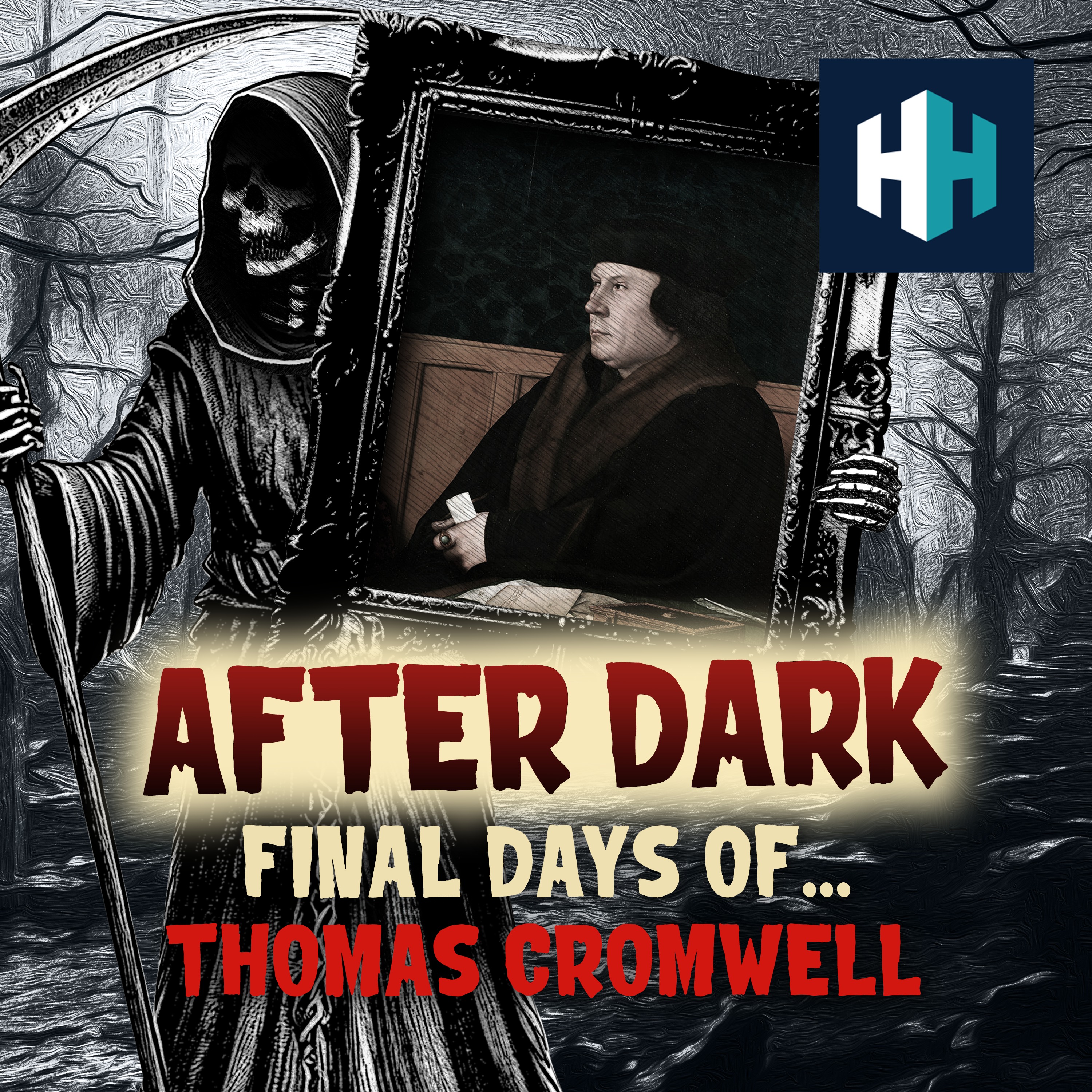
Loading summary
Transcript94 lines
- [00:00]
Anthony Delaney
Hi, we're your hosts, Anthony Delaney and Maddy Pelling, and if you would like After Dark, Myths, Misdeeds, and the Paranormal ad free and get early access, Sign.
- [00:10]
Maddy Pelling
Up to History Hit with a History Hit subscription. You can also watch hundreds of hours of original documentaries with top history presenters and enjoy a new release every week.
- [00:21]
Anthony Delaney
Sign up now by visiting historyhit.com subscribe Tower Hill July 28, 1540 the summer air is soupy, irritating even. A restless crowd gathers on Tower Hill, straining for a glimpse. The scaffold looms above them, casting harsh, angled shadows on the ground. Thomas Cromwell, once the second most powerful man in England, climbs the steps with a steady resolve. He is dressed simply, his face pale but calm. Once atop the platform, his eyes scan the crowd with what some will later interpret as defiance. Others, though, will call it resignation. Then he begins to speak. I am by the law condemned to die, and thank my Lord God that he hath sent me to the end of my life, says he, his voice clear and steady. The crowd falls silent, mesmerized by the dignity of a man who knows his fate is sealed. He asks for forgiveness, both from his king and his God, then kneels before the block, a figure humbled yet unbroken. The executioner, however, is not so composed. It is whispered that he is woefully inexperienced when it comes to dispatching noblemen, a man more used to wool and weaving, they whisper, than the heavy axe now in his hands. He shifts nervously, his grip uncertain. His first swing comes down with a sickening thud, but it is not enough. Gasps ripple through the crowd. Blood pools, quickly, staining the wood. The executioner adjusts his stance, lifting the axe again. Another blow. Again. The man fumbles, his face pale at what he sees he has done, his eyes wide with panic. The crowd murmurs, their unease turning to horror. The axe comes up once more. It takes a third, perhaps even a fourth strike before the deed is done. By the end, the scaffold is a grisly canvas, and the axe lies smeared with the remnants of its brutal work as the lifeless body of Thomas Cromwell is carried away. The crowd disperses, their faces pale, their voices hushed. This was no clean death, no swift justice, they say. A grisly end indeed, for the man some said wished to topple his king.
- [03:47]
Maddy Pelling
Well, that was quite the grisly opening. Hello, and welcome to After Dark. I'm Maddie.
- [03:52]
Anthony Delaney
And I'm Anthony, and as you may.
- [03:55]
Maddy Pelling
Have gathered today, we are going to be talking about the final days of Thomas Cromwell. And I'm pretty sure, Anthony, every single person listening to this has one particular actor in their heads. As we are discussing.
- [04:08]
Anthony Delaney
Is it me?
- [04:09]
Maddy Pelling
It's you, obviously, yes. Anthony Delaney will be playing Thomas Cromwell. Have you ever played Thomas Cromwell?
- [04:16]
Anthony Delaney
Oh, God, no. No, no, no.
- [04:17]
Maddy Pelling
I feel like it's too old a role currently because I'm only 20.
- [04:21]
Anthony Delaney
Yes, thank you so much. Yes, yes, yes.
- [04:23]
Maddy Pelling
Okay. Ass kissing aside, we are obviously in our Tudor era in this season.
- [04:28]
Anthony Delaney
We are. I feel like I am in a bit of my Tudor era.
- [04:31]
Maddy Pelling
Yeah, you're obsessed. Anthony behind the scenes, by the way, keeps suggesting Tudor episodes. So all of you who love Tudor history will be thrilled. He literally won't shut up about it.
- [04:39]
Anthony Delaney
I don't know why I'm having some kind of Tudor Renaissance. Well, quite fitting, but some kind of Tudor Renaissance within myself again. So I'm enjoying it.
- [04:47]
Maddy Pelling
Yeah, no, it's good, it's good. If you have yet to have your fill of Tudor history on After Dark, we've already done, I think, the Final Days of Anne Boleyn, we've done Lady Jane Grey, we've done Henry viii. And there are more to come. So go and check out those episodes if you haven't already listened. But for now, sit back and let's enter the world. The life of Thomas Cromwell. Anthony, give us some context, please.
- [05:15]
Anthony Delaney
So, as you will know, if you know anything about the Tudor period, this is time of religious upheaval. Now, if you don't know anything about the Tudor period, that's fine too, because what's happening is the dissolution of the monasteries and this is having a massive cultural and economic impact on Eng. Does that mean. Well, basically, Henry viii, along with his senior advisors, has wanted to consolidate the wealth of the monasteries, which was considerable, under the crown. And this has all got to do with his break from Rome. And the country is deeply divided, obviously between what were Catholics and now not necessarily Protestants, but people who will probably go that way eventually or who have reform of the Church in mind. So that's the religious upheaval that's happening in the background. As we discuss Cromwell, this particular Cromwell we also have. Europe is starting to become more of a player within England and Britain, what will later be Britain at this point as well. So we have Henry VIII marrying Anne of Cleves. And this is important because it feeds into what we've just heard at the start of the episode, because the fourth marriage, the marriage town of Cleves, is arranged by Cromwell, is arranged by Thomas Cromwell, and it is intended to form an alliance with the Protestant German states. And that's the whole point of this marriage. However, as is famously known, Henry does not find Anne in any way attractive. The marriage fails very quickly and it's strained and already annulled by 9 July 1540. So it's just weeks before the scene I described above where Cromwell is executed.
- [06:51]
Maddy Pelling
Now, obviously you're all thinking of Anthony in the role of Thomas Cromwell, but for me, Anne of Cleves will always be Joss Stone from the Tudors. And we've name checked the Tudors TV show before on this podcast. But every single time I think of Anne of Cleves, I do think of Joss Stone, who is, by the way, utterly stunning and gorgeous.
- [07:13]
Anthony Delaney
Well, everyone in that show is like.
- [07:14]
Maddy Pelling
It'S like, you know what I mean? It's just a roll call of incredibly attractive people. But what insulting casting.
- [07:22]
Anthony Delaney
I know, can you imagine?
- [07:24]
Maddy Pelling
Can you imagine getting that call in from your agent? They want you to play Anne of Cleves. I beg your pardon?
- [07:30]
Anthony Delaney
But yeah, that's the kind of European context that's in the background there. Good old Joss Stone.
- [07:35]
Maddy Pelling
Yeah, good old Joss Stone. Thank you. Okay, so we've got the religious upheaval, we've got these complex relations on the continent between the continent and England. What's the situation on the ground in England, though? Because there are other disruptions going on.
- [07:52]
Anthony Delaney
Yes, we've had. Well, I spoke about those kind of the religious discontent and that came to a bit of a head of the. With the Pilgrimage of Grace in 1536. And I know Susie Lipscomb has an amazing episode on that, on not just the Tudors. So if you want to find out more about that, go over there and listen to that. But discontent, as I say, religious discontent is really starting to divide the country somewhat. And the Pilgrimage of Grace is 1536. Cromwell is executed in 1540. So these areas of discontent are still very much present and they're being driven by the kind of continuous spread of printed material. So this is one of the ways in which these Reformation ideas, anytime you study the reformation in the 16th century, the idea of the printing press and how much that's helping to disseminate these new ideas is really to the fore. And we see that in England too.
- [08:46]
Maddy Pelling
I think that's so key. This is a moment where I think the sort of popular imagination when it comes to the Tudor period is these very complex, very deeply layered political machinations. Everyone is plotting against everyone else. Everyone is trying to get, certainly in the reign of Henry viii, the King's favour, trying to take a side with whatever wife is currently in favour. And within that you then have this extra technological layer. We've not only got documentation existing from that period and surviving from that period, that's in terms of handwritten letters or handwritten documents, but you're starting to this mass production on a scale that will not necessarily reflect the scale that's going to come later, but you are starting to get printing presses producing multiple versions of the same text which can relatively cheaply then be disseminated. And these ideas are spreading and those are ideas that spread not according to borders. They are transgressing the borders of people's houses, of national borders. And this spread of ideas, the spread of rebellious ideas, of new ideas is really dangerous and exciting in this period. And I think when I think of Cromwell, he's sort of tied up with all of that. Let's just address the Mark Rylance shaped elephant in the room because as we say, we have a sense of who Thomas Cromwell is and it is all thanks to Hilary Mantel, the great, late and great Hilary Mantel. So can you speak to that, Anthony? Can you tell us something about the version that we are now familiar with? And it's a very modern version.
- [10:27]
Anthony Delaney
Well, I find this utterly fascinating actually. The, the ways in which historic people can become present day characters and how that starts to inform the history. I think it's so, so interesting. So these are not dates. I know off the top of my head, our producer Freddie has provided these. So just to let you know that I don't know when Wolf hall was all published.
- [10:48]
Maddy Pelling
Wait, you mean you don't know every single date in history on which day.
- [10:51]
Anthony Delaney
Everything happened after 2000? I don't. Maddy.
- [10:55]
Maddy Pelling
Outrageous.
- [10:55]
Anthony Delaney
But Will Paul was published according to Freddie and I believe him, in 2009. Bring up the, the follow up, 2012 and then the third installment was published in the Mirror and the Light was published in 2020. Now these are Tudor based historic novels that Hilary Mantel, as you said, incredible, incredible writer, puts Thomas Cromwell at the centre of this narrative and then it became a huge TV series which I have not seen actually, but I need to put that on the list. Yeah, I haven' Seen it. So I don't necessarily. I do have Mark Rylance because, you know, the imagery from the TV show has infiltrated my mind somehow, but I still haven't actually seen it. But prior to Wolf hall, and this is the interesting thing, before that came out, Cromwell was seen as this devious, sinister Machiavellian character, or historic figure rather, who got rid of Catherine of Aragon, then had to murder or helped in the murder of Anne Boleyn, as some people would see it. And he's often very much kind of the antagonist in a lot of those histories. But now, in the wake of Hilary Mantel's book and then the TV series, there is this kind of recalculation of how we understand Thomas Cromwell. And it's interesting and we'll see some of this as we go through how much of that is based in history and how much is actually based in fact. And I have. I'm going to read, because we're talking about the book. I'm going to read an extract to you, Maddy. Have you read this?
- [12:21]
Maddy Pelling
I have. So I am a massive Hilary Mantel fan, which is, you know, hardly an original stance to take. She's beloved across the nation and beyond. But no, I think, as we'll no doubt hear in this excerpt, and I don't know what excerpt you've picked, but her prose is so crisp and lively and it takes you. It drops you into the world that she has not created but accessed. She is a time traveller, I think she allows time travel to happen. You open the pages of her books and you are transported. I don't know if you ever heard her wreath lectures that she did, where she talks about sort of ghostliness of the past. For anyone who hasn't heard those, go and listen to those. I think there's either three or four in total and they are life changing for how you think about the past, how proximate it still is, how we access it, how we imagine it and fill in the gaps, but also how so much of it is still within our reach. She is, or was, the most incredible mind and the most incredible writer. So go on, let's hear a little bit.
- [13:32]
Anthony Delaney
This is the very first page and it sets up how, from the get go, she lets us into Thomas Cromwell's world and starts to reshape him in a way that sometimes the historic documentation doesn't let us do. But anyway, I'll shut up and I'll just read this bit. So now get up. Felled, dazed, silent, he has fallen, knocked full length on the cobbles of the yard. His head turns sideways, his eyes are turned towards the gate as if someone might arrive to help him out. One blow, properly placed, could kill him. Now blood from the gash on his head, which was his father's first effort, is trickling across his face. Add to this his left eye is blinded, but if he squints sideways with his right eye, he can see that the stitching of his father's boot is unraveling. The twine has sprung clear of the leather and a hard knot in it has caught his eyebrow and opened another cut. So we have this depiction of Thomas Cromwell that is being abused, physically abused, and not just physically abused by his father at the very, very outset. So we start to see a far more, hum, humane side of Cromwell and why Cromwell becomes the Machiavellian character that he becomes in history. But Mattie Pelling, there is actually very little historic evidence to support the fact that Walter, his father, was abusive in any way. There are some indications that he was involved in his younger years in some fighting, maybe, or something like that. But some of Cromwell's proteges are very positive towards Walter in later life. So it's just interesting to see how that blends together.
- [15:16]
Maddy Pelling
Yeah, it's so interesting. And, you know, Hilary Mantel was, of course, a writer who was so obsessed with detail, and her writing is just cut through with such rich historical research. But she is a novelist at heart, and in terms of her practice and, you know, that's absolutely what we should expect from her writing. What I associate, and I think this is because of Mantel, what I associate with Cromwell, with his early life, his background, is this brutality, is this very kind of earthy, human, blunt existence. It's a very tangible world. I think.
- [15:59]
C
If you're like me and you love history, but in particular you love the smutty, salacious, gossipy history, then do I have the perfect podcast for you? If you fancy finding out about the slippery origins of lube or how Vikings linked sex and magic together, then listen no further. Join me, Kate Lister, on betwixt the sheets, where I delve into the most outrageous, the most taboo, and the downright sexiest parts of our history. It's the kind of history that you probably wouldn't bring up at a family lunch, but you might bring it up down the pub. From the history of swear words to answering important questions like just how incestuous were Neanderthals? And so much more. Listen every Tuesday and Friday, wherever it is that you get your podcasts, a podcast by History hit.
- [16:54]
Maddy Pelling
So can you take us back to the historic fact of his origins? And is it as brutal a world as Mantel gives us?
- [17:02]
Anthony Delaney
I would say we don't have the historic documents to say that it's as brutal as it's portrayed in Walt's hall, but he does come from humble beginnings. He was born in 1485 in Putney. He is the son of, or was the son of a Blacksmith, and that was the blacksmith we just encountered there. In novelistic form, it's modest, but he is ambitious. He goes to Europe in around 1503. In the book, the reason he leaves England is because his father is abusive. But in fact there is something around some kind of legal tension in 1503, why he leaves, although what that is we're not entirely sure. But it does seem to have involved violence, but not necessarily at the hands of his father. But anyway, there's something there. And this is why Mantel creates that incredible world.
- [17:44]
Maddy Pelling
So even at a young age, what we can say about him, I suppose, is that he is someone who is butting up against other people. He is involved in altercations and sort of ambitiously thrusting himself into the world. I don't know if that makes him Machiavellian, but the sense that I get of him is a very sort of flesh and blood person pushing his way into society and young, scrappy and hungry.
- [18:12]
Anthony Delaney
Whatever that song is.
- [18:14]
Maddy Pelling
He's a thruster.
- [18:15]
Anthony Delaney
He's a thruster. He is. He becomes. And there is violence in his background because he becomes a mercenary in the French army. He's fighting in Italy. He fights for noble employers. Basically, he's a hand for hire. And it's during that time that we see him start to kind of sort himself out a little bit. He starts to become quite disciplined and he thinks more and more strategically as he goes through that kind of combat training, I suppose. But he then pivots and becomes a cloth merchant, and then he goes on to be a banker's clerk. And what I love about this, and this is all in Europe, by the way, in Antwerp and in Italy. What I love about this is there are many iterations of the young Cromwell and he is learning all the time. He has this discipline that he's learning. He becomes fluent in several languages because he's moving around so much, and he's starting to establish this international network of contacts which obviously will become important later on.
- [19:09]
Maddy Pelling
So he's sort of distilling himself, isn't he? He's forged, to borrow from, you know, sort of blacksmith metaph. He's kind of forged in terms of war, in terms of fighting and violence. But as you say, he's making these more strategic decisions. It's quite a pivot to go from being a mercenary fighting in the French army to then being a cloth merchant. But it seems in terms of Tudor society, across Europe as well as England, you know, that that is a very sensible path to take for someone who's Born in relatively. Not poverty, but certainly sort of lowly. Lowly station. Yeah, yeah.
- [19:48]
Anthony Delaney
I mean, he remains sensible because by the time he returns to England, he's now a lawyer. So this is taking him up a notch in terms of society.
- [19:58]
Maddy Pelling
Can I just say, I love this period where you can have, like, 20 careers.
- [20:01]
Anthony Delaney
Right? But yeah, Maddie, that's totally that. And we're gonna see more of that. That really struck me about my Tudor renaissance as I'm having it at the moment, where I'm just like, God, I'd forgotten how fluid society was, because in the world where you and I are a little bit more familiar with in the Georgian period, it's not that fluid. You know what I mean? Things have definitely settled a little bit more by then. Whereas this is somebody who's going to become the second most important person in England. And he's a blacksmith's son, you know?
- [20:25]
Maddy Pelling
Okay, so he's reinvented himself again and again in Europe. He has distilled himself down to this. Fluent in several languages. He's now trained as a lawyer somehow. What's his next step? He's coming back to England. You know, for someone who is meant to be such a strategist, does he have an. An end game in mind, or is he just climbing and climbing and climbing?
- [20:45]
Anthony Delaney
I think he's just climbing. He's taking every opportunity that's presented to him. I think he's ambitious, but I don't think he has a strategy to get to where he gets to. What happens is he falls into cases because he's a lawyer now. He falls into cases involving ecclesiastical property rights. He then enters the employment, the service of Cardinal Wolsey, who is Henry VIII's Lord Chancellor, arguably the most powerful man in England in the kind of 1510s, who, by the way, is the son of a butcher. So does again, go to show that these humble beginnings can lead to something more substantial in Tudor England?
- [21:20]
Maddy Pelling
And also, I suppose, that Wolsey notices or recognizes something in Cromwell, right. That he sees those same lowly beginnings and that hunger to climb up, that hunger to make something of yourself and to be ambitious and sort of, I suppose, sees a kindred spirit. Is that fair to say, do you think?
- [21:37]
Anthony Delaney
I think so, yeah. I mean, he sees the drive and all of those kind of intangible things, but he also sees the intelligence and he sees the sharpness of mind, and he sees that that can be useful. And, you know, in the kind of cutthroat world of the Tudor court, who's the most useful is the most popular and the most powerful. And of course, there is one man who we haven't mentioned yet, and we're about to, and that is the king, Henry viii. And he's lurking in the background. And if there's anybody who's trying to find the most useful men and notice the most useful men and women, to a certain extent, it's. It's Henry.
- [22:12]
Maddy Pelling
For very different reasons.
- [22:14]
Anthony Delaney
That's where I went. I was like, I don't need to go there. It's fine. But for very different reasons. It's Henry viii. And he soon comes to Henry's attention because of the Amberlynn affair, because Wolsey is slightly failing. Now, Wolsey, remember, is Cromwell's mentor, employer at this time, and he has been seeking a divorce from Catherine of Aragon to allow Henry VIII to marry Anne Boleyn. And we have episodes on this. Go back and listen to those. But he's failing. He's not able to secure that divorce. And he dies in 1530. It still hasn't been done. But Cromwell, being the legal mind that he is, comes to Henry's attention. And he goes into Henry's employment in 1532. But by 1534, he has become a royal secretary. And he sees an opportunity. Cromwell sees an opportunity to give Henry what he wants. Again, remember I said, Cromwell seems to me to be the person who doesn't necessarily have a plan, but when an opportunity is presented to him, he's perfectly ready to take it and to exploit it. And he drafts a legal framework for England's break with Rome, which becomes essentially the act of supremacy in 1534. And this is what has enabled Henry VIII to then marry Anne Boleyn, because he makes Henry the head of the Church in England.
- [23:34]
Maddy Pelling
Can you imagine? One minute you're knocking around France as a young man, fighting as a mercenary, then you're selling cloth, and then you think, I'm going to train as a lawyer. And you think, do you know what? In this society, I've made it. Son of a blacksmith. This is going really well. Well, I've really made something of myself. And suddenly you find yourself stood in front of the king, offering him legal advice on how to break with the Church in Rome, get rid of one wife and marry another. What? I mean, we know this story. This is so well rehearsed. We've seen it portrayed a thousand times on TV in novels. Like, this is a part of our. Our English history, our British history, that is so familiar to us. And yet, if you put yourself as, I suppose, mantel was interested in doing into the shoes, into the mindset of someone like Cromwell, who has risen in this way. It must have been so hard to actually come to terms with the reality of where his life was going. It must have been so alien to him and changing so, so fast. And the pressure must have been enormous. You know, this is a time when people still believe that the monarch has been appointed by God, that he is God's representative on earth. Even to stand in his presence would have been a completely wild experience, spiritually, psychologically. And there you are literally changing the course of English history, English religion, the Church, the royal family, the future of the nation. It's sort of impossible to grasp how big this is for someone like Cromwell.
- [25:06]
Anthony Delaney
And it's because of his involvement with those big historic movements that we are left with the impression of him as being scheming and as being Machiavelli and as being evil in some aspects. Because we have taken England, specifically, has taken Anne Boleyn to heart so wholeheartedly that anyone involved in her downfall is obviously seen as the antagonist. And, of course, Cromwell, after he brings her, he gives Henry the wherewithal to marry her. He then doesn't stop scheming. See, that's where I would have just bowed out. I would have been like, thank you very much. I am going to take loads of money now and I'm going to go off up to Yorkshire somewhere and just have a nice life. But he doesn't, because he enjoys, I think he's a courtier through and through. And so he stays. And by 1536, then it's all changed with Anne Boleyn and he becomes involved in her trial and in condemning her and in all the allegations. Like, he's basically fabricating all of this. Just as he did to free Henry from Rome, he's now doing it to free Henry from Anne. And he's right at the center of that. And that's how we're left with this historic idea that this is an evil man, that this is somebody who, you know, is scheming and bad. Because we love Anne Boleyn so much, or people generally do. Yeah, it's more complex than that, I think.
- [26:24]
Maddy Pelling
Yeah, I think he's a really difficult person to pin down. And I can see why Mantell was so drawn to him because he has all these complex layers. You know, you could render him as someone. As a man who sees women in particular as disposable puppets, really. You know, he manages to get rid of Catherine of Aragon. He manages to bring up and then discard Anne, as you say. And ultimately his master is the king, his loyalty is to Wolsey and then it's to the king. And I find that fascinating. I wonder what was going on in his mind, who he really was, who he saw his loyalty to. And I suspect his loyalty was to Thomas Cromwell.
- [27:04]
Anthony Delaney
Yeah, yeah, I think that's true. I think that's true. And I think he knew that to be as loyal as possible to Thomas Cromwell, he had to be as loyal as possible to Henry viii because he ain't going nowhere, you know what I mean? In the mindset of the 16th century, despite the fact that we've just had wars in the previous century, the Tudors are only on the throne because of war, but the appetite for war is not in England now. And he knows that this is a period of relative stability on the throne and it turns out to be so. And yeah, he serves himself by serving the king. But actually, you know, it's interesting because you just said, I wonder what was going through his mind. And the nearest we can, obviously we can't know, but one of the insights we can get is we have the hands hold behind the younger portrait of him, which is very famous. Again, we'll put this on our individual socials, but Mattie, just describe him to us. It's not the most allegorical painting in the entire world, but you do get a sense of the man, I think.
- [27:56]
Maddy Pelling
Yeah, I mean, I think with Holbein generally, obviously, you know, you have this incredible talent for rendering people these sort of very fleshy presences. You know, you have a real sense of the idiosyncrasies of their faces and their bodies and they do seem like real people. This image is quite pared back actually. Cromwell is seated at some kind of settle or a bench of some kind of kind of high backed thing that's what looks like sort of boxing behind him. And his arm is leaning on a table that's covered in a very fine green cloth. He's not looking at the artist, which I think is interesting. He's looking at to what is for us the left of the painting and what would be for him the right. He is sort of swathed in this really fine jacket or coat that has some kind of incredible brown fur trim on it. And Cromwell himself seems quite plain. I think he's clean shaven, he has quite a sort of pinched face. There's quite a bulbous nose and some very thin lips and quite a furrowed brow actually. And he's looking off into the Distance in a way that suggests, you know, he's thinking very deeply about a problem, possibly scheming, coming up with a plan of some sort. In his hand, his fist is closed really tightly around a piece of parchment and there is a very fine gold and it looks like a sort of green jewel in it, a ring on his finger. Classic evidence in this period. A way of demonstrating your loyalty, your wealth and your sort of status. And then on the table in front of him, him are a sort of smattering of different items, obviously with the intention of indicating the kind of work that he does, the kind of employment he's in. And we've got lots of letters and parchments folded up, lots of little different documents. I can see there's sort of a red wax seal on one of them. And then we have this incredibly beautiful book that is. Seems to be edged in gold. There are two what look like gold clasps that close the book. This is a very valuable object. What is the book, Anthony? Do you know?
- [30:09]
Anthony Delaney
It is the Book of Hours, and it is a book, funnily enough, that was rediscovered only in 2003. What we think is this actual copy. You'll find articles about it online at one of the libraries in Cambridge, I think. And. Yeah, so that's the Book of Hours. And I think you're right, Mattie. I think this is where Mantel, again, we know it's not history, but it's just interesting to know, like, this painting obviously really informed what she decided she would project of the man in the Wolf hall novels, because there's a simplicity to him. It doesn't feel particularly complicated. It doesn't feel very Machiavellian. He just feels very straightforward. I can almost sense some of that military thing going on.
- [30:55]
Maddy Pelling
He's quite small. He's quite a diminutive figure. You can't see that much of him in the composition. As I say, there's a table in front of him and he's quite a sort of short and stocky figure. He doesn't sit very well with the luxury that surrounds him.
- [31:10]
Anthony Delaney
I suppose not. I mean, some of the things you're describing there, although they're quite plain and they are quite plain, but at the same time, they're. They're not the clothing of a blacksmith. Do you know what I mean? He's still dressed. Well, he's got.
- [31:23]
Maddy Pelling
Yeah, these. These are shows of money, just not. Not ostentatious. But this is. This is quiet luxury.
- [31:30]
Anthony Delaney
Yeah, that's very me. It's very. I wish. But he doesn't like, okay, that's him at his full power, but this doesn't last. And if royal marriages are the things that keep him going, they're also the thing that kind of bring him down because. And this is where we start to move towards his final days. Enter Joss Stone, enter Anne of Cleves. And so we know that Henry's third wife, Jane Seymour, she dies and she's the wife that gives him the long sought after son. But of course, Henry's not going to remain single. So Cromwell, as I said at the beginning of the episode, he arranges this fourth marriage to Anne. Protestant alliance being the thing that they're after here. And also there, you know, there's rising tensions between Catholic France and Spain, so they really want to secure those Protestant alliances on the Continent. They married in 1540. It was a disaster. Henry was, quote, not moved to touch her, apparently. I'm sure she felt very similar to that herself.
- [32:25]
Maddy Pelling
Yeah, I'm sure she was absolutely gutted about that.
- [32:28]
Anthony Delaney
Yeah, yeah, well, she probably actually was because realistically, her life starts to become in danger. She knows what she's getting into, you know, and he's a king. So, yeah, I'm. Despite the fact that he's no longer in his absolute prime at this stage.
- [32:41]
Maddy Pelling
What does she feel in this moment? She comes to England. I think I'm right in thinking that she at least gives the impression that she doesn't speak English to begin with. I don't know whether in reality, behind closed doors, she actually did, but she's come to this strange land, she has completely different clothing, completely different behaviours and customs, and a completely different view on the world. And she comes and this vile king, who's already killed off, divorced and seen the death of his three wives before, is now saying, oh, I don't want to. I'm not moved to touch her. Wow. Yeah. You'd be like, this isn't going great so far.
- [33:18]
Anthony Delaney
Somebody else who it's not going great for is Thomas Cromwell, because obviously he's arranged this marriage. So by the very beginning of 1540, we know this is a disaster, despite the fact that very shortly afterwards, Henry VIII ennobles Cromwell, making him the Earl of Essex. So you might think that that's an indication of, well, actually, this guy is quite safe, but he's not, because there are key figures at. We're talking about the Duke of Norfolk, for instance, who is Catholic. So we can see why he might be coming up against Cromwell because he has more Protestant leanings. And we have Bishop Stephen Gardiner and these two people are working against Cromwell's position at court. And bear in mind it's quite a powerful twosome because we have the nobility of Norfolk and then the religious influence of Gardiner. So they're coming at him from all sides and they're creating an image of him in his own time of Cromwellby a radical reformer and also that he's trying to dominate the King. This is kind of the key accusation that they use to bring him down.
- [34:37]
Maddy Pelling
It's so interesting, isn't it, that it's an aristocracy and a prince of the church who go against Cromwell in this moment. And I think there is legitimate, I think it's legitimate. So there is an element of classism coming into play here that Cromwell lets not forget. And certainly people didn't let him forget in his own lifetime. You know, he is the son of a blacksmith. And the impression that I get, and I don't know how much of this is again colored by warfall and Mantel's writing, but the impression I have is that in this moment moment Cromwell's enemies at court are sort of saying, know your place, get back in your box, you've extended yourself too far, wind your neck in, be a servant to the King and nothing more. And the idea that anyone from such lowly origins would dare to instruct the king and as they say, kind of dominate him is completely outrageous to them. And that without, you know, let's not forget that Wolsey is long dead at this point as Cromwell's mentor and protector in this world, the person who kind of dragged him up and brought him into this world of sort of political high level, high stakes machination. And that Cromwell, I suppose rapidly he's losing friends. He doesn't have the protection that he once did, the power that he once did. And of course I suppose the main thing that's kept him afloat all this time is the faith that Henry himself has in Cromwell because of the whole affair with Anne. You know, that Cromwell has really handed Henry the apparatus with which to break with Rome. The sort of legal free pass I suppose. And now with Anne of Cleves coming in and being very unimpressive to Henry, Henry's lost faith in his advisor.
- [36:22]
Anthony Delaney
Which brings us to 10 June 1540. We're at Westminster, Minister and Maddy. It is 3pm Henry VIII's Privy Council is convened in solemn assembly. The room is adorned with rich tapestries and the scent of expensive perfumes floats to the rafters. The chamber buzzes with the low murmur of discussion amongst England's most powerful statesmen. At the head of the table is Cromwell, the Earl of Essex, his presence still commanding and assured despite his recent troubles. Without warning, the heavy doors to the room swing open. A captain of the guards enters and the council members turn in startled unison, surprise etched on their faces, or at least on some of their faces. The captain approaches Cromwell directly, producing a royal warrant, then says words to the effect, by order of His Majesty, I arrest you for high treason. Cromwell rises in disbelief, in anger, or as some accounts gave it, occasioned by a gust of wind, his cap is cast to the ground. Is this. He is recorded as having demanded the reward for my services before apparently appealing to the captain and those gathered to say whether they in truth could confidently say that he was a traitor as he stood accused. But the shadow of his enemies loomed large, with the Duke of Norfolk amongst the most eager to see him fall. Norfolk would later oversee the dismantling of Cromwell's legacy, began by ripping off the insignia of the Order of the Garter that hung around Cromwell's neck. Traitors, he is reported to have declared, have no place among the knights of this realm. Following suit, William Fitzwilliam, Earl of Southampton, removed the Garter from Cromwell's leg, symbolically stripping him of his honours. That evening, as the sun dipped below the horizon, royal officials arrived at Cromwell's London residence, Austin Friars. They conducted a thorough search and drew up an inventory of his possessions, cataloguing sums of money and treasures amassed over years of search. The confiscated wealth was promptly transferred to the King's treasury, signaling that Cromwell's fall from grace was not only swift, but absolute.
- [38:53]
Maddy Pelling
So this fall comes thick and fast. This is an unrelenting disaster for Cromwell and he is stripped of everything. His position, his title, his wealth, his security, his political security, his financial security. It's all gone. Where is the King during this? Because he's not in this narrative, he seems to be an absent figure. He's standing back. Previously, we know that he loved Cromwell, that he relied on him, that he showed him. He showered him, in fact, with favour. What is going on here? He's just given up on him.
- [39:28]
Anthony Delaney
Surprise, surprise. Henry VIII was a fair weather friend and by the time that Cromwell has taken up, he apparently says, I will leave you to be judged by the Council. Now, can I just put a caveat in this? Based on what I just read and some of these quotes that we're hearing, I'm going to flag that a lot of this is storytelling. Now, some of it's storytelling from the 16th century, from the Duke of Norfolk's coterie and Southampton's coterie. But it just goes to show how the figure of Cromwell lends himself to storytelling because of his rise through the ranks and because of his background, etc, etc, and his personality. So we see it happening then and again in the 21st century mantel, you.
- [40:08]
Maddy Pelling
Know, in like a fantasy novel, how it's always someone from outside of the world who gets dragged in, whether it's the children going through the wardrobe in Narnia or whatever it is that it's always. That's the way in to the world that we then get to explore. And I feel like Cromwell is almost that he's a sort of pick your player character, you know, he's the way into the Tudor court and a way to understand it. He doesn't come from that world himself. And so we sort of follow him into that. And I can see how he has been such an interesting device, therefore, for different storytellers then and now he is arrested and he's taken to the Tower. What is life like for him in the Tower during this stage of imprisonment? In his life?
- [40:47]
Anthony Delaney
Relatively comfortable. He probably had a bed, he probably had writing materials. His meals were delivered. They would have been relatively good meals, but for a man like Cromwell. Reportedly, this is what comes down to us over the generations. For a man like Cromwell, the most difficult thing for him was not to be able. Able to strategize at court, because, remember, he is a courtier through and through, and the kind of isolation where he's not surrounded by people, so it starts to weigh quite heavily on him. And of course, you were probably. He's in the Tower, so what we're probably expecting next is a trial. But no, no, no, no, no. I mean, in a move that Cromwell himself would be proud of, they subject him to an act of attainder, which means that he is condemned without a formal trial. Because. Because they have a suspicion that if he went to formal trial, he wouldn't be found guilty because essentially he's not guilty of high treason.
- [41:38]
Maddy Pelling
And also because he is such a clever mind and a trained lawyer and has proven himself again and again as being legally smart and strategic. So, yeah, I suppose there's that risk that if you go up against someone like Cromwell in a court, you might actually lose because he is so skilled.
- [41:58]
Anthony Delaney
And he's gonna be defending himself. So it gives him a platform in court to publicly go, ah, you've got this wrong, and I'm targeted. So they don't give him that thing. But he does make a Plea. Though he does make a plea to Henry directly. And we have some of his words. If you want me to read those out.
- [42:15]
Maddy Pelling
No, thank you. I think we'll just end there.
- [42:16]
Anthony Delaney
No, we're done. We're done.
- [42:18]
Maddy Pelling
Go on. I would love to hear the real. And it's amazing, isn't it? Actually, let's just think for a moment. We have his words in this moment of crisis that is incredible because there are so many layers of storytelling added onto him. So let's strip it back and actually hear what he says in this terrible moment of his life.
- [42:36]
Anthony Delaney
So this is written from the tower. He says that himself. And he says, this Wednesday, the last of June, with the heavy heart and trembling hand of your highness's most heavy and most miserable prisoner and poor slave, most gracious prince. I cry for mercy, mercy, mercy. And then signs it Thomas Cromwell. So you feel it a little bit. It's so much more tangible.
- [43:01]
Maddy Pelling
It is. And you know what really strikes me about that is obviously the repetition of mercy three times is so, so human. Yes, but so it seems so panicked. It's emphatic, it is desperate. And this is a man who, his reputation is as a schema, as a calm, level headed plotter. He's someone who can sit quietly. If you think back to the. The Holbein picture of him, he's someone who is looking out onto the distance all the time, keeping an eye that's happening in the periphery, making plans ahead of time before other people have realised what's happening. He's always the first person there, he always knows what's going on. He's always one step ahead. And here he has been caught out, plotted against and politically defeated. It's almost like the mask slips for a second. And because I suppose this is a note that goes directly to the king and I assume would have been read by. By many other people in the process. But this is nevertheless a document, a piece of handwriting, something incredibly intimate, created by one person and sent to another. And what you get here, I think is a human being.
- [44:13]
Anthony Delaney
I agree, where I slightly have a different interpretation, is that I don't necessarily think it's desperation. I think this is still strategy. I think he's trying to. I don't know, obviously this is just my interpretation and that's. But I think he's chess playing where he's, you know, the way sometimes dogs roll over on their back. I think he's doing that slightly where he's like, hey, I understand, you are the person. I can go away now. And here's the reason why. Fast forward a little bit now to July 28, 1540. And we're back on the scaffold. Remember, this is where we started, okay? And I gave a little hint of what he said in the first opening narrative. Narrative. But here's. Here's what he said when he stood on that scaffold. And I just keep the letter to Henry in your mind as this is said.
- [44:59]
Maddy Pelling
And this is the moment. This is the day of his execution.
- [45:02]
Anthony Delaney
Yeah, yeah, yeah, yeah. This is the day. This is how he's on the scaffold right now. I am by the law condemned to die. And thank my Lord God that he hath sent me to the end of my life. I have offended my prince, for which I ask him heartily forgiveness. And I beseech you all to pray for me. I die in the Catholic faith, not doubting in any article of my faith. I heartily desire you to pray for the king's grace, that he may long live with you in health and prosperity. I think he's kind of going checkmate to you. I know you have to say these things on the scaffold, but I think he. For me, my interpretation is strategize, strategize, strategize. Know when you're out strategized, and he knows he's out strategized, strategized. Especially on the scaffold in the cell, he still has hope. He's like, I'm gonna play this. I'm gonna try and get out. But by the time he's standing there, it's over.
- [45:54]
Maddy Pelling
That is really interesting that he recognises defeat. Is that what you're saying? And he's final moments.
- [45:59]
Anthony Delaney
Yeah, I think so. And again, this is just me.
- [46:00]
Maddy Pelling
But it's difficult again to get into that Tudor mindset because when you read the last words of someone about to be hacked to death, as Cromwell is, you know, saying, I have offended my prince, from a modern perspective, it reads quite sarcastically. It can read, you know, well, I'm so sorry that I did that. And now look what's happened to me. I hope you all have a lovely long life, screw you kind of thing. And I don't necessarily think that's the sentiment in which it was meant at the time, but, you know, as well, it kind of reminds me, and I suppose this is fairly significant in terms of Cromwell's involvement. It reminds me me of when Anne Boleyn's on the scaffold and we've done this episode looking at her last moments in which she does a sort of similar speech really, where she defers to Henry's authority and his God given right to rule and kind of puts herself at his mercy and is, I suppose, in that moment accepting of her fate. We know that she goes to the scaffold constantly looking for Henry or his servants in the hope that he's going to pardon her. And he doesn't. And I, I wonder if there's something of an echo of that in Cromwell's speech. You know, considering he is one of the people who sends Anne to the scaffold. It's sort of interesting that this sentiment of all these people who sort of rise and fall in Henry's vicinity, in the end they have to bow to him. He's the constant throughout all of this. He's the sort of sun around which everyone orbits. And it's so dark that Cromwell, this man with obviously an amazing instinct for ambition, but also for survival even, he bows to this tyrant in the last few moments.
- [47:44]
Anthony Delaney
And I think that's so key, that link you're making between the Boleyn scaffold speech and Cromwell scaffold speech. That's hard to say. The link is the most, I think, historically important thing. And it's not just a link between those two people. This is what would be expected, expected to be set on the scaffold. Because what we, you know, we talk about this all the time. This is the, the thing for me that is the most tantalizing when we talk about belief. Right. We cannot for the life of us understand how much people believed in their monarch at this point in time. This was a divinely appointed person. So if you played the game and you're standing on the sky scaffold, this must have been how this was supposed to work out. And I think it's very easy for us now to read something more narratively complex and kind of emotionally complex, because that's how we would probably be feeling. But for them, I think it's really always key to bear in mind that king, whoever that is at the time, in this case, it's Henry viii, is all powerful and is divinely appointed, and whatever that will is, is, then I have no choice. He's the one that I have to. I'm dying. That's it.
- [48:57]
Maddy Pelling
Yeah. Cromwell goes to his death acknowledging that the world order is still in place.
- [49:04]
Anthony Delaney
Yeah.
- [49:05]
Maddy Pelling
So tell me a little bit about his actual death, because we heard at the beginning it ain't pretty.
- [49:11]
Anthony Delaney
No, no, it's not. It's. Yeah, it takes three to four, goes to kill him. This crowd are not best pleased. There's kind of an agreement between the executioner and the crowd that come to look at an execution, to see an execution, and that is that the executioner will dispatch of the person pretty swiftly. And that's seen as a good quote, unquote, execution. But that's not what Cromwell gets. And it's just shocking for the people that are there. It takes three or four goes, as I said.
- [49:41]
Maddy Pelling
And it's an axe, not a sword. Right. As well. So it's an axe, you know, which is not, you know, swords are usually, as I understand it, reserved for the elite. And Anne Boleyn gets a sword, doesn't she, as the Queen of England. So it's a sort of snub as well, I guess, at the last that, you know, he's not deserving.
- [49:59]
Anthony Delaney
Well, he's stripped of his titles, isn't he? Yeah, he's no longer the Earl of Essex.
- [50:03]
Maddy Pelling
Yeah. It's so grim. And again, I think the scaffold is such a sort of interesting place in which all these ideas play out. You've got this very, very, very human vulnerability. You've got someone who's about to have their head cut off. That's the brutality of it. The reality, you know, of the sort of the visceral act itself and the effect it will have on the human body and everyone watching. But then it's also a stage in which these ideas of monarchy, belief, faith are played out as well. And that moment collides. You know, I'm always, always, always, always amazed that any of these people going to their death managed to walk up the steps to the scaffold. And, you know, we've done so days, episodes. Now I'm thinking about, you know, when we did Marie Antoinette and she sort of falters and she loses a shoe and she apologizes to the executioner. You know, that's not surprising. You'd be absolutely fumbling your way to your death if not trying to, you know, claw and scrape your way out of there and run in the opposite direction. And I think Cromwell going up onto the scaffold and being able to say those words or, you know, an approximation of them. I mean, I suppose there's a question mark over exactly how I accurate those reported words are, but to be able to get any sound out at all, that's not just wailing or screaming. It's so incredible. And again, I think what you're saying, Anthony, it speaks to that. We have to remember these people have a completely different Perspective on the world, the afterlife, the way the world is organized, what is important, what is absolutely set in stone and cannot be changed, I. E. The monarchy, the hierarchy of the world. And in some ways Cromwell throughout his life subverts that. But yeah, I think you've changed my mind slightly that I think he does not give in to those hierarchies, but he acknowledges that they exist and plays his part in that system as he goes to his death.
- [51:54]
Anthony Delaney
Yeah. And it's almost like, well, I play the game. This is how the game ends. I don't know, I don't know. Again, that's just interpretation and we're putting that on top. But that's what historians do, we interpret. So that was my interpretation of it. But it also strikes me that actually Cromwell has left us with an incredible legacy as well. I mean, if we start to look at the centralization of, or the modernisation of English and later British governance, then Cromwell is at the very forefront of that. He is also totally enmeshed in the emergence. Although he says he's Catholic and we have no reason to doubt that because. And people forget that Henry VIII is also a Catholic. He dies a Catholic, technically, just he doesn't die under the Pope, but the religious shifts that happen then in Edward's reign and then later in Elizabeth's reign, you know, all of this kind of solidification of Protestantism in England, Cromwell's involved there too. And then, of course, and this is probably what these last two points are, probably what make him linger. Right. And make him worthy of great novels like Wolf Hall. There is a historiographical debate among scholars as to what kind of a man he was, whether he was this scheme evil hater of Anne Boleyn, or whether he was pragmatic and strategic and straightforward and saw an opportunity and had no choice but to take these things, but also willingly took those opportunities that came up and that leads into his kind of pop iconification. Now he's an icon where. Where we have Mark Rylands filling the spot, you know what I mean? So, like, his legacy is quite profound, I suppose.
- [53:37]
Maddy Pelling
Yeah. Do you know, having had this discussion, I in a lot of ways don't feel any nearer to understanding him because I think he's such an enigmatic, difficult to pin down figure and I think you can argue it any which way, actually. And I can see why there is such enduring fascination with him, but we've only just scratched the surface, really. Hopefully you've enjoyed this episode of After Dark. If you want to deep dive further into the Tudor period and the life and death of Thomas Cromwell and his contemporaries, then do check out Susanna Lipscomb Professor Susanna Lipscomb's podcast, Not Just the Tudors, which is another of the history hit podcasts. It's completely fantastic, and it goes really deeply into that period. So do check that out if you're not already a listener. If you have a suggestion for a episode of the Final Days of series that we do, or any other After Dark adjacent topic, then you can email us@after darkhistoryhit.com See you next time.