← After Party with Emily Jashinsky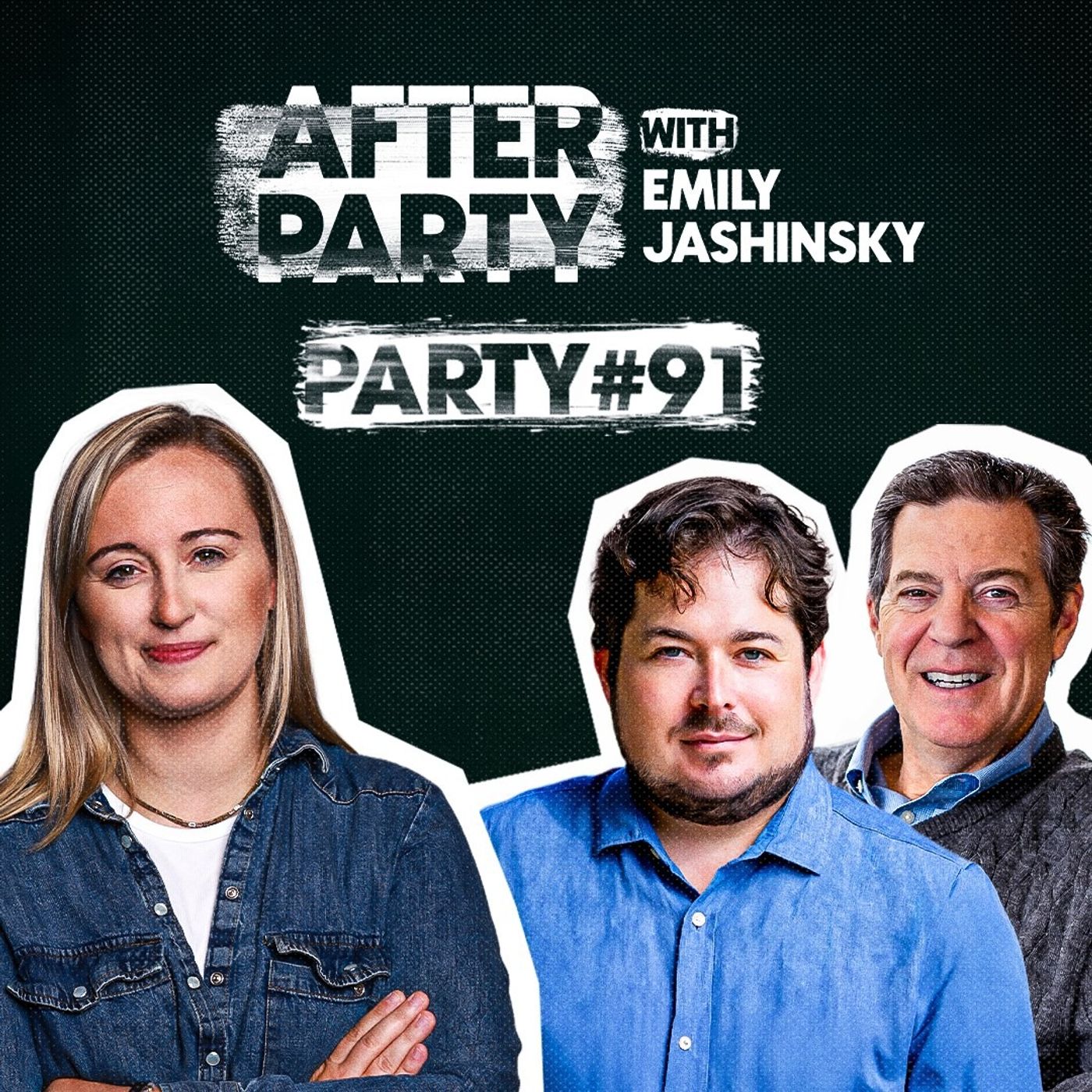
After Party with Emily Jashinsky
Colbert & Letterman Miss the Point, Alex Cooper Backlash, China’s Control, and Steve Jobs’ Lost Years, with Geoffrey Cain and Sam Brownback
01:05:06
Emily Jashinsky opens the show with a look at David Letterman and Stephen Colbert’s sad sendoff for “The Late Show” and explains why they just don’t get what really went wrong. Then Emily is joined by Sam Brownback, author of the new book, “China's War on Faith.” He’s also a former U.S. Ambassador at Large for International Religious Freedom, and a former Senator and Governor from Kansas. They discuss the truth about China’s crackdown on faith, the surveillance-heavy system where churches are monitored, how this is really a broader ideological battle between communism and the West, plus President Trump’s recent trip to China. Next Emily brings in Geoffrey Cain, journalist, and author of the brand-new book, “Steve Jobs in Exile: The Untold Story of NeXT and the Remaking of an American Visionary.” Emily and Geoffrey discuss the inside story of Jobs’ exile years when he was pushed out of Apple, how his transformation came through repeat failures, his near-bankruptcy, and family life....
Loading summary
Transcript92 lines
- [00:00]
Ryan Reynolds
Ryan Reynolds here from Mint Mobile with a message for everyone paying big wireless way too much. Please, for the love of everything good in this world, stop with Mint. You can get premium wireless for just $15 a month. Of course, if you enjoy overpaying. No judgments.
- [00:14]
Emily
But that's weird.
- [00:15]
Ryan Reynolds
Okay, one judgment anyway. Give it a try@mintmobile.com Switch upfront payment
- [00:22]
Livy Dunn
of $45 for 3 month plan equivalent to $15 per month required intro rate first 3 months only, then full price plan options available, taxes and fees extra.
- [00:29]
Thumbtack Advertiser
See full terms@mintmobile.com avoiding your unfinished because you're not sure where to start. Thumbtack knows homes, so you don't have to don't know the difference between matte paint finish and satin or what that clunking sound from your dryer is. With Thumbtack, you don't have to be a home pro, you just have to hire one. You can hire top rated pros, see price estimates and read reviews all on the app. Download today.
- [00:59]
Emily
Welcome back to another episode of Afterparty, everybody. Thank you so much for joining us this evening. Our guests tonight are Jeffrey Kane and Governor Sam Brown back. It's funny I just said our Jeffs tonight because got Jeff coming up. So maybe for the future we have to refer to all guests as as Jeff. So it'll be our little code word. As a reminder, please do subscribe if you haven't subscribed yet. It's the best way to help us do the journalism that we do here on Afterparty. Subscribe on YouTube wherever you get your podcasts. We appreciate it so much and it is so very helpful. We have a lot going on this evening. We're going to start talking about the last week of not the Stephen Colbert show, but the Late Show. Speaking of which, David Letterman has stopped by. Maybe you've seen some of the clips already. But there's something interesting that I want to talk about that we're seeing as Colbert goes into his final week of shows. We're going to talk with Governor Sam Brown back about China's war on faith, especially as President Trump returns from his China trip when he got back Friday. So there's a lot to break down that we saw over the course of the last week. Jeff Kane's book is called Steve Jobs in Exile and actually going to get him to react to a Harrison Ford clip. You're going to see why. So stick around for that, even if you're just curious as to how I'm shoehorning Harrison Ford's commencement speech at Arizona State University into a segment on Steve Jobs. It'll be worth it. Let's hope. And finally, Alex Cooper is pregnant. Wonderful news for her, but an interesting statement kind of on where we are right now in 2026 when it comes to the what the sexual revolution, dare I say so. A lot to get to. As a reminder, please do subscribe. We appreciate it very much. Now, let's go ahead and take a look here at a little bit of Stephen Colbert and David Letterman on the Late show last week joining forces as Stephen Colbert heads this week. Actually, just what, in a couple of hours, an hour, Stephen Colbert is going to start his final week of shows. So last week they joined forces to, I guess, best way to put it, frame themselves as brave truth tellers against the powers that be. Let's take a look here at S1.
- [03:14]
Sam Brownback
You guys will verify that this is actually CBS property, right?
- [03:17]
Livy Dunn
100%.
- [03:18]
Sam Brownback
Yeah. Okay. Anytime you're ready, Stephen.
- [03:20]
Emily
All right.
- [03:20]
Sam Brownback
Oh, guys, before we do this, Dave, I think we should have a target, don't you? Right down there, my friend.
- [03:27]
Emily
Something circular like a pole down there. Yeah, yeah.
- [03:30]
Sam Brownback
It's all fun until somebody puts out an eye.
- [03:33]
Emily
Yeah. CBS logo.
- [03:36]
Sam Brownback
Yes.
- [03:37]
Jeffrey Kane
Oh, oh, oh.
- [03:39]
Emily
Oh, my God. And they missed the target.
- [03:41]
Jeffrey Kane
But still that thud.
- [03:43]
Sam Brownback
The. Don't worry, Dave, we brought a spare. Here we go.
- [03:51]
Jeffrey Kane
Yes.
- [03:53]
Emily
Oh, there you go, guys.
- [03:55]
Sam Brownback
Now this is yours. This is my desk chair. All right. Well, say goodbye, my friend.
- [03:58]
Emily
All right.
- [03:59]
Sam Brownback
One, two, three.
- [04:02]
Livy Dunn
Oh.
- [04:05]
Emily
Oh, there you go. The network. I sent over one last thing.
- [04:10]
Sam Brownback
Oh. This is for both of us to enjoy. Thoughtful of them.
- [04:13]
Jeffrey Kane
Yeah.
- [04:13]
Sam Brownback
The Late Show, 1993-2026.
- [04:17]
Emily
It's cake.
- [04:23]
Sam Brownback
Thank you for everything you've done for our country. Feeling is mutual, Dave. Thank you.
- [04:27]
Emily
Anything you'd like to say to the audience before we go?
- [04:29]
Sam Brownback
Well, not necessarily to the audience, but to the folks at cbs. In the words of the great Ed Murrow, good night and good luck, Mother.
- [04:40]
Emily
It's so perfect, actually, that David Letterman was in this bit as they tossed desk chairs off the roof to try and hit the CBS logo and that they had the cake. They said The Late Show 1993-2026 in it, because I actually think this is them undermining their own joke right now. We have covered basically since the first day of the show what's been going on in late night comedy, because in, I think, is a great way to explain American culture, period. But also what is happening in the world of journalism. If you compare the ratings that Letterman had to get and compete with when he was at his peak. With what Colbert is up to right now, it's just not as close if you go back to Johnny Carson. In fact, we have Rolling Stone making this comparison. F3 we can put on the screen. It's a new headline. Trump wants Johnny Carson back off the air. On the air. He might want to think again. It was Rolling Stone making what I think they thought was a novel point, but is an entirely obvious point that nobody should be proud, particularly proud to make because it's so obvious, which is that Johnny Carson was political but not partisan. He didn't shy away from politics. He wasn't obsessed with politics like Stephen Colbert was. But that's how he won the late night wars when he was on the air. When Colbert comes around, he's the top rated host in Trump's first term. For much of Trump's first term, despite being the most political and the most partisan obsessed with politics and from a very partisan perspective. And again, I talk about this all the time. Carson had to sell ads to the biggest chunk of the American public that was possible. And the pie of people who were watching late night was closer to the pie of the entire country. Right, because we had fewer choices. So you were getting a bigger audience and it was more representative of the broader public, meaning you didn't really want to be partisan. You had to do in some ways what is much more difficult, much more difficult, which is humor that doesn't give in to your base partisan instinct, your ideological instinct. And I'm not saying that humor can't be funny coming from a partisan place or an ideological place. But I actually think it's more difficult to do what Johnny Carson did. And it prevents you from relying on so much low hanging fruit and becoming lazy, which is exactly what happened to Stephen Colbert. His show is losing money. It had some 200 staffers, an enormous amount of overhead. The math doesn't work out when you have the overhead of, let's say 1993 and a show in 2026 where you're working with a smaller slice of the American public. But what that does to your content, of course, is make it more niche ified, as I like to say. I don't even know if it's a word, but we'll go with it. But that is really what's happened is Colbert chased the resistance boomer wine moms who wanted something to. They wanted to be a part of the anti Trump movement. And so he bec kind of a go to shop for that cohort of the American public, cultivated Some loyalty. And it's amazing now to say for people to go and say, look at Colbert's ratings. You know, he's, he's really not that bad, not that bad compared to the other late night hosts right now, except for of course, Greg Gotfeld who's over on cable putting up great numbers. Nobody would have, I mean, that would be unthinkable just 10 years ago that somebody on cable, maybe 20 years ago, 15 years ago on cable would be beating the broadcast networks in the late night ratings. But that's happens when everybody is competing for smaller pieces of the pie. It gets nichified. And that's what Colbert did. Now to the Letterman part. We talked about this again from the beginning of the whole Colbert versus Trump versus Brendan Carr's FCC saga. We had Brendan Carr on this show talking about how maybe Congress, this is his, his argument as an appointee of the Trump administration is that he is just doing his job to say these networks, which have never really in recent memory been to the quote, public interest standard that the FCC is told to upheld in the law, maybe we should get rid of the idea that the FCC controls what's in the public interest on these broadcast airwaves because they're not scarce anymore and it's a totally different technological environment. Carr has said that, though. He's also then said, we're just going to enforce what's in the public interest here. Now, do I think the Trump administration is enforcing what's in the public interest across the board on a nonpartisan basis? No, of course I don't think that. Of course I, I don't think that's what's happening. And I don't like the administrator. I don't, I don't particularly like the administration getting involved in this period. But if this were just about Stephen Colbert and not about the entire franchise, which comes with all of the baggage of the overhead that we talked about in a show that is losing money despite having some of the best ratings in the game. They would just replace Stephen Colbert. But Letterman had the cake, right? They were standing there with the cake that said The Late Show 1993-2026. They're getting rid of the entire franchise. That's why David Letterman was there saying thank you for what you've done to the country, for the country. Maybe you should have said to the country rather than for the country, as he said. But that's why he was there. He was there because they were mourning this great historic franchise. And that undermines this entire point that it's just about Colbert. Colbert came with this massive staff. He came with all of the money that goes into the resources of having a massive staff, of having all of that overhead and the network was losing money on it. So yes, it had new ownership. But Colbert who has actually had some panning, he's gotten some panning from the press during the course of his goodbye tour. People saying it is insufferable. Even like quote unquote mainstream television critics saying that this goodbye tour which has lasted what a year basically has been utterly insufferable from Stephen Colbert. Expect now on his final week to hear some of those same folks maybe offer offering a criticism or there but no real big picture perspective on where this came from with cbs. Do I think that the new CBS owners want to please the Trump administration, want to show that they're kind of on board with the program in some respects? Yes. I think David Ellison has been pro Trump. Larry Ellison, his father who helped with his purchase, certainly pro Trump. They haven't just done pro Trump propaganda on cbs. There's been some stuff but it's not like they aren't criticizing the Trump administration on cbs. They also have this Titanic of a business to turn around and it was convenient to throw Colbert overboard, but not just Colbert, the entire late show overboard. It was an obvious target. Huge money loser. Like what they replace it with is interesting because the, the argument might just be the ratings will be worse but the math will work out because we won't be spending so much on the replacement show because it doesn't come with a multimillion dollar Colbert contract and 200 staffers. It's just a dinosaur. A dinosaur. That's time has come in this, this day and age. Now Fallon and actually to some extent Kimmel have been able to do better on social media and Colbert hasn't really done as well as Fallon is actually a pretty good example. There's some, some stories about that, how we're measuring things, the, the metrics of, of what's successful in late night television now it's kind of apples and oranges looking back at Nielsen versus what's happening on digital. But you just cannot get away from for much longer with having a staff that big and so many resources. And that's why they're getting rid of the entire franchise and not just Colbert. If it were just about Colbert they would replace him with some right wing comedian who is glazing Trump every night. And I'll leave it there for now, but you best believe we will be covering the final week of The Colbert shows closely because it's not really just a farewell to Colbert. It's a farewell to this format in general that he was occupying. So on that note, we are going to be back with Sam Brown, back in just one moment. But first we're going to take a quick ad break. See you on the other side. Well, for years, legacy media, government and big data companies coaxed us into surrendering our digital freedom, giving lip service, of course, to privacy, while leaving digital back doors wide open for their own purposes. Sometimes they're blatant in conveying the idea that encryption is only for criminals or that if you want privacy, you must have something to hide. Well, how did we get here from cherishing our Fourth Amendment rights to giving them up so readily for convenience? We talk about this on the show all the time. It was engineered. Powerful people discovered that with the right incentives, people willingly surrender their data. Who profits? The same government agencies, platforms and media companies that want you exposed and compliant? Well, Unplugged set out to do something about it. The upphone by Unplugged is the smartphone designed to restore your rights when it comes to blocking third party trackers from shadowy data brokers. The UPPhone by Unplugged outshines every device on the market. There's even a battery disconnect switch. So off really means off. All of this is independently verified and tested so you can be confident in knowing your upphone is the most private smartphone you can buy. Check out upphone from unplugged@unplugged.com Emily that's unplugged.com Emily
- [14:15]
Livy Dunn
I'm Livy Dunn, all American gymnast and Vuori athlete. When you travel and train as much as I do, you find happiness where you are on the mat or on the sand. Movement and comfort are essential. That's why I live in performance Joggers by vuori, made from Dream Net fabric that's made of 89% recycled materials, effortlessly soft and made to move as much as I do. My happiness starts here in the softest joggers on the planet. Get 20% off your first purchase at viori.com libby that's V U-O-R-I.com L I V-V-Y exclusions apply. Not only will you receive 20% off your first purchase, but enjoy free shipping on US orders over $75 and free returns. Go to vuori.com libby and discover your the full versatility of Biori clothing. Exclusions apply. Visit the website for full terms and conditions.
- [15:10]
Ryan Reynolds
Ryan Reynolds here from Mint Mobile. I don't know if you knew this, but anyone can get the same Premium Wireless for $15 a month plan that I've been enjoying. It's not just for celebrities. So do like I did and have one of your assistant's assistants switch you to Mint Mobile today. I'm told it's super easy to do@mintmobile.com
- [15:28]
Livy Dunn
Switch upfront payment of $45 for 3 month plan equivalent to $15 per intro rate. First 3 months only, then full price plan options available, taxes and fees, extra fee, full terms@mintmobile.com all right.
- [15:42]
Emily
We are joined now by Sam Brownback who's author of the new book, it came out on May 12 called China's War on Faith. He's of course the former US Ambassador at large for international religious freedom, former Kansas governor and former U.S. senator for Kansas. Thank you so much, Ambassador Brownback. I was saying Governor Brownback, but Ambassador Brownback, thank you for being here.
- [16:02]
Sam Brownback
Here, whatever. Yeah, it's great to join you. Thank you. Thanks for having me on. Appreciate it.
- [16:07]
Emily
Yeah, no, I appreciate you being here and just want to start out by asking, based on this book which I was looking at today and you have so much information, testimonies from people that were able to kind of understand their stories in China. But that has to be part of the difficulty of writing a book like this. It's been part of the work that you've been doing for a long time. But how does or how can the average American, the average American Christian, know what's real when it comes to what's happening behind not really the iron curtain in China, but a curtain nonetheless to our fellow Christians? How do we know what they're going through? How do we know what stories are real, what stories are fake? Tell us. Bring us inside the world of verifying these stories, talking to Christians who are suffering in China.
- [16:53]
Sam Brownback
Thanks for asking it that way because particularly I think for your generation and for people writ large right now, they just kind of have trouble making sure is that true or not? And some of it sounds so phenomenal that they just write it off. But that's why we did multiple stories in this book as well, so people could look at it. That's why really went and vetted the people that we were talking to. A number of them are folks that I've known over the years. I've had them at different forums. We've had people that have verified their stories that I know that, that I could talk to and then brought them on out. The other thing that was really nice for me is often in the past when you're an ambassador position or a Senate position, you just don't really have time to sit down and talk with people now that I'm out of office. We went to the play, I went to the folks, I went to where they are, I talked with them, and we did multiple interviews. It wasn't just one, it was several. And then we called back and verified this piece. Or wait a minute, you said this in your book, but you told us this because we spent a lot of time going through and verifying that, because it's important to have the information accurate, but it's also really, really important that people would hear this. A lot of this. These are stories that people just don't know of the level of persecution and what China is doing to its own people right now. People don't know it well.
- [18:21]
Emily
Yeah. And bring us inside this, because to some extent, the Chinese government is sort of open about wanting homogeneity in the country. And you see that in moments of honesty, it's kind of clearly the policy. Even with Uyghurs, they talk about how they somewhat open about how what they want to do is make sure there is homogeneity, that there aren't separatists. You know, Uyghur Muslim groups, they haven't been totally open about the complete persecution of Uyghur Muslims, which has amounted to genocide in some people's estimation. But even with Christians, they talk a little bit out of both sides of their mouth. You say we are protecting people's rights, but it's not rights like we conceive of here. I mean, there's facial recognition. I've heard of being installed in churches. Could you tell us a little bit what it's like for the average Christian community in. In China now?
- [19:13]
Sam Brownback
It's like it was under Mao. Mao Zedong, he went and just squashed faith. Communism is officially atheistic, but it's also operationally atheistic. They don't trust any power that looks to a higher authority than the government. The government is it. That is the top authority. And so anybody that seeks a higher moral authority, they go after them and they go after the leaders first of the faith community. That's who they take out. That's who Mao took out. And then under Deng Xiaoping, that era, they kind of opened up and they loosened up and they let people kind of of operate and look around. But Xi Jinping is a reincarnation of Mao. It's total control. They see religion as an existential threat to them. It's the only civil society left inside of China that has some organization and has some calling and capacity that can stand up to them. And I think they also, they saw the fall of the Soviet Union and they saw the role religion played in that. First the Jewish refused nix trying to get out and when they didn't let them out, that really undercut the Soviet Union its moral authority when they wouldn't let the Jews return to Israel. And then they also saw in Poland the Catholics there when Pope John Paul shows up and says be not afraid, that place just fell from communism. It went away. Even though the Poles hadn't been to mass in decades. But it was still there, that yearning for that higher authority. So that's why I put in the book really religion is this key entity for us as we confront China to push for religious freedom because it's an Achilles heel for them. They can't stand for free religion. It's really one of the things that wandum and just final point on this. China's one of the fastest growing Christian countries on the planet. The last decade, probably 100 million Christians there could well be more than are in the Communist Party today. That's a threat to them because they don't their final allegiance, of course they're Chinese citizens, but their final allegiance is to follow Christ and they'll stand up and sometimes even risk their own lives to follow their faith.
- [21:33]
Emily
Yeah, I wanted to ask you about that because I've heard reports of Chinese Christians in the churches having to sort of recite allegiances to the the party ahead of their own faith. The sort of creeds of their own faith I've heard of, as I mentioned earlier, reports that there were have been facial recognition services which are all over China but installed in churches and people have tried to protest this. Tell us, you know, is it hard to get a Bible? Is it hard to go to church? Are people underground? Are they having to recite sort of CCP creeds ahead of their own, the Apostles Creed or the Nicene Creed? What's that like?
- [22:11]
Sam Brownback
Well, you've got an above ground church, that's the official church. They have an official Protestant church, they have an official Catholic church. But each of those, their sermons have to be vetted by the People's Party Committee and that's on indoctrination. They have to put up pictures of Xi Jinping. They do have facial recognition cameras so they know when you come into the church that can get you scored down. Even if it's an official above ground church. But then the growth in the church has actually been the underground church where people freely practice. And there's a lot of charismatic Christians in that church and a lot of just phenomenal things that really grab people's eyes and mentality. One of the things about the Western church is that a lot of it's based on reason. It's appealing to people's mind. But most of the growing church around the world, in the third world countries and in China, it's a charismatic church. It hits at the heart and people see signs and wonders and miracles and they go, this is amazing. I gotta hear more about this. It really is the first century Acts church. And these guys, when you're around them, and I'm around them a lot, they really stimulate my faith and they challenge me for what my faith is and would I be willing to stand up. And the level of persecution they have, they look at prison a lot of times as Chinese seminary. That's what they expect to go to to deepen their faith.
- [23:48]
Emily
Oh, that is so interesting. Well, speaking of recent developments, the president obviously got back from his trip to China, his historic trip to China just last week. And before the trip, you spoke a bit about what you wanted to see the president talk about when he was in China. And I actually wanted to play this and get a sort of before and after from you, Ambassador. This is going to be S4, what you said you wanted to see from the president.
- [24:18]
Sam Brownback
But my hope is, is that he also raises these issues and raises specific cases, like Jimmy Lai the journalist, or Pastor Ezra Jinn the pastor, or the nine Catholic bishops that are detained and imprisoned somewhere in China, we don't know where. And then I would also hope he would just really go at the core issue of saying, you need to let your people be free. You're a great country. Why can't your own people practice the faith that they see fit to do? Now, I know the answer. I mean, it's just Communism is atheistic and they want total domination and total control. But I really think you ought to put them on the spot about why can't you let your people follow their own soul's convictions?
- [25:03]
Emily
And I'll add to this if we can put F13 up on the screen, it's a little bit different. But the President is getting some criticism. This is from the New York Times, of course, but from particularly people who are very, very supportive of Taiwan. Many people in that boat in America, the headline is, Trump's Taiwan Gambit is Already a Gift to China. People who are criticizing him for pretty openly saying that he was holding this $14 billion arms pack to Taiwan as a negotiating chip, a bargaining chip in his relationship with Xi Jinping and more broadly with China, obviously trade, foreign policy now with the Iran war playing, all kinds of. There are a lot of factors in the, in the relationship right now, Ambassador, but just what you saw as somebody who's been in the space studying the plight of Chinese Christians and religious minorities, what did you. Were you pleased with the president's trip to China last week? Did he address what you thought needed to be addressed? Was there something that could have been different? What's the kind of big picture takeaway?
- [26:01]
Sam Brownback
I thought he got what he needed out of it, and I was proud of him. I would love to go at the Chinese more aggressively direct, just right at them. But this president, he's gone at China. He's been the first president to go out and attack China since Kennedy. He's the first guy that's actually gone at him. Everybody else just kind of gave him a ball. He raised Jimmy Lai, he raised Pastor Ezra Jin didn't raise the Catholic bishops, but he raised those two cases. And we've got this situation with the rare earth minerals right now, the blocking of the Strait of Hormuz, which is sending up our gasoline prices and got midterm elections coming up. Of course, the Chinese Communists don't ever have to face the public on election cycle, but everybody in the world knows the US Election cycle. So I thought the president did a really good job tactically of what he can do at this point in time. I think when we get in a better position on getting other sourcing for rare earth minerals, when we get, you know, can get that straight of Hormuz situation, situation dealt with and so you can drop those oil prices, we'll be in a much stronger position at that point in time to start raising just the fundamental issues of the difference of our cultures, because we're in a clash of civilizations with them, their ideology of totalitarianism, communism, atheism, and us representing Western civilization that believes the individual is dignified and created in the image of God and has incredible rights and value and worth. These are systems in clash. And you're going to see this further accentuate and develop over the next few years.
- [27:43]
Emily
Okay, so, yeah, that would be my last question is are we on the Thucydides trap was raised, obviously, and I guess it's a good question. It's partially why I am heartened to see Trump take a kind of pragmatic approach to dealing with Xi Jinping. Are we destined to clash with China in a military sense? Can it remain sort of a cold war, a cold conflict rather than a hot conflict? How do you see that happening in the next five to 10 years?
- [28:16]
Sam Brownback
I think we're absolutely destined to clash with them. But I don't think it's the trap that was cited too of a rising power versus a declining one. The declining power is communism. Communism has never worked anywhere. It's been tried multiple places around the world. It never produces people's happiness and good for people or freedom. And freedom is where people best belong and operate and function. And they're representing a totalitarian model that ultimately fails and has failed everywhere. They've got a lot of tools at their hands with all this surveillance technology they've developed with the capacity and the willingness to, to kill people that they're willing and do do. But yes, we're going to be in conflict, but the decline is going to be of communism and the totalitarian state. It's just not the normal state where people produce the best or, or prosper the most.
- [29:17]
Emily
Sam Brownback's new book is called China's War on Faith. Thank you so much for joining us this evening. Much appreciated.
- [29:25]
Sam Brownback
My pleasure. All the best.
- [29:27]
Emily
Likewise. All right, we're going to be back in one moment with Jeffrey Kane. But first, let's take a quick break and talk about preborn. Over the years I have been clear about this. I'm not just pro birth, I am pro life. There's a meaningful distinction there, very meaningful distinction. And pro life being pro life means standing with mothers not only before the baby is born, but also long after. And that is exactly why I partner very proudly with the great people over at Preborn. And I hope you'll support them as well. Preborn doesn't just save babies, they help make motherhood abundantly possible. They provide free ultrasounds and share the truth of the gospel with women in crisis. And then they stay. They stay for up to two years after the baby is born. It is so incredible. They bring real practical help, including getting financial support. So important. For up to two years. Once again, after the baby is born, they share the truth of the gospel with those women when they need it most. This is what true Christ centered compassion looks like. And it's not just for the baby, but it's also for the mother. Both of them. Why not? It's so it's possible, like we said, abundantly possible. Pre life preborn makes the, makes motherhood abundantly possible. Which possible which is so important. And here's where you can make a difference. Just 28. $8. Just $28 provides a free life saving ultrasound. And get this. This is a real figure. One chance for a mother to see if to see her baby. Just one chance. When she does, she is twice as likely to choose life. That's amazing. It is so powerful. And Preborn is trying to save 70, 000 babies this year. So don't just say your pro life, live it. Help support mothers and save babies today. Go to preborn.com emily or call 8556, that's preborn.com emily do it.
- [31:27]
Livy Dunn
I'm Livy Dunn, All American gymnast and Vuori athlete. When you travel and train as much as I do, you find happiness where you are on the mat or on the sand. Movement and comfort are essential. That's why I live in performance. Joggers by vuori. Made from Dream Net fabric that's made of 89% recycled material, effortlessly soft and made to move as much as I do. My happiness starts here in the softest joggers on the planet. Get 20 off your first purchase at vuori.com libby that's V U-O-R-I.com L I V-V-Exclusions apply. Not only will you receive 20 off your first purchase, but enjoy free shipping on US orders over 75 and free returns. Go to vuori.com libby and discovery the full versatility of Biori clothing exclusions apply. Visit the website for full terms and conditions.
- [32:22]
National Debt Relief Advertiser
Do you have $10,000 or more in credit card debt? Maybe you're even barely getting by making minimum payments. With credit card debt hitting record highs, National Debt Relief offers real debt relief solutions for people struggling to keep up. These options may reduce a large portion of credit card debt for those who qualify. You don't need to declare bankruptcy and you may be able to pay back less than you owe regardless of your credit. National Debt Relief has already reduced the credit card debt for more than 550,000 consumers. So don't wait if you owe 10, 20, or even hundreds of thousands of dollars in credit card debt, you can now take advantage of this financial debt relief as the cost of living increases. To find out how much you could save, visit startndr.com that's startndr.com all right.
- [33:11]
Emily
We are joined now by Jeffrey Cain, who is the author of the new book Getting Rave Reviews. It is right here. I have it in my hands. It's called Steve Jobs in Exile. Jeff, thank you so much for joining us and congratulations on this book, I'm seeing it everywhere.
- [33:29]
Jeffrey Kane
Thank you, Emily. Well, it's great to be back with you.
- [33:31]
Emily
Yeah, it's great to have you here. The subheading of the book is the Untold Story of NEXT and the Remaking of an American Visionary. Now, tech nerds know. Know a bit about next, probably. But Jeff, I know you went deep and, and actually found some new, some new information to help us put those puzzle pieces together of what Steve Jobs, who he was, why he was, who he was. So I just wanted to see if you could start off by telling us, especially for the uninitiated, into the, the world of tech nerdom, what you mean by Steve Jobs being in exile during this, quote, untold story of next.
- [34:13]
Jeffrey Kane
Well, Steve Jobs is the guy who we think of as. He's that guy in the turtleneck. He's the guy who stands up on stage and gives the big famous keynote. We all have an image in our head of Steve Jobs as this leading entrepreneur of our area, of our era. But this is the story about what happened before that. How did he become the Steve Jobs we know? So I was doing research on this topic, writing this book, and I found that there was an entire period, so a third of his adult life, life. He died quite young, 12 years he spent just off in the wilderness. And by wilderness, I mean he was failing constantly. He started a company called Next Computer. He was pushed out of Apple, originally the company that he co founded. And this was the crucible period. So this is when he went out. He was trying to do something new, trying to invent something really brilliant and smart and technologically into the future. And he just kept failing over and over for 12 years. So the question my book is asking is what did those failures teach him? What did the Crucible teach him and how did he come out of it? And how did he become the great success, the great Steve Jobs who we all know now?
- [35:17]
Emily
Were you surprised by any of the information that you learned over the reporting process for this book, Jeff? Did anything stand out to you as something maybe it wasn't surprising to you in terms of like radically rethinking the way or maybe it was you saw Steve Jobs, but did anything jump out as surprising new information during the course of your report reporting?
- [35:35]
Jeffrey Kane
Well, I didn't realize how far he had gone to rock bottom. I mean, he really just hit the bottom. And he was about two to three years from personal bankruptcy. That's something that I learned in the reporting. Got access to a lot of internal documents, you know, Private emails, stuff that was being released to me. And he was really like, you know, by the 1990s, he was almost written out of history. So, you know, we look at guys like Steve Jobs, we look at these, these tech visionaries today, and you know, we talk about their success a of lot. But when you actually go back and look at their life and look at how they became that success, it's always a lot harder. It's a tortuous, winding road and how they got there, it just blows my mind. I mean, Steve Jobs was really suffering during this time.
- [36:18]
Emily
Right. And turned it around. So a big question is how, Jeff, what. What kind of was it who he was? Is that what. What brings Steve Jobs back from exile? Is it because of other factors, external factors? Maybe a combination of both?
- [36:36]
Jeffrey Kane
Well, all his co founders had left him. They were tired of working with him. We all know that Steve Jobs was really difficult to work with. That's like what he was really famous for. But at this point in his life, he just wasn't offering anything to anybody. So the turnaround happened when his co founders left him, when he, you know, he was hitting that, that almost near bankruptcy. And then he got married and he had a family and, you know, his, his marriage to Lorraine and him having kids. He had three kids with her. And also reconciling with his previous daughter from a different partnership. That started to turn him around because he started to see the importance of family and the importance of having a private life and not just dedicating yourself constantly to work. That's also what inspired partially the movie Toy Story. So he was able to show Toy Story to his kids. He was the executive producer. That was his credit. Something that we forget about him. And that was his big turnaround. It wasn't Apple, it wasn't the iPhone. It was when he produced Toy Story, you know, and had his family around that he started to recover from this exile.
- [37:35]
Emily
Well, I'm really glad you brought that up because speaking of Hollywood, I wanted to ask you to react to this Harrison Ford clip from the Arizona State University commencement commencement speech he delivered last week. And if people are wondering why we're about to talk about Harrison Ford, Jeff, maybe you're even wondering why we're about to talk about Harrison Ford. Although maybe you have some guesses. Let's go ahead. Roll the clip. Stick with us. Follow along and all will be clear in just one moment. This is going to be S5.
- [38:09]
Sam Brownback
Humanity is a part of nature, not above it. We need cultural change. We need to extend social justice. We need to respect and elevate the indigenous people that are being marginalized and in many cases, killed in cold blood. These communities have long understood that the trees, the mountain, water, soil are not commodities. They are relatives to be cherished. We can all play a role by embracing that wisdom in our day to day lives. The world you're stepping into, the world my generation left you is a real mess.
- [39:12]
Emily
All right, he said the last part, the most important part at the end. The world my generation left you is a real mess. And Jeff, I know you're aware of this, but Helen Andrews, in her book Boomers, which was very controversial when it came out, well received on the right, but she framed Steve Jobs as one of the archetypical boomers who represents the failures of the generation, actually, in a way that Harrison Ford is very much not referring to kind of the opposite sense of what he's describing. But I'm reading here from a review of Helen's book and the Claremont Review of Books. They write that Helen, quote, sees Steve Jobs as the most successful of the six archetypes. She writes about at, quote, finding the solution to the dilemma of wanting to be rebels and the establishment at the same time. And that, that feels like a very definitive way to look at who Steve Jobs was. Maybe one of the definitive struggles of his entire life. And I hear it in that Harrison Ford clip where on the one hand he's enjoying the spoils of the life of somebody who helped create this world, and on the other hand he's stuck on this meaningless string of cliches where that was just, I mean, it was like he was playing like liberal leftist cliche bingo with that speech. And somebody probably won. You just didn't hear them out there in the crowd. That's the only explanation for how silly that was. But I'm just curious what you make of Jobs and as a, as a boomer, with that Harrison Ford clip downloaded in the mind.
- [40:53]
Jeffrey Kane
Yeah. Well, I'd be curious to know how many trees Harrison Ford has planted lately. I don't think that's something that's been top of mind for him. So, yeah, I mean, when it comes to, you know, the generation of the baby boomers, Steve Jobs, the, the tension that you talk about is absolutely real in the life of Steve Jobs. And that's something that I went deep into and documented. He was, he was selling, he was making technology for the establishment, for intelligence agencies and, you know, big corporations during this time of his life. And it was a struggle for him because he had to abandon A lot of the, the ideals that he had when he was younger, he used to, he used to fly a pirate flag, the Jolly Roger, over the Apple headquarters, you know, back when he was a kid. And, you know, he would make these really rebellious computers, like he was the face of rebellion. But then he had to confront the reality that he was also becoming, you know, the pirate joining the Navy. So, yeah, I mean, absolutely, that's a tension that continued throughout his life. You know, he killed like the NSA at one point, wanted him to kill some privacy features in my book. And he went along with it because he wanted them as, as, you know, customers, business partners. So, yeah, you know, Steve Jobs and his generation, they've been more influential than almost anyone, I mean, any generation alive today on the world that we now live in. And, you know, now one of the things we have to contend with in this age of AI and all the technological changes happening is, you know, like, how far do you go with the rebellion and you know, how much you join the system? And it's like there's this, there's this discombobulation happening right now and it's like people just can't agree on what we need to do.
- [42:32]
Emily
How did Jobs grapple with this? I mean, again, he, he did have this. And you can tell us more detail and maybe there's some good stuff from the exile period, as you put it, which is just a great term for this, this time of his life. But how did he, how was he thinking about this in his, his own mind as somebody who was, is very, very interested in different kind of cultural ideas about, you heard Harrison Ford, they're talking about nature, about humanity. And I agree with Helen, sort of an archetypical, post war baby boomer way, trying to be a rebel against the, the greatest generation, but then at the same time building this ultra powerful technology, becoming very, very, very successful and changing the world. World. Personally, for him, what was that like?
- [43:24]
Jeffrey Kane
Well, personally, it was, it was tough because he was all about democratizing technology originally. I mean, you know, if you got to think back to a long time ago, decades ago, when computers were these giant machines that filled a room and he was grappling with that world, people thought that machines were going to take over and it was going to be, I mean, that's the age of Terminator, when the movie was made and so forth. And Steve's original idea was to take all that and to simplify it and to make it so that anybody can use it. You know, like the Macintosh, his computer had a Smiley face when you push the on button. He wanted it to be fully human. So, you know, as. As he matured and as he grew older, he came to realize. And it was tough. Like his. His fans, the people who were closest to him, a lot of them were really critical about what he was doing because he would go into these meetings with. With government agencies and the Pentagon, and for the generation that grew up with Steve Jobs, they were opposed to that. When I talked to them, they said that they're hippies. They literally use that term to describe themselves. And so Steve had to figure out, well, how far do I go selling out? How far do I go? I have to make a profit. I have to survive. And to make a profit, I have to sell, and I have to sell to big companies and government agencies. I'm not going to be, you know, selling to my neighbor down the street, probably because, you know, these computers are very expensive. And that was his big tension point. And it's something. It persisted, you know, very late into his life. He never really fully reconciled that one. But he had to make these choices about who he was going to work with.
- [45:00]
Emily
Another question that strikes me about Jobs is Tim Cook stepping down right now? It's in the process, and Cook being kind of tapped in the Jobs era. You mentioned AI earlier. I'm curious what you think Steve Jobs would have made of what's happening at the company right now of the AI revolution, of Apple's role in the AI revolution, as Tim Cook, sort of in his position as successor, passes the baton, so to speak.
- [45:36]
Jeffrey Kane
Well, yeah, this is a question I ask myself every day after digging this deep into his life. If you were looking at what's going on with AI. So, you know, there's a lot of distrust right now in the world over AI. What's it going to do to our Jobs? What's it going to do to us? Are we still going to be in control of our lives if we give control to a machine? And, you know, I think if Steve were around, you know, he would grapple with that. This would be the central question that he'd be working on right now. And the thing that he'd be thinking about is how do I. How do I simplify this thing and how do I make it human, you know, make it seem like more human, so that, you know, people feel like they're in control of it and they're, you know, they can sit down and they can enjoy it and they don't feel like it's going to take their job. Like, I Think that's, that would be top of mind. But then he'd have to grapple with, like, the same things that we just talked about. So I have to sell this to government agencies and I have to sell this to big institutions that want it. And, you know, he, he would run into that same tension. It's like, AI is probably the most powerful tool that humanity has ever invented when you look at the sheer number of things it can do and, like, the level of intelligence it has achieved. So I think he run into exactly that. And he'd be wondering, what can I do to make this friendlier? But, you know, what. What kind of concessions am I going to have to make? And, you know, can I actually make this happen? That would be a big question in his life.
- [46:57]
Emily
I can only imagine. Before you run, Jeff, you are one of the reporters who's most closely covered China. AI, the kind of repression. I mean, we just, we were literally just before you jumped on, talking to Sam Brownback about the plight of Christians in China after the President's trip to China last week. And, you know, this is a sort of 30,000 foot view question, but because we have you here and you've reported so closely on all of this, Jeff, I kind of wanted to get your reaction to Trump's visit. Big takeaways. Was it what you expected? Was there something you should have done differently? What did you make of it?
- [47:39]
Jeffrey Kane
You know, I thought that having covered China for a really long time, I could see the symbolism, right.
- [47:44]
Emily
And lived in China, we should say,
- [47:46]
Jeffrey Kane
yeah, yeah, I lived in China. I, I lived in East Asia, and I had been deep in some of the human rights issues there, some of the national security issues. You know, the Chinese Communist Party does horrible things to its people. And what I saw in this summit was, you know, a little. I think it's a little different from how others saw it. So the summit was not like a summit for trade deals. It was not a summit to talk about how many soybeans America is going to sell and how many Boeing jets were going to sell. Like, that was just the surface level material. What it was was China framing it as a, you know, a kind of civilizational struggle. Civilizational, you know, like the way that Xi Jinping, the President of China, talks to his people and talks to the party. He says that we are, you know, a great nation and we are on a resurgence right now. We're rising fast and we're going to overtake the Americans. We're already their rival. And he was trying to show, with all those you know, tech CEOs coming in with Trump showing up with the whole entourage. He was trying to show the world that Beijing is where the deal making happens now. And that's what he showed his people and all the propaganda news outlets. It's what he showed China's allies around the world. Look, the, the Americans are coming here. And in the end it was very much a symbolic meeting. There weren't actually many resolutions to anything. The Iran war, I mean nothing really happened on that front. Nothing really happened on the trade tariffs front front. It was all about, you know, China, like we are the equals now of America and we are going to approach this as such.
- [49:19]
Emily
It did seem like that. It's the media coverage I'm curious from your perspective on as well, because you kind of been, you've been critical of some of the like corporate media coverage of China over the years. What did you make of how the press reacted to and covered Trump's trip?
- [49:37]
Jeffrey Kane
You know, I thought that the press, it was, you know, so here's the thing. There aren't a lot of China correspondents anymore. We've all been kicked out. So there aren't a lot of people who are actually like living in the country covering it. So you get a lot of parachuting in and you know that the parachute journalists like they, it's it you go into this country that's a one party authoritarian regime and of course you're only going to see propaganda, you're only going to only going to see what the party is feeding you. And so like they're not going to show the full picture. It's just impossible to get it anymore. So yeah, I mean, I think that the press has just been way too friendly to like some of the linkages between US Tech companies and Chinese. The Chinese government, for example. I mean, me being a tech journalist, I look at this a lot. I think that they tend to overlook like things that are really bad. So I mean, you know, there are all kinds of companies there, including Apple, which is really deep into China, which, you know, has a massive supply chain there and has faced allegations of forced labor in the past, you know, like at their suppliers in China. This is a really serious problem because it means that the Chinese Communist Party and its organs are starting to capture American big tech companies and hold them hostage in China. And meanwhile we're going over there and holding these summits and making it look like we're bowing down to this authoritarian regime.
- [50:59]
Emily
Right. And my understanding is that Tim Cook was pretty influential in putting a lot of the supply chain, the Apple supply chain in China. Correct me if I'm wrong on that, Jeff.
- [51:10]
Jeffrey Kane
Yeah, well, that's exactly what he did. And that's, that's what Steve Jobs was actually opposed to originally. Something I found in my own book research. That one didn't make it into the book just because it, you know, wasn't about China. But yeah, it was, you know, wild. Like the Tim Cook strategy to go in there and to build this massive, like, never ending behemoth, this maze of, you know, of manufacturing factories, of, you know, people who make all the parts for the iPhone. You know, all the horrible things that have happened over there with, with, you know, the way people are treated. Like Apple has been found to be connected to this through all these, like, supplier, these relationships. It's set up in China. And the wild part about it is that it just gets glossed over. You just don't see it a lot. And that's, you know, one of my big criticisms of the press. It's like, you know, you, you, you know, you look at big tech or you look at, you know, a big company and what they're doing, and suddenly it's like it's. They're writing official journalism. They're not really, you know, going there and telling the real story of what's happening.
- [52:14]
Emily
And Jeff Kane has the real story of what happened to Steve Jobs in exile. That's the title of the book. Go ahead, pick it up. It's getting great reviews. Jeff, thank you so much for joining the show tonight.
- [52:26]
Jeffrey Kane
Good to be here, Emily.
- [52:28]
Emily
Really appreciate it. All right, we'll be back in just one moment, but first, let's talk about what's really in your makeup. It's disgusting. Most of us spend so much time worrying about what we eat and what we drink, how we take care of our families, all important. But then we cake our faces with these products that are just, just utterly full of chemicals that we cannot even pronounce. Your skin is your body's largest organ. Think about it that way. What you put into it gets absorbed right into your body. So that's why you should consider making the switch to tubes and company. Their liquid foundation and face primer are designed to do more than just cover your skin. They help support and nourish it throughout the day. Unlike traditional makeup that fades or requires constant touchup, this makeup is formulated with aloe vera that stays put while keeping your skin feeling comfortable. No caking, no buildup, just smooth, natural looking coverage that lasts. So if you're tired of choosing between looking good and poisoning your skin with mystery chemicals. You don't have to anymore. You really don't. If you're ready to simplify your routine and actually feel good about what you're putting on your skin, head to tupesandco.com afterparty they're offering my listeners 25 off your first order with code afterparty that toops T O u P S&CO.com afterparty and code afterparty for 25% off your first order.
- [53:56]
Livy Dunn
I'm Livy Dunn, All American gymnast and Vuori athlete. When you travel and train as much as I do, you find happiness where you are on the mat or on the sand. Movement and comfort are essential. That's why I live in performance Joggers by Vuori, Made from Dream Knit fabric that's made of 89% recycled materials, effortlessly soft and made to move as much as idle. My happiness starts here in the softest joggers on the planet. Get 20 off your first purchase at Vuori.com Libby that's V-U-O-R-I.com L I V-V-Y exclusions apply. Not only will you receive 20 off your first purchase, but enjoy free shipping on US orders over 75 and free returns. Go to Vuori.com Libby and discover the full versatility of Vuori Clothing Exclusions apply. Visit the website for full terms and conditions.
- [54:46]
Thumbtack Advertiser
Confronting high credit card debt can feel scary, but the good news is if you owe $10,000 or more in credit card debt, financial relief options are now available. National Debt Relief is currently offering debt relief designed to reduce what you owe, fast tracking your way to being debt free. If you qualify for debt relief, you may be able to pay back significantly less than what you owe and save thousands of dollars. Imagine only paying one low monthly program payment you can afford and saving money as you become debt free. Free National Debt Relief has already helped bring debt relief to over 550,000 US consumers, earning thousands of five star reviews and an A plus rating with the Better Business Bureau. You're stronger than your credit card debt. Take the first step and visit startndr.com to see what debt relief you qualify for. That's start NDR.com all right everyone, let's
- [55:36]
Emily
talk now about Alex Cooper who I suppose congratulations are in order to is pregnant. Alex Cooper announced we can put F4 and F5 up on the screen. Too much fanfare on Instagram that she is expecting a baby. Vogue posted Call her Mommy. Congratulations are in order for Alex Cooper and Matt Kaplan who are expecting their first child together. So call her mommy, obviously. Alex Cooper is the host of Call Her Daddy. And, and there have been some very interesting reactions because Alex Cooper is a person who does exemplify, I think she's a millennial, millennial zoomer era sexual revolution. And because she exemplifies, I mean, she exemplifies it in the sense that she does promote, I think, what millennials, elder millennials at least call sex positivity. This idea that there was real empowerment to be found in promiscuity or having sex without emotional tethers, without consequences, taking advantage of technological sex without consequences. So meaning new what I call high tech ways of abortion, certainly of birth control, plan B and the like. Just telling women that there, there's enjoyment and empowerment to be found in promiscuity. And here's Alex Cooper pregnant now. And there are a couple of reactions that caught my eye that I wanted to put up on the screen. This one was from at Florio Gina on X. I'm gonna pop this up here. She wrote, the common response to this news is that Alex Cooper is somehow leading her audience on a path that she herself is not choosing. But what's happening here is actually the exact act feminist dream. This is a very interesting point. A woman participates in hookup culture as much as she wants. When she's in her prime, she sleeps around, has casual sex, gets the ick, dumps men, gets dumped, has summer flings, gets abortions if needed. She's hot, she is pretty privileged and isn't afraid to use it. But when she feels like the time is right, she settles down with a high value man only because it's her choice, not because she feels pressured by societal standards or a ticking biological clock. This is a very long post. It's probably like 300 words long. But Gina ends by saying everyday women simply aren't on the same playing field as women like Alex Cooper. Few will fully understand this. Many will try to make excuses as to why this isn't true. Brace yourself for the outlier stories. Many such cases, even if you don't see anything morally wrong with the hookup culture that Alex Cooper praises on her show, young women would be smart to understand the real world that you have a much greater chance at locking down a high value man when you're younger and a bit more austere. Sorry, I. They don't make the rules. Gina adds. Now let me share this for my friend Brad Wilcox, who is a professor at the University of Virginia. He's a fellow at the Institute for Family Studies in the American Enterprise Institute. He wrote a great book called Get Married. He says great for at Alex Cooper, but the lifestyle her podcast has sold comes at a real cost. More partners does not equal better marriages compared with those who married with no other partners. So he has a chart on the screen. More partners before marriage. This is the headline, Higher odds of divorce. This is from a Smith and Wolfinger study from 2023. The odds of divorce do increase with the partners, sexual partners, number of sexual partners somebody had before marriage. It's a very uncomfortable statistic, but it is a real one. As Brad puts it, One to eight prior partners amounts to a 50% higher odd of divorce. Nine plus prior partners. That goes up to 160, 65% higher odds of divorce. Now you could have a million different conversations, pull out a million different threads about why that might be, but Brad is from a fairly conservative think tank. These numbers are what they are and people can make of them what they will. I just also want to add Lyman Stone, who works with Brad at the Institute for Family Studies, has compiled data showing women now are having fewer children on average than they say they want to have. A lot of that comes from women starting some of this process later in life. Right. And that's something that came about after the sexual revolution in some ways I should absolutely emphasize, for some reasons, very. Let's just say, because there were some necessary correctives, right, to what came before. Nobody is agreeing with Betty Friedan necessarily. What did she describe the. The household as a comfortable concentration camp. I think that's the Betty for Dan line. That's not what I'm saying. But I'm saying, for example, certain financial abilities, things that go along with civil rights legislation, this, these were necessary correctives. I would argue there could be all kinds of arguments here about no fault divorce and the like, but we don't have to get into no fault divorce right now just to say that what happened culturally and then legally, politically in the 1960s created a different America in some ways for women that were good, in some ways that were bad. And we are women right now in our 30s, our 20s, our teens, the inheritors of that. And what came along with this college attendance that now outpaces men, for example, what came along with that is, especially among women, sort of at the bottom of the socioeconomic ladder, a mismatch with men. Women are right now struggling to find, like, marriageable partners, according to the research. This is, this is pretty much everybody agrees on this. Women feel like they're Just the supply of men that are marriageable is, is too low. And some of that comes from the economic consequences, which again, I'm not saying are categorically bad, but the economic consequences of the sexual revolution. And women and men also, by the way, there's, there's research on whether men are truly happy with being, let's just say, having a pool of women who are more successful or earn more. How do men deal with that themselves? That's a problem too, because it's sort of strange to not be the provider for the man. And it's not an insurmountable hurdle at all. And men are providers in ways that are much more varied beyond just financial provisions. But all that is to say this has been the system, historic system through many, many centuries has been scrambled in some new and challenging ways. Sexually and women at the bottom of the socioeconomic spectrum. This is similar to the point Brad is making about partners. But women at the bottom of the socioeconomic economic ladder are getting married at lower rates. Marriage is becoming to some extent a luxury good men and women, by the way, men at the lower end of the socioeconomic spectrum say that it's actually even harder for them to date. They struggle even dating at the same level. I think that's ifs data I would have to find Institute for Family Study data. I'd have to find the, the exact citation. But I was just looking at it. That's really, a really, really bleak and sad story. And it's what bothers me when you see somebody like Alex Cooper promoting promiscuity and then finding her own, what she refers to as, as a quote, family. There was a normalization of a lot of this for women broadly that is easier for women who are, what did Gina refer to it as, who have pretty privileged. They're Alex co to cope with. At the end of the day, it's going to be easy for them to pair off. She's, she's rich, she's pretty, she runs in circles of educated, successful men who can certainly be good, if not better providers than she is. So she has a lot of built in advantages that the women who she's setting these norms for actually don't. And that's where it's true. I think what we are going to see ultimately is with Gen Z and Millennials, we're not going to see a total plummeting marriage rate. Obviously the birth rate is in a pretty precarious situation across the world. You see this in places like South Korea, this is Japan. It's not just Even in the west, there's a struggle with this across the board basically everywhere other than Israel where even secular people have high birth rates, higher birth rates than much of the West. This is a civilizational struggle right now. And you know, it's great that women still want to have babies and more of them than they are having. It's sad that when you start later, it's more of a challenge than I think many people realize to have as many as you maybe want after you have your first baby. How many people do you know who maybe were reluctant mothers and then really loved it and wanted to keep going but were tired because they were in their 30s? This is a story that's becoming more and more common. Tired or just. It was, it was physically difficult, that's true. And it's part of life. But it's, it's something that happens because there's a message about empowerment involving promiscuity and women spend a lot of time, not everyone obviously Gen Z is having less sex than other generations. They're very risk averse. But there is that message that goes out to especially women who are college educated and get the kind of fourth wave theory from academia and it's destructive. There was a Buzzfeed article back in I think 2019 that I mentioned a lot. It was about Gen Z women rejecting sex positivity. And one of the women in it was a rape victim. I think she was 23 years old, old. And she said, quote, hbo did a number on me. She talked about girls particularly and she talked about sex in the city as well. It's where she gets. HBO did a number on me setting these norms that made her feel as though a valuable life or a, an empowered life would involve sleeping around and that would kind of help her as a woman live her truth, help her find herself. And it wasn't the case. It was dangerous and unpleasant. And for people who have a lot of resources like Alex Cooper, it's still dangerous and it's probably still unpleasant for many of them in ways they're not honest about. But she also has more resources to deal with the consequences of so called consequence, less sex. And, and with these, she can afford fancy therapy, fancy medications and the like. Not fancy medications. Pretty much everyone can afford these medications. But obviously it's easier for her to access the healthcare system and all of that. And it's just different. It's just different. We all know that it's just different for people who have more resources and they don't think about, about the norms that they're setting for people who are struggling even more socioeconomically and financially, who have less social capital in areas of the country that have been hollowed out. And there's a lot of desperation, whether that's you in the middle of a city or whether it's in a rural area. These are, these norms are really, the destruction of some of these norms is really hurting people. And it's easy to get caught up in the illness. Elite feminist narrative. Alex Cooper famously interviewed Kamala Harris, Remember, in the 2024 election. Did not work, was not good. And Kamala Harris kind of helped. Alex Cooper lent some credibility, I think, to Alex. What Alex Cooper is most famous for, which is challenging some of what should be norms or enjoying the, enjoying the spoils of, you know, these, challenging these norms in ways that are again, easier for her to deal with. But yes, she, she represents women who are. Are pairing off having children probably later than a lot of women did in history after going through this time period of, of challenging or at least thinking you're a rebel, even though it was pretty at that point mainstream in elite circles to talk like Alex Cooper and to think like Alex Cooper and to act like Alex Cooper event. Essentially, this is what Tim Carney refers to as the Lena Dunham fallacy. Elite women get married and if you know how girls ends, you know what else they do. It's just, it's become a luxury good because it is less attainable down the socioeconomic ladder for a host of reasons, but one of which is just marriageability. These mismatches or perceived mismatches from women. Yes, women should probably change what they think constitutes marriageability. They have some crazy. Some women have some crazy ideas about that, don't get me wrong. But that's where we find ourselves. And that's the lens through which I see this pregnancy announcement. Very, very. It makes me sad because I feel like it's not happening for a lot of other women who went through the same life stage as Alex Cooper did, but aren't going to have the same ease at finding a good partner and a good husband and having the right circumstances to bring a child into the world. So it's, I guess, bittersweet. I mean, I'm happy for her, but sad for a lot of people who are just not going to have the same ease at approaching this as Alex Cooper did. Want to thank everybody for watching this evening. I'm gonna leave it there. Email me emilyovelmakeremedia.com make sure to subscribe if you haven't yet. We'll be back on Wednesday with more after party. Thanks so much everyone. See you then.
- [70:46]
National Debt Relief Advertiser
You ever wake up at like 3am and your bed is just warm for no reason? Like suddenly you're flipping your pillow, rotating like a rotisserie chicken, trying to find one cool spot that disappears immediately. At that point, you've kicked off the covers, adjusted the fan, maybe accepted your fate. And that's why Coop Sleep Goods made their cooling collection designed to stay cool all night, not just for the first five minutes. And right now it's 20% off, so you can retire the whole flip the pillow 47 times routine. Coops Pillows are adjustable, breathable, and made to help keep things cool while you sleep. Plus, they have sheets and toppers so your whole setup can chill out.
- [71:29]
Emily
Out.
- [71:29]
National Debt Relief Advertiser
If your bed's been running a little warm, this is your moment. Go to coopsleepgoods.com comedy that's c O-O-Psleepgoods.com comedy and get 20% off. Traditional home security only alerts you after a break in, and that's too late. SimpliSafe is changing that.
- [71:49]
Sam Brownback
Stop. This is Simplisafe. Police are on the way.
- [71:52]
National Debt Relief Advertiser
We don't just alert, we stop crime time before it starts. Simplisafe plans starting around a dollar a day, save 50% on your new system with professional monitoring at simplisafe.com sxm or with promo code sxm Outdoor deterrence requires
- [72:06]
Emily
a Simplisafe Active Guard Outdoor Protection plan starting at 49 99amonth. Visit simplisafe. Com licenses for lawn license information. Tennessee2012.