← Against The Odds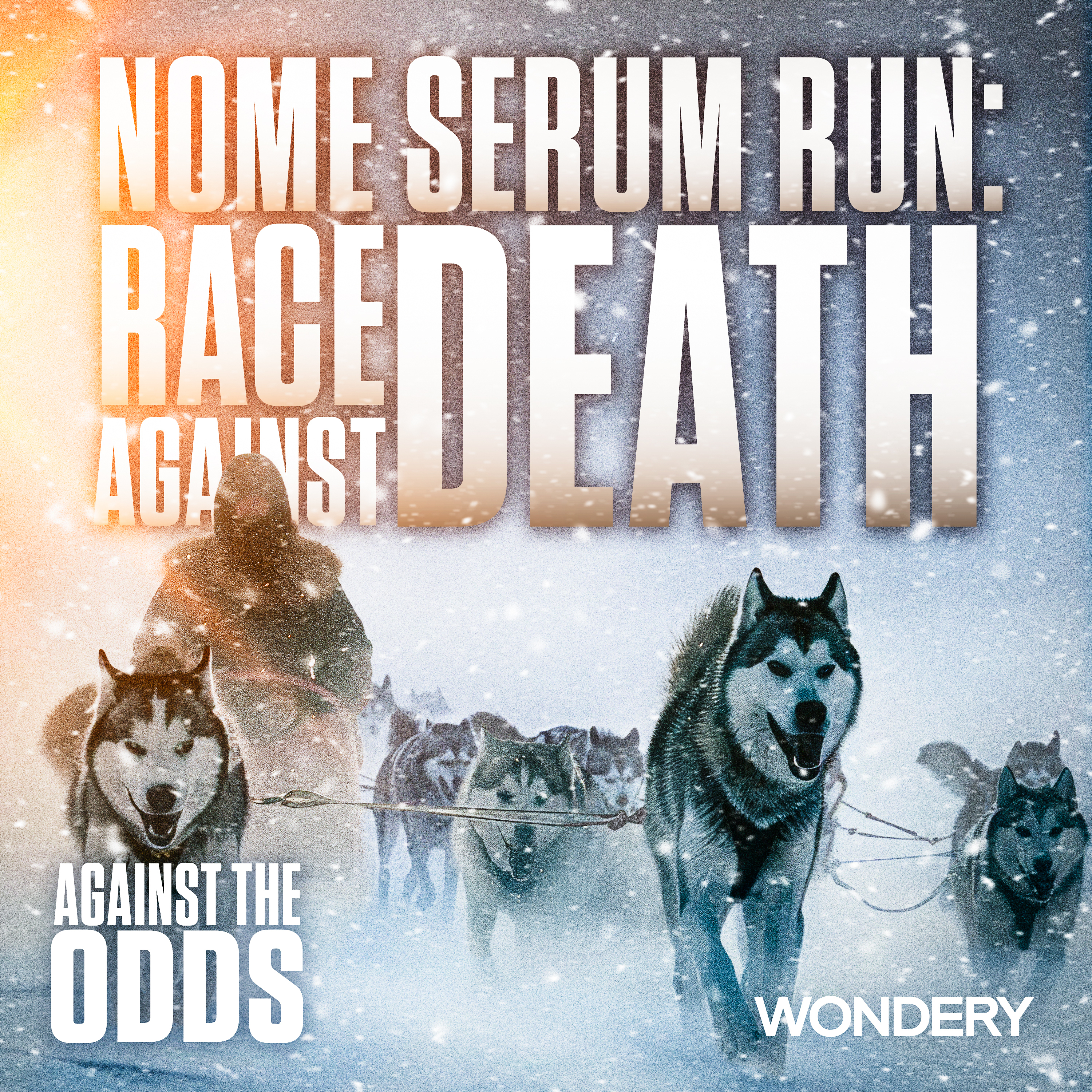
Loading summary
Transcript112 lines
- [00:00]
Mike Corey
Wondery subscribers can listen to against the Odds early and ad free right now. Join Wondery in the Wondery app or on Apple Podcasts. A quick note at the end of today's episode, we'll be joined by the folks from Amazon Books who'll be sharing their recommendations for fans of against the Odds. Wondery from Wondery. I'm Mike Corey and this is against the od. Musher Leonard Seppala and his dog team, led by Togo, made the longest part of the grueling trip from Ninana to Nome in the winter of 1925 despite life threatening conditions with temperatures well below minus 40. His team helped deliver diphtheria antitoxin to save the children of Nome a hundred years later. In honor of the 100 year anniversary, Musher Jonathan Nathaniel Hayes is going to recreate the Gnome Serum Run from Ninana to Nome with a team of dogs descended from Togo and the original team. Hayes is the owner of the Maine based Poland Spring Sepele Kennels, which breeds the registered descendants. He calls himself Chief Pooper Scooper and he's also a retired Marine, a high school biology teacher, and a preacher. It's a little bit of a jigsaw puzzle how Leonard Seppele got from Alaska to Maine and how Hays came to mush with Togo's descendants, but we'll explain Jonathan Nathaniel Hayes welcome to against the Odds.
- [01:56]
Jonathan Nathaniel Hayes
It's great to be here. Thanks for having me.
- [01:58]
Mike Corey
We'll get into the whole backstory of how you got into this, but first I want to talk about how you're getting ready to recreate the 600 mile plus gnome serum run. I'd love if you could describe training for such a large undertaking.
- [02:14]
Jonathan Nathaniel Hayes
So we start with two mile runs, we do six of those and then we do six four mile runs and then six eight mile runs and so on and so forth. The typical run is we'll get to the kennel and I'll hydrate the dogs right away and then the moment we pull out the gear I have to put some music in my head because the cacophony of noise when the dogs see the gear coming out the harnesses, they just get so pumped and so excited that I have to put earphones in. And you know a typical training run, I've got a story where our team was attacked for 45 minutes by a moose and we had to put it down and another time on the lake. So six of my eight dogs broke the gang line and I ended up mushing them back without a sled just Sitting on my butt. I actually broke, literally broke my tailbone just riding across the ice, sitting on my butt across the lake. It was the only way I could walk them home. So you never know what's going to happen when you get out on the trail.
- [03:10]
Mike Corey
And these are training runs.
- [03:11]
Jonathan Nathaniel Hayes
Yes.
- [03:14]
Mike Corey
So your lead dog is Druid, right? That's his name?
- [03:19]
Jonathan Nathaniel Hayes
Yes, that's right. He's the son of our matriarch who just passed away this past year, Frost. And then the granddaughter of Frost is our up and coming leader, Juno.
- [03:29]
Mike Corey
What makes a good lead dog?
- [03:31]
Jonathan Nathaniel Hayes
So lead dogs are both born and made. Druid's not a natural leader, but I just invested so much work into turning him into that. But then you have dogs like Juno. I say Juno is our Togo because she was such a runty dog. But from the time we hooked her up at 10 months old, every time the team would stop, she'd try to pass the dogs in front of her. And so I was like, okay. And I'd move her up. By 12 months old, she became one of our primary leaders. She's still runty. She's not a whole lot to look at, a lot like Togo, but she's got heart that just doesn't quit. And no matter where you put her on the team, she says, hey, I'm here. I'm in charge. This is my package.
- [04:11]
Mike Corey
I actually have some photos of Druid and Juno here, and they're vibrant white. They look almost like wolves, like very alert and very, very driven. You can tell?
- [04:20]
Jonathan Nathaniel Hayes
Yeah, the moment you put a harness on a Seppala Siberian sled dog, they take to it like a duck to water. It's really remarkable. And I say they're the dog for people who like cats, because they're very neat, they're very prissy, they're very clean. And I think that comes from, you know, the environment that they've been in for the last several thousand years.
- [04:39]
Mike Corey
I know you did a hell of a long race here a few years ago in Maine, 261 miles or so. I would love to know when you're going through Maine. Of course, Maine and Alaska are an entire continent away, but what are some differences of the trail?
- [04:53]
Jonathan Nathaniel Hayes
I would say that our region of northernmost Maine has similar snowfall to Willow, Alaska, just north of Anchorage. But you move further up to the low Arctic, where we're going to be running this expedition, and it can be frozen and no snow, or it can be dumped on with snow. And the major difference, obviously, is that we'll hit minus 40 here once or twice a winter. But last year it was 65 below zero on the trail at the time that we will be departing.
- [05:28]
Al Woodworth
Let's face it, when a new season rolls around, everyone gets that itch to freshen up their wardrobe. But who wants to throw money away on trendy pieces that'll be out of style before summer hits? That's what makes Quince different. Their clothes are the kind you reach for again and again. Classic styles that look expensive but don't break the bank. Like 100% European linen shorts and dresses from $30 Luxe Swimwear, Italian leather platform sandals and so much more. And everything with Quint is half the cost of similar brands. By working directly with top artisans and cutting out the middleman, Quint's gives you luxury without the markup. I love the featherless quilted long puffer jacket I got from Quint's. It's super lightweight and is such high quality for the price. Give your summer closet an upgrade with quince. Go to quince.com theodds for free shipping on your order and 365 day returns. That's Q-U-I-N-C-E.com theodds to get free shipping and 365 day returns. Quince.com theodds Here's a tip for growing.
- [06:29]
Capital One Ad
Your business get the VentureX business card from Capital One and start earning unlimited double miles on every purchase. That's right, with unlimited double miles, the more your business spends, the more miles you earn. Plus, the venturex Business Card has no preset spending limit, so your purchasing power can adapt to meet your business needs. The VentureX business card also includes access to over a thousand airport lounges. Just imagine where the VentureX business card from Capital One can take your business. Capital One what's in your wallet? Terms and conditions apply. Find out more@capital1.com venturexbusiness.
- [07:14]
Mike Corey
Backtracking a little bit. You grew up in Tennessee. Did you grow up with dogs?
- [07:19]
Jonathan Nathaniel Hayes
Yeah. So I'm a sixth generation Tennessean and my parents would not let me have dogs. So this is what happens.
- [07:25]
Mike Corey
Parents getting back at them.
- [07:28]
Jonathan Nathaniel Hayes
This is what happens when you don't let your kids have a dog. Let them have a puppy. Yeah, my mom would just say, hey, be home at sundown and I'd go out into the woods and spend the day there. And I was always adopting critters, bringing them home. Turned the bathtub in the basement into a little pond with an alligator snapping turtle. I was trying to do falconry with my rooster on my Arm. So I've always loved animals, had a passion for them. Yeah. So I didn't have dogs when I was a kid.
- [07:54]
Mike Corey
Now how many do you have?
- [07:55]
Jonathan Nathaniel Hayes
So I have 22 sepplas in the kennel right now.
- [07:58]
Mike Corey
Okay, so from none to 22, there you go. And how did you get into to mushing?
- [08:03]
Jonathan Nathaniel Hayes
I said when I was a kid that I was going to move where there's snow. I had a love affair with it from the time I was a kid. And when I was in the Marine Corps, I was attached to a cold weather infantry unit. And then we came to Maine for SERE training. SERE is survival, evasion, reconnaissance and escape. That was my first experience with frostbite. I think I was 19 or 20 years old. And then I thought, man, when I get out of the Marine Corps, I'm going to move to Maine. But an old timer that I met from Maine, he said, if you're going to move to Maine, you'd better find a way to enjoy the winters outdoors. You can't sit them out indoors. You'll get cabin fever. And so I said, I like snow, I like dogs. I'm going to put those two together. I'd never met a musher, but I started getting every book I could from the library and learning from the school of hard knocks. Just making a lot of mistakes and started out by adopting a lot of people's pet Siberians that they didn't want anymore.
- [08:58]
Mike Corey
They're magical dogs, man. I mean, people, I see them all over the world adopting them into their houses, and I feel like those dogs are meant to work, not to be in an apartment in New York City. You know what I mean?
- [09:09]
Jonathan Nathaniel Hayes
Yeah. You know, when I have people here say, hey, I'm worried about your dogs living outdoors in the winter. I say, I'm worried about Siberian huskies living outdoors down south in the summer. They start getting happy when it starts getting below 10 degrees. And the colder it gets, the more alive they come, the faster we move down the trail. Over the last. Now they're saying 9,000 years that we've been mushing with sled dogs. We have selectively bred this wolf desire to hunt in a pack and to run something down together as a team. And I think that generation after generation, we've just magnified that trait. And so you'll see it when you go to a race. You'll see it in my dog yard. The moment the harnesses come out, they just go insane. If you don't hook them up fast enough, they'll shred the harnesses, they'll shred the gang lines. They're just so excited to go. It's in their DNA.
- [10:04]
Mike Corey
A few years ago, you did a solo mush from Canada into Maine that was about as long as Leonard Seppla's run of about 250 miles, 260 or so. There was a documentary about it on YouTube, actually, and anyone can check that out, which is quite fantastic. I'd love to know why you first decided to do that. Was it already like, okay, I'm gonna do this and then go to Alaska, or was it its own thing? Or what was the motivation?
- [10:25]
Jonathan Nathaniel Hayes
I'm really not a racer. I am an adventurer at heart and I love the North Maine woods. And it had occurred to me that it was roughly 260 miles from the top to the bottom. It ended up being around 280. And when the owner of Poland Spring Inn, that's the same place that Leonard Seppele moved to and partnered with when he came to Maine in 1927. When the current owner of the Poland Spring Inn reached out to me and said, jonathan, I want to build a bronze statue to togo here at his final resting place. We were right in the middle of COVID All the races had just been canceled, and I said, man, this is my opportunity. I'm going to hit the trail in seven days. Crossing the Northwood solo, it was so good, actually. You learn to live in the moment. When you're on the trail, you're just thinking about the present. You're not thinking about your bills. You're not thinking about all of the things that weigh us down when we're in civilization. It was already dark and I could see Greenville off in the distance, and that was my finish. As I was coming down Moosehead Lake and. And I could see civilization up ahead. And there was really a part of me that just wanted to turn around and go back into the woods because I had gotten into this rhythm with the dogs. So I finished that. I had pretty much been a recreational musher up until that point. And then all of the reporters and everything started asking me, what's next? And when they asked me that, I was like, yeah, what is next? And the centennial's coming up, and so here we are.
- [11:52]
Mike Corey
And speaking of Seppala and the dogs, I want to ask you how you got the dogs. But first let's get some connective tissue for how Seppala himself got these dogs. Where were they from? What's their story?
- [12:02]
Jonathan Nathaniel Hayes
I really appreciate you asking that question because most people start the story of Leonard Zeppla and his team with either the sweepstakes races that he won handily or the serum run to save the children of Nome. But the story actually begins with Roald Amundsen. The people who first discovered gold in Nome, Alaska, were called the lucky Swedes. They were actually Norwegians. And one of them connected with Leonard Zeppla as a young man and invited him to come to Nome, and he did. And they actually bought Siberian dogs from Siberia for Roald Amundsen's attempt to become the first man to the North Pole. They were known to be not as strong as the Alaskan Malamutes and other dogs of Alaska, hundred pound dogs. But as far as endurance and crossing mile after mile after mile, these, and I'm putting air quotes, these Siberian rats, as a lot of Alaskans liked to refer to them, they were like an Energizer Bunny. They just kept going and going. And so the Lucky Swedes bought them actually for Roald Amundsen's attempt to the North Pole. But when another Mainer, Robert Peary, became the first person to the North Pole without telling any of his sponsors, Roald Amundsen shifted gears and sailed to the South Pole. He never went to Nome to pick up these dogs. So the Lucky Swedes gifted them to Leonard Seppla. And I really think that Seppla saw something of himself in these dogs, these Siberian rats, as Alaskans like to say. Leonard Seppala's five foot four, ice blue eyes, very wiry. People underestimated him. And so I think when he looked in the ice blue eyes of these little tiny Siberians that were always underestimated, I think he saw a bit of himself in them.
- [13:51]
Mike Corey
Yeah, yeah, I can see that. What a wild story. And how did you get your hands on the bloodline?
- [13:58]
Jonathan Nathaniel Hayes
So when I got into mushing, I didn't know the rich mushing history that Maine had and this breed's connection with Maine. I realized my first year that the show dog Siberians that I was running, the focus had come so much on form that they had lost the function. They weren't able to do what they had been bred to do over the last hundred years, being bred for a show ring. So I started doing my research. I was reading everything I could on Leonard Seppla. Jeffrey Bragg, who's a Canadian that saved the breed from extinction in the 1970s. He and I began communicating. Doug Willett, who is the man who showed that they could still beat Alaskan huskies in races in the 1990s, he and I started communicating and then a buddy of mine who is a coon hunter, he took me coon hunting. I took him dog sledding. And he said, I want a purebred team, but I want a team that can win races. And I said, well, there's only one breed of dog that can still do that, and that's the Seppala. And he said, do you know where I can get some? I said, I sure do. And so we took a road trip together. That was about a year and a half into my mushing career. That was about 28 years ago. And for the last 25 years, the Seppala's had my heart.
- [15:07]
Mike Corey
But then how did Seppala and Togo end up in Maine?
- [15:12]
Jonathan Nathaniel Hayes
So in late 1926, Seppala did a tour of the lower 48 states with his team. And when he got to New York, it was Roald Amundsen who met Leonard Seppla in Togo and awarded him the medal for his bravery. So that was really cool. But there in the crowd was a musher. His name was Arthur Walden, and he was a New Hampshire guy that had created his own breed of sled dog called the Chinooks, and they're actually the state dog of New Hampshire. Now. He challenged Leonard Seplo to come to Maine to the Poland Spring Dog Derby and race against them. Now, keep in mind that Leonard Sepoletogo and his team had been on display, traveling on trains throughout the lower 48, had not been conditioned, were not at all prepared to run a race. And Togo's old right, they get to Poland Spring and of course, Leonard Zeppla handily beats all of the New England mushers. And the owner of Poland Spring Inn and Resort, who is a flapper, if you know the 1920s terminology, she was quite the woman of her age, Elizabeth Ricker. She persuaded Leonard Seppla to stay in Poland Spring. Maine, established the first Sepla kennels. They dominated the racing circuit for almost a decade. They represented the United states in the 1932, I believe it was Lake Placid Olympics, the Winter Olympics, and a dog sled exhibition race in the Olympics. That's how the first first Seberian sled dog breed kennel was established right here in Maine. And so I'm just blessed to be carrying on that tradition.
- [16:54]
Al Woodworth
In today's job market, finding the right talent can feel like searching for a needle in a haystack. Slow, frustrating, and often exhausting. But there's a better way, indeed, when it comes to hiring, indeed is all you need with indeed sponsored jobs listings jump to the front of the line, right where ideal candidates are looking. And it works. According to Indeed data, sponsored jobs get 45% more applications than regular posts. And here's something remarkable. In the time it took to share this information, about 23 people just got hired through Indeed. The best part with Sponsored Jobs, there are no monthly fees or long term contracts. You only pay for results and listeners of the show will get a $75 sponsored job credit. To get your jobs more visibility at indeed.com theod just go to indeed.com theodds right now and support our show by saying you heard about Indeed on this podcast. Indeed.comtheodds Terms and conditions apply. Need to hire? You need Indeed.
- [17:53]
Nick and Jack
This is Nick and this is Jack. We're best friends, ex finance guys and resident 90s expert. And every week on our podcast, the Best Idea yet, we're bringing you the untold stories behind your favorite products. For instance, can you guess which billion dollar fashion company went viral thanks to a rhinestone covered tracksuit? Or which cartoon turned four turtles into a global toy empire by accident? It started as a joke. Last one. Which cold beverage was so hated by Starbucks they actually ended up acquiring it?
- [18:22]
Jonathan Nathaniel Hayes
Spoiler.
- [18:23]
Nick and Jack
The Frappuccino. Howard Schultz apparently thought cold coffee was super lame and then he bought it. From Teenage Mutant Ninja Turtles to Juicy Couture to the Orange Mocha Frappuccino, Join us every week to learn how your favorite things got made. Follow the best idea yet on the Wondery app or wherever you get your podcasts. And you can listen early and ad free right now by joining Wondery Plus. And if this podcast lasts longer than 45 minutes, call your doctor.
- [18:57]
Mike Corey
So Jonathan, you are recreating the Gnome Serum run from the Nana to Nome and it's going to be very cold there. Minus 50 perhaps. I'm wondering what's the big drive? Because you could just sit by a fire in Maine, you know, enjoy a nice cozy winter snow globe life. But you're going to get back on the trail. Why?
- [19:16]
Jonathan Nathaniel Hayes
Sepple was 48 years old when he did the serum run. I'm 48 years old. It's the centennial. It's the 100 year anniversary and I'm the president of the Breed Club, so I'm a steward of the Breed. A hundred years after their heroic deeds. There's less than 100 sepulas left in the world today. But you know, when you dig a little bit deeper, George Mallory said, you know, because it's there. That's why I'm doing it. But I really like what another explorer said to a reporter. When the reporter asked, why are you doing this? He said, if you have to ask why I'm doing it, no answer I will give you. Makes sense. And so there are just some people who are wired this way. And I really believe that providence has put me in this place with this breed for this time. And believe me, my wife would much prefer that I was the guy who worked a 9 to 5 and came home and ate dinner on the couch watching a television movie.
- [20:12]
Mike Corey
But she'll be very proud when you come back home.
- [20:16]
Jonathan Nathaniel Hayes
Right.
- [20:16]
Mike Corey
And speaking of that, who else is going on this trip with you?
- [20:19]
Jonathan Nathaniel Hayes
This is a team effort, and this isn't a solo expedition. Jamie Nichols is a master mechanic, so he's going to be our engineer. Caleb Gendry is joining me, and he's a brilliant videographer, and I'm really looking forward to the documentary he's going to be making. And Jeff Kelly is going to be with their support snowmobiles. Some people would say, oh, you've got, you know, snow machiners traveling with you. Doesn't that take away from the adventure of it? The original 20 teams that did this relay, there were 20 teams that did the relay, and they were going from roadhouse to roadhouse. Those roadhouses aren't there anymore. We're going to spend about two thirds of our nights camping in tents along the trail because that mushing trail system no longer exists. So the snow machines are our roadhouse, so to speak. That's the way we're looking at them. They're going to provide for us some of the supplies that would have been provided by a roadhouse to the teams that were traveling and relaying this serum.
- [21:18]
Mike Corey
Yeah, having support snowmobiles is a bit different, but I think also rolling up to a roadhouse with a nice hot pot of soup and a fire.
- [21:26]
Jonathan Nathaniel Hayes
Yes, exactly. And not only that, but these mushers were mushing in their backyard. Their dogs knew these trails by heart. With the exception of Seppala, who was out of his home range, these guys were mushing on their home turf, and they knew they could push it because 35 miles down the trail, there was going to be a hot fire and some warm soup, and they were going to hand it off to someone else. We're not going to have that luxury.
- [21:50]
Mike Corey
No, you're going to have the luxury of setting up a tent in the dark and -40, which I am not envious about at all. But speaking about the route that you'll be taking, is it different than the route that Seppala took in 1925, only.
- [22:03]
Jonathan Nathaniel Hayes
Slightly and only in the sense that it is longer. There's a lot of numbers that are thrown out. If you read Leonard Seppla's own account of his serum run, he claims to have run over 300 miles, although the standard is 261. And although many people say 600 miles for the serum run, in total, most reenactments in the past, which have been run, you know, in March, those have always consistently said it was over 700 miles. So we're going to be somewhere between 700, 750 miles. And the route is pretty much the same, just like Wild Bill Shannon. We're going to take off from Nenana, we're going to head up the Tanana River. We're going to spend a few days on the Tanana river, and then we're going to spend several days on the Yukon river before crossing a mountain range and coming down on the Bering Sea coast. And then we're going to spend several days working our way up the Bering Sea and across Norton Sound on the sea ice, if the sea ice is there, if the climate change will permit and make our way to Nome, we're doing it from start to finish, and we're going to be somewhere between 18 to 20 days. And unlike the original serum run where dogs died, that is not an option for us. Every dog that starts this expedition will finish. And because of that, we're going to be taking time on the trail, camping out and making sure that we're doing this, you know, with the dog's best interest at heart.
- [23:24]
Mike Corey
From the story we told, Norton Sound sounds quite harrowing, honestly, but in this journey, what parts are you most worried about?
- [23:31]
Jonathan Nathaniel Hayes
So every stage of this expedition has its own trials and tribulations. For the first half of this expedition, the local Athabascans in these villages are telling me, Jonathan, we don't even travel between villages at that time of year until the second or third week of February. They're not putting in trails between villages just because there's so many variables. So on the Yukon river, you have drum ice, you have jumble ice, all of these things that we have to contend with. We're going to be breaking our own trail. And even with the snowmobile going out ahead of us, there's no time for the trails to set. So the dogs will be waiting in what the locals are describing as sugar. You know, consistency of sugar is what they're going to be pushing through. So that would be what Most people think of are the sea ice breaking up underneath us as the major concerns. But my major concern are the blowholes. I have several friends who.
- [24:31]
Mike Corey
What's a blowhole? For those who don't know, like myself.
- [24:34]
Jonathan Nathaniel Hayes
A blowhole is where the winds coming off of the Bering Sea get funneled through hills and just turn the stream or river and the hills for that matter into just glare ice, just solid ice. So then these just extreme winds, gale force winds. I have several friends who have had to scratch 940 miles into a thousand mile race because of the blowholes. Just the wind comes in so hard and literally crawling on your hands and knees. The sled is no good because it's on ice and the wind just treats it like a sail.
- [25:10]
Mike Corey
Yeah. Because I imagine the snow keeps the tracks at least some friction there. But if it's just a sheet of ice, you're going to get blown like a, like a boat in the ocean.
- [25:17]
Jonathan Nathaniel Hayes
You're throwing around like a rag doll. And that's where a lot of people break a lot of bones. And if you're not careful, you can have injured dogs. So that's my biggest concern.
- [25:27]
Mike Corey
You mentioned drum ice. What's drum ice?
- [25:30]
Jonathan Nathaniel Hayes
Yeah. So with the drum ice, what happens is the river freezes, but then the water level under the ice recedes and then it freezes again. And sometimes this can be up to two stories of a hollow ice cavern underneath the river ice and you don't know it's there until you break through. And there have been countless stories of mushers being stuck in drum ice and unable to claw their way out.
- [25:56]
Mike Corey
Wow. I'm just trying to paint a bit of a picture of this whole journey. Man, it sounds like there's a lot to think about. And going back to this, setting up tents in the cold, how are the dogs staying warm? Are they coming in the tent with you or is there going to be a bonfire set up? How does that all work?
- [26:10]
Jonathan Nathaniel Hayes
We just spent $2,000 in the expedition funds just for coats for the dogs.
- [26:15]
Mike Corey
I know they used to use rabbit skins to cover the groins, so I guess we've upgraded a little bit.
- [26:19]
Jonathan Nathaniel Hayes
Yes, yes. With Velcro and everything now, but we've got extreme coats for the dogs, booties for the dogs, and we're going to be laying down straw for the dogs. But I'll be honest, those things are necessary for racing huskies who've been crossbred with hounds for speed. But for the most part our dogs are going to be quite happy and quite at home. They have layers of fat under the pads of their feet. They have this heat exchange system in their legs where the blood going down to the extremity is actually warming the blood that's coming back up instead of it going down hot and coming back cold.
- [26:55]
Mike Corey
Oh, wow.
- [26:56]
Jonathan Nathaniel Hayes
And then the double coats, even down to their blue eyes. You know, their blue eyes are designed to process low levels of light in the Arctic winter. So they're going home for us. We will just be using the heat of our cook stoves that melt our water. That's going to be the only heat in our tents, and we're going to be trusting the rest of it to a lot of high tech sleeping bags and parkas.
- [27:22]
Mike Corey
I think if you all kind of like huddled together as a big pack, kind of like penguins in the Antarctic, wouldn't that be helpful? I'm just throwing ideas out here.
- [27:28]
Jonathan Nathaniel Hayes
We were making jokes on our expedition training weekend as to who gets to spoon with who and who's going to be the big spoon and the little spoon.
- [27:36]
Mike Corey
But honestly, maybe it might come to that.
- [27:49]
Narrator
Today is the worst day of Abby's life. The 17 year old cradles her newborn son in her arms.
- [27:56]
Al Woodworth
They all saw how much I loved him. They didn't have to take him from me.
- [28:00]
Narrator
Between 1945 and the early 1970s, family families ship their pregnant teenage daughters to maternity homes and force them to secretly place their babies for adoption in hidden corners across America. It's still happening. My parents had me locked up in.
- [28:17]
Al Woodworth
The godparent home against my will. They worked with them to manipulate me and to steal my son away from me.
- [28:23]
Narrator
The godparent home is the brainchild of controversial preacher Jerry Falwell, the Falcon father of the modern evangelical right and the founder of Liberty University, where powerful men, emboldened by their faith, determine who gets to be a parent and who must give their child away. Follow Liberty Lost on the Wondery app or wherever you get your podcasts.
- [28:49]
Behind the closed doors of government offices and military compounds, there are hidden stories and buried secrets from the darkest corners of history. From COVID experiments pushing the boundaries of science to operations so secretive they were barely whispered about. Each week on redacted Declassified Mysteries, we pull back the curtain on these hidden histories. 100% true and verifiable stories that expose the shadowy underbelly of power. Consider Operation Paperclip, where former Nazi scientists were brought to America after World War II not as prisoners, but as assets to advance US intelligence during the Cold War. These aren't just old conspiracy theories. They're Thoroughly investigated accounts that reveal the uncomfortable truths still shaping our world today. The stories are real. The secrets are shocking. Follow declassified mysteries on the Wondery app or wherever you get your podcasts you can listen to redacted early and ad free right now on Wondery.
- [29:55]
Mike Corey
So I imagine recreating the gnome serum run and trusting the dogs and the team requires almost like an intuition between man and beast. Can you speak a little bit to what it's like to trust the dogs? Even like you said in low light in the storms and having your lead dog, I'm assuming, druid leading the way? Like, what's that relationship like?
- [30:18]
Jonathan Nathaniel Hayes
Oftentimes with these romanticized stories, we deify the dogs. They can make mistakes too, if there's a game trail or if there's a caribou. Togo was notorious for taking off after caribou, and that's actually why he didn't get a lot of his accolades after the serum run, because Leonard Seppla had lost him. He was off chasing caribou. So they do make mistakes, but they have senses that we don't have and we have some reasoning skills that they don't have. And when you put those two things together in that symbiotic relationship, that's what saved the children of Nome. You have the human mind with its problem solving skills coupled with these amazing senses. The dogs can feel the trail underneath their pads. They can feel it through the snow drifts. They can smell it. Even if a team has passed by there a week ago and there's no trail left, they can smell that a team had gone through there. They can feel the drum ice in a way that we can't. And so you trust them in those situations, but understanding that they are not infallible. So you have to always be on the guard and being partners with them in that.
- [31:25]
Mike Corey
So what are some things that you keep an eye on when you're moving with the team?
- [31:29]
Jonathan Nathaniel Hayes
Definitely their gait. When you spend as much time as I do out on the trail training these dogs, not only building them up physically, but building them up mentally. To think that you're never going to ask them to do something that they can't do. When you spend that much time with them, you learn their gaits, you learn their cadences. So if something is just minorly off, maybe they didn't eat as much as they usually do, they might have caught a little bug or a virus, and maybe they're a little dehydrated. When you walk down and pat them, you know you're Going to pull on their coat a little bit to make sure that it retracts really quick.
- [32:04]
Mike Corey
One second. Sorry. So you, you would pull on their skin to see how dehydrated they would be?
- [32:09]
Jonathan Nathaniel Hayes
Yeah. So the nap of their neck, you kind of just grab it with your hand and pull it up a little bit. And the faster that it retracts, the more hydrated the dog is and the slower it retracts, the more dehydrated it is. And if you're fueling the dogs right, we've got 400 pounds of beef, we've got 300 pounds of salmon, 200 pounds of beaver and 150 pounds of beef fat. All of that in addition to the native dog food kibble that we're going to be carrying on the trail for us. So fueling them is essential. As long as you're keeping the right kind of calories in them, they can go on and on forever. The reason why they're capable of doing what they do is they have a metabolic switch that we don't have. They only run on carbs for like the first hour and a half of a distance race or an endurance race. And then they switch this metabolic switch where now they're running on the fat that's in their bloodstream and the protein. So that's why you'll see in races on the trackers, you'll see they're every two and a half or three hours, you'll see a drop in their speed and then it'll pick back up again. That's where the musher is stopping and slamming that fat and salmon into their dogs because they know as long as they can keep that in the dog's bloodstream, they can just go and go and go and they love it.
- [33:32]
Mike Corey
Yeah, well, I imagine just the amount of calories they would use to push through it. And not even just the hard work, but also the cold. Right. Because warming up your body, whether you're a human or a dog, takes a.
- [33:41]
Jonathan Nathaniel Hayes
Lot of calories to 10 to 12,000 calories a day.
- [33:46]
Mike Corey
Wow.
- [33:46]
Jonathan Nathaniel Hayes
In a 50 pound dog. Wow. I wish I could eat that much.
- [33:52]
Mike Corey
Yeah, right. A lot of ice cream and spaghetti or something. So Druid is your lead dog. How old is druid?
- [33:59]
Jonathan Nathaniel Hayes
Druid's almost 10.
- [34:00]
Mike Corey
Do you think this might be his kind of like last Big Bang?
- [34:03]
Jonathan Nathaniel Hayes
Yeah. So for druid and vodka, those are my primary leaders. I can trust them to plow through anything. If I ask them to turn right over a snowbank and off of a trail into the woods, they'll do it for me. But they're having trouble keeping up with all the young upstarts behind them. The younger dogs want to set a little bit faster pace. So when everything's good, we'll put the younger dogs out front and give them a chance to lead and get that experience. But when the going gets tough, Druid and Vodka are going to be our go tos. But they're slowing down. They're having trouble keeping in front of a team of younger dogs. And this will be their last major expedition. I say that when we get home a week later, they're going to be leading me in the can am crown 250 mile race. A week after the expedition, and then I'll give them a quasi retirement of recreational runs.
- [34:50]
Mike Corey
Just a little warm up before, you know, a casual race. And I know you're a father and I think you have seven kids, so I can imagine you feel some empathy for what it would have been like way back in 1925 to have some sick kids and not really any cure besides the serum that was hundreds of miles away. Does this thought enter your mind at all as you prepare for this big run?
- [35:14]
Jonathan Nathaniel Hayes
When Leonard Seppele did this run, he had a daughter in Nome that was at the prime age where other children were dying. And as a father who was able to hold his son Arden, my son Arden, just for a short period of time before he died at birth, although it was for a short time, it had devastating effects on our psyche, on our family. So I understand what those families must have been going through. I mean, we just went through Covid and all life is precious. But Covid, you know, mostly took the life of the elderly. This was a disease that was taking the life of infants and children. That's horrible. I tell my adult kids, you're never going to understand a father's love until you're a parent. When they're little, they walk on your feet. When they're older, they walk on your heart. But it doesn't matter. No matter what they do, you just love them. Our kids are our legacy. They're our heritage. And the saddest thing is when a parent doesn't understand that. And Seppala understood it and the town of Nome understood it.
- [36:16]
Mike Corey
Finally, we should say that we are taping this interview right before you set out to recreate the Gnome Serum run. And Jonathan, Nathaniel Hayes, thank you so much for being on against the Odds today. We wish you so much luck on the trail and thank you for speaking to us today on the podcast.
- [36:33]
Jonathan Nathaniel Hayes
Thank you. I'm honored to be here. Thanks for having me.
- [36:39]
Mike Corey
So if you're a fan of against the Odds and you're looking for your next adventure story, we've got you covered because Al Woodworth, managing editor for Amazon Books, is back. Every year, Al and her colleagues read thousands of books to help people discover great stories. Today, Al joins me on against the Odds to share recommendations for some books she thinks you'll love.
- [37:00]
Jonathan Nathaniel Hayes
Hey, Al. Hey, Mike.
- [37:02]
Al Woodworth
Thanks for having me.
- [37:03]
Mike Corey
All right, first question. You ready?
- [37:04]
Jonathan Nathaniel Hayes
Sure.
- [37:05]
Mike Corey
So what's a book that you've read that really got under your skin?
- [37:10]
Al Woodworth
So I would say this is Chance by John Mualam. This is a book published in 2020, and it's one that I just can't get out of. My takes place in Alaska. It's the true story of a 1964 earthquake. It was 9.2 on the Richter scale, the second worst in history. And this is the story of this woman, Jeannie Chance, who broadcast on the radio for three days straight, ferrying messages of safety and providing calm in what was a tragic, chaotic event. The minute that it hit, she rushed down to the studio because this was in her blood to help out her community. And so a really selfless, if you think about it in that way, who knows what was happening with her family, but there she was in the broadcast booth trying to help. And so it's just an extraordinary story of regular people coming together to save their community. And it's a book that I think will resonate with folks who want to learn about Alaska and just resonates with people who are looking for some hope, I think, in what community can offer.
- [38:13]
Mike Corey
And you were saying that it was three days straight radio broadcast.
- [38:17]
Jonathan Nathaniel Hayes
Yeah.
- [38:17]
Al Woodworth
Which I can't imagine.
- [38:19]
Mike Corey
No breaks.
- [38:20]
Al Woodworth
Exactly.
- [38:21]
Mike Corey
It sounds like a wild book. And I know you have some fiction recommendations to share. What are some recommendations and what are some things about these books that you loved?
- [38:29]
Al Woodworth
Yeah. So I love Peter Heller's the Dog Stars. He's one of the best outdoor fiction writers working today, in my opinion. And the Dog Stars tells the story of the aftermath of a pandemic. And there is a man named Higgins who survived his dog Jasper, and then his neighbor, and they are trying to survive. They've got their plane, and so they get in their plane every once in a while to check out civilization and what's left of it. And this is really a story of a man and his dog and the hope that's offered. And there's another radio component in this one. So he hears a voice on the radio of his old Cessna plane. He hears the radio and then he gets in his plane to go check it out and it's sort of the story of what happens next. It is poetic and haunting and it's another story of survival that I just loved.
- [39:21]
Mike Corey
Any other books?
- [39:22]
Al Woodworth
And then the last one is the Great Alone by Kristin Hannah. She's a really great historical fiction writer working today. This also takes place in Alaska and it's the story of a damaged Vietnam vet who decides to move his family to Alaska to start from fresh. But winter is coming and so this is a story of his family and what they do when winter sets in. It's another story of survival. It's a story of family. It's a story of community. And I think for this one, Alaska is such a significant character in this book, which is why I loved it so much. You see it in all of its untamed, beautiful and dangerous glory, and I think that that's what resonated so much with me.
- [40:05]
Mike Corey
Seems like Alaska is a ongoing, fantastic source for wild stories.
- [40:10]
Al Woodworth
It sure seems like it. I've only been in fiction and nonfiction. I have not been in real life. But one day I hope to go well.
- [40:19]
Mike Corey
Al, thank you so much for this brief summary of some books you gotta read.
- [40:23]
Al Woodworth
Thanks so much for having me.
- [40:31]
Narrator
If you like against the Odds, you can binge all episodes early and ad free right now by joining Wondery in the Wondery app or on Apple Podcasts. Prime members can listen ad free on Amazon Music. And before you go, tell us about yourself by filling out a short survey@wondery.com survey.
- [40:52]
Mike Corey
This is the fourth and final episode of our series Gnome Serum Run. Thank you so much to our guest Jonathan Nathaniel Hayes. To learn more about the Seppala centennial trip, visit mushmain.com or search centennial Seppala Expedition on Social Media. Jonathan is the author of four books including the children's book the True Tales of Togo the Sled Dog. And thanks to Al Woodworth for sharing her book recommendations. To read book recognition reviews, learn more about new releases and explore author interviews, visit amazonbookreview.com I'm your host Mike Corey. This episode was produced by Pauly Stryker. Our senior interview producer is Peter Arconi. Audio engineer is Sergio Enriquez. Original theme music by Scott Velasquez and 2K for Freeze N Sink series produced by Emily Frost. Managing producer is Desi Blaylock. Senior managing Managing producer is Callum Plews. Senior producer is Andy Herman. Executive producers are Jenny Lauer, Beckman, Stephanie Jens Marshall, Louie and Aaron o' Flaherty for Wondery.
- [42:04]
Mr. Ballin
You know those creepy stories that give you goosebumps? The ones that make you really question what's real? Well, what if I told you that some of the strangest, darkest and most mysterious stories are not found in haunted houses or abandoned forests, but instead in hospital rooms and doctor's offices? Hi, I'm Mr. Ballin, the host of Mr. Ballin's Medical Mysteries and each week on my podcast you can expect to hear stories about bizarre illnesses no one can explain, miraculous recoveries that shouldn't have happened, and cases so baffling they stumped even the best doctors. So if you crave totally true and thoroughly twisted horror stories and mysteries, Mr. Bolland's Medical Mysteries should be your new go to weekly show. Listen to Mr. Bolland's Medical Mysteries on the Wondery app or wherever you get your podcasts. You can listen early and ad free right now by joining Wondery plus in the Wondery app or on Spotify or Apple Podcasts.