← Against The Odds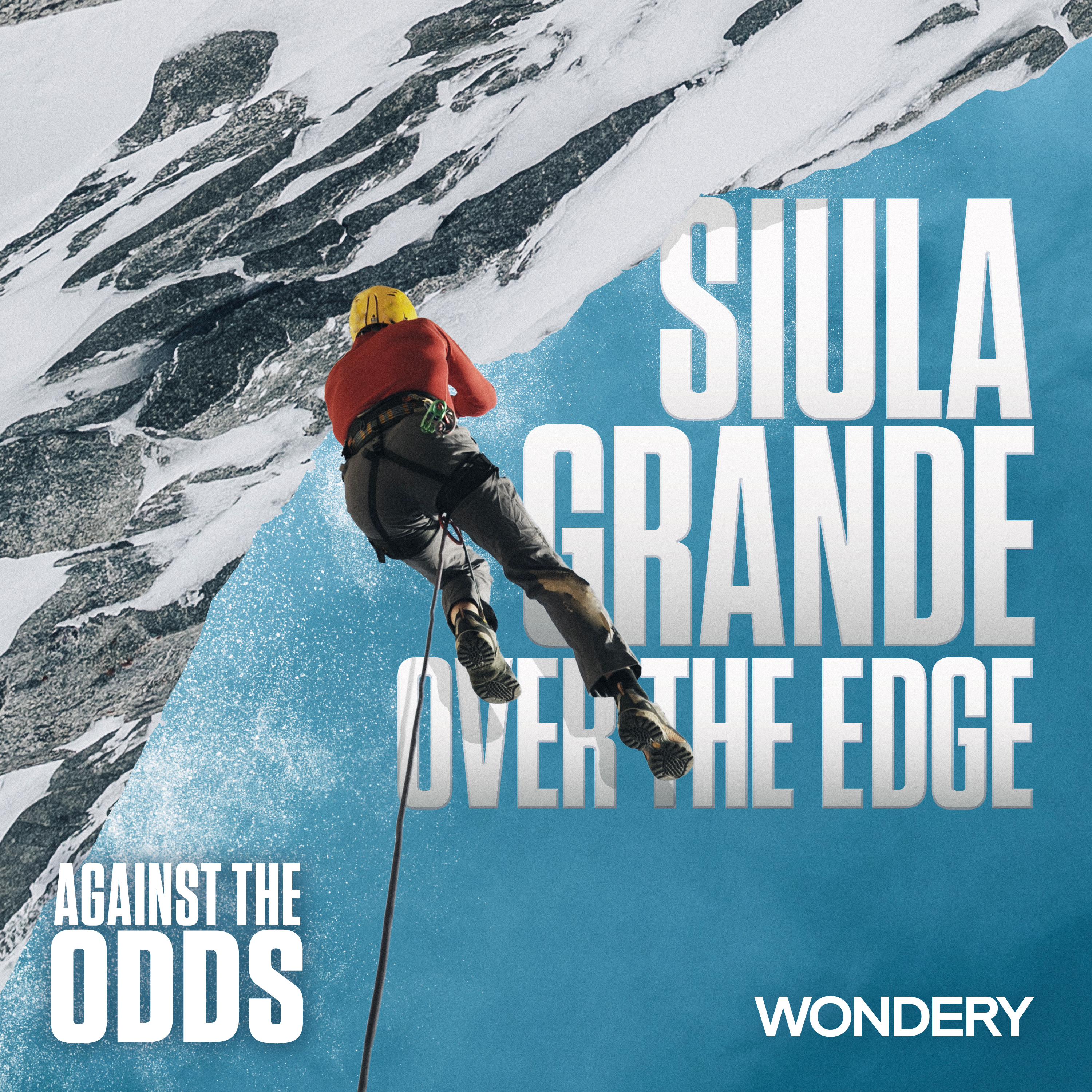
Loading summary
Transcript97 lines
- [00:00]
Advertiser/Announcer
Wondery subscribers can listen to against the Odds early and ad free right now. Join Wondery in the Wondery app or on Apple Podcasts.
- [00:17]
Cassie Depechel
From Wondery. I'm Cassie Depechel and this is against the Odds. It's widely regarded as one of the greatest survival stories of all time. In June 1985, two young British climbers, Simon Yates and Joe Simpson, completed the first ascent of the west face of Sula Grande, a nearly 21,000 foot peak in the Peruvian Andes. But on their way down, disaster struck. Joe fell and shattered his leg. Instead of leaving him behind, Simon lowered him 3,000ft down the mountain, risking his own life to save him. Then came the moment that would define their story. In zero visibility, with no way to communicate, Simon unknowingly lowered Joe over a cliff and was forced to make a decision that would follow him for decades. Simon Yates consulted on our series and he joins me today from the uk. Hi, Simon, welcome to the podcast.
- [01:41]
Simon Yates
Thanks for having me along.
- [01:43]
Cassie Depechel
You're now in your early 60s. This incident happened more than 40 years ago. How would you describe the person you were at 21?
- [01:51]
Simon Yates
Very different to how I am now. It's quite hard for me to imagine actually what I was like at 21. I was quite wild, really quite reckless, and maybe some people would think I was a little bit crazy in some ways, but hopefully in a nice way, you know, I was having a good time and I'd left college and I planned to sort of travel the world and climb mountains. I didn't really have much of a plan basically, other than just to go and climb. So that's what I was doing when I went to Peru.
- [02:18]
Cassie Depechel
Joe was a few years older than you, but he looked up to you both for your abilities and your overall approach to climbing. He also described you as having a glint of madness, quote, unquote. What do you think he meant by that?
- [02:31]
Simon Yates
Well, hopefully like a bit of a spark, a bit of fun, you know. Yeah, maybe he meant that I, you know, I perhaps had a slightly different view of the world. I lived in the moment. I didn't really think too much about tomorrow, which even at that age, quite a lot of people are already thinking about tomorrow. So, yeah, I suppose in that sense I was a little unusual and, yeah, a little mad. I mean, most people would argue that mountaineers are mad just for doing it anyway, aren't they?
- [02:57]
Cassie Depechel
Yeah, probably. So you've described a climbing partnership as kind of a marriage of convenience, right? What exactly do you mean by that? And why do you think you and Joe were a good match.
- [03:12]
Simon Yates
Well, obviously if you want to go and climb a mountain, you've got to have somebody. Well, some people do climb them on their own, but most people climb with another partner. So that's what I'm talking about. With a marriage of convenience, obviously you've got to get on as well. But it's in some ways it's like a working relationship. I think before you go and do a project like the thing on Sula Grande, it'd be foolish to not have an idea of who you were going with. So we climbed together before and at that point we lived in a climbing community in the city of Sheffield. So we wanted to go and climb mountains or mountain faces that hadn't been done before. We were in this city. And then as it turned out, a sort of climbing legend from Britain was there, a guy called Alan Rouse and he gifted us a mountain to go and climb. This mountain, Sula Grande in the Peruvian Andes. He'd done a load of climbing there previously and made a number of significant first ascents. And he knew that this mountain was still waiting to be climbed. So that's kind of the background of how we got together and why we went to that particular mountain.
- [04:11]
Cassie Depechel
And what was it about Ciula Grande that inspired you to climb it, especially its daunting west face?
- [04:18]
Simon Yates
There are a number of practical factors. I suppose we wanted to go ultimately probably on to the Himalayas, but Peru is like a. It's a staging post going from the Alps onto mountains, bigger mountains in the Himalayas or the Karakorum. It's big and it's steep and it's impressive. That's what drew us to it in the first place, because it did look so striking. And those mountains in Peru, and they're quite particular and peculiar because they have those incredible snow formations on them at the top. So that was what lured us to that objective, really. It is a fantastic looking mountain.
- [04:56]
Michigan Life Promoter
Imagine a place where innovation and lifestyle perfectly aligned. In Michigan, you can be part of our rapidly evolving automotive and clean energy industries while enjoying life to the fullest. By day, shape the future in our thriving tech hub. By night, discover beautiful natural wonders, accessible housing, exciting nightlife and an inclusive community that welcomes all. Whether you're developing next gen technology or exploring your next favorite restaurant, Michigan offers the perfect balance of work and play. Ready to make your career and life aspirations a reality. Live your best 9 to 5 and 5 to 9 you can, in Michigan. Work, play and find inspiration. You can in Michigan. Learn more@theMichiganLife.org that's TheMichiganLife.org it's your man.
- [05:49]
Nick Cannon
Nick Cannon, and I'm here to bring you my new podcast, Nick Cannon at Night. Every week, I'm bringing out some of my celebrity friends and the best experts in the business to answer your most intimate relationship questions. So don't be shy, join the conversation, and head over to YouTube to watch Nick Cannon at Night or subscribe on the Wondery app or wherever you get your podcast.
- [06:15]
Cassie Depechel
You were both in your early 20s, but already experienced climbers, having spent a lot of time in the French Alps. That said, you never climbed at such high altitude before, and coelagrande is almost 21,000ft. So looking back now, how prepared were you really for that kind of challenge?
- [06:34]
Simon Yates
Looking back, I could see we could have been better prepared. It wasn't just the mountain, you know, we'd never been out of Europe before either. So we're traveling to a developing world country. It's a country, we don't speak the language. So there was a lot of new things going on there. We had to get ourselves from Lima to a remote town. Then we have to hire a guy with some donkeys to get us into our base camp. Then we have to acclimatize. You know, we had to come up against high altitude for the first time, really. You get sort of headaches and a slight touch of it in the Alps, but nothing like you do when you go above sort of 5000 meters is where it really kicks in. So we were dealing with all those things and they were all new, really. We'd done some research, some background stuff, but I'd say looking back, probably not enough.
- [07:21]
Cassie Depechel
Alpine style climbing requires complete trust in your partner. As we say in the series, the rope between you could save your life or take you both down. Can you talk more about that kind of trust? The bond that forms between climbing partners.
- [07:35]
Simon Yates
You have to have that trust. So I guess if you've gone and climb with people and you see how they climb, you know, really, then whether you're willing to climb with them in mountains or not. And it is complete at times, because as you mentioned, you know, you have these times where either you can be both moving on the rope, climbing together, rope together, in which case, if one of you falls, they'd in likelihood pull the other one off. And you can have these occasions as well where you perhaps climbing together, but without a rope at all. So there's a lot of decisions. I mean, mountaineering, really, the risk and all the things involved in it, it's like a continuous risk. Assessment, basically. And the rope is a big part of that. You know, the rope is the primary means of protecting each other.
- [08:20]
Cassie Depechel
It took two and a half grueling days for you guys to scale the west face. And incredibly, you made it to the summit. So what did it feel like to stand on top to actually accomplish your goal?
- [08:32]
Simon Yates
Well, obviously it's a very happy moment, you know, we've done what we came to do, you know, but at the same time also nervous because the job's only half done, isn't it? You've got to get down, basically.
- [08:43]
Cassie Depechel
Not long into the descent, things kind of started to go wrong. First you collapsed into a cornice and Joe caught your fall. What do you remember about that moment?
- [08:53]
Simon Yates
Just a huge bang, I suppose, as the cornice broke off. A cornice, it forms on a ridge of a mountain and basically it's an overhang of snow. And what can happen if it's not consolidated is, is that somebody walking up from the other side doesn't know it's overhanging on the other side and it can break away and obviously you then fall down with it. I found myself tumbling with all these huge blocks of snow and ultimately I stopped and the blocks of snow carried on tumbling down below me down the west face of the mountain. So obviously it was pretty shocking, but I was quite happy that I'd stopped. Oh, gosh.
- [09:29]
Cassie Depechel
Wow. It just takes a split second, right?
- [09:31]
Simon Yates
It does, yeah. Yeah. I was hanging over the edge. Joe couldn't really pull me up that much actually, initially because the rope had cut into the snow and so it wouldn't pull up. I had to climb back up a little way myself and free the rope a bit for him to then start taking it in.
- [09:46]
Cassie Depechel
Then came the turning point. Joe took a fall while trying to descend an unexpected 25 foot drop in the path. When he first told you he'd broken his leg, what went through your mind?
- [09:58]
Simon Yates
Well, despondency, you know, it was like some sort of huge burden had suddenly dropped on my shoulders, basically. And my immediate thought was, well, neither of us are probably going to make it off the mountain.
- [10:10]
Cassie Depechel
Now, you've been honest about the dilemma you faced. You even admitted that part of you hoped he might fall off the mountain so you wouldn't have to face the impossible choice of leaving him behind or risking your own life to try to save him. When what's the common thinking in the climbing world about that kind of situation? Are there unspoken rules or is every choice left to personal ethics?
- [10:34]
Simon Yates
There's a set of ethics. They're unspoken Rules. But that was like a, you know, a moral dilemma I personally was having. But obviously I overcame it, didn't I? I've been honest in saying I had these thoughts, but ultimately I ended up trying to do the right thing, you know, which was to lower Joe down the mountain. But it took me a little while to get there because I'd never been in a position like this before. I'm very inexperienced. You know, this is our first visit to big mountains. And I think what sticks in my mind most about it now is that really pretty much from stepping foot on the face of the mountain the first day and climbing up it and climbing down, you're quite scared, really. I was quite scared. And obviously when you're scared and then something like this happens, it. It throws you further into out of control and into a mental fog, really, and you've got to make some decisions, but you're not in a good mental state to do that for a little while.
- [11:30]
Cassie Depechel
Then came the moment that changed everything. It was dark, snowing with no visibility, and you unknowingly lowered Jo over a sheer drop. When did you realize that you were stuck?
- [11:43]
Simon Yates
We'd got the rope knotted together, and so when I carried on lowering Joe until the knot came up to the belay plate and. And then I'm out of options because I can't lure him any further. And he couldn't get his weight off the rope for whatever reason. So this horrible stalemate developed, really. I couldn't pull him up. You know, I wasn't anchored to that mountain in any way, so I couldn't put his weight onto an anchor. There was basically nothing I could do. So I just grimly sat in the snow and hung on fairly quickly. Anyway. I started to get very cold, obviously, because I couldn't move. I'm just sat in a bucket chopped into the snow. It's soft, sugary snow. So that snow is gradually collapsing around me, and I don't know what to do. You know, my mind is racing at incredible speeds trying to come up with a solution to the predicament that I find myself in, but I can't.
- [12:41]
Advertiser/Announcer
The best candidates aren't scrolling job boards all day. They're busy being great at what they do. So how do successful businesses connect with top talent they use? Indeed. That's because indeed doesn't just post your job. It gets it in front of the right people. Their sponsored job feature puts your listing exactly where qualified candidates will see it. Even if they're just casually exploring their options. The numbers speak for themselves. According to Indeed data sponsored jobs get 45% more applications than regular posts. And here's something remarkable. In the time it took to share that fact, about 23 people were hired through Indeed, according to Indeed Data Worldwide. Plus, there are no monthly subscriptions or long term contracts with Sponsored Jobs. You only pay for results and listeners of this show will get a $75 sponsored job credit. To get your jobs more visibility at indeed.comtheodds just go to indeed.comtheodds right now and support our show by saying you heard about Indeed on this podcast. Indeed.comtheodds Terms and conditions apply. Need to hire you need Indeed. This episode of Against TheOdds is brought to you by Square. Your favorite Neighborhood Spots Run on Square Every neighborhood has those certain spots that make it feel like home. The shops, cafes and corner stores that are more than just businesses. For example, there's a spot just down the street where I like to stay in Playa del Carmen, Mexico, that serves fresh juices. All kinds of ones you'd never aloe, passion fruit, mango. They're fantastic. I go in, they know my name, I get my juice. It's local businesses like these that shape our neighborhoods. When they thrive, the whole neighborhood thrives. Square partners with more than 4 million neighborhood businesses worldwide, giving them the tools they need to keep doing what they do best. You can go to square.com gotheodds to learn more. But before you do, Go support your favorite neighborhood spot. You'll be happy you did Square. See you in the neighborhood.
- [14:57]
Cassie Depechel
Take me back to the moment that's defined so much of your life since coming Cutting the rope. It's often framed as a decision you made. But was it really? And to what extent was it a conscious choice versus a survival instinct?
- [15:11]
Simon Yates
I wouldn't call it a decision at all. I would call it an action. You know, I was trying to find a solution to this, and I wasn't coming up with one. And it was only when I remembered that I'd got a knife with me that there was a solution. There was a way out of it. And at that point, I don't know how long I'd been hanging on to Joe, but I was in a very serious position. I was going to be pulled off sooner or later. And here was a way out, wasn't it? So I as quickly as I could, I took that action. I got my rucksack off, which was quite difficult, with one hand holding the rope, to take the rucksack off to, then unzip the top flap of the rucksack where the knife was open the blade of the knife, and then I cut the rope, basically.
- [15:52]
Cassie Depechel
This incident wasn't just a physical ordeal. It was an emotional and psychological one. How did you process your grief, fear and guilt while still having to get yourself to safety?
- [16:04]
Simon Yates
Well, the first thing I had to do after I cut the rope, of course, was to get myself out of the. You know, I was desperately cold, and so I immediately I'd got something to do because I had to dig a snow hole where I was and get inside the snow hole and get myself inside my sleeping bag. And it was only once I'd done all of that that then I started to think, you know, what had happened. And, yeah, there was this incredible feeling of guilt. Obviously, I didn't know what happened to Joe. I kind of hoped that maybe he'd landed on a snow slope at the bottom, but I didn't know exactly. And, yeah, I just had this nagging doubt in the back of my mind, this nagging feeling that my action probably had killed him, you know, which is not a nice thing to spend the night with, really.
- [16:46]
Cassie Depechel
You said that at first you considered inventing a version of the story that would make you look better. Can you tell me more about that internal struggle?
- [16:55]
Simon Yates
Yeah, well, it's just when I was walking down, I was thinking, you know, like, I'd make it easier for myself if I came up with some story as to what had happened to Joe rather than the reality of it. But then I just, you know, I'm a reasonably honest person anyway, and I just thought, this is just going to be too complicated, and there's no way that I'm going to be able to live with it for the rest of my life. So I thought about it, but I ditched the idea fairly quickly because I wanted to do the right thing and tell people what had happened.
- [17:22]
Cassie Depechel
And I think that's an honest. You know, it's an honest thought I think most people would go through as well.
- [17:27]
Simon Yates
Yeah. But by the time I met Richard, I decided quite clearly, you know, I told him pretty much immediately exactly what had gone on.
- [17:35]
Cassie Depechel
What were those next couple of days like for you at base camp, believing Joe was dead and trying to get your head around everything?
- [17:43]
Simon Yates
They were awful, actually. I was in a very acute state of shock. I don't know whether I was mourning even at that stage, because I didn't really know what to do or how to look after myself. Richard was actually a great help to me over those days. You know, he looked after me and was excellent. Really. Yeah.
- [18:00]
Cassie Depechel
Yeah, it's great that he was there. And were you thinking about what you would say to Joe's parents?
- [18:05]
Simon Yates
I'd had that sort of dialogue with myself before I met Richard. You know, I decided I was going to tell Joe's parents exactly what I'd told Richard, which was, you know, the truth of what had happened.
- [18:17]
Cassie Depechel
Mm. No sugarcoating it.
- [18:18]
Simon Yates
Yeah, no, exactly. Part of the reason we stayed was I couldn't face all of that either. You know, I needed to rest and recuperate before we went out the mountain. So Richard wanted to go. There was nothing there for him. He'd been sat around, you know, at the base camp for ages anyway, and he was quite keen to leave. But, yeah, I just wanted that time we were going to leave. The morning that Joe appeared at the camp, that was the morning we were going to leave. And thankfully Joe turned up before we did.
- [18:47]
Cassie Depechel
Talk about timing.
- [18:48]
Simon Yates
Yeah, yeah. So if he'd have been a few hours later, we'd have gone, basically.
- [18:52]
Cassie Depechel
So you didn't leave and just hours before you and Richard were set to head back to Lima, you heard a sound. What happened next?
- [19:01]
Simon Yates
Well, we heard sounds earlier on in the evening, but in the middle of the night where we were, people moved around up there anyway, there were locals looking after their cattle and so there were people pottering around, so that wasn't unusual. But then, I mean, in the middle of the night when Joe arrived, I guess he'd been crawling and shouting and then he got close enough to the camp for us to recognise, you know, wake us up and recognize his voice.
- [19:23]
Cassie Depechel
What did he look like when you found him like that?
- [19:25]
Simon Yates
Well, it was all. It was a very eerie evening. Cause it was snowing, you know, the big, soft, wet snowflakes. And Richard and I, we ran towards Joe and because of all he'd been through, he looked really haggard and he almost looked like a ghost like figure. That's what came into my mind, you know, it was a big moment, you know, a big, very emotional moment for all of us. A lot of mixed emotions, but ultimately, you know, a feeling of joy, of celebration, of happiness.
- [19:54]
Cassie Depechel
One of the first things Joe said to you was thank you. He said, you did right, Simon, what did those words mean to you?
- [20:02]
Simon Yates
Well, that meant a massive amount to me, you know, like, I was so happy, you know, that he was grateful for all that I tried to do, basically. You know, obviously it was. It had not ended particularly well for him at that point, but I had been trying to do the right thing and I don't Know, in mountaineering sort of history of where anybody has single handedly lowered somebody else down a mountain for that kind of length of time. So, you know, I'd put in a good shift, but it didn't work out for me. And then it did work out, didn't it all in the end, there's a happy ending.
- [20:34]
Cassie Depechel
And Joe was never angry at you for cutting the rope. He understood it was the only option, that you shouldn't have to die just because he was going to. And he's always defended you to anyone who's questioned your decision.
- [20:47]
Simon Yates
Yeah, well, you know, I think that's fair enough. Ultimately, however you look at it, what I did on that mountain, it saved both of our lives, didn't it? So, you know, you can't really say it was some sort of fantastic planned decision making process because it wasn't. But the outcome was positive for both of us at the end of it all.
- [21:07]
Cassie Depechel
Yeah. And most people who understand mountaineering see you as a hero, someone who risked everything to get Joe 3,000ft down the mountain. They recognize that cutting the rope wasn't betrayal. It was more an act of survival in an impossible situation. But there have been a few armchair critics who have judged your actions from the outside. What do you think those people don't understand?
- [21:31]
Simon Yates
I think they don't understand the actual mechanics of climbing and the mechanics of what I was doing to get him down the mountain. And because of that, they come up with these. It's just a simple response, isn't it? You can't do that. But the situation, the predicament, everything, it's a bit more complicated than that. It's a bit more nuanced than just somebody cutting the rope because they've got fed up with it.
- [22:00]
Advertiser/Announcer
And Doug Limu and I always tell.
- [22:02]
Simon Yates
You to customize your car insurance and.
- [22:03]
Advertiser/Announcer
Save hundreds with Liberty Mutual better. But now we want you to feel it. Cue the emu music, Limu.
- [22:09]
Cassie Depechel
Save yourself money today.
- [22:12]
Simon Yates
Increase your wealth.
- [22:14]
Cassie Depechel
Customize and save. We save.
- [22:19]
Advertiser/Announcer
That may have been too much feeling. Only pay for what you need@liberty mutual.com.
- [22:22]
Simon Yates
Liberty. Liberty.
- [22:23]
Cassie Depechel
Liberty.
- [22:24]
Simon Yates
Liberty Savings.
- [22:25]
Advertiser/Announcer
Very underwritten by Liberty Mutual Insurance Company and affiliates.
- [22:27]
Simon Yates
Excludes Massachusetts.
- [22:28]
Nick Cannon
It's your man, Nick Cannon, and I'm here to bring you my new podcast, Nick Cannon at Night. I've heard y' all been needing some advice in the love department. So who better to help than yours truly? Nah, I'm serious. Every week I'm bringing out some of my celebrity friends and the best experts in the business to answer your Most intimate relationship questions. Having problems with your man? We got you catching feelings for your sneaky link. Let's make sure it's the real deal first. Ready to bring toys into the bedroom? Let's talk about it. Consider this a non judgment zone to ask your questions when it comes to sex in modern day, in relationships, friendships, situationships and everything in between. It's gonna be sexy, freaky, messy. And you know what? You'll just have to watch the show. So don't be shy, join the conversation and head over to YouTube to watch Nick Cannon at night or subscribe on the Wondery app or wherever you get your podcast. Wanna watch episodes early and ad free? Join Wondery plus.
- [23:30]
Cassie Depechel
This story has been hailed as one of the greatest survival stories of all time. It tops a lot of people's lists. What do you think it is about this particular story that has captured people's imaginations so deeply?
- [23:44]
Simon Yates
I think it's just the whole sequence of events. It goes wrong and you think, oh dear. And then it goes wrong again. You think, oh dear. And it reaches a point where it's gone wrong so many times. It's all. It's almost ridiculous, you know. And then ultimately it comes right, doesn't it? That's what makes it such a powerful story. There've been stories about people falling down mountains or getting lowered down mountains. You know, there's lots of survival stories really from mountains, but this one is. It's because so many small things go wrong and then ultimately it comes right. That's what I think makes it so compelling to other people.
- [24:16]
Cassie Depechel
I think so too. You know, telling the against the odds story and then the movie, my jaw was just dropped over and over and over again. I couldn't close my mouth.
- [24:25]
Simon Yates
The whole movie you think, you've gotta be joking. And then it's just the most ridiculous series of events, basically.
- [24:33]
Cassie Depechel
It's unbelievable.
- [24:34]
Simon Yates
Yeah, yeah. What more can possibly go wrong? And it does, you know, like, right. Oh my gosh.
- [24:41]
Cassie Depechel
For you personally, what did you take away from the experience about survival, about friendship, and about your own resilience?
- [24:49]
Simon Yates
Well, that just tells me how different I am now, really. I didn't take much away from it at all probably at that moment in time, because I was young, I was driven, and within a few weeks I was back in the Alps. You know, I got straight back on the bicycle and carried on climbing. I climbed the north face of the Eiger at the end of that summer, that same year. So I got straight back onto it. I think if Joe had died, I Think it would have been much more difficult to deal with psychologically, but obviously he hadn't.
- [25:19]
Cassie Depechel
It's crazy that you kept on climbing. That's incredible. And of course this was something that happened to you. But over the past 40 years, it's also taken on a kind of mythical quality, as epic survival stories often do. How has your relationship to what happened and to the story of it changed over the decades? And has your perspective shifted with time?
- [25:42]
Simon Yates
Yeah, my perspective has. I think that's a very interesting question. My perspective has shifted with time because there's kind of this bravado. Young men, you know, gung owners and all the rest of it. I didn't recognise it at the time, but I was actually quite scared a lot of all of this. And as time has gone on and I suppose I've aged and matured and my knowledge and all the rest of it has increased, I find. Yeah, that's what I think of those times. And now when I'm in a mountain because I know what I'm doing and I'm very comfortable there. I'm just not scared like I was when I was in those early years. And it's a good thing on lots of different levels. One, I'm able to enjoy being in the mountains more because I'm not scared. And most importantly, because I'm not scared. You're then able to make processing decisions much more effectively.
- [26:32]
Cassie Depechel
You've had to revisit this ordeal countless times over the years as a public speaker, even as a consultant on the series. What's it been like having to constantly relive something so traumatic? Have there been moments where you just didn't wanna talk about it anymore?
- [26:48]
Simon Yates
Yeah, to be honest, there are moments where like that. But I can't avoid it, you know what I mean? So it's going to stay with me forever, isn't it, really? So I just have to make the most from it, really, and just get on doing what I'm doing really.
- [27:06]
Cassie Depechel
For a long time now, you've been known, at least in the public eye, as the guy who cut the rope. How has it felt to be summed up in such simplified terms? Has the label been a burden or have you made peace with it over time?
- [27:20]
Simon Yates
No, I've made peace with it. I've heard some fantastic rope cutting jokes actually, over the years, so really very clever ones. Very funny. So I remember it through those. Do you want me to tell you one?
- [27:33]
Cassie Depechel
Yeah.
- [27:34]
Simon Yates
I used to work on, you know, on construction, on ropes, on buildings. So I was actually ringing up A mate of mine who was on a building, you know, hanging on a rope on a building in London. And I spoke to him and we finished the conversation and about a minute later and he ran me back to tell me, you know, he'd had this conversation with me and he was working with a guy and the guy said when the call had finished, said, well, who was that you were talking to? And John said, oh, it was Simon Yates. And this guy, quick as a flash said, oh, did you get cut off? It's good, yeah, that's a good one.
- [28:05]
Cassie Depechel
Oh my gosh. So you never stopped climbing and in 2023 you experienced a serious fall while climbing into Tajikistan, suffering five broken ribs and two crushed vertebrae. Can you tell us what happened?
- [28:20]
Simon Yates
I went with a very well known British mountaineer called Mick Fowler to a mountain called Patkar in eastern Tajikistan. And Tajikistan is a mountainous country immediately north of Afghanistan. Mick wanted to do a new route up the north face of the mountain to the summit of it, which has only been climbed about four or five times. I think it's around about 20,000ft high. The mountain was very dramatic and the line that Mick had chosen to climb up it looked fantastic. And we start climbing. Everything went perfectly well really until we got to our first camp. That first night on the mountain we had a meal of freeze dried foods and we'd not finished them very long when we both started to feel incredibly ill. This is after sort of 10 or 15 minutes, stomach cramps, pain, basically we got food poisoning from these freeze dried meals which manifested itself as very acute diarrhea. And we spent many hours just being incredibly ill basically. And the next morning there was a big debate as to what we should do. Should we go up, should we go down? We both felt very weak and what we decided in the end was we would continue and see how we got on. So we continued. We went slowly through that day, but we did feel a bit better by the end of it. We camped another night and then the following day we went up to what we hoped would be our sort of high camp. You know, the weather had been perfect up to this time and so what should have been our summit day was horrible. We were in a storm. We carried on through it anyway for a while, but when we got nearer to the top of the mountain it was quite complicated and we didn't really know exactly where we were. So we then turned round and we went back to the camp we'd started from that day. That evening we ran out of food, so we then had a day Coming back down to our original first camp, during which time we're abseiling down the mountain. We spent a night there. And then another problem, a weird thing that happened. We set the alarm for one o' clock in the morning, or Mick did, because we needed to go back down the couloir in the darkness for the same reason as when we came up, because of all this rock going down it in the daytime. So Mick woke up at three in the morning. There was a lot of cursing. Battery had come out of the alarm, would you believe. And so we had to spend another whole day at this place before we could go down. And this is another day without food, of course. And then the second night, the alarm did go off, you know, as planned, and we continued. We made a series of abseils down the Cool World. And basically, I made a really silly mistake. Nick had. He was anchored to another snow screw near me. I should have clipped my absail rope into his anchor to act as a backup. I didn't do that. So the anchor that I've got on the ropes, the abseil ropes, is the only thing that's holding me to the mountain, potentially. Without thinking, I started to abseil. I stepped off the ledge we were on and started falling. I just sort of fell off into the darkness. And I knew immediately what had happened. I just thought, I've ripped the anchor. I'm dead. This is the end of my life. And it was just a very brief moment. In some ways, it was really insightful because I wasn't angry or bitter or there was no sort of negative emotion at all. It was just sort of acceptance and then a kind of an inquisitiveness as to what would happen next. And, well, what happened next? Were there a couple of collisions as I went off down this steep couloir? And then I lost consciousness. And when I came round again, which was a surprise to me in itself, I was lying on my belly sliding down the inside of a runnel of snow in a basin where these couloirs dropped down into a basin. And I just put my elbows out and I stopped miraculously.
- [32:01]
Cassie Depechel
And this time you were the one who had to be rescued. Right. So how did that feel, to be on the other side of that equation?
- [32:07]
Simon Yates
Well, so Mick, eventually he turned up, and you couldn't think of anybody better to be with, really, or I couldn't. He's super organized. He makes very cool decisions. But when he arrived, looking at him, I could see that burden of responsibility that had fallen on him, and just I felt a Bit sorry for him. He's got to take control of the situation. He's got to deal with this, really, because I've got, as it turned out, I'd got two crushed vertebrae and five broken ribs. But more importantly, I'm in a state of shock there as well. So he's got to make the decisions. And that's what he set about doing. And it was impressive how he dealt with it. But it had its bad moments, you know, he couldn't lower me down because we didn't have enough time. We needed to get out of this cool while before the sun came up, as it was dangerous, I'd lost one of my ice axes. He lent me one of his ice axes. I had to down climb with no ropes. And he down climbed behind me or next to me with just one ice axe. And that's how he got me back to the glacier. We walked down the glacier a little way until we got to a flat spot where it was good for us to stay. It was level ground, there was water nearby us. And we thought it would be a good place for a helicopter to come in and land and rescue me. We had a satellite phone, we made lots of calls. Ultimately we spent two nights there sharing a sleeping bag, sleeping in the open, after which Mick decided he was going down. By this stage, we knew some people were coming up, so he was going to meet up with those and tell them where I was. I did have some very strong painkillers with me, some tramadol. So I was just basically a bit spaced out, lying on this GL last year, waiting for a helicopter which never came. And at the end of that day, two guys appeared out of nowhere and gave me a meal. I mean, the meal was a big thing. When I got a packet of noodles inside me after, I think five days at this stage without anything to eat, I could actually feel this sort of heat going around my body as my body absorbed the nutrients from the food. After that, I was told there wasn't a helicopter coming. Or there might be a helicopter that picked me up further down, but realistically, the only way I'd basically got to walk down or stay there forever. And of course I decided to walk down. And so we ended up walking for three days back to the roadhead. It was very easy terrain to fall over on, so it was really hard work. It was the weakest I've ever felt in my whole life. Certainly the third day, the final day of it, we went, it dropped down into a gorge, a very dry, hot, dusty gorge. And you Know, I was walking literally about 200, 300 yards, and then I'd have to stop and sit on a rock and then continue. And we got back to the roadhead where there was a doctor and a helicopter, but the helicopter was not much used to me at this stage. So basically I had a rest day at the roadhead. The following two days, we went a jeep that we'd already got booked to go back to the airport to catch our original flights home. Flew back to Birmingham and my wife met me in Birmingham and drove home to our village in the north of England, spent the night, and the following morning, it was a Sunday. It was 10 days after the original accident. My daughter drove me to the nearby infirmary and I walked into the accident and emergency unit and told them what had happened. It caused a bit of a stir, really. They did a lot of X rays, they did a lot of scans, and although the two vertebrae were crushed, they were not displaced in any way. The surgeon just signed me off, he said, you know, just keep walking, basically, carry on. The pain subsided probably after about three or four months. The following year, I was back sort of winter climbing and going back to the mountains as normal again.
- [35:49]
Cassie Depechel
Did you think about Joe in those days?
- [35:51]
Simon Yates
No, I didn't, actually. But later on, some journalists were asking me about it and then I thought back to those times and I thought, it's going to be worse for him because he's crawling, he's got a broken leg. And the thing I had with my back is it wasn't massively painful when I was upright walking. The problem for me was it was transitioning from lying on my side to standing upright. And that was just massively painful. But obviously, yeah, it's easier to walk, isn't it, when both your legs are working? And I suppose that's what I take away from it. You know, human bodies are meant to walk. If you think after an accident like that, I could still walk.
- [36:29]
Cassie Depechel
So what's next for you?
- [36:31]
Simon Yates
Next for me is some trips to Tierra del Fuego, the tip of South America. I'm hoping to go and be able to climb down there again in January, February next year. In terms of climbing mountains for a long time, I sort of rationalized it as a mental and physical exercise in an extreme environment. And throughout, through that exercise, if you like, one of the big things for me was reconnecting with the natural world, the world that we're now removed from, or a lot of us are, certainly in the developed Western world. But really now I've got older, I can't even be bothered thinking about it in those terms. I just think it's really quite simple. I just love doing it, and because of that, you know, I'll carry on doing it as long as my body and my mind will let me, basically.
- [37:16]
Cassie Depechel
Well, this has been great speaking with you. Thank you so much, Simon. And thank you for sharing your story with us.
- [37:21]
Simon Yates
Pleasure.
- [37:36]
Cassie Depechel
This is the fourth and final episode of our series Sula Grande over the Edge. Thanks so much to my guest, mountaineer Simon Yates. He's the author of several books, including the Wild within the Flame of Adventure and against the Wall. For more incredible true stories of everyday people facing life or death situations, plus tips and expert insights, order our new book, how to Survive against the Tales and Tips for Animal Attacks and Natural Disasters. Available now where wherever you get your books, click the link in the episode description. For more I'm your host Cassie DePechel. This episode was produced by Polly Stryker. Our senior interview producer is Peter Arcuni. Audio engineer is Sergio Enriquez. Original theme music by Scott Velasquez and 2K for freesound sync series produced by Alida Rosanski. Managing Producer is Desi Blaylock Senior Managing Producer Producer is Ryan Lohr. Senior producer is Rachel Matlow. Executive producers are Jenny Lauer, Beckman, Stephanie Jens Marshall, Louie and Erin o' Flaherty for Wondery.
- [38:53]
Simon Yates
If you like against the odds, you can binge all episodes early and ad free right now by joining Wondery plus in the Wondery app or on Apple Podcasts. Prime members can listen ad free on Amazon Music. And before you go, tell us about yourself by filling out a short survey@wondering.com survey.