
Podcast
Ahrvo Network Podcast
Hosted by Bringing Clarity to Payments, Banking, and Compliance – One Headline at a Time. · EN
Welcome to the Ahrvo Network Podcast, where we bring you the latest insights in payment, banking, and compliance news! Join us as we explore the evolving landscape of financial technology and discuss the trends shaping the industry. Stay informed and ahead of the game with our expert analyses and thought-provoking conversations.
ahrvo.substack.com
ahrvo.substack.com
18episodes
Episodes
Newest firstAll episodes

Simplifying FBO Accounts: A Faster Path to Scaling Third Party Payments in the US
Feb 19, 202500:16:28Tap to summarizeThis podcast outlines the challenges associated with traditional "For Benefit Of" (FBO) account implementation and introduces Ahrvo Network as a solution for businesses in travel, hospitality, real estate, insurance, cryptocurrency, and other sectors needing efficient management of client payments. Ahrvo Network offers a streamlined platform to overcome the hurdles of banking partnerships, compliance infrastructure, and technical integration, resulting in faster market entry, reduced costs, and enhanced operational efficiency.Key Themes and Ideas:* The Importance of FBO Accounts: FBO accounts are critical for businesses that manage payments on behalf of clients, enabling clear separation and management of funds across various industries like travel, hospitality, real estate, insurance, and cryptocurrency. "FBO accounts enable businesses to manage multiple sub-accounts under a master account, creating clear separation and management of client funds."* Challenges of Traditional FBO Implementation: Implementing FBO programs through traditional methods (directly with banks) is time-consuming, resource-intensive, and complex due to banking partnership challenges, compliance infrastructure hurdles, and technical integration complexity. "The traditional path to implementing an FBO program is often fraught with obstacles that can significantly delay market entry."* Ahrvo Network's Solution: Ahrvo Network offers a platform that significantly reduces the time and resources required for FBO implementation, offering business onboarding in 7 days and full program implementation in 40-50 days – an 80-90% reduction compared to direct bank relationships. "Our platform enables business onboarding in just 7 days, with full program implementation possible within 40-50 days. This represents an 80-90% reduction in implementation time compared to direct bank relationships."* Multi-Bank Network Benefits: Ahrvo Network provides access to a multi-bank network (including tier-one and medium-sized US banks) through a single onboarding process, creating built-in redundancy and operational stability. "Our multi-bank network approach provides immediate tangible benefits through access to both tier-one and medium-sized US banks via a single onboarding process."* Comprehensive Payment Capabilities: The platform supports a full spectrum of business needs with domestic and international payment capabilities, including ACH, RTP, foreign exchange in over 150 currencies, and payout connectivity with more than 180 countries. It also offers treasury-yielding accounts, scheduled/batch payments, and real-time reconciliation.* Enhanced Program Management and Revenue Generation: Ahrvo Network empowers businesses to create comprehensive FBO programs, offer their own FBO accounts and banking services, and generate new revenue streams while maintaining control over client relationships and compliance. "Organizations can extend their capabilities to clients, allowing businesses to offer their own FBO accounts, business banking services, and individual banking programs. This creates new revenue opportunities while providing clients with the tools they need to manage their downstream relationships effectively."* Risk Management and Compliance: The platform accommodates various risk profiles and provides automated compliance monitoring, ensuring businesses operate confidently within regulatory requirements.* Cost Efficiency and Transparent Pricing: Ahrvo offers a cost-effective solution with transparent fees and allows businesses to retain 100% of the markup above their industry-leading buy rates. "The cost of running an FBO program through Ahrvo consistently beats direct bank relationships, and businesses retain 100% of the markup above our industry-leading buy rates - a key differentiator in the market."* Streamlined Implementation and Ongoing Support: Ahrvo offers a structured onboarding process, continuous support, and monitoring capabilities, allowing businesses to adapt to market demands and client requirements without significant additional infrastructure investment.* Modernizing Payment Operations: The Ahrvo Network enables businesses to modernize payment operations, reduce barriers to entry, and focus on growth and client service. "Through a partnership with Ahrvo Network, businesses can modernize their payment operations while reducing traditional barriers to entry."Key Facts:* Traditional FBO implementation can take months or years.* Ahrvo Network can onboard a business in as little as 7 days.* Full program implementation is possible within 40-50 days with Ahrvo.* Ahrvo provides access to both US and non-US UBOs for US-based businesses.* Ahrvo supports foreign exchange in over 150 currencies and payout connectivity with more than 180 countries.* Businesses retain 100% of the markup above Ahrvo's industry-leading buy rates.* Ahrvo offers a transparent fee structure.Conclusion:Ahrvo Network provides a compelling solution for businesses seeking to implement and manage FBO accounts efficiently. By addressing the common challenges of traditional FBO implementation, Ahrvo empowers businesses to accelerate their time to market, reduce costs, enhance revenue generation, and maintain compliance in a dynamic business environment. This is a public episode. If you would like to discuss this with other subscribers or get access to bonus episodes, visit ahrvo.substack.com
Transcribe →
The Corporate Transparency Act: Legal Battles and Business Implications
Dec 20, 202400:19:20Tap to summarizeExecutive Summary: The Corporate Transparency Act (CTA) is a landmark piece of legislation aimed at combating financial crimes by increasing transparency around corporate ownership in the United States. It mandates the reporting of beneficial ownership information (BOI) to the Financial Crimes Enforcement Network (FinCEN). However, the CTA has faced significant legal challenges regarding its constitutionality, scope, and practical implications, particularly for small businesses. These challenges have resulted in legal uncertainty, and its future remains somewhat unclear. This document provides a detailed analysis of the CTA's provisions, legal battles, and the potential impact on businesses and the compliance landscape.II. Key Themes and IdeasA. Purpose and Rationale:* Addressing a Loophole: The CTA was enacted to address a significant gap in U.S. corporate governance, namely the lack of transparency surrounding beneficial ownership. Historically, anonymous shell companies have been used to conceal illicit financial activities.* Combating Financial Crimes: The primary objective of the CTA is to combat money laundering, terrorist financing, and tax evasion by creating a centralized database of beneficial ownership information. As the document stated, the law "aims to establish a centralized database that supports law enforcement and regulatory agencies in tracking and preventing financial crimes."* Centralized Database: The legislation aims to establish a centralized, secure database accessible to authorized law enforcement agencies, regulators, and financial institutions to conduct due diligence and combat financial crime.B. Core Provisions of the CTA:* Reporting Requirements:Who Must Report: Most US-registered corporations, limited liability companies (LLCs) and similar entities. Exemptions apply to publicly traded companies, large operating companies, and some regulated entities.* What Must Be Reported: Names, birthdates, residential or business addresses, and government-issued identification numbers of beneficial owners holding at least 25% ownership or exercising substantial control.* Database Access: Access to the BOI database is limited to authorized law enforcement, regulators, and financial institutions conducting due diligence.* Compliance and Penalties: Non-compliance can lead to substantial penalties, including fines of up to $500 per day and potential criminal charges for willful violations.C. Legal Challenges to the CTA:* Constitutional and Practical Concerns: Several lawsuits have challenged the CTA's constitutionality, citing concerns about federal overreach, violations of privacy rights, and disproportionate burdens on small businesses.* Key Cases:National Federation of Independent Business (NFIB) v. Yellen: Argued the CTA imposed excessive burdens and violated Fourth Amendment protections concerning private information, leading to a nationwide preliminary injunction. As stated in the document, "The NFIB, representing small businesses, argued that the CTA imposes excessive compliance burdens and violates constitutional protections."* National Small Business Association (NSBA) v. FinCEN: Challenged the CTA on Commerce Clause and Tenth Amendment grounds, claiming federal overreach, resulting in a ruling that applied only to NSBA members.* Firestone v. Yellen: This case argued the CTA exceeded federal authority and imposed disproportionate costs on small businesses, however, this case upheld the CTA.* Texas Top Cop Shop v. Garland: Reaffirmed arguments against constitutional overreach and administrative burden, extending the nationwide preliminary injunction issued in the NFIB case.* Core Legal Questions:Privacy Rights: Does the government's interest in transparency outweigh individual privacy rights, specifically concerning the Fourth Amendment?* Federal Authority: Is the CTA an overreach of federal power violating the Commerce Clause and Tenth Amendment, encroaching on states’ authority over corporate governance?* Vagueness: Are the CTA’s rules too ambiguous, creating compliance ambiguities and risking inconsistent enforcement?* Disproportionate Burdens: Do small businesses face excessive administrative and financial burdens due to the CTA’s requirements?D. Potential Outcomes and Implications* Uncertainty and Fragmentation: Conflicting rulings across jurisdictions have created significant uncertainty for businesses and regulators. The document notes that "the judicial responses to the CTA reveal a fragmented landscape, with varying rulings across jurisdictions."* Potential Scenarios: Revised Legislation: The CTA could be modified to address privacy concerns, narrow the scope of reporting, and create clearer exemptions for small businesses.* Phased Implementation: Enforcement could be phased in, starting with larger entities, allowing small businesses more time to comply.* Enhanced Privacy Protections: Stricter safeguards may be implemented to limit data access and ensure data is used exclusively for law enforcement and regulatory purposes.* Regulatory Fragmentation: Conflicting rulings might lead to inconsistent compliance obligations depending on jurisdiction.E. Impact on KYC/AML Compliance:* Improved Transparency: The CTA aims to improve transparency in corporate structures, addressing the opaqueness often exploited by shell companies.* Streamlined KYC Processes: The centralized database could streamline KYC processes, enabling financial institutions to verify ownership information more efficiently. The document states that "Financial institutions can leverage the centralized database to verify ownership information more efficiently, reducing duplication and improving accuracy in KYC checks."* Strengthened AML Programs: Access to verified BOI data will help mitigate risks associated with money laundering and other illicit activities.* Implementation Challenges: The CTA could increase the volume of data requiring analysis by financial institutions, requiring upgrades to existing systems, and small businesses may face challenges complying with existing and new requirements.* Alignment with Global Standards: The CTA brings U.S. transparency efforts closer to international benchmarks, such as the EU’s 5AMLD.* Increased Enforcement Risk: Businesses failing to comply with both CTA and KYC/AML requirements could face significant penalties.F. Recommendations for Businesses:* Monitor Legal Developments: Businesses should closely track court rulings and FinCEN announcements.* Engage Legal Counsel: Consult with legal experts to assess the impact of the CTA on the organization and develop a compliance strategy.* Invest in Compliance Systems: Adopt technology solutions to streamline data collection and reporting.* Advocate for Industry Interests: Participate in industry associations to influence future regulatory changes.III. ConclusionThe Corporate Transparency Act is a significant initiative designed to enhance corporate accountability and combat financial crimes. However, its implementation is facing considerable legal challenges, highlighting the inherent tension between transparency, privacy, and federal authority. Businesses must remain vigilant, adapt to evolving compliance requirements, and actively participate in shaping a more equitable and effective regulatory framework. The future of the CTA and its impact on the business and compliance landscape remain contingent upon the outcomes of ongoing legal battles and potential modifications to the legislation. This is a public episode. If you would like to discuss this with other subscribers or get access to bonus episodes, visit ahrvo.substack.com
Transcribe →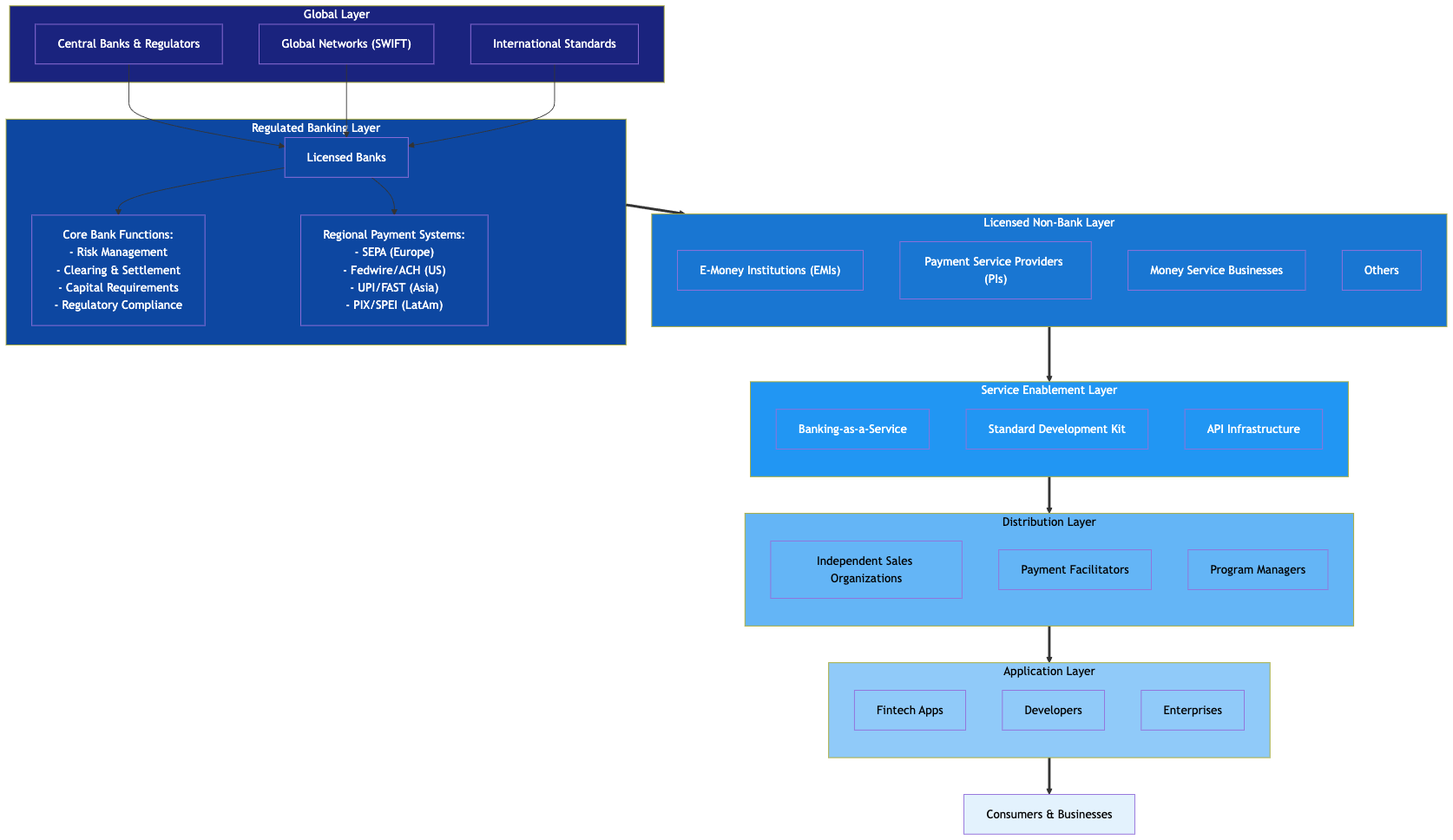
The Global Financial Stack: A Guide to Modern Payment & Banking Architecture
Dec 18, 202400:16:45Tap to summarizeThis podcast provides a summary and analysis of "The Global Financial Stack: A Guide to Modern Payment & Banking Architecture". The document outlines the increasingly complex and layered structure of the global financial ecosystem, moving beyond traditional direct bank-customer relationships. It emphasizes the importance of understanding the roles and interdependencies of different players within this multi-tiered system. The document explores the regulatory landscapes across various regions and the implications of this layered system for businesses selecting financial partners.Key Themes & Ideas:* Layered Financial Ecosystem:* The modern payment and banking landscape is not a simple, direct relationship but a multi-layered stack of interconnected entities.* The stack consists of:* Regulatory and Banking Layer: Fully licensed banks and highly regulated institutions form the foundation.* Licensed Non-Bank Providers Layer: Entities such as MSBs, EMIs, PIs, and BaaS providers rely on the foundational banking layer.* Distribution and Application Layer: Fintechs, ISOs, payment facilitators, and program managers focused on user-facing products and innovation.* This layering explains market saturation, regional compliance differences, and partner selection challenges.* The Regulatory and Banking Foundation (Layer 1):* This layer is the bedrock of the financial system and is composed of fully licensed banks and regulated institutions.* Key Responsibilities: Maintaining liquidity and complying with regulations (e.g., maintaining liquidity ratios, and abiding by regulatory requirements). "Banks must maintain liquidity ratios and abide by domestic regulatory requirements, ensuring they can meet settlement and withdrawal demands at all times."* Handling clearing and settlement. "They handle the secure transfer of funds between institutions, manage dispute resolution, and maintain accurate, reliable records for all transactions."* Acting as agents for downstream entities (Licensed Non-Bank Providers). "Banks often represent licensed non-bank providers as agents, taking on final reporting, settlement, and compliance responsibilities for downstream entities."* Providing core banking functions (lending, credit, interbank access). "Foundational players facilitate lending, credit issuance, and access to interbank networks, providing a stable backbone for all financial operations."* Global Payment Networks: The document highlights key global payment networks, such as:* Fedwire (U.S.), SEPA (EU), Faster Payments (UK), RTGS Systems in Asia, PIX (Brazil), and M-Pesa (Kenya). These networks provide the backbone for fast, reliable settlements.* Licensed Non-Bank Providers (Layer 2):* Includes entities with specialized licenses like MSBs, EMIs, PIs, and BaaS providers.* These providers rely on the infrastructure and oversight of the foundational banking layer.* They focus on services such as:* Issuing electronic money.* Facilitating cross-border transfers.* Offering digital wallets.* Regional Variations: The document emphasizes regional variations in licensing and regulations for this layer, with examples from the EU (PSD2), Asia, Latin America, and Africa.* Agency Relationships: Non-banks heavily rely on banks for core operations (e.g., holding customer funds, processing settlements, and ensuring compliance). "Although these relationships vary by jurisdiction, the common thread is that regulated banks maintain ultimate accountability, allowing non-banks to focus on innovation and user experience."* Distribution and Application Layer (Layer 3):* Composed of fintechs, ISOs, payment facilitators, and program managers who focus on user experience and innovation.* They do not hold their own banking or payment licenses but integrate with the upper layers for core financial services.* Key Functions: Tailoring services, aggregating payment methods, and developing niche solutions.* Creating advanced mobile payment experiences, integrating local payment methods, and layering financial products on top of licensed partners.* Market Saturation: The distribution/application layer is often crowded due to low entry barriers. The document states, "Where entry barriers are low, the marketplace at the application and distribution layers becomes crowded."* Compliance: Despite not being licensed, this layer still requires alignment with upstream partners' AML, KYC, and reporting standards.* The Application Layer: Innovation Frontier:* This layer empowers developers to integrate financial services into their offerings using APIs, SDKs, and other tools.* The focus is on user-centric design and rapid deployment.* Key Components: Developer tools, APIs, and SDKs to embed functionalities* No-code/low-code platforms to reduce technical barriers* Open-source frameworks to enable bespoke solutions* Sandbox environments for testing and refinement* Market Saturation and Differentiation:* The document acknowledges that saturation, particularly in the application layer, creates a highly competitive landscape.* Strategies for Differentiation: Focus on specialization, addressing niche needs (e.g., SMEs needing cross-border financing), and leveraging regional nuances. "To stand out, providers must specialize."* Consolidation: The document suggests that consolidation will likely occur as the market matures, with larger players acquiring smaller ones. "As ecosystems mature, consolidation is likely. Market leaders adept at navigating both local and international regulations could acquire smaller players."* Increased regulation on non-banks is also expected.* Navigating the Ecosystem:* Success requires understanding the multi-layered nature of the financial system, regional differences, and compliance requirements.* Businesses must ask key questions such as:* How many layers separate them from the foundational bank?* How robust is the provider's compliance framework?* Are fees transparent and are local payment systems properly supported (e.g. SEPA, UPI, PIX, etc)? "How many layers separate you from the foundational bank service? How regionally attuned and robust is the provider’s compliance framework? Are fee structures transparent, and can the provider seamlessly navigate local payment systems"* Future of the Ecosystem* Expect more alignment between layers, stricter regulatory oversight, further technological advancements and expanded financial inclusion. "The future will likely bring more alignment between layers, stricter oversight, new technological leaps, and expanded financial inclusion."* Those with a good understanding of the layers, their interdependencies, and evolving regulations will be best positioned to succeed.Conclusion:The global financial ecosystem is a complex and interconnected system characterized by its multi-layered structure. Businesses seeking to navigate this ecosystem effectively must understand the roles and interdependencies of each layer, the regulatory landscape in different regions, and the importance of compliance. Market saturation creates a competitive environment, but also drives innovation and competition. Those who can adapt to regional nuances and build strong compliance frameworks will be best positioned to thrive. This is a public episode. If you would like to discuss this with other subscribers or get access to bonus episodes, visit ahrvo.substack.com
Transcribe →
What the Success of Faster Payments Systems Globally Can Teach Us About CBDCs Adoption
Dec 9, 202400:20:03Tap to summarizeThe Rise of Two Payment Paradigms:* This section introduces the parallel development of Central Bank Digital Currencies (CBDCs) and Fast Payment Systems (FPS), highlighting their transformative impact on the global financial landscape. It emphasizes that these technologies are redefining the very essence of money in the modern economy.II. A Tale of Two Adoption Rates:* This section delves into the contrasting adoption patterns of FPS and CBDCs. It showcases successful FPS implementations like Brazil's Pix and India's UPI, attributing their popularity to factors like seamless bank integration and clear value propositions. In contrast, it examines the slower uptake of CBDCs, attributing it to their broader objectives beyond payment efficiency, such as safeguarding monetary sovereignty.III. Learning from FPS Successes:* This section explores key success factors from FPS implementations that can inform CBDC adoption strategies. It underscores the significance of stakeholder integration, robust risk management, and clear regulatory frameworks. It also highlights the importance of flexible infrastructure design, allowing for both centralized and distributed architectures.IV. Connecting the World: Cross-Border Payment Innovations:* This section examines the potential of integrating FPS and CBDCs to revolutionize cross-border payments. It showcases successful initiatives like the linkage between Singapore's PayNow and Thailand's PromptPay, illustrating their impact on reducing transaction times and costs. It also discusses broader efforts, such as the ASEAN's push for unified real-time payments infrastructure and the BIS Innovation Hub's Project Nexus, aimed at facilitating seamless cross-border transactions.V. Navigating the Implementation Landscape:* This section outlines key considerations for implementing CBDCs and FPS, including comprehensive market analysis, technical readiness evaluation, user needs assessment, clear communication of policy objectives, phased deployment strategies, and continuous ecosystem development.VI. The Privacy Conundrum:* This section addresses privacy concerns associated with CBDCs, emphasizing the challenge of balancing transaction privacy with regulatory compliance and financial crime prevention. It explores innovative solutions such as tiered privacy levels, allowing varying degrees of anonymity based on transaction size.VII. A Future of Financial Synergy:* This section envisions a future payment landscape where CBDCs and FPS coexist and complement each other. It posits that CBDCs will leverage their programmability and monetary sovereignty advantages, while FPS will facilitate real-time global financial interactions.VIII. Beyond Payments: A Transformative Impact:* This section explores the broader implications of CBDCs and FPS, extending beyond payments to encompass monetary policy transmission, financial stability frameworks, and the very definition of money. It emphasizes the transformative potential of these technologies to create a more efficient, inclusive, and intelligent financial system that caters to diverse user needs. This is a public episode. If you would like to discuss this with other subscribers or get access to bonus episodes, visit ahrvo.substack.com
Transcribe →
The AI Agent Hype in Payments, Banking, and Compliance: A House of Cards?
Dec 5, 202400:12:18Tap to summarizeI. Introduction: The Paradox of AI in FinanceThis section introduces the core tension between the transformative potential of AI agents in financial services and the limitations imposed by legacy systems and regulatory frameworks. It highlights the challenges AI faces in achieving true autonomy within the complex financial ecosystem.II. Not Truly Autonomous: The Dependency ProblemThis section delves into the specific dependencies that hinder AI agents' autonomy. It explores three key areas: legacy systems, compliance frameworks, and fragmented global systems, illustrating how each presents significant obstacles to seamless automation.**A. Legacy Systems: A Bottleneck to Autonomy**This subsection focuses on the challenges posed by outdated banking systems, particularly core banking and payment processing infrastructure. It provides examples of how legacy systems restrict AI agents' capabilities due to their lack of real-time processing and rigid integration points.**B. Compliance Frameworks: The Human Factor**This subsection examines the limitations imposed by compliance regulations on AI agents, specifically in AML and KYC processes. It highlights the dependence on external data sources, manual risk assessments, and varying regulatory standards as key constraints.**C. Fragmented Global Systems**This subsection explores the challenges of navigating the global financial landscape, characterized by inconsistent standards and regulations. It discusses cross-border payments and currency exchanges as prime examples of how fragmented systems limit AI agents' autonomy.III. Fragility in System InteractionsThis section analyzes the risks associated with AI agents' reliance on non-autonomous systems. It identifies four main vulnerabilities: delays and inefficiencies, error propagation, systemic risks, and inconsistent standards, explaining how each can compromise the effectiveness of AI in financial operations.**A. Delays and Inefficiencies**This subsection highlights the impact of legacy system limitations on the overall speed and efficiency of AI-driven processes. It explains how delays in data verification or regulatory checks can negate the speed advantages offered by AI.**B. Error Propagation**This subsection explores the risks of inaccurate data from external systems cascading through AI-driven processes. It illustrates how errors in sanctions databases or other sources can lead to incorrect decisions and financial losses.**C. Systemic Risks**This subsection examines the interconnected nature of financial systems and how failures in one part of the network can have widespread consequences for AI agents reliant on those systems. It emphasizes the potential for amplified risks as AI integration deepens.**D. Inconsistent Standards**This subsection focuses on the difficulties AI agents face in adapting to varying data formats, validation rules, and processing standards across different systems. It underscores the added complexity and costs associated with integration efforts.IV. Risks of Universal AI Adoption in Financial ServicesThis section shifts focus to the potential downsides of widespread AI adoption in the financial sector. It explores four key concerns: diminishing competitive edge, dangerous uniformity, interconnected vulnerabilities, and skill atrophy, outlining how each could negatively impact the industry's stability and adaptability.**A. Diminishing Competitive Edge**This subsection discusses how standardized AI implementation across institutions can lead to a loss of competitive advantage. It explains how common AI solutions become baseline expectations rather than differentiators.**B. Dangerous Uniformity**This subsection explores the risks of systemic blind spots arising from widespread use of identical AI models. It provides examples of how common AI systems could miss sophisticated financial crime patterns or systematically exclude legitimate businesses.**C. Interconnected Vulnerabilities**This subsection highlights the heightened risk of shared points of failure when multiple institutions rely on the same AI systems. It explains how flaws in widely used algorithms can have ripple effects across the entire financial ecosystem.**D. Skill Atrophy**This subsection examines the potential for AI to erode crucial human expertise in financial operations. It discusses how over-reliance on AI can lead to diminished investigative skills and reduced ability to evaluate non-standard situations.V. Are AI Agents Even Necessary for Automation?This section critically examines the necessity of AI agents for automation in financial services. It explores existing automation tools like scripts, algorithms, and rule-based logic, questioning whether they can achieve similar outcomes without the complexity of AI agents.**A. Existing Automation Tools**This subsection delves into the various components that underpin AI agents, highlighting their reliance on predefined rules, scripts for integration, and algorithmic decision-making. It emphasizes that these existing tools form the foundation for many AI-driven processes.**B. Can Conventional Automation Handle the Job?**This subsection explores situations where traditional automation methods may be more efficient than AI agents. It focuses on repetitive tasks, cost considerations, and implementation speed as factors favoring simpler solutions.**C. The Unique Role of AI Agents**This subsection acknowledges the specific capabilities that AI agents bring to automation, particularly in dynamic decision-making, handling unstructured data, and learning capabilities. It identifies scenarios where these features are essential for optimal performance.**D. Balancing AI with Existing Tools**This subsection emphasizes the importance of a balanced approach to automation, utilizing both traditional tools and AI agents strategically. It advocates for careful evaluation of task complexity and the need for adaptability in determining the best automation approach.VI. Conclusion: Embracing Simplicity and Resilience in the Age of AIThis section summarizes the key insights from the paper, emphasizing the need for a nuanced understanding of AI's role in financial services. It calls for a focus on modernizing legacy systems and standardizing compliance frameworks to create a more resilient and adaptable environment for AI to thrive. It concludes by advocating for a balanced approach to automation, utilizing both traditional tools and AI agents strategically to achieve optimal outcomes in the complex financial landscape. This is a public episode. If you would like to discuss this with other subscribers or get access to bonus episodes, visit ahrvo.substack.com
Transcribe →
Beyond Price: Smart Buying in the Commoditized Compliance Market
Nov 21, 202400:12:45Tap to summarizeThe Evolution of the Compliance Landscape* A. Historical Dominance by Large Compliance Providers: This section examines the traditional compliance market, characterized by expensive, bespoke solutions offered by established firms like Thomson Reuters and LexisNexis. It highlights the dominance of these firms due to their comprehensive solutions and the high cost of entry for smaller players.* B. Increased Demand for Scalable and Cost-Effective Compliance Solutions: This section explores the shift in the compliance market driven by the emergence of fintech companies. It discusses the rising demand for affordable, scalable, and automated solutions and the role of RegTech in meeting these needs. Examples from various regions, including Africa, Southeast Asia, and Latin America, illustrate this trend.II. The Challenge of Commoditization* A. The Commoditization of Compliance Tools: Low Barriers to Entry: This section delves into the commoditization of compliance tools resulting from increased competition and lower barriers to entry. It emphasizes the shift towards price and speed as primary differentiators and the challenges businesses face in a saturated market.* B. Beyond Per-Check Evaluation: A Holistic Approach to Compliance: This section cautions against solely focusing on per-check costs and advocates for a comprehensive evaluation of compliance solutions. It outlines crucial questions buyers should consider, emphasizing the importance of end-to-end solutions that encompass the entire client lifecycle.III. The Hidden Costs of Fragmented Compliance* A. The Pitfalls of Piecemeal Solutions: This section analyzes the drawbacks of relying on fragmented compliance solutions. It explains how this approach leads to inefficiencies, increased manual intervention, delays in revenue recognition, and ultimately higher operational costs.* B. Compliance as a Revenue Driver: This section reframes compliance from a cost center to a potential revenue driver. It highlights the importance of streamlined, automated processes for efficient onboarding, customer satisfaction, and ultimately, business growth.IV. The Future of Compliance: Beyond Commoditization* A. The Rise of End-to-End Compliance Platforms: This section introduces the concept of new-generation compliance platforms powered by AI and automation. It describes the capabilities of these platforms, including real-time cross-verification, automated workflows, and seamless integration.* B. From Cost Center to Revenue-Generating Asset: This section explores the potential of compliance platforms to evolve from cost centers to revenue-generating assets. It discusses features like white labeling and the ability to leverage client lifecycle data for enhanced customer experiences and business opportunities.* C. Value over Price: The Key to Smart Compliance Decisions: This section concludes by emphasizing the importance of prioritizing value over price when selecting compliance solutions. It advocates for informed decision-making to leverage compliance as a driver of growth and efficiency. This is a public episode. If you would like to discuss this with other subscribers or get access to bonus episodes, visit ahrvo.substack.com
Transcribe →
What Basel III’s 1250% Crypto Risk Weight Means for Institutional Adoption
Nov 15, 202400:15:35Tap to summarizeI. IntroductionThis section sets the stage by introducing Basel III, a regulatory framework initially designed for traditional banking stability, as a pivotal force shaping institutional adoption of crypto assets. It emphasizes the importance of risk management in Basel III's approach and previews the challenges and opportunities presented by the framework for responsible crypto integration.II. Basel III Crypto Asset Classification: Groups and Prudential TreatmentsThis section breaks down the Basel III classification system for crypto assets, highlighting the different risk profiles and corresponding prudential treatments.* Group 1 Cryptoassets: Preferential TreatmentThis section discusses the lower-risk assets that receive favorable treatment, including tokenized traditional assets (Group 1a) and highly regulated stablecoins (Group 1b).* Group 2 Cryptoassets: Conservative TreatmentThis section focuses on the higher-risk assets subject to stricter requirements, including unregulated tokenized securities and less compliant stablecoins. It differentiates between those eligible for hedging recognition (Group 2a) and those subject to the highest scrutiny (Group 2b).* Hedging Recognition Criteria for Group 2 Cryptoassets* This section outlines the strict requirements that crypto assets must meet to qualify for hedging recognition under Group 2a, focusing on eligible instruments and key market metrics.III. Understanding the 1,250% Risk WeightThis section explains the rationale behind the 1,250% risk weight assigned to unbacked cryptocurrencies like Bitcoin and Ethereum. It highlights how this high capital requirement reflects Basel III’s cautious approach and delves into the mathematical framework underlying the capital requirements for these assets.* CET1 Ratio FormulaThis subsection defines the Common Equity Tier 1 (CET1) ratio and its components, which are crucial for understanding the impact of risk weights.* Applying the 1,250% Risk Weight to Unbacked Cryptocurrencies* This subsection walks through the calculation of risk-weight assets (RWA) for unbacked cryptocurrencies, demonstrating the significant capital burden.* Capital Requirement* This subsection explains the CET1 capital requirement (7% of RWA) and calculates the specific amount needed for a hypothetical holding of unbacked cryptocurrency.* Total Capital Requirement* This subsection expands on the total capital requirement under Basel III (8% of RWA) and its implications for banks holding unbacked cryptocurrencies.* Implications for Crypto InvestmentsThis subsection summarizes the implications of the 1,250% risk weight, emphasizing high capital costs and the framework's role in risk mitigation.IV. How Crypto ETFs WorkThis section provides an overview of cryptocurrency ETFs, explaining their function as tracking the price of digital assets without requiring direct ownership. It details the different types of crypto ETFs and their potential for aligning with Basel III's risk management principles.* Types of Crypto ETFsThis subsection breaks down the different categories of crypto ETFs, including physical, futures-based, and hybrid ETFs.* Why Crypto ETFs Align with Basel 3 This subsection highlights the potential benefits of crypto ETFs from a Basel III perspective, including lower capital burden, diversification, and compliance/transparency.V. The Rise of Crypto ETFs and Tokenized ETFsThis section explores the growing adoption of crypto ETFs, particularly Bitcoin and Bitcoin Futures ETFs, and their role in bridging the gap between traditional finance and crypto. It also introduces tokenized ETFs as an emerging trend aligning with Basel III's goals.VI. Basel 3 Impact on Stablecoin Adoption with BanksThis section delves into the implications of Basel III's classification system on stablecoin adoption by banks. It contrasts the favorable treatment of Group 1 stablecoins with the limited use of Group 2 stablecoins due to high capital requirements.* Implication for BanksThis subsection focuses on the attractiveness of Group 1 stablecoins for banks seeking a controlled and compliant entry into the digital asset space.* Implications for Institutional AdoptionThis subsection discusses the likely limited use of Group 2 stablecoins within the banking system due to their capital-intensive nature.VII. Unique Perspective: Basel 3 as a Catalyst for a Safer Crypto MarketThis concluding section presents a positive perspective on Basel 3, emphasizing its potential to foster a safer and more resilient crypto market. It argues that the framework's strict approach may ultimately enhance investor trust, attract conservative institutions, and drive innovation in risk management.VIII. ConclusionThis final section reinforces the idea of Basel III as a filter for the crypto market, incentivizing stability, compliance, and the development of a more reliable digital finance ecosystem. This is a public episode. If you would like to discuss this with other subscribers or get access to bonus episodes, visit ahrvo.substack.com
Transcribe →
Basel III Decoded: What the 'Banking Endgame' Means for Digital Finance
Nov 14, 202400:17:52Tap to summarizeI. Introduction: The Intersection of Basel 3 and Digital FinanceThis section provides a brief overview of Basel 3 and its relevance to the rapidly evolving digital financial landscape. It highlights the challenges and opportunities arising from the application of traditional banking regulations to emerging financial technologies.II. Basel 3 Framework: A Deep Dive into Core ElementsThis section delves into the specifics of the Basel 3 framework, including its implementation timeline and core principles. It outlines the enhanced capital requirements, introduces the Liquidity Coverage Ratio (LCR) and Net Stable Funding Ratio (NSFR), and emphasizes the importance of robust risk management practices, particularly for derivative activities and counterparty exposures.III. Digital Assets Under Basel 3: A Two-Tier SystemThis section examines how Basel 3 classifies and regulates digital assets. It explains the stringent risk weighting assigned to unbacked cryptocurrencies like Bitcoin and Ethereum, contrasting it with the more nuanced approach to stablecoins. The section differentiates between Group 1 and Group 2 stablecoins and their respective capital treatments, effectively creating a two-tier market for digital assets.IV. Impact on Downstream Sectors: The Ripple Effects of Basel 3This section analyzes how Basel 3 indirectly impacts various players in the fintech ecosystem, even those not directly subject to its regulations. It explores the heightened due diligence and compliance costs faced by fintech companies partnering with traditional banks, the potential contractual adjustments and service scope limitations in Banking-as-a-Service (BaaS) partnerships, and the cost pass-through and compliance constraints faced by Payment Service Providers (PSPs).V. Broader Market Influence: Shifting Investment LandscapeThis section details how Basel 3's stringent standards influence the broader financial market, particularly in relation to investments in digital assets and fintech. It explains how enhanced capital requirements, leverage ratio limits, liquidity requirements, and risk coverage standards impact banks' risk appetite and partnership strategies. The section highlights the potential limitations on funding and collaboration opportunities for fintech firms operating in high-risk sectors.VI. Alternative Investment Vehicles and Shadow Banking: Parallels and ConcernsThis section draws parallels between the current financial landscape and the pre-2008 crisis period, highlighting the growth of non-bank financial intermediation (NBFI) and the re-emergence of complex financial structures. It examines the use of special purpose vehicles (SPVs), securitization, and wholesale funding, raising concerns about potential systemic risks. The section also details regulatory efforts to enhance oversight of NBFI, including improved transparency, reporting requirements, and monitoring of systemic risk.VII. Regulatory Arbitrage: Exploiting Global InconsistenciesThis section explores the phenomenon of regulatory arbitrage arising from variations in Basel 3 implementation across different jurisdictions. It outlines the strategies employed by financial institutions to exploit these differences, including seeking out regions with less stringent regulations, developing structured products that capitalize on regulatory loopholes, and expanding non-bank financial intermediation in less regulated markets. The section emphasizes the challenges in achieving uniform regulatory standards and the need for international cooperation to mitigate risks associated with regulatory arbitrage.VIII. Conclusion: Balancing Stability and Innovation in the Digital AgeThis section summarizes the impact of Basel 3 on the digital financial landscape, highlighting its role in fostering responsible growth and sustainable innovation. It acknowledges the challenges posed by the framework's rigorous standards but emphasizes its contribution to strengthening financial system resilience. The section concludes by acknowledging the likelihood of future adaptations to Basel 3 as new technologies emerge, reinforcing its core objective of maintaining stability while embracing innovation in the financial sector. This is a public episode. If you would like to discuss this with other subscribers or get access to bonus episodes, visit ahrvo.substack.com
Transcribe →