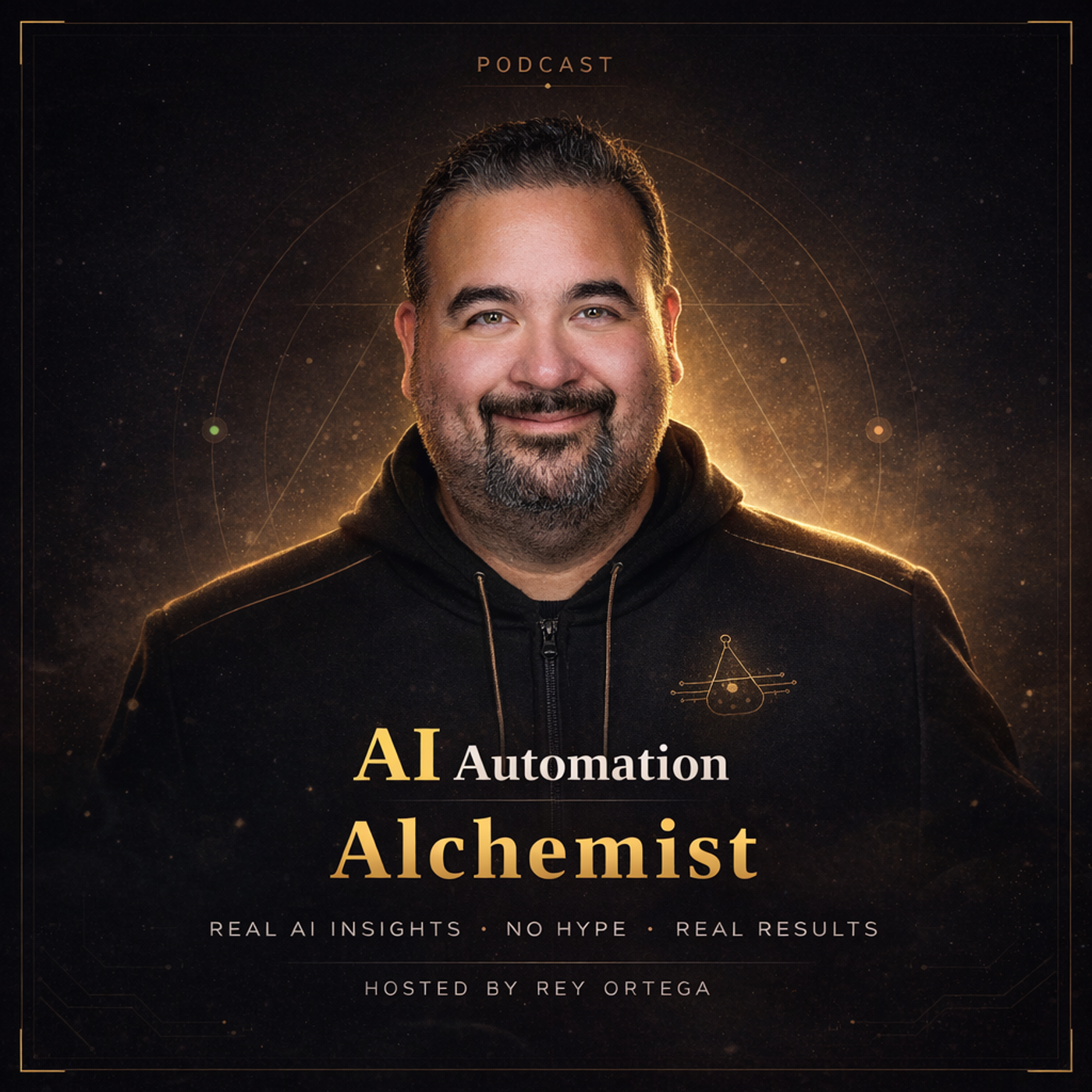
Podcast
AI Automation Alchemist
Hosted by Rey Ortega · EN
Practical AI for small business entrepreneurs! AI shouldn’t be overwhelming or overhyped. AI Automation Alchemist breaks the noise into actionable playbooks for small business owners and scrappy founders. We cover the headlines that matter, de-risk adoption (security, compliance, costs), and walk through real workflows for leads, service, and back-office. Informational, honest, and inspiring, so you can do less manual work and drive more growth.
21episodes
Episodes
Newest firstAll episodes
The Truth About AI, Imposter Syndrome & Building a Business
1w ago00:29:50Tap to summarizeCan you be successful and still experience imposter syndrome?Absolutely.In this episode of the AI Automation Alchemist Podcast, Rey Ortega shares the story behind a major software and AI implementation that recently went into production after nearly two years of development.What started as a technology modernization project expanded into a much larger AI initiative — including a prototype that achieved approximately 98% accuracy and an AI-assisted development workflow that helped the team complete work originally planned across multiple project phases.But the bigger lesson wasn't about software.It was about mindset.Even after years of building software, implementing artificial intelligence, helping businesses improve operations, and successfully delivering projects, it's still possible to question yourself when you compare your success to everyone else's.Rey discusses why entrepreneurs, consultants, developers, executives, and experts can struggle with imposter syndrome — and why evidence from your own work matters more than comparing yourself to someone else's visibility online.He also shares his journey into public speaking, from learning speaking frameworks and finding mentors to preparing to speak at the Built to Win Summit in Orlando.Chapters / Timestamps00:00 — Getting the podcast running00:56 — Welcome to the AI Automation Alchemist Podcast02:00 — Getting sick and experimenting with AI-generated videos04:00 — Surviving Florida without air conditioning07:20 — Why Grata Software sponsors the podcast08:45 — The AI project that took nearly two years10:20 — Using LLMs and n8n to reach 98% accuracy12:00 — How AI coding accelerated development13:30 — Hiring developers in the age of AI15:10 — What Rey looks for when hiring16:00 — Completing four project phases during phase one17:30 — Delivering the system into production18:30 — Why successful people still get imposter syndrome20:00 — Stop comparing your success to other companies21:00 — The entrepreneur mindset problem22:20 — Why confidence matters when investing in your business24:45 — Building confidence through helping other people succeed25:30 — Rey's journey into public speaking27:00 — Finding your first speaking opportunities28:00 — Learning from Russell Brunson and the Perfect Webinar29:35 — Speaking at the Built to Win Summit31:30 — Digital Strike: Understanding your ideal customers33:50 — How large language models actually work34:30 — Tokens explained35:20 — Embeddings and numerical representations36:00 — Why AI predicts the next word36:50 — Parameters and improving AI models38:15 — Are AI models reaching diminishing returns?39:00 — Join the Digital Strike community39:45 — Final thoughts👉 Join the Digital Strike Facebook GroupGet AI and automation resources created specifically for small and medium-sized businesses.👉 Built to Win Summit — OrlandoRey will be speaking about using artificial intelligence to identify your target niche, understand your ideal customers, create messaging that resonates, and develop offers designed to convert.👉 Subscribe to the AI Automation Alchemist PodcastFor practical conversations about artificial intelligence, automation, entrepreneurship, software development, and building businesses with AI.
Transcribe →AI agents aren’t the future: They’re an expensive solution to a problem you don’t have
3w ago00:33:43Tap to summarizecontent typeInterview primary goalEducational summaryRey Ortega discusses the realities of agentic AI versus traditional AI models, emphasizing when to use each and the importance of human oversight in AI systems. keywordsAI, agentic AI, artificial intelligence, automation, business automation, AI models, AI tools, AI systems, AI in business, AI automation key topicsDifference between AI and agentic AICost implications of AI systemsWhen to use AI agents vs traditional AIBuilding multi-agent workflows for software developmentImportance of human oversight in AI systems takeawaysAI models already include brain, memory, and tools; the autonomy is what differentiates agentic AI.Overusing AI agents can be costly and unnecessary for many business processes.Human oversight remains crucial to ensure AI outputs are accurate and appropriate.Building multi-agent systems can optimize complex workflows like software development.Choosing the right level of AI automation depends on the specific business need and budget. guest nameRey OrtegaTitlesUnderstanding Agentic AI: When Human Oversight MattersAI vs Agentic AI: What Your Business Needs to Know sound bites"Agentic AI can be overkill for many business processes.""Models already come with brain, memory, and tools.""Autonomy is what truly sets agentic AI apart."Chapters00:00 Introduction to AI Agentic Systems00:30 The Client Story and Overkill of Agentic AI01:57 Simplifying Business Processes with AI04:02 Why Overusing Agents Can Be Costly06:54 Difference Between AI and Agentic AI10:07 Building Multi-Agent Workflows for Software Development13:09 The Human Element in AI Oversight17:01 Skills and Hierarchies in AI Systems19:56 Cost and Complexity of Agentic AI23:04 How AI Models Work: Brain, Memory, and Tools27:56 Autonomy in Agentic AI29:59 Recap and Final Thoughts on AI Implementation resourcesClaude AI - https://www.anthropic.com/claudeChatGPT by OpenAI - https://chat.openai.com/Eleven Labs - https://elevenlabs.io/Go Digital Strike - https://godigitalstrike.com/ guest linksLinkedIn - https://linkedin.com/in/reyortegaTwitter - https://twitter.com/reyortega
Transcribe →3 Zero-Budget AI Marketing Moves That Can Save Small Businesses 20+ Hours a Week
4w ago00:49:27Tap to summarizeRey Ortega discusses his recent podcast episode, his work on the Digital Strike program, and the impact of AI on marketing for beginners. He also shares insights on the use of AI agents in business operations and the successful launch of a software application by Grata Software. Rey Ortega shares his journey of learning sales and marketing through trial and error, the frustration of hiring ineffective marketing companies, and the subsequent self-education in AI-driven marketing. He emphasizes the importance of human judgment in marketing and the role of AI as an assistant rather than a replacement.TakeawaysAI Marketing for BeginnersThe Role of AI Agents in Business Operations Sales and marketing are crucial for business successAI can be leveraged to automate marketing tasks and save timeHuman judgment is the differentiator in marketing and salesChapters00:00 Introduction and Podcast Episode03:04 Digital Strike Program and AI Marketing11:05 AI Agents in Business Operations22:11 Successful Launch of Software Application39:05 The Importance of Marketing and Sales40:01 Building a Company on Traditional Sales and Marketing41:27 Frustration with Ineffective Marketing Companies44:49 Self-Education in AI-Driven Marketing50:27 The Role of Human Judgment in Marketing
Transcribe →Unmasking AI Myths: A Deep Dive with Rey Ortega
Jul 1300:37:05Tap to summarizeRey Ortega shares insights on artificial intelligence, its current state, misconceptions, and future challenges, sparked by a social media interaction. This episode explores the depth of AI knowledge, industry realities, and the importance of research and expertise.keywordsArtificial Intelligence, Neural Networks, AI Industry, Tech Entrepreneurship, Deep Research, AI Costs, AI Future, Tech Industry Cycleskey topicsCurrent state of AI and social media misconceptionsThe importance of deep research in AIIndustry challenges: costs, hardware, and market dynamicsThe cycle of tech innovation and industry giants' strategiesThe importance of expertise and research in AI development sound bites"Expand the video. Complete the post.""Getting ready to have this conversation about AI.""Using ChatGPT doesn't make you an AI expert."Chapters00:00 Introduction and Episode Overview01:17 Rey Ortega's Personal Background and Journey06:04 The Social Media Incident and Its Significance09:52 Episode 20 Introduction and Focus on AI10:35 Current Perceptions of AI on Social Media11:42 Debunking the Myth: How Well Do We Know the Brain?14:33 The Foundations of Neural Networks and AI Development16:24 The Frustration with Superficial AI Knowledge17:38 The Dangers of Overconfidence and Lack of Research20:33 The Passion and Deep Knowledge of Early AI Engineers25:00 The Evolution of Software Engineering and AI29:42 Building True AI: Deterministic Solutions32:49 The Economics and Cost of AI Development36:10 The Misconception of Cheaper AI and Hardware Advances41:38 The Exponential Cost of AI Processing44:48 Future Hardware Innovations and Industry Challenges46:23 Industry Cycles and Big Tech Strategies50:14 Supporting Small Businesses with AI and Tech51:02 Upcoming Guests and Future Episodes
Transcribe →Claude, ChatGPT: The Truth AI "Experts" Don't Want You To Know About Jobs
Jul 500:24:02Tap to summarizeRey Ortega discusses the realities of AI in the workforce, its capabilities, limitations, and the importance of expert involvement in AI development and deployment. He addresses common fears about AI replacing jobs and emphasizes the need for security and expertise in AI applications. keywordsAI, artificial intelligence, jobs, automation, security, neural networks, large language models, AI safety, AI in businesskey topicsAI's probabilistic nature and limitationsThe role of human expertise in AISecurity concerns with AI systemsReal-world examples of AI failuresThe importance of skilled AI developmentTakeawaysAI is probabilistic, not deterministic, and will never be 100% accurate.Human expertise is essential for building and maintaining secure AI systems.AI has been used in various applications for years, including in games and physics engines.AI failures in quality control and customer service highlight the need for human oversight.Security and proper development practices are crucial to prevent malicious use of AI.Sound bites"AI doesn't have true reasoning or experience""AI is just a bunch of ones and zeros""You need an expert in AI and security"Chapters00:00 Introduction and overview of AI's impact on jobs03:21 Rey Ortega introduces himself and his companies04:44 Common fears about AI replacing jobs05:14 Rey explains his background in software and AI07:07 AI's history and current capabilities08:29 Understanding large language models and transformers10:25 Probabilistic vs deterministic AI solutions13:48 AI's limitations in reasoning and nuance15:36 Case study: Ford rehires human engineers16:36 AI's lack of true reasoning and experience20:37 Failures of AI in quality control and customer service23:00 Security risks and malicious AI models30:31 The importance of expert development and security in AI31:45 Services offered by Rey Ortega for AI and automationResourcesGrata Software - https://gratasoftware.comGo Digital Strike - https://godigitalstrike.com
Transcribe →Unlocking Business Growth: Master AI Tools for Marketing Success
Jun 1800:40:21Tap to summarizeRey Ortega provides an update on his podcast and discusses his recent public speaking engagements on artificial intelligence. He delves into the rise of agentic AI experts, the challenges with AI models, and the government's push for AI education. Rey also covers the fundamentals of computer science, AI sales and marketing systems, email automation, and the anatomy of a social media post. He emphasizes the importance of leveraging AI and SaaS platforms, and shares insights on upcoming presentations and events. Additionally, Rey discusses the importance of video views and engagement, the role of large language models in AI, and the balancing of work and podcasting.TakeawaysImportance of understanding the complexities of agentic AI and the challenges with AI modelsThe significance of leveraging AI and SaaS platforms, and the role of large language models in AIThe importance of video views and engagement, and the need to balance work and podcastingChapters00:00 Introduction and Podcast Update05:07 Complexity of Agentic AI11:01 Value Ladder and Messaging16:16 Social Media Lead Capture and Automation21:28 Leveraging Artificial Intelligence and SaaS Platforms27:51 Triggering the Reptilian Brain on Social Media33:18 The Role of Large Language Models in AI
Transcribe →The Hidden Cost of AI Hype: Why Companies Get Lied To About Automation
May 2400:41:53Tap to summarizeRey Ortega shares insights on AI hype, misconceptions, and practical tools for small businesses, including his experiences with public speaking, social media strategies, and AI resource management.keywords:AI automation, AI misconceptions, small business AI, public speaking, social media marketing, Gamma presentation tool, digital marketing, AI influencers, AI resource managementkey topics:AI misconceptions and hype cyclePractical AI tools for small businessesInfluencer marketing and social media strategiesAI resource management and capital accessMy personal journey with public speaking and family challengessound bites"AI agents can't be put into modes""AI token costs won't get cheaper""There are no modes in AI models"Chapters00:00 Introduction and Personal Updates04:31 The Current State of AI and Automation13:43 The Role of Influencers in AI Marketing27:21 Debunking AI Myths and Misconceptions33:54 Leveraging AI Tools for Presentations40:26 Conclusion and Audience EngagementresourcesGamma Presentation Tool - https://gamma.appDigital Strike Facebook Group - https://www.facebook.com/share/g/17ruSkscU6/Grata Software - https://gratatech.com
Transcribe →AI for Small Business: BizFest Lessons, AI Agents, Automation & the “Train Track” Theory
May 600:43:58Tap to summarizeIn this episode of the AI Automation Alchemist Podcast, Rey Ortega breaks down a busy day speaking at BizFest on Florida’s Space Coast, where small business owners, entrepreneurs, and professionals gathered to learn practical ways to use artificial intelligence.Rey shares the five quick AI wins he presented at the event, including writing faster emails, creating short-form video scripts, building a reusable prompt library, reviewing contracts and RFPs with AI, and generating graphics or brand imagery. He also dives into deeper conversations from the event’s AI roundtable, including agentic AI, automation triggers, AI agents, cron jobs, webhooks, and why many business owners still hit a wall when trying to use AI beyond basic prompting.This episode also covers Rey’s “train track theory,” explaining why companies like OpenAI, Anthropic, Google, Microsoft, and X own the foundational AI models while many startups are simply building “trains” on top of those tracks. Rey also gives his honest take on whether AI will replace people, why human oversight still matters, and how small businesses can start using AI without getting lost in the hype.If you’re a small business owner, entrepreneur, consultant, or operator trying to understand how AI and automation can actually help your business, this episode will give you practical ideas and a clearer framework.Learn more about Grata Software:https://gratasoftware.comLearn more about Digital Strike:https://godigitalstrike.comChapters / Timestamps00:00 Introduction: A busy day at BizFest01:20 About Grata Software and small business automation04:00 What BizFest is and why SCORE matters06:30 Speaking to small business owners about AI08:45 The challenge of explaining AI as a software engineer10:30 Getting cut short during the presentation12:15 AI quick win #1: Writing faster emails13:25 AI quick win #2: Creating short-form video content14:50 AI quick win #3: Building a reusable prompt guide15:55 AI quick win #4: Reviewing contracts and RFPs17:45 Why every business needs a brand voice document18:55 AI quick win #5: Images, graphics, and professional branding19:51 The AI roundtable discussion22:20 Questions about AI agents and automation24:00 What AI agents really are26:10 Why agentic AI still confuses many business owners28:00 The WordPress comparison: simple tools become complex30:00 Will AI replace people?32:30 Why human-in-the-loop still matters34:00 The “AI won’t replace you…” conversation35:00 Rey’s train track theory for AI companies37:30 Why AI wrappers are vulnerable39:30 Cursor, Composer, and owning the coding train track41:30 Digital Strike: AI consulting and training for small businesses43:10 LATAM event and international AI opportunities46:00 How to connect and become a podcast guest47:30 Closing thoughts on AI and automation#AIForBusiness #SmallBusinessAutomation #ArtificialIntelligence #AIAutomation #AIAgents #Entrepreneurship #GrataSoftware #DigitalStrike #PromptEngineering #BusinessGrowth
Transcribe →Intention Hacking AI with Max Kyllonen
Apr 2701:18:22Tap to summarizeAI is moving fast, but most people are still stuck at the starting line.In this episode of the AI Automation Alchemist Podcast, Rey Ortega sits down with Max Kyllonen for a deep conversation about where AI is really headed, why most business owners are overwhelmed by it, and why the future may not be about better prompts… but better intentions.We talk about:Why AI feels “alien” to most peopleThe problem with basic prompt engineeringWhy Max believes “intentioneering” is the next major AI skillClaude vs. ChatGPT vs. GrokHow AI changes marketing, software, business, and decision-makingWhy humans still matter in AI systemsThe real danger of optimizing AI for the wrong outcomeHow business owners can start using AI without getting overwhelmedMax also breaks down why he teaches AI from a relationship and personality perspective first, because when AI feels like a true collaborator, people start using it differently.If you are a business owner, entrepreneur, marketer, engineer, or just trying to understand how AI fits into your future, this conversation is for you.Connect with Max KyllonenInstagram: https://www.instagram.com/a_real_max_k/Facebook: https://www.facebook.com/max.kyllonenWebsite: https://www.maxoutloud.com/COYOU AI: https://www.coyou.ai/Sponsored ByGrata Software: https://www.gratasoftware.com/Digital Strike: https://godigitalstrike.com/Chapters00:00 Intro00:52 Why everyone is talking about AI01:48 Why AI feels amorphous and hard to explain06:07 Why Max starts AI training with pen and paper07:05 Building AI-powered marketing systems10:04 How few people are really using AI deeply14:00 Why AI adoption is different from the internet17:09 Will AI create massive unemployment?20:14 The dangerous middle period of AI disruption27:19 Why AI may never become fully autonomous32:40 Why intention matters more than tools34:00 AI and the prisoner’s dilemma36:04 Using AI as a collaborator40:20 Max’s AI training framework41:36 ADHD, associative thinking, and AI47:52 The moment AI copywriting changed everything50:26 Claude, Sonnet, Opus, and model selection57:39 Using Grok for brainstorming58:26 Intention defines context01:01:16 Where intentioneering is going01:06:49 Open-source models and local AI01:12:10 Hybrid AI systems and local models01:15:20 Why your intention is the real unlock01:17:42 Where to find Max#AI #ArtificialIntelligence #AIAutomation #PromptEngineering #ClaudeAI #ChatGPT #GrokAI #Entrepreneurship #BusinessAutomation #MarketingAutomation #FutureOfWork #AIForBusiness #SmallBusinessAI #Intentioneering #AIAgents
Transcribe →The Future of AI in Business Operations: A Conversation with Rob Wright
Apr 1300:51:43Tap to summarizeIn this episode, Rey Ortega interviews Rob Wright, a member of Waffle, a company that leverages artificial intelligence for small businesses. They discuss the challenges and opportunities in the AI industry, the distinction between AI and automation, and the impact of AI on various business functions. The conversation covers a wide range of topics related to AI, token usage, and the impact of AI on small businesses. It delves into the challenges and opportunities of AI adoption, as well as the complexities of token usage and pricing models. The discussion also explores the role of AI in small business growth and the need for a deeper understanding of AI's capabilities and limitations.TakeawaysAI and automation are not synonymous; using AI does not guarantee a competitive advantage.The Dunning-Kruger effect highlights the challenge of accurately assessing one's own skills and knowledge in the AI industry. Token usage and pricing models are critical considerations for businesses leveraging AI.AI adoption in small businesses presents both challenges and opportunities.Understanding the capabilities and limitations of AI is essential for leveraging it effectively in business growth.sound bites"AI and automation are not the same thing""Show your expertise, not just use AI tools""Leverage AI to level up small businesses"resourcesGoWaffle - https://gowaffle.comOpenClaw - https://github.com/openclawPerplexity - https://perplexity.aiClaude AI - https://www.anthropic.comCursor - https://cursor.comguest linksLinkedIn - https://linkedin.com/in/rob-wrightWebsite - https://gowaffle.comChapters00:00 Introduction to AI and Waffle02:14 The Evolution of Waffle and AI Integration04:45 Understanding AI vs Automation10:08 The Dunning-Kruger Effect in AI Consulting11:46 Evaluating AI Expertise and Influencers18:58 Context Windows and AI Performance21:12 Swarm Agents in AI Development23:36 OpenClaw and Its Impact on AI Tools27:45 Integrating AI Skills for Business Automation30:14 Challenges with Token Usage in AI Tools34:59 Pricing Models and Token Economics39:59 Navigating the Wild West of AI Adoption48:31 The Future of AI in Business Strategy51:37 NEWCHAPTER
Transcribe →