Podcast
AI-Enhanced Processes
Hosted by Alex McMillan · EN
This is where I talk with educators about how we bring AI into our schools intentionally. I also record voice-overs of my articles, so you can listen to the whole project while you're walking, commuting, or making coffee.
aienhancedprocesses.com
aienhancedprocesses.com
10episodes
Episodes
Newest firstAll episodes

Transparency in the Process
Jun 100:11:33Tap to summarizeI’m closing out the school year by slowing down to actually look back and make sense of what happened. It’s a metacognitive act that I, for one, could certainly do more of.In this article, I’m inviting a few guests from the podcast episode “How Did It Actually Go?” (link below) to guest-write an article. Each of them agreed to go a little deeper in writing, reflecting on how process-based learning with AI actually played out in their schools.In this article, Leon Lam reflects on building an AI chatbot for process-based learning and what he’d do differently next time. Reflecting back, what he found is at the center of this piece, so I won’t spoil it. But here’s a takeaway I want to reinforce: he assumed students would follow the process without ever explaining why. A process that remains invisible asks students to comply rather than learn. Adolescents need both to understand why we do something and how it helps them grow.Let’s check in with Leon to hear his thoughts.IntroLeon Lam here, guest posting on Alex’s Substack. This will be an extension of what I discussed on the podcast episode “How Did It Actually Go?” I want to dive deeper into what I learned building an AI chatbot for process-based learning, and what I would do differently next time.A lot of teachers use custom chatbots in their classrooms. I went a step further and built an entire platform for creating custom chatbots, mostly for analytics and data. I wanted to know whether or not the AI chatbots were making an impact. My hope is that what I learned can help you decide whether to invite an AI tutor into your classroom or to keep it outside.What I BuiltAs mentioned in the podcast episode, my Socratic essay-writing bot coached students through Cambridge AS Economics 12-mark essays. It was structured around stages: question analysis, planning, and paragraph coaching.In my bot, Alex’s Think, Generate, Edit process was built into each stage. Students had to think through the questions the AI gave, craft their own responses, which the AI gave feedback on according to preset criteria, and then they had to edit their work until it matched the criteria. The stages were important because they allowed students to plan first instead of jumping into the writing immediately.What I ObservedI categorized student behavior into three patterns. The first group of students spent hours with the bot. They exchanged hundreds of messages. They followed the bot’s strictly enforced reply format. They complied with it for as long as it took to complete the essay on the platform. It looked like they were fully engaged, but upon deeper digging, I discovered that the chatbot I made was needlessly ruthless, and that the learning could’ve happened much more quickly if I had built in human touchpoints or relaxed the restrictions. Students had reported how cumbersome it was to get the exact answer the AI wanted.The second group of students tried to game it for answers. The bot was designed to ask them questions, so they worked at getting around that. These students weren’t really learning anything. They tried prompt injection, off-topic detours, anything to extract an answer. They mostly failed, but time was wasted on trying to manipulate an AI instead of learning.The third group of students did not engage with it at all. That was just not how they wanted to learn. In the end, the bot was just a chat interface. They wanted a teacher, and I saw their eyes light up when I took back the reins in the classroom.Performance on summative assessments did not change since using the bot, either. Students who did well before continued to do well. Students who struggled before kept struggling. What did change was my ability to see the process. I could zoom in on student artifacts and query the data with an LLM, and that visibility was genuinely useful. So in that way, you might say the bot served as an assessment, which provided data that in many ways reinforced what I already knew about the students.I suspect the issues came from two main reasons:* I did not name the thinking processes out loud with the students. I built it into the bot and assumed they would just follow along. Thinking back, I should have made them aware of the process so they know why I chose to set up the assignment this way. My thinking is that it would help the hacker group and the disengaged group to want to use the bot meaningfully.* I removed too much of myself from the process. In theory, the assignment should have worked. In practice, my students handed the entire feedback process over to an AI, and the efficiency I was chasing became the flaw. Aimée had named it before I did. She’d been a guest on the same podcast; when I heard her portion of the episode, her idea of “gates” mapped exactly onto what I’d been considering ever since I put the bot in front of students.What I would do differentlyI do believe that process-based learning is the way to go in the age of AI, but my next iteration of this assignment will definitely be different. Here’s how I will pivot moving forward:I will reinsert myself in the feedback loop. AI should not give feedback on its own, no matter how well it is trained. Giving feedback to students is what builds trust and rapport; that’s the teacher’s job. There’s still a real role for AI, though. An AI can be trained to spot specific writing weaknesses and tag them to feedback I’ve already written, or to extend a comment of mine by pointing to a resource. The condition is that everything passes under my eyes before it reaches the student. The main point is that AI-use should reinforce things that we are learning and want to support in class.I’m going to teach the process out loud. I will explicitly teach my students Think, Generate, Edit, and other processes, or co-create a process with them in class that suits the task. This time, they got a tool that already knew the answer to that question, and they were left to comply with it. However, if I had printed our process on paper and written underneath each step where and how AI was used, and why, my students would have understood the design from the inside and hopefully have been engaged with every step.I’m changing how I grade. Because some students will focus too much on the final output, even if I ask for process artifacts, I won’t accept a finished essay unless the artifacts back it up. The artifacts will be graded, too, but the bulk of the grade for the final product will be awarded only if the final output was the natural product of the process.I’m magnifying authentic, in-person assessment without neglecting AI literacy. I want students to share opinions that are actually theirs, in front of other humans, with their screens closed. That is often uncomfortable for them, and that is the point. My ideal classroom is one that maximizes original thought, critical thinking, and other capacities needed to interact effectively with AI, which I am making a focus outside of the classroom. Students will be instructed to interact with AI without my supervision. This means I will need to teach AI literacy, so my students can remain thoughtful and responsible.I’m still building, but smarter. I built a platform that made students learn through Socratic chatbots, a workflow that’s still new and unproven in their minds, piled on top of everything else they already had to do. So the next iteration starts from what students already do instead of inventing something foreign. I rewrote the entire textbook with AI for accessibility, same flow through the topics, but with simpler, more direct wording. I put MCQs inline for formative checks, and digitized over 3,500 past-paper MCQs organized by topic so students can set up their own mock tests, complete with explanations for the wrong answers. Because I own the platform, I’ll know exactly which topics a class struggled with. So I will keep building my own platform and iterate on the processes students already go through, improving their learning and my teaching at the same time.ConclusionThinking back to my own time in schooling, I don’t remember which teachers had the coolest PowerPoints or used the latest gadgets. I remember the chance to question alongside other students, the jokes, the moments of wonder and care. I miss watching students struggle through the thinking, take pride in what they made, and own their learning. With the changes I’ve shared, that’s the classroom I want to build in this AI-enabled world.Monday Ready ResourcesOne of the most important realizations from this experience is that I need to talk to students along the way about the process or even co-design it with them, as well as teach AI literacy. Here are three ways you can get started with your students to make a process or build AI literacy:1. Go to Alex’s AI Enhanced Process generator and take a crack at making your own process on your own or with your class.2. Take Anthropic’s free course on AI Fluency: Framework & Foundations. This can also be done on your own or with your students.3. Use my Process-Based AI U...
Transcribe →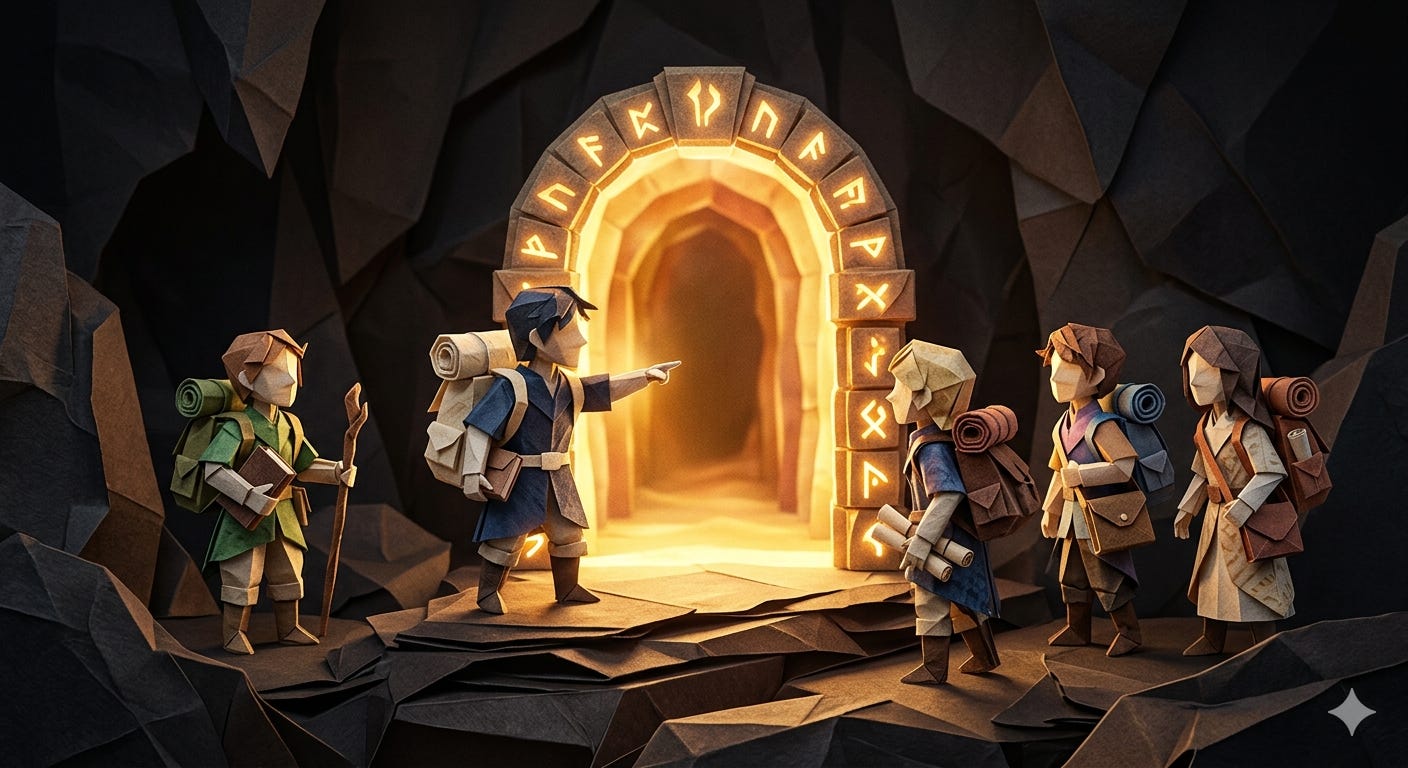
"Gates" to Pause Processes
May 2400:14:59Tap to summarizeIntroI’m closing out the school year by slowing down to actually look back and make sense of what happened. It’s a metacognitive act that I, for one, could certainly do more of. Over the next few weeks, I’m inviting a few guests from the podcast episode “How Did It Actually Go?” to guest-write an article. Each of them agreed to go a little deeper in writing, reflecting on how process-based learning with AI actually played out in their schools. Writing is both output and thinking. Writing is the actual process of figuring out what you believe. I’ve found this idea to be true on this Substack, and I think my guests have too. There’s a depth in that kind of deliberate slowing down that I haven’t always experienced with AI-generated text. Personally, I can’t help but wonder whether that reflective habit is at risk. The world is moving fast, and every week there’s a new exciting model. Deliberate slowing could look inefficient in that context and anti-zeitgeisty.With that, I want to thank Aimée Skidmore for this week’s post, which sits at the center of this discussion. Aimée teaches Grade 12 in Geneva and thinks hard about when GenAI is in the room, how we can maintain student agency and effortful thinking, as they are prone to wanting to move too fast in the name of completion. To get students to deliberately slow down, she created something that she calls gates that serve as pauses, or deliberate moments in a thought process, where students have to show what they are actually thinking before they earn the right to move on. The idea came from the game Dungeons and Dragons, which tells you something about how Aimée thinks. She’s practical, a little playful, and genuinely curious about the tension between structure and ownership in a classroom where AI can skip the messy middle entirely.In this piece, she walks through two iterations of the same project, what she noticed between them, and the questions she’s still thinking about. The Monday-Ready resource at the end is concrete and immediately usable, with a checklist of things we can do with gates in a process.Make sure to follow Aimée on Substack. Enjoy!From AiméeWhen students use GenAI, the worry is that they’ll outsource the final product. But the bigger risk is that they outsource the messy middle: the testing, rejecting, revising, deciding, and explaining.So many of us avoid this issue by designing around GenAI. And I used to spend a lot of time wrangling with how to do this with some of my lessons and projects. Now, I spend less time doing that and more time engineering moments where students have to show what they are thinking before they move on.My Grade 12 students were working in pairs to build a chatbot to help another student practice a certain habit of mind, like persistence or thinking flexibly. I wanted them to work through a Design Thinking process of empathy, define, ideate, prototype, test. Some of these steps involved getting support from GenAI, and some were not. I wanted them to be balanced in their use of tech.Alex McMillan’s AI Enhanced Process Generator was a key tool in helping me decide and communicate on which steps students might use AI to help and where I wanted them to work on their own. Full product scrolling screenshot below.At first glance, it could have looked like a dream GenAI project. Students were using AI, building something for a real purpose. They seemed to be in the flow and moving quickly. Maybe a little too quickly.I started noticing that students were at their computers, starting to build the chatbots, pretty early on. Some were even submitting the link to their final product in one class period. I felt a little panic and then decided to walk around and ask how things were going. What I found was disappointing: I couldn’t get to every student, there were some who couldn’t answer my questions about their process, and there were some who didn’t accept my suggestions to slow down and have another look at the first steps.So I went back to the drawing board to rethink the approach and rebuild it for the next cohort. How could I get them to slow down and go through all the steps of design thinking? I was trying to find out how I could get them to hand in a ‘rough draft’, like we do with essay writing, but I was more interested in checking their process than their product. I didn’t really care so much about whether the chatbot was 100% functional. It was only one small piece of the project rubric.Iterating with GatesOn my second iteration of this project, I decided to add some proficiency checkpoints: a pause and check that students have to take before they move to the next stage of the work. I called them gates because I had this image of a DnD player facing an important decision where they need to slow down, check equipment and consult with their party before going through.Here are the two I built:Here’s what happened:The pace slowed. Students appeared to be more thoughtful in their choices. They had to sit through the struggle and check their own work before asking me.The talk changed. I was able to have short conversations with each student when they called me over to sign off. Over time, our talk became less about me checking their work and more about “Tell me where you are now.” “What do you like about this tool so far?”Students started explaining choices. “What led you to that decision?” I was able to redirect them when I saw they were not thinking deeply enough and ask them some questions that made my coach’s heart flutter. “What was challenging here for you? And what else?”They noticed problems earlier. Before they handed it in, they were able to make improvements because they could see those changes would make the final product stronger. The project became less about “my chatbot works” and more about “my chatbot is designed for a real learner.”This felt like a real win. The gates did what I hoped they would do. They slowed the project down in the right places. They made the process more visible and gave students a reason to explain their choices before rushing ahead.And this is the part I’m still thinking about. I feel a tension here about how much of the process I should define for them.When I create something, I do not move through the work in a straight line. I start in one place, jump to building, get stuck, jump somewhere else, come back, revise, test, rethink, and slowly find my way through. That movement feels natural to me now, but it took years to build. Students are still learning what that kind of process feels like.So the questions I’m sitting with now are: how do we give students enough structure to support their thinking, without turning the process into another set of steps they simply complete for us? How do I avoid a heavy process that will lead to more paperwork and overfunctioning for me?Because if I build too many gates, or if every gate depends on my approval, I risk creating the very thing I’m trying to move away from: students waiting for me to tell them if they are doing it right, if they are allowed to continue.So, the next version of this project might have students deciding where the gates go. It might involve more student self-checks, more peer testing, and more room for students to say, “This is what we tried. This is what we changed. This is why we’re moving forward.”And probably more modeling from me, too. Not modeling the perfect process, but showing what it looks like to get stuck, change direction, reject an idea, return to an earlier version, and keep working. That feels important because students do not learn ownership by being dropped into total freedom. They learn it by practicing responsibility within a structure that helps them keep going.The gate is not the point. The pause is the point. And what students do inside that pause is where the learning lives. That, to me, is one of the real design challenges with GenAI in the classroom. Yes, the tool can make the work move quickly. My job is to help students slow down enough to notice what they are doing, make real choices, and stay awake inside the process.Monday-Ready ResourcesResource #1 - Checklist when Using GatesSeparate the gate from the grade. If students associate checkpoints with judgment, they’ll perform readiness rather than demonstrate it. Frame the gate as a conversation. “Walk me through your thinking” lands differently than “let me check your work.”Unpack the steps before students take them. When you introduce a process, explain why each stage exists. Human psychology is consistent on this: we do not expend effort on things that feel arbitrary. If students understand why the empathy phase comes before the prototype phase, they’re more likely to take it seriously.Use a student-facing checklist, then release some gates over time.Before students call you over, they should be able to say yes to two or three concrete criteria. This shifts the first layer of accountability to them and changes what the teacher conversation is actually for. Over time, some gates can become peer-checked or self-certified. Early on, every checkpoint might involve the teacher. Once students show they understand the process, they can take on more of the checking themselves. This builds toward ownership without dropping them into total freedom before they’re ready. You can see how I built this into ...
Transcribe →
"How Did It Actually Go?"
May 1700:20:10Tap to summarizeIt's time to finish up the year with one last podcast episode. I decided that I wanted to have a reflection and talk to people about how process-based learning has been going inside their schools or classrooms. I talked to a range of educators and asked them several different questions, and this episode is a series of highlights from those conversations. So, over these 20 minutes, you're going to hear a series of short recordings in which we look at process-based learning with AI from several angles. Below are notes about each of the guests with links to their websites and social media. Thank you all for contributing to this episode!Aimée Skidmore | Teaching and Learning Coach | GenevaAimée works with experienced teachers who are tired of being the engine in the room. Her focus is student ownership: structures where students start, think, revise, and take responsibility without the teacher carrying it all. She appears twice in this episode. First, she describes what process-based AI use looks like from inside her classroom. In her second segment, she explains how deliberate checkpoint gates changed the outcome of a chatbot-building project.Aimée offers a six-week Student Ownership Sprint for secondary teachers. She also hosts the International Teacher Staffroom podcast.LinkedIn | TeachSparkAimée wrote a companion piece to go along with this episode. After you listen, make sure to read her more in-depth write up about “gates” below.Jay Goodman, Ed.D. | PBL Consultant | CanadaJay has spent nearly two decades designing problem-based learning programs. His Ed.D. focused on PBL program design. He co-developed the Innovation Institute, an award-winning interdisciplinary PBL program in Shanghai.In this episode, he describes mentor bots: teacher-designed AI personas built around specific domains of expertise. Students identify a knowledge gap, do initial research, and then bring that thinking into a structured conversation with a field-specific model. It solves a real PBL logistics problem without replacing the thinking students need to do first.LinkedIn | Goodman Learning PartnersVamshi Mugatha | Director of Technology | American School of BrasiliaVamshi brings in a leadership perspective as an admin. Vamshi describes a familiar challenge for many schools around the implementation side of a policy. What he realized was that the missing piece was expectations. When teachers weren’t setting them, students were using AI without disclosing it. The gap between the two created tension that the policy alone couldn’t resolve.LinkedInLeon Lam | A-Level Head of Humanities | Beijing National Day SchoolLeon teaches A-Level economics and leads Humanities at Beijing National Day School. Last year, he vibe-coded a Socratic essay coaching chatbot designed to slow students down and move them through idea generation, outlining, and drafting as distinct stages. He’s candid about what happened. Some students engaged deeply. Others focused entirely on getting the chatbot to advance to the next stage, treating compliance as the goal. He reflects on what he’d do differently next time. His biggest takeaway is that co-designing a process with students can be a powerful way to make the process less performative and more purposeful in supporting their work. LinkedInLeon wrote a companion piece to this podcast episode. Check it out below. This is a public episode. If you would like to discuss this with other subscribers or get access to bonus episodes, visit aienhancedprocesses.com
Transcribe →
Scaffolding
May 400:20:49Tap to summarizeScaffolding is one of those practices most educators have been trained to use, talk about as a part of daily planning, but might need to reconsider now that we live in the age of AI. We’ve been using it for a long time: breaking down a complex task, modeling a thinking move, offering a hint when a student gets stuck, then stepping back as they find their footing. But knowing what scaffolding is and implementing it with fidelity in an AI-enhanced classroom are two different things. When the support is too tight, too scripted, or never fades, scaffolding can stop being supportive of student learning and growth. In a classroom where AI is available, a student oriented toward completion rather than understanding is one click away from outsourcing the whole thing.So this article is about one question with two parts: what does strong scaffolding look like when AI is in the room, and how do we design for it deliberately? The research on effective scaffolding gives us the foundation. AI gives us both a powerful new tool and a new set of risks. Understanding both is what makes the difference between AI enhancing student thinking and replacing it.DefinitionsI find that Universal Design for Learning (UDL) and differentiated instruction (DI) are often used interchangeably with scaffolding, so I want to take a minute to explore the three of them in relationship to one another before we move forward. I imagine that the conflation comes from the fact that each involves a teacher adjusting something for a learner to be successful. But there are some nuances between the three, and to make it more interesting, all three could technically exist at the same time. Defining Universal Design for Learning (UDL)CAST, the organization that developed Universal Design for Learning, describes UDL as a framework for designing curriculum so it works for all learners from the outset. Before the unit exists, a UDL-informed teacher is asking: Why are we learning this? How will I present it in multiple ways? How will students engage with it? How will they show what they know? The three principles (engagement, representation, and expression) aren't checkboxes. They're what Katie Novak might call design orientations. Many teachers and school systems treat UDL as a synonym for accommodation: extra time, modified texts, assistive technology. Those things matter, but they aren't UDL. UDL isn't retrofitting the curriculum for students who can't access it. It's designing the curriculum so the barriers don't exist in the first place. Defining Differentiated Instruction (DI)Carol Ann Tomlinson, who is arguably a leader in differentiation, has stated for decades that differentiation is a proactive mindset that a teacher brings to planning. Before the lesson begins, a differentiated teacher is asking: Who are my learners? What do I know about where they’re starting? What pathways and options can I build in so the learning reaches all of them? Multiple approaches to content, process, and product; not different destinations, but different routes to the same one. Many teachers have accepted a version of differentiation that means reducing the task for students who struggle. Fewer requirements or something like that. Tomlinson calls this myth out directly: differentiation is more qualitative than quantitative. It isn’t giving some students less of the same assignment. It’s rethinking the nature of the assignment so it fits the learner while keeping the learning objectives intact.Defining ScaffoldingScaffolding is what happens once learners are in the room, and you can see what’s actually happening. Pauline Gibbons puts it precisely in her book Scaffolding Language, Scaffolding Learning. She writes: “Scaffolding is not simply another word for help. It is a special kind of help that assists learners in moving toward new skills, concepts, or levels of understanding. It is future-oriented and aimed at increasing a learner’s autonomy. As Vygotsky has said, what a child can do with support today, she or he can do alone tomorrow.”In practice, scaffolding might look like a sentence frame that gives a student the language structure so their thinking can do the real work. It looks like a worked example that shows the process, not just the product. It looks like gradual release: I do, we do, you do. A think-aloud where a teacher makes their invisible reasoning visible. A guiding question that narrows the cognitive load just enough to get a student unstuck without removing the challenge. Notice what all of these have in common: none of them lower the intellectual demand. Second, with scaffolding, the aim is that students gain a level of independence to implement learning strategies on their own or with peers rather than relying on the teacher. Bringing UDL, DI, and Scaffolding TogetherHere’s a Claude Artifact (screenshot also below) of my understanding between UDL, Differentiated Instruction (DI), and Scaffolding as supported by several texts and AIs.All three of these practices can occupy the same classroom, the same lesson, even the same moment. Consider a history teacher designing a unit on the civil rights movement. Before the unit begins, she thinks about how students will access primary sources, how they will engage with the material, and how they will show understanding through writing, discussion, or a visual product. That’s UDL doing its work at the design stage. Within the unit, she notices some students need more time with the documents while others are ready to move into analysis. For students still wrestling with the sources, she designs a close-reading process. For students ready to push further, she moves them into a comparison and argument-building process. Different actions, same destination. That’s differentiation. Then on a Tuesday, she opens a language scaffold bot she built in advance; one that knows the sentence starters, knows the argument structure, and knows its job is to practice with students until they can do it alone. A student who can’t connect evidence to a claim works through three or four cycles with the bot; it offers a starter, the student completes it, the bot pushes back gently, and the student tries again. By the end, the student has written the sentence. The bot didn’t write it. The teacher didn’t write it either, though she designed the whole condition that made it possible. The scaffold existed for six minutes. The student is ready to meet the standard and gains a sense of independence.Over-Scaffolding and The Learning PitWhen a teacher manages every step of a lesson, students follow the path but never make sense of the terrain. Ready-made answers lead students to reuse solutions rather than build reasoning. Frey, Fisher, and Almarode put it plainly in How Scaffolding Works: without sufficient fading, students develop a dependency on the supports provided and fail to reach independence. It's a little counterintuitive, but teachers need to allow students to sit in what James Nottingham calls "the learning pit"; that uncomfortable space of not yet knowing, which is where the real thinking happens. Tolerating that discomfort long enough for the thinking to happen isn't cruelty. It's the whole mechanism.Monday Ready Resource: Prompt for Learning Pit Coach When students get stuck, this bot helps them sit with the discomfort long enough to work through it rather than around it. A great addition to a “ask three before me” approach.COPY AND PASTE INTO AN AI BOT FOR STUDENTS: You are a coach for students who are stuck and frustrated. Your first job is not to ask a question. It is to acknowledge what the student is feeling. Tell them directly that being stuck is not a sign that something has gone wrong; it is a sign that they are in the middle of real learning. Be warm and specific: the discomfort they feel right now is the learning pit, and every person who has ever learned something hard has felt exactly this. Only after that acknowledgment ask them one question: what is one small thing you could tr...
Transcribe →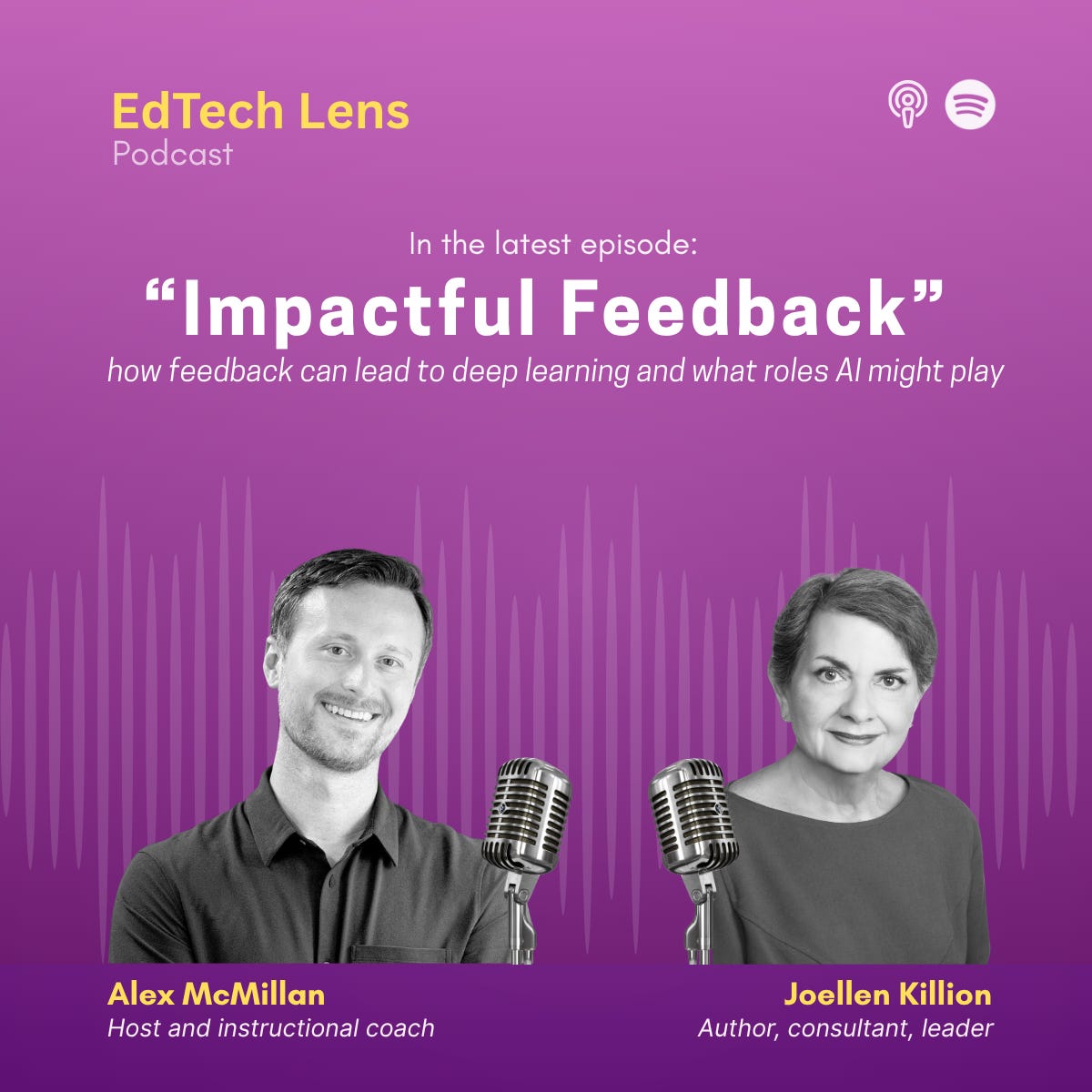
"Impactful Feedback"
Apr 1900:33:29Tap to summarizeIn this episode Joellen Killion joins the podcast and talks about what impactful feedback could look like as a practice as well as what it could look like in the age of AI. Joellen's Book on Feedback (link)About JoellenJoellen Killion champions educator learning as the primary pathway to student success. She serves school systems, schools, regional, state, and national agencies within the U.S. and abroad as a consultant and learning facilitator. She is senior advisor to Learning Forward and formerly was its deputy executive director. Joellen leads, facilitates, and contributes to a number of initiatives related to examining the link among curriculum; leadership; quality instruction; professional development; and student learning. She has over 30 years of experience in curriculum development and implementation and planning, design, implementation, and evaluation of professional learning at the school, system, state, national, and international level. She was the recipient of the Don Deshler Leadership Award and the Adams County District 12 Merit Award. She serves on the advisory board for the Association for the Advancement of Instructional Coaching in International Schools and is a member of the editorial board of the International Journal on Mentoring and Coaching in Education.Joellen is a frequent contributor to education publications. Her books include What Works in the Middle; What Works in the Elementary Grades;, and What Works in the High School; Teachers Who Learn Kids Who Achieve: A Look at Model Professional Development; Assessing Impact: Evaluating Professional Learning, 3rd edition; Collaborative Professional Learning Teams in School and Beyond: A Tool Kit for New Jersey Educators; Taking the Lead: New Roles for Teacher and School-based Coaches; The Learning Educator: A New Era in Professional Learning; Becoming a Learning School; Coaching Matters; The Feedback Process: Transforming Feedback for Professional Learning.; and Elevate School-based Professional Learning. She authored and co-authored numerous papers, articles, reports, and workbooks such as PDK’s EDge, The Changing Face of Professional Development; A Systemic Approach to Elevating Teacher Leadership; and resources associated with the Transforming Professional Learning for Common Core Implementation initiative. She serves on the editorial board of the International Journal of Mentoring and Coaching in Education. Her particular interests are collaborative learning teams, coaching educator success, evaluation and program audits, standards for professional learning, policy to support professional learning, and comprehensive planning and implementation of high-quality, standards-based, results-focused professional learning. This is a public episode. If you would like to discuss this with other subscribers or get access to bonus episodes, visit aienhancedprocesses.com
Transcribe →
If It’s Difficult, You’re Doing It Wrong
Apr 1200:20:13Tap to summarizeWant a summary of this article? Jump to the bottom where I have a one-pager waiting that is printable with the main ideas. Last week, I was standing in a 7-Eleven in Nara, Japan on spring break, and before setting off to explore the charming city, I stopped to buy an onigiri rice ball as a snack. While checking out of the 7-11, I remembered something from the time when I lived in Japan. My friend Soichiro taught me how to open onigiri about twenty years ago by following the numbers on the packaging: three tabs, a folded plastic wrap that keeps the seaweed crispy and separate from the rice until the exact moment you want them together. Precise folds, purposeful sequence, color-coding— to me, it was the kind of design that seemed to draw upon the wisdom of origami. Check out the video below of me showing the packaging of an onigiri and how opening it is easy and leaves the seaweed dry and crunchy. Fun fact: 7-11 wraps their packaging in bioplastics! Actually, Soichiro was not there the first time I tried to open one on my own. I just started pulling at the plastic like I was unwrapping a granola bar. I tore straight through the seaweed, the rice went everywhere, and I ate a slightly soggy, structurally compromised snack standing outside a convenience store, feeling very foreign. The packaging already had the answer, though; three numbered tabs, right there on the wrapper. The design was not the problem. I just didn’t stop to read it.Over the remainder of my trip, I kept noticing the same well-designed logic everywhere, from vending machines to train exit gates to conveyor-belt sushi restaurants. One of my favorite designs was a paper cup dispenser with a single button to release exactly one cup from a locked stack. I watched a tourist wrestle with that type of machine for thirty seconds before noticing the button. Back when I lived in Japan, I learned that when I struggled with something like a paper cup dispenser, the right response was to self-correct. That is, if something is difficult to open, use, or do, you’re probably doing it wrong. In Japan, the user experience is often carefully planned and meant to be easy. I came home thinking about teaching and learning, and I kept thinking: what if we applied the same logic to classroom instructions? Much like a wrapper with instructions, classroom instructions should be easy. The task should be where the energy is put. Students’ effort belongs to the thinking, not to decoding what you want them to do. In other words, opening the onigiri was not the point. Eating a delicious snack was. The packaging exists to serve the experience, and the best packaging gets out of the way quickly. Classroom instructions work the same way in that they are the vehicle for learning, and not the purpose or when learning happens.Picture a high school student with four classes, each coming with lengthy instructions and teachers who carefully cover every edge case before anyone touches anything. By the time a student opens a task on their computer, they are more glazed over than a honey-baked ham! And because we live in an age in which everyone is using AI, they’ve probably got their favorite model running in the background of their laptops. Once they reach the point that the instructions become overwhelming, the internal monologue becomes: I honestly couldn't care less. I'm exhausted. I just want to get through this. This classroom and day-to-day experience sets kids up to have a mentality that is vulnerable to AI misuse. Kids who feel less engaged and disinterested will want to complete tasks quickly, and AI can provide a shortcut. If your instructions lose them from the get-go, you’re heading in the direction of compliant task completion. Too much teacher talk that muddies the instructions might indirectly push them toward feeling overwhelmed and toward a desire to cognitively offload the task as efficiently as possible. My suggestion is this: get into the intellectually engaging, stimulating process of active learning in class. The better you can design your instructions to be short, verb-based, and clear, the better. If you are noticing friction with instructions, processes, or any element, that difficulty is highly informative and can help us to adjust.So in other words: difficulty is data.The Look on Their FacesA quick clarification before I go further. Direct teaching is a powerful tool (see Hattie’s work). There is absolutely a time to stand at the front of the room and teach. This article is not about that moment. This article is about when you ask students to do something, and you are explaining how to engage (e.g., create, discover, reflect, collaborate, analyze, build). The task is meant to generate learning, and before any of that can happen, you have to explain what to do. From my experience as a teacher and coach, fifteen minutes or less with an exemplar is the limit. When teachers overexplain instructions, it leads to a kind of glazed-over, fading anticipation mixed with compliance. It’s funny too, kids will avoid asking questions because they just want to get on with it, even though they actually have many things they want to ask you, they bide their time and plan to ask a classmate what they are actually supposed to do. Myth: good instruction means frontloading every common misconception and pitfall before students have touched the work. To be clear, anticipating roadblocks is good design; that is what Universal Design for Learning asks us to do. But there is a difference between designing for barriers and narrating all of them upfront before students have had a chance to think. When teachers over-explain every obstacle in advance, they usurp the learning; students never have to construct cause and effect for themselves because the teacher already did it for them. They arrive at the work with a head full of caveats and nothing left to figure out. That is not so different from handing a task to AI in that the thinking gets outsourced before it ever begins. Just as we don’t want AI to do the work for students, we also don’t want teachers to do the work for them either.I used to be the over-explaining guy: I’d hover while students work, point at their screens, announce new pitfalls I just remembered or noticed, and announce that there are thirteen minutes left. I would not necessarily call that a rich thinking environment; you know what kids are thinking in that situation? I’m going to just get through this block so I can go home and do it on my own, and I’ll just ask AI and my friends if I get stuck.Could you imagine if 7-Eleven sold onigiri that required 27 steps to open, and a lengthy training video that walks you through every possible way it could go wrong, and then you are given 13 minutes to do it, while in the back of your mind you know that you have a really important train to catch at the station? You would be exhausted, uninterested in the snack, stressed, and looking forward to the whole thing being over. If we are explaining the instructions to an activity and the students have their heads down, that’s data. It is the equivalent of struggling with an onigiri wrapper. It does not mean your students are necessarily unprepared. It could mean your instructions have friction in them, or the students are just not paying attention due to distraction, confusion, or feeling overwhelmed. Every minute a student spends decoding your instructions is a minute they are not spending on the actual thinking you designed the task around. That thinking, the brainstorming, the analyzing, the revising, the reflecting, is where the learning happens.Teachers are designers who are constantly testing their products and empathizing with their clients. So with that design thinking mentality, when students look lost before the learning starts, we can think of this as an observation in which we ask ourselves: what did I build here? What can I subtract? How can I activate thinking and step out of the way? How can I provide just-in-time feedback?Monday-Ready MovesHere’s a list of a few strategies that I have seen work as a teacher and coach. They directly support process-based learning in that a strong process can actually serve as clear instructions that do not necessarily require lengthy explanation. 1. Limit teacher talk. Read your instructions once and keep the total instructions to 15 minutes or less. The shorter your instructions, the more energy your students will have. If you are still talking after 15 minutes, something needs to come out, or additional instructions can happen later in the same lesson. Again, this is not for direct teaching in which essential information has to be taught; I’m talking about the instructions for an activity.In terms of designing a slide, make the words large and easy to read from across the room. Don’t write all the instructions, just the main points so they can recall what they’re supposed to do. ...
Transcribe →
"Writing with AI"
Mar 1502:05:25Tap to summarizeIn this four-part episode, Alex has an interview with five different guests who share their insights on using AI to meaningfully help students to write. Key ideas that emerge: grading chats can be fun and insightful, writing is a form of thinking, process and product are important, it's possible to write with AI and still know your content, and much more. Below are the details about this episode's guests:Mike Kentz is an award-winning educator and former journalist with 15 years' experience across teaching and news media. He is a TEDx Speaker and the founder of AI Literacy Partners, a professional development and curriculum design firm that aims to build AI literacy in educators and students through high-quality instructional materials. His work in AI and Education has been featured in The Harvard AI Pedagogy Project, EdSurge, The Writing Across the Curriculum Repository from Colorado State University, The Wall Street Journal, and more. He lives in Morristown, New Jersey, with his wife, son, dog, and cat.With over 27 years dedicated to advancing educational excellence, Eileen Heller serves as an Education Consultant for Professional Learning at ESU #3, supporting 18 diverse school districts across Omaha’s metro communities. Her career journey—from sixth-grade classroom teacher to technology specialist, instructional facilitator, and instructional technology trainer for Omaha Public Schools, as well as adjunct instructor for multiple higher education institutions—has equipped her with a deep understanding of how to design and sustain impactful systems of professional learning. Her varied experience has led her to focus on building effective professional learning systems. She is committed to supporting educators’ growth through collaboration and encouraging self-directed solutions that improve student outcomes.Chase Heller is beginning his freshman year of high school and enjoys staying actively involved in both his school and community. He serves on the student council and volunteers whenever possible. Passionate about athletics, Chase runs cross country and plays soccer, consistently working to improve his fitness and teamwork. In his free time, he enjoys walking his dog Lucky, swimming, playing with his brother McKennon, and spending time with friends and family.Amelia King is the Director of Digital Transformation at one of the UK’s leading independent schools, where she helps educators navigate new technologies without losing sight of deep learning and student wellbeing. With a Master’s in Smart EdTech and Co-Creativity, she has researched how students think when using AI, sharing her findings at international conferences and through her widely read newsletter for educators. Amelia mentors colleagues worldwide, teaches her “Thinking with AI” course, and speaks regularly about the need to blend artificial and human intelligence in education. Known for translating academic research into practical classroom strategies, she is passionate about ensuring that technology lifts attainment, deepens learning, and protects the well-being of both students and teachers. Learn more about her work at amelia-king.com.Andrew Easton is an education speaker, author, and consultant specializing in personalized learning, artificial intelligence in education, and learner engagement strategies. He serves as the Digital Learning Coordinator for Nebraska’s Educational Service Unit Coordinating Council, supporting schools across the state with innovative technology integration. A former classroom teacher with more than a decade of experience, Andrew has delivered over 50 conference presentations and 125 professional development sessions for educators across the U.S. and Canada. He is the author of Empowered to Choose: A Practical Guide to Personalized Learning and the host of The Good Life EDU Podcast, where he explores the latest ideas shaping the future of teaching and learning. This is a public episode. If you would like to discuss this with other subscribers or get access to bonus episodes, visit aienhancedprocesses.com
Transcribe →
Six Pitfalls That Break AI-Enhanced Processes
Mar 100:31:00Tap to summarizeTL;DRII’m back after a break for Chinese New Year!Process-based teaching is meant to protect thinking. With AI in the classroom, it can accidentally protect the appearance of thinking instead. But before any process can hold, the essential conditions for learning have to be in place. This article looks at both through a self-determination lens: the load-bearing walls a classroom needs, and the six predictable ways a process still breaks down even when they’re standing.IntroIf you’ve seen me speak, you’ve heard me say that AI doesn’t create new problems. It reveals old ones. Take one that’s been hiding in plain sight: we have long valued the static artifact of a finished essay over the messy, cognitive act of actually constructing an argument. When a student can generate something that looks finished in seconds, old habits get exposed. When the essential conditions for real learning aren’t in place, students learn quickly that what matters is to look finished, not to think deeply, or even to know what that looks like. And when a dysfunctional system meets a tool that can produce polish without effort, it shows its hand.Process-based teaching is meant to protect thinking. In the AI era, it can accidentally protect the appearance of thinking. And here’s the uncomfortable part: most teachers think of themselves as process people. They believe in the work. They value thinking over polish. The problem isn’t bad intentions or misplaced values. It’s the behavioral implementation gap between believing in process and actually designing for it.That gap is what separates an AI-enhanced educator from a slop-enabling one. Not philosophy. Design.This article is a list of the six predictable ways process-based learning breaks down with AI, plus the early look-fors that tell you it’s happening.Before we start, great process design requires the essentials to be in place first. I didn’t invent those essentials. Deci and Ryan’s “Self-Determination Theory” (SDT) names three of them: autonomy, competence, and relatedness. That third one is worth pausing on, because relatedness is the term that tends to trip people up. In SDT, it refers to the felt sense of being connected to the people around you, of mattering to others, and having others matter to you. But in a classroom context, relatedness fails in two distinct ways that are easy to confuse. A student can feel genuinely cared for by their teacher and still have no personal stake in the work. And a task can connect to the real world and still land in a room where a student doesn’t feel seen or cared for by their teacher.So I’ve split relatedness into two walls, drawing on Zaretta Hammond’s work in Culturally Responsive Teaching and the Brain: belonging, the felt sense that a student is known in the room, not just present in it, and relevance, my own interpretation of her ideas around cultural connections to learning: the sense that this particular work has something to do with a student’s own life, community, and experience.So: Belonging. Competence. Relevance. Autonomy. These are the load-bearing walls of a classroom, as I see it. A student who doesn’t feel seen will feel invisible in the learning. A student who finds the task too difficult will use AI as relief. A student with no personal stake in the work will use AI as the fastest way out of what looks like a checklist. Process design without these walls just creates more elaborate hoops to jump through.So the conditions come first. But here’s the harder truth: even when they’re strong, a process can still fail. Small design mistakes compound fast when “finished work” is one prompt away. That’s what this article is about. Here’s how processes break.Six Common Pitfalls of AI-Enhanced Processes 1) Vague language leads to vague behaviorEvery breakdown in this pitfall starts with unclear communication. When teachers say “AI allowed” without defining what that means, and when schools frame AI as “just a tool” without examining what that metaphor actually teaches, students are left to interpret expectations that were never made explicit. That’s not an academic honesty problem, though many teachers see it as one. For many students, it’s actually a communication problem.“AI allowed” without a definition leaves students guessing. Some use AI for idea support. Others outsource the whole task. Mismatched voices, “gotcha” moments, and disputes are the predictable result of thinking expectations that were never stated clearly in the first place.The same problem lives in the metaphors we use in the classroom. Tool language is genuinely useful early on. It makes AI feel manageable, puts responsibility back on the human, and gives schools a practical framework for early questions: What is this for? Who should use it? When does it help? But tools are neutral. Generative AI is not. It pushes back, persuades, and carries patterns from its training data in ways a hammer never could. Framing AI as a guest collaborator picks up where tool language stops, and it carries a different set of values with it. A guest has a role, operates within norms, and is welcome but not in charge. But more than that, a guest changes the nature of the work. Learning isn’t transmitted from AI to student. It’s constructed through the interaction: the push and pull of a draft that gets questioned, an argument that gets challenged, an idea that gets stress-tested and comes back stronger. The guest doesn’t write your essay. The guest reacts to your draft, pushes back on your argument, and asks what you actually meant. That’s a co-learning relationship that we like and want to continue to instill in young people. There’s a relevance cost to vague language, too. When task language is generic, it signals that any student could have received this assignment. It doesn’t invite students to bring their own experience, community, or perspective into the thinking, and it doesn’t honor or celebrate the families, values, and identities they carry into the room. A student who doesn’t see themselves in the work has no particular reason to do the cognitive heavy lifting when AI can produce something plausible without any of it.Spot the pitfall early:* You might see “AI allowed” in the task brief, and nothing specific beyond that. Fix it with one concrete allowed/not-allowed example and a short why. Then ask yourself one more question: does the task brief invite students to bring their own experience, community, or identity into the thinking? Generic language and vague AI permissions tend to arrive together, and they send the same message: this work wasn't designed with you in mind. Students need to see what your expectations look like in action, and they need to see themselves in the task.* You might hear students say “I just used it to clean it up,” “you never said we couldn’t,” “just tell me what to do,” or “does it have to be in my own words?” Fix it with precision: name the step in your process where AI enters, and name who owns the decisions. “In this step, use AI to draft two alternative structures. In the next step, the decisions are yours.” And model it first: “Here’s how I used AI this week and what I noticed.” That positions you as a co-learner and shows students what honest reflection on AI use actually sounds like.* You might notice students describing AI's role in completely different ways in the middle of a task that you thought had clear expectations. That's not a dishonesty problem. It's a norming problem: the class never built shared language around what AI's role actually is in this process. Fix it by making that conversation public. Post a one-sentence class agreement on the wall: “In this task, AI is a guest at the drafting stage. The decisions stay with the writer.” 2) Documentation serves policing rather than learningA process designed to protect academic integrity isn’t automatically a bad thing. But when documentation serves the teacher’s need to prove honesty rather than the student’s need to see their own growth, the purpose gets inverted. Breadcrumbs that could show a learner how far their thinking has traveled become evidence in a case. A folio that could make effort visible and meaningful becomes a paper trail. And students who already weren’t sure they belonged in the room now have confirmation that they’re being watched rather than supported or coached. They’ll invest in not getting caught rather than in the learning.The better question isn’t “how do we catch them?” It’s “what have we designed that makes outsourcing feel logical?” If the assignment is product-only and thinking never has to show up during the work, detection won’t fix the design problem. A task that hides thinking produces students who hide AI use. That’s a design flaw, not a character flaw. The stronger move is a process so intentional that AI use is built in, expected at a specific moment, and tied to a specific cognitive move. When the teacher defines where AI enters and what the student has to do with it, there’s nothing to hide. There’s also no ambiguity about where the effort needs to be exerted. A rigorous system of thought (I love that phrase) doesn’t leave room for shortcuts because it already accounts for them.Spot the pitfall early:* You might see process steps treated as proof rather than support, and AI use t...
Transcribe →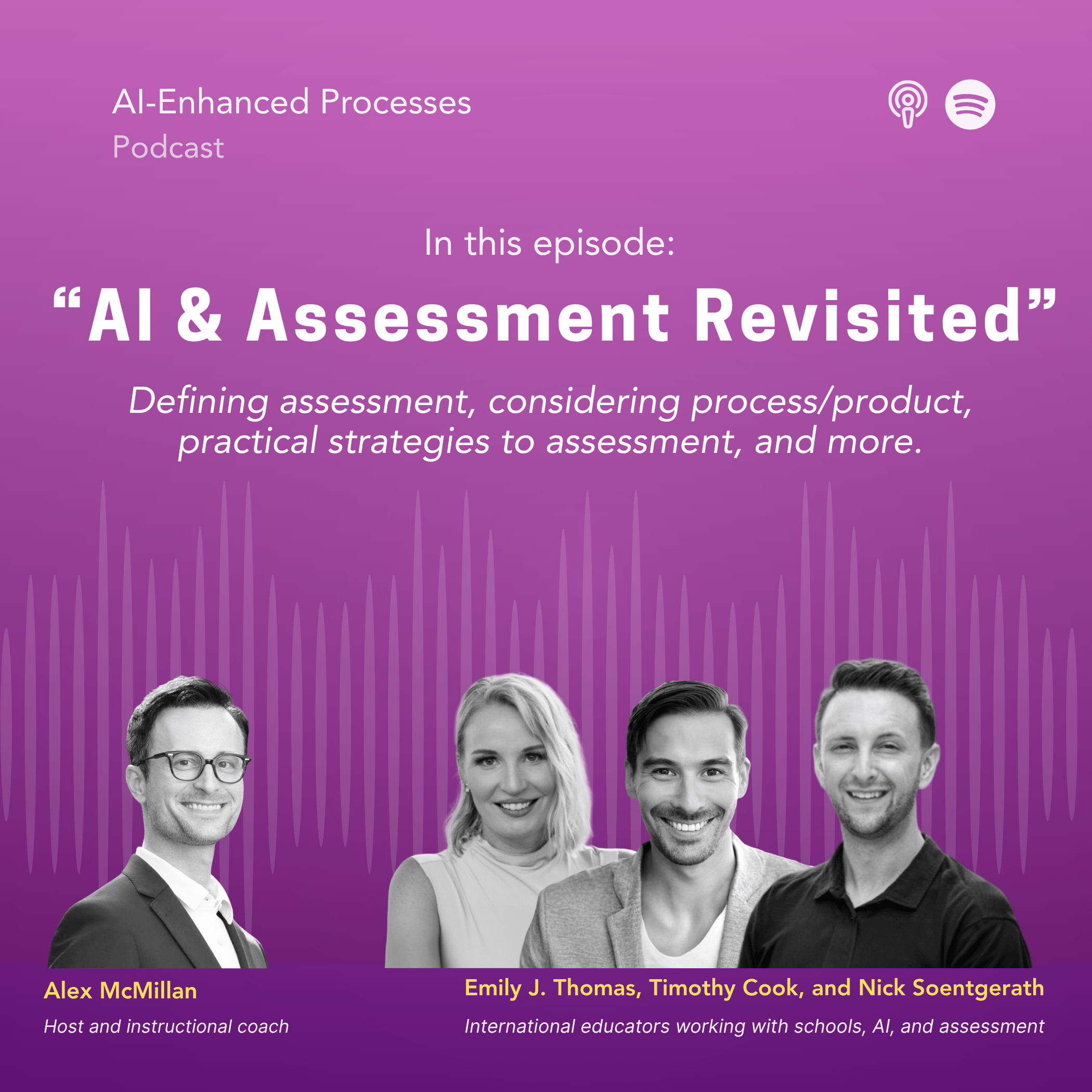
"AI and Assessment" (Revisited)
Feb 801:19:49Tap to summarizeIn this episode, I have three chats with different international educators who are working with AI and assessment in different contexts. My previous episode on assessment was one of my more popular, so I thought it was time to come back and see where we were at in terms of thinking that might be developing or getting more refined. It’s been a year since we recorded the last episode. Wow, time flies! Let’s take a look at the details of what you can expect and the folks joining me in order of appearance in the show. Emily J. Thomas is an educator, educational consultant, and entrepreneur who supports international schools in strengthening curricular development, coherence, and a clear vision for teaching and learning. She has spent over a decade in IB international schools as an MYP/DP English language and literature teacher and, most recently, served as an MYP Coordinator; she’s also an IB Educator Network workshop leader and a DP Literature examiner, and works as a literacy strategist with Erin Kent Consulting (EKC). Alongside her work in schools, Emily founded Playground Pedagogy (“playful minds, serious learning”) and leads yoga-focused work through Teaching Matters Yoga and Drift Yoga in Bangkok, and she writes the weekly Substack Elsewhere, Examined.In this conversation, Emily reframes assessment as an opportunity to extend learning; a way to “tune in” to what learners have actually acquired, not a checkbox to end a unit. She unpacks why formative vs. summative terminology can create anxiety and mixed signals for students and argues for schoolwide clarity, including shared definitions, consistent language, and policies that treat formative evidence as meaningful rather than “worthless.” Turning to AI, Emily’s message is “process first”: the best response is doing the fundamentals well with simple, standardized task sheets and clear expectations (including what AI use is appropriate) that teachers and students see consistently across classes. She closes with empathy for educators navigating this moment and a call for leaders to “steer the ship” with clarity so teachers can feel calm and supported.Timothy Cook is an educator and the founder of Connected Classroom, exploring how AI shapes student cognition and learning. He currently teaches third grade at the American Community School in Amman and writes Psychology Today’s “Algorithmic Mind” column, where he examines the intersection of education, AI, and human cognition, especially the risks of dependency and what schools can do to protect critical thinking, creativity, and moral development.In this conversation, Tim argues that writing still matters more than ever because it’s fundamentally a process of thinking: the focus, word choice, revision, and self-argument that helps students clarify what they actually believe (and that AI can’t authentically replicate). He introduces the idea of “jagged edges” that include the human, lived, imperfect uniqueness that gets flattened when AI produces the same “academically average” response to predictable prompts. From there, he makes a practical case for “AI-proofing” assessment by redesigning tasks around community, identity, and design: prompts where students must apply content in locally grounded ways (and where AI can still be used as a tool without replacing the thinking). Nick Soentgerath is a Technology Learning Coach at Yokohama International School (Japan), where he supports teachers and students in designing practical, future-focused learning with a strong emphasis on ethical, responsible, and safe use of AI. In our conversation, Nick brings a practical, classroom-grounded lens to what assessment can be when it’s less about “gotcha” grading and more about clarity, feedback, and growth. Helping schools move from measuring learning to actually improving it. He also presents at international conferences and works with educators on assessment practices that are more authentic, equitable, and aligned with the skills students need beyond school. In the episode, Nick and I discuss the upcoming conference at his school. Find out more here: www.AIFE.community. This is a public episode. If you would like to discuss this with other subscribers or get access to bonus episodes, visit aienhancedprocesses.com
Transcribe →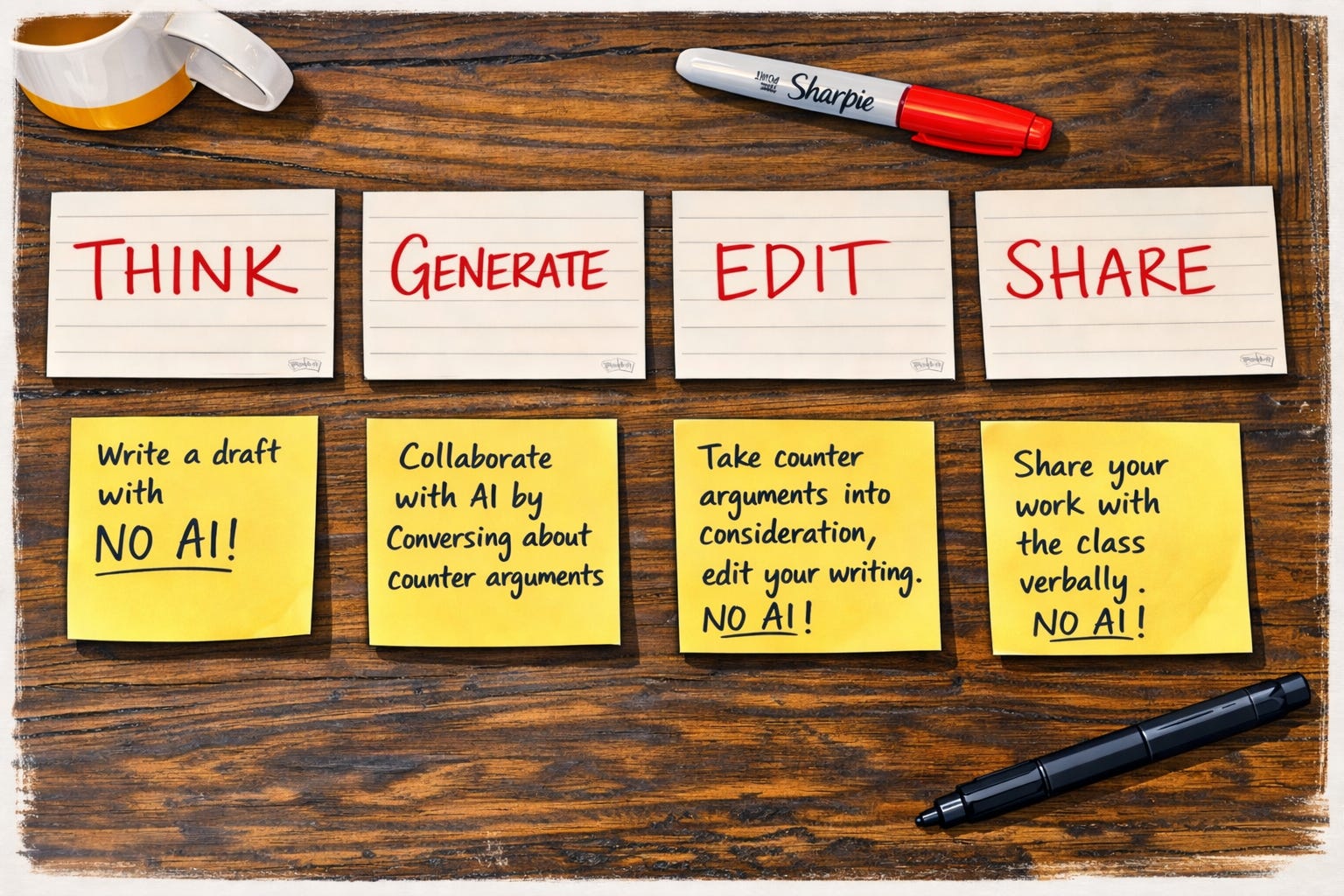
How to Design AI-Enhanced Processes
Feb 800:29:15Tap to summarizeInviting AI into your classroom and simply saying, “Use it responsibly,” is like inviting a wacky stranger to your dinner party and saying, “Just don’t make it weird.”Nobody knows what that means. You turn your back for five minutes to grab the wine, and you come back to find the stranger reorganizing your spice rack by scent and trying to sous-vide the family cat. Everyone is staring at you, and you’re left scratching your head, trying to reverse-engineer the chaos from the mess.That’s the problem with vague instructions: they invite interpretation. As Katie Novak points out in the foreword to the forthcoming second edition of my book, AI-Enhanced Processes, being a host isn’t just about opening the front door; it’s an intentional design. In a classroom, we’re hosting a digital guest in a room full of humans. If we don’t facilitate the introduction, the humans don’t know how to engage, and the guest, with all its enthusiasm and desire to please, takes over the party learning experiences.That’s basically the current state of AI school policies. Often, they're labels that sound decisive but rely on conceptual language. Many teachers are still unsure how to put that language into practice. Don't get me wrong, schools need a policy that establishes a shared language for how stakeholders will engage with AI in classrooms. However, action plans, practice, professional development, and coaching are the necessary next steps. Without the practical implementation plan, we likely will encounter selective interpretation: a teacher thinks “use AI only for brainstorming” when indicating AI is allowed. A student hears “drafting with AI is fine.” A school leader hears “future-ready learning.”We need a better way to host AI as a guest in our classrooms, and that means practicing our shared agreements, not just writing them.That’s where an AI-enhanced process (AIEP) comes in as one meaningful strategy to operationalize good practices. AIEPs are short, repeatable sequences of thinking moves that make expectations concrete. They keep the effort with the learner and give AI a clear role without letting it take over. Instead of “AI allowed,” we get shared language for action: here are the thinking moves, here’s how AI can collaborate on each one, and here’s what stays human.A strong AI-enhanced process includes these facets by design:* Multiple steps that break a complex task into smaller moves, so learning happens through a sequence.* A variety of action-oriented thinking moves (generate, analyze, evaluate, reflect) that build toward a larger outcome.* Visible thinking through drafts, notes, prototypes, and reflections so the work can be coached while it’s still happening. Process journals, folios, photos, Padlets, to name a few, are great ways to document student learning. It’s most powerful when it’s for the students first, and adults second. I will share more about this below, but I also have a two-article series you might enjoy. They touch on big ideas like efficiency and effort. Links below.* Explicit roles so each step clarifies what students do and how AI can collaborate without taking over like our wacky guest at the dinner party.* Embedded AI literacy happens through classroom dialogue and intentionally designed learning experiences, where AI shows up in ways that actually enhance learning. Students learn by doing. They build meaningful habits with AI when lessons use it to strengthen thinking, not replace it. Reflection helps students notice how the process actually flowed for them: where AI supported their growth, where it got in the way, and what they want to adjust next time. Over time, that cycle of practice and reflection becomes a lifelong strategy that students can carry into adulthood.In summary, AI-enhanced processes are strategies we intentionally design in conjunction with meaningful classroom dialogue about how we use AI with our students, which can lead to powerful learning experiences and lifelong strategies.Ok. Now that we have shared language for what an AIEP is, we can actually host AI in our classrooms. In the next sections, we’ll look at three powerful moves to build your own processes that take the above ideas into account and operationalize them. * Powerful Move 1: Name The Thinking* Powerful Move 2: Set Expectations around Student-AI Collaboration* Powerful Move 3: Make Learning VisiblePowerful Move 1: Name The ThinkingNaming the thinking in a process is an idea borrowed from Project Zero’s work around making thinking visible. And in that sense, this is not really a new idea; it’s the notion that we consider the category of thinking, and then name the verb we want students to practice. For example, the category might be to think critically, and the verb might be to evaluate. Project Zero suggests that if you care about thinking, you have to design for it. You have to name it, value it, and make it observable, because what a classroom repeatedly reinforces and rewards is what students learn to do. And with AI, if we don’t name the thinking, the easiest path of the least resistance wins: creating a polished product automatically. It’s tempting for students to skip the messy process that requires effort and to focus on task completion. If we do name it, we can build the habits of mind we actually want to instill in our students.Another important thing to note when naming the thinking is that each thinking move is not an “activity” to keep kids busy, nor are they compliance checklists. They’re steps that make thinking visible enough to practice another powerful move: metacognition, in which we can talk about the thinking, coach for improvement, encourage students to notice their own growth, and plan their own independent next steps. In addition to Harvard Project Zero’s Thinking Routines, there are other processes that follow very similar patterns, like Stanford D.School’s Design Thinking cycle, writing workshops, lab reports, Socratic seminars, critique protocols, coaching cycles, research, and a hundred other classroom processes that work because they support the thinking that leads to a solid product. Below is a preview of my book with samples of words that we can draw upon. It’s not an exhaustive list, but it’s a good place to start, helping us think about what we mean by “naming the thinking moves”. Notice the bolded words under the “Example Thinking Verbs” column. Those are things that AIs can currently do quite well on their own or in collaboration with our children. When planning, ask yourself:* What types of thinking are important in this task?* If I were to name what students should do as verbs, which ones come to mind?* How can I build a shared vocabulary with my learners about what these words mean?* When in the year is it helpful to introduce, practice, and review this language?In the next section, we will take the named thinking moves and set expectations for when and how AI collaborates with students on each move.Powerful Move 2: Set Expectations around Student-AI CollaborationI like to frame AI as not a tool, not a calculator, and certainly not a threat, but a guest collaborator. That framing changes the way we introduce it to students. We’re not handing them a device and saying, “Go use this.” We’re inviting AI into the learning space, and we should be deliberate about the roles it plays.For example, if the thinking move is brainstorming, you might say: “AI will collaborate by asking Socratic questions that push your creativity. It will not generate ideas or suggestions for you.” Now students know what they’re responsible for, what AI is responsible for, and what’s off-limits.You can take that one step further by narrowing which AI students use. In class, that might sound like: “I built a bot for you to use that’s aware of our learning objectives. Please use this bot only. It helps me be a better teacher, it allows me to coach you with more precision, and it makes your AI use transparent so we’re both clear on when and how you leveraged AI to support your effortful thinking.”From there, the planning move is straightforward: decide how AI supports each thinking move based on your knowledge of the learning goal and your students. Caveat: this kind of decision making does require some AI literacy from us as teachers, enough familiarity to predict what the tool will do well and where it might take over the thinking.If you’re new to it, AI-use scales can make expectations easier to name and share. You can use an existing one or build your own.One option is the Expectations Scale that Holly Clark and I created. It helps you label what AI can and cannot do within each step of a process. For example: “During empathizing, you may use AI to give feedback on the depth of your interview questions,” or “During outlining, you may use AI to help you structure your plan.” Another option is the AI Assessment Scale by Perkins et al. It’s widely used and has influenced a lo...
Transcribe →