Loading summary
Transcript73 lines
- [00:08]
Erica
Welcome to the Air Health R Health Podcast.
- [00:10]
I'm Erica, a lung and ICU doctor.
- [00:13]
Every day in my ICU and clinic I see patients who are there from breathing unhealthy air and I started Air Health R Health to focus more upstream on the importance of healthy air for healthy people and healthy economies. Thanks for joining me.
- [00:30]
Podcast Host / Narrator
As a lung doctor, I am very familiar with how humans breathe. We generate a significant amount of carbon dioxide in our bodies and need to exhale it. When we can't, we can become progressively confused and even unconscious. It turns out that when we live indoors in groups and continue to exhale CO2, it can accumulate to levels higher than those outdoors and affect our thinking in more subtle ways. On today's podcast, I wanted to explore what we know about CO2 indoors and what we can do.
- [01:01]
Erica
Today I am joined by Dr. Georgia Lagutis, who completed her PhD in Biological Engineering at MIT and is a Senior Fellow and Faculty at Brown University School of Public Health, where she brings extensive expertise in biosecurity and indoor air quality to lead the Clean Indoor Air Initiative, advancing policy and implementation projects to improve indoor air quality and reduce disease transmission. Prior to this role, she served as Senior Advisor for Biotechnology and Bioeconomy at the White House Office of Science and Technology Policy and launched their initiative on clean indoor air. Welcome to the Air Health Our Health Podcast.
- [01:32]
Dr. Georgia Lagutis
Great to be here, Erika. Thanks.
- [01:34]
Erica
So first, why don't you tell us about yourself and how you got interested in clean indoor air.
- [01:40]
Dr. Georgia Lagutis
Of course, I'm thrilled to be talking with you today about air quality. I think about it every day and it's such a cool and important topic and my own journey into this topic. I as you outlined, I completed my PhD in Biological Engineering and was doing work in hospitals and thinking about how skin bacteria are transferred between patients and nurses, was really focused on the technology and then came to D.C. through a policy fellowship and was working at the White House a few years later as the COVID pandemic was unfolding. And during that time period, this was in particular late 2021, as a new variant, Omicron, had just come out and we were all pretty tired of isolating. We were tired of wearing masks and being at home and schools being closed or opening and closing again. And really at time, the role of airborne transmission and the role of cleaning the air had not been fully elevated at the federal government level. And it was just, I think, kind of continued focus on touch as a mode of transmission and not a recognition that the quality of the air and the cleaning of the air really matters. Like there's a way to make indoors more like the outdoors, where disease has much, much lower rates of transmission. And so that was where I came to this topic. And while my first focus been on disease transmission reduction and launching this White House initiative on clean under air, since then I've continued to work on this topic because there's so many other aspects of health, the air quality. And the piece that got me the most is that we don't have health based standards for indoor air quality. Our building ventilation standards are set at the numbers at which 80% of people do not complain about odor or smell. And I find that extremely insufficient. And I think that we should have health based standards.
- [03:34]
Erica
Absolutely. And the focus of this podcast is to talk about carbon dioxide, which is something I guess we are all making. So in general, how does carbon dioxide get generated indoors? Where is it coming from?
- [03:47]
Dr. Georgia Lagutis
Where is CO2 coming from? CO2, also known as carbon dioxide. We are breathing this out every single moment of every single day. And I'm sure most folks that are listening on the podcast are supremely aware of it, especially if in their kind of the pulmonology lung space. But for folks that may not be that familiar, CO2 is this product of exhalation. And there's two things that are interesting about it. One is that CO2 is also kind of a metric of what we're exhaling. So it's a signal of lots of people in a room exhaling breaths together. And I have a little monitor next to me on my desk. This measures CO2 in my room.
- [04:25]
Erica
I have the same one.
- [04:27]
Dr. Georgia Lagutis
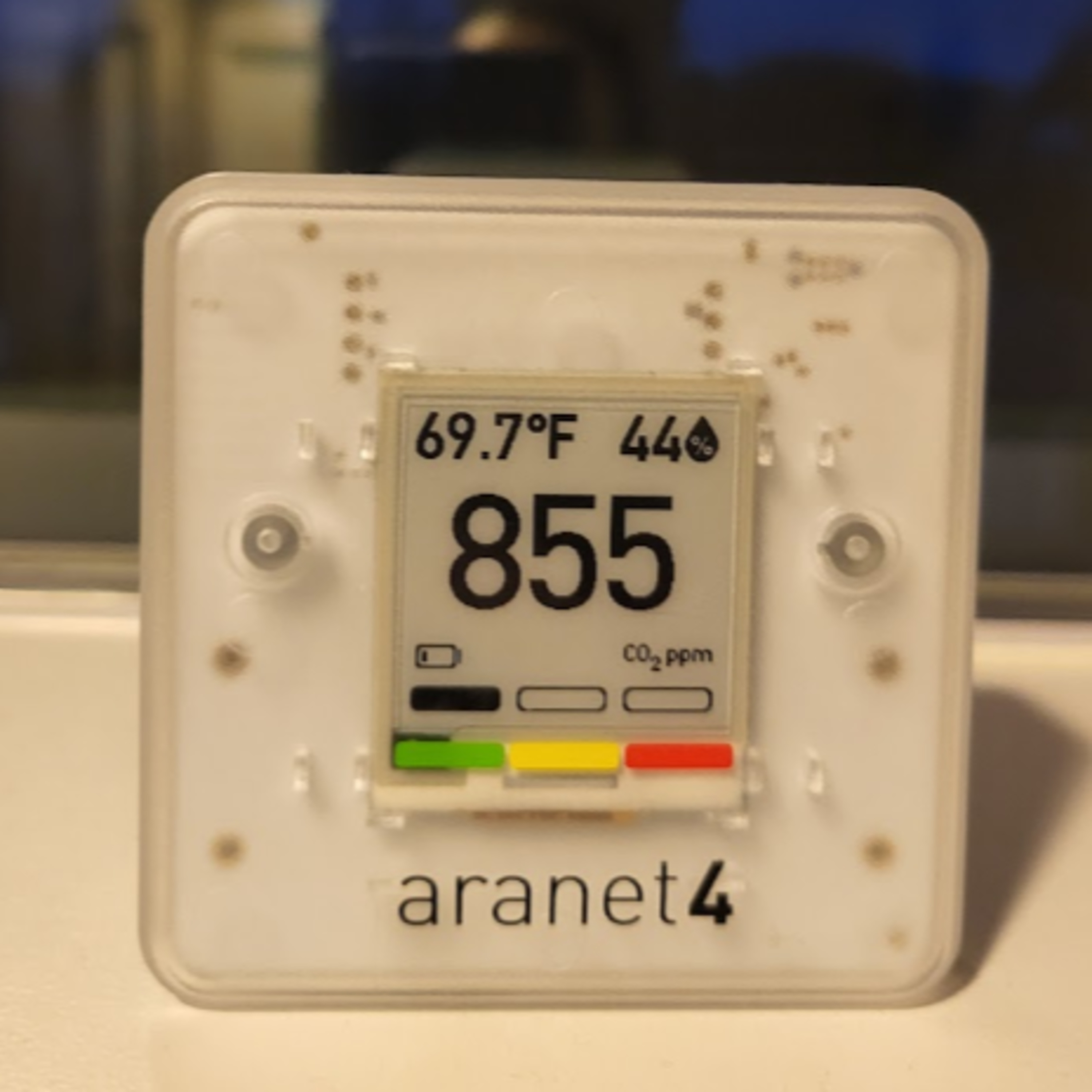
Yep, this Aeronet 4 is a pretty good one. Mine's about 750 right now, parts per million. So that's how much CO2 is in, in the space outside. It's about 450 parts per million. It can go up depending on the day or conditions. But so one, it's a metric of just like humans being in a space and accumulated breath gathering. And then two, because of that, it can be a proxy for things that, that, that breath carries. Like I could be breathing out virus if I'm infected with some virus. Also, elevated CO2 in a space can impact how our brain works. And I think that's a really underappreciated aspect of CO2 that we kind of went through this arc of sealing up buildings in the 1970s and didn't realize that in making buildings more efficient and reducing energy usage, we've sealed things up. And by accumulating things like CO2 or exhaled breath in a room, it actually slows down our brain function, which is a really unfortunate consequence.
- [05:27]
Erica
As a lung doctor, I always worry about CO2 narcosis. Right. I see patients in the ICU all the time who can't ventilate their CO2 and they can actually pass out from it as the levels get high. What do we know about how ambient elevated CO2 levels affect people? And is it different at different ages?
- [05:43]
Dr. Georgia Lagutis
Right. And Erica, you're probably talking about like really high concentrations that knock you out or like give you headaches and kind of like serious head pain. Those, as one example target, just to put out some numbers, around 5,000 units or parts per million is where the United States Occupational Safety and Health Administration has some safety thresholds. That's like above 5,000, we should be pretty concerned about headaches and like other serious consequences, we should have standards that are much below those for our day to day usage and day to day living ground in spaces generally. The scientific community has standards that are recommended around 800 or 1,000 parts per million of CO2, which is both for reducing infectious disease risk, like respiratory disease that could be transmitted through the air, as well as reducing any impact on slowing down your brain cognitive function. This is also really, really important in schools. Kids are spending eight hours a day in classrooms, often in the same room for a majority of the day. And if that room isn't well ventilated and those CO2 levels are ticking up higher and higher, 1000, 1500, 2000, or where we often see levels, that means those kids aren't able to think as well, and test scores are lower, there's clear evidence that shows that. And so I think children and younger adults can be particularly impacted by lower CO2 levels and as well the elderly population. So we've done some work with nursing homes that's particularly important for brain health and thinking about dementia and supporting, you know, positive mental health, those are kind of important to things, things about. And in saying that we can have a standard that's broadly for the general pop list, that's like around a thousand parts per million of CO2 is what we should aim to have below.
- [07:38]
Erica
And do you think those targets should be different for homes or schools or businesses? Or do you think a thousand protective in general, or maybe we should have it even lower for kids, for example, Right.
- [07:50]
Dr. Georgia Lagutis
I think in high risk areas or areas of particular focus or concern, like schools, I think we should aim for below 800. Nursing homes, I think we should aim for below 800. Hospital waiting rooms and emergency rooms. We should aim for below 800 and even less. I sit in a big building downtown in D.C. that was built recently, so it has kind of top of the line ventilation. And my office there is at 550 parts per million of CO2. So those numbers are achievable with good ventilation systems. It's not always with your existing infrastructure, but I think particularly schools, where you have lots of people coming together and you have this vulnerable population, should be a priority sector. I think compared to some spaces that are less densely populated or, you know, some office spaces don't have a ton of people and don't have a ton of mixing. But really I think schools could be a high priority.
- [08:49]
Erica
Is this why everyone feels so sleepy on airplanes?
- [08:53]
Dr. Georgia Lagutis
Oh, that's a great one. Yeah, you could feel sleepy on airplanes. There's also plenty of conference rooms I've been in where it's like later in
- [08:59]
Erica
the pack, 25 people in there and everyone wanting to pass out.
- [09:02]
Dr. Georgia Lagutis
It's kind of warm and stuffy, like, why can't I focus? Like, yeah, if you have an air quality monitor in your pocket, it's probably going to show that CO2 levels are really high.
- [09:11]
Erica
When we first went back in person for the American Thoracic Society, I actually flew on an airplane with my CO2 monitor. And the levels, let me tell you, they blew through a thousand.
- [09:20]
Dr. Georgia Lagutis
Yeah, yeah. On airplanes I carry around this monitor with me most times that I travel and it's usually between 1500 and 2000, so upwards there. A unique thing to note, Erica, is that if you take that air quality monitor into the cockpit of the airplane, so where the pilot is sitting, you'll often see that that has really good air quality. So it's like 500 or 600 parts per million of CO2, because they found that it really, really matters for how your brain works. And so we've actually done studies with airplane pilots, put them in flight simulators, raised up the CO2 and found that when it goes to 1500, they have a 15% reduction in their capacity to do risky maneuvers. And when it goes up, thousand units of CO2 that goes down, their capacity to do risky maneuvers goes down by half 50.
- [10:12]
Podcast Host / Narrator
Oh, gosh.
- [10:13]
Dr. Georgia Lagutis
So you're like, wow, we do not want pilots facing cognitive decline as they're trying to land our plane safely. But absolutely. I think it's, it's like an important thing to recognize and we should probably say this should be a standard for the entire population. Right.
- [10:29]
Erica
Or anyone doing anything risky.
- [10:32]
Dr. Georgia Lagutis
Right. And there's some, a handful of CEOs that I know. That said they won't make an important company decision or board decision if the CO2 levels are high in the room because they're like, no, I want us all to be thinking at like high cognitive function. I'm trying to make a, you know, big important decision for this company's direction. I should be doing that in like the best scenario possible.
- [10:54]
Erica
It's like you don't want to make decisions after a few drinks, after the important business dinner, probably. Similar. Similar idea.
- [11:01]
Dr. Georgia Lagutis
Yeah, exactly.
- [11:02]
Erica
So you and I have mentioned CO2 monitors a few times, and I have to be transparent. I have one in my living room and during the pandemic, I was constantly opening windows when we were hitting certain thresholds. Do you think we should just have routine monitoring of CO2 in important places like classrooms?
- [11:18]
Dr. Georgia Lagutis
Yes, absolutely. I think we need that. And I think it's not something we will get tomorrow, but I think it's a trajectory we need to be on. Something really phenomenal has happened over the past five years or so, which is that these CO2 monitors, the one I'm holding in my hand that folks maybe can imagine back home, they're, they're small, they're about the size of a deck of cards. And this costs order of 150 bucks. It was 10 times more expensive order of five years ago. And so in the past, I definitely
- [11:52]
Erica
paid more for that exact monitor a few years ago. So that price is shocking to me.
- [11:56]
Dr. Georgia Lagutis
Yeah, so the price has gone down, the size has gone down, our capacity for good long term battery capabilities has gone up, accuracy has gone up, and suddenly we have these pretty low cost and accurate monitors that we can deploy widely at scale. Just like most buildings you walk into will have a carbon monoxide monitor to detect harmful levels, your buildings will also have temperature and humidity monitors in most rooms. We should integrate CO2 monitors and PM2.5 particulate matter monitors. I think in all buildings and as a minimum in all public buildings, which includes schools. I'll tell you why I think this is not only transformative for knowing levels and how does that correlate to what should be a health based level, but it's also transformative for action because it turns this invisible metric suddenly into something visible. And there's a really cool parallel with what happened with outdoor air quality in China. There was really poor outdoor air quality. And in the lead up to the 2008 Beijing Olympics, the US embassy plopped an air quality monitor on top of their embassy and they started tweeting the numbers and suddenly it gave that community numbers to put to this parameter that was. They weren't able to define. They're like, well, the air kind of feels bad and it kind of feels smelly, but sudden.
- [13:26]
Podcast Host / Narrator
A.
- [13:26]
Dr. Georgia Lagutis
A target. We knew what is good or bad. And then we had a measurement. And that led to dramatic improvements in outdoor air pollution in Beijing. And this led to, over the past two decades, kind of globally, improvements in outdoor air pollution. So I think the same thing as indoor air quality. We haven't realized that there's invisible risks. And by putting in monitors, we can make some change.
- [13:50]
Erica
Yeah. Well, you mentioned PM2.5 and I live in wildfire country out here on the west coast. And so we frequently find ourselves in the situation where we have to seal up our homes to keep the outdoor air pollution out. But then this can cause problems indoors. Right. Like, I remember being in my house with my three young kids and the PM2.5 level outside was over 600 micrograms per meter cubed. And then I'm indoors and at the time I didn't have a CO2 monitor. But I can tell you that we were starting to feel a little loopy after a while because we have a tightly sealed, newish construction house. And how do you. What solutions do you recommend?
- [14:26]
Dr. Georgia Lagutis
How do you.
- [14:26]
Erica
How do we balance that?
- [14:28]
Dr. Georgia Lagutis
Yeah, that's a great question. I mean, we can think about it in. In some ways, a phased approach. The first is reduce the most risky threat. In that case, I would say it's probably better that you're sealed up. CO2 levels are kind of high in the household. But those really high rates of particulate matter and wildfire smoke outside, you're not breathing that in your lungs. I would agree with that approach. That is a riskier threat. There's also something to think about is high levels of CO2 are temporarily. Are generally thought of as a temporary threat. Right. So it's like something that can be pretty easily reversed. So CO2 levels are high. If you go outside, you get a breath of fresh air, or if it's clean, wherever that is, you're in some order of minutes or hours, like you're back to a good baseline. A challenge with particulate matter is those are actually absorbed into your bloodstream, and so they can stay in your bloodstream over a longer duration of time, causing inflammation. And you guys have probably already talked about this on your podcast, but I just. Yeah. So show that as like, I would try to figure. I would try to rank order what's riskiest in that case? Wildfire smoke in an ideal scenario, what we have is we have a way to be able to, to do two things. We want to be able to ventilate and we want to be able to filter. So ventilate means bring in fresh air that can dilute CO2 or lower the rates of carbon dioxide. But like you said, if you just open your window, you're going to pull in all this wildfire smok. So ideally we have a system that you have a filter so that you run that outdoor air through. A filter captures all the particulates and then you can bring in some amount of clean fresh air that can lower your rates of CO2. So that's what most high end buildings can do. These class A buildings that you'd find commonly in a city, they have the sophisticated systems of bringing in certain amount of outdoor air. They put it through filters and they circulate it. So those are maybe some approaches to take. But it's like wildfire. Wildfire risks are serious and I think those should be at the top of the list.
- [16:31]
Podcast Host / Narrator
That's helpful.
- [16:31]
Erica
Or you can also just scatter your family to other rooms. Try not to all hang out in one space.
- [16:36]
Dr. Georgia Lagutis
Fair enough. Yeah. If you're about to make like a, you know, take your SATs or big tests, maybe say like, hey, mom and dad, leave this room so I can have some, you know, low, low CO2 air. But otherwise it's probably okay.
- [16:51]
Podcast Host / Narrator
Yeah, yeah.
- [16:52]
Erica
So can you tell us about the Clean Indoor Air Initiative at Brown?
- [16:56]
Dr. Georgia Lagutis
Sure. I formed this a little over a year ago that's at the Brown School of Public Health with the core purpose of advancing policy and implementation work. And in some ways, like I am a scientist by training and this field, I think has a large amount of science and research in it. And evidence based. We have the evidence. And when I first came to this topic, I was like, well, maybe we just haven't, we haven't like built the right tool. We don't have the right technology for sure, it's a tech problem. I had my hat on and so I went and interviewed a few dozen people and 95% of them told me it's not a tech problem, it's an implementation problem. And so what we're trying to do as part of the Clean Endure initiative at Brown is translate existing evidence to policymakers and to leaders and to decision makers and turning that into action. So one example is at the state level level. We're engaging with four different states right now. One includes Rhode island, which is where Brown University is based on moving forward proposing and supporting legislation that would advance indoor equality in schools and trying to give them the right kind of technical expertise and toolkits and template language, legislative language that they can move ahead. We're also doing work to translate this to the business community. So why should businesses care about doing this? For employee productivity. And we're also not only doing work within the United States and policy work, but also globally. Last September, we launched the first ever event at the United nations specifically on indoor air quality and how it relates to health and to brain function and to workplace safety and to vulnerable populations, and launched a global pledge on that effort and are excited to continue that.
- [18:51]
Erica
Wonderful. So what steps can people take to ensure healthy air in their own home?
- [18:55]
Podcast Host / Narrator
Problems?
- [18:57]
Dr. Georgia Lagutis
Yeah. So one is probably get a monitor. It's great. You can't manage what you can't measure so suddenly. If you can put some numbers on it, you'll have a little bit more information. I would recommend a monitor that can tell you CO2 and ideally also particulate matter. PM2.5. Those are two great metrics to have. PM2.5 might go up if you're cooking and all the doors are closed, windows are closed, and your vent isn't on and kind of gives you an indication of, hey, I should be ventilating this space. Or if there is outdoor pollution sources like wildfire smoke. So number one, get a monitor so you can have some metrics. Number two is find ways to improve ventilation and filtration in your own home. So I have an air purifier in my office and I have one in my bedroom. Right. We spend a lot of time sleeping and that amount of time would be great to make sure your body has clean fresh air. And the energy costs for these air purifiers are very low these days. They're actually very efficient. And so it's order of having a light bulb. So having an air purifier I think is really helpful. And additionally check the if you have an H Vac system, like a mechanical ventilation system, checking the filters that you have are really important. So I've upgraded my filters from MERV 8 to MERV 11 or if you can even MERV 13. Those are names of filter types. You've probably talked about this. But just like an interesting thing to note is these lower level of filters, typically MERV8, essentially capture close to 0% of airborne virus particles. And if you go up to a MERV 11 or if you go to a MERV 13, you can capture closer to 70%. That just helps create a safer space in your home. If you have guests over, you're capturing more of the things near. That's what I would do. Then the third thing I would do is not only checking the space that you live in, like your home, but asking your school or asking your business, what is their equality? What are they doing to make sure you're breathing healthy under air or your children are breathing healthy under air and have them tell you something about the quality there.
- [21:10]
Erica
So moving on from homes for schools, workplaces, cities, counties, what policies or procedures are you guys advocating for to help the whole population?
- [21:21]
Dr. Georgia Lagutis
Great question. This was a good kind of segue from the previous one. And thinking about what you can do as an individual, what the three primary recommendations are in particular in schools that also applies to workplaces and cities. We've published and Erica, maybe we can share this in the links of the podcast. We've published a state guide for clean indoor air force leaders in particular at the state level. So this could be governor's offices or state health departments or school district leaders. About two dozen organizations came together to write this guide. And so we have a couple of key recommendations, but three top lines are, number one, put someone in charge. So this should be under someone's job responsibility to check the indoor quality of that space and to have a management plan and kind of a maintenance plan of making sure that you maintain some health.
- [22:14]
Erica
Health.
- [22:14]
Dr. Georgia Lagutis
Unfortunately this is often not done and this is because it falls between the gaps of all these different people. This happens in the US Federal government that it falls between the gap of public health like cdc, epa, that's, you know, air pollution and environment. But is it indoor air places like hhs, the Health and Human Services and NIH that focus on health translational work? So I just give this as an example of often there's not a person in charge. So number one, put someone in charge. Number two, publish guidelines for health based standards for indoor equality. So that entity, whether it's the school or the city or the state, to actually put out some targets for people to aim for. And then three, have regular ventilation assessments of those spaces. So most places, the only time you're required to check the ventilation indoors and air quality indoors is when the building was built and after that. Most building codes are such that they don't require ongoing maintenance and operation. So it's up to that own building owner or their own entity to be like, well, have we checked the filters or have we checked the air quality of space? And so we've supported some of the technical assistance in writing a bill in the state of Rhode island that does those three things particularly focused on schools to say, let's put someone as the key point of contact, let's publish some guidelines and let's have routine assessments of air quality in schools.
- [23:45]
Erica
Yeah. You wonder about all these behavioral issues in schools and all these things that people talk about being concerned that children are checking out and just starting to think, well, has someone checked the CO2 levels in these classes?
- [23:55]
Dr. Georgia Lagutis
Absolutely. Yeah. In some ways it's like we're walking around with a brain tax, like a 10% brain tax. We're all 10% slower than we could be if we had cleaner air. We just like haven't realized it.
- [24:11]
Erica
Yeah, I think one of the things that people hear, you know, I've done a little, you know, a bit of advocacy in our state legislature on other topics of clean air. And I think everyone's just worried up front, including families and parents, about the upfront costs for clean indoor air. You know, they hear things like buying air filters and H vacs and upgrading and for a family, when you know, everyone worried about cost of living and then you're hearing about, okay, now someone wants me to buy more things or make changes and these sound expensive. And so I think a lot of people worry about that upfront cost, but may not think about that 10% brain tax or the cost of unhealthy air. And has your group quantified the cost of poor indoor air? A lot of times people just want to know the dollars and cents, you know, what's the cost of the poor indoor air in different scenarios?
- [24:59]
Dr. Georgia Lagutis
Yeah, no, great question. And maybe I'll take a two, two part approach in answering that of one, what have we done to assess the costs and then to how you might think about that in your own day to day. There is. We've compiled a summary of studies that have assessed costs. The easiest place to see this is in businesses because businesses are driven by revenue and product generation. And in businesses it's about a 200 to 1 return on investment. So you can, you'll spend about $35 per employee per year to double the ventilation rates. So if you want to go from a medium level of ventilation rate and double that of clean air delivery rate per person, you'll spend about 35 bucks and you will get about $6,500 in return on employee productivity. And that's mostly due to cognitive function. Just like your employees are going to be smarter and be more aware and be able to work about that 10% better. And that doesn't even include, we haven't include their sick leave. So presumably you will also expect to have a reduction in sick leave as well. And that return on investment is very quick. It's on the order of months to a year, not you need to wait 10 years to see the bottom line change. That's one case. There's a second which is specific to schools. And we're working with a partner right now that will be hopefully releasing results of a study very soon across the state of Colorado. They deployed air purifiers and air monitors in thousands of schools and are finding that there is order of a 10% reduction in student absenteeism. And other studies have shown similarly about 10 to 15% improvement in student test scores. There are ways to also I think, position this in the educational community that there are positive returns on investment because of student outcome in reduction in teacher sick leave and having to pay for substitute teachers. And potentially in some states that have revenue ties to student absences, it's part of, it's pretty easy to kind of have a positive return on investment there. But ultimately the other, the other piece I'll say is that the scale of change or the cost of the interventions can be scaled. So you could move from making sure you have functioning windows, right? So I'm like, make sure that we can open windows and bring in fresh air painted shut. Yep, that's one. You could just upgrade a couple bucks more for these higher quality filters in your H Vac system. You could buy some low cost air purifiers. They range from 1 or 200 bucks up to a thousand, depending on like what you're finding out in the market. And then there's the higher end which is upgrade your H Vac system. But I think we have a lot of tools in the toolbox before upgrading H Vac systems that can be used. And I also think about this at home. Like I rent an apartment. I don't have the financial means to upgrade this H Vac system. And so I do the two things that are financially feasible for me is I buy, I have my two air purifiers, one in my office and one in my bedroom. And then I use, I open windows when I have a large crowd of people home to help make sure we're getting in some outdoor air and ventilating the space. And also turn my H Vac system instead of to auto, I turn it to on just to be able to like circulate and move air around. So there's kind of a whole, a whole scale of things And I think for me, what's been a helpful mindset adjustment is becoming air aware. This concept of now I can walk into a space and kind of have a sense of does it feel more risky or less risky or does something really not have any air quality standards in place and how I should assess that space? And I don't always need to have a monitor with me, but just some awareness I think is really helpful.
- [29:14]
Erica
Absolutely. So it sounds like there are a lot of cost effective strategies to improve indoor air quality. That return on investment seems incredible. I am always encouraging people to plug the return on investment of the Clean Air act into retirement calculators and you see a 25% annualized rate of return. I think anyone would want that in their 401k.
- [29:34]
Dr. Georgia Lagutis
Wow, that's a good.
- [29:35]
Erica
It seems like we see a similar return when we were trying to think about upgrading our homes and schools.
- [29:41]
Dr. Georgia Lagutis
Yeah, yeah, yeah. In, in terms of, for businesses, like the average business, the vast majority, 90% of a business's costs are for its people. 10% or less of the cost is for the actual building and the energy usage of the building. So often we're thinking about, oh, do these interv interventions, you know, they cost more money and they're going to cost more energy, but really it's people that are like the prime investment. I think we should also think about that for our own selves, like stepping away from a business. Just like you said, Erica, like we should all be a little selfish to be like, I, as an individual, I want this brain to function well for many decades and how do I make sure that I'm giving it the good, clean, healthy resource it needs for a long time?
- [30:27]
Erica
Absolutely. Well, that's the mission of our health.
- [30:29]
Our health.
- [30:30]
Dr. Georgia Lagutis
Yeah. Can I throw out one more? Because I'm, I'm guessing like some in your audience are, are, are kind of science focused. And I think there was one thing for me that relates to CO2 that was a kind of a fun fact to understand. I went down this rabbit hole question of why. Why does elevated rates of CO2 make your brain slow down? And what's happening essentially is that you're acidifying your brain. So CO2 enters your bloodstream and is circulated slightly higher levels and it acidifies your brain environment. That essentially slows down the transmission of neuronal signals. So that's one of the mechanisms. And there's a couple other. But I just think understanding that that's like, wow, it actually changes how your brain works and slows things down for me was Kind of a helpful connecting the dots on how this has an impact in my day to day life.
- [31:24]
Erica
Yeah, I see it very dramatically. Like we talked about in the intensive care unit, we actually can measure the arterial ph of a patient and their oxygen tension and their CO2 tension and their bloodstream. And the brain really wants it in a very specific area. And when that level starts to rise because someone can't ventilate, you know, they can become obtunded and we actually will have to put them on a breathing machine to blow that CO2 down, basically to open the window and get the CO2 down so that they can wake up. You know, it's so, it's so fascinating that even smaller levels of that can just be affecting all of us in ways that we don't particularly see or understand.
- [32:02]
Dr. Georgia Lagutis
Yeah, that's a really cool connection of kind of like the extreme ends that you've seen. But it can happen in our day to day.
- [32:07]
Erica
Well, that's the whole point of this. You know, in the icu, I see all these people who are functionally there from breathing unhealthy air, whether it's smoking cigarettes, tobacco vaping, you know, CO2 going up. And so it's trying to go more upstream of. Well, how do we, how do we have fewer people end up in the icu?
- [32:23]
Dr. Georgia Lagutis
Right.
- [32:24]
Erica
So I really want to thank you for mostly your career of public service. But for today, for your time, is there anything else you want to add?
- [32:34]
Dr. Georgia Lagutis
Just invite folks to learn more about this topic. We'll share some resources for the Clean and Dirt Initiative and this global pledge. And we've launched a community of, we're calling them Clean and Dryer Advocates through this new nonprofit called Air Club. So if you care about air and you want to help, add your voice to this topic. Airclub.org is a, is a community we're trying to build to accelerate some momentum on this topic.
- [33:04]
Erica
But yeah, this was so like to join.
- [33:07]
Dr. Georgia Lagutis
You're in it. You're an Air Club member. Thanks. Thanks for, for being part of this, Erica, and for your voice on this topic.
- [33:14]
Erica
Thank you.
- [33:20]
Podcast Host / Narrator
I am delighted to have shared this interview with you. Naturally, I worry a great deal about outdoor air pollution and how it can affect my patients, especially because they often have minimal to no control over pollution generated where they live. However, we have a lot more control over the air inside the buildings in our community. It is important for all of us to understand this so we can advocate for that air to be as clean as possible. This is especially important because we all spend most of our time indoors and the people about whom I worry most, my patients and others with chronic illness, often spend even more time indoors than the general population. It is vital that indoor air is healthy to avoid worsening disease, increasing infection and apparently making us all dumber. The world is fast paced right now and we can't all afford to be paying a 10% brain tax because of high CO2 and poor ventilation in our building. But how do we make this happen? Honestly, I increasingly think low cost sensors may be the way to go. As Dr. Laguta says, you can't manage what you can't measure. Having now lived with a PM2.5 sensor and a CO2 sensor in my home for a long time, I am very used to closing windows and running the HEPA filter when PM2.5 levels increase or opening a few windows when our CO2 levels rise in a large gathering. There is something that is just easier for humans to see information from our own environment and to make adjustments than to do so in a data free zone. It also prevents people from wasting time and effort and money on air that is already pretty clean and focusing efforts where they are needed. So what can you do first? If you can afford it, consider purchasing a simple sensor that detects CO2 and PM2.5. You want your CO2 level less than 1000, perhaps less than 800 if you have kids in the home and your PM2.5 average under 5 micrograms per meter cubed. Prioritize the PM2.5, but pay attention to the CO2 as well. Dr. Lagutas provided a link for Cost effective Sensors which is available in the show Notes Notes. You can also find out if your work or the school for your children monitors indoor air quality. If not, consider advocating for indoor air quality sensors there. It will help reduce absenteeism and improve cognitive function and for your kids, their test scores. You can also check out the Clean Indoor Air Initiative at Brown to encourage clean indoor air policies at local, state and federal level. You can find the State Guide for Clean Air in the show Notes. You should Also check out airclub.org if you have an organizational interest in advocating for clean air. We covered a lot of resources in this episode, so please see the post for the episode for all the references we discussed and more. I also include those links to budget friendly air monitors recommended by Dr. Lagutas.
- [35:40]
Erica
We're coming to the end of the podcast for more information about the importance of healthy air. Please visit airhealthrhealth.org and follow on Instagram and Facebook. Remember if you do nothing else, don't light things on fire and breathe them into your lungs. This applies to tobacco, diesel fuel, forest risks and more. Thanks for joining me today. I am a full time physician and not an epidemiologist or public health expert. This podcast is for your education and entertainment but should not be interpreted as individual medical advice. Please consult with your own healthcare team to determine what is right for your health. Thank you and stay safe.