← Alan Watts Being in the Way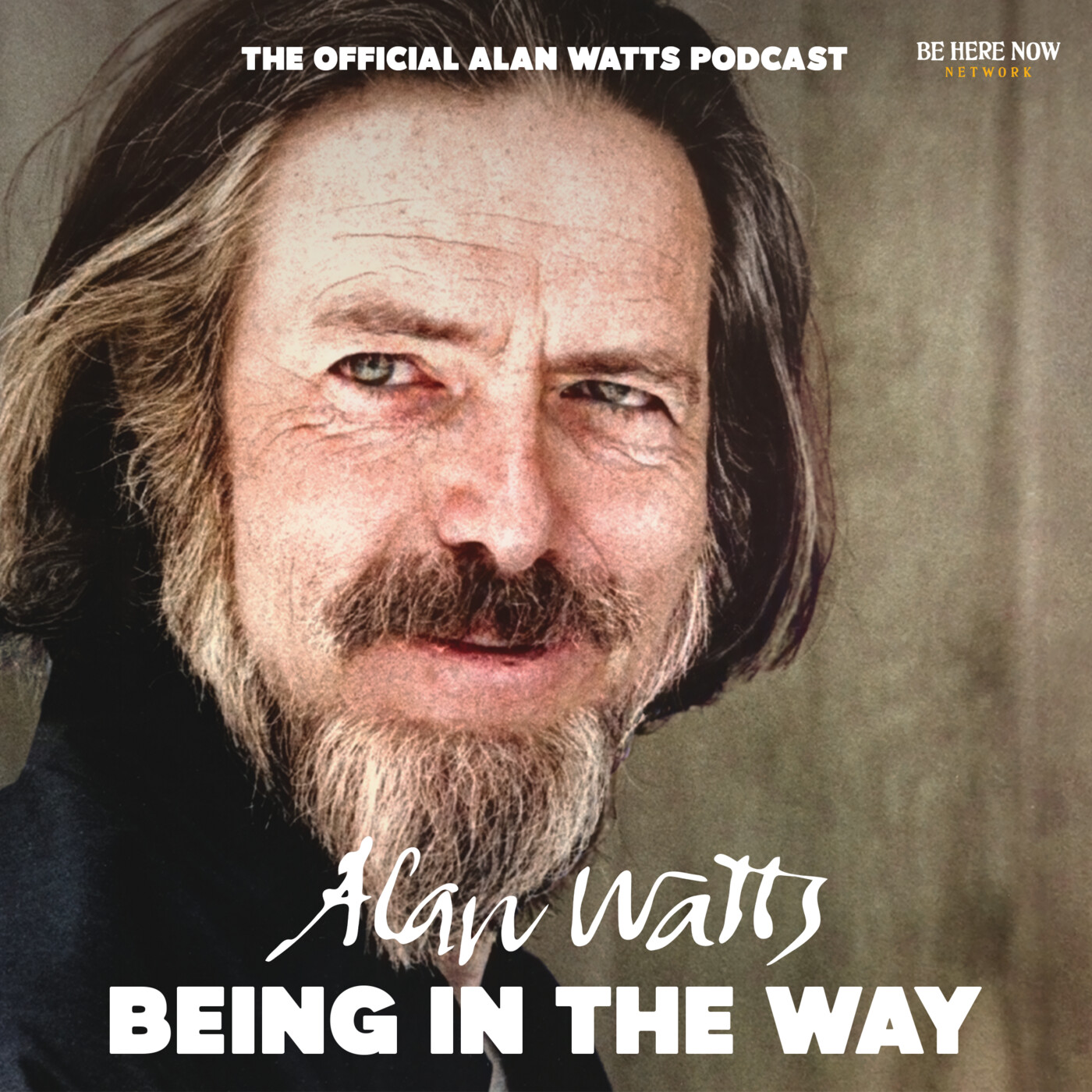
Loading summary
Transcript4 lines
- [00:02]
A
Teaching meditation is its own skill. You don't need to be a master practitioner to begin learning how to guide others, but you do need real training. Join Buddhist teacher David Nichtern and Professor Robert Thurman for a free online discussion on Tuesday, May 26th at 6:00pm Eastern Time, exploring the role of the teacher in the Buddhist tradition, why lineage and transmission matter, and what it means to skillfully support others in meditation practice. Today they'll also discuss Dharma moon and Tibet House's mindfulness meditation teacher training program beginning in June 2026. You'll have a chance to ask questions, meet the teaching team and find out whether the program might be a good fit for you. Visit dharmamoon.comfriend that's dharmamoon.comfriend for more information and to reserve your spot for the free event on Tuesday, May 26th. Welcome to Being in the Way, the Alan Watts Podcast and today we're going to listen to the second talk from the Japan Tours, Religion of no Religion. And this was a talk that he gave at Mount Koyasan, and it's a wonderful exploration of Buddhism. And without further ado, here is Alan Watts from Religion of no Religion.
- [01:53]
B
I was discussing last night the Bodhisattva doctrine in Mahayana Buddhism and comparing it or relating it to the two great tendencies in Indian spirituality, anti worldliness or otherworldliness and world affirmation, and showing how the idea that the highest kind of a Buddha is in a certain way a non Buddha, the highest kind of a Buddha is like an ordinary person. And this comes out very, very much in various tendencies in Zen, where, for example, all the painting peculiarly characteristic of Zen Buddhism in the Chinese and Japanese tradition is, as it were, secular. It has a peculiarly non religious atmosphere. That is to say, the painting of Shingon sect and Tendai sect as you saw it in the museum today, was religious painting. You could tell at once that the subject matter of these paintings is religious. But with Zen painting, the way of dealing with philosophical on spiritual themes is secular. So that when an artist like Sengai living in the 17th century Japan, paints the Buddha, there is something slightly humorous about the Buddha. He wears his halo over one ear. There is an informality, a slight raffishness. And so this comes from China, from those great Song artists like Liang Kai, who painted the sixth patriarch of Zen chopping bamboos looking like the most extraordinarily unkempt country oaf. So also the greatest Zen painting has as its subject matter not really religious themes at all. It uses pine branches, rocks, bamboos, grasses Everything of that kind. And you would never know that these things were icons. Likewise also in poetry, which we will go into more extensively in the future. The superb expression of Zen poetry is derived from the Chinese poet Hokoji, who says, wondrous action, supernatural power, drawing water, carrying fuel. Now that's. That poem is a little bit too religious for Zen taste. And so preferable to that is Basho's famous poem, the old pond, a frog jumps in. Plop. Plop is the only possible English translation for the Japanese Mizu no otto, which means literally the water's sound, plop. But that poem, you see, is very high styles and poem because it has nothing in it about religion. There is a poem on the edge, which also was written by Basho, which says, when the lightning flashes, how admirable. He who does not think life is fleeting. You see, the flash of a lightning is a Buddhist cliche. For the transiency of the world, your life goes by and it disappears as fast as a flash of lightning. That becomes a cliche. So all religion, all religious comments about life eventually become cliches. And that's why religion always is falling apart and becoming a certain kind of going through the motions, a kind of imitation of attitudes. As if one would say, we've got a book called the Imitation of Christ. It's a terrible book. Because everybody who imitates Christ is a kind of a fake Jesus. So in the same way there's all kinds of imitation Buddhas, not just sitting on altars made of wood gilded, but just sitting around in monasteries. So one might say then that the highest kind of religious or spiritual attainment has no, no sign about it that it is religious or that it is spiritual. And so as a metaphor for this, there was used in Buddhism from the very beginning the idea of the tracks of birds in the sky, they don't leave any tracks. And so the way of the enlightened man is like the track of a bird in the sky. And as one poem, a Chinese poem, says, entering the forest, he does not disturb a blade of grass. Entering the water, he does not make a ripple. In other words, there is no sign about him to indicate that he is self consciously religious. And this goes too, for the fact that his not having any religious sign is also not something contrived. It isn't like Protestant simplicity, you know, all those Catholics with their rituals and how dreadful and insincere that is. The real reason, you know, why Protestant think Catholic ritual is insincere, you know, it's expensive. Protestantism started in the burger cities of Europe, places like Freiburg, Hamburg, you know, and Geneva. Because the merchant class, who were the foundation of the bourgeoisie, got annoyed because every time a saints day came around, all their employees got a day off because it was a holy day and they had to attend mass. There were so many of these nuisance holy days and all these contributions that were assessed by the church buying your way out of purgatory and saying masses for the dead and so on and so forth. They found this not very economical. The priests were getting the money instead of the merchants. And so they decried as unbiblical and irreligious and wasteful all the finery of the Catholic religion and wanted something plain and simple. So it became, in course of time, a sign of being really religious, to avoid rituals and to avoid colorful clothing and splendor in churches, and to be as ordinary as possible. But that is not yet the real religion of giving no sign of having a religion. Because this simplicity and absence of ritual itself becomes a sign, a way of advertising how spiritual you are. So the completely Bodhisattva type of person doesn't leave any track either by being religious overtly or by being non religious overtly. How will you be neither religious nor non religious? See, that's the great test. How will you avoid that trap of being one or the other? It's like, are you a theist or are you an atheist? See, the theist is caught by God and the idea of God, the belief in God. But the atheist is equally caught, because an atheist is very often an atheist because he cannot stand the idea that God is watching him all the time, that there is this constant, all seeing eye prying on your most private life. And that there's this. You know how when you're a child in school and you are writing something or doing arithmetic and the teacher walks around the class and looks over your shoulder, Nobody wants to be watched like that. Even someone who's good at writing or at arithmetic doesn't want somebody looking over their shoulder while they're doing it. It puts you off. It bugs you. So the idea of the Lord God, who is watching us all the time, who is judging everything that we do, puts people off and they can't stand it. So better be an atheist to get rid of teacher. So, but the atheist, you see, the man who advertises his disbelief in God, is a very pious person. Nobody believes in God like an atheist. There is no God, and I am his prophet. So then the true Bodhisattva state is Very difficult to pin down as being neither supremely religious nor blatantly secular. And people who think that the height of Buddhism or the height of Zen is to be perfectly ordinary have still missed the point, like the atheist has missed the point. But for this reason, then, there is an element in the art, the painting, the poetry, etc. Which has been inspired by this kind of Buddhism, this kind of art where the subject matter is non religious. Nevertheless, there is something about the way in which this non religious subject matter is handled that stops you and, you know, there's something strange about it. This is how I first became interested in Oriental philosophy and all that kind of thing. I had an absolute fascination for Chinese and Japanese painting, the secular painting, the landscapes, the treatment of flowers and grasses and bamboos. There was something about it that struck me as astonishing, even though the subject matter was extremely ordinary. And I, just as a child practically, I had to find out what was the strange element, those bamboos and those grasses. I was being, of course, taught by those painters to see grass. But there was something in there that one could never pin down, never put your finger on. That was this thing that I will call the religion of no religion, the supreme attainment of being. A Buddha who can't be detected, Who in this sense then leaves no trace. You remember, some of you have seen those 10 paintings called the 10 Stages of Spiritual Ox Herding and the the author. There are two sets of these paintings. There's a heterodox one and an orthodox one. The heterodox one has the as the man catches the ox, it gets progressively whiter until in the end it disappears altogether. And the last picture is an empty circle. But the orthodox set of paintings doesn't end with the empty circle. That the empty circle arises two from the end, three from the end. It is followed by two others. After the man has attained the state of emptiness, the state, in other words, of complete iconoclasm, the state of no attachment to any spiritual or psychological or moral crutch. There are two more steps. One is called Returning to the Origin, which is represented by a tree beside a stream. And the final one called Entering the city with hands hanging down. That means hands giving a handout, as it were, giving bounty. And it shows a picture of the fat Buddha, Putai, or in Japanese known as Hote, who is an enormous belly, big ears, who carries around a colossal bag. And what do you think this bag has in it? Trash, wonderful trash. Everything that children love, things that everybody else has thrown away and thought of as valueless. This bum collects and gives it away to children. And so it says here that he goes on his way without following the steps of the ancient sages. His door is closed. That's the door of his house, and no glimpses of his interior life are to be seen. So in other words, it's like when you erect a building, while you're building it, you have all kinds of scaffolding up that shows you that building is going on. But when the building is complete, the scaffolding is taken down to open a door, as they say in Zen, you may need to pick up a brick to knock at the door, but when the door is open, you don't carry the brick inside. To cross a river, you need a boat, but when you've reached the other side, you don't pick up the boat and carry it. So the brick, the boat, the scaffolding, all these things represent some sort of religious technology or method. And in the end, these are all to disappear so that the saint will not be found in church. I don't take what I say literally. The saint can perfectly readily go to church without being sullied by church. But ordinary people, when they go to church, they come out stinking of religion. There was a great Zen master once, and one of his disciples asked him, how am I making progress? He said, you're all right, but you have a trivial fault. Well, what is that? He said, you have too much Zen. Well, he said, when you're studying Zen, don't you think it's very natural to be talking about it? The master said, when it's like an ordinary conversation, it is much better. And so another monk, who was standing by listening to this exchange, said to the master, why do you so specially dislike talking about Zen? And he replied, because it turns one's stomach. So what did he mean when he said, when it's like an ordinary, everyday conversation, it is somewhat better. When the old master Joshua was asked, at the end of the kalpa, when everything is destroyed in fire, there will be one thing remaining. What is that? And Joshua replied, it's windy again this morning. So in Zen, when you're asked a question about religion, you reply in terms of the secular. When you are asked about something secular, you reply in terms of religion. So what is the eternal nature of the self? It's windy again this morning. Please pass me a knife. The master hands him the knife with the blade. First, please give me the other end. What would you do with the other end? See here, the disciple starts out with the ordinary, please Pass me the knife. And suddenly he finds himself involved in a metaphysical problem. But if he starts out with the metaphysical, he's going to get involved with a knife. So now to go deeply into the religion of non religion, we have to understand the what you might call the final ultimate attainment of Mahayana Buddhist philosophy. And this is contained in a school of thought which is called in Chinese Hua Yun and in Japanese Kegon. Kegon is the intellectual foundation for Zen. And there was a great Chinese master by the name of Schument who was simultaneously a Zen master and the fifth patriarch of the Huayan sect. Hua, it means flower, Yen, garland, the garland of flowers. And it's all based on a Sanskrit sutra called Avatanksaka. This is called simply the in Japanese Kegon Kyo, very big Sutra. And the subject matter of this sutra are what are, what are called the four dharma worlds. And I must explain what these four worlds are so that you get the point. First of all, there is a level of being which we will call ji. The word ji, which is Japanese way of pronouncing the Chinese ch, is the world of things and events, what you might call the common sense world, the everyday world that our senses normally record. This, the word ji, the character in Chinese, has a multiplicity of meanings because it can mean a thing or an event. It can also mean business, an affair, not in a love affair, but something in the way the French say les affairs for business, something important. It can also mean affectation, Putting something on or showing off. And so a person who is a master in Zen is called buji, which means no business, no affectation, nothing special. The poem says, on Mount Lu there is misty rain, and the river Jung is at high tide. When you have not been there, your heart is filled with longing. But when you have been there and come back, it was nothing special. Misty rain on Mount Lu, River Jung at high tide. But this nothing special is not a way of putting something down. Do you see that? I could say, well, it was nothing special. It didn't really amount to anything. That's one way of saying it was very ordinary. But Buji, just as it doesn't mean it was very ordinary, in the same way that the person who has no religion is really the most religious, you do see, he's not just a common, ignorant moron. He looks like one, but he isn't. And you have to know what he knows in order to see that he isn't and to recognize him for what he is. So nothing special, Buji, it doesn't stand out, it doesn't, as we would say, it doesn't stick out like a sore thumb. So the world of G, then, means generally the world of particulars, the world of multiplicity, the world we ordinarily feel we're involved in. So that's the first world. The second world is called the world of re. Now, re in Chinese, li is, as I explained to you when we were discussing the idea of the law of nature, the character means the markings in jade, or the grain in wood or the fiber in muscle. But in the Huayan philosophy, the word re means the universal underlying all particulars, the one underlying all multiplicity, the unitive principle, as distinct from G, which is the differentiation principle. So, as it were like. It's like this. When you see into the nature of this world, you start from G. You start from noticing all the particular things and being baffled by their multiplicity and dealing with the multiplicity of things. But as you go into this, you discover as you understand things. What do you mean when you understand things? It means you become aware of their relationships to each other, and eventually you see the unity behind them. And it is as if the multiplicity of the world dissolved into unity. So here you encounter a problem. I can see the world as a unity. I can see the world as a multiplicity. But how the devil am I going to put the two visions together? If I am to be a practical success in business, in family life, and so on, I have to observe the world of particulars. It's particulars that matter. I have to know chalk from cheese. But if I become a saint, a monk or a hermit, then I can. Or even perhaps a poet or an artist, I will forget about the practical matters and contemplate the unity, the secret meaning underlying all events. But then every. All those practical people are going to say to me, you're. You're falling down on the job. You've escaped from life. Because they feel that the world of particulars is the real world. But the other guy says no, and your particulars are not real. You make a success of things, yes, but it's completely temporary. You think you're an important person, that you're really contributing to human life. But actually, your success in doing this sort of thing lasts for a few years, and then you fall apart like everybody else does. Where's your success now when you're dead? What happened to the millions of dollars you made? Where are you all gone? So that isn't real from the standpoint of the person who concentrates on the unity. So then to perfect our understanding, we have to go to the third of these worlds, which is called Re. G muge. Now, that means between Re the unity and G the particulars. Mu. There is no GE block. That means the world of the universal and the world of particulars are not incompatible. Let's take two very different things and see how they can be united. Take shape and color. Never in a million years can you, with a black pencil that can draw shapes, make red. But if you have red, you can draw a circle. You can draw a red circle, even though the circle shape and the red color will never be the same. Yet red circle, they go beautifully together. So think of circle as G and red as re. The circle is the particular, the color is the universal. They go together. So then we might say the properly rounded out person is both spiritual and material, both otherworldly and worldly. This is the supreme attainment of a human being, to be both. Don't get one sided. A person who is what you might call just a materialist. Ends up by being very boring. It's, you know, you can live the successful life of the world and you can own every kind of material refinement. You can have the most beautiful home, delicious food, lovely women, marvelous yachts and cars and everything. But if you have no touch of mysticism, it eventually is all perfectly boring. And all those beautiful women turn out to be made of plastic and you get tired of it. Then, on the other hand, there are people who are purely spiritual and they live in a kind of dry world where all luxury has been scrubbed away. And they are very intense people. When you are in their presence of a very spiritual person, an excessively spiritual person, you feel inclined to sit on the edge of your chair. You are not at ease because you know the eye of judgment is looking through you and going down into your very soul and finding that you're just a scallywag after all. And here's this absolutely sincere, this dreadfully honest and unselfish person. Now, he is like a wine which has no body. It is pure alcohol, pure spirit. And on the other hand, the materialistic person is like a soft drink which is all sweet and sugary, but no alcohol. Good drink. You see, a very marvelous wine is not alcohol. It has alcohol in it and it's not poured in. You see, you don't add so much alcohol to grape juice to make wine. The alcohol in a fine wine is part and parcel of the whole substance of the wine. And also, it has its body, it has fragrance, and it has all this Grown together. So in exactly the same way a superior human being has sensuality, that's the body, as in the body of a wine. And spirituality, which is the alcohol, the heady, the intoxicating part. And thus this is something which is always puzzling to people brought up in a Western environment. Because great spiritual people are often very, very sensuous because they, they can't be materialists in the ordinary sense. They can't be straight, open sensuous because for them the world is too wonderful for that. See, they can't go around just say, picking up anything in a skirt and make love to that, see? Because any, any human being is too marvelous to be treated as just a kind of sexual object. They may be very much a sexual object, but so marvelous you have to stop with it and really go into the whole of that marvelous, wonderful personality. So there is a trouble keeps coming up for the west. When you go to church and you suddenly go to a church where there's a marvelous clergyman and you think he is the very exemplar of life and you idealize him and then suddenly there develops a frightful scandal that he has an affair with his secretary and you think all is lost, that the faith has been sold out, that everything's going to rack and ruin because he was not purely spiritual. And he himself may be terribly confused and worried about this. Because in our world, you see, we make the spiritual and the material mutually exclusive. But Re, ji muge, this third world means that between the spiritual and the material there is no obstruction. So we might say this would sound as if it were the highest level. But it's one more to come which is called jiji muge. This means then suddenly Re has disappeared. But between G and G, there is no obstruction between one event and any other event or events. There is no mutual exclusiveness. Shall I put it that way? This is the doctrine, the highest doctrine of Mahayana Buddhism, which you could call the doctrine of the mutual interpenetration of all things, or the mutual interdependence of all things. And its symbol is the what is called Indra's Net that is used in the Avatar Sutra. Imagine at dawn a multi dimensional spider's web covered in dew. A vast, vast spider's web that is the whole cosmos and is not only a kind of a flat thing, but a solid thing, and a solid in 4, 5, 6 and n dimensions covered with jewels of dew, all of which have rainbow coloring. And every drop of dew contains in it the reflection of every other drop of dew. And since every drop of dew contains the reflections of all the others, each reflected drop of dew contains the reflections you see of all the others. And so ad infinitum. Now, this is the Mahayana vision of the world, which is to say this is relativity, that whatever exists in this world and is characterized as something particular, as a thing, as an event, as something or other, you see, as a unit, this does not exist without all other such things and events. So that you might say any one event implies all events and all events. The total universe, past, present and future, depends on every single member. In other words, you may say, I can understand that I depend on this whole universe. There could not be me unless there was everything else. It is harder to see the corollary of that that the whole universe depends on you. You might say, well, how can that be? Because I come into being and then I go out of being. And when I'm. Before I was born, I'm sure the universe was here, and after I die, I'm sure it will go on. How can you say then that the whole thing depends on me? Very simply, it depends on your supposing you're dead and we are talking about someone in the past. Let's say we're talking about Socrates, and I'm going to say this whole universe depends on Socrates. I may put it more exactly, it depends on Socrates having existed. You see, your parents. Now, some of your parents may be alive, but some of your parents may be dead. Without your parents, you would not have come into being. So you depend on your parents even when your parents have gone. So everything, even when you disappear, the universe will still depend on you, on your having been here, or if you have not yet arrived, it depends on your going to be here. So we can say, obviously, going back to Socrates, there's. The fact that Socrates existed tells us something about the kind of world we're living in. This world once socratized, and that Socrates and his wisdom was a symptom of the kind of universe we're living in. In just the same way as I showed you that an apple is a symptom of a tree, certain kind of tree tells us something about that tree, what it functions, how it produces things. So a world which produced Socrates, or a world which produced John Doe, who was nobody in particular and nobody ever remembered him or thought to write his biography. Nevertheless, for all his obscurity, the whole universe depends on him. And it depends equally on every fruit fly, every gnat, every vibration of every gnat's wing, and it depends on every last electron, however brief its manifestation may be. So that what. What this is saying is that everything that there is implies everything else. And all those other things collectively in their totality, which we call the universe, in turn imply each individual object, event, and so on. That's the meaning of Indra's Net. So that this is called in Zen, to take up a blade of grass and use it as a golden Buddha 16ft high. When you have a chain and you pick up a link, all the other links come up with it, you see? Because it implies if this is a link, it is a link in a chain. If it isn't, it's just an oval piece of metal. But if it's a link, up come all other links. So if you are an event, every event. No, there's no such thing as a single event. The only possible single event is all events whatsoever that could be regarded as the only possible atom. The only possible single thing is everything. But the things that we call things all imply each other. We know what we are only in relation to what we aren't. We know of the sensation of oneself only in relation to a sensation of something other. So the other goes with the self as the back goes with the front. And your life, however short, everything depends on it. If that did not happen, nothing would happen. So in this sense, the whole world bears your signature. It would not be the same world if it weren't for you. You've heard, haven't you, what is called the pathetic fallacy? This was a idea of the 19th century which said that it was false, wrong to project human feelings on the world. The wind in the pine trees is not sighing, it's you who are sighing. The sun is not happy, it's you who are happy when the sun shines. So don't mix up your happiness with the sun. The sun has no feeling. The sun is not human. The wind has no feeling and is not human. The poet says, the moon doth with delight, look round her when the heavens are bare. And the logician says, no, the poet looks round with delight at the moon in the bare heavens. How awful. I mean, if that's. What? If that's the point, you see, Better not say any poetry, just have prose. But actually the moon does look round with delight when the poet looks round with delight. Because the world of which one symptom is the moon is the same world of which another symptom is the poet. They go together. A world where there is a moon implies a world where there is a poet, a world where there is a poet implies a world where there is a moon. So in this sense the moon can be said to look round with delight through the agency of the poet. Because you can't separate poet and moon, just as you can't separate head and feet without destroying the unity of the body. So in that sense then this whole world is a human world. And we should not take the silly attitude or philosophy called the philosophy of the pathetic fallacy which says outside our skins it's all inhuman and dumb and blind force and only inside the skin is there the human world. All this world is human because it depends not only on the existence of humanity in general, but on the existence of Mary Smith in particular. So the whole world is covered, as it were, with your personal signature. But at that moment when you suddenly seem to be everything and to be Mr. A, you know, you suddenly see the obverse of this, that your particular personality is nothing at all without everything else, without everybody else. I need, in order to be Alan Watts, I need every single other human being and the uncontrollable otherness of all those other human beings that I can't do anything about. They are going to be themselves whatever I do. And yet at the same time I depend on all their difference from me. And yet they all depend likewise on me. So that I'm in a very funny position. The moment I would be egoless and say I am nothing without you. Then suddenly I find I'm. I'm the kingpin, they all depend on me. Then suddenly, then when I get swell headed about being the kingpin, I find I'm nothing at all without them. So everything keeps going bloop, bloop, blur, blurp. In other words, the moment you think you've got it in one state, it transforms itself into the other. That's the Gigi Muge. Now in Gigi Muge you see, you've got a vision of the world in which everybody is boss and nobody is boss. There is no one boss who governs the whole thing. It takes care of itself. It's a colossal democracy. But yet every man and every uguisu and every snail is king in this world. And at the same time is commoner. And that's how it works. And there is no great king. Although in Hinduism they have an idea, a very strange one to us, called Ishvara. Ishvara means the supreme personal God, the top being in the deva world. And they many Buddhists believe that there is such a God. There is a ruler of the universe, but he is Lower than a Buddha. Because in the course of the endless cycles, Ishvara will dissolve into nothing. All gods, all angels are within the round of being. It's a very curious idea to our, our minds. And therefore, although Buddhists believe in God in that sense, they don't take it importantly, there are no shrines in Buddhism to Ishvara. So then it is through Gigi Muge, this idea of the mutual interpenetration and interdependence of all things that we have the philosophical basis for Zen as a practical, non intellectual way of life. Because of the realization that the most ordinary event, the charcoal brazier, the mat, soup for dinner, sneezing, washing your hands, going to the bathroom, everything, all these so called events, separate events, imply the universe. So this is why Zen people will use the ordinary event to demonstrate the cosmic and the metaphysical. Only they don't rationalize it that way. To see infinity in a grain of sand and eternity in an hour is still Riji Muge and not Jiji Muge. Jiji Muge is when you offer somebody the grain of sand. For God's sake, stop thinking about eternity. Here's just the grain of sand. There is no difference between the grain of sand and eternity. So you don't have to think about eternity as something implied by the grain of sand. The grain of sand is eternity. So in the same way, exactly, our sitting here at this moment is not something different from Nirvana. We are Nirvana as sitting here exactly like this, you see. So you don't have to say any philosophical comment on the grain of sand or on our sitting here. That's called legs on a snake or a beard on a eunuch. You put legs on a snake, you see, and you embarrass the snake in its motion. And a eunuch doesn't need a beard. We would say in our idiom, don't gild the lily. Or Zen would say, don't put frost on top of snow. So all what you might call specifically religious activity is legs on a snake. Eventually this is going to be eliminated. Just as eventually we hope that government will be eliminated and will become unnecessary. Because every individual will be self governing and therefore relate properly to his brother and the state will vanish. So too at the same time the church will vanish. And that's why in the, in the Book of Revelation in the New Testament, it is said that in heaven there is no temple, because the whole place is the temple. So in when we achieve the fulfillment of Buddhism, there is no Buddha, no temple, no gong, no bell, because the whole world is the sound of the bell and the image of Buddha is everything you can look at. So a Zen master was asked, mountains and hills, are they not all forms of the body of Buddha? The master replied, yes, they are, but it's a pity to say so.
- [53:53]
A
You've been listening to Alan Watts with the Religion of no Religion. This podcast was co produced with the Ram Dass Be Here now podcast network and our theme music is by Zakir Hussain, courtesy of Moment Records. For further information about the Japan Tour series, visit Alan Watts.org and there you'll find all eight talks and today's was the Religion of no Religion.
- [54:28]
B
Sa.