Loading summary
Transcript54 lines
- [00:00]
A
Foreign.
- [00:10]
B
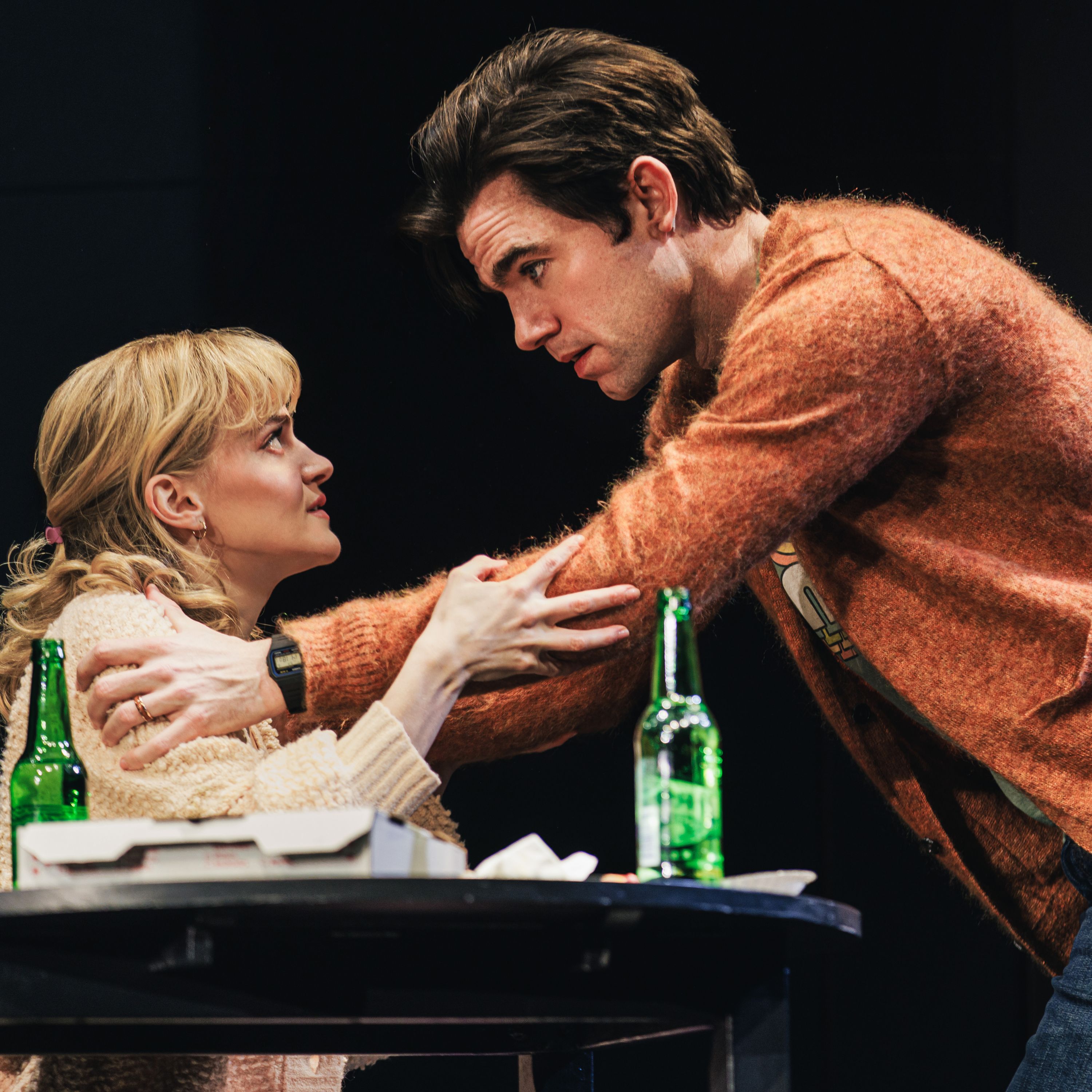
This is all of it on WNYC. I'm Alison Stewart. The 2026 Tony Awards are set to broadcast live this Sunday 7th from Radio City Music Hall. And one of the shows up for best revival of a play is Becky Shaw. The play is centered around a very bad first date. Andrew, played by Patrick Ball, sets up his co worker Becky, played by Madeline Brewer, with his wife's best friend, a guy named Max. But what poor Andrew doesn't know is that Max and his wife have a past and that Becky has some serious issues. The first date is an epic disaster and Andrew finds himself helping Becky pick up the pieces, putting his own marriage in jeopardy in the process. It is a darkly funny play. Actors Patrick Ball and Madeline Brewer join me to discuss the play. You might know Patrick from the hospital drama the Pit and Becky from her roles in shows like the Handmaid's Tale and you'd. But the play marks both actors Broadway debuts and now it's nominated for a Tony for best revival of a play. I began our conversation by asking Madeline what interested her about Becky's character.
- [01:18]
C
I mean, I think what's not to like about Becky? Even though that doesn't seem to be the general consensus for people that I talk to after the show. I just think she's utterly fascinating. And I also think that she's. It's really relatable. Everybody's made like a social faux pas, you know, and then tried to climb kind of out of that hole of shame and she just can't seem to let things go, which I do understand. I just, I love her. I think she's. I love her determination, even though it's kind of what puts people off of her. And yeah, I'm happy to play her every day.
- [01:58]
B
Patrick, how would you describe Andrew?
- [02:01]
A
Well, I think it's interesting because we were just talking about all those years of eating black beans for dinner and not knowing if you're gonna be okay, if you're not gonna be okay in your career, if you're not gonna be able to be eligible partner for someone. And I think that's something that I think Becky and Andrew have in common. That, that they are really, they. They're out in the wind and, and they feel it. And I think you see both of these people knowing that they have a lot of love to give and they might not have. They might not have much else to give. And so I think life has tossed both of them around quite a bit. And they're doing, they're doing their best to play the hand they were dealt with to the best of their ability.
- [02:50]
B
What does Becky see in Andrew?
- [02:53]
C
I mean, he is kind. His kindness, his gentleness. I think that he gives her a moment to express some of this darkness that she feel has happened. He's a sounding board. He's a listening ear. Whereas most people just kind of discard her and run away from these more dangerous impulses or this dangerous history of hers. And he's there for her. And what's funny about it is that to her it just looks like complete altruism and like a real friend available to me. And you don't realize until later in the play that it kind of has its own self serving element, is that he has. Maybe not self serving, but he has his own agenda or his own desires that he gets out of this situation. And that. Yeah, that's.
- [03:52]
B
It's interesting because at one point it becomes clear that Andrew might have a thing or a weakness for damsels in distress.
- [04:01]
C
Exactly.
- [04:02]
B
He just wants to rush in. He wants to help. Not even be a Prince Charming, but he wants to help.
- [04:06]
C
Yeah.
- [04:07]
B
Why do you think Andrew is drawn to these women who need help?
- [04:14]
A
Well, I mean, how deep do we want to go on?
- [04:16]
B
Go deep for public radio?
- [04:19]
A
Like. Yeah, no. One of the things that drew me to this project that I thought was really exciting to do this project in tandem with the pit is the conversation on codependency and the conversation on sort of like the shadow side of what it means to be a hero in the shadow side being that you do need to be needed and you can be really helpful to the people around you and you can give a lot of care. But if that falls into a pattern of requiring those around you to need that care, it can be quite toxic and destructive. And I thought the. The play that Gina wrote really understood that and really exposed that for the complexity. And she's described in the front of her own play that each one of these characters are someone that she would hook one of her friends up with. These are not bad people. It's just an acknowledgement of this need that is complicated and it's not without its merit, but it's also not without its shadow.
- [05:32]
B
I'm interested in the play. Becky turns up to the first date, this blind date, and sort. She's sort of overdressed. She sort of dresses a little bit like a birthday cake, I think, to say. What does it say in the script about how she's dressed?
- [05:46]
C
Oh, I believe that it says the dress is a maddeningly subtle faux pas. Like it really is Just enough over the line that it's noticeable. But I think that it's constructed in such a way. And it took us a long time to choose the dress. It was really something that we. It needed to work with the way our set is. But it also had to be the appropriate amount of. We had a dress that was a little too childlike. And then the dress that we chose, we had to adjust because it was a little too sexy. It was just had to walk a very. A very fine line. A tightrope, really, as we all do in the whole show. But it is a maddeningly subtle one in that you can see that this night means a lot to her, and it gives her. It's an immediate opening for the audience to get on her team, because we need to get on Becky's side in the end of act one so that we. So that I lose Everybody in Act 2. And I know exactly when it is. I was just talking about. It's in our scene with the hot dog, is when I start to lose people. And that's the brilliant construct of what Gina has made for them, this character. And it starts the second she takes her jacket off. And you can hear it in the audience.
- [07:08]
B
Can you say. Can you tell when you take it off Immediately?
- [07:10]
C
I mean, I can hear. Sighs. I can hear the pity. Oh, boy.
- [07:13]
A
It's delicious. It's so good.
- [07:15]
C
It's so good. And then he has to come right in and make up for it and be the guy who's like, everything's gonna be fine. And this is my friend, and she's okay. And it's really a very fun balance, especially when we walk out there, and I think sometimes Patrick and I have a difficult job when they've already established the relationship between Max and Susanna in scene one, and they're on their team, and we come in and we have to get the audience to believe in us and our relationships. And it's fun every night to see where the loyalties lie by the end of act one.
- [07:56]
B
Patrick, it's really interesting because the show has gotten great reviews. And I think it's interesting because your character is the most understated of them all. And one of the reviews really complimented you on that about your role, how you portray that role. New York Times. It was. It was good. It was good.
- [08:11]
C
I believe it was the New York Times.
- [08:12]
B
It was the New York Times.
- [08:14]
A
Great.
- [08:16]
B
What did you. And director Trip Coleman. How did you talk about how to bring Andrew on. On board, as you were saying? Because the first part of the show is just Max and Suzanne. And then you come on and it's a slow burn as we get to know you.
- [08:30]
A
Well, I think. And I had a. I had the fortune of meeting Tom Sadoski at opening night, who originated the role of Andrew. And we were talking at the bar about the. The greatest trap of this part and of this play is to let the audience get out in front of you. And figuring out, which I think is also true of the game that I play with Langdon is like making sure that you don't, you keep your cards somewhat close and you don't let the audience get out in front of you. And I think that was a really, really fun process. You know, you don't want to see the fissures in the relationship between Susie and Andrew too soon. You want people to be able to believe in that relationship. And there's also this like, like Mattie was saying, there's this interesting challenge of the audience has spent the last 30 minutes, the first 30 minutes of the play falling in love with this couple. And then I have to enter and assume the. Assume the role of like, of Susie's husband.
- [09:39]
B
Yeah.
- [09:40]
A
And at times, there are times whenever I walk into that situation and the audience is like, who is this guy?
- [09:45]
B
Who's this guy?
- [09:46]
C
Right.
- [09:47]
A
Like, what is going on here? And so it is a night to night sort of experience. And then I think also making sure that whatever sense of attraction, whether it be overtly sexual attraction or just like emotional bond, like wound to wound attachment that happens between Andrew and Becky, which I think does happen to make sure that we allow that into the room so people can see it, but not, but not send it up in such a way that it, it sort of makes the latter half of the play unnecessary. So it's, it's a, it's a, it's a fun needlework game.
- [10:28]
B
Every night we're discussing the Broadway play Becky Shaw. My guests are Patrick Ball, who stars as the well meaning guy named Andrew, and Madeleine Brewer, who stars as Becky, a woman set up on a blind date that goes terribly wrong. The show is running at the Hayes Theater. I was joking with Patrick that I went to Brown. There's lots of jokes about Brown, lots of jokes about Providence. Heard about the Bubbler quite often and it's very funny. But it also gets to class because your character goes brown has to drop out. It gets to the issues of class. What do you think they are when you think about the play?
- [11:03]
C
I mean, it's clear from the outset, I think that we're dealing with this kind of affluent, like, white family from the south that has their life crumbling around them. I think that interjecting someone like Andrew, who I'm not sure of his total, like, history, but I know for Becky, not. Not growing up with any particular wealth, I think that that is. It's a structure of Gina's to get people on her side. Is she very. In the first scene that I'm in, in scene two, kind of calls them out ever so gently. Oh, yeah. And that was something we also worked into the costumes with, with Kay Voice, our costume designer, to try and place a little bit of distance between Becky and Susanna and Max, particularly. I think the conversation around class is. Well, it's also absolutely necessary because it's not. It's not something that has changed. It's still very much a prescient topic. And as so much of this play is, it's like, God, things are just so cyclical, it seems for a show that was written in 2007, 2008, to feel still so. So immediate. Yeah.
- [12:36]
B
What did you want to say about the idea of class in this play?
- [12:40]
A
That was the other essential thing that drew me to the play. And like Matty was saying about Andrew's background, you know, he's somebody that went to Brown, but is an artist, is a writer. And as somebody that graduated from Yale School of Drama with an Ivy League degree and then two years later was catering at that same school for that same department and going through a breakup and losing a relationship because. And for. For many reasons, but. But financial insecurity was. Was one of them. And just. Just knowing, like, you have somebody like Becky, who is a college dropout and is now facing a future, facing a life without the white picket fence that she dreamed of, has no access to that. Whereas Andrew has come through the halls of privilege in a different way and landed on the sort of same conclusion, landed on the same sense of being exposed to not being able to have a retirement, not being able to buy a house, not being able to have a marriage. And that sense of scarcity and how real that can feel. And then you put that next to somebody like Max, who represents, I think, struggles with a different form of scarcity on, like, an emotional level, but represents, like, someone who has access to security. And watching the different ways that the world responds to Max versus how the world responds to Becky or world responds to Andrew and the role that transaction plays and money plays within relationships was something that was very interesting to me.
- [14:37]
B
This sounds like it's a really heavy play. It's really funny.
- [14:40]
C
It's very funny.
- [14:41]
B
Hilarious in moments. How do you think the play walks that narrow line between, in a fun way, making fun of big issues, but also making light of something serious?
- [14:56]
C
I mean, I think that there's a lot of points in the show where if you. If you don't laugh at it, you are gonna get up and walk out, which I know that there are people who have struggled with some of the subject matter and the kind of way that it's talked about. I feel that some of the best art and some of my favorite art and my favorite work is. Is toeing a line, is taking a risk. And I feel that this show does that in a lot of ways, but especially to be. If this show had been done even three or four years ago, it just wouldn't. It wouldn't have the same impact. And I don't think it would be received the way that it's being received now, which is. Is really well. But I think that a lot of people are. Are eager, I think, to have distance from terrible people, to kind of. It's why we love succession. You know, it's like to watch these terrible people be terrible to each other and then also to find redeeming qualities in them, to find what it is that we. That we love about them and relate to them and have to confront in ourselves that kind of discomfort in. I relate to Becky. I do. I do personally, Maddie. And that makes me feel so bizarre. And I think because she uses her
- [16:23]
B
vulnerability, she uses her white woman ness
- [16:25]
C
in a way that, like, I wouldn't and all. But also, I grew up at a different time than Becky did, and I think it's, as a theater goer, just a relief to watch people be terrible and have some distance from it and maybe laugh at how terrible they are. And I. You speak so eloquently, Patrick. I'm sweating. It's okay. That's so sweet.
- [16:56]
B
What have you enjoyed, Patrick, about being on stage night after night? Some people. It's a little bit of a grind. But what do you like about it?
- [17:05]
A
I guess immediately I love the. The. The audience of it and the fact that I think you. Theater is one of these rare places where you can get a bunch of people in the room gathered around a similar conversation, and you can walk out of the theater and all be challenged in the same way, and you can go to the bar afterwards and you can talk about it, and you can have difference of opinions, especially with a play like this, where you can walk out and be like, okay, who are You. Who are you rooting for? And I think in this. I think in this moment where people are getting further and further isolated behind their phones and in their apartments, and, like, we have seen, like, we've seen an incredible decline in happiness and mental health, especially amongst young people that have become so isolated behind their screens. I think the utility of theater in just bringing people together and having embodied experience with one another is only going to become more and more and more essential as time goes on. And it's what drew me to the theater, and it's something that I hope continues to be part of my life.
- [18:11]
B
All right, I'll make you sweat. This is the last question, I promise.
- [18:14]
C
I'm just a really nervous person, but that's why I play Becky.
- [18:18]
B
You're making your Broadway debut. What is something that you didn't know about Broadway that now you know?
- [18:25]
C
Oh, that's a good question. I. I didn't know that the Helen Hayes would smell so much like Sardis next door. It's really like a kind of.
- [18:36]
A
It's crazy.
- [18:37]
C
It puts a tiny damper on things.
- [18:41]
B
They make a great turkey club sandwich, but when they were open.
- [18:44]
C
But we can smell it. We can smell it next door. No, it's been. It's, you know, really the community element. I mean, I was so, so lucky to make my New York stage debut in Little Shop of Horrors, which is off Broadway with Thomas Dougherty. He was Doherty. Was he? Yeah, he's great. Isn't he sweet? Love him. And then, you know, I did a show called the Disappear at the Audible Theater right before this. So I've been in New York doing theater, and I know you're no. You're. No. You've done a lot of theater, is what I'm trying to say. But the community. To be a part of this community and how supportive it is and, you know, to kind of, you know, walk the boards that legends have walked. It's really. It's humbling and it's so inspiring, and I. God, it's a drug. I'm so addicted to it. I want to do it over and over again.
- [19:37]
B
That was my conversation with actors Patrick Ball and Madeline Brewer about the Broadway revival of the play Becky Shaw, which is nominated for a Tony for best revival of the play. The awards ceremony is happening this Sunday, April 7th. Coming up tomorrow on the show, we'll speak with the directors of the new documentary Mario. It explores the life of former New York governor Mario Cuomo. We'll also talk about the Ballisters with this playwright, David Lindsay. Abair, as well as actors Anika Nani Rose and Richard Thomas. That's all coming up tomorrow on All OF it. All OF it is produced by Kate Hines, Jordan Loft, Simon Close, Zach Goderer Cohen El Malik Anderson and Luke Green and Sasha Cohen. Megan Ryan is the head of Live Radio. Our engineer is Juliana Fonda. We had production help today from Shana Sengstock. Our intern is Emma Lee. Luscious Jackson does our music. If you missed any segments this week, catch up by listening to our podcast, available on your podcast platform of choice. If you like what you hear, leave us a great rating. It helps people find the show. I'm Alison Stewart. I appreciate you listening and I appreciate you and I will meet you back here next time.
- [21:02]
C
Hi, I'm Maggie Smith, poet and host of the Slowdown. Each weekday I share a poem and a moment of reflection, helping you turn listening into a daily ritual. It's five minutes to slow down, pay attention and begin the day with intention. Find it in your favorite podcast app and make the Slowdown your new daily poetry practice.