← All Of It with Alison Stewart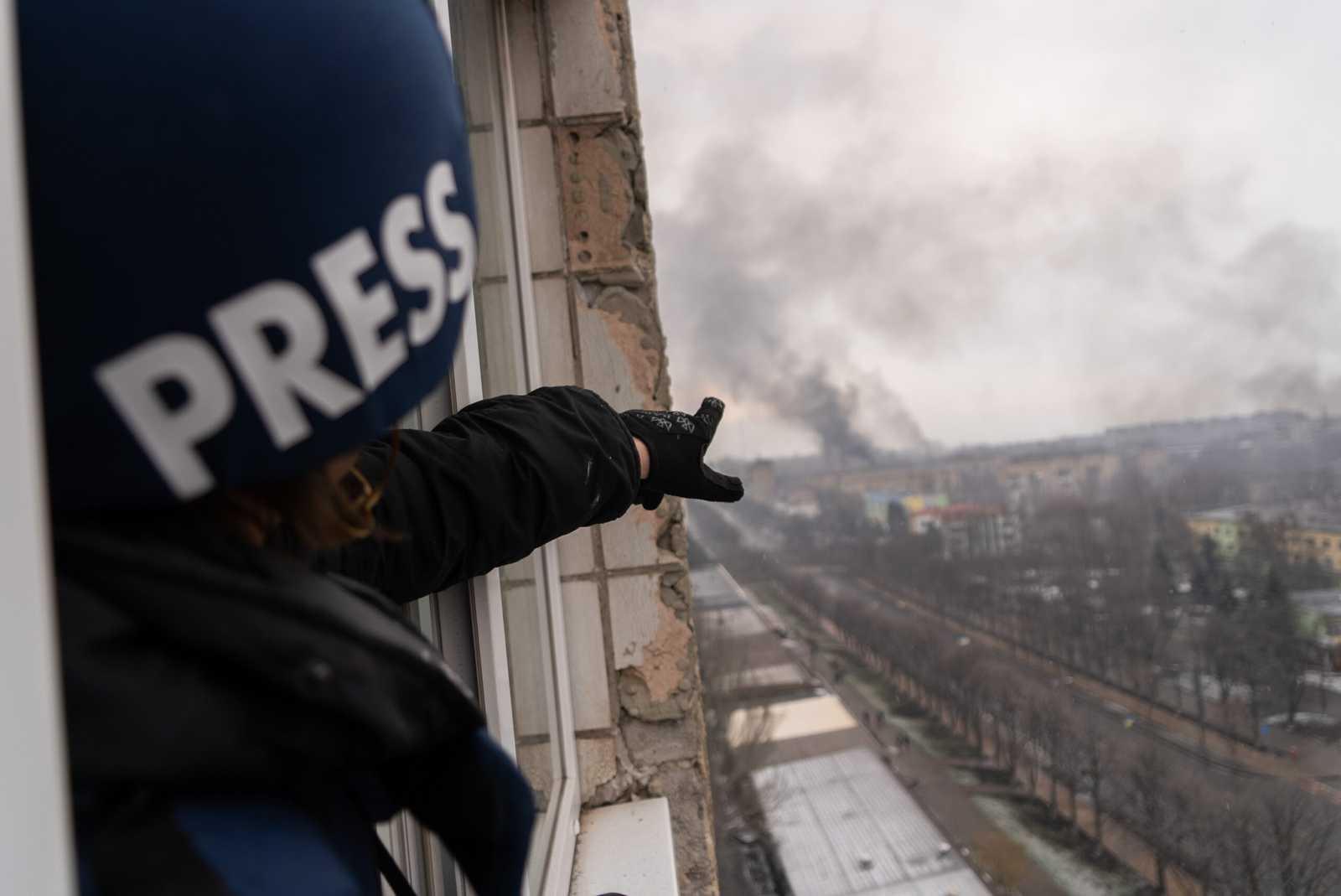
All Of It with Alison Stewart
A Harrowing Inside Look at the Russia-Ukraine War
00:21:00
A conversation with the director of 20 Days in Mariupol, a first-hand account of Russia's invasion of Ukraine, filmed by journalists trapped inside a city under siege.
Loading summary
Transcript38 lines
- [00:02]
Narrator/Advertiser
Surprise Beach Day. No excuses.
- [00:05]
Mstislav Chernov
I'm in.
- [00:06]
Narrator/Advertiser
Gimme 5 with Bix Soleil Glide Razor, you'll have hydrated, smooth skin that's ready to go on the fly. No shave cream needed. You can prep, shave and hydrate all in one step thanks to moisture bars that hydrate your skin during and after shaving. 5 flexible blades hug your skin for a close shave. Glide into smooth. It's your time to shine with bixsolil. Buy now at Amazon and Walmart. Ready. Your skin looks amazing. So smooth and beach ready.
- [00:29]
Mstislav Chernov
Let's go.
- [00:32]
Commercial Announcer
Your new beginning starts now. Dr. Horton has new construction homes available in Ellensburg and throughout the greater Seattle area. With spacious floor plans, flexible living spaces and home technology packages, you can enjoy more cozy moments and sweet memories in your beautiful new home. With new home communities opening in Ellensburg and throughout the Seattle area, Dr. Horton has the ideal home for you. Learn more@drhorton.com Dr. Horton, America's builder and equal Housing Opportunity Builder.
- [01:03]
They say if you want to go fast, go alone. But if you want to go far, go together. At Amica Insurance, we know what matters most to you and we work even harder to protect it. Together, as a mutual insurance company, we're built for our customers and prioritize your needs. Amica empathy is our best policy. Visit amica.com and get a quote today.
- [01:34]
Mstislav Chernov
It's not rocket science.
- [01:35]
Commercial Announcer
Grayscale has been educating investors on crypto for over a decade. Grayscale Invest in your share of the future. Investing involves risk and possible loss of principle. Visit grayscale.com for more information.
- [01:52]
Mstislav Chernov
Listener Support WNYC Studios.
- [02:07]
Alison Stewart
This is all of it from wnyc. I'm Alison Stewart. The New York Times called the film 20 Days in Mariupol about the February 2022 Russian attack on a critical city in Ukraine. Quote, a relentless and truly important documentary. It is also, tragically, as relevant as ever. A year And a half plus later just about 24 hours ago, it was reported by news outlets including the Guardian, that Russia had increased attacks in the Donetsk region of Ukraine. That part of the country includes the port city of Mariupol, where fighting began on February 24, 2022, in a siege that lasted three months and ended in Russian occupations and many thousands of deaths. The first three weeks of that siege, from the first shellings through the presence of ground artillery, are captured in the documentary 20 Days of Mariupol, reported by our next guest journalist Mislav excuse me, Chernov. The film features 90 minutes of the near 30 hours of footage caught by Chernov's small team footage, they struggled to get out and to the. In the midst of the bombing and city lockdown, these images are harrowing.
- [03:12]
Interviewer/Host
Bodies of small children who didn't survive the shelling.
- [03:15]
Alison Stewart
Pregnant women are wheeled out of bombed.
- [03:17]
Interviewer/Host
Maternity hospitals on stretchers. A boy who was playing soccer, whose legs were blown off. And those who survived are now homeless and hungry and are confused and in despair. After stunning audiences at Sundance and winning the audience awards, 20 days in Mariupol debuted on PBS Frontline this month. It is now available to stream for free on YouTube from Frontline PBS. Joining me now from Ukraine is Mr. Slav Chernov. Mr. Slav, thank you so much for spending time with us.
- [03:46]
Mstislav Chernov
Thank you for inviting me.
- [03:47]
Interviewer/Host
Before February 2022, what was life like for people in Mariupol?
- [03:54]
Mstislav Chernov
Actually, Mariupol was a very interesting city. Interesting and quite significant because as two big cities of Donetsk region were occupied already since 2014, Mariupol was kind of an example for Ukrainian government to show how the city would look like, how the city would look like if it wasn't occupied by Russia. So culturally, economically and just morally, it was kind of advanced, it was booming and it's all destroyed now. And I, I guess, I guess because it was developing so well, because it was defended well, many people, when a full scale invasion started, many people decided to remain inside the city and probably this was also a mistake and caused some in death.
- [04:59]
Alison Stewart
Did the average person before February 2022, did they think about Russia as a threat?
- [05:06]
Mstislav Chernov
Oh, yes. Well, look, so Mariupol is like 15-20 km away from the front line of where the front line was in occupied territories. But Russia is quite close anyway to Mariupol and always was. So Russia was, was imminent threat. Everybody understood that. Everybody understood that sooner or later the escalation will happen and everybody understood that Mariupol. Well, those people who kind of really thought through, thought this through, understood that Mario Paul will be the primary target for Russia as it's just on the way to Crimea and strategically is incredibly important for Russia. And also they tried to occupy it in 2014 and they failed. They were kicked there. Therefore it was also kind of a symbolic thing for Russia to, to get it and it didn't really matter for them how much civilian lives would it cost.
- [06:09]
Alison Stewart
What brought you to Mariupol in the first place?
- [06:12]
Mstislav Chernov
So for me, the being a war correspondent, the coverage of. I've been through five, no, six probably already different wars in Afghanistan, in Syria and Karabakh, Libya, Gaza and. But every year, every year I was coming back to Ukraine every year I was reporting and it all started for me in Ukraine throughout these nine years. Mar was for me in a significant place, place where I would always come back because it was so close to the front line and it was kind of a very similar to my own hometown. I had that personal connection to it. So all that resulted and knowing that it will be a strategic target, all that resulted in just, just kind of a gut feeling that we need to be there. The AP team which I was leading had to be there for if the full scale invasion starts as we expected, we'll have to be there.
- [07:15]
Alison Stewart
As you mentioned, you are a seasoned war correspondent. So when did you really realize the severity of the threat to Mariupol surviving as a city and as a country culture? Can you kind of remember the moment.
- [07:26]
Interviewer/Host
When that became really clear?
- [07:29]
Mstislav Chernov
Yeah, well, I remember arriving to Marup and it was at night, just like a few hours before the full scale invasion, before the bombs started to hit the city and people would still not believe that it's going to be that serious. They lived on the front line for so long that they didn't, they didn't really believe it could go forward. And they kept asking me what's going to happen? You know, because I, I've been through wars and I said honestly, look, we know how Russia does what Russia does to cities that it besieges that Grozny Chechen wars and Aleppo in Syria. And you know, so we know what they do, the cities, they just level them if they don't, if they can't take them easily. And that is probably what was going to happen to Mariupol. Is trying to tell people around me that. But no one wanted to believe. Most of the people didn't really want to believe that and I can understand why. But the feeling was there, the feeling was there. The feeling of, of the tragedy this that's coming was, was, was I, I had it and that's why I thought it was so important to, to stay as long, as long as we could covered it. What we didn't expect is that it will be so swift. The southern front line just collapsed and Russians just surrounded the city. Almost like within a week they've been blocking the whole city. And the strangest thing happened. We. It appeared that we were the only journalists reporting from Marupol. It's a, it's a 500,000 people's city. It is a big city. It's. It's very improbable, actually. It's very improbable that There are only three active journalists in. In the city like that, in the war zone. But it happened. And, yeah, and therefore, our names. There was no anonymity anymore.
- [09:35]
Alison Stewart
Right.
- [09:36]
Mstislav Chernov
If there are many journalists working in the siege like that, then it's easier if there are many. But if you're alone, then you become a direct target. And, you know, we should make no mistakes. For Russia, information is a target, therefore, information is a weapon, therefore, journalists are the targets.
- [09:58]
Interviewer/Host
My guest is Mrs. Love Chernoff. The name of the film is 20 Days in Mariupol. I do want to talk about the information war as much as the physical war as well, because they're intertwined. But, you know, in watching the film, there are. There's footage of bombed hospitals, fatally injured, pregnant women in the early days of the war. We see footage of children injured by bombs, doctors performing CPR on a child. There's one particular child, and I know you've been asked about this, and it's hard to talk about. The child is unresponsive. It is clear that this little, little child has died, was killed. I shouldn't say has died, was killed. And there is a moment when everyone has left the room, the doctors have left the room, and your camera stays on an image of the child's feet. The child is cover. How do you think about your responsibility in terms of capturing what was actually happening versus the privacy and the pain of the families?
- [10:57]
Mstislav Chernov
I have to say that at that very moment and further on, the whole world was watching Ukraine, and the whole world was not sure what is happening. It was absolutely, absolutely crucial to. To make sure that we bring unsanitized, truthful reporting to as much people as possible across the world and as quickly as possible, because these atrocities wasn't. Were unfolding in front of us. And if the world didn't do anything at the moment, and I know this kind of a. Sometimes it seems like pointless hope that you do something, you show something, and the world immediately reacts and the war stops. But anyway, the hope is always there that if the world sees what is happening to these children, if the world sees that, what is happening to the city, to the civilian infrastructure houses, then somehow this would stop. So there. The need and the urgency to keep reporting was incredibly strong when we were editing the film. And if you watch the film, you will see when you say that the film is hard to watch, is actually not because you see a lot of blood or gore or it's. It's like a lot of privacy violations. You know, you're never that close to the violence, but the feelings of people, the parents that we are talking to who are losing their children, the, the doctors who are asking us to, to keep filming just because they really, really want the world to see that struggle Ukrainians are going through. So all of that, all of that, as sad as it is, as traumatic as it is, it's also at the same time somehow brought hope because all of those people who were suffering, all of those people who were losing their loved ones, they were never alone. You can see when you watch the film, you can see how they are surrounded by the community, how they are surrounded by people who are trying to help, whether they are doctors or neighbors or journalists. And you see me talking to people, trying to just calm them down. So all that sense of community that brings the viewer, that brings the audience a sense of strength and strength of hope. And I think it's crucial to have that sense of hope and community when you are under attack, when your home is under attack.
- [13:55]
Interviewer/Host
You notice I didn't actually say, I know other people have said it's hard to watch. I did not say it was hard to watch. I actually think it's important to watch. I actually couldn't stop watching it. And I also thought that, you know, staying on certain images for an extended period of time, an extra beat or two that wouldn't, than you would normally see in this kind of documentary, was really important because it made the point that just because the camera turns away from it doesn't mean it stopped happening or that it didn't happen.
- [14:24]
Mstislav Chernov
Exactly. Yeah, you, I think, I think you pinpointed it very, very correctly. We perceive our world through quite short clip of news of headlines that are burning in front of our eyes. Right. And news are so quick and we rarely get enough context. We rarely even have time to think what, or feel what about what we see. We get informed, but we don't really go deep in that. And in this sense, documentary is very important for, for, for events like, for tragedies like Mariupol. Making a documentary is very important because it's not only. It's not going to be forgotten because everything gets forgotten in this dream of tragedies we're going through. But it's also, it also makes sure that the, the, when we, when we see it, we spend time with people. We don't just see people pictures, we see real people. And that is what it is. It's a story about real people. These are not images. They are, they are real families and real tragedies. And we have to make sure that their tragedies are not forgotten, or at least we have to make sure that people learn something from them.
- [15:50]
Alison Stewart
We're talking to the director of 20 Days in Mariupol, which you can now stream for free on YouTube on Frontline. My guest is Mstislav Chernov. I want to talk about the power of images. This is an important. I was going to say subtext in the film, but I think it's actually forward text in the film. Who gets to see what and how it can impact the future? I do want to start with a procedural question first. How did you get at least some of those images now? Because some of these images are now the images that will forever be associated with this tragic time that's also a part of the story. And the tension is trying to get these images out. Would you share with our audience the challenge of that and how you ultimately got some of them out?
- [16:34]
Mstislav Chernov
Yeah, it was not only. It was not only. When you are, when you're waking up and you're in a basement and there is a bombing happening around the hospital or other basements where we were hiding, it's actually just even hard to force yourself to get out and to start filming. And as soon as you're out, as soon as you see firefighters, which without war, trying to keep working and with, you know, just like police and doctors and all the, again, all the people who are trying to do their work as best as possible against all the odds, against all the dangers, then it motivates you too. But it's not just enough to, to film. Then you have to get somehow. Get it somehow out. And if it's a photo, it's kind of. It's slightly easier, but it's a video, it's a heavy file. You have to first pick the most important. And how do you pick one minute and a half out of a day of tragedies? And then there is just no Internet. You either climb somewhere on the top of the building, risking you get shot by sniper or you get bombed by mortar, or, or you, as we were just found one single small place in the city where under the concrete stairs of a looted grocery store where we were sitting and catching some kind of a signal. And to send this video file, I have to split it in small pieces, like 10 second pieces, and file it from three different phones together with the team. And then the editors had to assemble it back when they received it. And all of that kind of under bombing and under stress. So that's a challenge. And then there's a challenge to get the original files out because, well, if we're talking about possible war crimes, if we're talking about future investigations and just sheer importance of this footage, which only a small fraction was published, we had to get some out through 100 kilometers of occupied territory and 15 Russian checkpoints. And we were lucky to get out because there was so much confusion in the beginning of the Green Corridor. But here's an example. Mantas Kudaravius, Lithuanian filmmaker, who also at that time was in Mariupol. We never saw him, but he was there. He was trying to leave and he was just executed on the Russian checkpoint. That would happen to us.
- [19:24]
Interviewer/Host
So yeah, not to mention the backdrop of. Is, there's no electricity, there's. People are running out of food, there's no water. That's like just the basic needs of life. There's no place to sleep. Before we run out of time, I did want to make sure we touched on this. Some of the most important images of the film, the Russian pushback, to them, it shows how Russian officials just simply lied. While you were still in Mariupol, footage began to be challenged by officials saying, this is fake, these are actors.
- [19:55]
Alison Stewart
How aware were you of this?
- [20:00]
Mstislav Chernov
I think when, when we saw that the hospital was bombed, when we ran there, when we saw Irina and rescue workers carrying her in a stretcher, the pregnant woman who later died, unfortunately with her child. When we saw all that when I was filming that I, I knew that this is, this is so important. And I had to get every single second of it filmed because probably it will show the reality of this war. And at the same time, I knew from those times when I already covered the war, when I covered stories which were challenged by Russian propaganda, for example, 2014 crash of MH17 Boeing flights that Russia shut down over Donbass. There were so many versions, so many propaganda after that event. So I did expect something like this is going to happen. But again, as EP correspondent, as international journalists who already know that this is going to happen, we. It's not our job to fight propaganda. It's our job to follow up to stories and to give as much context as. As possible to. To these stories. So people have. People will kind of make their own informed understanding of. Of what, what's the reality? And that's exactly why documentary is so important, because it does give you much more, much more context of what happened before. And the fact that this. Versions that Russia presents to the world are also in a film is important for me, again, as a journalist who always tries to be unbiased, and show the reality of what is happening. We wanted to show all the versions. We wanted to show without moralizing the audience, without pointing fingers how things unfolded and what were their reactions. And that's why those, those Russian comments are there.
- [22:17]
Interviewer/Host
The name of the film is 20 Days in Mariupol. You can stream it for free on YouTube from Frontline PBS. My guest has been its director, Mr. Slav. Sure enough, Mr. Slav, thank you so much for sharing your work with us.
- [22:31]
Mstislav Chernov
Thank you.
- [22:33]
Interviewer/Host
And that is all of it for today. I'm Alison Stewart. I appreciate you listening and I appreciate you Tomorrow, we'll talk about the UN's COP20 Clement summit happening now in Dubai. And world leaders are discussing environmental policy on a global scale. We'll talk about it on the local scale. That's happening tomorrow.
- [22:58]
Commercial Announcer
At Capella University. We believe accessible education can make a difference in people's lives. That's why we offer scholarship opportunities, opportunities to all eligible students. Whether you're considering a bachelor's, master's or doctoral degree, our teams will walk you through the process and help you get the savings you are eligible for. Furthering your education is an investment in yourself. Entonces que estas un futuro diferente esta macerc de los cres con Capella University. Learn more at Capella. Eduardo.