Loading summary
Transcript34 lines
- [00:00]
A
WNYC Studios is supported by Progressive Insurance. Did you ever think about switching insurance companies to see if you could save some cash? Progressive makes it easy to see if you could save when you bundle your home and auto policies. Try it@progressive.com Progressive Casualty Insurance Company and affiliates. Potential savings will vary. Not available in all states. All of it is supported by Memorial Sloan Kettering Cancer center in a small groundbreaking clinical trial where 100% of participants with a specific type of rectal cancer saw their tumors disappear using immunotherapy alone. Researchers at MSK are now studying this approach in cancers of the stomach, liver and more, and a majority of tumors are disappearing. For MSK Giving day, all gifts will be tripled. Learn more@msk.org all of it.
- [00:57]
B
This is all of It Alison Stewart More than 50 years ago, a tree loving astronaut named Stuart Roosa brought hundreds of seeds on the Apollo 14 mission to the moon. When he returned to Earth, the US Forest Service germinated the seeds in greenhouses just to see what would happen given they'd been to space and all. And when they grew, they were planted in locations all over the world. And then many of them were forgotten until a third grader in Indiana saw a plaque in front of one of the so called moon trees. The WNYC's podcast terrestrials did an episode about this, but the story of these trees is not over. In 2022, NASA offered up some of the remaining moon tree seeds and Madison Square park in Manhattan applied and won. Holly Light is the executive director of Madison Square Park Conservancy, which is hosting a launch to unveil its moon tree to the world tomorrow. Hi Holly.
- [01:51]
C
Hi.
- [01:51]
D
How are you?
- [01:52]
B
I'm doing well. And joining us also is Lulu Miller, host of Terrestrials podcast. Lulu, welcome back.
- [01:59]
E
Thank you.
- [02:00]
B
So why did Stu Rosa take these seeds to the moon? What was NASA looking for?
- [02:06]
E
Well, Stu was just a tree lover. He was this gangly, nerdy kid who grew up in Colorado and apparently moved around a lot. And trees were always a constant in his life. And his first job before he became an astronaut was actually to fight fire and fight fungus to protect trees. And it was in that process he was what's called a smoke jumper, where he would parachute out of planes into forest fires to protect trees, that he started dreaming of going to space. And so when he went aboard the Apollo 14 mission, that famous one in 1971, that where the other guy, Alan Shepard, played golf on the moon, he was, he was the pilot on that. He drove the spaceship. He was allowed to bring one bag of anything precious. And he chose those 500 tree seeds that you mentioned just because he wanted to have them near. He wanted to see if space travel would affect them. There were all kinds of experiments on how space travel affects human bodies, and so he wanted to see how it affects. Affected plant life.
- [03:02]
B
Did the seeds end up on the moon or were they orbiting the moon? What were they doing up there?
- [03:07]
E
They were orbiting. They were nearby, as far as I know. They didn't, like, crunch any into that lunar dust, but that could be neat. But no, they. They orbited the moon. You know, they went on this, you know, all told there and back, about half a million miles, you know, hundreds and hundreds of thousands of miles. And then they. They came back and the experiment was to see, you know, would they germinate, and if they did, would they grow any differently.
- [03:30]
B
Now, how did terrestrials find out about moon trees?
- [03:33]
D
So we.
- [03:33]
E
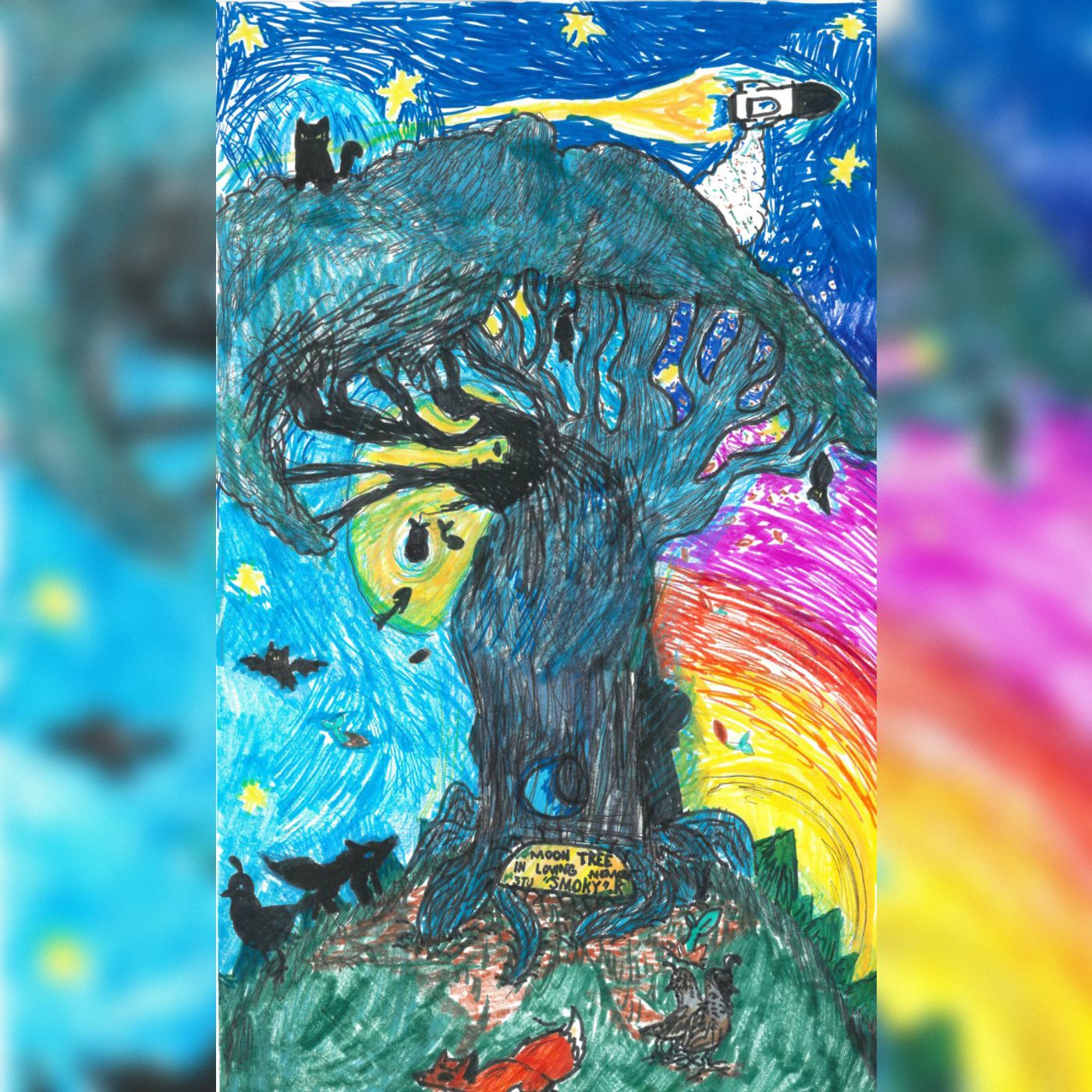
Our fact checker, Natalie Middleton, who's also a great science reporter, she pitched this story to us. She said, I think kids would love it because she found out about that detail about the third grader who had kind of uncovered this forgotten treasure maps of moon trees all around the globe. Some had been planted in fancy places like a NASA lawn, but others were just at private residences in public parks. And so she, this third grader, uncovered the treasure map and has been starting. And Natalie, our fact checker, started compiling this into an actual map where you can click and find out where there's one near you. And so there. Yeah, she just thought it would make a great story for kids. And this kind of idea of like, there are these secrets on the planet. And so we, we did the episode, and it's been a fan favorite. And. And kids have drawn what, you know, their image of what they think moon trees might look like. And Holly can tell you more about. About where some of those drawings are gonna end up.
- [04:26]
B
We'll talk to Holly.
- [04:27]
D
Right now.
- [04:27]
B
You're the executive director of the Madison Square Park Conservancy. When you made the case to NASA that Madison Square park deserved a moon tree, what was the case you made?
- [04:39]
D
Well, first and foremost, we are the only certified arboretum in Manhattan. And so we felt like with the tree collection, we have a diversity of 300 trees. This would be the perfect place in the heart of Manhattan to have a moon tree. We get in the park over 60,000 people every day. So we also felt like it would be a really exciting opportunity to really educate a large community segment of the population. We get a lot of Tourists as well as New Yorkers about moon trees. And we have a pretty hardcore maintenance plan and program for our trees. So I think we could assure NASA that we would take very good care of this little sapling.
- [05:22]
B
So you came as a sapling, not a seed?
- [05:25]
D
Right. So the seeds return to Earth and then the USDA Forest Service germinates them. And what we received in a little box in the mail was a tiny sapling.
- [05:38]
B
When did you plan it?
- [05:40]
D
We planted it a year ago in. Just over a year ago last April. But we kind of did it covertly because we wanted to be sure that it could establish itself and have a little, you know, freedom to grow before we told the world that it was here. So we're launching it this year. But it's really its first birthday.
- [06:01]
B
Did it have any instructions sent by NASA? You should treat it a certain way. It should get this much sunlight or moonlight for the matter.
- [06:09]
D
It did not. Happily, we have a certified arborist on our horticulture team. She's the one, Stephanie Lucas, who applied for the tree, and so she was ready to go. She knew exactly what to do. And we've been taking special care of it for the last year and will continue to do so with our arborist team.
- [06:30]
B
And finally, what kind of. Not finally, but what kind of tree is it?
- [06:34]
D
It's a sweet gum, which is not a typical New York City tree. They also have London Plains, which is a typical New York City parks tree. But we went with a sweet gum. It's adapted for warmer climates. And a lot of the work we're doing in our arboretum, working with arboretums in other parts of the country, is bringing warmer climate trees to New York because we know that with climate change, those trees will be adapting to the changing climate in New York. So we felt like this tree actually has a better chance of surviving in New York for the long term, which could be decades and decades if all goes well, rather than the more traditional Linden Plain.
- [07:20]
B
Holly. Madison Square park is throwing a moon tree unveiling party tomorrow from noon to 8pm Tell us what is happening and how people can participate.
- [07:29]
D
So we're really excited we're going to start. We're partnering with the Simons foundation and they are providing scientists to come into the park and talk to kids and adults both. We'll start with some solar viewing, so safely looking at the sun around noon. And then the party really gets going. At 4 o' clock. We're going to have a reading of for kids new poem that we commissioned from the New York poet Laureate Kimiko Han. She wrote a special poem about our Moon Trees journey that she's going to debut. We'll have other story readings. We're going to have experiments, ask a scientist. So we have four scientists coming that will answer any questions. They're astrophysicists who can talk all about Artemis 1, which is what our seed was on Artemis 2, which was the mission this summer that people actually went on, not just seeds. And kids will be able to do their own science experiments, scavenger hunts and rocket launches. We're gonna have stomp rockets, which we think will be very powerful.
- [08:36]
B
And Lulu, some members of the terrestrials team will be on hand at Madison Square park tomorrow. What are you doing?
- [08:42]
E
That's right, our beloved song guy, Alan Gaffinski, who makes all our songs, he's gonna be there as well as some other team members. And we'll be discussing displaying some of these moon tree drawings that kids sent in, as well as having drawing supplies for other people to do more drawings and, you know, just walk around, celebrate the fact that this kind of lunar landing back on Earth.
- [09:05]
B
You can join the celebration for the moon tree at Madison Square park tomorrow from noon to 8. And you can listen to the terrestrial episodes about the moon trees. I've been speaking with Lulu Miller, the host of WNYC's podcast Terrestrials, and Holly Light from Madison Square Park Conservancy. Have a great celebration.
- [09:24]
E
Thanks.
- [09:25]
D
Thank you so much, Allison.
- [09:27]
B
And let's go out on Alan's song about moon trees.
- [09:34]
C
I wanna know the truth Tangled in your roots the things you've been through that make you you I wanna know the truth Tangled in your roots Every leaf, every tree holds a history Tangled in the roots did you float through the sh alone Surrounded by a silence that no one else Tangled in the room Were you lost in the ocean of stars where it all fades the dark and the air goes cold Tangled in the moon did you go to the dark side of the moon? Would you talk about the feeling? Talk about the vehicle in the room.