Loading summary
Transcript130 lines
- [00:09]
A
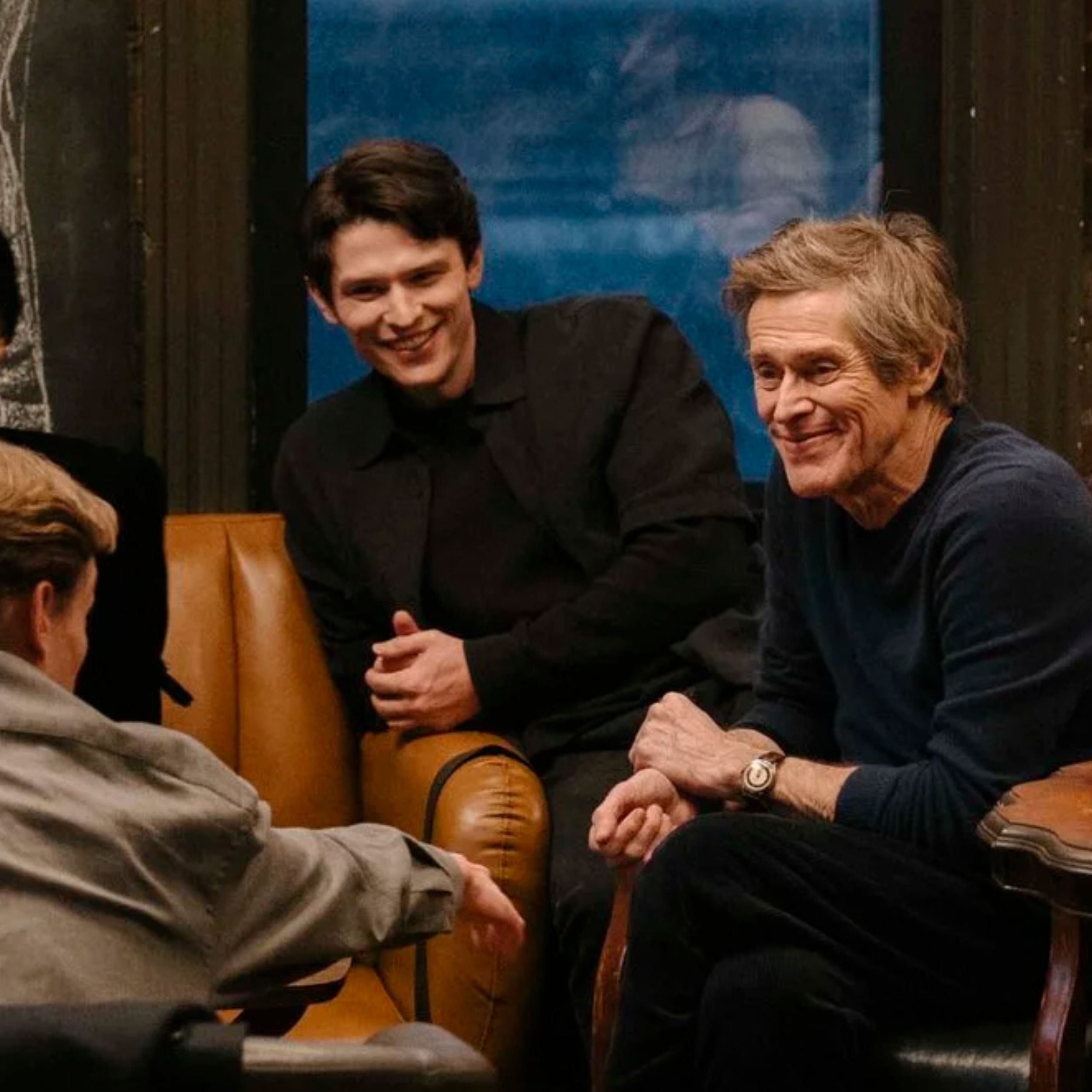
This is all of it. I'm Alison Stewart live from the WNYC studios in soho. Thank you for sharing part of your day with us. I'm really grateful that you're here today. It's going to be a scorcher. So let's get out of the heat and into the cool movie theater. That's the theme for today. Coming up later in the show, we'll speak with writer, director Jane Schoenbrun and actor Hannah Einbinder about their new film Teen Sex and Death at Camp Miasma. We'll also hear from Rashida Jones and Will McCormack about their film the Invite. But first, let's get this started with Late Fame. Oh, boy, this is gonna be interesting. In the film Late Fame, Willem Dafoe plays a New York City poet named Ed Saxberger who is super famous. Well, at least to one group of about six people. Sax Berger wrote a book of poetry called Way Past Go. That was a long time ago now. He's been working at the post office and playing pool with his buddies when his shift is over. One day, an eager young man shows up outside of his apartment building and declares himself a fan. His name is Myers. Myers is played by Edmond Donovan. Let's hear the moment they meet.
- [01:26]
B
Did you see that kid?
- [01:28]
C
What kid? He's been waiting for you like a prom day. Can I help you?
- [01:44]
B
You're Ed Saxberger.
- [01:46]
C
What is this about?
- [01:47]
B
My name is Wilson Myers. Myers. Everyone calls me.
- [01:51]
C
Okay.
- [01:51]
B
I apologize for showing up like this, but I discovered that you lived here
- [01:54]
C
in my neighborhood, okay? And
- [01:59]
B
I read Way Past Go. You are the Ed Saxburger, right?
- [02:06]
C
The poet?
- [02:07]
B
Of course you are. I recognize you from the back cover.
- [02:10]
C
You read Way Past Go? That's crazy. Where'd you find a copy?
- [02:15]
B
I bought it at Foyles on Charing Cross Road. And then I read it at a pub in Covent Garden, straight through. It's brilliant. We all think so. My whole group.
- [02:26]
C
Your group?
- [02:27]
B
We're an artistic community of poets and artists, essayists, intellectuals. That sounds pretentious.
- [02:35]
C
Is this some kind of joke? Did Paulie put you up to it?
- [02:39]
B
I'm dead serious. I don't know when you last read
- [02:42]
C
the book yourself, but it's as if
- [02:45]
B
the poems were written yesterday. They're modern, they're moving, they're scathing. They just slap you across the face with their style and their relevancy. They're timeless.
- [02:59]
C
Wow. That was a long time ago.
- [03:02]
A
Saxburger starts spending time with this misfit group of pseudo intellectuals. They gather at Cafes and restaurants. They're all entranced by an actress named Gloria. They praise his work. But as Saxberger spends more time with Myers and Gloria, things start to get a bit more complicated. Was Saxberger a great poet who didn't get his due? Was he good at all? How will he balance his current life with his potential future? The film Late Fame is based on a 19th century novella. It is directed by Kent Jones, who's my guest. Hi, Kent.
- [03:33]
D
Hey, how you doing? Allison.
- [03:34]
A
As well as actors Willem Dafoe. Hi, Willem.
- [03:36]
C
Hello.
- [03:36]
A
And Edmund Williams. Hi, Edvin.
- [03:38]
B
Hey.
- [03:38]
A
Late Fames is in theaters tomorrow. So before y' all met for this film, you both were aware of the novella. You had the novella? Yes.
- [03:47]
D
Wow. Yeah, I mean, you know, Killer. The producers called me and asked me if I want was interested in reading it. I said yes, but before I read the script. I read the novella then, and I really liked the script and kind of preferred it for various reasons. And then this guy and I found ourselves on a flight from LA to
- [04:07]
C
New York City together, separately. A friend of mine, New York writer and actor named Danny Sippy, gave me the novella and said, I think this is a movie. You should check it out. And I read it and I thought, indeed, it's very interesting. And I read it and I was like, thinking about trying to find who had the rights. So little did I know Killer Films had already had a script, had hired Ken, and they were set to go. Then I see him on the plane and we talk about everything but that everything. And then a couple days later, he calls me and says, listen, there's this property called Late Fame and we're going to make a film and would you like to be on it?
- [04:50]
A
That's an amazing coincidence.
- [04:52]
D
It was crazy.
- [04:53]
A
Meant to be.
- [04:54]
D
Absolutely.
- [04:55]
A
Yeah, I'll go with that.
- [04:58]
D
Come on, man. Meant to be?
- [05:02]
C
What is anything meant to be?
- [05:04]
A
Well, if two people have a novella from the 19th century and they talk about everything but. And then.
- [05:09]
C
Well, the crazy thing is too, when I heard they transposed it to New York, present day, my heart sank because Vienna was a huge part of the novel. And I thought, oh, that's like a Hollywood cheat. I don't know. Let's check this out. But in fact, it's beautiful because it really spoke to some things in the air and some things about New York, and it was very relevant.
- [05:38]
A
Edmund, describe for me in the script written by Sammy Birch how Myers is described.
- [05:45]
C
Oh, that's funny.
- [05:46]
B
I have to look back. Old Fashioned is definitely used, if I remember, evocative of a 19th century industrialist.
- [06:00]
C
Yeah, that's true.
- [06:01]
B
Right. I'm shocked I remembered that. But. Yeah, but it's very memorable.
- [06:05]
D
But what's the other adjective that you and I decided on?
- [06:09]
B
Odd.
- [06:10]
A
Odd. Do you think he's odd?
- [06:12]
B
Yeah, I think that. Maybe less so in the novella. But if you read both, if you were to read both or to see the movie and then read the novella, you'd notice that Sammy didn't change all the language that Myers uses in his dialogue. He has a very old fashioned way of speaking. And I figured, I mean, it just feels odd to me. Not in a negative way. There's just something sort of. He's just eccentric and descriptive of him. Yeah, I just found that he had to have some sort of oddness to him to sort of justify the way. The way that he spoke.
- [06:43]
A
But, Kent, why did you want to direct this movie?
- [06:49]
D
A few reasons. Like, I could really relate to the idea of like, you know, a bunch of people swooping in and reclaiming the lost artistic hero. It's something that, you know, I. It's an enterprise that I think I've been involved with a couple times and I remember the vibe around it. I think also that I really have a special relationship with poetry. And the film is actually dedicated to a very close friend of mine, Peter Gizzi, who's a great poet. And so I wanted to do that and then also exploring New York and particularly SoHo and the ghost of what SoHo was for the memory of those of us who were alive in the late 70s, early 80s and then seeing what it is now, and it still looks the same from a distance, but boy was it different. So I was, for all those reasons. Plus it was really good script, Willem,
- [07:44]
A
so listeners can kind of think about Saxberger as a person. What was he doing pre Myers like the day before? What was his lit day like?
- [07:55]
C
He was fine. He was, you know, dealing with his sister on the telephone, making tuna sandwiches, going shopping, walking between home and going to the bar to see his friends. He had a pretty simple life. Yeah. Edmund not, you know, content, same.
- [08:17]
A
Yes, he seemed very like. Had a good life. Yeah, Just enjoyed it.
- [08:20]
B
Yes.
- [08:22]
A
We heard in the clip that your character is so enthralled by Saxberger's writing. What does he see in it?
- [08:34]
B
I think like a freedom, an authenticity, you know, and like a place in a culture, I think probably. I think that seems to be the thing that Myers is void of and is like yearning for so badly. And all these young people are, you know, to be a part of, like an authentic. An authentic scene, you know, that was really about something and had beliefs and. Yeah.
- [08:59]
A
What's the thing that he can't buy?
- [09:01]
C
Right.
- [09:01]
A
You can't buy authenticity.
- [09:03]
C
Right, right.
- [09:04]
B
And is the antithesis of the thing that he's surrounded by all these young people on cell phones and. Yeah. Scrolling their lives away.
- [09:11]
A
Willem, how does Saxberger feel about his poetry?
- [09:17]
C
I think he thinks it was the product of a different life. You know, there are stations in life, and it was connected to a scene. It was connected to him being a young man having an adventure, living in New York City, making things, going to loft performances, doing readings, that sort of thing. And I think the thing that's important is he probably didn't have an ambition. He probably was just in it, you know, and that's why it was easy to transition to the practical thing that when the scene went away, he said, okay, now I gotta get. Get to life. So that's the difference. I think they project this Enthusiasm Society projects a little bit this thing of fame onto him. When that really, I don't think was specifically his thing. It was when he was younger, it was where he had a passion for doing something and he wasn't thinking about tomorrow. He wasn't thinking about a career path, because there was no career path. And that's as difficult anyway for poets. But particularly at the time, in my experience, when I was in New York in the mid-70s, you know, there were lots of people like that that they weren't thinking about tomorrow and they weren't thinking about where this was all leading. They were just doing it. And I think that's what made it very exciting. And it's hard for people today to imagine that because there's been a real shift about, for example, this Enthusiasm Society. They're all educated in the stuff of that period where people that were making things in that period in New York, they weren't trained at it. They were just. It was kind of an amateur aesthetic doing what they loved to do.
- [11:05]
A
We're talking about the film Late Fame. It's about obscure New York City poet whose old work is rediscovered by a group of young intellectuals. My guests are actor Willem Dafoe as well as Edmund Donovan alongside director Kent Jones. What was the casting process like for the Enthusiasm Society?
- [11:25]
D
It was great putting them together, just thinking about how it would work visually, behaviorally. Edmund was the first person I met, and I was really, like, you know, immediately into it, and then just. It turned out that, you know, when we got together for dinner a few days before, we Started shooting. It turned out that a bunch of you guys knew each other, right? Yeah, you know, and it just felt like everything would flow with them. But then, of course, Gloria, played by Greta Lee, is the other member of the group and she's, you know, that's another factor in terms of what Willem's saying, talking about New York. You know, she's come to New York a little bit too late, you know, and now, as we all know, it's very difficult to come here and just find an apartment and, you know, make your way.
- [12:18]
A
So, Edmund, the Enthusiasm Society. The scenes are kind of funny with them. They're also a little cringy. Occasionally they wear clothing from other times. Lots of suspenders going on
- [12:32]
B
its way in.
- [12:33]
A
Yeah, yeah. But they do like their phones as well.
- [12:36]
B
They do.
- [12:37]
A
What are Myers aspirations for the Enthusiasm Society?
- [12:42]
B
Oh, man, it's so. Yeah, I mean, I think in his heart of hearts, if he were honest with himself, I mean, this is kind of a spoiler, but I think his aspirations have so much more to do with himself than anyone else. You know, I'll say. I think he wants to be, you know, regarded, highly regarded, and in some way in the arts as a critic, as a writer, as a thinker, as a, you know, and I don't. I think he'd kind of take any outcome. But as for the, you know, the timeline of the movie, I think that the best case scenario would be for them to create this evening of poems and of writing that made a huge splash and, you know, got people talking and got great write ups and, you know, that I think is in the short term, like, you know, the greatest thing he could accomplish with this group of people.
- [13:42]
A
I was trying to think who admires, admire now what writers, what filmmakers
- [13:49]
D
from the past.
- [13:50]
B
Yeah, that's the, it's so into such an interesting question because, you know, I've in, in talking about this movie, I'm, I'm constantly jumping back and forth between my own experiences in my early twenties in New York and his because there's a lot of overlap. We're very different, but there's a lot of. There was a lot of yearning. You know, like, I really came to New York and I was like, I really want all these things. And I saw this group of people making off Broadway theater and making. And that's kind of all they did. You know, this was before there were so many people who were both in theater and in TV and film. There were a lot of these people that just seemed to do play after play. And I really Wanted to part of that group of people. And I really felt far away and I couldn't get in. I mean, that was true for most people coming to New York out of school or not from school. And I think for him, the people he's yearning to be like, don't exist anymore, to Willem's point, you know, like, I don't.
- [14:42]
C
He.
- [14:42]
B
He has so much anger in him, really, and resentment in a way that we find later in the movie. But there's like a. A bitterness about the contemporary scene, you
- [14:52]
D
know, but the anger isn't about the scene. It's about the fact that he's got the vision in his head. And when something disturbs the vision, that
- [14:59]
B
it throws him and no one can quite see it like he can, you know?
- [15:04]
D
Yeah, that's right.
- [15:05]
A
We're talking about the movie Late Fame. We'll have more after a quick break. This is all of it. You're listening to all of it on wnyc. I'm Alison. Steven Stewart. We're talking about the film Late Fame. It's about an obscure New York City poet whose old work is rediscovered by a group of young intellectuals. My guests are actor Willem Dafoe and Edmund Donovan, as well as alongside director Kent Jones. The film opens in theaters tomorrow.
- [15:39]
D
The film opens at Film Forum, right around the corner.
- [15:41]
A
Love that. Oh, you filmed a lot right around here.
- [15:44]
D
Right around here. Carmine street was our hangout, and then in Jersey for all the interiors.
- [15:50]
A
Something that Will mentioned earlier in the interview, I want to get back to Kent, is that Saxberger is dealing with his sister on the phone, and we learn that his brother's dying, and he just. He kind of wants to stay out of it.
- [16:05]
D
Certainly does, yes.
- [16:07]
A
How did you handle those little glimpses of what's going on with his family? How did you work them into the script and into the filming to give us a sense of his other side?
- [16:19]
D
That was very much a part of Sammy's script. And it was something that, you know, for junior executives would say, oh, you should get rid of that. It doesn't really advance the story, but it gives you a side of, you know, it gives you something where you have to put the pieces together of the story. And then I think also there's a key line in there when his sister's saying, you know, family's the most important thing. And, you know, his response is, who says? And that says a lot right there. And I just need to say that the voice on the other end of the line is Walker White, who's a great actress. I mean, she's Goodfellas, the Irishman killers of the Flower Moon. But I think that that's. It was an interesting thing to deal with and let people put the pieces together.
- [17:06]
A
It's also interesting in the film. There's two other things that were themes to me. Generational differences and also wealth and art and class. What is interesting to you, Willem, about the way that this film, Late Fame tackles class and art?
- [17:26]
C
Oh, God. Well, they're huge. I agree with you. Well, Ed is a middle class guy from Jersey that comes to New York City and then he has. This time from Pennsylvania. From Pennsylvania, rather details. Details from somewhere. And he has his period and then he basically becomes a working class New Yorker. And he's dealing with these guys that have been going to the finest schools for the most part and are very educated and come from wealth. So they're looking up to him and they're trying to advance. I don't know. Actually, as I get there, that's why we make movies, because I can't tell you what happens, but putting those things next to each other creates something interesting.
- [18:29]
A
Yeah. Because, Edwin, we discover that your character is very wealthy. He lives in a gorgeous apartment. What did you like about that apartment?
- [18:38]
B
It was. It was a set. It was. It was very much not an apartment. Yeah, it was like. What was it?
- [18:42]
D
It was an Airbnb, but it was
- [18:45]
B
like a first floor. Like. Anyway. Yeah, the way that it reads in the movie is very different than weight on the day. But. But, yeah, I think in the movie it's standing for. It's standing in for this kind of. What do we say, like Sullivan Street, Like a West village, you know, LaGuardia Place.
- [19:01]
C
Yeah, yeah.
- [19:02]
B
But one of the. It's huge and it's very. I mean, it's. It's. It's gigantic and covered with. And filled with, you know, expensive art and things like that. But yeah, he doesn't foreground that part of himself, which is a bit deceitful.
- [19:19]
A
Why. Why doesn't he foreground it?
- [19:21]
B
Because he knows the people he admires didn't come from that place.
- [19:25]
C
That's. That's what I couldn't express.
- [19:28]
A
Yeah, you helped each other out.
- [19:31]
D
I mean, I think that in that regard, there are three different stories that reflect on each other. There's the story of the guys in particular, Elaine Myers. There's the story of Ed, and then there's the story of Gloria, you know, played by Greta Lee, and, you know, she's come too late, and for her, it's the saddest story.
- [19:45]
A
Yeah, she's sort of a muse. She's supposed to be a muse, but she's a little bit older. She's in between your character Myers and Saxberger. In terms of her age, what does this detail tell us about her presence among the group? That she's just a little bit older?
- [20:04]
D
Well, I think that for the group, she's like a guarantor of authenticity. You know what I mean? She's a little bit of a tragic heroine mascot for them, and I think a bunch of them flirt with her and have their dealings with her. But I think, you know, again, it's obliquely telling the story by having her sing Surabaya Johnny by Brechton Weill, because it's a very, you know, it's a harsh song, but it's a great song, and she does it in an amazing way, and she's a real artist and she's committed to it, but she just can't afford to hang around New York.
- [20:36]
A
Willem, aside from the fact that she's beautiful, what does Ed see in Gloria?
- [20:42]
C
A return to a younger self again, a little romance, a little flirtation, I think, because it seems like he lives a pretty solitary life and doesn't have much of a sentimental life, so not only the attention of these young men, but also this attention of this woman. And also he recognizes something in her. Her brashness, her love for what she does and her talent, too. Yeah. And she injects a little showbiz into the dryness of this poetry group, you know, and that's. That's also something they appreciate, really, because, look, when they go to the reading, they need something to put it on its feet, and they really lean on her to kick it up, and she's there for it. So, yeah, she's sort of a link. She's sort of a link, but also she's the person that got to the place where Saxberger got in a funny way, where he figured where he had to decide how he's going to sustain himself and if he's going to continue to indulge this urge to make things. And he made one choice, and she won't give up on it. And she's sort of tragic because she. She pushes. She pushes. She needs the attention. She's like. And you can see it takes quite a toll on her.
- [22:08]
A
I don't want to give too much away, but it does seem that Saxberger can't or won't write anything new for this program. They are developing the enthusiasm society is developing.
- [22:21]
C
I think he would if he could.
- [22:24]
A
Well, I was going to ask you, what do you do when you get in that situation, when you can't make yourself creatively go forward, Lean on someone else.
- [22:35]
C
Right. No, I mean, really, really. It's a collaborative thing, this life.
- [22:42]
A
What do you do, Kent, when you're, like, sort of stuck or you just can't get around it and you have to move forward creatively, you just move
- [22:49]
D
forward, you know, That's a great thing.
- [22:52]
C
Barry Gifford, the writer, once tells one of the great noir writers, said, when you get stuck, just have a man come to the door with a gun. I'm paraphrasing. But that will get you to the next stop step, and then you can erase him, you know, so you do whatever it does to push it, I guess, until it breaks, and then you pick up the pieces and then you reconfigure.
- [23:21]
D
Yeah. Just because you feel stuck doesn't mean you get. You are stuck. You just move ahead.
- [23:26]
B
You just keep.
- [23:26]
C
Wow.
- [23:28]
D
Right. Just because you feel like that doesn't mean you are. It doesn't feel like, you know, or ready to. You do it. Which.
- [23:36]
C
Which brings us to the one thing that I like. It's in. In this movie. It really reminds you not only that, you know, flattery is. It can be a very dangerous thing, but also how easily when you're seduced and people pay attention to you, how you can become the thing that they want you to be and give up on who you are.
- [23:59]
D
It's a big part of the movie.
- [24:00]
C
Yeah, that's a big part of the movie. And not in a didactic way, but, I mean, it's all over the place. And that's not only true for Saxberger, it's true for sort of everybody.
- [24:11]
D
Sure.
- [24:11]
A
We've been getting so many texts for you, Willem, about it. Says Willem was such a big part of the New York art scene back then. I saw so many of your performances. Thank you. And someone wanted to know, how has it changed, given the topic of this movie?
- [24:27]
C
You know, New York has changed. You know, all that. You just go back to. You don't want to get too nostalgic. And I'm sure there's a scene somewhere, but I'm older now. I'm doing other things. I live in other places. I'm still in New York some, but I always go back to just think. Go back to, you know, like, Basquiat. I was here when I started seeing the Sammo graffiti, and he was a guy doing these brilliant things on the wall. And then it kicked up into Something else. So in that period, I think. I mean, I'm talking about visual art, but for a lot of. Also for the performing arts, people started to take that and find a way to bring it into the fold. You felt it in theater. A lot of the innovations, I think, of the Wooster Group with dealing with homemade video equipment soon were taken by actually even Broadway with more money. And sometimes they were taking that language and using it. So, you know, I think there's periods of innovation and then periods of digestion and periods of progress and sliding back and all that. I'm not the one to say, because I'm a moving thing. New York is a moving thing, but it was different. And I'm also struck that a lot of people. There's very few people around to tell that story, you know, because enough time has passed. And it was a lot of people living very marginally and between drugs, AIDS and just things changing, a lot of people that were really doing it aren't there to tell the story. And a lot of people that do tell the story weren't really there.
- [26:15]
A
What do you want?
- [26:16]
C
I'm somewhere in between the two because I was locked in the basement.
- [26:20]
D
You're kind of there.
- [26:20]
C
Well, I was, you know, but this idea that we're all hanging out at the Mud Club and our CBGB's are, you know, finally making the Studio 54 or whatever, you know, that wasn't. I was busy trying to make a little theater company, be part of theater company that was trying to survive. And I think everybody was like that until they got some success. And then there was some cross fertilization. That's when I got to know other people in the neighborhood, but not before that.
- [26:56]
A
The name of the movie is Late Fame. I've been speaking with actors Willem Dafoe and Edmond Donovan, as well as director Kent Jones. Thanks for coming by the Studio.
- [27:04]
D
Thank you. Thanks.
- [27:07]
C
Hear that? That's now crispy or McCrispy strip meeting.
- [27:11]
B
Creamy Caesar sauce sounds extra crispy.
- [27:17]
C
Caesar sauce at McDonald's for a limited time. Ba da ba ba ba.