Loading summary
Transcript91 lines
- [00:00]
A
All of it is supported by Memorial Sloan Kettering Cancer Center. In a small, groundbreaking clinical trial, 100% of participants with a specific type of rectal cancer saw their tumors disappear using immunotherapy alone. Researchers at MSK are now studying this approach in cancers of the stomach, liver, and more, and a majority of tumors are disappearing. For MSK Giving Day, all gifts will be tripled. Learn more@msk.org all of it.
- [00:36]
B
This is all of it on wnyc. I'm Alison Stewart. Hey, a quick reminder. We've officially launched our all of It Summer Reading Challenge. We are challenging readers to read six books in different categories by Labor Day weekend. If you finish, you get a prize. Now, you've only got until July 4th to sign up. Head to wnyc.org summerreadingchallenge.com, to find out how and to learn about all of the categories. Now, one of those categories is a book about U.S. history or an American American historical fiction. So let's get this hour started with one corner of US History. This month's NYC Pride theme is for all of us. We here at all of IT are taking this month to look at some of the history that still has resonance today. In the 1980s, there were an estimated 200 lesbian bars across the United States. Today, that number has dwindled to just a few dozen. But a new book suggests lesbian bars may be on the verge of a resurgence. It's titled the Lesbian Bar the Living History and Hopeful Future of America's Dive. Dykes Dive. Dykes Dives. Wait, say it again. Dyke Dyke Dive Dives. Thank you. And Sapphic Spaces.
- [01:54]
C
Woof.
- [01:54]
B
Say that five times fast. From Rachel Karb, co creator of the history and culture podcast Cruising the Book. Book explores how these communities have sustained themselves through decades of change and challenges. The book also highlights newer venues creating intentional spaces for women of color. The Lesbian Bar Chronicles is out now, and Rachel Karp is sitting across from me. It's nice to talk to you.
- [02:16]
D
Thanks for having me, listeners.
- [02:17]
B
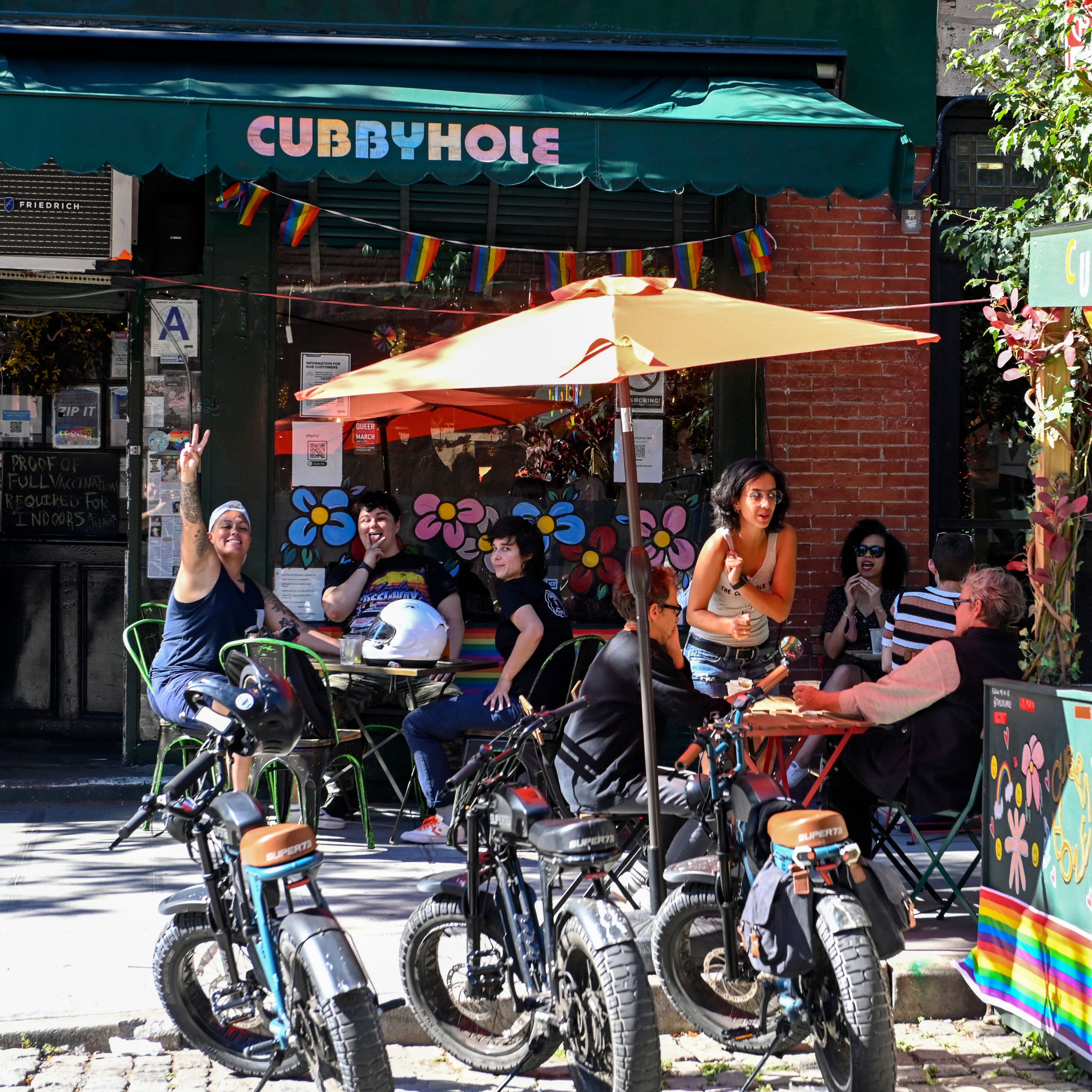
We want to hear from you. Do you have fond memories of visiting Henrietta Hudson? Or the Cubby Hole in the West Village? Or Ginger's Bar in Park Slope? When was the last time you went to a lesbian bar in New York City or elsewhere? What was called? What was it called and where was it? Tell us what made that feel special to you? Our number is 2124-3396-9221-2433-WNYC. Now this was started started as a road trip across the United States to visit lesbian bars. How did it start?
- [02:49]
D
Yes. So I had been chatting with my best friend from high school, Sarah Gabrieli, and my then girlfriend, now wife, Jen Mc, about making a podcast of some sort. We've been talking about this for a while, and on New Year's eve, heading into 2021 at this time, where there were a lot of headlines coming out about how lesbian bars are disappearing. There were 13, there were 17, there were 12. No one could quite decide, but there were not a lot of them. And I turned to Sarah and Jen and I said, what if we drive to all of these bars and we interview the people in them and that can be our. That can be our podcast. And they were like, okay, yeah, let's do it. And you did it. And we did it. I took a little bit of time to get it together and make it happen, but that was the impetus for the road trip.
- [03:46]
B
What was the most interesting thing about
- [03:48]
E
visiting these bars in person?
- [03:51]
D
I mean, I think that the. Something that we definitely knew going into it, but still kind of continued to surprise me every step of the way, was just like, the recency of queer history and queer liberation and the extent to which it really lives in these spaces. You can. You can walk into any one of these bars and you can talk to anyone over the age of 50, and they have specific firsthand memories of really key moments and in queer history. And so, yeah, I think that was very quickly became the most fascinating part of the experience for us.
- [04:32]
B
Did you have any concern about visiting these bars in the parts of the country where it could be, frankly, dangerous? In New York and San Francisco, not so much, but in other parts of the country it could be.
- [04:43]
D
I think it certainly was something that was on our radar as we were particularly, like, traveling through the deep south. I would say less so in the big cities or in the spaces themselves. But, you know, the gas station in rural Texas, like, you know, my girlfriend and I, now wife, are maybe behaving a little bit differently than we do in New York. And there definitely was an awareness there as we traveled through different parts of the country.
- [05:14]
B
So you decided to make this into a book. How much was there written about lesbian bars?
- [05:20]
E
That's a good question.
- [05:22]
D
I think there has been a lot of. There have certainly been a lot of, like, op eds and features about lesbian bars in the past few years in particular. And the bars pop up in a lot of books about queer history and culture more broadly. There's a book about mostly gay male bars that includes a handful of lesbian bars, but to knowledge. I think this is the first book that entirely focuses on lesbian bars.
- [05:56]
E
You noted the country was sort of on the cusp of a lesbian bar resurgence after visiting all these places. And it was interesting because you said it was post pandemic.
- [06:07]
B
Why have these spaces become more in
- [06:08]
E
demand, especially after the pandemic?
- [06:11]
D
Yeah, I mean I think that the pandemic in general, like, I mean we're arguably still in a pandemic, but this sort of post pandemic peak of COVID as stuff was starting to open up again. There was a, I think huge desire across all communities for in person space and IRL gathering and a renewed appreciation for that. So I think that is, that's definitely a piece of it. I also think the all the press that lesbian bars got surrounding their diminishment like made people realize, oh no, we, we want more of these. I've definitely heard stories from a number of bar owners who have opened spaces in the last couple of who have said, well, we heard they were disappearing and we didn't want it to be a thing of the past. So I think that also has been a big piece of it.
- [07:02]
E
Author Rachel Karp is here with me to discuss her new book, the Lesbian Bar the Living History and Hopeful Future of America's Dike Dives and Sapphic Spaces. It's out now, listeners. We want to hear from you. Do you have fond memories of visiting Henrietta Hudson's the the Cubby Hole or Ginger's bar in Park Slope? When was the last time you went to a lesbian bar here in New York City or elsewhere? What was it called? Where was it? Why did that space feel welcoming to you? Share your favorite story, an unforgettable night or a meaningful connection that happened while you were out? Give us a call at 2124-3396-9221-2433 wnyc. You can call in, you can join us on air or you can send us a text to those numbers 212-433-969-2212. Let's talk about the history of lesbian bars for a second. From 1920 to 1933, the sale of alcohol was illegal in the U.S. however, you introduce readers to a place called Eve's Hangout. What did you find out about its owner, Eve Adams?
- [08:09]
D
So Eve Adams was a anarchist, Jewish, gender, non conforming, self identified lesbian and she came to the United States And I think 1918, I want to say and immigrated to New York from Poland and she opened this space in the village called Eve's hangout that, while it probably did not sell or serve alcohol and so wasn't necessarily a bar, really, in my opinion, resembles what we think of as a contemporary lesbian bar. She was this kind of out and proud lesbian at the helm of this space. It was welcoming to the lesbian community at the time, but also to gender nonconforming and queer people across the board and artists and bohemians and allies. And, yeah, it was this little underground space on McDougal street that had a great run for about a year until the NYPD swooped in and arrested Eve for both publishing an obscene book because she had also written this book called Lesbian Love that same year, as well as for disorderly conduct, which was kind of just the generic charge used to arrest owners of spaces like hers. And, yeah, she was eventually deported.
- [09:41]
E
Yeah.
- [09:42]
D
Why was she deported? So she was deported for these criminal charges. They basically, like, prosecuted her for the exact amount of time. Like, she went to jail for one year, which was the minimum amount of time that they could then deport someone for. So I think was quite. And other authors and historians have looked into this. It was fairly premeditated, the kind of the charges and the arrest and the deportation.
- [10:11]
E
Do we know what happened to her after she was deported? I believe to Poland?
- [10:14]
D
We do. She was deported. So she was deported to Poland, and she eventually made her way to France, where she made a living selling dirty books. They were referred to at the time, which was very characteristic of her. And she met a woman named Hella Olsteen there, and they lived together for a number of years until, of course, we know, the Nazis rose to power and occupied France. And she and Hella were both eventually captured by Nazi forces and taken to Auschwitz, which they did not survive.
- [10:57]
B
Let's take a few calls. Let's talk to Caitlin, who's calling in from Montclair, New Jersey. Hey, Caitlin, thanks for taking the time to call, all of it. You're on the air.
- [11:07]
F
Hey.
- [11:08]
G
So my sister's friends started a lesbian bar in Philly, and prior to that, they had kind of talked about a lot of lesbian bars. They heard about kind of being almost canceled within the community because they weren't radical enough. They didn't take care of their employees enough. There was enough focus on intersectional or whatever it was. They just kind of didn't fit the culture that people were looking for. And I was wondering if that's been something that was just in Philly or if that's something that Rachel has come across anywhere else.
- [11:45]
B
It's sort of an interesting Topic about whether lesbian bars should be just for lesbians or they should be open for everybody. You get into this a little bit in the book.
- [11:55]
D
Yeah, definitely. I mean, I think to that question, there is no such thing as an exclusively lesbian bar anymore. I believe that is a good thing. I think historically, throughout most of history, lesbian bars were not checking your lesbian or woman status at the door. They were just spaces, you know, owned. Owned by lesbians and centering lesbian and queer women and oftentimes trans community. So I definitely think that holds true for pretty much all of the bars in the book. There are a couple of spaces that are covered in the book, more contemporary spaces that have had to contend with, you know, infighting or tension surrounding what the space should be and who it should be for. And that's definitely something that I get into in a couple of the chapters and don't shy away from it. And I think that in general, we tend to see a decent amount of infighting in the queer community sometimes because we have so few spaces and we hold them to such a high standard. And that is sometimes a beautiful thing. We should hold our spaces to a high standard. And of course, sometimes it can play out in intense ways. But I don't think that this is, like, the leading cause for why lesbian bars are closing. I think it's more a few isolated incidents rather than a few an attribute of lesbian bars as a whole.
- [13:37]
E
Let's talk to James. Hey, James, thanks for calling all of it.
- [13:40]
B
You're on the air.
- [13:42]
F
Hey, all, I'm calling from Jersey City, but I'm originally from Texas, and I wanted to talk about Pearl Bar in Houston, Texas. Pearl Bar is a really great lesbian bar that, especially after the pandemic, really opened its doors to community. And I think one of the coolest things about Pearl Bar is that in the springtime, they have crawfish barrels on Sundays. And it was really delicious and just altogether a really fun time.
- [14:09]
E
Thanks for calling in. James, you gave a big nod when you heard about Pearl Bar.
- [14:15]
D
Yeah, I love Pearl Bar. I was there for steak night when the owner, Julie Mabry, grills steaks for everyone outside on the patio.
- [14:25]
E
This says Lipstick Lounge in East Nashville is an amazing lesbian bar.
- [14:29]
B
Used to live down the street, and it's a point of pride for the community.
- [14:33]
E
We are talking about the book the Lesbian Bar Chronicles. Its author is Rachel Karp.
- [14:39]
B
Listeners, we'd like to hear from you.
- [14:40]
E
Do you have fond memories of visiting, say, Henrietta Hudson's or the Cubbyhole in the West Village or Ginger's and Park Slope. When was the last time you went to a lesbian bar in New York City or elsewhere?
- [14:51]
B
What was it called? What made the place feel.
- [14:53]
E
Feel special to you? Share your favorite story and unforgettable night. Our number is 2124-3396-9221-2433.
- [15:03]
B
WNYC. When we return, we'll talk about Henrietta Hudson. You're listening to all of it on wnyc. I'm Alison Stewart. My guest is author Rachel Karp. She's here with me to discuss her new book, the Lesbian Bar Chronicles. All right, we've made it to Henrietta Hudson, started by Lisa and Minnie in the West Village. Why'd they choose their space?
- [15:37]
D
So Henrietta Hudson, this is a little bit of convoluted New York City Lesian bar history. Henrietta Hudson used to be a bar called the Cubby Hole. That's Cubby Space Hole. And Lisa Canastrasi, who then went on to found Henrietta Hudson, was a bartender there for many years. And so eventually, when after the original cubbyhole closed, Henrietta Hudson opened in that space that had a lot of history with the lesbian community already. And then to make matters more confusing, a number of years later, the cubbyhole that is open today that we all know and love opened also in Manhattan's West Village and took the name with the blessing of the original cubbyhole owners.
- [16:22]
B
So Lisa got her start in the bar business on Wall street in the early 1980s. What did she start doing on Wall Street?
- [16:32]
D
Yeah, yeah. I mean, she just, she started bartending on Wall street and making a whole lot of money and really kind of getting embedded in the scene on Wall street, the bar scene there.
- [16:48]
B
How did she imagine her career in nightlife growing? What did she see for herself?
- [16:54]
D
I don't think she saw a career in nightlife for herself. I think it was just, you know, something she was doing to pay the bills. She was in school. She was, I think, pursuing social work for a while. And she kind of just kept getting sucked back into it. And so I think nightlife chose Lisa. I don't think that Lisa chose nightlife.
- [17:18]
B
On your podcast Cruising, you get into some tougher issues. You talk about the AIDS epidemic in the 80s and the 90s and how much of the focus was around gay men. And you talked to Lisa about this? We have a little clip, and we can talk about it on the other side. Here's a clip of Lisa reflecting on that time.
- [17:37]
H
My friends were dying. You know, I mean, they would get diagnosed and be dead in 10 days. That's how quickly they died.
- [17:45]
I
Back then, all she really knew about the virus was that it seemed to spread through gay men, whereas women like Lisa seemed to be less vulnerable.
- [17:54]
H
My friends who were lesbians and the gay women in the city, we went to St. Vincent's Hospital to take care of our guy friends because guys were terrified to go in. They didn't know how it was transmitted back then.
- [18:06]
B
Yeah, it was interesting. When you talked to Lisa and other women who were in New York at that time, what did they tell you about the AIDS epidemic and how it affected the community?
- [18:17]
D
I mean, I think it absolutely devastated the community. Like Lisa says in that clip and has talked about, it was like all of her friends were like, every week somebody was getting sick or dying. And of course, we know there was a huge amount of fear and stigmatization surrounding the illness and a lot of misinformation as well about how it was spread. For the first few years, people thought maybe it was through saliva or airborne. And so there wasn't. I think the general population was largely, like, very afraid of going in and even like sitting with gay men who are dying of aids. And across the country, not just in New York City, we've seen the lesbian community really stepping in to take care of their friends and sit with them and be present in hospitals across the country.
- [19:15]
E
This text says, how could we not mention Meow Mix on the Lower east side that had a full on Go Go dancers in the late 90s, which then evolved into the fabulous Caddyshack on 4th Ave.
- [19:27]
B
In Brooklyn.
- [19:29]
E
Let's talk to Michelle who's calling from Florida. Hey, Michelle, thanks for calling, all of it. You're on the air.
- [19:35]
G
Hi. Thank you for having me. I was just calling because it's so nice to hear people talking about lesbian bars, because me and my friends used to hang out at Henrietta's and Cubbyhole, and it always felt like each bar had its own personality. At Henrietta's, it felt very open and free. Spir at Cubbyhole, it always felt a little snobby. And when we had to move out of New York because it got too expensive to live there, we didn't think we'd find a community. But here in Florida, we have Southern nights, which is really cool too. And every bar, every lesbian bar I've been to was special because it felt like if you wanted to disappear and just be there for the environment, you could be. But if you wanted to be seen and felt and heard, you could do that too. It was like everybody knew how to read the room. And I thought that was really special.
- [20:22]
E
Thank you so much for calling, Michelle. We really appreciate it. Let's talk to Paige from West Harlem, who has a little bit of an update on one of the people we mentioned. Hey, Paige, give us the deets.
- [20:33]
J
Hi. I am a playwright, and I actually wrote a whole play about a couple of years ago that had some productions at the Space in Irondale and Brooklyn and at the Tank in Manhattan. And just kind of like an interesting part of, like, the horrors of her arrest and the censorship is the woman who. It was actually a woman who arrested her, a woman named Margaret Leonard, who was an undercover female detective, one of the first female detectives as part of the newly minted NYC Women's Bureau, which I believe was founded in maybe 1924, so just a year or two before. But she posed as a customer actually coming to eavesdropping. You see, when you hang out, asking her on a date, kind of like canoodling with her as a way to lead her on and actually get the evidence that she needed to convict her and deport her.
- [21:26]
E
Thanks for the update. We appreciate it. My guest is Rachel Karp. She's the author of the new book, the Lesbian Bar Chronicles.
- [21:34]
B
Let's talk about a newish bar, the
- [21:36]
E
Bush, located in Bushwick. It opened in spring of 2023. Why was that an important institution for you to highlight in your book?
- [21:49]
D
I mean, I think for a number of reasons. For one, I live in Brooklyn, and so it's geographically close and sentimentally close to my heart to see a new bar opening in Brooklyn. And yeah, I think that is definitely an example of one of the spaces that really arose out of people. The owners, Nikki and Justine, seeing that the spaces were closing and saying, we don't want these to be a thing of the past and we're gonna open a space in Bushwick.
- [22:25]
B
Let's listen to a clip from your podcast, Cruising. These are the Bush owners, Nikki and Justine, talking about how difficult it was to find a space at first. The first voice you will hear is
- [22:36]
K
Justine's looking for a space was really challenging because landlords don't necessarily want to rent to somebody that's never done the thing that's going on in the space also.
- [22:47]
B
Or queer people.
- [22:48]
K
Yeah, we were shocked by, like, how conservative a lot. I don't know why I was shocked, but I was shocked by how conservative a lot of the, like, landlords in New York are. Who'd have guessed?
- [22:58]
I
Justine and Nikki recalled one potential landlord in particular who seemed to demonstrate some Blatant homophobia towards them.
- [23:05]
K
He was, like, really Christian and worried about, like, us being too political. And we're like, well, what do you mean by that? Like, he's like, I don't want you to, like, put stuff in the windows. And we're like, well, what do you mean by that? Because we hadn't even really told him anything about the project. And so I'm like, is being gay political to you? Is being like, what do you. What are you saying to me right now? Like, what. What about us and what we've presented to you, which is a concept, a pitch deck for a cocktail bar, makes you feel like you need to make this. Put something in our lease about us being political.
- [23:38]
D
It was so specific, too, because it said something about, like, rallies and, like,
- [23:44]
K
election and things like that, which was like, a pretty big red flag.
- [23:48]
E
Yeah, that's from your podcast Cruising. I'm curious how this bar, the owners, have embraced the history of the neighborhood as they're creating a space for current residents to enjoy.
- [24:01]
D
Yeah, that is a great question. I think that they, for one, are so. Justine is from the Midwest, I believe, and Nikki is from Jamaica originally and is a bipoc person. And so I think they're sort of just presence. Both of their presences in the. In the bar has helped them to cultivate, like, a really diverse space and a space that actually represents the demographics of the neighborhood historically and presently. And that's something that was extremely important to them as they went into opening a bar in Bushwick, which is, of course, a rapidly gentrifying neighborhood here in New York.
- [24:49]
E
When you talk about several places like Walker's Pint Milwaukee, you talk about how they're great bars, but they do so much more for the community. Could you share some of the ways that these lesbian bars are adding to the community?
- [25:03]
D
Yeah, I mean, I think that particularly because historically, lesbian bars are one of the only spaces and resources available to queer people. They really have evolved to be this sort of stand in for a lot of social services and like, a really pseudo community center. So we've heard, I mean, so stories about bars raising money for patrons in need, whether it's to cover rent or to cover gender affirming surgery or to, you know, just help through a tough time. Bars. Lesbian bars have a long history of hosting, like, Thanksgiving and Christmas dinners and being open 365 days a year. Cubbyhole is one that is open every day, seven days a week, 365 days a year. And that is because of the. Just need for people to have these spaces available to go to on a day like Thanksgiving or Christmas where they might not have biological family that are accepting and affirming to spend those holidays with.
- [26:16]
E
In a chapter that you focused on the Northeast, you refer to lesbian bars as neighborhood bars. And I wanted to play a clip from Ginger's owner, Sheila Frayne, explaining how her mom in Ireland would tell everyone to visit the bar in Brooklyn. This is from your podcast, Cruising.
- [26:32]
C
My mother was the business. She really was. She was just, like, so proud of you and Gingers. And she would tell everybody about it and, oh, all the time giving people the address. Go see her when you go over. And I would have people be like, oh, Jesus, who are these? And she there they are. Your mother told me to come here
- [26:54]
I
prior to opening Gingers. Sheila's mom and two of her brothers came to the US to help with cleaning and renovating the bar. And Sheila's mom would continue to visit Gingers for years to come. She took a lot of pride in it.
- [27:07]
C
And they used to smoke on gingers at the time. And she'd be going around, clean the ashtrays and talking to everybody. And, you know, all my friends, can we have your mother for the weekend? Because she was so cool. She was. She was so cool, and she never judged anybody. And she would always say, if you said something about it, she said, they're somebody's kid. Don't say that. She was very open about everything.
- [27:27]
B
You know, how often are these spaces filled with allies?
- [27:33]
D
I think that allies are welcome, particularly family members. Like a lot of these bars that opened in the 80s 90s, early 2000s, like that era of the lesbian bar owners talked about wanting a place where they could bring their family and that they could feel proud to bring their parents or their siblings or their aunts and uncles. So I think it's definitely common.
- [28:01]
B
Is there anything you didn't tell me that I haven't covered in the book you think is interesting and you want
- [28:05]
D
people to know anything? I want people to. Well, one thing I want to shout out is just that other voice you hear as the host of Cruising podcast is Sarah Gabrieli, who conducted all the. All the interviews for this project and is the host of the pod. So I wanted to shout her out on the air because she's been a huge part of this project.
- [28:30]
B
Is there any bar you can see yourself thinking, yeah, I'd go there again. Someplace outside of New York.
- [28:36]
D
Someplace outside. I mean, I go to Ginger's a lot. It's in my neighborhood. But I really fell in love with Wildside west in San Francisco. It's historically a lesbian bar, has this really long and fascinating history, but is really a kind of quirky neighborhood bar today and has this beautiful backyard garden that is filled with all of this kind of reclaimed garbage art that the owner created in the 70s when she moved the bar to San Francisco. And I would hang out there all the time if I lived there.
- [29:13]
B
I've been talking to author Rachel Karp. Her new book is titled the Lesbian Bar Chronicles. Thanks for joining us and taking our listeners calls.
- [29:21]
D
Thank you for having me.
- [29:23]
L
The Colonels cooked up a new $10 bucket of the day just for you. Monday 24 nuggets for $10 Tuesday 8 piece fried chicken for $10 Wednesday 10 wings for $10 Thursday 8 tenders for $10 Friday 24 nuggets for. Oh, you guessed it, didn't you? $10 finger licking machine the $10 bucket of the day deal every weekday only at KFC. It's finger licking goo Prices and participation
- [29:49]
B
variable supplies last not available on third party ordering platforms.
- [29:52]
I
Tax extra.