← All Of It with Alison Stewart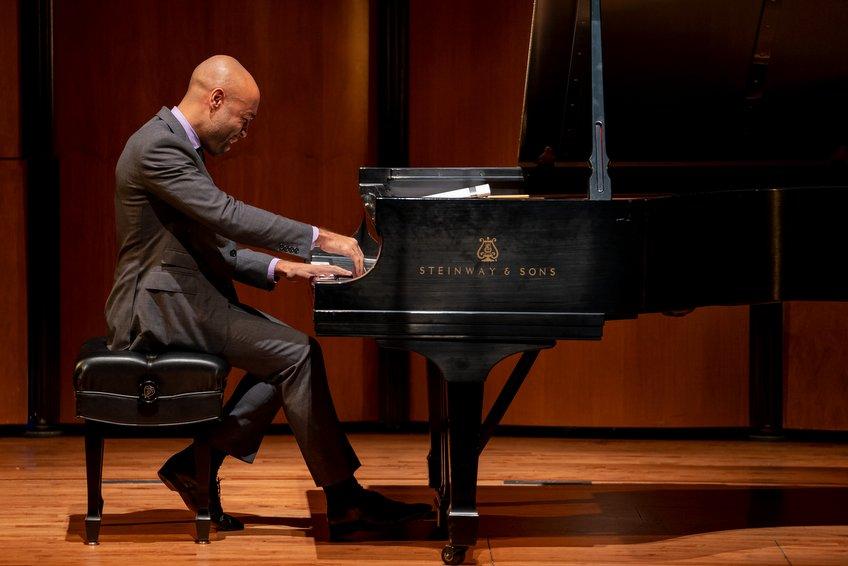
All Of It with Alison Stewart
Aaron Diehl Performs Mary Lou Williams
00:23:36
Pianist Aaron Diehl’s latest album with orchestral group The Knights revives "Zodiac Suite," a relatively obscure work from the great Mary Lou Williams.
Loading summary
Transcript31 lines
- [00:00]
Uncle
I' ma put you on nephew.
- [00:01]
Aaron Deal
All right, unk.
- [00:02]
Alison Stewart
Welcome to McDonald's. Can I take your order miss?
- [00:04]
Uncle
I've been hitting up McDonald's for years. Now it's back. We need snack wraps. What's a snack wrap? It's the return of something great. Snack wrap is back.
- [00:15]
Old Navy Announcer
Some days call for sleek and straight, others for slouchy and relaxed. Whatever your vibe, Old Navy has the denim fits to match from extra high rise to barrel. It's not just a mood, it's a whole style range. And with jeans Starting at just $22, you can collect them all snatched waist go extra high rise straight lived in staple vintage slim, low slung and laid back slouchy wide. You've got range. Your denim drawer should too. Premium fabric deluxe details your perfect pair or weights. Shop in store or online@oldnavy.com oh my gosh.
- [00:47]
Marshalls Announcer
Have you been to Marshall's lately? They have all the brand name and designer pieces you love, but without the jaw dropping price tags. Alright, so here's the truth. You should never have to compromise between quality and price. And at Marshalls, you don't have to. Marshall's believes everyone deserves access to the good stuff and that's why their buyers hustle around the clock to make it happen for you. Visit a Marshalls store near you or shop online@marshalls.com.
- [01:18]
Uncle
Listener supported WNYC studios.
- [01:24]
Marshalls Announcer
This.
- [01:24]
Alison Stewart
Is all of It on WNYC. I'm Alison Stewart. Pianist Aaron Deal performs and records music with an open mind, tackling early 20th century jazz as well as the minimalist music of Philip Glass. On his latest album, Aaron worked with the orchestral collective the Nights to revive a piece by composer Mary Lou Williams. Born in 1910, Williams was a virtuosic piano player from a young age who became a major figure in the bebop era jazz of the 40s, and later in life composed liturgical music in a jazz vernacular. She also devoted herself to teaching younger musicians about African Americans. Huge contributions to the genre. In 1975, hers was the first jazz mass ever performed at Manhattan's St. Patrick's Cathedral, but before then, in the 1940s, Williams composed a work called the Zodiac Suite, featuring 12 selections each named after an astrological sign. Early recordings of it are hard to find, and some errors in the original manuscript have made it difficult for later performers to take it on completely faithfully. Deal's new album helps correct the record and bring more attention to the work of a talented composer and pianist, and he joins me now in Studio five at the piano to tell us more. Hi, Erin.
- [02:37]
Aaron Deal
Hi, Alison. It's good to be here.
- [02:39]
Alison Stewart
What are we going to hear first?
- [02:42]
Aaron Deal
Well, I think I'll start off with cancer. Mary Lou Williams, she wrote each of these pieces, which is a zodiac sign, dedicated them to various friends, some who were musicians, some who weren't. And she wasn't like a fervent astrologist of any kind, but she wanted to find a way to dedicate music to her friends and people that she loved. So, for example, cancer. She says that this movement is sort of a sign of peace and tranquility. And she dedicated this to two people. Lena Horne and then also Lim Davis, who was an alto saxophonist in Eddie Haywood's band. Eddie Haywood was a pianist who was the band director of the Cafe Society, the house band of the Cafe Society, which was the first integrated nightclub in New York. And a lot of the origins of Zodiac Suite come from that. Barney Josephson, who was the founder of Cafe Society, he was the one who sort of supported this suite. So I'll start off with cancer, and then maybe we can go off from there.
- [04:10]
Alison Stewart
Let's hear it.
- [06:02]
Aaron Deal
Sam Sat Sa. Sam.
- [07:54]
Alison Stewart
Was Aaron Deal performing Cancer, composed by Mary Lou Williams. Aaron Deal's album is called Aaron Deal and the Knights Zodiac Suite. I'm a cancer, so I felt that deep in my soul. Zodiac Suite is an orchestral piece originally composed for solo piano, piano, bass duo. That was its original makeup. What is special about Mary Lou Williams as a composer?
- [08:19]
Aaron Deal
Well, she was someone who really lived through the entire evolution of what we know as jazz. And at every stage, she was able to reinvent herself, modernize her sound. Take all of the influences from early on with Andy Kirk to the influences of the younger generation, what they call the Beboppers. I mean, Monk and Dizzy and Charlie Parker, I mean, they loved Mary Lou Williams. They would hang at her apartment in Harlem. That was like the hang of the 40s and beyond. I mean, she was always able to remain modern, remain original, while always keeping true to the foundations of the language of the music. And, you know, someone who's highly, highly underrated today. I mean, she had a bit of a break in the 50s. She. She was in Paris, and I guess the story goes, she was at a performance, and she just walked away from the piano in 54, and then went on to have sort of a spiritual conversion. She converted to Catholicism, actually, I think, along with Lorraine Gillespie, Daisy Gillespie's wife. And she started. She started her own foundation called the Bel Canto foundation, which supported people who were in need, homeless musicians, who were struggling with addiction. So she was a very generous person outside of music. And she didn't come back to music until later. So, in fact, There's a recording, 1957 Dizzy Gillespie at Newport. It's widely accessible, where she basically comes out of. Briefly comes out of retirement. Dizzy wanted her to play, and they played, I think, two or three. Yeah, three excerpts from the Zodiac Suite. And she wrote all this great liturgical music. The reason why I really became interested in her is because of her manager for, I think, the last two decades of her life. His name was Father Peter O', Brien, and I met him in around 2004 when I was at Juilliard. They were doing a Mary Lou Williams concert. I wasn't playing on the concert, but he was. Father o' Brien was there sort of to supervise the programming of the music. And I grew up Catholic. I grew up in a predominantly Catholic church in Columbus, Ohio. And first of all, the fact. I couldn't sort of reconcile the fact that Mary Lou Williams, manager was a Jesuit priest. I know. I mean, I think that's hilarious. And so I met again, Father o' Brien when I was playing at a church in Harlem, St. Joseph the Holy Family, around 2006. And he just happened to be, like, the guest priest, guest presider. And he went up to give his homily, and I was playing the piano there, and he said, I know you. I remember you. And after Mass, we started talking, and he was like, do you know that Mary Lou Williams wrote all this liturgical music, these Mass settings? You should maybe play them here. So I. I think that following year, like 2007, during Lent, we played her Mass for the Lenten season. Use that as part of the, you know, the Mass parts. So, in fact, she. There was. There's only one recording of that still is from St. Thomas. It doesn't exist anymore. It was on 118th and Frederick Douglass. And she, I think, might have premiered it there. So, unfortunately, Father O', Brien, he passed in 2015. I was really sad because he was such an advocate for Mary's music through the Mary Lou Williams Foundation. And, you know, he's always very generous about sharing his knowledge about her and sharing her music, which a lot of it still isn't really accessible.
- [13:11]
Interviewer
With the Zodiac Suite, there were some issues with the original manuscripts. What were the issues, and how did you know how to address the issues?
- [13:25]
Aaron Deal
That's a good question. Well, first off, she orchestrated this particular arrangement that's on the album that I did with the Knights. She orchestrated that fairly quickly. And with the help of a guy named Milton Orent, who was a staff arranger at NBC. And they were very good friends, and she was interested more. Became more interested in orchestration. And I think Barney Josephson actually encouraged her to take the Zodiac Suite in its original form, which was just a piano trio or duo, and expand it to. For orchestra. And so she enlisted Milton Oren to help her with orchestration. Although it's, to my knowledge, it's Mary Lou Williams herself who did the orchestration. And I think a number of reasons, you know, when you're every. They didn't have all these engraving softwares like they do now. You know, you can, you know, easily put stuff on the computer, so everything was done by hand. And then, you know, just when you have a short amount of time, I don't know quite how long she had between when she knew she was going to do this concert at the Town hall and the actual concert. But she didn't have time to really go through, I think, all of the details and the parts. And so the rehearsal, apparently, and the performance, which you can actually find on CD somewhere of the Town hall concert, it was less than stellar, let's say, and partly because of the lack of real preparation time. And so as a result, she became really frustrated with this performance and she shelved this particular arrangement. It didn't resurface until I found out during the pandemic, until, like, I guess around 2011, when it was published. But even when it was published, there were still all kinds of errors. And so how did I go about doing it, sort of correcting for it? Well, I mean, I. I went to the source, specifically the recording, the original recording she did. And there are some things that were very obvious, like some accidentals, like if it's a sharp or it's a flat, and it's like, oh, I know in the original recording, that's not actually how the melody goes. So there's some obvious, you know, there's some obvious issues that can. Can be pinpointed, but there are some other issues that, you know, they took some, you know, consulting people and some trial and error. I mean, that was the privilege of working with the Knights. They were very enthusiastic about doing this project. I mean, because I. Like I said I had the idea during the pandemic of doing this, but it was. It was a matter of finding people who would really be interested in going on the adventure with me. Yeah. And so I feel like it was maybe around October 2021, I want to say, or. Yeah, about 2021 where we all got together at Jazz at Lincoln center. And we had a sort of a reading, and we just read through the whole suite and figured out what might need to be corrected. We recorded it, and I spent several months just trying to work things out.
- [16:58]
Interviewer
Yeah, well, let's listen to a little bit of what you worked out. Let's play a clip from the album with the night so we can hear what the pieces sound like with the whole group. We're going to play a little bit of Sagittarius. That is from the album Aaron Deal and the Knights Zodiac Suite. My guest is Aaron Deal. So when you're playing these pieces solo on piano, what kind of decisions are you making to translate? We just heard the orchestration there with the Knights.
- [17:48]
Aaron Deal
Well, I mean, I don't even know if it's a matter of translation because most of the original recording on record label called Ash Records, Mo Ash. And they were mostly either solo piano duo with bass. Like Cancer was bass and piano or trio. And so even Williams herself, she said, I think she started off with three that she wrote ahead of time. It was actually for a radio broadcast that she had on WM Any U. And every Sunday she was going to feature a different zodiac sign. And I guess it came to a point where she was kind of getting a little bit of writer's block. So sometimes she would just, on a broadcast, improvise something and sort of compose really in real time that became the movement. So as I've grown to understand a bit more about these pieces and hearing some other interpretations of the suite, including especially, I'd say, Jerry Allen, I try to take more of a free form approach to it and keeping all the themes and the motifs in, but trying to expand sort of the core of, you know, the original and try to make it my own in a way. So, yeah, it's. It's. It's been a. It's been a wonderful journey with. With this piece, certainly.
- [19:26]
Alison Stewart
Maybe hear another piece.
- [19:28]
Aaron Deal
Oh, yeah, we can do that. Let's do Wama Virgo. Okay. And maybe. Yeah, we'll do Virgo. And I think she dedicated this. One of the people she dedicated this to is Leonard Feather. And yeah, it's probably the most swinging movement of the. The entire suite and really kind of harkens to her days with Andy Kirk Band and the whole Kansas City style. So this is Virgo.
- [20:02]
Alison Stewart
This is Aaron.
- [20:58]
Aaron Deal
Sa. Sa.
- [24:53]
Alison Stewart
And Wrap. Yay, Aaron. Thank you so much.
- [24:58]
Aaron Deal
Thank you.
- [24:59]
Uncle
I'm gonna put you on, nephew.
- [25:00]
Aaron Deal
All right, unc.
- [25:01]
Alison Stewart
Welcome to McDonald's. Can I take your order, miss?
- [25:03]
Uncle
I've been hitting up McDonald's for years. Now it's back. We need snack wraps. What's a snack wrap? It's the return of something great. Snack wrap is back.
- [25:15]
Marshalls Announcer
Oh my gosh. Have you been to Marshall's lately? They have all the brand name and designer pieces you love, but without the jaw dropping price tags. Alright, so here's the you should never have to compromise between quality and price. And at Marshall's, you don't have to. Marshalls believes everyone deserves access to the good stuff and that's why their buyers hustle around the clock. To make it happen for you, visit a Marshalls store near you or shop online@marshalls.com.