Loading summary
Transcript82 lines
- [00:00]
Alison Stewart
All of it is supported by Progressive Insurance. You chose to hit play on this podcast today. Smart Choice make another smart choice with Auto Quote Explorer to compare rates for multiple car insurance companies all at once. Try it@progressive.com Progressive Casualty Insurance Company and affiliates. Not available in all states or situations. Prices vary based on how you buy
- [00:23]
Celia Keenan Bolger
Me Reese Witherspoon in London ordering fish and chips so often they might start wrapping me in paper. I'm traveling with my Wells Fargo Autograph Journey card so I earn rewards wherever I book travel five times points with hotels four times with airlines, three times on restaurants and other travel and one point on other purchases. Imagine getting rewarded for eating a toad in the hole. Wait, what is a toad in a hole?
- [00:46]
Tony Shalhoub
Visit wells fargo.com autographjourney Terms apply.
- [00:52]
Commercial Narrator
There's an SUV that turns the unthinkable into the unforgettable. The new Nissan Pathfinder. Built for big adventures and all that family chaos. It's powered by a strong V6 engine with a nine speed automatic transmission. Inside, it's rugged and capable, but still premium and tech forward with room for up to eight passengers. It's also available with seven passenger seating and second row captain's chairs with massive hauling capability. Now you can bring all the gear you and your family need for unforgettable adventures. The new V6 Nissan Pathfinder power your adventure.
- [01:30]
Alison Stewart
This is all of it on wnyc. Hi, I'm Alison Stewart. The title of a new play sounds like something you might say to someone who asks you a question about your actions or maybe what leads you to a certain conclusion. You might start the sentence with Antigone. This play I read in high school. That's the name of a new play by Anna Ziegler that navigates back and forth between the past and the present in character and in execution. The action is based on Antigone fighting for what is right and her uncle doing what he thinks thinks is right. He is played by Tony Shalhoub. Antigone is a headstrong woman who wants to be in charge of her body. Society wants it otherwise. Celia Keenan, Boulder, is a woman whose life has been shaped by Antigone and she is the chorus. She is our chorus. Antigone, this play I read in high school is at the Public Theater and has just been extended until April 5th. Joining us now is playwright Anna Ziegler, Tony Shalhoub and Celia Keenan Bolger. It's so nice to have you in studio.
- [02:25]
Tony Shalhoub
Thank you.
- [02:26]
Anna Ziegler
Thanks.
- [02:27]
Alison Stewart
So Anna, what was it about Antigone that was interesting to you that you wanted to take it in a new direction.
- [02:35]
Anna Ziegler
So Antigone is obviously one of the classic Greek plays. And I've always been obsessed with the classics. And I was particularly interested in Antigone because it felt like a play that could be translated into
- [02:54]
Alison Stewart
our.
- [02:55]
Anna Ziegler
Something that would be relevant to our times. The original play has as its core problem, Antigones does not want her. Her brother is not given a proper burial by her uncle the king. And it seemed like there was a possibility for an update that could really speak to our society and our politics today.
- [03:29]
Alison Stewart
It's very interesting in the play. You summarize that very quickly at the beginning as the chorus for us in the audience, but in the time. But while you're summing that up, you say, I didn't really want to read Antigone. You let us off the hook in the beginning. For people who haven't read it at first, why does your character not want to read Antigone?
- [03:50]
Celia Keenan Bolger
You know, well, in the play, she's just read Jane Eyre and she's like, I liked Jane. She seemed like a relatable character in my 10th grade year. But it's interesting, like the parallel of being sent this play as an actor that I was like, I don't think I really want to see Antigone, and I don't think I really want to be in Antigone. And I think that had more to do with my feeling like I wasn't intelligent enough to, I don't know, understand it. I didn't read it in high school. And I feel like the classic sometimes feels to me like these faraway intellectual exercises that are not the reason that I love to go to the theater. And then when I read it, I was like, holy moly. This is not what I expected. And it just opened up not only this new play, but also this re understanding and going and actually reading the play for the first time and having this whole new real admiration for what Sophocles was doing in 441.
- [04:53]
Alison Stewart
Anna, do you think you have to read to Antigone to see your play?
- [04:55]
Anna Ziegler
I definitely do not. I think it is for everyone.
- [05:01]
Alison Stewart
Tony, where is Creon when we meet him in the play?
- [05:05]
Tony Shalhoub
Well, Creon is kind of the reluctant. He's become the king by default, reluctantly. He is the brother in law of Oedipus. This is probably a number of months, half a year after Oedipus and Jocasta have off themselves and the sons have we learn in vying for the throne because they were next in line. They kill each other. And so Creon is by default put in that position. Everyone knows he's not suited to it. He knows he's not suited to it, but he has to take it on. And because of his personality, his sort of type A personality, he kind of overshoots. He wants to everything strictly by the book. He doesn't want to make any mistakes, and in the play describes him as that sort of straight A student that wants to, you know, be perfect in everything. And which. Which then leads him to be very inflexible. And he's confronted by his niece Antigone, who is headstrong and also very inflexible. And so. And that's part of what Sophocles was originally writing about, about how tragedy and disaster can ensue when two parties are immovable and unwilling to, you know, to actually listen and communicate and compromise.
- [06:40]
Alison Stewart
We keep saying, like Antigone is this headstrong, this strong young woman. How do you describe her when we meet her?
- [06:48]
Anna Ziegler
I would say in this play she is supposed to be in sort of her late teens. So she's quite young. And she has just suffered, as Tony said, the sort of tragic death of her parents and real implosion of her family. So everything has changed in her life very quickly, and she is really unmoored. And we meet her when she is on a bender in the bars of Thebes. So she's really kind of rebelling and
- [07:31]
Alison Stewart
flirting, all kinds of things.
- [07:33]
Anna Ziegler
Yes, she's acting out, even though she is betrothed at the time and is supposed to get married soon. So she's in the midst of rebelling and trying to figure out kind of what. What to do with herself. And. And of course, we. We quickly find out that the. That she is. That she's pregnant.
- [07:57]
Alison Stewart
So we see in. In the Playbill, you are the chorus. What do you see as your role? Because you're the chorus, but you're also a person that we get to know.
- [08:08]
Celia Keenan Bolger
Yeah, you know, I. I went back and tried to learn a little bit more about what those original Greek choruses, their function in those old plays. And so much of what they were there to do was reflect the questions of the society inside of the play. And I think in our version, because I get to be my own character, but I also am sort of this, I don't know, narrator of other details of the actual story of Antigone that I hope what I am is a kind of proxy for the audience to feel both inside of the play and also to say, like could my. How does my experience. There used to be a line in the play that was like, what could Sophocles or Euripides have to do with my life? And I hope that part of the function of my character is to say, like, we. There is a reason that I think Oedipus and Antigone and the play at the Shed right now, like, we are reaching back for these tragedies. And I really don't think that that is a coincidence, given political landscape and the cultural moment that we find ourselves in. And that I hope that part of what I'm doing is helping draw people in personally, so that they feel not only like, oh, I get to watch this incredibly woven story that Anna's written, but also I get to feel something myself as an audience member.
- [09:32]
Tony Shalhoub
I think another. If I can just add to that.
- [09:34]
Alison Stewart
Please.
- [09:35]
Tony Shalhoub
What Anna has done so brilliantly in the writing in order to. Another way to draw audiences in and make the material that much more relatable is she has woven comedic elements through this play, which I think people would. Coming to Antigone might not know or imagine that that's even a possibility. But without compromising the depth of it and the darkness of it, she has sort of woven all of this. These kind of bizarre, absurdist characters through it. So there is, strangely, there are a lot of laughs in this play.
- [10:21]
Alison Stewart
Yeah, it's this funny moment when you introduce. When Celia introduces her sister, Antigone's sister, and she calls her the hot one. Right. Gets a big laugh. How did you think about writing this so that you could include colloquial language in this age old text?
- [10:39]
Anna Ziegler
Yeah, strangely enough, that kind of came naturally. It was always my impulse to write it that way. There were other elements of the play that were much more challenging and came later, but the kind of language of it and the tone of it were there from the start. This kind of weird collision of modern day and ancient. And the ancient past. And I think it strangely kind of works. And I think, as Tony said, it allows it to, you know, to have a lot of modern comedy. And I think that that's really important. And I hope the title also kind of indicates to people that it's, you know, we're not there to be a bleak evening of theater.
- [11:36]
Alison Stewart
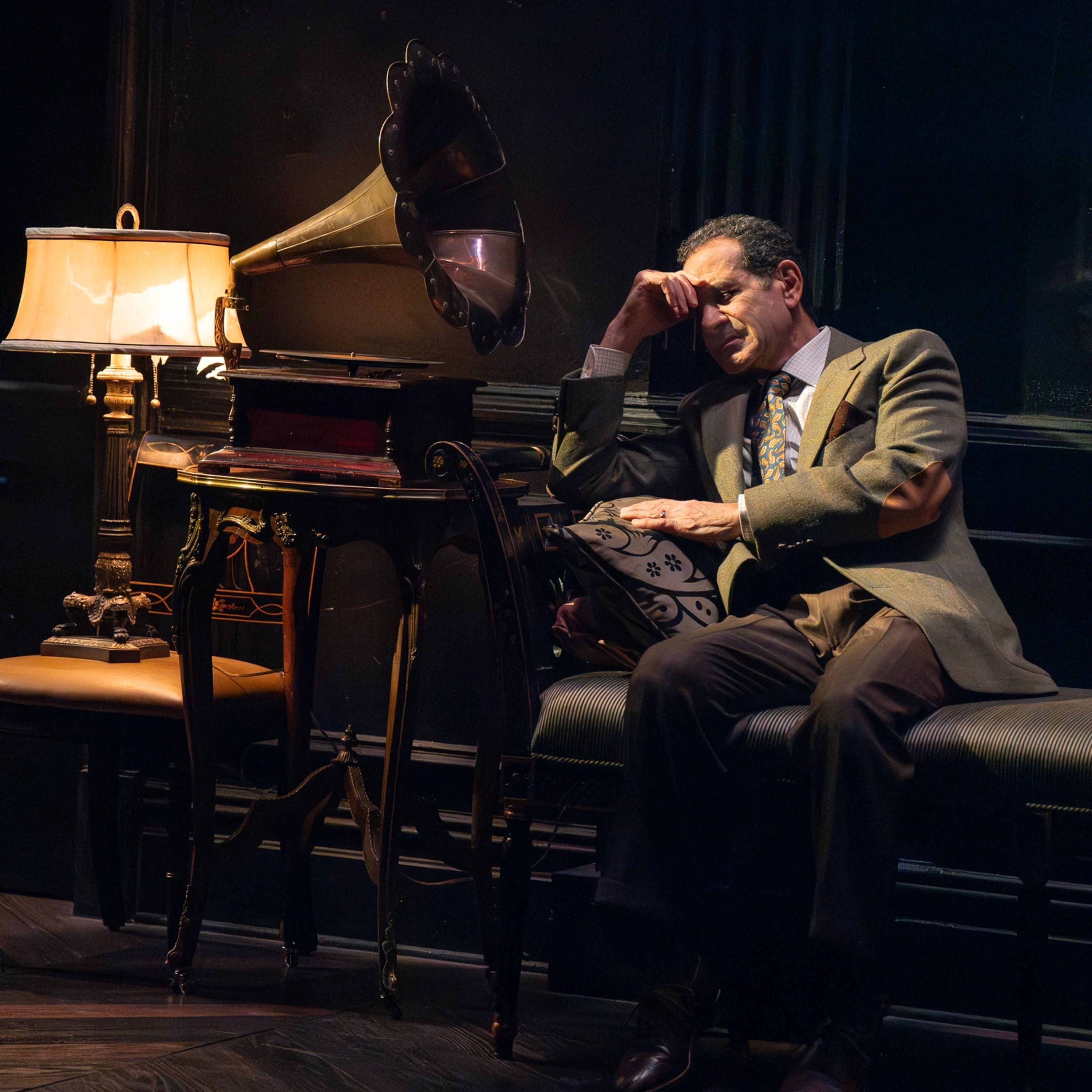
We are discussing Antigone, this play I read in high school, playing at the public theater until April 5th. My guests are Celia Keenan Bolger, Tony Shalhoub, as well as the playwright Anna Ziegler. The costume is interesting. There's a lot of motorcycle jackets, Tony, when you come in, can you describe for us what you are wearing and what do you think it tells us about Creon?
- [11:57]
Tony Shalhoub
Well, Creon is sort of described as bookish, and I'm wearing a kind of a. Some sort of really nice pleated slacks, but also a kind of tweedy jacket with patches on the elbows. Kind of professorial, really. And as on my initial entrance, I'm wearing an overcoat, a beautiful sort of charcoal overcoat. But it's. It's sort of. It's hanging on my shoulders, which is just a kind of a choice. We. I came up with, with our. Our wardrobe, our costumer and the tailor. And it just felt. It just gave it a little bit of. I mean, I could have worn the overcoat with, you know, my arms and the sleeves and everything, but I don't know, there was something about just wearing it over my shoulders that just felt more like a cloak, but also just a sort of casualness to it and a kind of. That this guy is reluctantly taking on the mantle of king. And so he's. I feel like the coat on my shoulders is a kind of half commitment to the role. I'll kind of. I'll don the costume, but I. I'm not inside of it yet. I'm not fully wearing it yet. So that. That sort of helped me sort of step into this world. Because when we first see Creon, it's the day of the coronation, and so he is in a complete. His mind is in a complete jumble. He feels not up to the task, but he's. He's committed, but he's not. He's feeling quite insecure and. And confused.
- [13:44]
Alison Stewart
I wondered about that coat because I was like, that's, that's. That's a positioning of the coat has something to do with it. He also is very keen on writing a letter to his son, and it provides for some hilarious moments. Why is he so keen on writing a letter to his son?
- [14:01]
Tony Shalhoub
Well, his son Haman, who is actually Antigone's betrothed. That's another story in the play. But Haman is his only child and he is devoted to this boy, this man, young man. But they've not had the closest relationship. They kind of worship each other, but they don't connect well. They don't communicate well. As I'm learning, Creon does not communicate well with anyone, but that's. That's my task. And so he's. He wants to write this letter to. To let his son know that even though he is now has to take on this role of the king, he still will be there as a father. I mean, the fact that he's writing it in a letter and not walking into his son's room because they're in the same building palace is an indication of how kind of tentative they are about tiptoeing toward each other and connecting.
- [15:11]
Celia Keenan Bolger
I think, just if I can say another thing that I so appreciate about what Ana has done is with the character of Creon, of what it is to be what, what leadership means like. And if we think back to these Greek plays, as democracy was rising, this question of, like, what is it to lead? And in a moment when we are so faced with authoritarian leadership, on the brink of that, of. To see that played out in a theater in a character who is very different from our own president. But that, I think is. I just think it's so good for us to interrogate what it is to lead and then what our responsibility as citizens is to push back against leadership and
- [15:59]
Tony Shalhoub
how power corrupts, too.
- [16:01]
Celia Keenan Bolger
Yes, yes.
- [16:03]
Alison Stewart
We are discussing the play Antigone, this play I read in high school. We'll have more after a quick break. This is all of it. This is all of it on wnyc. I'm Alison Stewart. We're discussing the play Antigone, this play I read in high school. It's playing at the public theater until April 5th. My guests are Celia Keenan Bolger, Tony Shalhoub, as well as the playwright Anna Ziegler. Okay. Things are getting tough for Creon. He has news about Antigone. She was caught canoodling. I believe you used the word canoodling with someone. And she's also seen at an abortion clinic. First of all, ask you, Anna, why is this a problem for Creon?
- [16:50]
Anna Ziegler
So, as Tony mentioned, Creon has put in place all of the laws. He's going to enforce all of the laws in Thebes because he does not want to make any mistakes. And so he thinks the answer is to be as thorough as possible. And. And Thebes, at the moment where we meet this city, is mayhem and experiencing anarchy. So he is trying to quell a really inflamed populace. So he has a tough task. So he's enforcing all the laws, including laws that police women's bodies. And so he is closing. So these laws include the shutting down of abortion clinics and outlawing abortion. So that is certainly a problem for him that his niece, that it could be found out that his. His niece might be. If she gets an abortion, that would
- [17:58]
Alison Stewart
not be good for him at this point. In the play, Tony has a monologue about nation states. What is his thinking about nation states? And what did you think when you read that?
- [18:12]
Tony Shalhoub
Well, I, I love. I love the writing here because it's, It's. It's comedic Again, he's. Creon is a. Is a. Is a man who's always struggling for words and for the right metaphors. And he, He. I think he sees language as. As just a minefield, you know, and he. He just doesn't want to. He doesn't want to make a misstep and. But it's his understanding of what leadership is and what it means to manage a city, a state, in the broader terms, a country, let's say. And so he's. In a lot of ways, he's thinking out loud. He's. He's trying to lay out how. How he's. How he's going to proceed. And what he understands is his position, his job to do, which is to restore this. This place that's unraveling very quickly in front of him. And he, He. He's taken it on and he's. He's going to try not to screw it up. And unfortunately, you know, he has these other things to deal with. He has his family to contend with too.
- [19:35]
Alison Stewart
Celia, at this point, you start to have scenes with Antigone towards the end of the play. And working with her as an actor. What did the director tell you about your scenes with her? Because you technically don't exist in the same time that she does. Mm. Yeah.
- [19:54]
Celia Keenan Bolger
You know, it's. So when we first started rehearsing, I was like, I just don't really wanna be on stage the whole time. I just don't wanna watch the whole play every night if that' There I am on stage the whole time. But I actually think it feels so much of what my character is metabolizing throughout the story are the actions of Antigone and trying to pull from her courage and her bravery and her sort of inner wisdom. And so when I do actually get to come face to face with Susannah, who is like one of. Susannah Perkins I first saw many years ago in a play called the Wolves. And I was like, I will be in a play with that person someday. And I just am in awe of their capabilities as an actor, as a translator of stories. And so when I actually get the chance to just be in a scene with them, it's a real joy. Also, because the job of the chorus is somewhat lonely in that you don't ever have a scene partner. The audience is your Scene partner. And, you know, some audiences are more generous than others, and they don't talk back. I mean, hopefully they don't talk back. And so to finally actually be in an actual scene feels like enormous relief to me.
- [21:23]
Alison Stewart
But it's interesting because during your performance, the lights are up, correct?
- [21:29]
Celia Keenan Bolger
I can see all. I mean, I actually sort of like that. I've never done that in a theater before to like, see eyeballs. And it feels Greek to me in a way that I'm like, in the Coliseum, you know, they would gather together to try to. You know, I remember hearing something that these Greek tragedies were there to communalize trauma, to help the Greeks communalize what they had been through. And I think the theater right now feels like a really opportune place to. And when the house lights are up and I can see everybody, that feels even more possible as opposed to sort of creating this distance between myself and them.
- [22:09]
Alison Stewart
Is it distracting at all?
- [22:11]
Celia Keenan Bolger
You know, there were a lot of reviewers there in the last two days, and so I saw a lot of white paper, like pet. And I was like, oh, golly, there's all those people talking about our show. I hope they like it. It's behind us, Tony.
- [22:24]
Alison Stewart
So it's past. I can't tell thinking about it anymore.
- [22:27]
Celia Keenan Bolger
But, you know, you do.
- [22:28]
Anna Ziegler
It's.
- [22:28]
Celia Keenan Bolger
So you find people in the audience who. I don't know. Every night I'm just like. That person seems either very engaged or like they are. They're really listening. And I return to those people throughout the show as like, little touchstones in case other people are sleeping.
- [22:50]
Anna Ziegler
I mean, Celia also has a unique ability to connect with the audience. She does. And so I think it's kind of amazing to have the house lights up and to let her see them. And, you know, I think that communion is really special. To have an actor like Celia in that position with the audience, it's really exciting.
- [23:14]
Alison Stewart
It's a fairly open stage. Tony, what do you like about working with a pretty simple stage?
- [23:20]
Tony Shalhoub
Well, it's. It's been a while since I've worked in the three quarter round. You know, it's. There's really. It's not any real set. I mean, there are pieces that come on and off, you know, furniture pieces, of course. But it is kind of like being under a microscope in a way. Exactly like that. But it's so. That space is so intimate. It's. You know, you really are connected to the. I mean, when I'm out there, the. The lights on the. On the audience are down But I can still see because the front row, their feet are right on the floor that we're playing on. And. But. But I. It's. And it also feels very Greek. It's. It's like. It's like we're. We're really. We're trying to recreate that dynamic. And. And so at first it was daunting, and now. Now I'm. I'm loving it.
- [24:20]
Alison Stewart
When I went to see the play, it was a while ago.
- [24:22]
Tony Shalhoub
It's.
- [24:22]
Alison Stewart
The director came out and said, you know, this is a play in progress. There may be lines that change tonight. He's laughing. How have you seen this play evolve over time?
- [24:34]
Anna Ziegler
Oh, well, it's hard to know what version of it you saw because it has changed so much over the last 10 days or over previews. We changed. I mean, especially for Celia's character, a whole series of monologues. So her trajectory changed completely. And she went from speaking in the third person to speaking in the first person. And we restructured the whole first act.
- [25:05]
Tony Shalhoub
You should come back. Because it's a different show.
- [25:08]
Alison Stewart
It is interesting.
- [25:09]
Anna Ziegler
It really is a very different feeling play.
- [25:12]
Celia Keenan Bolger
Now, is it helpful?
- [25:13]
Alison Stewart
Because the audit. I went on, I guess, five nights ago, so the director said that the audience helps develop the play. Is that true?
- [25:25]
Anna Ziegler
Yeah, it's absolutely true. In fact, we were just talking about this in the green room right before coming in here, that it's incredible that you really can't discover everything about your play until you are in front of an audience. And it's wonderful and also kind of frustrating that you have. I've been working on this play for years, and yet there we are on the first night of our production, and these kind of major discoveries.
- [26:00]
Tony Shalhoub
They're the final collaborators.
- [26:01]
Anna Ziegler
Yeah. No, they really are.
- [26:03]
Celia Keenan Bolger
And a movie, television doesn't do that in real time. And I think so few writers would be able to take the note that's like this entire trajectory has to change, and you need to write it in two days. And that is what Anna did. And then I learned it, and then
- [26:21]
Anna Ziegler
Celia learned it in one day.
- [26:22]
Celia Keenan Bolger
But we really. I just think that's the dream. I think when you sign up to do a new play, a big, ambitious new play, is that you will work as hard as you possibly can to get it to the best place you can. And this was an incredibly rigorous group of people.
- [26:40]
Anna Ziegler
Yeah. And our director, Tyne Raffaelli, had to, you know, make it. Had to wrangle so many people in such a genius way. So she deserves a lot of credit, too.
- [26:52]
Alison Stewart
Yes. I want to ask two questions which are not play related. Last year you won a Tony award for your activist work and especially being a death doula. What did that mean to you?
- [27:02]
Celia Keenan Bolger
You know, Alison, when I was coming here, I was really thinking about you. Gavin Creel, you interviewed him. I think you were one of the last interviews that he did. And it meant so much to him that he got to be on this show. He loved this show. And a huge part of, I think why I was even recognized was that I think Gavin was my best friend. But he also. I had trained. I had done this training to be a death doula. And I was able to use some of what I learned while he was dying and then try to sort of help our community. He meant a lot to a lot of people. And so I think part of what that recognition was about was trying to help a community like process grief. So it was really meaningful to be.
- [27:50]
Alison Stewart
It was such a good day to have him here.
- [27:52]
Celia Keenan Bolger
I'm so happy he got to do
- [27:55]
Alison Stewart
was immense warmth in the room.
- [27:58]
Celia Keenan Bolger
That sounds about right.
- [28:00]
Alison Stewart
Tony, you and your daughter are doing a book together.
- [28:05]
Tony Shalhoub
Wow. I shamelessly pitched that on the break.
- [28:08]
Alison Stewart
It's okay.
- [28:09]
Tony Shalhoub
And then you, you pitched it back to me. Yes. My daughter Josie and I have written a book. I really. Josie really wrote it. I kind of. No, I. She. She really helped me a lot. It's. It's a sort of kind of vignettes about my family. I come from a large family. We do large family reunions every year for a week, many of us now generations upon generation. And it's a kind of about food and has some recipes, but it's more of narrative style. And it's coming out in the fall and it's called We Thought They'd Never Leave.
- [28:51]
Alison Stewart
Until then, you have time to see Antigone. This play I read in high school is playing at the public theater until April 5th. My guests have been Celia Keenan Bolger, Tony Shalhoub, as well as Anna Ziegler, the playwright. Thanks for coming in.
- [29:04]
Celia Keenan Bolger
Thanks for having us.
- [29:12]
Alison Stewart
The new cookbook from James Beard award winning author Aneesa Halou explores the culinary history and diversity of her home country of Lebanon. She joins me to discuss Lebanon cooking the foods of my homeland.
- [29:37]
Commercial Narrator
There's an SUV that turns the unthinkable into the unforgettable. The new Nissan Pathfinder. Built for big adventures and all that family chaos. It's powered by a strong V6 engine with a nine speed automatic transmission. Inside, it's rugged and capable, but still premium and tech forward with room for up to eight passengers. It's also available with seven passenger seating and second row captain's chairs with massive hauling capability. Now you can bring all the gear you and your family need for unforgettable adventures. The new V6 Nissan Pathfinder power your adventure. Do you ever find yourself playing the budgeting game? Shifting a little money here, a little there and hoping it all works out well? With the name your price tool from Progressive, you can be a better budgeter and potentially lower your insurance bill too. You tell Progressive what you want to pay for car insurance and they'll help find you options within your budget. Try it today@progressive.com Progressive Casualty Insurance Company and affiliates Price and coverage match limited by state law not available in all states.