← All Of It with Alison Stewart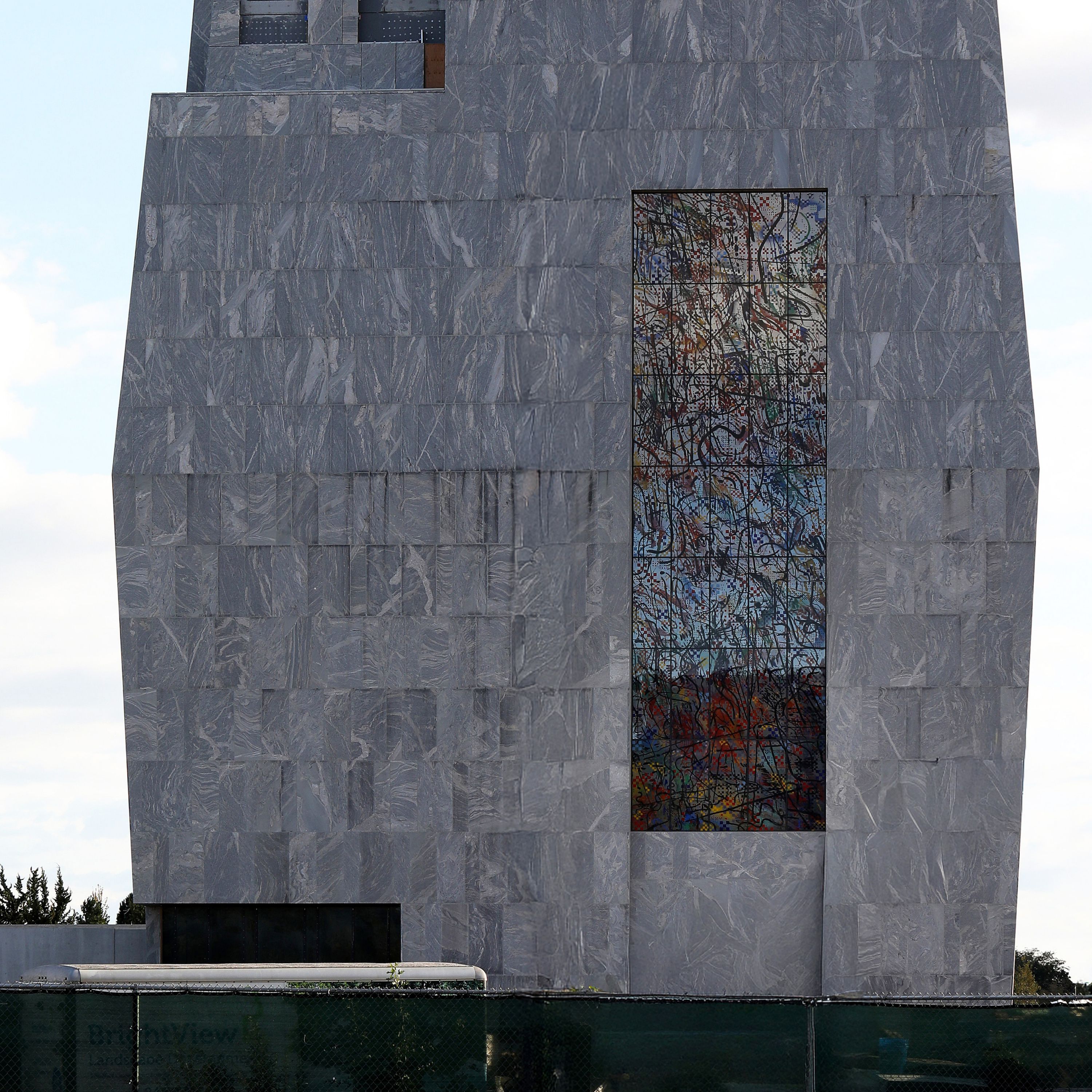
All Of It with Alison Stewart
Artist Julie Mehretu Talks Exhibit at Marian Goodman, Obama Presidential Center Installation
00:20:49
Loading summary
Transcript51 lines
- [00:00]
A
Now is your time to get into a new Dr. Horton home by taking advantage of its national red tag sales event going on right now through Sunday, May 3rd. Stop by any of its participating communities and find select red tag homes at incredible pricing. So whether you're buying your first home or looking for an upgrade, you don't want to miss the red tag sales event going on right now. Discover the Dr. Horton difference. Visit Dr. Horton.com Dr. Horton America's Builder and Equal Housing Opportunity Builder.
- [00:39]
B
This is all of it on WNYC. I'm Alison Stewart MacArthur. Genius winning artist Julie Mehretu is known for creating large abstract, multi layered pieces that explore themes of history and globalism. It's the 10th anniversary of her being commissioned to do a massive massive paintings that would hang in the San Francisco Museum of Modern Art. And you may remember the Whitney did a mid career retrospective of her work in 2021. And now she has a new exhibition featuring work from 2024 through 2026. It's titled Our Days Like a Shadow A Non Abiding Hauntology, her seventh solo exhibition. The show's title references a verse from King David's prayer and the Buddhist concept of non abidance and it takes up three floors and you'll see pieces liberated from the walls held by Iranian born German artist Nayri Bagranian's upright brackets called Structural embraces. Our Days Like a Shadow A Non Abiding Hauntology opens at the Marian Goodman Gallery at 385 Broadway next Tuesday, April 14th. And Julie Mehretu joins us here in studio to give us a preview of the exhibition. It is so nice to see you.
- [01:45]
C
Thank you, thank you. So nice to be here.
- [01:47]
B
So your show includes some of your more recent paintings, trans Paintings and a new cycle called Black Paintings up on the Floor. We'll talk about those in a minute. But what were the concepts you were thinking of as you developed these new works of art?
- [01:58]
C
These works, like all the works that I've made and that I'm constantly trying to negotiate is who I am and what's going on in our world. And so they're digesting the world, but they're also and digesting the time that we're living through. But they're also a further investigation in the mark making that I've been working with for the last 30 years. And I think it's this constant evolution of ideas and how that can materially manifest. But then at the same time it's always made in the context of the social reality and political reality we live in because it's hard. You know, that's the context that we exist and move and process the world through.
- [02:37]
B
How do you not. Right.
- [02:38]
C
Yeah, exactly, exactly.
- [02:40]
B
Can you tell us a little bit about the title of the show?
- [02:44]
C
Yeah. So the title was. You know, there's a lot in these paintings that are about perception, or not even about perception, but that are percept, but they're hard to perceive or hard to grasp. There's an ungrasping graspableness in a lot of the works, or they're constantly mutating and shifting. And I think we're really in this very vertiginous time. I feel like, especially since maybe 2016 or something like that, 2015, since early kind of rumblings of Brexit and Trump. And we had a real shift in how things were happening and how we were thinking through things. And the world of the body politic has shifted a lot during that time. And I think the. There's this constant, things are happening so rapidly, or we're consuming things that happen so rapidly that things feel like you're already in the past of something as it's in the process of becoming. And, you know, as we were watching January 6th happen, you could already understand what an aftermath would be of that and that we had to have the following days because there was these ballots that need to be counted, for example. So there was always this constant. There's this. We're living in this time where we understand how quickly things are happening, and yet these. These are major, violently intense times. And we're constantly ricocheting between these realities, whether it was the pandemic, whether it was these very different political realities. We're going through these different wars we've experienced in the last four years. We're in this moment where things are passing so quickly, but at the same time, it's really hard to make sense of it. And we're constantly being. We're constantly feeling the past as well as the cycling of the past. And what we've studied in the past kind of come up to us and bubble up in the current moment. And we don't really necessarily have a clear grasp on that or an understanding of how to make sense of that. And I think you have a lot of people who. The desire to make sense of that by grabbing onto certain political ideas or certain historic ways of responding to time, to moments. And I think we're in a moment where we really have to invent something else, where the language of the past is not enough, where the crimes of the past are not the same as the crimes at this moment, where what it means to be part of a pan global world is a very different reality. We're much more engaged with one another. So how do we ask these questions? And yet there's so much that we can learn from the past and that we have to. We live that way. So I think all of that came up and I was. You know, it goes back again. It's like the old books, the old story, the old myths. We go to those a lot in creative times. And so the title comes from the Bible. And these ideas of, you know, non abidance is one part of the title and the Hunter. But our day is like a shadow. Shadows are these things that are really material, but also as immaterial as they are material. They're part of the physical and world we live in in terms of light and created by that. But at the same time, they can shift and disappear within the moment that light disappears. And I think you see that in the street, walking through the street all the time, and the concept that we're here in this very fleeting way and with impermanence. And yet, you know, this is very real, what we're experiencing. So I think it's the profundity of that. And then at the same time, I think underneath that, this idea that we're constantly being haunted by these. By the past that's not really the past and not already the future. And there's this constant kind of different understanding of time.
- [06:09]
D
It's interesting because I went yesterday and I saw a gentleman who kind of walked behind your painting. It was a beautiful, bright day, and the painting changed as he walked behind it. And I thought, after hearing your answer, I'm like, that makes sense to me. Yes, but by what you said, how things change and how the shadows can change in the work and.
- [06:27]
C
Yes, exactly. And the works are made with these shadows. They're blurred images. And that's what you have in blurred images are these photographic blurs of shadows and light and color. And all of that happens because of what happens with the way that light operates and including the different pigments. I'm working with these kind of interference pigments that are made with mica, and they respond to light differently. And so when you look at a painting or look at one of those pigments, from one perspective, you see orange, for example, and from another perspective, it's a green or gold. And that impermanence, that unability to deal with fixity, like the fixed idea of what our vision wants to do and how Our brain wants to understand. We want to see and understand and somehow read an image. But that's not how we. That's not how these paintings work. That's not how we experience the world. It really. There's so much in the space of unknowing and in the space of illegibility that I think is really interesting. And part of what I was really thinking about in the show, it was
- [07:30]
B
interesting as you were talking about how the past few years, sometimes I find myself saying my age is three or four years younger because of COVID Yes. Like, time has kind of expanded. I'm like, wait, I'm not that age. I'm this age. How does time work?
- [07:44]
C
We just have the excuse of COVID I think this happens all the time as people get older.
- [07:48]
B
But I'm wondering, is time an issue when you're painting? Yeah.
- [07:52]
C
I mean, these paintings take a lot of time. Some of them I can work on very quickly. I can have intense creative spurts. But there are times where I really do sit with them for a long time. And, you know, the process of creative work in the studio, it's a time based process. It takes a lot of time. Things you can't rush things. Like, one of the most important skills is to learn how to be patient and await for the arrival or understanding of what one is doing. And that can be very hard, learning how to pay attention and really hone that skill in the studio while also being patient and present. So, yeah, time is really important to that. And I think as you get older and more experienced with that, one can become more and more comfortable with that. I've noticed that with myself and I feel. Yeah, but time is part of. And I think what we're going through, we're going through something where we want this to resolve it and we want to move past this. We know in the past that people have moved past really difficult times. And we live with that history embedded in us, especially in this country, and with the horrors of the past and the possibilities and the inventiveness of all of that. And so we're in this moment where we want, you know, but what. How do we resolve these? How do we. Especially in these moments of incredible creativity too, where new technologies and new forms of thinking are coming to the fore at the same time as these. As these kind of reverting to war, which is, you know, it feels like really in 2026. That's we.
- [09:27]
B
That's your answer?
- [09:28]
C
Yeah, that's your answer exactly. Yeah.
- [09:30]
B
We're talking to Julie, mehretu about her new show, Our Days Like a. A Non Abiding Hauntology. It opens on April 14th. It'll run through June 6th at the Marianne Goodman Gallery. Could you tell me about these upright brackets and the way the show is presented?
- [09:46]
C
Yeah. So I've been working on this group of trans. They're translucent and they're paint. They're sheets of acrylic paint that are on a monofilament screen. So you can really see completely through the painting. And they're not transparent, but they are translucent. So the light, like you said, you see the shadows. And I was very interested in how the kind of choreography of the audience will affect the perspective in the painting. And that came from my own shadow in the paintings that I was working on before that I showed at the Marian Goodman Gallery in my last show in 2021 or 2020, whenever that was pandemic times. And I saw my own shadow in the painting as I was working on them. And I became really interested in the blurred shadows and the interaction of the shadows, which you mentioned earlier as well. And so I was thinking for a long time, Nairobagrami is I think a phenomenal sculptor. One of the most important of our time. And I think she's a good friend. And I was. I had seen one of her exhibitions at the Nasher in Texas. Was really blown away by her work and when what and her and. And the background like we have a very similar history in terms of leaving our countries of origin. The reasons we left. She's Iranian, I'm Ethiopian. We both of these countries went through these kinds of revolutions that really became co opted and undermined these countries and the stability of these countries. And I think so the way that she has dealt with her history of like she has this history of whole of dealing with the brace and the kind of the some form of holding. And there's always aspects of care and structure. Like her sculpture has this inherent in it. And she's been working with this language for a long time. And after I saw this exhibition I had been talking about Lena Bo Bardi and other forms of display that could do this. But what became very clear is Nayri would be this amazing artist because she has both this way of working with the material and letting the material do its work. But at the same time there's some other image in that that becomes very apparent. These aren't just the extension, they're not frames, they're not just the extension of a wall or frame. They're not four things holding something Up. But because of one arm, they feel like they can pivot. They feel like they can go into motion. They feel like animatronic beings or agents in the space. And that becomes something very different. And so it gives these paintings and the sculpture a different form of agency. So rather than just being these transparent paintings that you're looking at, they become these other. These other agents in the space. And the painting then is not just this sculpture or this painting, but it becomes this skin that's held in this structure, this clamped, presented structure. Like a kid who's trying to hide from their people that they're supposed to meet. And the mom, like, holds you out with your arm. Oh, say hi. Say hi. You have to be right here. I'm holding you front and present.
- [12:38]
D
On the first floor, there's this large scale work on black canvas. And it almost feels like you're looking at the cosmos. And the colors kind of flash as you walk by. What kind of paint did you use on that?
- [12:49]
C
That's the interference pigment. Various levels. I found some in Berlin when I was working on the first black paintings in my friend Tacita Dean's studio. And it was an accident to find this paint. It was. I didn't have my glasses on, and I thought I was buying silver paint. Turned out it was silver violet that did this flip floppy interference. I would never have bought it if I knew that. But it's a good thing that I didn't have that glasses on. Anyway, I started working with this material, and at first I thought I had to. It was a mistake in the bottle. And then I realized. And then we started to research in the studio different forms of interference pigment. And it's used for cars and bicycles and motorcycles. And, you know, this material is used and for different materials in the world. But I had never thought of using it for painting. And I was. And I became very interested in its exact. The way that it worked on the black ground. And it doesn't do this on other grounds. It's really on the black ground, where if you do it on white, you won't see this or on other colors. But when you see the black, it allows for you to really experience this shift in tonality mark. The marks either disappear, reappear, appear another color. So the fixed look, the fixed gaze, your perception is completely constantly adjusted by where you are and your relation to this painting. And because of the scale of the painting, that really then brings up another issue. You have this really different. Like, usually paintings of that scale are somewhat of this. They're somewhat of. In the history of Western art, there's an authoritarian kind of dynamic that happens with a painting of that or monumental.
- [14:22]
A
I'm here.
- [14:23]
D
This is it.
- [14:23]
C
This is the way it's gonna be. This is your. Yeah, there's something about that sovereign view or something. And I think in this. That really gets dismantled. It's always. Where it's always subjective. It's how one experiences the painting. Even if you're right next to me, we don't see the same painting at the same time. And that your body and whether you're close or far and how you see those marks really changes. And I've always been really interested in that point of view or that perspectival change and how these paintings shatter into many other paintings. And what does that mean, like, in the experience of painting? But for me, that would. Playing with this pigment and really pushing it. That is the cosmos, in a sense. You know, it kind of sets the stage for the rest of the show downstairs.
- [15:04]
B
It's interesting when you look at the paintings, I'm curious, how much were you involved with where they're placed?
- [15:12]
C
Yeah, very carefully. I was involved in all of that.
- [15:15]
B
Tell me more about that. Because I took pictures and I was like, oh, these two frames, it has an arch and there's a picture there. And then these two frame it nicely. And I'm like, that can't be an accident.
- [15:24]
C
No, no, there's a lot. Yeah, there's a lot. There's a lot. So there's a whole choreography. Especially when the paintings leave the wall and you're. And when you see these. The upright brackets from the side, you only see this aluminum structure. One is not even aware of it. And then you see one. So it could be a painting. It could be just a beam, a sculpture. And then you turn. And when you know the paintings, then you know that that's what's happening. But because of the pivot, these paintings don't need to be shown on the really dance or perform in the space. And so I really did think about the archways and the conversations between the two galleries. These paintings also in conversation with one another and how you see one on its side relating to another the different types of axes that are presented. And it actually led into a desire to work with a choreographer and dancers, which we'll be doing later in the exhibition. And so it became out of actually installing the first group of trans paintings in London at White Cube.
- [16:20]
B
Yeah, these live events that are going
- [16:22]
D
to happen at the gallery.
- [16:23]
C
Tell me more about those so through my partner, Ari Osterweiss, I was able to meet John Jaspers, this choreographer. And I had been thinking about this even before I met Ari a while ago. And I was really interested in what type of choreographer, what type of dance, what type of movement. And she's a dance scholar. I met her and started to really investigate. That's interesting how that happens in a life, how people come into your life. You learn, you know, and through that, I was really taken by John Jasper's work because of his felt this commitment to abstraction. But it's also very formal. There's this formal, intentional, like, way of looking at the body and how it moves and it feels intuitive, but it's very. It's very choreographed, very planned out. In fact, he was in the gallery yesterday with a measuring tape, like measuring between paintings to really get this right. Yeah, exciting.
- [17:16]
D
Yeah.
- [17:16]
C
So he's been working on it a year as well, with these dancers. Different from phrases and different. And so I've learned an enormous amount. We've had the dancers in the studio for rehearsals. They also have been rehearsing in different places. And I'm really excited to see what happens when you actually move through this tripartite space, you know, level to level with. And each of the gal. Each of the floors has a really different color palette, attitude, sensory kind of feeling or experience. And I think that the dance and what happens with the sound will really affect or animate that in a very different way.
- [17:50]
D
We're talking with artist Julie Mehretu. Her new exhibition, Our Days Like a Shadow on Non Abiding Hauntology, which opens at the Marianne Goodman Gallery at 385 Broadway. It opens next Tuesday. The gallery's owner, she recently passed away.
- [18:05]
C
Yeah.
- [18:05]
D
Yeah. What did you want. What do you want people to know about her?
- [18:08]
C
Marian Goodman? You know, Marian, she. She was really an incredible force and. And I just feel so lucky and blessed that I had to the experience of knowing her and that I could learn from her. She took very seriously the time it takes to make art, what the value, like, what it means to be an artist and what. And, you know, there's a big industry around the art world. There's a big. You know, there's a lot of commerce and there's a lot of exchange and there's a lot of different dynamics that happen. But Marian was very committed to what it takes to make the work and what it takes to present that properly, and then how to nurture that work, how to maintain it, how to protect it. But also. And what I learned from her was that she was. Just because an opportunity is there doesn't mean you're gonna do this. It has to be. It has to make sense for the artist. She's the one who made the commission happen with SFMoma. She really handled that in an extraordinary way. I was. You know, and the way that she's handled everything since I started working with her, she was just. I learned an enormous amount, and she's gonna be so. But we are having stamps made that say Marian is here, so.
- [19:22]
D
Oh, that's amazing.
- [19:23]
C
She will be with us one way or another. Yes.
- [19:26]
D
This is a funny question. When you're putting together a show like this, how do you know when you're done?
- [19:33]
C
Yeah, that is a good question. You know, it's like, I knew when I had too much work. I thought I had too much work. I didn't think we. There were some paintings we were not able to install that had made the last couple years that I envisioned as part of the show. But I think, you know, in the end, it was like I needed to get a certain amount of work done that I want as bodies of work that then I wanted to, like, really experiment in the space to see what works. It's my first time showing in this space. The gallery only has only been there a few years.
- [20:03]
B
Yeah.
- [20:04]
C
So it took a. It was a biggie. It was a big kind of. You know, it was really. I worked with the model a lot. I kept changing it. I've tried so many different variations of how I would install it and then really reduced it to this. And so, you know, I think in terms of when you're done with a painting, that's a really hard question or hard thing to answer, because most of the time, you know, you arrive there and you have the time to really understand that it's finished. But I like to describe it to people as, like, when you're taking a photograph of somebody and you know that your iPhone can't really focus or your mobile phone can't focus, and then all of a sudden it does, and you're like, okay, it's focused. Time to click. It's that kind of an intuitive feeling where it comes together and nothing's really nagging me about it or, you know.
- [20:47]
B
Yeah, you just know.
- [20:48]
C
Ye.
- [20:49]
B
The name of the show is Our Days Like a. A Non Abiding Hauntology it is by artist Julie Mehretu. It's opening at the Marion Goodman Gallery at 385 Broadway, next Tuesday, April 14th. Congratulations on the show.
- [21:04]
C
Thank you so much. And thank you for taking time to see it and talk to me about it.
- [21:08]
B
And that is all of it for today. I'm Alison Stewart. I appreciate you listening and I appreciate you. I will meet you back here tomorrow.
- [21:15]
C
Foreign.
- [21:20]
A
Now is your time to get into a new Dr. Horton home by taking advantage of its national red tag sales event going on right now through Sunday, May 3rd. Stop by any of its participating communities and find select red tag homes at incredible pricing. So whether you're buying your first home or looking for an upgrade, you don't want to miss the red tag sales event going on right now. Discover the Dr. Horton Difference. Visit Dr. Horton.com Dr. Horton America's Builder and Equal Housing Opportunity Builder.
- [21:50]
D
WNYC's journalism and storytelling is heard by millions of passionate listeners. Sponsors of our programming gain our listeners attention and their respect. Learn about how your organization can support WNYC and wnyc studios@sporship.wnyc.org.