← All Of It with Alison Stewart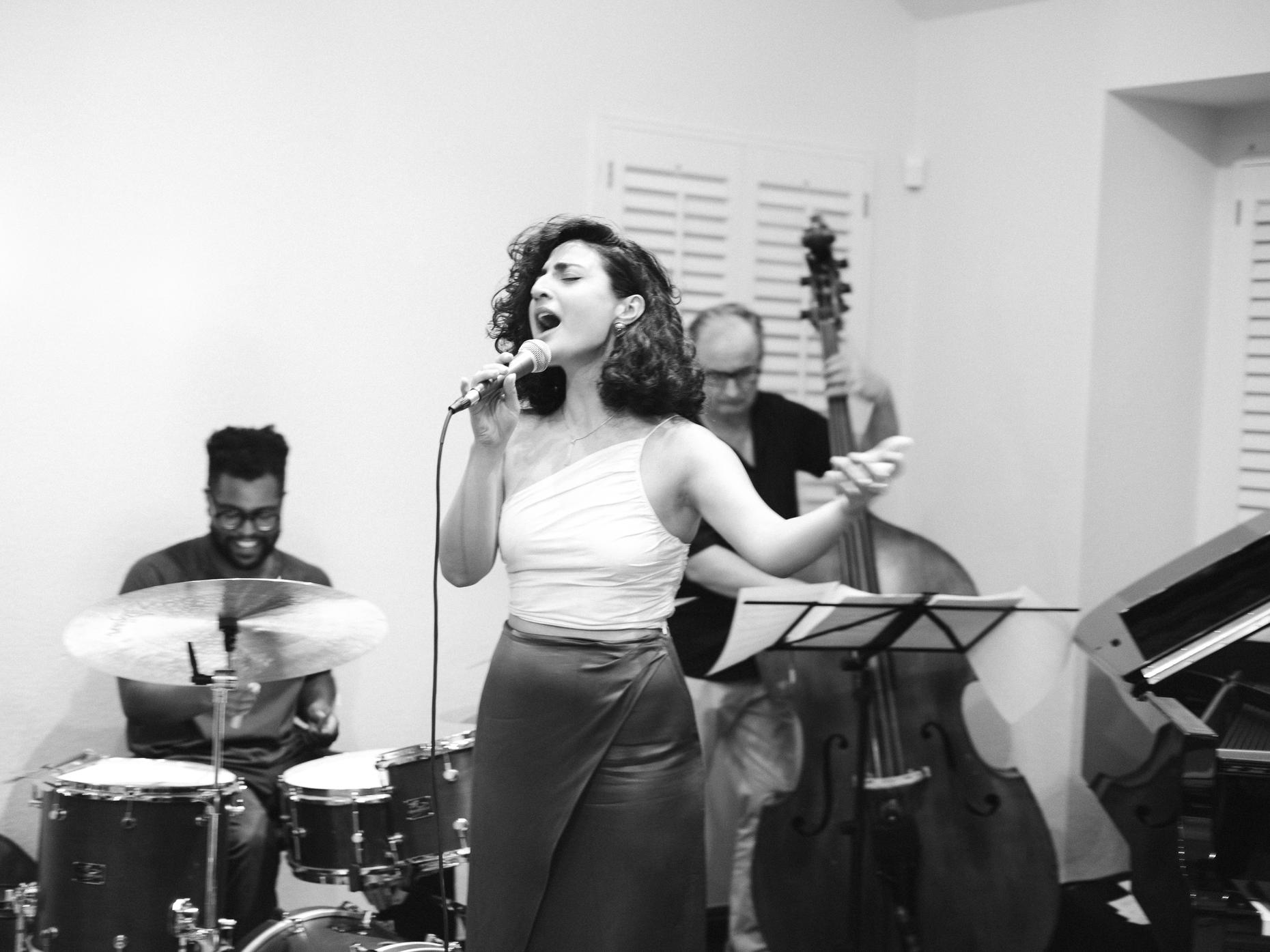
All Of It with Alison Stewart
Astghik Martirosyan Performs Live
00:21:44
NYC-based Armenian musician Astghik Martirosyan plays songs from her debut album.
Loading summary
Transcript45 lines
- [00:00]
Michael's Party Shop Announcer
Attention party people. You're officially invited to the party Shop at Michael's where you'll find hundreds of new Items starting at 99 cents with an expanded selection of party wear, balloons with helium included on select styles, decorations and more. Michaels is your one stop shop for celebrating everything from birthdays to bachelorette parties and baby showers to golden anniversaries. Visit Michaels store or michaels.com today to supply your next party.
- [00:27]
McDonald's Customer
I'm going to put you on nephew.
- [00:29]
Astrik Martirozian
All right unc.
- [00:30]
McDonald's Employee / Singer
Welcome to McDonald's.
- [00:30]
Alison Stewart
Can I take your order, miss?
- [00:32]
McDonald's Customer
Been hitting up McDonald's for years. Now it's back. We need snack wraps. What's a snack wrap? It's the return of something great. Snack wrap is back.
- [00:42]
Old Navy Announcer
Some days call for sleek and straight, others for slouchy and relaxed. Whatever your vibe, Old Navy has the denim fits to match from extra high rise to barrel. It's not just a mood, it's a whole style range. And with jeans Starting at just $22, you can collect them all. Snatched waist go extra high rise straight lived in staple vintage slim, low slung and laid back, slouchy wide. You've got range. Your denim drawer should too. Premium fabric deluxe details your perfect pair or weights. Shop in store or online@oldnavy.com oh my gosh.
- [01:14]
Marshalls Announcer
Have you been to Marshalls lately? They have all the brand name and designer pieces you love, but without the jaw dropping price tags. Alright, so here's the truth. You should never have to compromise between quality and price. And at Marshall's you don't have to. Marshalls believes everyone deserves access to the good stuff and that's why their buyers hustle around the clock to make it happen for you. Visit a Marshalls store near you or shop online at marshalls.com.
- [01:45]
McDonald's Customer
Listener support at WNYC Studios.
- [01:59]
Alison Stewart
This is all of it on wnyc. I'm Alison Stewart. Let's end today's show with some live music. Armenian born and New York based pianist, composer and vocalist Astrik Martirozian combines her jazz training with elements of traditional Armenian folk music to create a style that is all her own. She's premiering that music and her debut album Distance at National Sawdust this Sunday. The compositions on the album were created during a time of turmoil for Astruc. The COVID pandemic left her isolated in Boston while fans and friends back home in Armenia were suffering through an armed conflict with forces in Azerbaijan, a conflict that has recently escalated. Military forces in Azerbaijan launched an offensive against a territory occupied mainly by ethnic Armenians, leading Thousands to leave their homes behind and flee the country. Astruc turns that pain and her hope for future peace into beautiful music on Distance. She'll be performing at National Sawdust on Sunday at 7:30. But first, she's performing live with us here in Studio Astruc. So nice to meet you. Thank you for coming in.
- [03:03]
Astrik Martirozian
Thank you so much for having us, Allison. Thank you.
- [03:06]
Alison Stewart
The first piece you're going to play for us is the first song on the album titled Silence. Why did you want to begin the album with this song?
- [03:15]
Astrik Martirozian
I wrote Silence after inspired by this opening line of a poem by Emily Dickinson. And the poem starts with this phrase. It says, I many times thought peace had come when peace was far away. And I remember really not even reading the rest of the poem. That was. You know, this was during the fall of 2020, where the war was happening and I was in Boston and I was finding ways to really express myself and express all of these emotions. And that was the moment that I really felt like I'm ready to write music and put this into music. And I guess Silence is where it all started. And that's why I felt that it should be reflected in the album as well, starting with that song.
- [04:08]
Alison Stewart
We're going to hear it now. Would you introduce us to your colleagues?
- [04:11]
Astrik Martirozian
Absolutely. At this moment, we have Joe Martin on bass and Carl Uzbek on drums. Right now I'm on piano, but Moshe Maquias is going to join us later.
- [04:25]
Alison Stewart
Okay. Let's hear Silence.
- [05:48]
McDonald's Employee / Singer
Will I ever be in peace with the sun till the end of time? The beauty of silence is what I recall you and I will ever be the same Closing my eyes again and winning and rain or within again Sa Sam, you and I the boring us Will ever be Closing my eyes again and wind and rain or women.
- [08:30]
Astrik Martirozian
Will.
- [08:30]
McDonald's Employee / Singer
I ever be the same Closing my eyes again and when warmed with it again.
- [09:10]
Alison Stewart
That was Astrik Marterian. The new album Distance is out now. The name of that song was Silence. That was beautiful. Thank you so much for that.
- [09:17]
Astrik Martirozian
Thank you. Thank you.
- [09:19]
Alison Stewart
When did you know that you wanted to pursue music professionally?
- [09:25]
Astrik Martirozian
Well, I was raised in a musician's family. My mom is an opera singer, and I grew up in the theater. First, I was born in St. Petersburg, Russia, where my mom was performing in Mariinsky Theater for 10 years. So music was kind of always in my life, and I studied piano since I was 5, just because it was kind of not even a question I had to. But then it just became part of me, really.
- [10:02]
Alison Stewart
How did you first discover jazz? Music.
- [10:06]
Astrik Martirozian
I remember I was 13 and I would sing songs at home and play, but they were different types of songs. And Artistic director of Armenian State Jazz Orchestra Armen Husnunt was one of my mom's friends and I remember the day when she called him and she said, Armen, I don't know what she's doing. She's singing a bunch of songs and playing. But let's. Anyway, we went to him and I heard the orchestra for the first time and jazz orchestra live and I was so inspired. I'm in. Started giving me just, you know, giving me songs to listen to and just learn and learn more about jazz music. And I did my debut performance as a singer when I was 14 with Armenia State Jazz Orchestra and since then I performed with them for around five years.
- [11:04]
Alison Stewart
If someone googles you after, after this interview, and I suggest you do, there's a really terrific video of you explaining a bit of the history and the specifics around Armenian musical notation. Yeah, it's so interesting. Tell us a little bit about the Armenian musical notation system. And what does it tell us about the foundations of Armenian music?
- [11:28]
Astrik Martirozian
Oh, well, because of Armenian notation system, first of all, kind of. There's the first version of Armenian notation system, which is Khazr. And this comes back from 8th century, 7th century. And unfortunately there aren't almost. I'm. I'm not quite sure, but I know that probably if there is someone who can read it, it's probably one or two people. But. But then in the, in the 14th century there was. Came up with a. With the more modernized version of it, which is one that we use today. And we, I mean, not everyone can read it obviously. And it's not that we use it all the time, but I mean that's something that I learned at the conservatory and that's how we read religious music. And Armenian folk music was notated also with that because it has a specific. So it's tempered in a way that every. It's four note links to each other. Every last note of each four note is the first note of the following one and the third note of each one of those groups is slightly flat. So then because of this we have variety of intervals. That is almost impossible. I mean, not almost. It's impossible to notate with Western notation system. So. Yeah.
- [13:05]
Alison Stewart
Are there certain sounds or rhythms that are specifically when you hear them? You know. Oh, that's, that's an ode or that nods to Armenian folk music or is Armenian folk music?
- [13:16]
Astrik Martirozian
Yeah, yeah, definitely. Yeah, absolutely. Well, a lot of it comes from the language. Oftentimes you might not. You know, you might not hear the. It's so much reflected in the rhythm. So the. I guess even Meli, like certain embellishments that are very common to a region overall, but we define them. We understand that those are Armenians. Armenian, because of the specific nuances of the language and what. The way certain dialects dictate rhythmic structure or a way of saying things. Because all of it, most of it comes, let's say, the way you ask a question and in a different dialect of Armenian, that question sounds different. And that's so much reflected in the music. We. Oftentimes we might not hear. We might not know the lyric, but based on a melody, we might understand where. What from what region that song is coming from.
- [14:28]
Alison Stewart
Interesting.
- [14:29]
Astrik Martirozian
Is there.
- [14:29]
Alison Stewart
Is there a way you could show me a small example on the piano?
- [14:32]
Astrik Martirozian
Oh, my God. On the piano. I don't know. If you can't. It's okay. I didn't mean to put you. I can. I can sing, I guess, actually.
- [14:48]
McDonald's Employee / Singer
Well.
- [14:50]
Astrik Martirozian
For example, the song that I'm going to perform next. Okay, let's go right to. It is. But we can talk about it a little bit. But this is from the region of Van. There are different today. It's in Turkey. But the way the rhythmic structure is. When we look at that rhythmic structure, we can tell that this is from that region. But also, not only that, there are different versions of that song of different dialects, and the melody reflects that as well. So oftentimes we would see a song that would travel from different. With different regions. But that song really shifted. Even the context of it changes as well. Because, for example, if Van was more kind of like a. It was a city they were in, the lifestyle was different. But then you see more songs who come from more mountain regions where. Where everyday life is kind of completely different, and they think about their own story, which is completely different, let's say, than what the story would be from in Vaughan. Yeah, that makes sense. Yeah. Yeah.
- [16:10]
Alison Stewart
My guest is Astrik Martirozian. The new album is called Distance. You're gonna perform Summer Night. Would you tell us a little bit about this before we hear it?
- [16:18]
Astrik Martirozian
Yeah. So it's funny, before moving to the US I rarely would sing folk songs. It was not something that I really felt like, oh, this is something that I want to do. Of course, it was strongly in my life. I had mentors. My dear Alina Pahlevanyan, who till today is such a huge mentor to me. I learned folk music through her. But it was not something that I would perform. And I guess 2020 and especially the war, just I was trying to find ways to reconnect, to heal, to express so many emotions, to feel more connected to Armenia. And folk songs were. Were an amazing outlet for that. And my father's side is actually from van, so my grandparents were. And their parents, they escaped genocide and they're coming from that region. And so I thought. And this song tells about this beautiful. It shows this picture of a beautiful summer night in the village after a long working day. The people are gathered, they're singing songs. Women are working with the wool and men sing about these women, how beautiful they are. And it's a beautiful summer night. And I think during the war I was dreaming about that view.
- [17:55]
Alison Stewart
The name of the album is Distance. Ashtiq Martirozian will be performing at National Sawdust on Sunday at 7:30pM to play us out. Here she is with Summer Night.
- [18:56]
McDonald's Employee / Singer
Lo K. Sam. There's Sam I.
- [23:34]
Michael's Party Shop Announcer
Attention, party people. You're officially invited to the party shop at Michael's where you'll find hundreds of new Items starting at 99 cents with an expanded selection of party wear, balloons with helium included on select styles, decorations and more. Michaels is your one stop shop for celebrating everything from birthdays to bachelorette parties and baby showers to golden anniversaries. Visit Michaels store or michaels.com today to supply your next party.
- [24:01]
McDonald's Customer
I'm gonna put you on, nephew.
- [24:03]
Astrik Martirozian
All right, unc.
- [24:04]
McDonald's Employee / Singer
Welcome to McDonald's.
- [24:05]
Alison Stewart
Can I take your order, miss?
- [24:06]
McDonald's Customer
I've been hitting up McDonald's for years. Now it's back. We need snack wraps. What's a snack wrap? It's the return of something great. Snack wrap is back.