← All Of It with Alison Stewart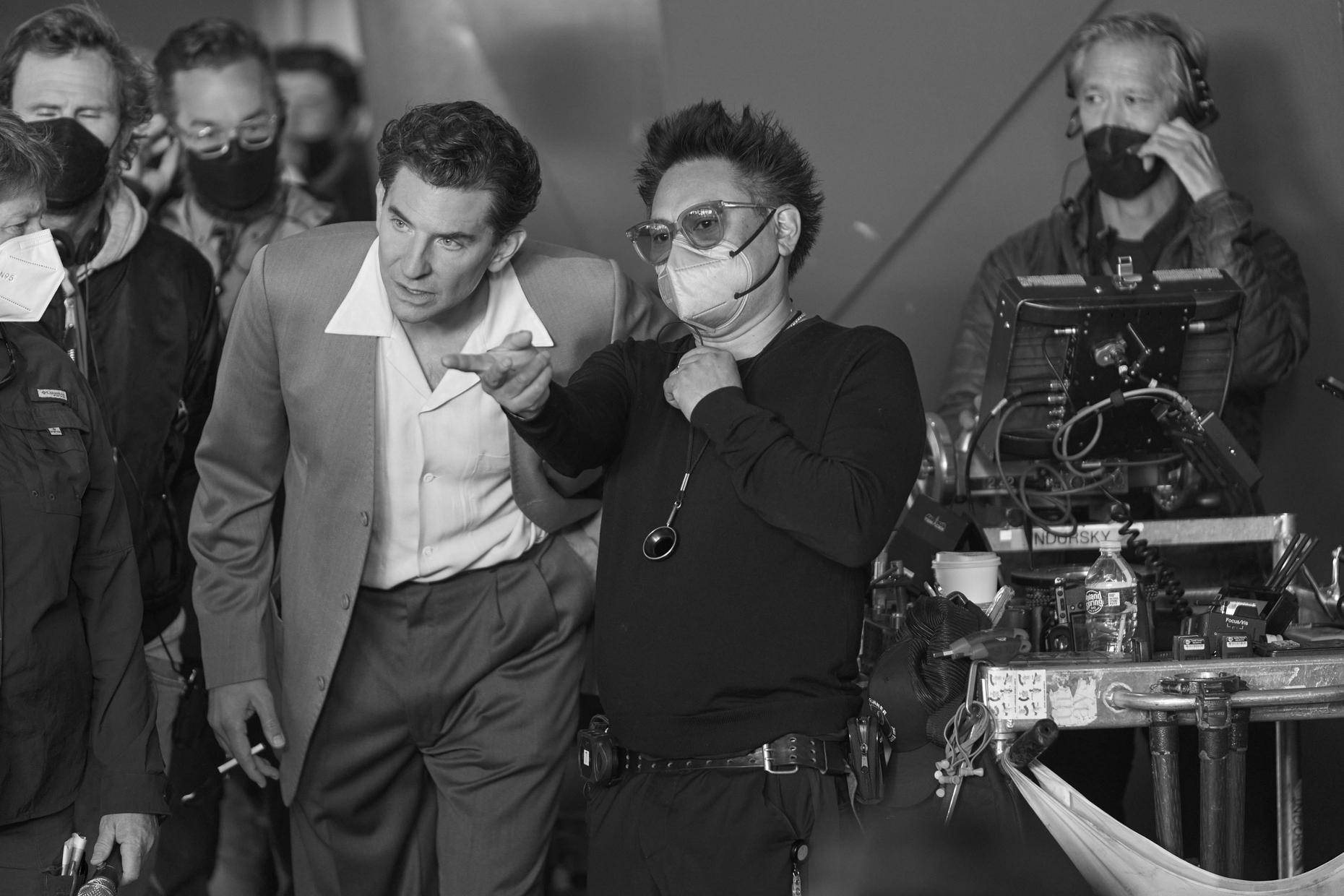
All Of It with Alison Stewart
Best Cinematography: Matthew Libatique for 'Maestro' (The Big Picture)
00:13:05
For the biopic, "Maestro," cinematographer Matthew Libatique had to work in black and white and color, capture intense conducting scenes, and journey through decades of time.
Loading summary
Transcript84 lines
- [00:02]
Bix Soleil Razor Advertiser
Surprise beach day.
- [00:04]
Michaels Party Shop Announcer
No excuses.
- [00:05]
Bix Soleil Razor Advertiser
I'm in. Gimme five. With Bix Soleil Glide Razor, you'll have hydrated smooth skin that's ready to go on the fly. No shave cream needed. You can prep, shave and hydrate all in one step thanks to moisture bars that hydrate your skin during and after shaving. 5 flexible blades hug your skin for a close shave. Glide into smooth. It's your time to shine with bixsolil. Buy now at Amazon and Walmart. Ready? Your skin looks amazing. So smooth and beach ready.
- [00:29]
McDonald's Customer
Let's go.
- [00:32]
McDonald's Employee
I don't mean to interrupt your meal, but I saw you from across a cafe and you're the Geico Gecko, right?
- [00:36]
Geico Gecko
In the flesh.
- [00:37]
McDonald's Employee
Oh my goodness. This is huge. To finally meet you. I love Geico's fast and friendly claim service.
- [00:42]
Geico Gecko
Well, that's how Geico gets 97 customer satisfaction.
- [00:46]
McDonald's Employee
Anyway, that's all. Enjoy the rest of your food.
- [00:49]
Geico Gecko
No worries. So are you just gonna watch me eat?
- [00:52]
McDonald's Employee
Oh, sorry.
- [00:53]
Matthew Libatique
Just a little starstruck.
- [00:54]
McDonald's Employee
I'll be on my way.
- [00:56]
Geico Gecko
If you're going to stick around, just pull up a chair.
- [00:58]
Matthew Libatique
You're the best.
- [00:59]
McDonald's Customer
Get more than just savings. Get more with Geico.
- [01:02]
Michaels Party Shop Announcer
Attention party people. You're officially invited to the party shop at Michaels where you'll find hundreds of new Items starting at 99 cents with an expanded selection of party wear, balloons with helium included on select styles, decorations and more. Michaels is your one stop shop for celebrating everything from birthdays to bachelorette parties and baby showers to golden anniversaries. Visit Michaels store or michaels.com today to supply your next party.
- [01:29]
McDonald's Customer
I'mma put you on, nephew.
- [01:30]
Matthew Libatique
All right, unc.
- [01:31]
McDonald's Employee
Welcome to McDonald's. Can I take your order, miss?
- [01:33]
McDonald's Customer
I've been hitting up McDonald's for years. Now it's back. We need snack wraps. What's a snack wrap? It's the return of something great. Snack wrap is back. Listener support at WNYC Studios Foreign.
- [02:01]
Matt Katz
You're listening to all of it on wnyc. I'm Matt Katz and I'm sitting in for Alison Stewart today. We continue now with our annual series the Big Picture where we speak with some of the Oscar nominated creatives who worked behind the scenes to make movie Magic in 2023. Our next guest had to juggle a lot while working as the cinematographer for Maestro. Mat Labatique was working with director Bradley Cooper who also had to dedicate a lot of his time to his performance as famed conductor Leonard Bernstein. Matthew also had to work both in black and white and color and in Two different aspect ratios. Plus he had to capture the magic of conducting. His work on Maestro, which focuses on Bernstein's relationship with his wife Felicia, earned him an Oscar nomination for Best cinematography. And he joins me now to discuss. Matthew Libatique. Welcome to all of it.
- [02:55]
Matthew Libatique
Hey, thank you. Nice to meet you. Matt.
- [02:56]
Matt Katz
Nice to meet you. And congratulations on the nomination. Very exciting. I want to get into the movie. Obviously, we're going to talk about the film, but I feel like I need to start here. For those of us who aren't necessarily familiar with the ins and outs of moviemaking and think we might know what cinematography is, can you just give me a basic rundown on what a cinematographer on a set actually does. Does and how you would describe your. Your role in making movies?
- [03:25]
Matthew Libatique
Well, I mean, I think the camera that everybody is familiar with is kind of a shared object between the director and the cinematographer. Sometimes the cinematographer is responsible for the compositions of every shot, but generally speaking, the cinematographer is responsible for the look of the film. And that encompasses lighting and camera and optics and all things technical, but a lot of creative choices to go try to articulate a director's vision. So you're basically the old term for a cinematographer was the cameraman. But, you know, a lot of it has to do with the light as much as the camera.
- [04:03]
Matt Katz
I imagine you're not physically operating a camera. You are moving around and looking at how the shot looks on a screen and giving some sort of direction in terms of, like, angles and all the rest of the technical aspects that go along with it.
- [04:18]
Matthew Libatique
I mean, generally speaking, it's. When you're a cinematographer, you. You can operate depending on the film. It depends on the film. Sometimes something is much smaller where you're operating. For example, on the whale, I operated the film, and on Maestro, I did it. You know, I had operators. So typically, the film and the sort of style of the film and the size of the film dictates whether or not you are on the camera. But, you know, you still. You're still connected to it.
- [04:44]
Matt Katz
Sure.
- [04:45]
Matthew Libatique
By the lens choices and how you use the aperture on those lenses to create the looks that you want.
- [04:51]
Matt Katz
Do you remember anything from your first ever cinematography job that maybe you've taken with you through the years? Is there anything you learned from one early project that you continue to think about and maybe incorporate in your work?
- [05:06]
Matthew Libatique
I once was shooting a music video, and I was shooting. At the end of the day, we were out of light, and I thought we didn't really have enough light to expose the film. But when we got the dailies back. It was absolutely gorgeous. It was the best looking stuff of the whole, whole project. And I, I realized that, you know, there is a way to make the film see what the human eye see. And that's sort of been a guiding principle.
- [05:32]
Matt Katz
Say that one more time. You can make the film see what the human eye sees.
- [05:37]
Matthew Libatique
I realized that, you know, we were shooting at dusk.
- [05:39]
Matt Katz
Yeah.
- [05:40]
Matthew Libatique
With a woman walking down some train tracks. I didn't really think I had enough light, but we kept shooting any.
- [05:45]
Interviewer
Right.
- [05:45]
Matthew Libatique
And it ended up becoming the most beautiful image in the entire piece. And I realized that there is a way to make film see what the human eye sees.
- [05:55]
Interviewer
Wow. Wow.
- [05:57]
Matt Katz
You, you worked with Bradley Cooper before in A Star Is Born. Was there something different about working and collaborating with him on this project? I mean, he, it seemed like there was a lot more involved in really transforming into a real life Leonard Bernstein. It was there something about this collaboration that was deeper or different from A Star Is Born?
- [06:21]
Matthew Libatique
I mean, it was, it was deeper just because it was our second film together and, you know, we had sort of a shorthand going in. But there was an intensity to it that was amplified because, you know, he really had to undergo a physical transformation.
- [06:35]
Interviewer
Yeah.
- [06:35]
Matthew Libatique
And that was, you know, played a part in his energy. It played a part and it also motivated him. He was very. He was extremely. I wouldn't say intense, but he was extremely focused and. But he was of a creative high level. Such a creative high level that, you know, everybody on set had to kind of bring it, you know, you sort of match the energy of the director. And I would say Bradley was, you know, on a scale of 1 to 10, was like a 12.
- [07:01]
Interviewer
Right, right.
- [07:02]
Matt Katz
I mean, this was really one of those films where you forget you're watching an A list actor. You feel like you're watching the, the real person that he has. He has basically become. It's really remarkable. Really remarkable.
- [07:14]
Matthew Libatique
Yeah, I agree with you there. I agree with you there.
- [07:17]
Matt Katz
What, what strikes the, the lay person about this, this film in terms of how it was shot is that the, the first half of this film is in, in black and white, and then, then you go to color. What, what was the thought process behind that and what kind of challenges might that have presented?
- [07:33]
Matthew Libatique
I think, you know, we, we, Bradley and I tested a lot preceding our actual shooting of the film. You know, we did some tests of different formats, digital, different digital cameras, film stocks, and we, when we landed on black and white film, it just. Something spoke to us about it and especially spoke to him. You know, he's told me it's transported him. You know, when we shot, it transported him into the time. And the reason that it goes from black and white to color is that it sort of exhibits a time where the world went from black and white to color.
- [08:06]
Interviewer
Right.
- [08:07]
Matthew Libatique
So that's sort of the motivation behind the choices. But really, the black and white was. It's. It was just transformative in terms of space and time for us and really put us in the place where Felicia and Lenny meet for the first time.
- [08:22]
Interviewer
Right, right.
- [08:23]
Matt Katz
Is it. What. What is. Can you give us a little bit of the. The technical challenges involved with shooting black and white in a way we might understand how that works.
- [08:32]
Matthew Libatique
Well, yeah. Well, you know, I'll start here. If you shoot with your iPhone, you. You don't really need a lot of light.
- [08:39]
Interviewer
Yeah.
- [08:39]
Matthew Libatique
Even at night, it'll shoot the sensitivity. So imagine having none of that sensitivity, and you're. You're starting with something that you actually have to bring a lot of light into to get an image. So, you know, because we're shooting. Because we've been shooting digital for the, you know, past whatever, 15, 20 years, we've been accustomed to less light levels, softer light, things that don't even get hot. And then now when we were shooting, you know, if we're shooting film, all of a sudden we're bringing out the big lights that we don't use anymore, and we're. We're having to bring the light level up so high that the set gets hot. And, you know, people start to sweat and make up. You know, we go back to makeup, having to powder people down. You know, we. We go back to. We go back in time a bit, and we're. And people are wearing gloves again on set, hot lamps around.
- [09:30]
Interviewer
Wow.
- [09:31]
Matthew Libatique
So it's. And, you know, there's. There's also a quality of light that changes because, you know, films look the way they look back in time because the lighting that was necessary to expose the film dictated what the films look like. And now we could do it on a digital camera. And again, you could walk into a mall and not need any light. You could walk into a restaurant and not need any light.
- [09:55]
Interviewer
Right.
- [09:56]
Matthew Libatique
But when you're shooting on film, it becomes a different story. And you bring things in and you're creating a reality through an artifice of movie lighting.
- [10:03]
Interviewer
Yeah, right.
- [10:04]
Matt Katz
I mean, the other technical, unique element of this, from what I understand, is that you shot in different aspect ratios. Can you explain what that means and how that works?
- [10:14]
Matthew Libatique
The aspect ratio Speaks to the shape of the frame, the composition. You know, what you see in widescreen is called 2, 4, 0 or 2, 3, 5. That's a. That's a. It's a mathematical aspect ratio that relates to the horizontal and the vertical. Some films are 185, so that's actually not as wide, but taller. What we shot was 133, which is the original Academy aperture. It was the original Academy aspect ratio before films went widescreen. So we. It's a. Basically a square. For the longest time before HD, you know, TVs were 133 because that was the industry standard. So we framed that way again, just to sort of transport us in the. Into a time where that's how people saw the world. And then, as you know what I love about that, it sort of metaphorically felt like kind of an embrace of these two people within their sort of. Their sort of inner sphere, like these. It was almost like hugging these two people in their marriage.
- [11:17]
Interviewer
Right.
- [11:18]
Matthew Libatique
And when she dies towards the end of the film, the film expands to a 1-85-frame, which is wider. And there's more negative space showing that Lenny is alone.
- [11:26]
Interviewer
Right.
- [11:27]
Matt Katz
Oh, it's so interesting. Another. That's. That's an amazing scene. Another scene I wanted to ask you about that's been getting a lot of attention is a sequence at the Ely Cathedral where Leonard is conducting and just seems totally enraptured in the moment.
- [11:41]
Interviewer
It.
- [11:42]
Matt Katz
This. The shot begins from way up high and then it comes down. Why did you start with overhead view? And. And what were you trying to achieve just in general, in that whole scene?
- [11:56]
Matthew Libatique
I just. There is serving two masters. I mean, actually serving one. It's not showing, like, his. We don't show him conducting that much in the film. Yeah, you see him at the very beginning, but you don't see a whole piece. And this is really the one time you see the entire piece. So it was about, you know, you're talking about a culmination of this man's working life. It's not even a culmination. He was right in the middle. It was his prime. And you're showing the sheer scale of this cathedral and the depth of it and the amount of people, the size of the orchestra. But at the end of the day, the camera moves in so you can sort of see this, like you say, his intensity. I think that the challenge in that scene really was that Bradley had transformed each and every day to Leonard Bernstein. But to conduct like Leonard Bernstein was the search. That was the. And he found it, he really found it. He. I think that what Pete, what resonates is that he really, he, I think he really felt like you're watching Leonard Bernstein. When you look at old YouTube clips of the man, his passion and his joy, I feel like you feel that in his performance in that particular scene is you feel that passion, you feel that joy. And you know, I think that's what the strength of it is. Whatever I did was just capture this beautiful thing that was happening in front of us.
- [13:18]
Interviewer
Right. Wow.
- [13:18]
Matt Katz
It must have been quite the experience to be on, on set and feel like you were maybe watching Leonard conduct in, in real time.
- [13:28]
Matthew Libatique
The most amazing thing is of London Philharmonic was there and London Symphony Orchestra was there and they, they applauded him after that take. I mean these are people, some of these people worked with Leonard Bernstein. It's like, you know, they studied him, they played his music and you know, you're basically one of the best orchestras in the entire world and they're just applauding their performance. So it's like it gave me chills.
- [13:50]
Matt Katz
Matthew, as I mentioned, you have been nominated for an Oscar for best cinematography. Are you nervous? Are you looking forward to Oscar tonight? Like, where's your head at?
- [14:02]
Matthew Libatique
I excited, told myself I'm just going to have fun with this award season, you know, so no, I'm not nervous at all. I'm just, I'm excited to be there. I think it's an amazing class of cinematographers and films that have been nominated for my category and also for best picture category. I think it's a, it's an amazing year for cinema beyond Barbenheimer. I think it's been an amazing year for cinema.
- [14:28]
Interviewer
Right? Right.
- [14:29]
Matt Katz
Yeah. Cinema is not dead. Far from dead.
- [14:32]
Interviewer
Right?
- [14:33]
Matthew Libatique
Yeah, 100%. You know what it feels like? It feels like there's a lot of people of like mind all working really hard to make sure cinema lives.
- [14:42]
Matt Katz
We're gonna leave it there. Perfect way to leave it. Matthew Libatique is nominated for best Cinematography for his work on Maestro. The Oscars are coming up next month. We wish you the best of luck and thanks for joining us on all of it.
- [14:57]
Matthew Libatique
Nice to meet you. Thank you for having me.
- [14:59]
Michaels Party Shop Announcer
Attention party people. You're officially invited to the party shop at Michael's where you'll find hundreds of new Items starting at 99 cents with an expanded selection of party wear balloons with helium included on select styles, decorations and more. Michaels is your one stop shop for celebrating everything from birthdays to bachelorette parties and baby showers to golden anniversaries Visit Michaels store or michaels.com today to supply your next party.
- [15:26]
McDonald's Customer
I'm gonna put you on, nephew.
- [15:27]
Matthew Libatique
All right, unc.
- [15:28]
McDonald's Employee
Welcome to McDonald's. Can I take your order, miss?
- [15:30]
McDonald's Customer
I've been hitting up McDonald's for years. Now it's back. We need snack wraps. What's a snack wrap? It's the return of something great. Snack wrap is back.