Loading summary
Transcript57 lines
- [00:00]
WNYC Studios Announcer
WNYC Studios is supported by Odoo. When you buy business software from lots of vendors, the costs add up and it gets complicated and confusing. Odoo solves this. It's a single company that sells a suite of enterprise apps that handles everything from accounting to inventory to sales. Odoo is all connected on a single platform in a simple and affordable way. You can save money without missing out on the features you need. Check out Odoo at o d o o.com that's o d o o.com
- [00:33]
Liberty Mutual Insurance Spokesperson
and Doug there's nowhere I wouldn't go to help someone customize and save on car insurance with Liberty Mutual. Even if it means sitting front row at a comedy show.
- [00:42]
Em Lin
Hey everyone, check out this guy and his bird. What is this, your first date?
- [00:46]
Liberty Mutual Insurance Spokesperson
Oh no. We help people customize and save on car insurance with Liberty Mutual together. We're married. Me to a human, him to a bird.
- [00:53]
Em Lin
Yeah, the bird looks out of your league.
- [00:54]
Liberty Mutual Insurance Spokesperson
Anyways, get a quote@libertymutual.com or with your local agent.
- [00:58]
Alison Stewart
Liberty Liberty Liberty Liberty.
- [01:02]
Liberty Mutual Insurance Spokesperson
It's time to bring on the blooms at the Home Depot with Spring Garden Deals. Find savings on hanging baskets and flowers to brighten your backyard or any space that needs instant color. Then get everything you need to plant and protect them with low prices guaranteed on soil and mulch. Dig into Spring garden deals for four days at the Home Depot now through May 10th exclusion supply see homedepot.com Pricematch details.
- [01:38]
Alison Stewart
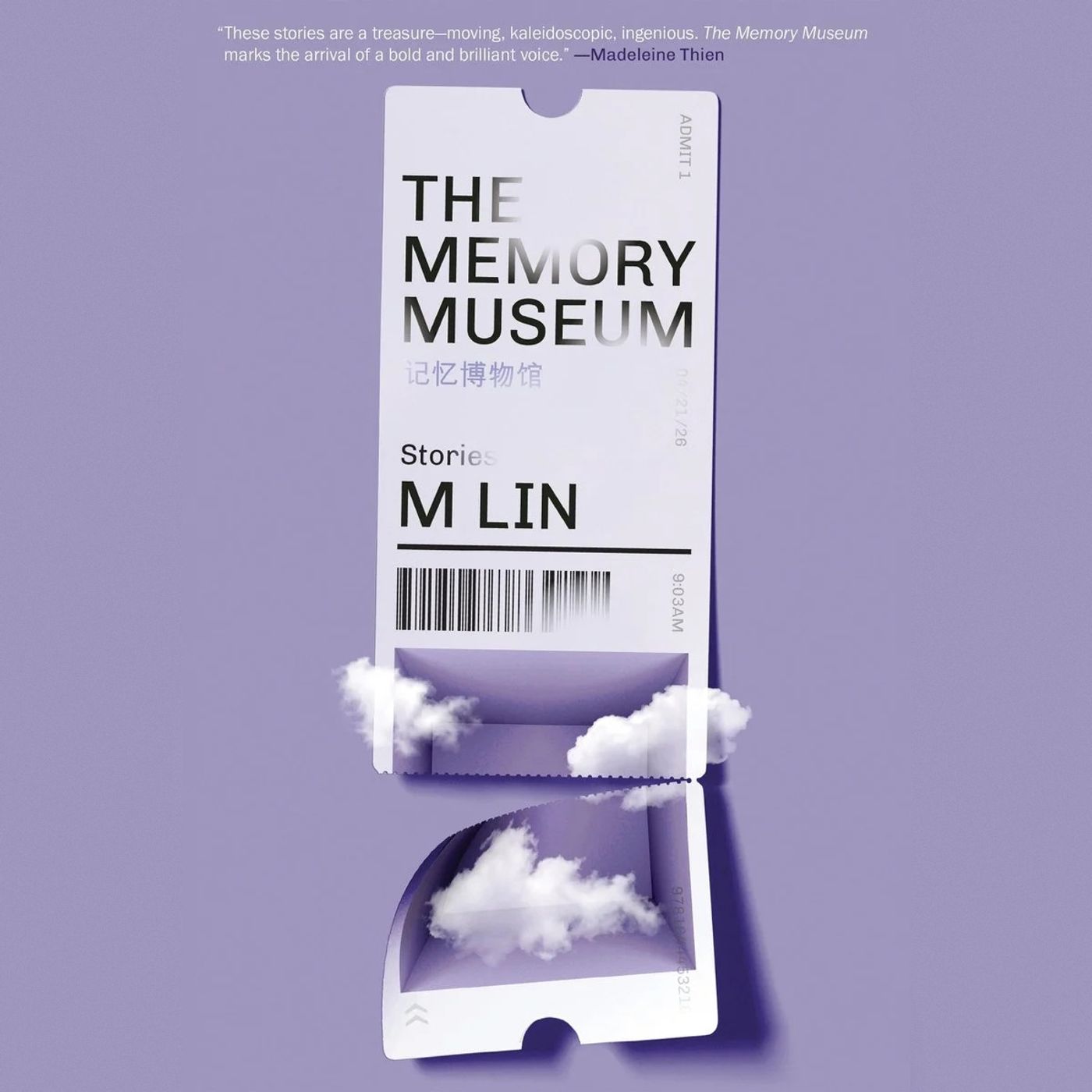
This is all of it on wnyc. I'm Alison Stewart. We're going to spend this hour talking about books, so I should remind you that our next get lit with all of it book Club event is happening in a little less than three weeks. We are reading Ghost Town by Tom Parotta. It involves grief, 1970s New Jersey and Ouija boards. I will be in conversation with tom on Wednesday, May 27 at the Stavros Niarchos branch of the New York Public Library. Get Lit Tickets are free, but they tend to go fast. Reserve yours now by going to wnyc.org getlit Again, that's wnyc.org getlit. You can also find out how to borrow an ebook or to watch the livestream of the event. Now let's get this hour started with a celebration of debut works of fiction, literature and of Asian American and Pacific Islander heritage. Our first debut author is M. Lin, who just published her short story collection titled the Memory Museum. The stories take place between the present day and the near future and follows Chinese women from different backgrounds in their home country and in various stages of immigration and impatriation. The title story is about a museum established as the new Chinese government has replaced the subject of history with memory. Its main character is a woman who works in the department dedicated to smells and tastes. Publishers Weekly says each of these stories conveys an indelible emotional truth. Emilyn, welcome to all of it.
- [03:18]
Em Lin
Hi, Alison. Thank you for having me on.
- [03:21]
Alison Stewart
Sure. You started writing this book in 2020, sort of the height of the pandemic. How and when did these stories begin?
- [03:28]
Em Lin
Yeah, so in 2020. I had been in the States for 10 years. I came in 2010. And obviously we are aware that in 2020, China was in the center of attention and because the COVID virus started there and anti Asian hate started peaking also in the States. So I was started questioning myself what it means to be Chinese in that context and in general today, as the country has changed a lot since I left in 2010 to the day of 2020. So a lot of these stories came from this line of questioning.
- [04:11]
Alison Stewart
How much did the anti Asian hate that developed during the pandemic or that we saw during the pandemic?
- [04:18]
Em Lin
Yeah.
- [04:18]
Alison Stewart
How'd that feed into the stories as you were starting to write this new book?
- [04:23]
Em Lin
Yeah. So I think I really realized that a lot of Americans and even people close to me didn't really understand the place I grew up in, which is contemporary China. Because a lot of the fiction, especially fiction about China, has focused on the history of China, which, you know, we. We know about cultural revolution, we know about Tiananmen Square protests, but what contemporary China is like is very rarely depicted in fiction. And at the same time in the news, we read almost every day about China, what's happening in China, about the technology or about the politics. And I think there's really this gap between the understanding of. Of the everyday reality there and this and these other, you know, very highly topical and political ideas that's happening. So, for example, one story, this story about that you mentioned, titled the Memory Museum, which is the titular story of the collection, really started with me thinking about how a lot of contemporary Chinese memories are being erased because of the highly developed technology of censorship, both online and offline, which we read, you know, in the news, but we. We don't get the details of how it really operates on a daily basis. And another story that is about a filmmaker who's working in the censorship system. How she navigates the different roles and how that censorship is like, influences her personal and intimate relationships. But I do Want to mention, like, aside from a lot of the political frameworks that's in the book, they're also, these are also just human stories. These are about contemporary Chinese women, you know, looking for a better place in the society that they're given with, and looking for considering motherhood and thinking about the future when the climate disaster might be coming. So all of these very universal concerns that are also happening elsewhere in the world.
- [06:46]
Alison Stewart
I'm speaking to debut author EM Lin about her new collection of short stories titled the Memory Museum.
- [06:52]
Interviewer
Let's talk about that titular story, the Memory Museum.
- [06:56]
Alison Stewart
It's in the near future and it centers on a character who works in the olfactory and gustatory department of the Museum of Memory. Where did the concept of the Memory Museum come from?
- [07:09]
Em Lin
I have been asked this question before and I really tried to think about it and I really can't remember.
- [07:15]
Alison Stewart
That's okay.
- [07:16]
Em Lin
Yeah, and my friend had joked that I had trade my own memory of that into the museum. But yeah, I really don't have a great answer of that. Sometimes ideas, you know, just appear.
- [07:26]
Alison Stewart
Well, how about this idea that in
- [07:29]
Interviewer
this story the new Chinese government has replaced the subject of history with memory.
- [07:34]
Alison Stewart
So what's the distinction there?
- [07:36]
Em Lin
Yeah, I think history, as we know, is always written by the winning party or the ruling party who, you know, want certain things to be remembered and certain things to be erased. And in the, in particular, in the Chinese context, history sometimes gets rewritten right in front of our eyes. And so I really want an alternative as like, perspective on history. I have a certain distrust, distrust in the history that's available and that's taught to me. And this is also from personal experience where I have learned a certain system of history in my textbook growing up in China. And then, you know, of course I find out a lot of them omitted mostly a lot of, a lot of key facts that were not available to me. And the memory. It's interesting also in the Chinese context that because there are a lot of traumatic memories in history in, in the past, and a lot of people actually choose, you know, as a coping mechanism, choose not really to talk about it. And, and so these memories sometimes don't get inherited. So I think the idea of the Memory Museum is to, for people to have a place to, to store them, to, to have a way to, to have memory passed on to future generations.
- [09:16]
Interviewer
Let's talk about the short story Lucy. I know you're going to read a little bit from it.
- [09:21]
Em Lin
Sure.
- [09:22]
Interviewer
Tell us a little bit about Lucy.
- [09:25]
Em Lin
Lucy is about a story, a Woman who recently found out that she has asymptomatic brain tumor and she is going on a flight to see her parents in Shanghai. She lives in New York. So this flight is from New York to Shanghai. And the whole story happens, happens on the plane as she considers if she is going to tell her parents about this brain tumor, which really is not affecting her life on a daily basis, but also is sort of a seed of mortality in the back of her mind.
- [10:03]
Interviewer
Let's listen to Emlyn read a little bit from her short story, Lucy.
- [10:10]
Em Lin
I had taken the same China Eastern flight once or twice a year for the last three years. It always felt like I was teleported home before even setting foot on the plane. Standing among the Chinese passengers, I felt a sense of solace that I hadn't known I needed. I had, without realizing it, gotten used to existing as an alien, which was what I was on all my immigration paperwork. Comfort now came from looking the same as people around me. The relief of being invisible. I thought for a second that these were my people, but immediately sensed the falseness in that possessive phrase as I remembered how often I felt out of place in China where people thought I should love, hate, and do the same things as they did. Just because I too was Chinese, I couldn't truthfully say if I was more of an alien here or there. Beneath my longing for home, there was always this simmering dread. And when it was time to return to New York for a new school year, the same cocktail of conflicting emotions would again monopolize my hours, stretching me in opposite directions. It was as if home were always elsewhere and so was life. And I stopped there.
- [11:26]
Interviewer
That was M. Lynn reading from her story Lucy. It's in her short stories collection, the Memory Museum. It's her debut collection.
- [11:34]
Alison Stewart
You.
- [11:35]
Interviewer
In. In the book, she describes the relief of being invisible.
- [11:39]
Em Lin
Yeah.
- [11:41]
Interviewer
How is that complicated?
- [11:43]
Em Lin
That is very complicated question. So I think so. So growing up in China, I was. I'm the Han ethnic majority and I'm. I never thought about race. And then most Chinese people don't think about race because, you know, everyone is Chinese. And when I came to the U.S. i think I started to be of my own ethnicity, my own skin color and then my own body that is highly visible sometimes and also have a sense of invisibility sometimes when I'm in a room and no one else is my race, I stand out at the same time that I disappear. So, and. And I think this is the hypervigilance about your body, especially as a woman, as an Asian woman, as a woman of col that I carry with me in the US It's a very somatic experience. And whenever I go back to China these days, I feel that kind of tension slowly kind of being released from my body that I no longer stand out anywhere. So it's a very interesting and complicated experience, as you mentioned, that I'm still dealing with. Yeah.
- [13:05]
Interviewer
There is a character in Lucy, a little girl whose first language is English. Her father encourages her to speak Mandarin. And you write, quote, in an effort to preserve her Chineseness, the parents impose the language on her. Why did you use the word impose?
- [13:23]
Em Lin
I think language carries so much of our history and our culture. And I think a lot of Chinese parents, I am not a parent myself, but if I were to have a kid, I would also try to impose the language on the child because I think it's a way to connect to your, well, your family, immediate family, but connect to our culture. But I think as a child, I have seen this in my firsthand experience that children don't really enjoy speaking the language that they are not feeling in the moment or that feel difficult to them or has a particular association sometimes being rebellious to what parents want. So I think it's a very delicate relationship that people play with language when you have multiple languages happening in your life.
- [14:20]
Interviewer
Yeah. You wrote an op ed for the New York Times a few years ago with the title My Chinese Generation is Losing the Ability to Express Itself. And it had to do with government censorship, but also self censorship of your own language. How do you find express yourself differently in Mandarin versus English?
- [14:39]
Em Lin
I think in Mandarin, I am primarily a daughter, a child, a student, and a citizen who has experienced patriotic education like every Chinese citizen has. So I think there are a lot of ideas that I, I know and I understand, but I feel different, more difficult to express them in Chinese. And I really, you know, I went, I left China at 18 and went to college in the States. And I really came to my own being and came into adulthood in the English, in the language of English. So in English I feel more clear headed and more free, to be honest. And I'm more, I think, more courageous because English has represented this intellectual freedom and artistic freedom to me. But I think the two languages are still, you know, playing with each other in my mind and forming each other. And I do hope that I could take this freedom into Chinese and express myself more in Chinese as well.
- [16:00]
Alison Stewart
And many of the stories in the collection are set in the present day and a couple look to the near future. What drew you to stories based in the future.
- [16:10]
Em Lin
In particular, the Memory Museum has a very utopian imagination of the future. And I really do believe that we have so many dystopian stories around us, and I think it's very easy to see why that is the case from the reality that we're living now. But I think it's also very important to imagine a future that we want to live in and we, you know, we, we desire to live in and that to imagine it first in order to build toward it and to work toward it together. So I think fiction is a great exercise in, in the way of imagination of, of a future that we want to live in.
- [16:58]
Alison Stewart
And finally, which story was the hardest to finish?
- [17:02]
Em Lin
Wow, that is a hard question. I think I will say maybe the Memory Museum is the hardest to finish. And I did work with the ending tweak a lot. And I'll leave this as a surprise for the reader, but it comes to a very surprising ending and a very. You do not see that in a lot of books.
- [17:28]
Alison Stewart
The name of the short story collection is the Memory Museum. We've been speaking to debut author Em Lin. Thank you so much for joining us.
- [17:37]
Em Lin
Thank you so much, Alison
- [17:41]
Liberty Mutual Insurance Spokesperson
and Doug. There's nowhere I wouldn't go to help someone customize and save on car insurance with Liberty Mutual, even if it means sitting front row at a comedy show.
- [17:50]
Em Lin
Hey, everyone. Check out this guy and his Bert. What is this, your first date?
- [17:54]
Liberty Mutual Insurance Spokesperson
Oh, no. We help people customize and save on car insurance with Liberty Mutual together. We're married. Me to a human, him to a bird.
- [18:01]
Em Lin
Yeah, the bird looks out of your league.
- [18:02]
Liberty Mutual Insurance Spokesperson
Anyways, get a quote@libertymutual.com or with your local agent.
- [18:06]
Alison Stewart
Liberty. Liberty.
- [18:07]
Em Lin
Liberty.
- [18:08]
Alison Stewart
Liberty.
- [18:09]
WNYC Studios Announcer
Every day, WNYC Studios is working to get closer to New York and to New Yorkers. The underwriting we get from businesses helps power our independence. Learn how your organization can join in at sponsorship.wnyc.org.