Loading summary
Transcript84 lines
- [00:00]
A
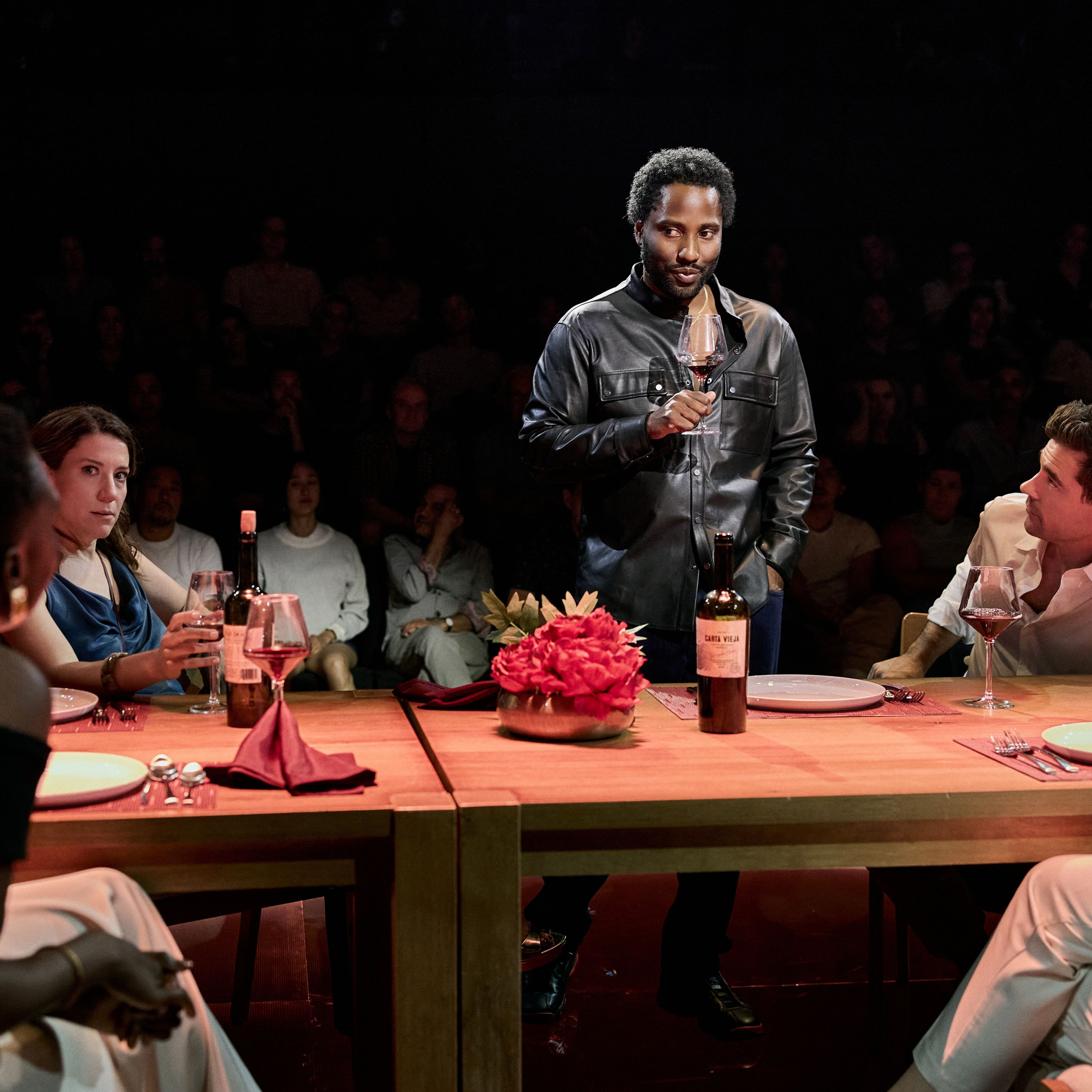
All of it is supported by Memorial Sloan Kettering Cancer Center. In a small, groundbreaking clinical trial, 100% of participants with a specific type of rectal cancer saw their tumors disappear using immunotherapy alone. Researchers at MSK are now studying this approach in cancers of the stomach, liver, and more. And a majority of tumors are disappearing. For MSK Giving day, all gifts will be tripled. Learn more@msk.org all of it. This is all of It. I'm Alison Stewart live from the WNYC studios in soho. Thank you for sharing part of your day with us. I'm really grateful that you're here. On today's show, we'll talk about the new version of the Whoopee Monologues, which is now at Lincoln Center. Tony winner Keisha Lewis will be with us in studio. Plus, we'll get a preview of the upcoming Broadway Bound, the theater festival. That's the plan. So let's get this started with a play that asks some very deep questions. The play, Disruption, asks a provocative question. If an algorithm could tell you what the best decision to make is about your family, your. Your finances, would you follow its lead? The play follows three couples who have been asked to dinner by their friend Nick. Nick is a Silicon Valley bro who sold his last company for millions of dollars. Now Nick says he wants his friends to invest in his latest venture, an algorithm that can tell you with absolute certainty what decision to make. Nick is played with charm and a slight edge by John David Washington. One friend is skeptical. He's an affable professor Ben, played by Tony nominee Conrad Rickamora. Ben. Ben is in a great relationship with Susie, who's not that psyched about Nick's proposal. That isn't a secret. But something else is. In fact, many things are. In fact, Nick doesn't tell his friends that he's using them as test cases. And the consequences will be serious. Disruption is running now at the Pershing Square Signature Center. I'm joined now by playwright Andrew Stein. Hi, playwright Andrew Stein.
- [02:16]
B
Hey.
- [02:16]
C
Good morning.
- [02:17]
B
Thank you so much for having us.
- [02:18]
A
And actors John David Washington. Happy birthday, by the way.
- [02:22]
D
Thank you. Thank you.
- [02:22]
A
And Conrad Ricker Moore. It's nice to meet you in person.
- [02:25]
D
Hi.
- [02:26]
C
Good to see you again, Allison.
- [02:27]
A
So, Andrew, when did you first get interested in algorithms and AI?
- [02:31]
B
Yeah, so in 2018, I was working in commercial real estate in New York, and I had all of these friends and clients who were in tech and, you know, Flatiron was exploding with tech bros, trying to figure out how to. How to build and scale and sell a company. And the thing that I kept hearing again and again and again is, what can we disrupt? Uber disrupted taxis, and they were really successful and got really rich. And there was. There was like this. This constant echo of that word, like, what can we disrupt? How do we disrupt? What's next? And I just like that. That was like a whisper from the universe that just really landed with me and I dug into it.
- [03:18]
A
This play was put on a few years ago. And it's interesting because when you write about technology, it changes so quickly. How is this play different than the version you originally wrote?
- [03:28]
B
Yeah, people ask me how different it is, and my answer is about 15%. And, you know, when I was first envisioning it, I worked really hard to ask a question that the algorithm could do that would be hopefully timeless. And it's not going to be timeless. This is going to. Going to, going to come. It's already coming to be. So I think the big difference is when we did it in 2023 in London chat, GBT had just launched that summer. It was like really early, early days. People were, for the most part not aware of it. Certainly we're not. We're not using it the way. The way they're using it now. And so the, the big thing that we had to look at is there's a character who asks Nick, can your thing actually do all of these things? Can it understand human emotion and marriage? And to some degree, the answer is, yes, it can. So we had to sort of rework and re. Envision some of those questions that three years ago seemed. Seemed like very, very distant days and now we're living, but not that many things had to be changed.
- [04:47]
A
John, David, your character Nick is spoken about a lot before he comes on stage. How do you want your entrance to play with expectations that the audience has about Nick?
- [04:58]
D
Wow. How do I. How do I want it to play? Like how I want them to receive Nick? I guess.
- [05:04]
A
Yeah.
- [05:06]
D
Maybe a little unsure or maybe a bit excited. Like, we're in for a hell of a night. Oh, sorry for cursing.
- [05:13]
A
That's okay. That's not on the list.
- [05:14]
D
It's okay for a heck of a night. You know, does he have the money that, that, that. That is promoted, or is he struggling and how close is he with these people that are talking about him?
- [05:28]
A
Conrad, when you play Ben, when you think about Ben, what would be a really good day for Ben so people could get to know him?
- [05:35]
C
Maybe we wouldn't see this, but you. Oh, gosh, I think a Great day for Ben. Waking up and taking a walk to Joe Coffee on the Upper west side and sitting down with his wife at their dining room table, reading the New Yorker and listening to wnyc.
- [05:56]
D
Hey.
- [05:56]
C
Oh, and all of it with Alicey Stewart.
- [06:00]
A
Hit it right on the nose. Nick refers to Ben as his best friend, his true north. Would Ben say the same of Nick?
- [06:09]
C
Oh, I think that there is, yes. You know, when you have a friend that you knew before your brain was fully developed, which we, you know, Ben and Nick were friends before, you know, they were 26, is when your brain is fully developed. You. There's a bond that transcends a lot of logical, rational thinking. I think there is a bond that is almost like, I will go to my grave being this person's friend. And so true north, I think, can sometimes get skewed when it comes to. Comes to matters of the heart. And your friends that you knew during really formative times of your life are grouped in with your family like they are your family as well. And I think that that's what Nick is to Ben. And so I think that the judgment, There's a lot of trust there, and sometimes a lot of trust can sometimes cloud Judge, judgment.
- [07:26]
A
We learned that Nick is super wealthy. What does money mean to Nick, John David?
- [07:33]
D
Freedom and a space to create. I think this project, if you will. His portfolio is vast. So this is more about legacy, what this algorithm represents. I think he's made the money which has afforded him to get into more rooms, giving him freedom to operate the way he actually really wants to. And that's what we're seeing in this example, in this play. And I think he struggles with faith and maybe even religion a bit. And I think money has something to do with that. But I think he very much knows how important it is, but it's not the ultimate goal.
- [08:10]
A
When you were writing Nick, did you write him to have charm? Did you write him to have charisma? Or was he supposed to be manipulative or all of the above?
- [08:18]
B
Wow, that's a great question. I mean, I wanted him to be a really sort of dynamic, polarizing presence, because people who. People often who reach this level, this height of success and influence, I think they're not like the rest of us in some ways. I think that there is inherent to that a charm or a drive or a charisma or. Or like a working out of a deep inner conflict. And so I just. I didn't ask my. I didn't sort of frame it of. I want him to Be charismatic, though. I did want him to be charismatic. I wanted what he did and his passion for what he's doing to. To come through and hopefully be clear and compelling and believable.
- [09:16]
A
Conrad, what is the state of Ben's relationship with Susie?
- [09:20]
C
I think Ben is deeply in love with Susie. There are. There's, I think, one core thing that they're not talking about, but I also think that thing. Yeah, I don't know how much I want to say about that.
- [09:42]
A
Don't give me spoilers. We'll talk around it.
- [09:48]
C
I think that Ben is deeply, deeply in love with Susie and loves his life with Susie. I think Susie is an intellectual and is emotionally available the same way. The same way Ben is as well. Yeah. I think they're content at the beginning of the play. That's all I'll say.
- [10:16]
A
Andrew, how would you describe Susie's attitude towards technology?
- [10:21]
B
Oh, she's deeply suspicious of it. She's the person who strongly articulates the. We should be worried. We should be eyes open. We should be very careful.
- [10:36]
A
It seems like Nick is most reluctant to manipulate Ben and Susie, yet he does it anyway. Why does he do it anyway?
- [10:47]
D
I think it becomes a little more emotional than he anticipated, you know, and, you know, the true north that line particularly means. I think he admires the ethics, no pun intended, because that's what he's a professor in, but the way he lives his life. And I think he sees a person that he respects in, like, how he operates and how he is with people, and he might measure his own sincerity and how he is as a person against Ben's. So, yeah, I think it becomes a little trickier with them, too, because of the history, which I won't give away because it's in the play.
- [11:21]
A
My guests are John David Washington, Conrad Rickamora, and playwright Andrew Stein. We're discussing the new Off Broadway playwright Disruption. It follows a tech entrepreneur who claims to have created an algorithm that makes decisions for you, and he's testing his friends on it. Disruption is running now at the Pershing Square Signature Center. I want to talk about Raven real quick.
- [11:42]
B
Okay.
- [11:43]
A
Nick has a partner. She's sort of a tech genius named Raven. John, let's start with you. How would you describe Nick and Raven's working relationship?
- [11:52]
D
Who can top who you know, who can outwit who? Fiercely competitive. But at least it starts out, they kind of want the same thing. You know, they have different ways of doing it. I think Nick sees the potential in this person and sees what their capabilities are and thinks that this is what it's going to take to fulfill what he believes with this algorithm.
- [12:16]
A
Andrew, what did you want to do with the character of Raven to sort of upend the expectations of women in tech? Because I found that kind of interesting.
- [12:28]
B
Well, you know, I think that in most really sort of, you know, change the world companies, there's a Nick and there's a Raven, there's a Jobs and there's a Wozniak. There's sort of the front facing, you know, person who can, who can wow people. And then there's the, there's the maybe less front facing person who really can. Who's really genius in whatever the field is. And I wanted, I wanted that dynamic to come through and I wanted, I wanted Raven to be a force that is. That's mysterious that you can't quite pin into a box.
- [13:12]
D
And
- [13:15]
B
really the primary force that's disrupting and upending and pushing forward, like, let's push this as far as we can. I wanted her to be those things.
- [13:26]
A
Did you write her as gorgeous?
- [13:29]
B
Because she's gorgeous, you know. Wow. It's a tricky thing, right? Like, I think that, like, the world's changed since 2018 and I've changed. And I think that the impact that she has just sort of physically walking into the room, I think is, you know, to quote the play, an arrow in her quiver. But it's not the primary thing. So I did want that to be part of it because I think that's, I think that people react to, but I definitely didn't want it to be the primary thing.
- [14:08]
A
All right, this is the essay question of the interview. We'll start with you, Conrad. Obviously, this play has a lot of themes. One is about technology usurping our free will or making us think we have free will. What kind of discussions did you have among the cast with Andrew about this issue about what tech is doing to our lives?
- [14:29]
C
I mean, I don't know. God, we, we've been talking about this. It's hard to pick one example, but I'll give an anecdote from rehearsal. Jason, who plays Barry in the show, and I were talking just in a. During a break, during rehearsals and he was, we were talking about our fitness routines and he was like, oh, I go to Orange Theory. I've never looked up Orange Theory. Never been interested in it, never sought out any information about it. I just go on the elliptical every morning and watch YouTube. And then the commercial I started getting during my, like the commercial breaks was for Orange Theory after. And I'd never before gotten a commercial for Orange Theory. And so. And it. It freaked me out just because here we are doing this play and Jason just talks to me about Orange Theory and then I start getting ads for it. I didn't search. Would have had to have been listening in some way. And that was just a couple of weeks ago. So, yeah, I think. But because I was doing this play, my consciousness of how I might be being manipulated was heightened. And I'm hoping that people come to the show to so that their consciousness of what they could, the ways that they could be manipulated online is heightened and that they're more aware of it.
- [16:00]
A
John David, do you have any personal anxieties about tech that you wanted to explore in this play?
- [16:08]
D
Well, it's like, yeah, the idea of, you know, software technology being at its peak powers is when it goes from a convenience to a necessity. And what does. How scary is that upside? Also, maybe it can save us too. You know, there's that duality of it that it's not just one answer. I think it's very nuanced. And what's beautiful about for me doing this play is I get to sort of explore that every night.
- [16:42]
A
How do you feel about it, Andrew?
- [16:44]
B
You know, I love what both of these guys are saying, and we had so many conversations. I'm fundamentally an end of the day, an optimist, and I'm team human. I think that. I think we're going to survive and we're going to be okay. But I also think that there's a lot going on that we don't see that we're not aware of, and we should be more eyes open than we are.
- [17:08]
A
I want to talk about the set. It's really interesting because you walk in and you can sit on either side of it. It's lit up by lights. It sort of looks like a computer screen. There are mirrors on the side, there's language going on on the floor. First of all, how did you envision the set?
- [17:28]
B
This is the brainchild of Hirsch Ellis, our director, and. And an absolutely phenomenal design team. Zoe on set. And like, the video that we have is phenomenal. And I wish I could say that, like, I had a real vision for the set. This is them, and I'm so grateful for it.
- [17:54]
A
Conrad, as an actor, are you aware of the set? Is it like a character in the play or are you just doing your thing and the set comes alive?
- [18:03]
C
I'm just doing my thing.
- [18:05]
D
Yeah.
- [18:06]
C
And I think that that's. The set is not for. It's like we have right now sitting here in the studio, there's data whizzing bias right now as we speak that we can't see. And I think that, to me, you know, when I first saw the set, it made me think, oh, the audience is going to be able to visualize this data that is always around us. But the characters in the play, besides Nick and Raven, the rest of the three couples are oblivious and just focused on each other and their life.
- [18:42]
A
How about for you? What does the set do for you? Do you see yourself in the mirror? Do you take advantage of that, or are you doing your thing?
- [18:48]
D
No, a little combination we have to incorporate, particularly with the Raven and Nick scenes being in our office, sort of the. The center of our brain trust. But then, you know, how it's lit and kind of gets. It's dimly lit and the dark moments represent the feelings and maybe what I'm going through with my friends. So that also can sort of manipulate or at least influence, I should say, how the scene is going, how I deal with each character. So it's a little bit of both.
- [19:21]
A
In the script, we learn that Nick just doesn't want his friends to invest in this algorithm. He's kind of using them as guinea pigs as a control. A control group.
- [19:32]
D
Okay, okay, okay. Let's see where this is going. Okay.
- [19:37]
A
How does Nick feel about keeping this from his friends?
- [19:40]
D
Keeping what he's doing from his friends?
- [19:42]
B
Yeah.
- [19:45]
D
If he is keeping it from his friends, I think he's doing it because of the amount of respect and care he has for them. He wants to. He's trying to do the right thing by them. It's not about. I think he literally says it to at least one of the characters not to give it all away. I don't want your money. I think he means that. And like I said before, it's not about the money with him. He's been doing good. I think he knows that he's on the precipice of changing something. Actually. This is his legacy. And I think he wants his friends to be a part of it, you know, And I know we talked about it a little bit, Andrew and Hirsch, about backstory. Like, what kind of upbringing did he have? Like, was he the only. An only child? And when you cling on to friends at that age.
- [20:24]
A
Oh, interesting.
- [20:25]
D
And they showed actual, you know, belief in him and gave him the sense of camaraderie that he might not have had before. That kind of stuff, at least for a guy like him, means something. And he holds on to that. So there's a. That that is incorporated with the ultimate goal of what he's doing with the algorithm.
- [20:42]
A
We're talking to John David Washington and Conrad Rickamora as well as playwright Andrew Stein. We're discussing their new Off Broadway play, Disruption. Like, we're not going to give anything away because there's a lot to give away. It's a good play. Ben makes a decision about children, which will have long lasting consequences. Why do you think that's a powerful end to this play?
- [21:06]
C
Ooh. Oh, I think it's. Humans are data made flesh. Data is. And algorithms are things that feel eternal and infinite. We are not infinite and that's what makes us so precious. There is no. Yeah. Once a human is born. So far. There is, there is. They're on their way to their death. Whereas this technology and data and knowledge can grow and grow and grow. But we do have an expiration date. I think that, yeah, when you choose to bring life into the world, you are also choosing to have that life form potentially suffer. And yeah. Despite all of the promises that technology has offered, they have not eliminated human suffering. If anything, some people would argue that they've made it worse and made us feel more alienated. So I think that, I don't know, I don't want to say too much because it's like. But I do think there's something to do with flesh. Like, it's, it's just like. Yeah. Talking about all of this data and algorithm, you. There's put that up against like our human flesh and. And what. Where are our values then? This. That was a very convoluted way. But I'm still trying. I. It's something that I still think I'm working out it and. But you feel it? I feel it. I just don't know how to say it because it's like, how do you explain a human life?
- [23:06]
A
Do you still. Are you still working out the character?
- [23:09]
C
I work it out every night.
- [23:10]
B
Yeah.
- [23:10]
C
It's, it's. I. Yeah. My whole goal is to just show up and exist in the world of the play without like, you know, some you, you do all the work to, to build pathways, but then you jump off the cliff every night and. Yeah. Like. Yeah. Yeah.
- [23:26]
A
Is that the same for you?
- [23:28]
D
Yeah. I've experienced where, like when we finally close, I'm like, oh, I got it now. Now I know. Now I know the guy. No more shows left. I hate. So, yes, it's always a work in progress.
- [23:41]
C
That's so funny.
- [23:42]
A
Andrew, what do you hope audiences leave the show thinking about. They go out for coffee and they're having a conversation about the play. What do you want them to ask themselves to talk about?
- [23:54]
B
I think that, you know, I think that the conversations that people are having and that we're having that examining, you know, what's happening, how are we using technology, how do we maintain and hold on to our humanity? And, you know, I would, you know, I think it's so important to just put your phones down and be with somebody, you know, And I think that, you know, to the extent that these conversations can lead us to value more the human connection with the people right in front of us who we love and care about, I'd be thrilled. If that's a direction. If that's a direction it leads.
- [24:39]
A
The name of the play is Disruption. It's running now at the Pershing Square Signature Center. My guests have been John David Washington, Conrad Rickamora and Andrew Stein. Thanks for being with us.
- [24:49]
B
Thank you so much.
- [24:50]
D
It was really cool.
- [24:50]
A
This is all of it.